
Maine · Portland service planning
Long-distance moving from Portland, ME
A long-distance move from Portland, Maine needs a clear shipment, usable access at both ends and a receiving plan suited to the service you choose. A peninsula apartment, an off-peninsula house and a Peaks Island property can introduce different preparation and transport stages. Send Sterling Oakbridge the full addresses, belongings, dates and help you need so those stages can be reviewed together.
We can review household moves across the United States and Canada, including direct dedicated delivery and suitable smaller consolidated shipments. The number of rooms alone does not describe the work. Include large furniture, cartons, fragile pieces and belongings in basements, attics or another storage location. Identify what remains in Maine and what travels with your household separately.
For the wider service discussion, use the Portland moving page. The Portland relocation guide covers housing, everyday routines and detailed local procedures. Here, the practical question is how the shipment can leave the actual property and reach the receiving rooms under the agreed plan. The four examples are hypothetical planning situations, not reports of completed customer jobs.
Start with the delivery arrangement you can receive
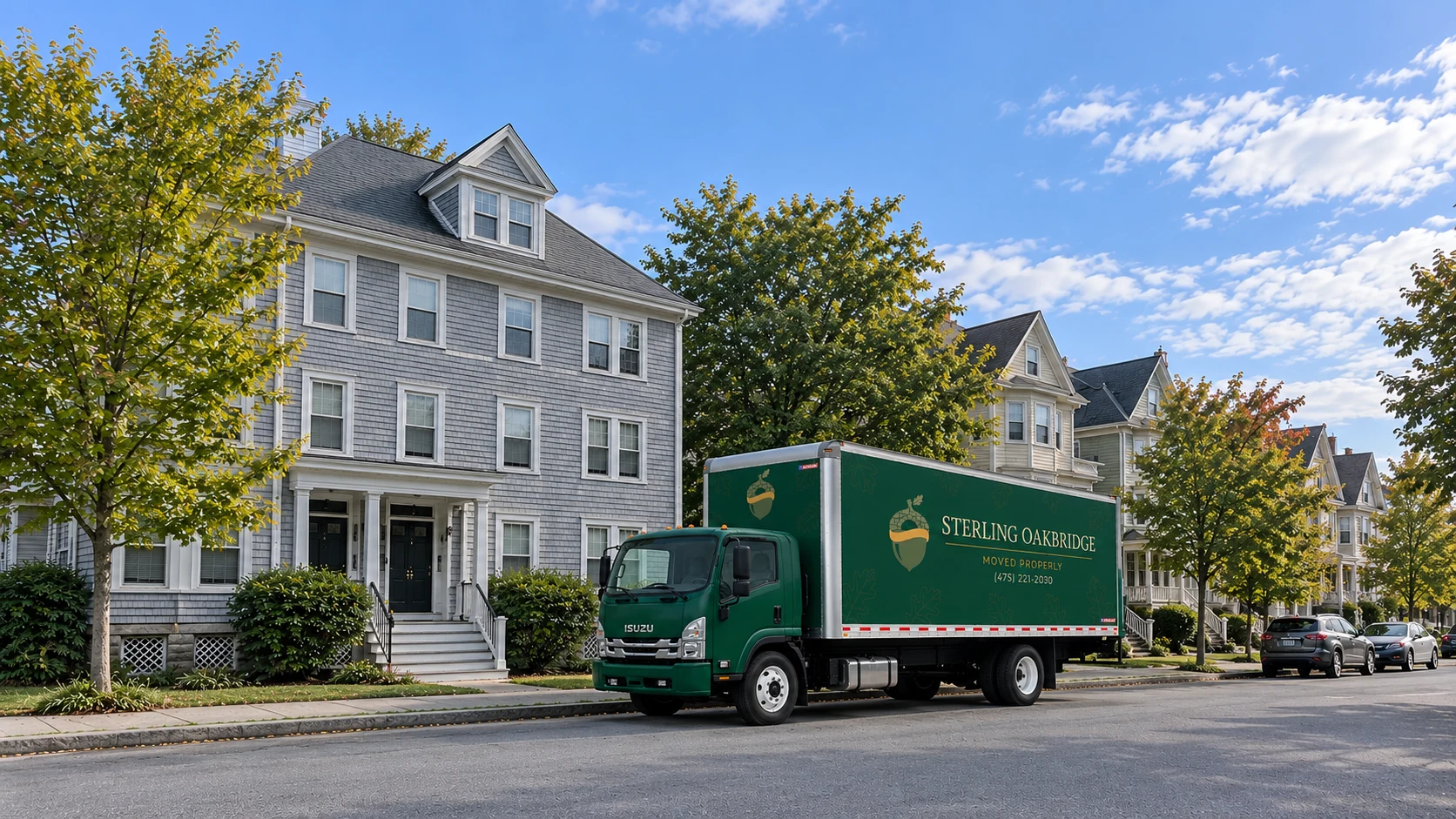
Direct dedicated delivery uses a dedicated truck with the same moving crew at pickup and drop-off. It can suit a substantial household shipment or a closely coordinated receiving plan. Confirm preparation, loading and delivery with the actual restrictions at each property. The survey and planning team has a separate role from the crew carrying out the move.
Consolidated delivery can suit a smaller shipment when you can accept a wider receiving window. A selected group around 300–400 cubic feet is an illustration worth reviewing, not a minimum volume. Confirm the real inventory, packing and receiving needs before choosing it. Do not assume that consolidation provides the dedicated truck or same-crew arrangement of direct service.
A receiving person needs keys, authority to answer placement questions and a workable way to arrange any required loading or elevator appointment. A flexible travel calendar does not resolve a building that accepts deliveries only during a narrow, unconfirmed slot. Put that restriction into the estimate discussion while you still have choices.
The windows below begin after pickup and loading are complete. Packing, an island transfer, border procedures and building appointments each need review within the complete plan. A nearby route may support a specifically coordinated same-day or next-day move, but distance alone does not promise either appointment.
| Illustrative destination | Direct planning window | Consolidated window |
|---|---|---|
| Portsmouth, New Hampshire | 1–2 days | Up to 30 days |
| Venice, Florida | 3–4 days | Up to 60 days |
| Stratford, Ontario | 1–2 days | Up to 60 days |
| Olympia, Washington | 5–6 days | Window agreed individually |
These are illustrative planning references. Confirm the shipment's dates and receiving conditions in writing. The Olympia consolidated window needs individual agreement; the California limit does not become a blanket rule for Washington or every other western state.
Put street space and building access on one schedule
Portland's parking-permit guidance explicitly identifies an On-Street Occupancy Permit for reserving moving-van space. A resident parking sticker is a different arrangement and does not reserve that position. The city's commercial loading-zone rules allow eligible commercial or combination-plated vehicles only 30 minutes, with further conditions on individual signs.
For a reservation, the Street and Sidewalk Occupancy page gives a five-to-ten-business-day application window. Payment precedes issuance; payment after 3 p.m. cannot result in issuance until the next business day. Describe the actual frontage, vehicle, dates, duration and any sidewalk use. Sidewalk occupation or closure requires a pedestrian-routing plan. Obtain the applicable charges and approval for the proposed operation.
The official sign-posting FAQ says to post Emergency No Parking signs before 5 p.m. on the business day before the planned ban, then send the tow sheet to the applicable departments. Signs can be printed after approval. Keep the current sheet: its towing contacts vary by hour. Assign the application, payment, posting and day-of check to named responsible people.
Arrange the building separately. Confirm the service entrance, keys, each elevator, the permitted carrying period and management's documents. An approved curb period does not unlock the building, and a lift reservation does not reserve the street. Ask whether a booked lift is exclusive or shared and who can release it when the crew arrives.
Where the property permits it, complete packing and preparation before a short carrying window. Materials may need their own access appointment. If the assessed work will not fit, agree another slot or a separate stage. More workers do not automatically increase the capacity of one elevator or authorize use of another entrance.
Example 1: A Portland apartment to Portsmouth, New Hampshire
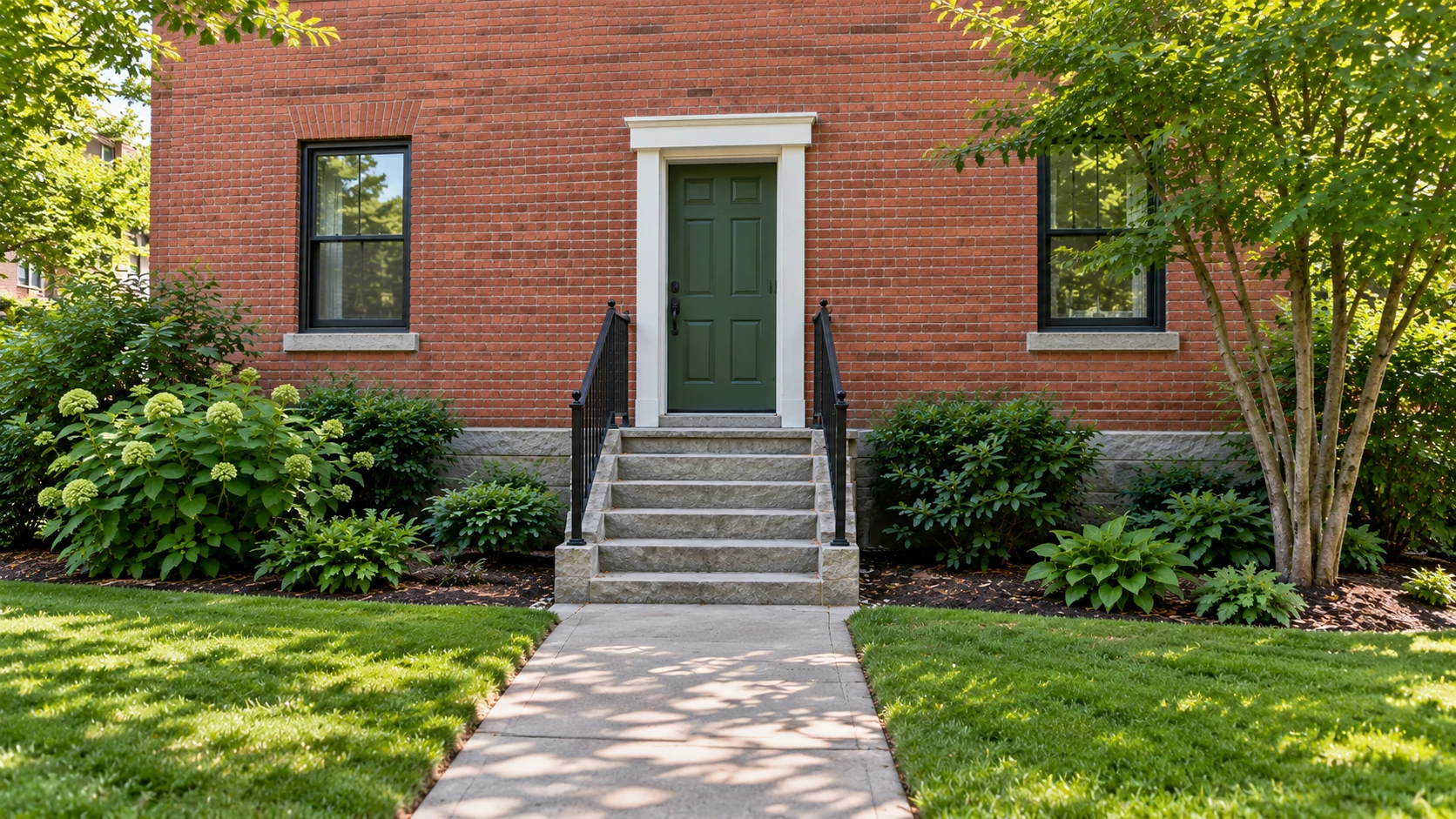
Suppose a household is leaving a West End apartment reached through an older brick building for a Portsmouth rental. The origin has exterior steps, a shared hall and a tight stair return. The destination's main concern is a key handoff late in the day. A short road journey does not resolve either property's access.
Photograph the authorized entrance and the continuing route, including the landing with the door open and the handrail in place. Include furniture dimensions and belongings stored on another floor. Ask the owner when the shared passage can be used and how other occupants keep their required access. Review a large sofa or tall cabinet before treating the main doorway as proof that it will reach the unit.
At Portsmouth, obtain the actual possession time, receiving contact and entry instructions. Coordinate them with preparation and the approved Portland loading period. If a morning pickup is proposed, discuss how the household and shipment will be managed before the destination becomes usable. Do not let an expected key time stand in for confirmation.
The illustrative dedicated window is 1–2 days after loading. A specially coordinated same-day or next-day plan may be possible when both properties and the work support it. A suitable small consolidated shipment has an illustrative window of up to 30 days. Choose with the household's need for beds, seating and other daily items in view.
Set a decision time for a late handoff while a later access slot or storage alternative can still be arranged. Confirm that alternative, its receiving authority and any additional work before using it. A friend's nearby address is not automatically an authorized second delivery stop, and an unreviewed side door is not automatically an available furniture route.
Example 2: An off-peninsula household to Venice, Florida
Consider a Deering-area household moving most of its belongings to a Venice condominium. The Portland property has a driveway approach with an overhead branch and a sloping walk. The destination requires a service entrance, an elevator appointment and a receiver who can attend during the building's moving period. Put those particular conditions into the inventory and access review.
Show the driveway approach, turning space, surface and route to the door. Obtain the owner's approval for the proposed vehicle position; a household car's parking place does not establish suitability for the moving truck. If street loading is needed instead, arrange the correct frontage and duration rather than assuming the driveway will work on the day.
Finish the agreed packing before the carrying stage. Identify cartons by room and contents, keep essential personal items with the household and separate anything staying behind. Empty ordinary dresser drawers and retain them in the protected body. Safely removable long furniture legs need preparation suited to the piece, with the matching parts and hardware kept together.
A substantial direct household load combines protected sofas, dressers, cabinets, cartons, totes and other belongings in supported tiers. The finishing rows step down where the shapes cannot be stacked safely. Side materials and partial retaining flat panels have secured positions. Continuous furniture quilts cover vulnerable surfaces and bases, and restraints hold the mixed load against movement.

The Venice receiver confirms the service door, usable elevator dimensions, reservation, protection requirements and management contact. If the route involves more than one lift or a transfer between levels, record every stage. A booking for one part does not establish that the complete route is available.
The illustrative direct window is 3–4 days after loading; Florida consolidation uses up to 60 days for a suitable shipment. Agree a receiving plan that fits the selected service. Keep a decision-maker available if the building changes the window, then review any genuinely changed work before proceeding.
Keep the long-distance flat rate tied to the agreed work
For a long-distance move quoted at a flat rate, the agreed price stays the same when the inventory, access and services stay the same, even if travel or delivery takes longer. An added shipment, unfinished packing, another stop or a changed carrying route can change the scope. Have that change reviewed and agreed in writing before the affected work begins.
Compare estimates using the same belongings and conditions. Include basement and attic items, fragile pieces, large furniture and every requested preparation stage. Tell us which cartons you will pack, what needs company packing and what must remain accessible between stages. The cost of a home does not describe the work of moving its contents.
| Part of the quote | What belongs in the review |
|---|---|
| Belongings | Furniture, cartons, totes, fragile items and contents of secondary storage; what stays behind. |
| Preparation | Customer packing, requested packing, basic furniture work and separately reviewed specialist handling. |
| Property access | Authorized entrances, stairs and turns, carrying distance, each lift and approved moving hours. |
| Transport stages | The chosen delivery model, any island handover, additional stop or agreed storage interval. |
| Receiving | Keys, available contact, final rooms, loading position and the written window. |
Basic furniture disassembly and reassembly are part of moving labor without a separate basic assembly fee. Moving blankets, shrink wrap and tape have no separate basic material charge. Supplied boxes are charged separately. Packing, optional box unpacking, packaging removal, specialist work and storage need the appropriate agreed scope and charges. See the packing service and storage service when those stages are needed.
Municipal, building and applicable ferry or freight charges also need assigned responsibility. An island transfer or a possession gap should appear in the written plan before the shipment leaves. A wider delivery window does not automatically include free storage or every additional handling stage.
Example 3: A reviewed island pickup to Stratford, Ontario
Imagine a household moving from Peaks Island to a home in the City of Stratford, Ontario. Peaks is within Portland, while Long Island and Chebeague are separate towns. Casco Bay Lines identifies those jurisdictions. Give the actual island and full address so the pickup can be reviewed as an island operation rather than an ordinary mainland curb stop.
First confirm the accepted transport method. The operator's Peaks vehicle guidance has a commercial reservation process; a passenger ticket does not establish vehicle acceptance or a sailing reservation. If the agreed method uses shipped freight or a vehicle transfer, identify responsibility at each handover, the inventory check and the receiving transport at the landing. The freight guidance has its own packing, acceptance and check-in requirements.
The quoted plan must connect the island pickup, any transfer and the mainland journey. Do not infer that every Casco Bay island accepts the same moving vehicle. Downbay vehicle service has separate limits and is not a routine box-truck alternative. Obtain the actual operator arrangements and company scope before relying on the date.
At Stratford, confirm the receiving property, possession and lawful vehicle position. The City of Stratford contact page identifies the Ontario municipality and its departments. Use the actual address, rather than confusing it with another place called Stratford or assuming a nearby address has the same street authority.
Review CBSA's moving guidance for the household's circumstances. Prepare consistent accompanying-goods and goods-to-follow lists and keep the accounting documents and receipt available for the unaccompanied shipment. BSF186 is the Personal Effects Accounting Document. Eligibility, restrictions and clearance need their own review; the move plan cannot promise duty-free admission or a particular border completion time.
The mainland route's illustrative direct window is 1–2 days after the agreed pickup and loading are complete. A suitable Canadian consolidated shipment uses up to 60 days, even on a relatively short route. The island stages and Canadian receiving conditions must be included in the complete written schedule; this reference does not reserve a ferry or remove a transfer stage.
Keep border papers and daily essentials with the household. If a sailing, possession date or receiving arrangement changes, agree where the goods can safely wait, who can receive them and what costs or additional work arise. Update every handover contact before sending the shipment toward an unusable stage.
Example 4: Selected Portland belongings to Olympia, Washington
Suppose a household is keeping some furnishings in a Portland apartment while sending an oak console table, books, a kitchen tote and other reviewed belongings to an Olympia home. The selected shipment may be around 350 cubic feet once the actual contents and preparation are assessed. This is an illustration, not a minimum volume or a measurement inferred from the photograph.
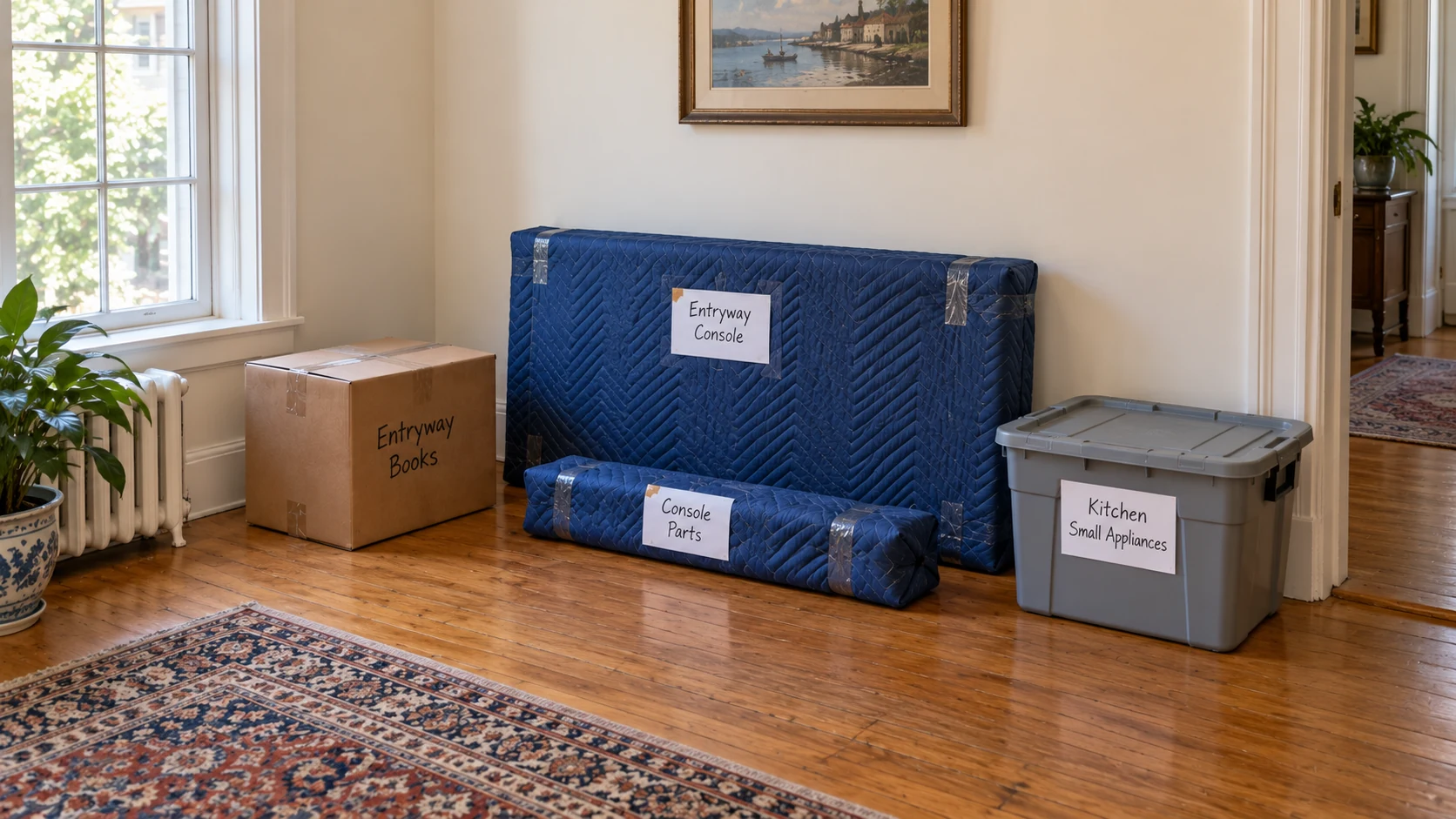
Identify the pieces that leave and those remaining in use. A simple console with safely removable long legs is prepared differently from a cabinet with fixed feet. Protect the body before handling it for removal, pack the removed legs together as a protected set and retain matching hardware with the furniture. Use related labels for the body and parts. A genuinely fixed component needs its own suitable method.
Cartons and totes should state their destination room and contents. A suitable small carton makes heavy books manageable; a customer tote needs readable identification, such as an attached paper label. The selected parcels can be ready while the household continues using other furniture. Keep a clear route and a permitted staging position until pickup.
At Olympia, confirm the actual entrance, threshold, room doorway and console position. A single-level rambler can still have a narrow door or an interior turn. Check those connections instead of treating the absence of an upstairs flight as proof that every piece will fit. Arrange an available receiver and the lawful truck position before choosing the service.
The illustrative dedicated window is 5–6 days after loading. For a consolidated move to Olympia, agree the window individually. Do not carry the California limit into Washington. If the household needs the furniture for a particular date, review that need against the available service before accepting a wider receiving arrangement.
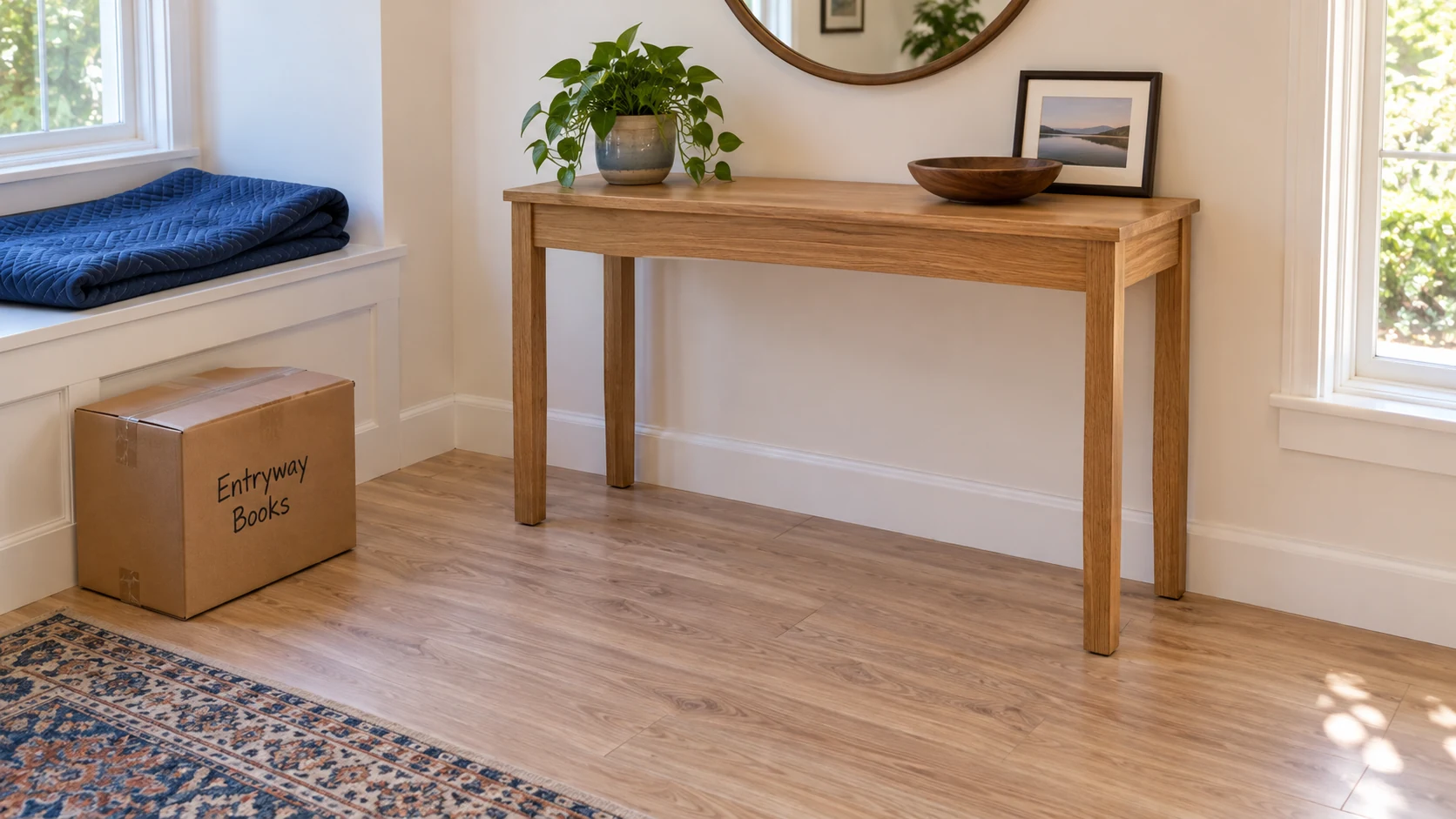
After placement and basic reassembly, check the console position and agreed work. Ordinary installed long legs are appropriate at this finished stage. Furniture unwrapping does not mean every carton has been opened or the whole room is complete. Keep the identified carton and adjacent passage accessible for the household's next tasks.
Use confirmations to decide when delivery can proceed
Keep the inventory, written scope, property instructions and responsible contacts together. Before departure, confirm keys, the receiving person, usable loading access and every part of a booked building route. A permit application, requested lift time and expected possession date are separate pending steps until the responsible parties confirm them.
Portland's street-maintenance guidance generally uses an October-through-May season on the peninsula and in the Nathan Clifford area, with year-round restrictions in the Old Port and daytime exceptions on particular blocks. Posted signs control. Check the actual frontage and date; an emergency snow ban is a separate condition and can change a previously workable position.
Assign the private walk, steps, driveway and loading-to-door path as well as the public frontage. Check the route close to the date and confirm essential services at the receiving home. Keep children, pets and visitors away from the active carry while maintaining required exits. For an island operation, add the operator's current notices and each landing handover to that check.
Choose a Plan B before the usable alternative expires. Name the trigger, decision time and person authorized to approve a change. Confirm a later appointment, approved alternative entrance or actual storage availability, including extra handling and costs. Arrange temporary accommodation for people and pets where needed, then identify the confirmation that allows the next stage to resume.
At delivery, use the inventory and room labels to review the agreed placement and preparation work. Record concerns while the item and moving documents can still be identified. Optional box unpacking and packaging removal should be in the scope; furniture unwrapping alone does not include every household task.
Review protection and belongings staying behind
Discuss liability and protection choices before the move and disclose high-value items in advance. FMCSA's interstate guidance distinguishes Full Value Protection from Released Value. Full Value Protection applies unless you select Released Value through the required written agreement. Valuation differs from a separate insurance policy; review the selected cost, limits and claims terms in your documents.
Separate unwanted furniture from the travelling inventory before packing. Use the property's actual waste or collection arrangement and confirm acceptance and any booking before taking large items outside. Mainland, island, routine household and bulky-item processes can differ. The Portland guide's waste chapter provides the local starting points; company removal work needs its own agreed scope.
Pickup addresses around Portland
We can review long-distance pickup in Portland, Maine and nearby South Portland and Westbrook. These are separate cities in Cumberland County. Portland includes Peaks and other named island communities; an island address needs its own accepted vehicle or freight and receiving plan. Send the actual address, inventory and carrying route, then confirm the responsible municipality and property access.
Long-distance moving questions
Where can you review long-distance pickup near Portland, Maine?
We can review long-distance pickup in Portland, Maine and nearby South Portland and Westbrook. These are separate cities in Cumberland County. Portland includes Peaks and other named island communities; an island address needs its own accepted vehicle or freight and receiving plan. Send the actual address, inventory and carrying route, then confirm the responsible municipality and property access.
What does direct dedicated delivery include?
A dedicated truck and delivery serve the reviewed shipment, with the same moving crew at pickup and drop-off. Confirm preparation, pickup, access and receiving dates in the move plan. The survey and planning team performs a separate role from the carrying crew.
When is a consolidated shipment worth reviewing?
Consolidation can suit a smaller shipment when you can receive within a wider window. A group around 300–400 cubic feet is an illustration, not a minimum volume. Review the actual inventory, packing, access and destination; do not assume that the direct same-crew arrangement applies.
When do the delivery windows begin?
They begin after the agreed pickup and loading are complete. Packing, island handovers, building access and border procedures need their own review within the full schedule. The planning table does not reserve a ferry, loading space or delivery appointment.
Can a Portsmouth move arrive the same day?
It may be possible when the work, travel and both properties support a specifically coordinated plan. Distance alone does not promise it. The Portsmouth direct example uses 1–2 days after loading; a suitable consolidated example uses up to 30 days.
How do the Florida and Washington examples differ?
The Venice direct example uses 3–4 days after loading, with Florida consolidation up to 60 days. The Olympia direct example uses 5–6 days, while its consolidated window is agreed individually. The California consolidated limit does not automatically apply to Washington.
Can a passenger ferry ticket establish island moving access?
No. Passenger travel, vehicle transport and shipped freight have different conditions. Name the island and shipment, then confirm the accepted method, operator arrangements and responsibility at every handover with the company and receiving contact before relying on the date.
Will a longer trip increase the agreed flat price?
For unchanged long-distance inventory, access and services, the agreed flat-rate price stays the same when travel or delivery takes longer. Added belongings, extra preparation, another stop or changed access can change the scope; have that work reviewed and agreed separately in writing.
What information helps with an older Portland apartment?
Send the actual unit, inventory, photographs and measurements of the authorized entrance, stair returns, landings and continuing route. Include belongings on other floors, shared access, any lift instructions and the proposed lawful truck position. A wide front door does not establish access to the final room.
Is a commercial loading zone enough for an all-day move?
Portland gives eligible commercial or combination-plated vehicles 30 minutes in commercial loading zones, subject to individual signs. For a moving van needing reserved space, the city explicitly offers an On-Street Occupancy Permit. Match the lawful arrangement to the actual duration and property access.
How early should the occupancy application and payment be arranged?
The city publishes a five-to-ten-business-day application window. Payment must be completed before issuance; payment after 3 p.m. cannot result in issuance until the next business day. Confirm approval, charges and location-specific conditions instead of treating submission as a reservation.
When are the signs posted, and what if the space is occupied?
The city FAQ says to post Emergency No Parking signs before 5 p.m. on the business day before the planned ban, then send the tow sheet to the applicable departments. Keep the current sheet; its towing numbers and responsible departments depend on the hour.
How can a short building window be prepared?
Confirm the complete route, every lift, the permitted work period and responsible management contact. Where the property permits it, arrange materials, packing and preparation beforehand. If the assessed work will not fit, agree another window or separate stage; more workers do not automatically increase elevator capacity.
Should long console-table legs stay installed for transport?
Safely removable long legs are removed for the reviewed move. Protect the body first, keep the removed legs together as a protected set and retain matching hardware with the furniture. A genuinely fixed component needs a suitable separate method. Normal legs can be installed after placement and basic reassembly.
What happens to drawers and furniture protection?
Empty ordinary dresser drawers and retain them in the protected body. Identify genuinely loose parts requiring separate preparation. Continuous quilt cloth should cover vulnerable surfaces, bases and retained feet. The selected console example has a shallow apron without drawers; other furniture needs its own construction review.
How should packing, boxes and unpacking appear in the quote?
Agree what you will pack and what the company will prepare. Basic protection materials have no separate basic material charge, and basic furniture work is part of moving labor. Supplied boxes are charged separately. Furniture unwrapping, optional box unpacking, packaging removal, storage and specialist tasks need their appropriate scope and charges.
What needs attention for the Stratford, Ontario move?
Review CBSA guidance for the household and keep accompanying-goods and goods-to-follow records consistent with the shipment. Keep the accounting document and receipt available for unaccompanied goods. Confirm restrictions and receiving access; a suitable Canadian consolidated shipment uses up to 60 days, without a guarantee of admission or duty-free clearance.
What if the receiving property is not ready?
Choose a decision time and authorized contact while alternatives remain available. Confirm an actual later appointment, approved route or storage arrangement, with any additional handling and costs. Account for people and pets and identify the confirmation for resuming delivery. A facility phone number is not a reservation.
Which protection choice should be reviewed before an interstate move?
Review FMCSA guidance and the written documents. Full Value Protection applies unless you select Released Value through the required written agreement. Valuation differs from a separate insurance policy. Disclose high-value items and confirm the selected cost, limits and claims terms before moving.
Explore long-distance destinations from Portland, Maine
These destinations are examples within our United States and Canada household-moving coverage. Portland, Oregon is a separate destination from the Maine origin. Confirm the actual addresses, shipment, access and receiving conditions before agreeing the appropriate delivery arrangement.
East Coast and nearby interstate examples
- Portsmouth, New Hampshire
- Boston, Massachusetts
- Worcester, Massachusetts
- Cambridge, Massachusetts
- New York City, New York
- Newark, New Jersey
- Albany, New York
- Philadelphia, Pennsylvania
Florida and the Southeast
- Venice, Florida
- Tampa, Florida
- Sarasota, Florida
- Orlando, Florida
- Jacksonville, Florida
- Raleigh, North Carolina
- Charleston, South Carolina
- Savannah, Georgia
Midwest and Texas
- Cleveland, Ohio
- Columbus, Ohio
- Chicago, Illinois
- Detroit, Michigan
- Dallas, Texas
- Houston, Texas
Mountain West and Southwest
- Phoenix, Arizona
- Las Vegas, Nevada
- Salt Lake City, Utah
- Denver, Colorado
- Albuquerque, New Mexico
Pacific Coast and Washington
- Olympia, Washington
- Sacramento, California
- Los Angeles, California
- Portland, Oregon
- Seattle, Washington
- Spokane, Washington
Canada
- Stratford, Ontario
- Ottawa, Ontario
- Toronto, Ontario
- Brockville, Ontario
- Burlington, Ontario
- Montreal, Quebec
- London, Ontario