
Massachusetts · Boston service planning
Long-distance movers in Boston MA
A long-distance move from Boston needs a workable departure and a home that can receive the shipment. A rowhouse stair turn, a shared apartment entrance or a controlled service elevator can determine that sequence before road distance does. Sterling Oakbridge reviews the inventory, both addresses and dates before agreeing direct or consolidated household delivery throughout the United States and Canada.
Bring the curb, building and shipment into one plan
Start with the actual municipality and front door. A Boston-area description can refer to a home in another City with a different street authority and building process. Describe the legal truck position, entrance steps, halls, stairs or elevators through to the rooms that will receive the largest pieces. At an older apartment, the limiting point may be a landing after the front door; at a managed property, it may be a second elevator or an approved loading entrance.
We can review long-distance pickup in Boston and nearby Greater Boston addresses, including Cambridge and Somerville. Boston is a City in Suffolk County; Cambridge and Somerville are separate Cities in Middlesex County. Confirm the actual municipality, inventory, legal truck position, building route and dates before applying Boston procedures. A regional Boston label does not establish City of Boston jurisdiction.
Then separate the facts you know from requests awaiting approval. A proposed curb reservation, an elevator application and possession of the keys are different confirmations. Name the household contact, the person approving the building route and the person who can receive the shipment. Include storage rooms, books, outdoor belongings and customer totes in the inventory rather than using a bedroom count as a substitute for contents.
The Boston moving page explains the service discussion and estimate inputs. The local relocation guide has the detailed access worksheet. Use those records for pickup and delivery separately: the usable dimensions or opening hours of one property do not describe the other.
Choose the delivery model before fixing the receiving date
Direct dedicated delivery uses a truck for your reviewed shipment and the same moving crew at pickup and delivery. It can suit a household that wants its inventory and two access plans organized around one agreed transport arrangement. Choose the actual vehicle from the volume, dimensions and route; a two-bedroom label alone does not select a 16-foot or 26-foot body or establish that every piece will fit.
Consolidated delivery can suit a smaller shipment when receipt is flexible, illustratively around 300–400 cubic feet or less. That is not a minimum. The comparison begins with the actual furniture, cartons and totes, the destination and who can receive them. Confirm the crew arrangement, any handling or storage stage and the agreed window rather than assuming the dedicated-service conditions or an unconfirmed saving apply.
The delivery clock starts after pickup and loading are complete. The household may travel earlier, collect keys or settle school and work separately. Keep those personal arrangements distinct from the furniture appointment. The table below provides normal route-planning illustrations with a reserve; it does not certify a commercial truck route or reserve a building slot.
| Illustrative destination | Direct planning window | Consolidated window |
|---|---|---|
| Portsmouth, New Hampshire | 1–2 days | Up to 30 days |
| Fort Pierce, Florida | 2–3 days | Up to 60 days |
| Victoriaville, Quebec | 1–2 days | Up to 60 days |
| St. George, Utah | 4–5 days | Window agreed individually |
For a suitable close domestic move, same-day or next-day receipt can be reviewed when preparation, routing and both properties support it. That possibility does not replace the normal illustration in the table. Consolidated Canada and Florida shipments can have windows up to 60 days; a suitable close domestic shipment can have a window up to 30 days. California has its own window, which should not be transferred to Utah or every western destination. Other distant consolidated routes need an individually agreed receiving window.
Example 1: Boston to Portsmouth, New Hampshire with a close key handoff
Suppose a household is leaving an upper-floor Boston apartment for a home in Portsmouth. Much of the inventory is already packed, and the practical constraint is a morning departure followed by an afternoon key handoff. The close distance makes timing worth discussing, but the shipment still needs a complete inventory and workable access at both ends. This is a hypothetical planning case, not a completed customer job.
For the Boston pickup, record the furniture entrance and every stair return. A sofa that fits the ground-floor door may not turn on the next landing. Show the limiting geometry with the actual piece rather than assuming a wide doorway settles the route. Review whether safe disassembly or a different approved carrying arrangement is needed before work begins; the move does not authorize a window, balcony or property alteration.
Next match the packing deadline with the truck arrangement. State which cartons are sealed and which room contents remain in use. Identify anything staying behind, and keep keys, medication and travel essentials with the household. If a reservation is proposed for the frontage, assign the application and sign tasks while there is time. The receiving key holder in Portsmouth needs a contact method that will work while the household is on the road.
Direct delivery has a normal 1–2-day illustration after pickup and loading. A smaller, ready shipment may be reviewed for same-day or next-day receipt where the agreed schedule supports it. Do not promise the afternoon slot merely because the cities are close. Confirm the actual arrival arrangement and how the household will respond if its own key handoff moves.
Consolidated delivery is another option if the shipment is small and the household can receive within the wider agreed window, illustratively up to 30 days for this close domestic direction. It is a different plan from a tightly connected morning pickup and afternoon handover. Compare the receiving flexibility, included work and actual quotation, not an assumed percentage discount.
Before choosing, ask the household to identify the one confirmation that would change the plan: keys, stair fit, packing completion or the legal truck position. Resolve that condition early and keep the written scope consistent with what will be ready. The useful outcome is a clear handoff between two homes, even if the final appointment differs from the first preference.
Example 2: Boston to Fort Pierce, Florida with a substantial household shipment
Consider a Boston condo household taking its selected furniture, kitchen contents, linen and customer totes to Fort Pierce. The list is substantial enough to review dedicated transport, and the origin property gives a controlled carrying period. Full packing is requested for some rooms while the household packs personal essentials. This example illustrates the decisions; it does not establish a fixed vehicle capacity, price or actual customer history.
The first task is to reconcile the room-by-room scope. Include the pieces in closets and storage areas, the quantity and contents of cartons, and unusual furniture dimensions. State which cabinets or delicate items need preparation. A large library and a few linen cartons call for different packaging and weight planning; books should not be treated as an excuse to fill an oversized linen carton.
Obtain the building instructions before relying on its slot. Confirm the service entrance, usable lift dimensions, whether access is exclusive or shared, documents accepted by management and any staff needed. Materials or packing may require an earlier permitted stage. Assign City and building charges separately from the moving quote. An approval email for one part of the route does not establish every other permission.
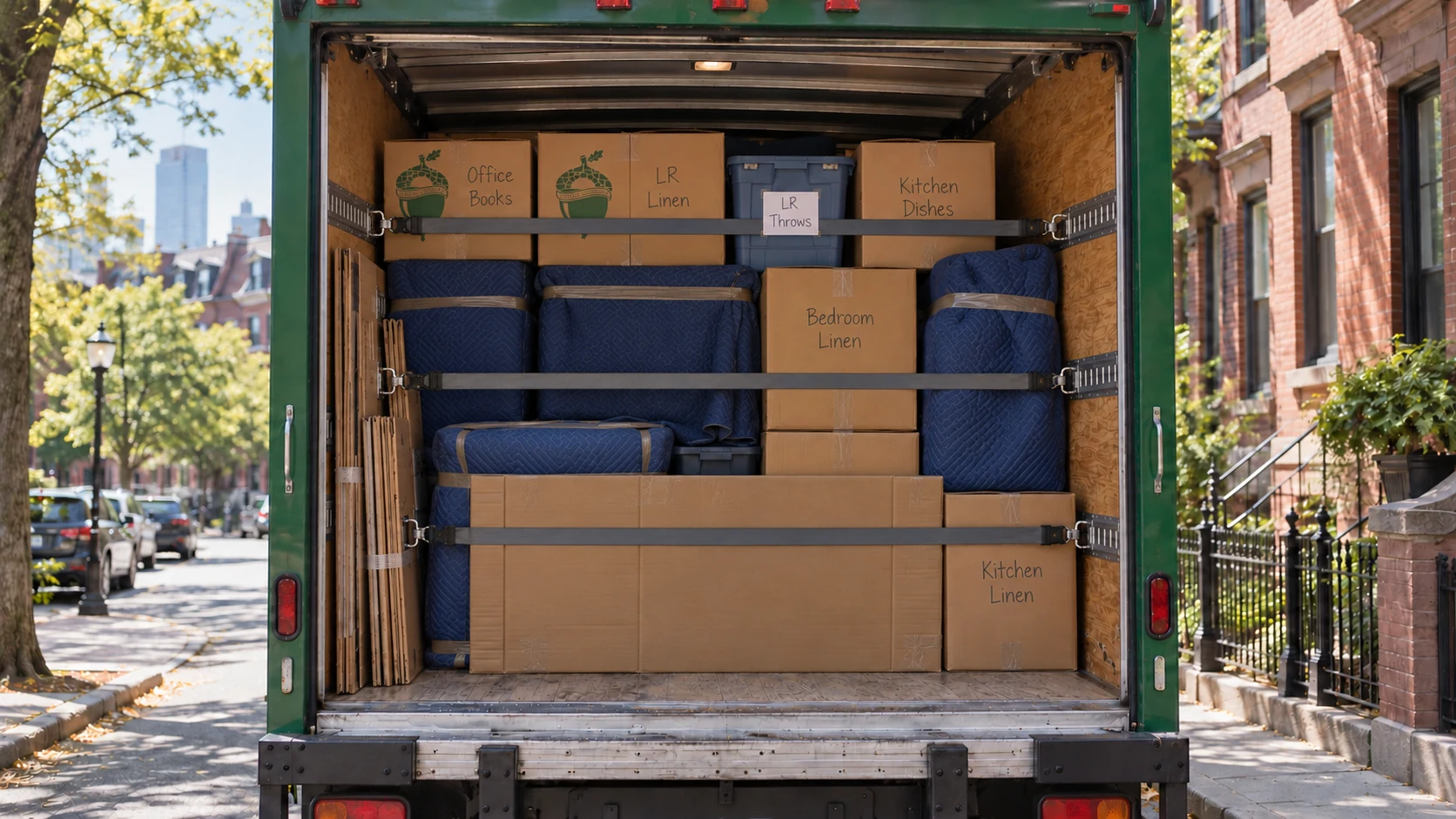
For a substantial direct shipment, the selected vehicle needs dense, supported mixed loading. Furniture protection remains a real cloth layer over the body and vulnerable retained feet; loose cartons and totes are secured as actual pieces. The end of the load can step in height while restrained faces remain aligned at each tie-down level. Remaining flat cartons belong in a secured side position rather than floating loose across the rear working area.
The normal Fort Pierce direct illustration is 2–3 days after pickup and loading. Consolidated Florida delivery can have an agreed window up to 60 days for a suitable smaller shipment. Review the complete inventory before comparing those models. A direct truck and the same crew belong to the dedicated arrangement; they are not automatic conditions for consolidated transport.
At Fort Pierce, settle possession, the actual receiving entrance and the person authorized to direct furniture placement. The household's own travel can have a different timetable. If access changes, agree the available alternative and any new work in writing before sending the crew into a situation that the original plan did not describe. Keep the agreed flat rate distinct from genuinely changed inventory, access or services.
Example 3: Boston to Victoriaville, Quebec with removable furniture parts and paperwork
Suppose a household is leaving a restored Boston apartment for Victoriaville in Quebec. Its dining table has safely detachable long legs, and the stair route makes separate protected components useful. Kitchen and book cartons need identification for the receiving rooms. The household will travel separately with essential documents. This is a planning example for a Canadian destination, not a statement about customs eligibility or a completed move.
Survey the origin route before choosing how the pieces will be prepared. Identify the table's actual construction and the narrowest turn with the move-planning team. An antique label alone does not prove fixed joinery, and a normal broad doorway does not justify a staged measurement unrelated to a furniture-fit question. Review the actual item and limiting route, then agree the safe preparation method.
For the selected removable-leg table, protect the body first. Keep the complete matched removed set together with its associated hardware. Finished protection encloses the actual body with real blanket folds and securing bands; it does not merely paint a quilt texture over exposed furniture. The common leg set is a separate identified group, with no invented extra legs. Genuine fixed construction needs its own method and continuous full blankets, not tiny separate foot sleeves.
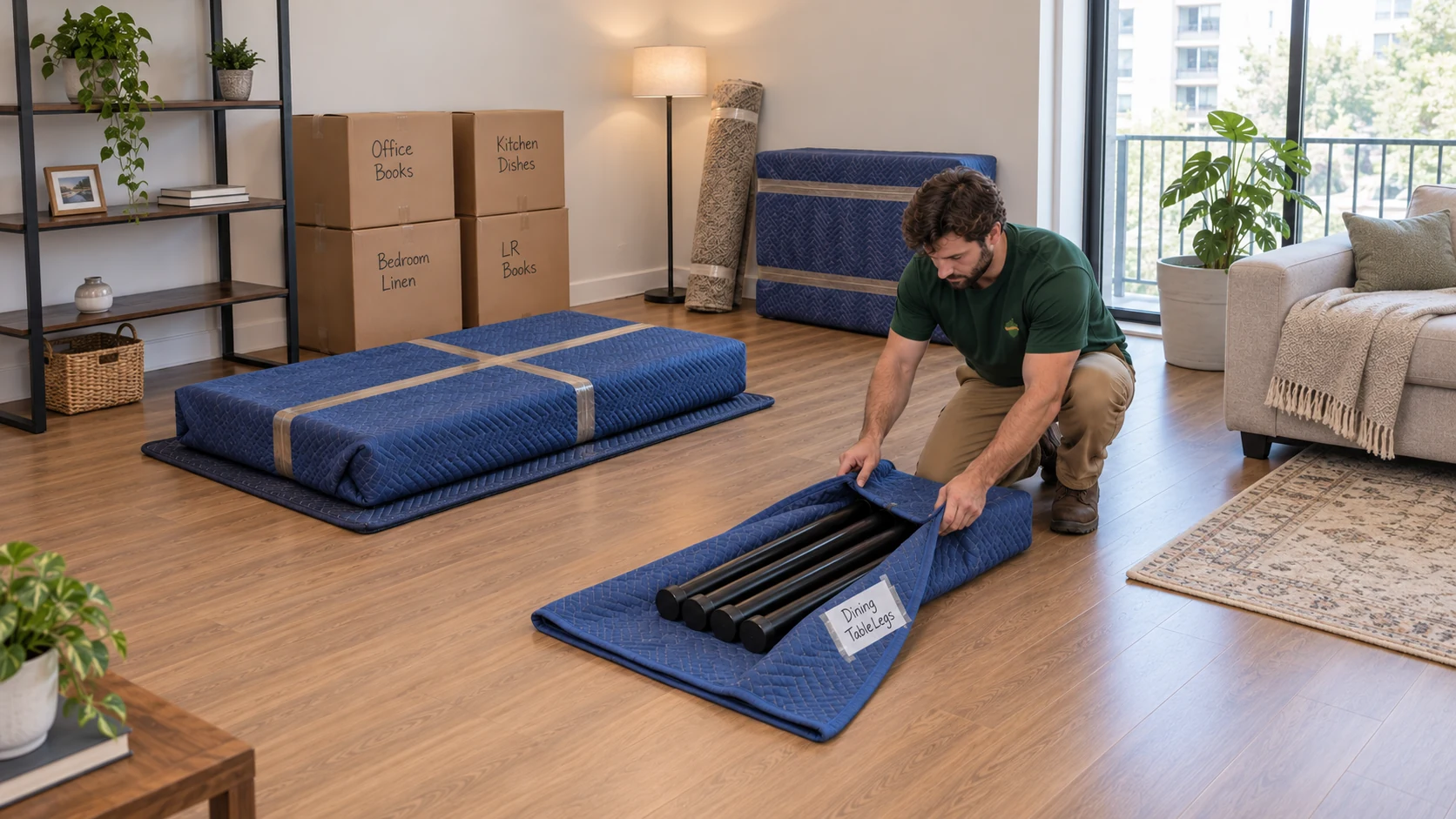
Keep the packaging record practical. Write destination room and contents directly on ordinary kraft cartons, and use an attached paper label for a customer tote. Separate household travel essentials from the shipment. A carton marked only “Books” does not identify its receiving room, while a list packed inside the truck cannot help the traveller when that paperwork is needed earlier.
For the applicable situation, CBSA's moving or returning guidance explains the personal-effects inventory and the distinction between goods travelling with you and goods to follow. Review the process that applies to your circumstances and controlled items with the appropriate authority and coordinator. Do not assume that a route quote establishes tax-free entitlement or that every used item has the same import conditions.
Victoriaville's normal direct illustration is 1–2 days after pickup and loading; consolidated Canada delivery can have a window up to 60 days. That Canadian window has its own policy even when the road reference seems comparatively short. Arrange the receiving home, contact and accepted documentation before tying the delivery to a fixed appointment. The person's entry and the shipment's clearance or arrival are separate confirmations.
At the home, use the room plan to direct the table and its matched parts into the approved area. Basic reassembly belongs to the reviewed moving work; complex furniture or additional installation is separately scoped. Record any concern through the agreed process while the piece and inventory are available. Retain the associated hardware until the actual assembly is complete, rather than scattering it among unrelated linen cartons.
Example 4: Boston to St. George, Utah with a smaller selected inventory
Consider a household sending a selected sofa, books, linen and a few customer-packed containers to St. George rather than moving every room. Some ordinary Boston furnishings remain. The task is to identify that smaller shipment and establish a workable receiving window, not to make a half-empty large truck look like a completed substantial direct load. This is a distinct hypothetical case, with final vehicle and quotation subject to review.
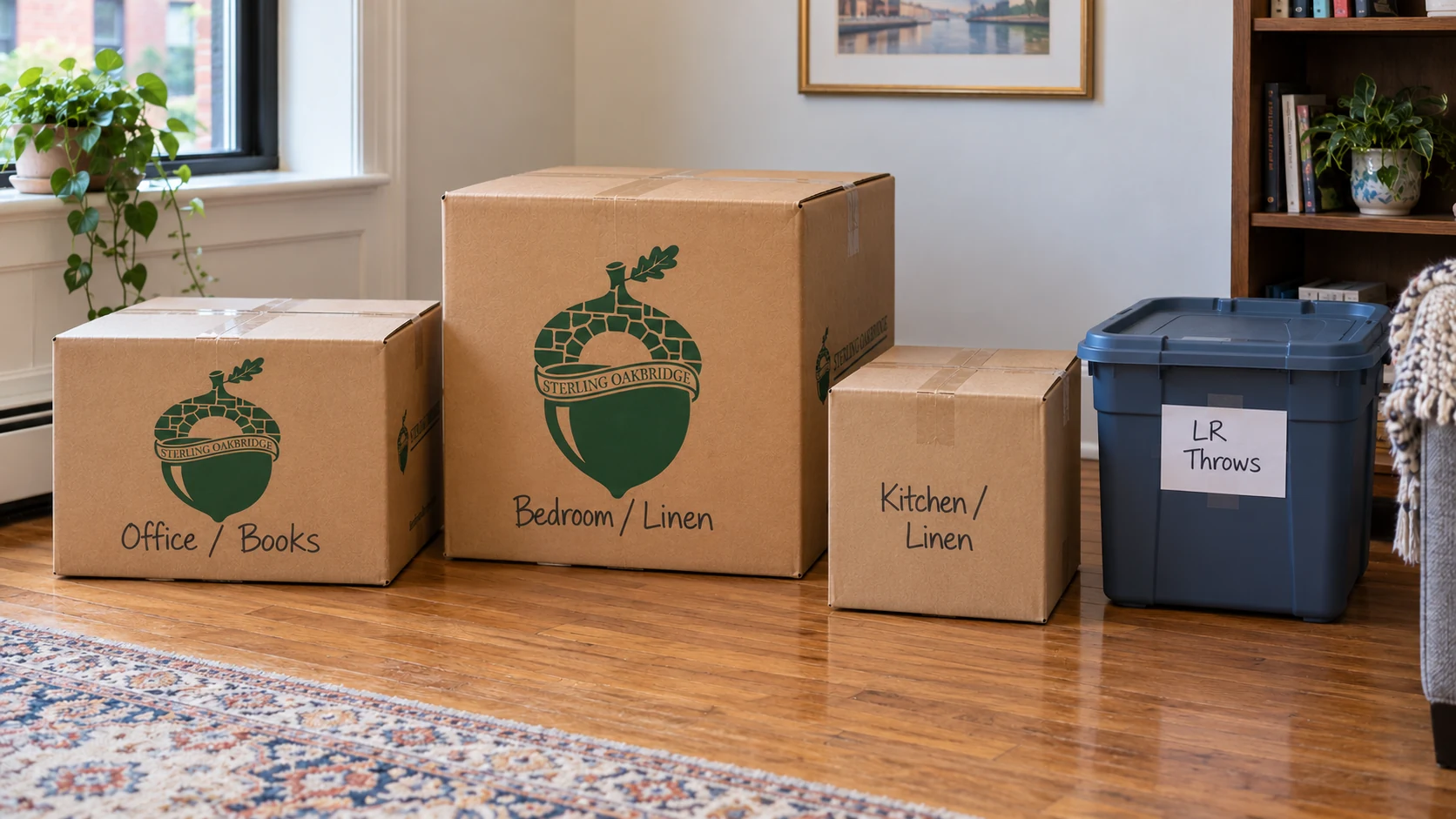
List every piece and identify what stays. Estimate the actual carton and tote quantities, describe the sofa dimensions and show the origin route. Different packing formats should remain different: a smaller book carton, a medium linen carton and an unbranded customer tote do not become identical display boxes. Put their room and contents into the inventory and directly on the appropriate packaging.
The nearby room can remain in normal use when it is outside the selected shipment. That is different from showing the last wrapped furniture in a supposedly finished full-house packing scene surrounded by loose books and untouched belongings. Explain the actual division of inventory and work before the crew arrives, so a useful small selection does not hide unreported pieces.
Direct delivery has a normal 4–5-day illustration after pickup and loading for St. George. Consolidated Utah delivery needs an individually agreed window; the California figure does not apply simply because the home is in the western United States. Consider the person's travel, the earliest confirmed receipt and the practical flexibility to accept the shipment. Confirm any storage or additional handling instead of treating a wide window as an included warehouse service.
At the receiving home, choose the sofa's final position and keep its carrying footprint available. Ordinary existing furnishings need not be removed from every other room. Place the selected main piece, remove its protection and retain access to the labelled cartons. A sofa with normal bare short feet is appropriate once it is placed and unwrapped; it is not an example of unprotected transport preparation.
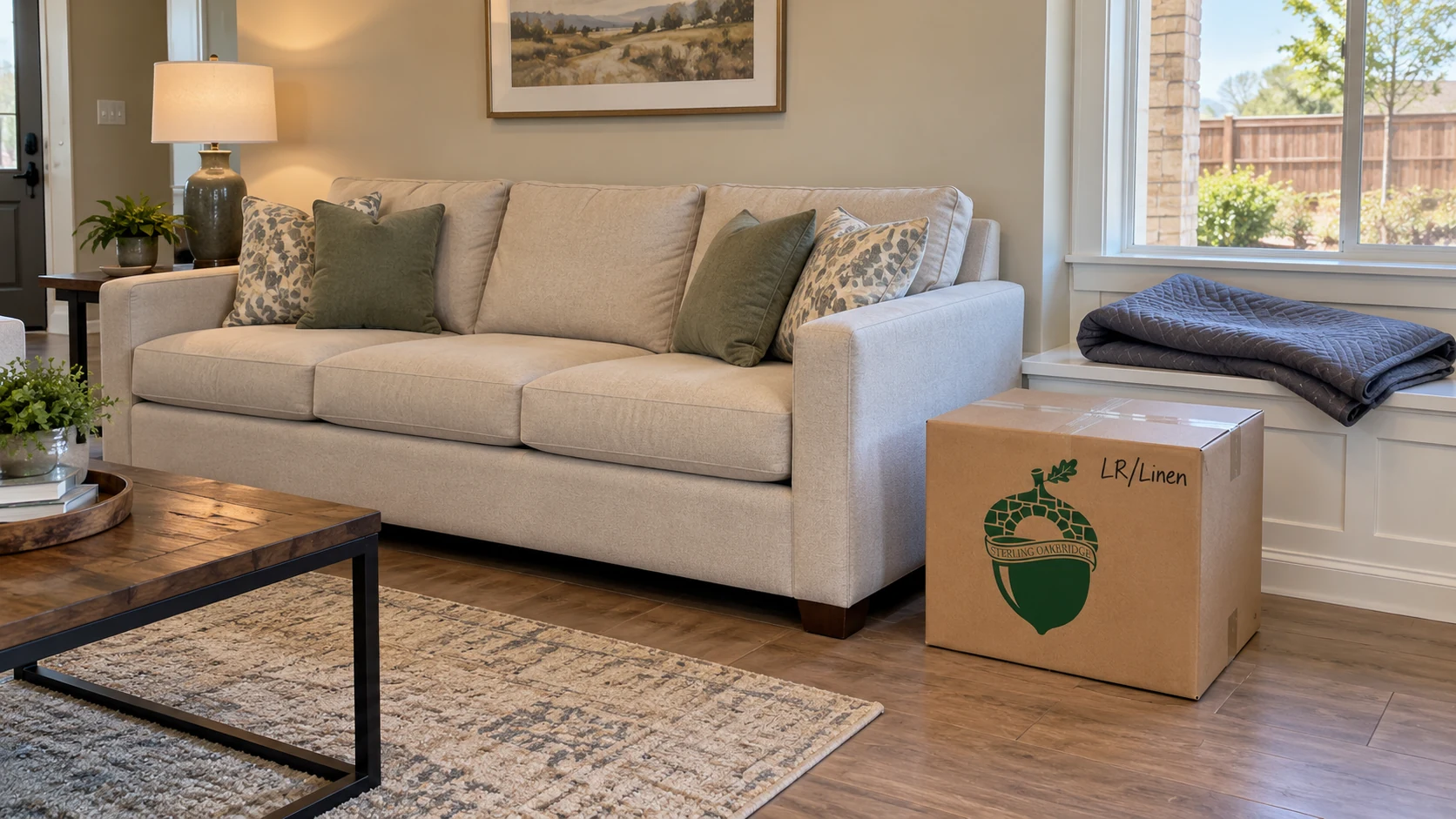
The remaining sealed linen carton shows that furniture placement and unpacking every box are separate tasks. Optional carton unpacking and packaging removal should appear in the scope if wanted. A used folded moving quilt belongs to the completed protection-removal stage; it is not loose unused stock being staged for vehicle storage. Confirm the selected furniture arrangement and record any issue before losing the connection to the inventory and delivery paperwork.
Keep the flat rate tied to the reviewed scope
For unchanged long-distance inventory, access and services, the agreed flat price stays the same when travel or delivery takes longer. A road delay does not by itself turn the shipment into a new job. Added furniture, extra packing, another stop or different building conditions can change the work; those changes need a separate written review.
Bring uncertainty into the first estimate conversation. Identify packing still to be done, access awaiting approval and possession dates that can move. Our planning team can recommend a list review, video review or visit according to the actual scope. A survey helps assess the work; it does not promise that the surveyor will be on the moving crew.
| Work or material | What to establish in the quotation |
|---|---|
| Basic furniture disassembly and reassembly | Moving labor includes basic work without a separate basic assembly surcharge; review actual construction and access. |
| Moving blankets, shrink wrap and tape | No separate basic material charge; use appropriate protection for the selected pieces. |
| Company-supplied cartons | Charged separately; agree the formats and quantity needed. |
| Packing work | Define full or selected-room work and what the household handles; cartons remain separate. |
| Furniture unwrapping | Part of delivery; distinguish it from taking contents out of every carton. |
| Optional carton unpacking and packaging removal | Agree unpacking work and separately charged removal before relying on them. |
| Complex furniture, specialist work and storage | Individually review the item, operation, access and stages; no automatic inclusion or generic price. |
Resolve Boston street ownership and actual restrictions
Use the City reservation instructions for the proposed legal frontage. A standard reservation covers two spaces for one day, 7 a.m.–5 p.m. The published City charges are $69 for two nonmetered spaces plus $40 for two metered spaces. They are municipal charges, separate from a moving quote; confirm the actual application and payment requirements.
The Parking Clerk FAQ gives the online 15-day and in-person three-day minimums within an eight-week maximum. Assign receiving and local posting of the actual signs, and follow the supplied neighbour-notice instructions. Approval and receipt of materials are separate steps. Recheck snow emergencies, construction, accessible spaces and no-stopping or no-standing zones; the reservation does not override those restrictions. During street cleaning, the City requires someone to remain with the truck.
City reservations apply to City-owned streets. A DCR-controlled frontage has a different authorization owner. DCR also identifies Storrow Drive, Soldiers Field Road and Memorial Drive as closed to trucks and moving vans, with Memorial Drive in Cambridge. Vehicle class, dimensions and current restrictions determine the legal approach. An ordinary passenger driving reference is not a certified moving-truck route.
Plan readiness, weather and what will not move
Agree the departure deadline, receiving possession and the last time at which a fallback can be arranged. Waiting, storage and a later delivery need an actual permitted resource and written terms. A garage is not a default answer to unclear room readiness. An explicitly approved whole-house date-gap hold has a different inventory and density from a few selected delivered pieces or seasonal furniture storage; none is an automatic included company service.
Before a winter pickup, recheck the legal truck position and the full outdoor route. Boston's snow-clearing guidance gives the three-hour rule after snowfall ends, or after sunrise for overnight snow, with at least a 42-inch pedestrian path. Assign clearing, treatment and protection at the curb, ramps, steps and shared entrance. A cleared minimum pedestrian path does not prove that a large furniture item will turn through it.
Keep discarded goods separate from the shipment while there is time for the appropriate collection. Boston trash instructions distinguish ordinary furniture, special appliances and cardboard recycling. The mattress program requires an appointment for most eligible properties with six units or fewer; larger buildings use management or a hauler. Follow the actual item instructions, including fully sealed bags for soiled, dirty or bedbug-affected mattresses. An unwanted item is not automatically part of transport or separately requested removal.
Long-distance moving questions
Where can I arrange long-distance pickup around Boston?
We can review long-distance pickup in Boston and nearby Greater Boston addresses, including Cambridge and Somerville. Boston is a City in Suffolk County; Cambridge and Somerville are separate Cities in Middlesex County. Confirm the actual municipality, inventory, legal truck position, building route and dates before applying Boston procedures. A regional Boston label does not establish City of Boston jurisdiction.
What does direct dedicated delivery include?
Direct delivery uses a dedicated truck for the reviewed shipment and the same moving crew at pickup and delivery. Agree the inventory, truck arrangement, both building routes and actual dates in writing. The person surveying or planning the move is not necessarily on that crew.
When is consolidated delivery useful?
A smaller shipment with flexible receipt can suit consolidated delivery, illustratively around 300–400 cubic feet or less. That is not a minimum volume. Describe the actual furniture, cartons and totes, then agree receiving arrangements, crew conditions and any storage separately; a wider window is not a confirmed discount or free storage.
When does the delivery window start?
After pickup and loading are complete. Application dates, sign posting and the household’s own journey are separate timelines. The route table gives normal planning illustrations; agree the actual appointment for your truck, inventory, route and receiving property.
Could a Boston-to-Portsmouth move arrive the same or next day?
A suitable close domestic shipment can be reviewed for same-day or next-day receipt when loading, lawful routing and access at both homes support it. The normal Portsmouth illustration is 1–2 days after pickup and loading. Confirm the appointment before tying it to a key handover or elevator slot.
What is the Fort Pierce delivery illustration?
For the illustrative Boston-to-Fort Pierce route, direct delivery is normally planned at 2–3 days after pickup and loading. Consolidated Florida delivery can have an agreed window up to 60 days. The household’s travel, possession and receiving arrangements need their own plan; the example does not book a date.
Does a relatively close Canadian destination get the domestic consolidated window?
No. The Victoriaville example has a normal direct illustration of 1–2 days, while consolidated Canada delivery can have a window up to 60 days. Canadian receipt, paperwork and the applicable border process need confirmation. A driving reference does not establish customs eligibility, clearance time or a tax exemption.
Does Utah use the California consolidated window?
No. The St. George example has a normal direct illustration of 4–5 days after pickup and loading. Its consolidated window is agreed individually. The California window is not a rule for every western state; use the actual destination and confirmed receiving arrangement.
Does a longer journey increase the agreed flat rate?
For unchanged long-distance inventory, access and services, the agreed flat price holds when travel or delivery takes longer. A delay itself does not change the reviewed shipment. Added items, different access or new services are scope changes and are reviewed separately in writing.
What should be reported after the estimate?
Report added or omitted belongings, unfinished packing, a changed entrance, extra stairs, an unavailable booked elevator, another stop or revised receiving requirements. Explain which facts changed and have the affected scope and price agreed in writing before the extra work. Keep the inventory and approvals accessible.
Which materials and preparation are included?
Basic furniture disassembly and reassembly use moving labor without a separate basic assembly surcharge; moving blankets, shrink wrap and tape have no separate basic material charge. Company-supplied cartons are separate. Agree packing work, complex operations, optional carton unpacking, packaging removal and storage in the written scope.
How should a table with long legs be prepared?
Review the construction first. Safely detachable long legs are normally removed before transport: protect the body first, then protect the complete removed set together and keep its hardware associated. Genuine fixed construction needs its own continuous full-blanket protection and access review. An already assembled, unwrapped table after delivery is a different stage.
Is a Boston moving-truck permit always required?
The City does not require its reservation for every move, but the truck must have a lawful place to work. Establish who controls the exact frontage and review posted restrictions and the vehicle. A City reservation and building access are separate; confirm the actual proposed pickup arrangement with the Parking Clerk.
How early should I arrange a City reservation and signs?
The current City instructions allow online application at least 15 days and no more than eight weeks ahead, or in-person application at least three days ahead within the same maximum. Signs go up at least 48 hours before the 7 a.m. permit start; three days is recommended. Assign receipt and local posting of the actual materials.
Can the moving truck use Storrow Drive if it fits under a bridge?
Height alone does not grant permission. DCR identifies Storrow Drive and Soldiers Field Road in Boston, and Memorial Drive in Cambridge, as closed to trucks and moving vans. The carrier must review the actual vehicle’s legal approach and current restrictions; passenger navigation and the illustrative driving table are not that review.
Does a parking reservation confirm the building’s elevator?
No. Obtain the property’s moving instructions, accepted documents, entrance, key holder, each elevator or stair section, and the actual usable slot. Agree who submits requests and who approves them. Match curb use, keys, protection, carrying and clearing the route; a booked single elevator does not describe every part of the journey.
What if the receiving home is not available?
Discuss the possession gap, decision deadline and authorized receiving person before dispatch. Waiting, storage, separate stages or later delivery need an agreed scope and actual resource. Do not invent a garage waiting stage just because rooms are vaguely not ready. Keep essential belongings with the household and nominate who can approve a change.
What changes for a winter pickup?
Recheck snow-emergency parking and the whole outside approach. Boston instructs property owners to clear sidewalks and curb ramps within three hours after snowfall ends, or three hours after sunrise for overnight snow, with at least a 42-inch path. Assign clearing and treatment before the crew needs that route; those dimensions are not furniture clearance approval.
How should discarded furniture and mattresses be handled?
Keep discarded goods outside the moving inventory and use the actual building’s collection arrangement. Boston mattresses require an appointment for most eligible buildings of six units or fewer; residents in buildings with seven or more use management or a private hauler. Follow item preparation instructions; soiled, dirty or bedbug-affected mattresses must be fully bagged and sealed.
Explore long-distance destinations from Boston
These destinations illustrate household shipments from Boston within Sterling’s reviewed United States and Canada coverage. Send both addresses, the complete inventory, access conditions and dates, then agree the actual shipment and receiving window.
Northeast and nearby interstate examples
- Portsmouth, New Hampshire
- Portland, Maine
- Albany, New York
- New York City, New York
- Providence, Rhode Island
- Hartford, Connecticut
- Philadelphia, Pennsylvania
- Washington, District of Columbia
Southeast and Florida
- Fort Pierce, Florida
- Tampa, Florida
- Jacksonville, Florida
- Orlando, Florida
- Richmond, Virginia
- Raleigh, North Carolina
- Savannah, Georgia
- Charleston, South Carolina
Midwest and Texas
- Cleveland, Ohio
- Columbus, Ohio
- Chicago, Illinois
- Detroit, Michigan
- Minneapolis, Minnesota
- Dallas, Texas
- Houston, Texas
Mountain West and Southwest
- St. George, Utah
- Salt Lake City, Utah
- Denver, Colorado
- Phoenix, Arizona
- Las Vegas, Nevada
Washington, Oregon and California
- Seattle, Washington
- Spokane, Washington
- Portland, Oregon
- Sacramento, California
- San Diego, California
Canada
- Victoriaville, Quebec
- Sherbrooke, Quebec
- Montreal, Quebec
- Ottawa, Ontario
- Kingston, Ontario
- Toronto, Ontario
- Vancouver, British Columbia