
New Jersey · Elizabeth service planning
Full Packing and Unpacking in Elizabeth, NJ
Choose the contents you want Sterling Oakbridge to prepare and the help you want when they arrive.

We review the household inventory, access and usable dates before agreeing packing, materials and optional receiving work.
Explore packing, costs and local examples
Decide which preparation you want to hand over
A move can take over the evenings before the truck arrives. Sorting a cupboard, finding enough suitable cartons, protecting the contents and deciding what must stay accessible are separate jobs. Packing help can return some of that time to work, rest or the household's usual routine. You still make personal decisions about what to retain and where it belongs; the crew needs those decisions in time to prepare the right groups.
Full packing covers the retained household contents in the agreed scope. Partial packing covers named rooms, cupboards or groups. Fragile-only packing can cover selected ordinary breakables while you prepare clothing, books or other belongings. Say which drawers, shelves and storage spaces are included, and identify work you will finish yourself. An instruction to “pack the kitchen” should distinguish what travels from food, cleaning products and the few things needed until departure.
The Elizabeth moving page covers the whole move and building access. The local relocation guide covers the home and everyday arrangements. This page connects the preparation you choose with a usable last night and receiving plan. Packing does not automatically include unpacking, final cupboard placement, material removal or every finishing task.
Show the contents behind the room count
Open cupboards, closets, drawers and bookcases for the inventory review. Include the retained belongings in a basement, attic, garage or separate storage room. Identify small framed pictures, dishes, decorative objects and collections individually enough to choose protection. Photographs of an empty doorway and a closed wardrobe cannot reveal how much is inside.
Elizabeth's 2020–2024 Census housing profile distinguishes housing units in two-unit and three-or-four-unit structures. That historical city-level context makes shared entrances and separate households worth asking about. It does not establish the layout of your unit, the number of cartons or how long your preparation will take. Check the actual retained inventory and route.
A household may expect twenty cartons and discover that the contents need sixty or a hundred. That is an illustration of underestimating cupboards, not a bedroom-based allowance or a prediction for Elizabeth. The estimate should identify the actual goods, suitable materials and selected work. Put belongings that stay with another household, a landlord or a relative on an explicit excluded list.
Consider: two work schedules and a shared-house departure
Imagine two people leaving an upstairs Elizabeth unit. One starts work early; the other needs a desk and reference books until the final evening. Their retained inventory includes ordinary kitchenware, hanging clothes, the desk contents and boxes stored in the basement. The shared entrance serves another household, so preparation groups cannot occupy its passage.
Start with belongings that are no longer needed that week. Give the crew a clear list of basement contents and the household's own cupboards; a common stair does not authorize packing someone else's goods. Keep the next morning's clothing, medicine, chargers, breakfast items and work materials in a named final-night group. Agree when that group can be closed and who will carry personal necessities.
Hanging clothes can move into suitable wardrobe cartons while enough clothing remains available for departure. Keep the carton outside the closet's working access and the shared route. The useful saving comes from completing selected groups before the last evening without repeatedly opening them. It does not come from assuming every unit of the same bedroom count needs the same staff or hours.

Give packing its own workable period
Some reviewed local inventories can fit preparation and moving into one day. Others benefit from an earlier packing visit. The decision depends on contents, furniture preparation, the carrying route and accepted work hours at both properties. A smaller apartment with extensive books and dishware can need more preparation than a larger home with fewer retained contents.
Keep a final-night group usable until its agreed packing time. Confirm when beds, essential kitchen items and work equipment can be released. An earlier visit is useful only when the crew has authorized access, suitable working space and a clear scope. Protect completed groups from later household use or an unrelated contractor's work.
For a larger project, a separate visit by four packers and a moving day with six movers can illustrate different tasks and staffing. It is not a standard crew for a particular number of bedrooms. Discuss which arrangement fits the actual work, availability and cost. If a building period cannot accommodate the proposed sequence, agree a different visit or method before that period and other options expire.
Consider: selected dishware in a common-corridor apartment
Imagine an Elizabeth apartment household that will pack its own books and clothing but wants ordinary kitchen breakables prepared professionally. The apartment opens onto a common corridor. A contemporary apartment setting does not establish a service lift, a booked entrance or permission to use the corridor as a packing area.
List the selected cupboards and show dishes, serving pieces and any removable glass shelves. Set aside the few pieces needed until departure. Review fragile items that need a different method rather than assume one carton will suit every object. The packer needs a supported preparation area inside the unit and enough suitable materials for the named contents.
Ask management to identify the complete route, accepted work period, protection and any certificate-of-insurance or required-personnel conditions. Give the coordinator those requirements before the visit. Keep customer-packed groups distinguishable from the selected fragile group. The result should be prepared, identified contents and usable access, with the remaining household tasks still clear. A pending entrance request is not a confirmed work period.
Protect the contents for their whole journey
The contents need support inside the carton as well as protection on the outside. Choose a suitable size and strength, protect individual ordinary breakables and provide cushioning appropriate to the object. Closed cartons must work through carrying, stacking, restraint and travel; an upright photograph of a neat stack does not prove that the contents are supported.
Books, hanging clothes, glassware and a glass-front cabinet need different preparation. Show removable shelves and the whole furniture piece before agreeing the method. Empty ordinary furniture drawers and normally retain them secured in the complete protected piece. Do not force an integral part to detach. Clean handling and any gloves must suit both the material and a secure grip.
Basic moving blankets, shrink wrap and tape have no separate basic material charge. Cartons and preparation labor still need the agreed scope. Delicate art, unusually valuable collections and pieces needing a special enclosure require an item-specific review; use the fine-art service for that separate discussion. An ordinary packing photograph is not a claim of museum treatment, a certified enclosure or a guarantee against damage.
Make each destination intelligible before closing cartons
Write the next destination, receiving room and useful contents on each carton. Add a number and an opening priority where useful. Color can reinforce a written instruction, but a colored sticker alone does not tell a receiver whether the goods belong at the apartment, with another person or in storage. Keep the same instructions on the item list, loading plan and receiving list.
Distinguish what you need during travel from what should be opened soon after delivery. A priority carton inside the load is still part of the shipment. Keep identification, keys, medicine, chargers and essential work or school items with the household. Give the coordinator clear instructions for excluded and separately destined belongings before loading starts.
Consider: one household dividing goods between two homes and storage
Imagine an Elizabeth household separating its retained belongings into a smaller apartment, a relative's home and storage. Kitchenware travels to the apartment, a selected bookcase, books and guest linen go to the relative, and guest bedding is held for later. The decision is about ownership and the next usable destination, not three interchangeable colored piles.
Confirm that the relative accepts the named items, can receive them and has a usable entrance and space. For storage, agree the inventory, intake, access, expected release and later delivery arrangements with the appropriate parties. A storage enquiry does not establish an available place or an included second delivery. See moving and storage for that separate stage.
Use a destination name, room and contents on every group, with the matching inventory. Keep the three groups distinct without obstructing the exit. Unwanted belongings stay on a separate list until their receiving or removal route is accepted. The saving can come from preparing each retained item once for the correct destination and avoiding a second sort in the smaller apartment. Include extra handling, visits, storage and travel in the comparison.

Open the agreed cartons onto usable surfaces
Basic box unpacking opens the agreed cartons and places their contents on suitable available surfaces. Choose the rooms, cartons and opening priorities. Clear enough supported space before the visit, and tell the crew which cupboards, furniture and belongings must remain untouched. Emptying every carton is not useful when it fills the only working counter or blocks the way to the bedroom.
Collect used paper and empty packaging in a distinct group as the work progresses. Check it for small parts and retained belongings before it is discarded. Gathering materials indoors does not include taking them away. Tell the coordinator whether you want separately priced material collection and which materials that arrangement accepts.
Home organizing adds final placement according to the customer's instructions. It is separately selected work, rather than an automatic consequence of opening cartons. Decide which shelves, drawers and household systems need attention and who can direct placement. A smaller team may be easier to guide through detailed choices than the full moving crew. Keep personal papers and private belongings under the household's control.
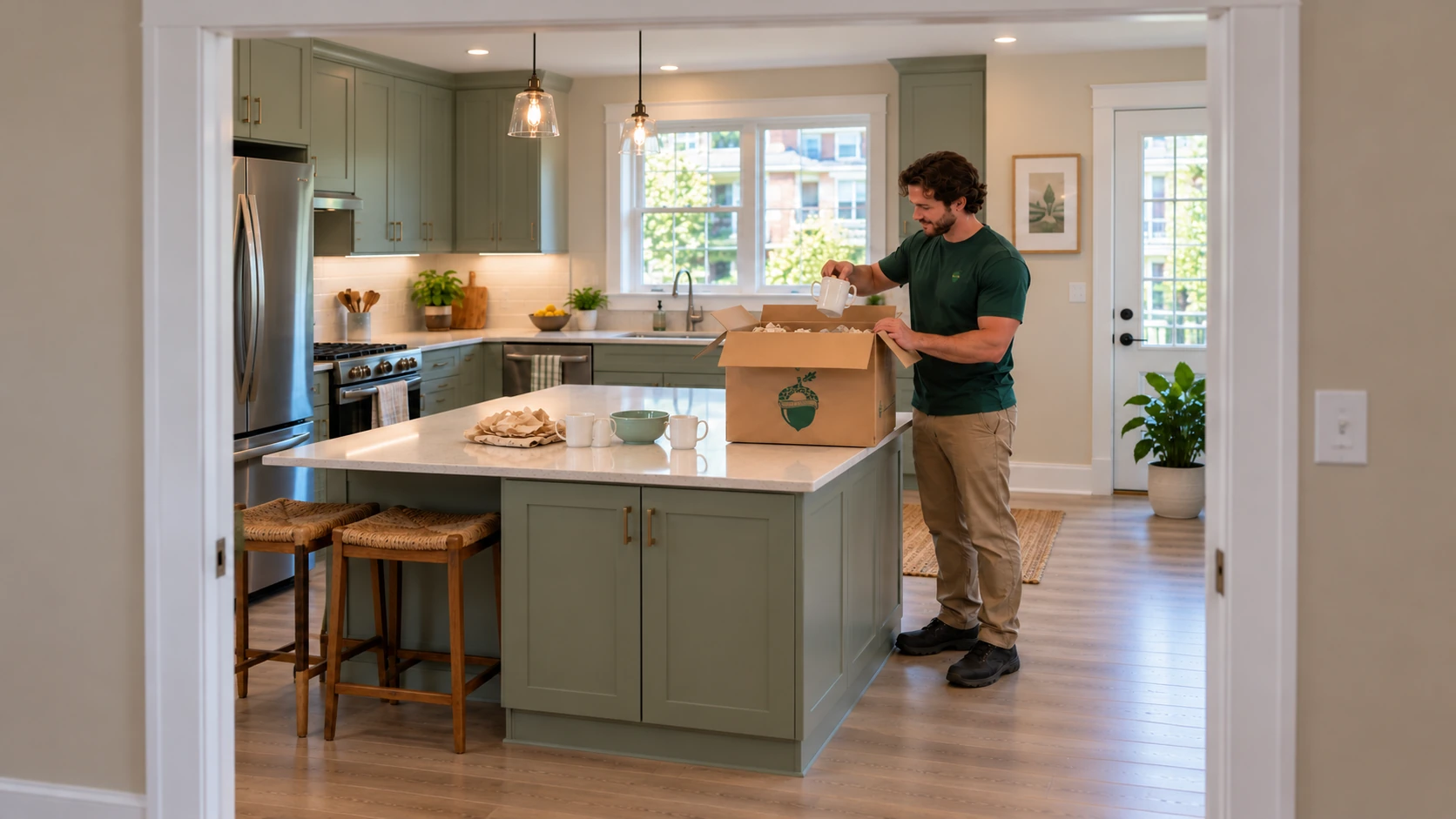
Consider: returning to unpacking before the next school and work day
Imagine an Elizabeth household that has moved and begun unpacking itself. The kitchen contains unopened groups, bedding is still mixed with guest linen, and the next work and school morning needs a practical start. The problem is different from packing the old home: the household already knows which rooms are occupied and which surfaces are available.
Ask about a later unpacking visit with a clear list of priorities. Describe what remains boxed, the usable surfaces, access hours and where the empty materials can be gathered. A separately agreed visit by two people can be easier to direct through the kitchen and bedrooms; its timing depends on actual availability. Do not rely on an unconfirmed return before a firm morning commitment.
Open the everyday kitchen and named bedding groups first while preserving a route through the occupied home. Leave later groups closed if there is no usable place for their contents. Choose directed organizing only where final placement is wanted. On a larger project, three or four additional hours can illustrate the receiving work being considered, not a promise of completion. Agree the inventory, priorities and visit rather than assume a completely organized home by bedtime.
Choose assembly and finishing work by the object
A bed or table may need basic disassembly and reassembly as part of the reviewed moving labor. A new furniture purchase, a piece already inside the home and a mounting request have different owners. Use furniture delivery for a separate purchase, or in-home moving when the furniture is already at the property.
Identify requested handyman work, wall material, fixings, permissions and the intended result individually. Television, picture or mirror mounting does not automatically include wiring, an electrical connection or repair of an unsuitable wall. Agree the executor and technical scope before the appointment. Crane work is excluded, and computer reconnection and testing remain with the customer's IT provider unless another confirmed scope says otherwise.
Keep identified hardware with its matching item and protect it from the used-paper group. Tell the coordinator about damage or incomplete parts before the work. A finished packing stage can hand over protected belongings without claiming that every fixture, appliance or technical system is ready for use.
Separate packaging preparation from its accepted collection
The City's 2026 brochure says corrugated cartons should be collapsed, folded and securely tied or nested for the applicable paper collection. It treats household wrap and specified foam separately. Do not put mixed packing waste into a cardboard bundle or assume all paper has the same route.
For buildings with three or more units, the brochure specifies an outside enclosure with garbage and recycling signs. Ask management where the separated empty materials can wait without occupying a common corridor. Match the property's actual collection arrangement and date; finishing unpacking does not create an extra pickup. The resident recycling center does not permit commercial dumping.
Removal needs its own agreed scope and price. Confirm the material, collector, accepted route and date before relying on it. Unwanted furniture, appliances, electronics and construction waste need separate decisions; the removal and disposal service owns that fuller discussion. Do not add an unwanted chair to the prepared shipment because its collection is unresolved.

Fit receiving work around the actual delivery
For a distant move, preparation is complete before the delivery date is necessarily fixed. The Elizabeth long-distance page explains direct dedicated and suitable consolidated arrangements. The delivery window starts after pickup and loading are complete. Confirm who can receive, the accepted building route and usable rooms, then agree any unpacking visit against the applicable window.
Direct delivery uses the reviewed dedicated truck and the same crew at pickup and delivery. Do not extend that arrangement to consolidation or assume optional unpacking is included. For an unchanged agreed long-distance flat-rate scope, a longer journey does not itself increase the price. Added goods, changed access, another destination or extra receiving work need separate written agreement. A move entirely within New Jersey still needs its applicable in-state pricing basis and written estimate.
Before dispatch and before alternatives expire, identify who can resolve a missing key, lost receiving period or unavailable room. Another accepted slot, a different reviewed method or confirmed available storage and redelivery must have a receiver, inventory, access, dates and costs. Resume the affected stage when the property controller confirms usable access and the coordinator accepts the revised plan. A hope that a room will be ready does not supply a workable fallback.
Compare the whole paid scope and the household time retained
Packing labor is charged for working time, and company-supplied cartons are separate. Identify optional unpacking, directed organizing, return visits, specialist protection, storage and material removal where wanted. If transport has an agreed flat rate, establish which preparation tasks are included in that scope and which are separately itemized. Local estimated hours help plan the work; they are not a guaranteed maximum charge.
Compare the same inventory, access and destinations with and without preparation help. For a substantial inventory, packing plus moving may approach twice the cost of moving an already packed shipment. That is an illustration of different work, not a company multiplier, rate or ceiling; the actual comparison can be lower or higher. Include the household time needed for sorting, preparation, reopening essentials and final placement.
Send both addresses and every extra destination, the firm dates, cupboard and storage photographs, retained contents and the complete carrying routes. Specify full, partial or fragile-only packing and what you will prepare. Add opening priorities, organizing or finishing requests and the empty-material arrangement. The estimate can then identify a useful handover at each stage and the work the household will still do.
Elizabeth packing and unpacking questions
What does full packing include?
It covers the retained household contents and preparation tasks in the agreed scope. Identify cupboards, closets, stored belongings and special items, together with exclusions. Packing does not automatically add unpacking, final cupboard placement, material collection or every finishing task.
Can I choose partial or fragile-only packing?
Yes. Name the rooms, shelves or selected ordinary breakables you want prepared and show their contents. Identify the books, clothing and other groups you will pack yourself. The estimate should make the boundary clear enough for both the household and crew to follow.
How can packing help with two work schedules?
Prepare groups no longer needed first and retain a named final-night group for clothing, medicine, breakfast and work. Agree when those essentials can be packed and who keeps personal necessities. Earlier preparation can preserve evenings without making the unit unusable before departure.
Can you estimate cartons from my apartment’s bedroom count?
The contents need their own review. Show open cupboards, closets, drawers, bookcases and retained basement, attic or storage groups. Room counts and historical Census housing figures do not reveal carton quantities, fragile handling or the time the work needs.
Do I need to sort belongings before the packing visit?
Decide what will travel, what stays and what has another destination. Mark belongings belonging to another household or a landlord as excluded. You can request agreed preparation help, but the crew should not have to make personal ownership or disposal decisions.
What changes when another household shares the entrance?
Identify your unit and retained contents, agree preparation inside the authorized space and keep the common route usable. Tell the coordinator about stairs, turns and accepted hours. A shared basement or entrance does not authorize packing the other household’s belongings.
Can packing and moving happen on one day?
They can for some reviewed inventories, access arrangements and work periods. Larger or more involved contents may benefit from an earlier visit. Agree the inventory, release of essentials, staffing and accepted building hours before relying on a one-day sequence.
Does a separate preparation day mean everything must be packed early?
No. Agree which groups can be completed and which must remain usable for the last night. Give beds, kitchen necessities and work equipment a release time. Keep completed groups identifiable so ordinary household use does not reopen them unnecessarily.
How are hanging clothes prepared?
Review suitable wardrobe cartons and the actual closet access. Keep the carton outside the closet opening and the room route, and separate clothes needed before departure. Do not assume hanging clothes, shoes and every cupboard item belong in the same container or preparation method.
What protects ordinary dishes and fragile contents?
Use a suitable carton, individual protection and cushioning appropriate to the object. Contents need support through carrying, stacking, restraint and travel. Show unusual or valuable pieces separately so the coordinator can review an item-specific method instead of treating every fragile object alike.
Should furniture drawers and legs all come off?
Empty ordinary drawers and normally retain them secured in the complete protected piece. Show the construction and restricted route before agreeing preparation. A removable component and an integral support need different decisions; do not force furniture apart to fit a general packing rule.
Are cartons and packing labor included with protective blankets?
Packing labor is charged for working time and company-supplied cartons are separate. Basic moving blankets, shrink wrap and tape have no separate basic material charge. Identify the selected labor, materials and any preparation already included in an agreed transport scope.
How should I label goods for two homes and storage?
Write the actual next destination, receiving room and useful contents, with a number and opening priority where helpful. Match those instructions to the inventory and receiving lists. Confirm each receiver and any storage intake and later delivery; color alone is not enough.
What stays with me during travel?
Keep identification, keys, medicine, chargers and essential work or school items with the people who need them. Separate this group before the final inventory check. A priority carton inside the moving load may still be unavailable during the household’s own journey.
What does basic box unpacking leave me with?
The crew opens the agreed cartons and places their contents on suitable available surfaces. Choose rooms, groups and priorities, and make space for the contents. Basic unpacking does not itself put everything into final cupboards or remove the empty materials from the property.
Can I request help after trying to unpack myself?
Yes, describe the remaining boxed inventory, occupied rooms, usable surfaces and access. Ask about a separately agreed later visit and its actual availability. Prioritize the groups needed for the next household routine rather than assume an immediate return or a complete organized home.
How does home organizing differ from unpacking?
Organizing adds final placement according to your instructions. Agree shelves, drawers, priorities and who can direct decisions, together with scope and price. A smaller team can be easier to guide through detailed placement; personal papers and belongings remain under the household’s control.
Can you add assembly, mounting or handyman work?
Request each task and show the item, wall or fixing, permissions and intended result. Basic moving assembly, a new furniture purchase and technical mounting need distinct scopes. Agree the executor; mounting does not automatically include electrical work, reconnection or repair.
Will all empty packing materials go into the cardboard group?
No. The City brochure calls for collapsed, folded and tied or nested corrugated cartons on the applicable paper route. Keep used paper, film and foam separately identifiable and check their accepted arrangement. Do not mix retained belongings or miscellaneous waste into the empty-carton group.
Where can packaging wait in a multiunit building?
Ask management about the designated separated-material area and collection arrangement. Keep common corridors and entrances usable. The City brochure specifies a signed outside garbage/recycling enclosure for buildings of three or more units; that does not reserve corridor space for packing waste.
Does unpacking include taking the empty materials away?
Material removal needs its own agreed scope and price. Confirm what will be collected, the accepted route and date. Gathering empty packaging indoors and completing a room do not establish a collection booking or authorize contractor use of a resident-only route.
How should I book unpacking after a long-distance move?
Match the receiving help to the actual agreed delivery model and window, which starts after pickup and loading are complete. Confirm a receiver, usable route and rooms. The Elizabeth long-distance page explains the transport choices; optional receiving work needs its own accepted scope.
What if the keys or a receiving room are not ready?
Resolve the alternative before dispatch and before other options expire. A later slot, reviewed method or confirmed available storage and redelivery needs an actual receiver, access, inventory, dates and costs. Resume the affected stage when the property controller and coordinator accept a usable plan.
Can packing and moving cost twice a transport-only move?
For a substantial inventory that can be a useful illustration of adding preparation to the same already-packed move, rather than a rate or ceiling. The actual comparison can be lower or higher. Compare labor, cartons, access, destinations, optional receiving work and return visits.
What should I send for a useful written estimate?
Send all addresses, firm dates, open-cupboard and storage photographs, retained contents and the complete routes. Specify full, partial or fragile-only packing, what you will do, extra destinations and unusual pieces. Add unpacking priorities, organizing, finishing and the empty-material arrangement.