

Where would your next ordinary week work better?
A move out of Albany can begin with a surprisingly small wish. You want to finish work and still have an evening. You want a room where a sewing machine can stay open, a school pickup that does not depend on a favor, or a front door you will still enjoy using in ten years. Another person wants a larger professional circle, an ocean in the week, or the chance to build a life in another language. These are different searches. Giving yours a clear purpose makes the map much more useful.
Start with a sentence about the change you want: “We want one adult to reduce hours without losing the ability to save,” or “I want to take a sound-editing job while keeping a neighborhood life outside it.” Then add three things that already work in Albany. They might be a reliable colleague, a parent close enough for an unplanned visit, and a familiar walk that gets you outdoors. A destination earns its place when it improves the first sentence without casually spending all three of those advantages.
There is room here for a small change and a very large one. Troy, Schenectady and Saratoga Springs let you examine a different home base within the Capital Region. Rochester, Providence and Portland, Maine, ask what another northeastern city would add. Farther US choices range from Cleveland and Milwaukee to Albuquerque, Anchorage and Los Angeles. The international section opens four distinct conversations: Riga, Papeete, St George’s and Lilongwe. Each is a beginning for a particular kind of household, rather than a claim that everyone should want the same life.
You do not need to research every place. Read the profiles that answer your reason for moving, keep two to four possibilities, and give each a question that could change your mind. A person with a firm job offer may need to compare neighborhoods. A household hoping to live on less may need to settle the income question first. Someone drawn to another country may need to establish a lawful way to live and work there before pricing furniture or choosing a view.
Keep an improved Albany option on the same sheet. A quieter apartment, a home with fewer stairs, a better work arrangement or a room rented for a small creative business can sometimes deliver the change you want with much less disruption. It is useful to find that out before you leave. It is equally useful to discover that the life you want really does need another place.
The people and situations in this guide are illustrative examples, not customer stories or reports of available jobs. The city scenes are original AI illustrations. The maps help you explore geographic relationships; the historical data give a common comparison background. Your shortlist becomes a practical plan when an actual income arrangement, actual homes and the journeys your household makes all point in the same direction.
Keep Albany involved
Compare another city home with the distinct Troy, Schenectady and Saratoga Springs connections.
Try the nearby routines →Improve the whole month
Put actual housing, full transport and usable income into the same comparison.
Compare the money left →Choose another setting
Explore a regional, southern, interior, mountain-region or western week through its less convenient season too.
Explore US horizons →Begin in another country
Match a lawful residence and work plan with an ordinary week in one of four international destinations.
Explore four international destinations →Decide which parts of Albany should come with you
Before you compare another city with Albany, compare it with the Albany you actually use. “The Capital Region” can mean a short city trip for one person and a long chain of driving, transfers and favors for another. Write down the addresses behind your week: work, school or training, the relative you help, the place you buy everyday groceries, and the activity you would miss if you stopped going. The result shows which connections need to survive and which journeys you would welcome the chance to change.
Imagine a museum conservator whose work stays in Albany while their partner makes books by hand. A smaller home near a workable route could free money for a separate studio; moving much farther away could remove the conservator’s job without creating a customer base for the bookbinder. That household has a good reason to look at Troy before considering the other side of the country. A different couple, both changing careers and without a fixed workplace, may gain little by organizing every option around a commute they are about to stop making.
Support deserves the same attention as employment. If a sister can collect a child when a rehearsal runs late, that help is part of the current arrangement. Put the replacement into both the calendar and the budget. It may be a paid program, a different work shift or another adult giving up an activity. A nearby move can preserve help without making it effortless; a faraway move can work well if the household deliberately builds a replacement instead of assuming one will appear.
Also separate the house from the place. You may love your neighbors and dislike carrying laundry down steep stairs. You may enjoy the region and be tired of maintaining a large yard. Those problems suggest a different kind of home before they suggest a different state. Make one realistic Albany search with the new requirements. If it still leaves the central problem untouched, the case for a wider move becomes clearer.
A useful “keep” list is short enough to make choices. “Family, culture, nature, affordability and good jobs” could describe almost anywhere. “Dinner with my father twice a month, a workshop I can reach after work, and a weekday walk that starts at the door” tells you what to test. You can change the list as your life changes. Its purpose is to protect what matters while you explore, rather than tie you to an old version of yourself.
Give staying a fair trial with one action and a date. Ask about a schedule change, visit a suitable apartment, or price a workroom you could share. Compare the result with the same seriousness you give a promising destination. Staying after that comparison is a decision you can explain; moving after it has a stronger purpose than simply hoping that distance will improve everything.
Albany’s Hudson crossing and station relationship
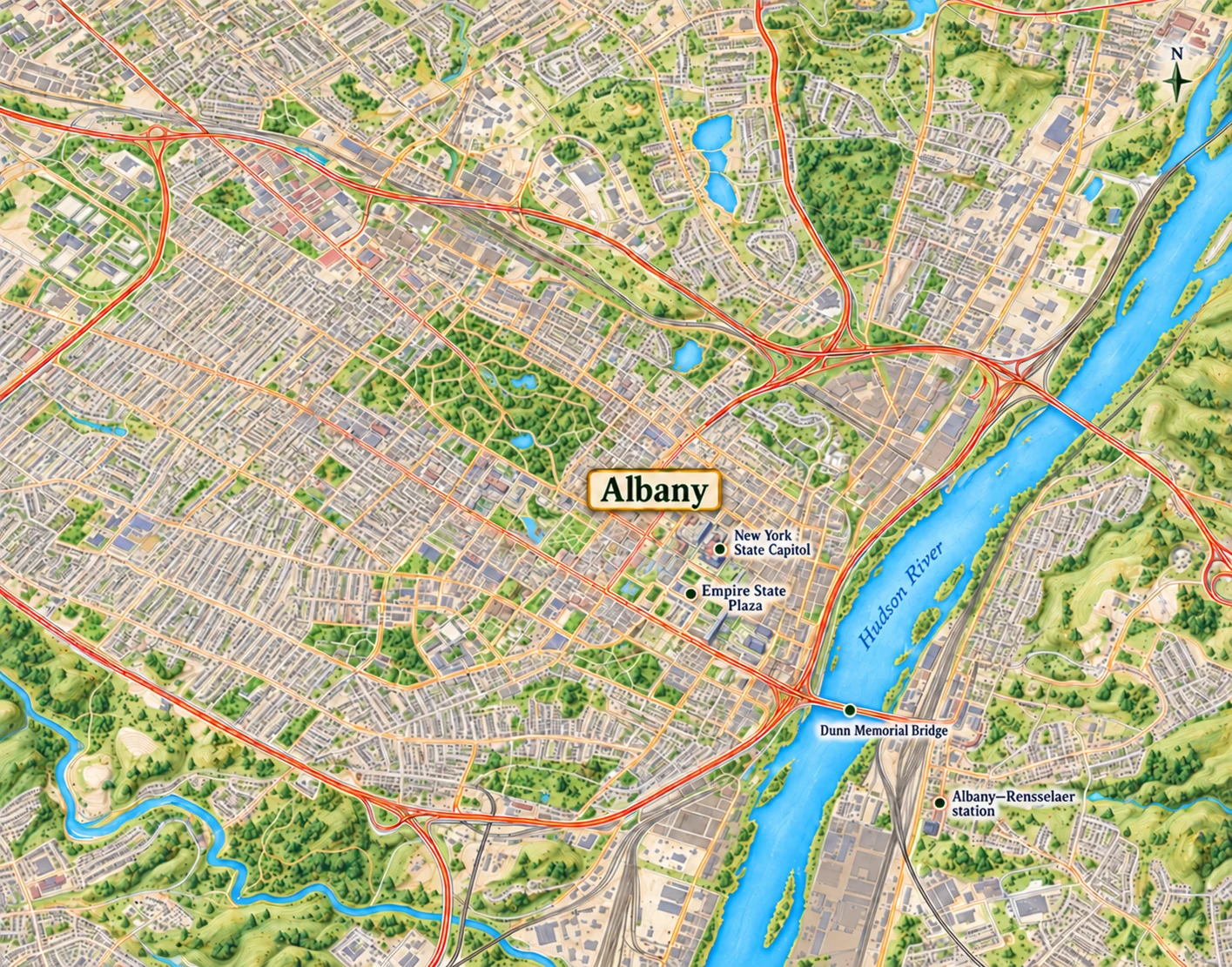
Geographic reference

- A fixed connectionThe workplace, person or commitment that still needs a real journey.
- A daily pleasureThe activity or familiar place you want room to keep enjoying.
- A change worth makingThe improvement that earns the next home its place.
Choose the size of the change your life needs
Distance changes more than the moving day. It changes who can come for dinner, how you get home for an urgent visit, whether a job remains possible and how many familiar parts of life need rebuilding at once. Start with the smallest move that could deliver your goal, then widen the search when a more distant place offers something the smaller change cannot.
A move within the Capital Region may let you change the home, neighborhood and daily route while keeping a workplace or an important relationship. It can still be a substantial change. A late finish in Albany, a child’s activity in another municipality and a home farther north can produce a much harder evening than the map suggests. Choose the route at the time you need it, including the return, and count the walking, parking or transfer at either end.
Another northeastern city offers a different local life while keeping you in a broadly familiar seasonal setting. Rochester, Providence and Portland, Maine, are not interchangeable versions of Albany. Their riverfronts, coast, transport networks and housing markets invite different routines. They also replace an ordinary Capital Region visit with a planned journey. Decide whether the trip home would happen often enough, and comfortably enough, for the connection you want to preserve.
A farther domestic move can be a more deliberate change of work, landscape or scale. Dallas may enter the search because of an actual employer conversation; Cleveland because a whole household budget looks more workable; Los Angeles because a particular creative career matters. These reasons can justify a larger transition. A pleasing skyline or a general promise of lower costs cannot tell you whether that transition improves your own week.
Moving abroad adds another set of decisions: the basis for residence, permission to do the intended work, money in another currency, language and the practical shape of returning to New York. Those decisions need not take the excitement out of the idea. They help distinguish a possible next life from a holiday you enjoyed. A supported overseas appointment and an independent remote-work experiment should lead to different plans even when both households like the same city.
Use a simple sequence: settle the reason, establish the income and residence basis, compare two plausible homes, then test the week around them. If a closer option meets the reason well, keep it beside the farther one. If the farther destination adds an opportunity or setting you truly value, name what you are willing to spend or change to obtain it. You are choosing a useful scale of change, not competing to travel the farthest.
- Another home nearbyTest the region and income arrangement you can keep.
- Another US cityName the opportunity, budget or setting that justifies rebuilding.
- Another countryGive the new chapter a residence, work and household basis.
Three nearby beginnings, with different daily consequences
Troy, Schenectady and Saratoga Springs preserve different kinds of access to the Capital Region. Start by deciding which connection is fixed. A person attending an Albany workplace most days has a different search from someone visiting family twice a month or beginning a new job elsewhere in the region. The same city can be a good option for one of those lives and an awkward one for another.
CDTA’s route information gives you a way to investigate the Troy, Schenectady and Saratoga connections. It does not make every home in those places equally convenient. Check the actual stop, walking approach, hours and return journey against the week you expect. If you drive, do the same comparison with the workplace parking arrangement and the busiest part of your own schedule. A route you can use only when everything goes right is a weak foundation for a household plan.
Give each nearby option its own purpose. Troy can prompt a conversation about a smaller urban home and space for a creative practice. Schenectady can prompt one about a household whose evening activities need a better meeting point. Saratoga Springs can prompt one about choosing a northern home base and using its parks as part of everyday life. These are ways to start comparing, not promises that a particular home, studio or activity place is available.
The historical Census rent estimates also keep the nearby search honest. Albany’s municipal point estimate is $1,216 a month; Troy’s is $1,175 and Schenectady’s $1,145, while Saratoga Springs is $1,470. Those are 2020–2024 survey estimates for occupied rental homes, with margins of error in the table below. Small differences do not establish a saving, and none of the figures prices the apartment you might rent now.
Choose two actual homes in the city that interests you, then draw the complete day around them. Include work, a meal or grocery stop, the activity that gives the move a purpose, and the journey home when you are tired. A nearby move becomes worthwhile when that ordinary sequence improves enough to justify changing homes. If it merely rearranges the same frustration, keep looking or reconsider the kind of home you need.
Three nearby Capital Region city beginnings
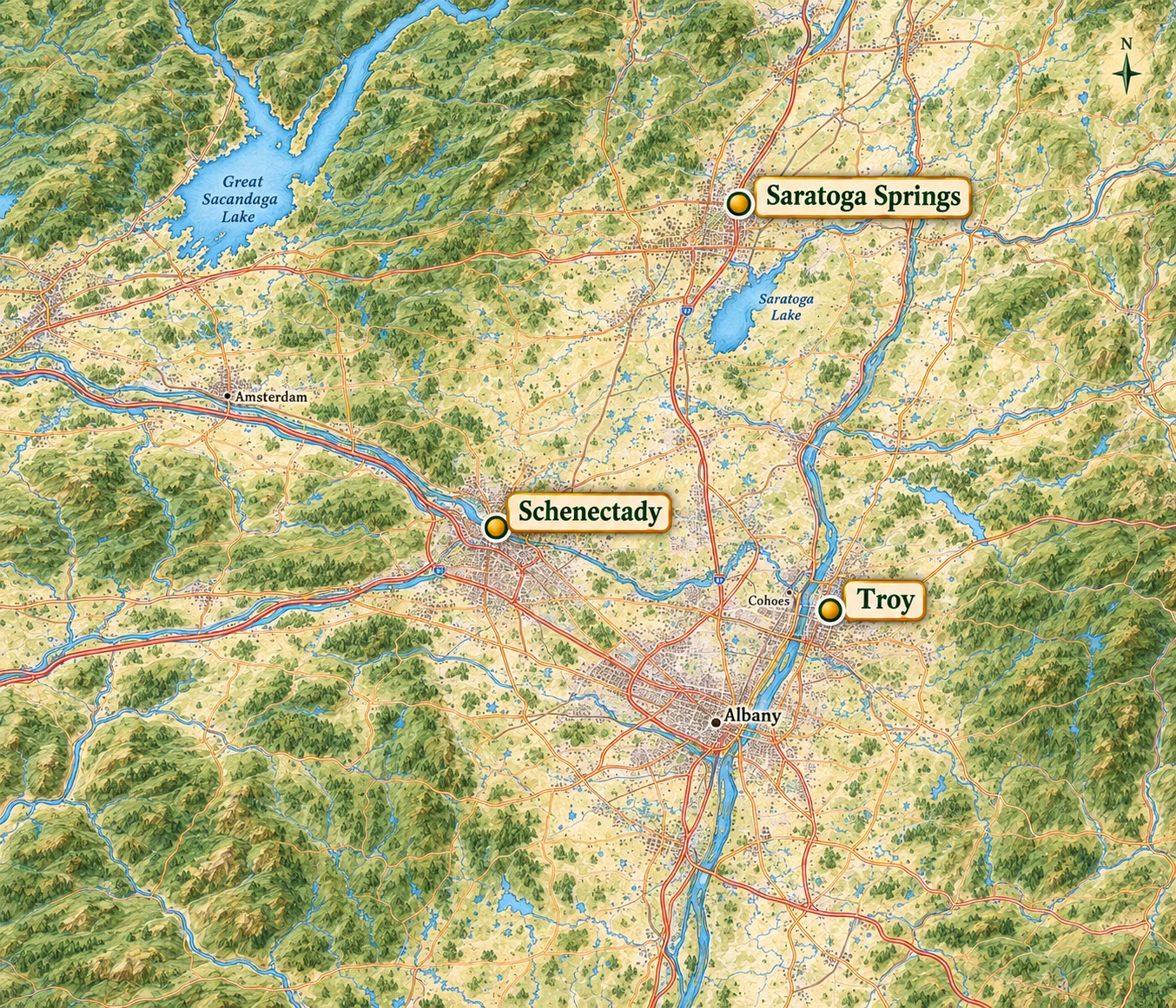
Geographic reference
Troy: let a smaller urban home support a creative practice

Troy is worth a closer look when you want a different city home while keeping Albany work and relationships involved. Imagine the conservator and bookbinder introduced earlier: the useful change might be a modest apartment and a separate place to work, rather than a larger home where the living room is permanently covered in materials. Troy gives that household a concrete nearby alternative to test without beginning by replacing both livelihoods.
Start with the conservator’s actual Albany journey and the bookbinder’s practical requirements: a usable bench, storage, deliveries and somewhere customers could meet by arrangement. Ask about the particular space and its permitted use before budgeting for it. CDTA’s Troy connection and the downtown market information supply two useful starting points for investigating the city, but neither proves that a chosen address supports the complete household routine.
The survey rent point estimate is $1,175 against Albany’s $1,216. That small historical difference should not carry the decision. The stronger reason would be finding a home-and-work arrangement you can obtain now that frees time, protects income or makes the craft practice easier to sustain. Include any second-space rent and travel before calling the move less expensive.
The exchange is a new local circuit and a different home for the effort of changing address while some Albany journeys remain. Try a day that includes the fixed workplace, the proposed studio area, ordinary shopping and the return home. Keep Troy if that whole sequence improves the part of life you wanted to change, not simply because it is close enough to feel easy.
Try first: Put one plausible home and one suitable work space on the same weekday route, then test the Albany return at the hour you need.
Local sources: CDTA: Route 22 between Albany and Troy · Downtown Troy: farmers market · Troy city, New York Census historical gross rent.
Schenectady: bring the household’s evening back together

Schenectady can make sense when the household’s problem is the way its days finish. A parent may be keeping an Albany job while a teenager wants an evening music lesson and the other adult works a different schedule. The goal is a home base from which those events can meet without a chain of last-minute driving or favors. That is a more useful reason to investigate than assuming that another Capital Region address automatically shortens every trip.
CDTA’s Red Line information is a starting point for the Schenectady–Albany connection. Check the stops and full operating pattern for the hours your household uses, then add the walking approach and the trip after the lesson. If one person drives, include the vehicle’s location at the end of the workday. A car parked at an Albany workplace cannot also collect someone elsewhere at the same time.
Schenectady’s $1,145 historical gross-rent point estimate sits only $71 below Albany’s. A modest difference can disappear in a parking charge, extra trip or a home of a different size. Use current properties and both adults’ income to find whether a practical improvement exists. The lesson itself also needs a real place, cost and available time; the illustration is a way to picture the question, not a named studio offering a place.
The exchange is a different local rhythm while some existing commitments remain elsewhere. Test the hardest evening rather than the easiest weekend. If the household can finish that day with enough time and energy left, the nearby move may offer more than a farther city whose opportunities you cannot use.
Try first: Rehearse the work–lesson–home evening from two candidate addresses, including the latest return you would regularly need.
Local sources: CDTA: BusPlus Red Line 905 · Schenectady city, New York Census historical gross rent.
Saratoga Springs: choose a northern base you will actually use

Saratoga Springs belongs in the search when you want to build a northern Capital Region life on its own terms. For an older adult reducing housework and an adult child hoping to see them more often, a smaller home and a park used several times a week may be a meaningful improvement. The question is whether that arrangement also supports shopping, appointments and the relationships that matter outside the pleasant walk.
Choose the home around the ordinary circuit first. the local park and the wider Saratoga park setting can give the week a useful outdoor destination, but the address should also work on a day when you do not feel like driving. If Albany remains a fixed workplace, examine the CDTA connection or your driving pattern in full. A northern base and a daily Albany commitment can produce a very different proposal from a home chosen after retirement or a local job change.
The historical municipal gross-rent estimate is $1,470, above Albany’s $1,216. This is a setting or household choice to budget for, rather than an automatic cost reduction. Compare the particular smaller home’s payment, utilities, maintenance responsibilities and transport. Less space can reduce work without reducing every bill, and that may still be worthwhile if the trade matches the purpose.
The exchange is the home base and outdoor routine you want for potentially higher housing costs and different trips south. Try an ordinary weekday with the person whose independence matters most. A move earns its place when the new routine remains comfortable between family visits and park outings.
Try first: Visit a suitable smaller home, make one everyday errand independently, and test the Albany journey only as often as your real plan requires.
Local sources: CDTA: Route 450 Saratoga Springs–Schenectady · New York State Parks: Saratoga Spa State Park · Saratoga Springs city, New York Census historical gross rent.
Explore a different city through the week it could give you
A wider search is most helpful when it introduces possibilities you would not get by choosing the next familiar city on the map. The following groups offer several kinds of change: another northeastern base, a southern work-and-season pattern, an interior city life, a mountain-region or Alaska setting, and three Pacific choices. The maps show relationships within each group. They are not rankings or commuting diagrams.
Look first for the profile that speaks to your own reason. A two-career household may learn more from Columbus than from a scenic place with no suitable second job. A person with a firm creative-work offer may have a serious reason to compare Los Angeles despite higher housing costs. Someone who wants a northern outdoor routine may prefer to investigate Anchorage’s full year rather than assume that every move should seek a warmer winter.
Each city deserves a specific home search. The most useful unit is usually the home, its route to the real workplace and the few places you expect to use often. A large city can contain a manageable everyday circuit. A smaller city can produce long driving days if your work, groceries and relationships sit far apart. City size alone cannot answer how your household would live there.
Use the Census table as a background check, then move quickly to current homes and usable income. A lower historical rent may sit beside lower earnings or transport that costs more than you expected. A higher-rent city may still make sense if a confirmed opportunity improves the amount left at the end of the month, or if you knowingly choose to spend more for a valued setting. Both decisions are clearer when the trade is visible.
Keep the less convenient day in every profile. What happens after a late shift, when it rains, during the season you like least or when one adult is away? You do not have to eliminate difficulty. You do need to know whether the destination’s advantages remain useful under ordinary pressure. When two places look equally appealing, that question often produces the more revealing visit.
Six US examples across the wider search from Albany
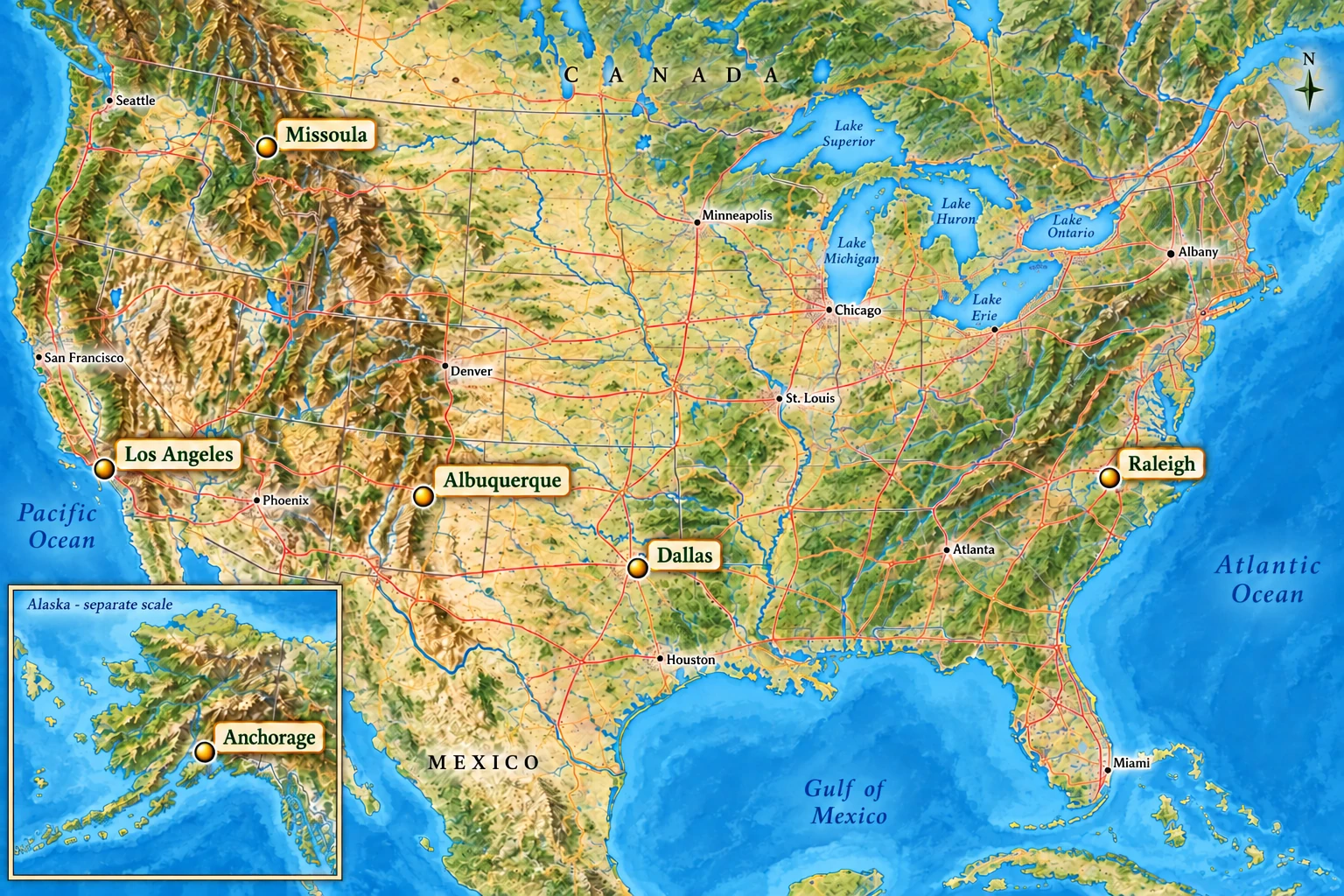
Geographic reference
Another northeastern city
A regional move can give you a new local life while making Capital Region visits planned journeys. Compare the purpose of the change, not just which direction feels familiar.
Rochester, Providence and Portland, Maine from Albany

Geographic reference
Rochester: give a new skill room to become part of the week

Rochester is a useful regional comparison when a household wants a different New York city and enough space in the month for a new skill or reduced working hours. Consider a payroll specialist whose partner is moving from irregular stage work into a more predictable technical role. The move should create a workable first year of training and income, not merely a lower rent on a spreadsheet.
Begin with the course or employer and a second adult’s work. Then connect two homes within budget through RTS information and the journeys you would actually make. The Genesee Riverway gives the outdoor part of the idea a concrete place to investigate. Choose a section you can use after a normal day rather than treating a riverfront image as a promise attached to every address.
Rochester’s $1,081 historical rent estimate is below Albany’s, but its municipal median household income is also lower in the same survey. Those figures describe different populations, not a personal offer. A job kept at dependable pay creates a different budget from a new local role with lower earnings. Put the transition period and training costs into the comparison before deciding what the housing difference buys.
The exchange is another city and a possible new rhythm for rebuilding local connections and planning returns to Albany. Visit around the training or work schedule, try the evening journey and leave time for one activity you would repeat. Keep Rochester when the whole arrangement supports the change of work as well as the change of home.
Try first: Match a real course or role with two attainable homes and one repeatable riverfront or community activity.
Local sources: RTS Rochester: maps and schedules · City of Rochester: Genesee Riverway Trail · Rochester city, New York Census historical gross rent.
Providence: make a two-career city choice

Providence is worth investigating when two adults want a different city life and need to make both careers visible in the decision. An architectural technician and a food-service manager, for example, may value different locations and working hours. A home that makes the first person’s morning easy may leave the second with a difficult return after closing. Start by drawing both journeys before choosing the neighborhood that looked best on a short visit.
The city’s transportation information provides a local framework for that comparison. Use the relevant current operator and the particular addresses to work out the complete route, including walking, transfers or parking. Then add one ordinary pleasure: meeting beside the river, a recurring class or a place to eat after a shift. The benefit of a different city becomes clearer when it fits between the fixed parts of the day.
Providence’s $1,408 historical gross-rent estimate is above Albany’s. A move can still make sense for a confirmed opportunity or a city routine you value, but the case needs current homes and dependable earnings. If only one adult has an offer, allow for the second search rather than balancing the month with an assumed paycheck.
The exchange is a new urban setting and professional chapter for housing that may cost more and a support network that takes time to grow. Test a late finish as carefully as the first commute. A good two-career choice leaves both people enough of a week beyond work, instead of asking one to wait indefinitely for their own move to begin.
Try first: Put both workplaces or realistic job-search areas on the map, then test the less convenient return from a home within budget.
Local sources: City of Providence: transportation · Providence city, Rhode Island Census historical gross rent.
Portland, Maine: make the shore an ordinary pleasure

Portland, Maine, offers a coastal-city comparison for someone who wants water to be present between the rest of life’s commitments. A technical illustrator working an approved schedule might picture a short sketching walk after work, while their partner wants a manageable local home and a community activity. The purpose is an everyday coastal rhythm, rather than a long holiday that happens to include a laptop.
Start with homes you can afford and the place where work happens. Use Greater Portland METRO information for the journeys the network can serve and check the remaining trips separately. The Eastern Promenade can help you picture the kind of shore time you want. Find out how you would reach your chosen access point on a normal day, carrying what you need and with the time you actually have.
The municipal survey rent estimate is $1,577, substantially above Albany’s $1,216. A smaller home or dependable income may make the choice workable, but scenery does not pay the difference. Include utilities, transport and returns to the Capital Region. If the work arrangement depends on being remote, confirm that arrangement and the home’s workspace before letting a view decide the search.
The exchange is a working coastal life for housing costs, a different weather exposure and more deliberate family visits. Try the home area outside the most appealing season if possible. Portland belongs on the shortlist when you will use the shore often enough to value it and still enjoy the rest of the household week.
Try first: Try a workday from a plausible home area, followed by the shore walk and the grocery trip you would repeat in an ordinary month.
Local sources: Greater Portland Metro: routes and trip planning · Portland city, Maine Census historical gross rent.
A different southern work-and-season pattern
Start with a real role or schedule and the outdoor year you want. The household month still needs to work when a lower payment or a warmer visit looks appealing.
Raleigh, Dallas and Baton Rouge in their southern settings
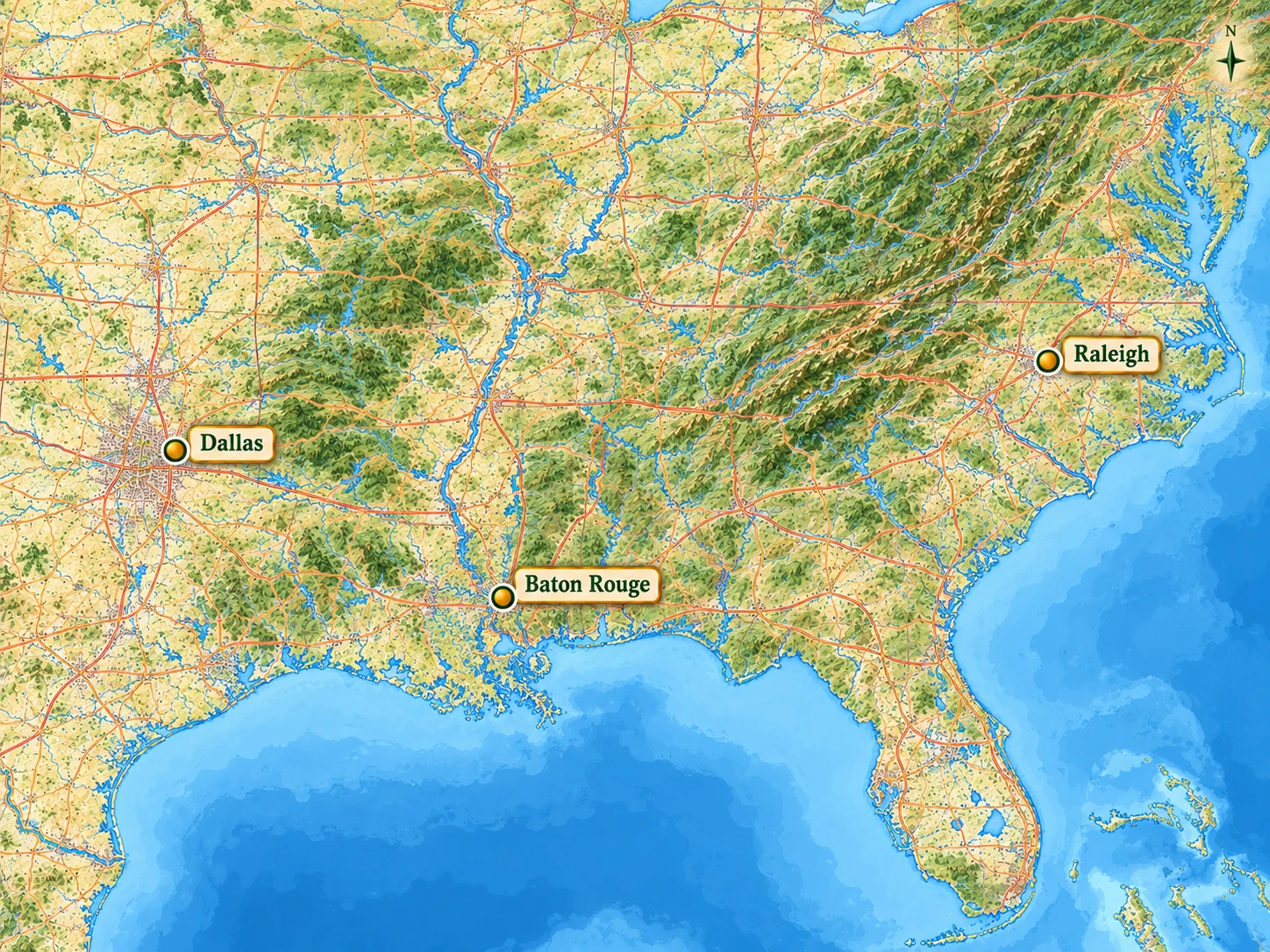
Geographic reference
Raleigh: trade a late finish for a usable outdoor evening

Raleigh can be a useful southern comparison when a household wants a different seasonal pattern and a weekday outdoor activity. Picture an equipment technician considering a confirmed role with more predictable finishing times. A greenway outing after work could become part of the reason to move, provided the home, workplace and trail access leave enough of the evening intact.
Begin with the job’s actual address and attendance pattern, then compare two home areas. Use the local transit information where it serves those journeys and price driving where it remains necessary. A household should not remove a vehicle from its budget because a bus route appears somewhere in the city. The complete work, care and errand pattern has to fit.
Raleigh’s $1,572 historical gross-rent point estimate is above Albany’s. This is not a clear housing-saving example. The move needs a suitable income arrangement or a deliberate willingness to spend for the setting and schedule you want. Include the second adult’s work, cooling and the transition before comparing the monthly result.
The exchange is a different working and outdoor year for summer adaptation and much longer returns to familiar help. Try the activity at the hour the technician would finish, then consider the hottest part of the year and what replaces the outing when conditions are uncomfortable. Keep Raleigh if the new workday gives you a life you can use, rather than just a nicer plan for the weekend.
Try first: Ask for the work location and finishing pattern, then test the home–work–outdoor-activity circuit from two attainable addresses.
Local sources: GoRaleigh: routes and trip planning · Raleigh city, North Carolina Census historical gross rent.
Dallas: let a real opportunity define a smaller daily area

Dallas deserves a look when a particular opportunity gives the move a purpose. A procurement analyst with a firm offer and a partner starting a building-services course may find a large metropolitan area useful, but they need a home that works for two different destinations. The city’s size is a reason to be specific, not a reason to assume every neighborhood offers the same access.
DART’s rail and wider travel information lets you investigate useful corridors. Start with the workplace and course, including the trip at each person’s actual hour. A home near a station can help when the route serves both ends; a long final connection or a late finish can change the answer. Price parking, vehicles and the trips that remain outside that arrangement.
The historical Dallas rent estimate is $1,472 against Albany’s $1,216. A stronger confirmed income may support that difference, but the household needs the amount left after recurring costs. If the partner will study before earning, budget for that first chapter rather than using the salary they hope to earn later. Keep enough time in the schedule to make the course itself feasible.
The exchange is the particular career or training opportunity and a larger urban setting for summer heat, more complex home selection and distant Albany support. Use a park or activity near the proposed daily area to test whether the city also offers a life around the opportunity. A manageable routine inside Dallas matters more than trying to experience the entire metro every week.
Try first: Compare two home areas against the confirmed workplace and course, then price the complete transport pattern before choosing either.
Local sources: DART rail: official network and routes · Dallas city, Texas Census historical gross rent.
Baton Rouge: another capital city, with a different household equation

Baton Rouge offers a different river-and-capital-city setting for an Albany household with a specific professional reason to go south. An environmental analyst considering a real project might value that change, while a partner wants enough predictable time to continue a small creative practice. Treat the project’s location, duration and pay as the foundation. The city’s governmental role does not establish that an Albany job or credential transfers there.
Use the Capital Area Transit System’s current information for the route that could serve the home and work. Test the hours and walking approach, and include driving where the household needs it. The Mississippi riverfront can be a repeatable outing if the home circuit makes it practical; a pleasant evening on the levee is only one part of the working week.
The historical gross-rent estimate is $1,067, below Albany’s. The same survey’s household-income estimate is lower too. That combination invites a full budget comparison rather than a confident saving claim. Ask about the actual offer, household transport and the home’s utility and insurance arrangements before deciding what the lower payment would leave available.
The exchange is the project and a different southern routine for heat, humidity, property-specific questions and a longer journey to New York. Check the candidate home’s relevant official property information and obtain answers about its condition and costs. Try a normal workday from that area, then decide whether the professional opportunity also supports the life the second adult wants.
Try first: Get the project’s workplace, term and pay clear, then compare two homes with their full recurring costs and actual weekday journeys.
Local sources: Capital Area Transit System (CATS) · Baton Rouge city, Louisiana Census historical gross rent.
Three interior cities, three different reasons to look
A second career, time released from housing costs, or a steadier life around project work can lead to different home searches even within this broad horizon.
Three city settings around and beyond the Great Lakes
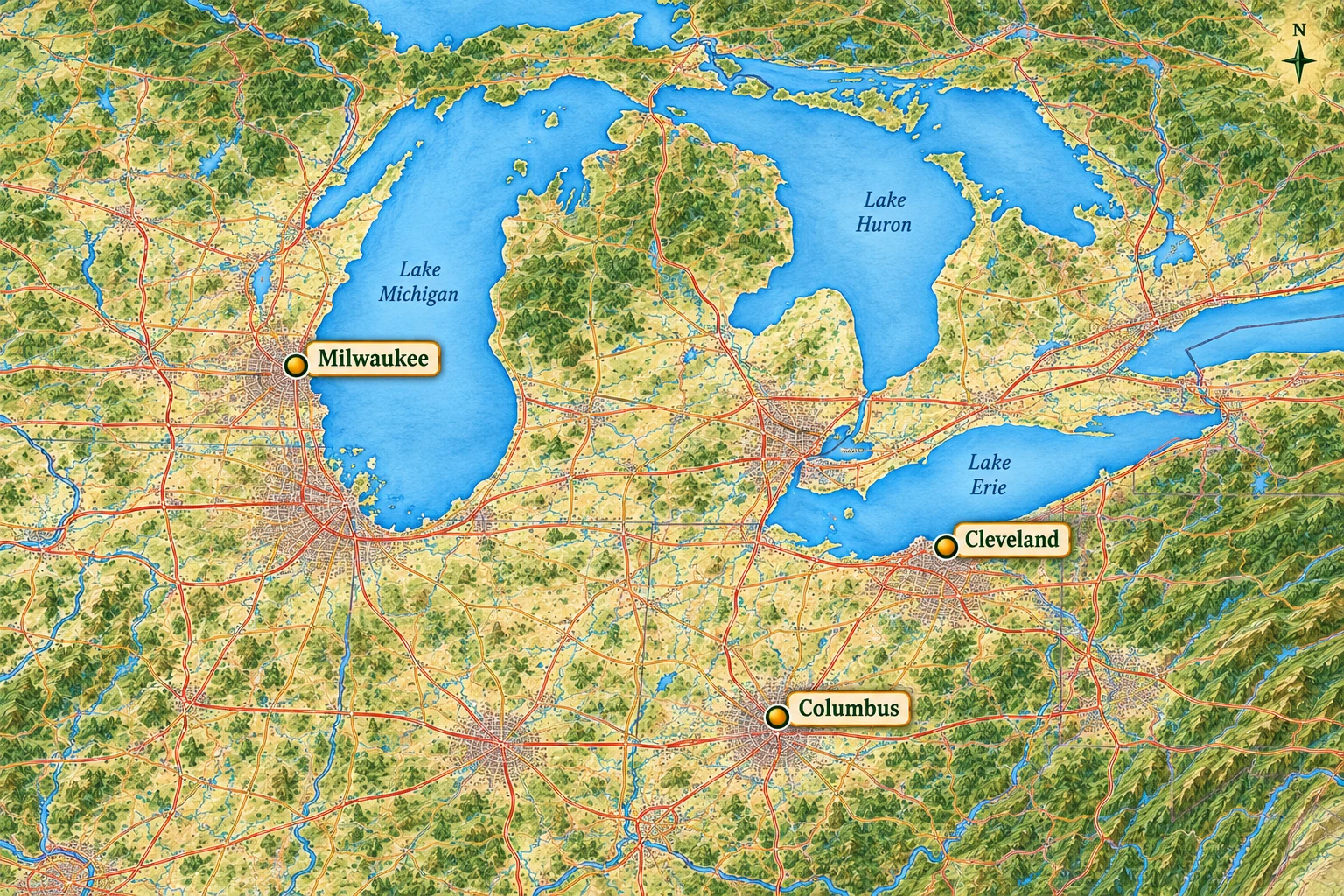
Geographic reference
Columbus: give a second career its own address on the map

Columbus is a useful interior-city option for a household in which two people are beginning different chapters. Imagine an adult-education coordinator considering a position while their partner trains for a practical trade. The move succeeds when the course, job and home form a workable week together, rather than one person accepting a long and uncertain journey to make the other’s offer work.
COTA’s information identifies fixed-route, rapid-transit and other services with their own service areas. Investigate the option relevant to the actual home and destination; the existence of an on-demand service in one zone does not make it available everywhere. For a course with early practical sessions or an employer outside the main daily area, check the full journey and backup arrangement before choosing a home.
The survey rent estimate is $1,295, slightly above Albany’s $1,216. Current properties and the household’s first-year earnings matter more than that modest historical difference. Include course costs, equipment, time without the second income and any extra transport. A good later career may justify an investment, but it should not be counted as money already earned.
The exchange is a possible two-career reset and another river-city life for the work of building connections and maintaining longer family visits. Try the busiest shared day and one ordinary evening beside the Scioto or at a recurring activity. Keep Columbus if both people can see their own next step and the household can fund the period before both plans are established.
Try first: Map the actual job, course and first-year budget together, then test the day when the two schedules overlap least conveniently.
Local sources: COTA Services | COTA, Central Ohio Transit Authority. Let's Go! · Columbus city, Ohio Census historical gross rent.
Cleveland: ask what a lower housing payment could release

Cleveland is worth comparing when the goal is to free money or working time without giving up an urban life. A costume maker and a library assistant might want enough room for materials while reducing the pressure to accept every extra shift. The useful question is whether attainable housing, usable income and transport really create that room in the month.
The municipal historical gross-rent estimate is $945, below Albany’s $1,216. Its household-income estimate is also lower, so the citywide figures do not establish how this couple would fare. Compare actual work or an approved job kept from elsewhere with homes suitable for the household’s needs. Include storage or a workroom if the craft cannot fit safely and comfortably at home.
Greater Cleveland RTA supplies full-system, rapid-transit and corridor maps. Use the relevant route for the actual workday, then add groceries, appointments and the late return. A winter approach from the home is part of that test. A lower payment is more useful when it does not require a second car or so much extra travel that the time you hoped to recover disappears.
The exchange is the possibility of a more manageable month and a Great Lakes city setting for a new work-and-support arrangement and a northern winter. Try a day that includes the activity the freed time is meant to support. If the complete budget leaves less money than Albany, or the schedule remains just as crowded, the appealing rent figure has not yet delivered your reason to move.
Try first: Price two suitable homes against dependable earnings and complete transport, then state exactly which expense or working hours the move would release.
Local sources: System Maps | RideRTA · Cleveland city, Ohio Census historical gross rent.
Milwaukee: make room for a regular life outside project work

Milwaukee can be a useful comparison for someone whose work comes in projects but who wants a steadier life around it. A live-event audio technician may enjoy the work while wanting a home area that supports groceries, a recurring class and an ordinary riverfront evening without a long drive between every task. A partner’s own work and social life belong in that same small daily area.
MCTS publishes route listings and current alerts, including the Wisconsin Avenue CONNECT 1 corridor. Start with the actual venue, employer or training site, because irregular finishing times can change which journeys work. A useful daytime route does not settle the return after an event. Include the vehicle or paid ride that remains necessary and the less busy month when bookings fall.
Milwaukee’s $1,059 historical rent estimate is below Albany’s. That makes a current home search worth doing, but a person paid by the project should compare dependable average earnings and a weaker month as well. Include equipment storage, insurance where needed, winter transport and trips to family. The lower payment matters when the household keeps a workable reserve and time to enjoy the new city.
The exchange is a possible cost-and-routine improvement in a river-and-lake city for rebuilding a professional circle and living through another northern year. During a visit, try the home area between work engagements, when you would actually have time to become a regular somewhere. Keep Milwaukee if it gives the less scheduled parts of life a useful place as well as supporting the work.
Try first: Build the budget from a dependable and a quieter work month, then test the latest regular return from the venues or employer you would use.
Local sources: Routes & Schedules · Milwaukee city, Wisconsin Census historical gross rent.
High desert, mountain valley and a northern year
These are distinct geographic changes. Albuquerque and Missoula share the main western atlas; Anchorage appears in its own clearly separated Alaska inset at another scale.
High desert, a mountain valley and an Alaska inset
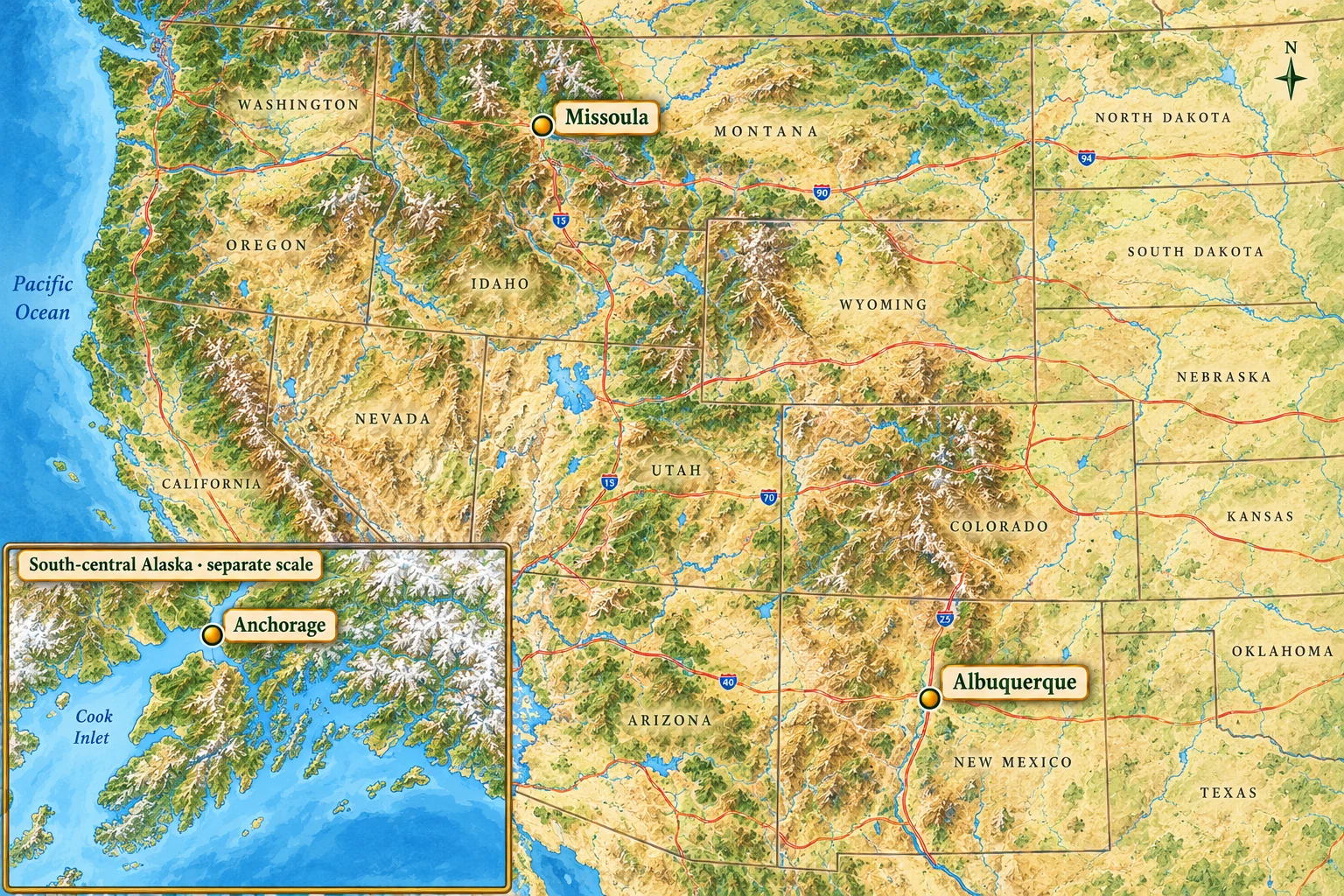
Geographic reference
Albuquerque: choose another light without losing the daily structure

Albuquerque offers a deliberate change of landscape for an Albany household that wants a high-desert city and a different outdoor rhythm. An instrument repairer with a workable customer or employment plan might value the light and setting, while an older relative wants a smaller home and independent errands. The setting can be a strong reason to move, provided the work and everyday access stand up beside it.
ABQ RIDE publishes its fixed routes, schedules, detours and planned changes. Use the network for the particular home–work or appointment journey and check the dates relevant to your move. An attractive Old Town walk does not describe every residential area. Compare the household’s destinations, including the trips that still need a vehicle and the part of the day when outdoor travel is comfortable for you.
The historical rental estimate is $1,145, only $71 below Albany’s. That small point-estimate difference cannot fund a major transition by itself. Look at current suitable homes, dependable income, utilities and travel back east. A person bringing a craft practice also needs the space, local operating requirements and time to establish customers in the new location.
The exchange is the high-desert setting for a more distant support network and a year that needs its own comfort and home-condition checks. Try the ordinary errand with the older household member and the work setup with the repairer. Albuquerque belongs on the list when the landscape adds something you will use and the practical arrangement remains clear enough to enjoy it.
Try first: Test two home areas against work space and an independent errand, with the actual travel and home-comfort arrangements included.
Local sources: Routes & Schedules — City of Albuquerque · Albuquerque city, New Mexico Census historical gross rent.
Missoula: make a valley life fit a household with two callings

Missoula is an option for someone who wants a Montana valley routine and has a credible way to fund it. Imagine a music instructor hoping to combine teaching with more time outdoors while their partner needs dependable administrative work. A river walk after lessons can be part of the appeal, but the partner’s opportunity should be as concrete as the instructor’s wish for a different setting.
Use Mountain Line’s maps and schedules to connect candidate homes with teaching, work and the places you would use often. An in-town arrangement and a home farther into the valley create different transport commitments. If instruments, several teaching sites or evening hours require driving, keep those costs in the model. Do not assume that every outdoor activity begins at the door.
The historical rental estimate is $1,189, close to Albany’s $1,216. This is not a substantial survey-rent saving to rely on. A current home of the required size may tell a different story again. Put actual income, any period of building a teaching practice, winter travel and returns to New York into the same comparison. A valued landscape can be worth paying for, but the trade should be deliberate.
The exchange is a smaller valley-city circuit and the outdoor life you want for a more limited personal job search, changing outdoor conditions and distant familiar help. Visit during an ordinary working period and test one activity you could repeat. If the work plan leaves no time or money to enjoy the setting, the most important part of the move is still unresolved.
Try first: Verify both income paths and an attainable home, then try the actual after-work river or trail outing with the time the household would have.
Local sources: Mountain Line: Missoula route maps · Missoula city, Montana Census historical gross rent.
Anchorage: choose the northern year for a reason that lasts

Anchorage calls for a purposeful northern move, perhaps a confirmed technical appointment or a long-held wish to make an Alaska outdoor routine part of life. For an Albany household, this is more than choosing another winter city. It changes seasonal light, the journey to family and the practical scale of moving and receiving belongings. The opportunity or setting should matter enough to justify those changes.
Start with the employer, term, hours and any relocation support that is actually offered. Investigate the second adult’s work separately. People Mover provides a way to examine the urban transit journey, including service hours and the home’s approach. Activities beyond that network require their own transport plan. A coastal-trail image helps picture one pleasure, but it cannot stand in for the household’s winter routine.
The $1,489 historical rental estimate covers Anchorage municipality, an unusually broad geography, rather than just a neighborhood you might choose. It is above Albany’s point estimate. Price a suitable current home, utilities, food, vehicles and the journeys east. Keep an emergency family visit in the financial and leave discussion as well as the holiday trip you can plan months ahead.
The exchange is the specific northern chapter for greater distance and a demanding transition. Test the darker-season workday as well as the long light of a pleasant visit. Ask a carrier suited to the actual Alaska route about timing, receiving access and what is practical to take. Keep Anchorage when the whole household wants the year it would live there, not only the first extraordinary week.
Try first: Settle the appointment and first-year household plan, then test the winter journey and obtain an actual route-specific shipment and return-travel plan.
Local sources: Municipality of Anchorage: People Mover · Anchorage municipality, Alaska Census historical gross rent.
Choose a smaller daily life inside a Pacific city
A large city can be useful when the home, opportunity and everyday activities form a manageable circuit. Decide what the setting or career chapter is worth to your household.
Three Pacific city beginnings from north to south
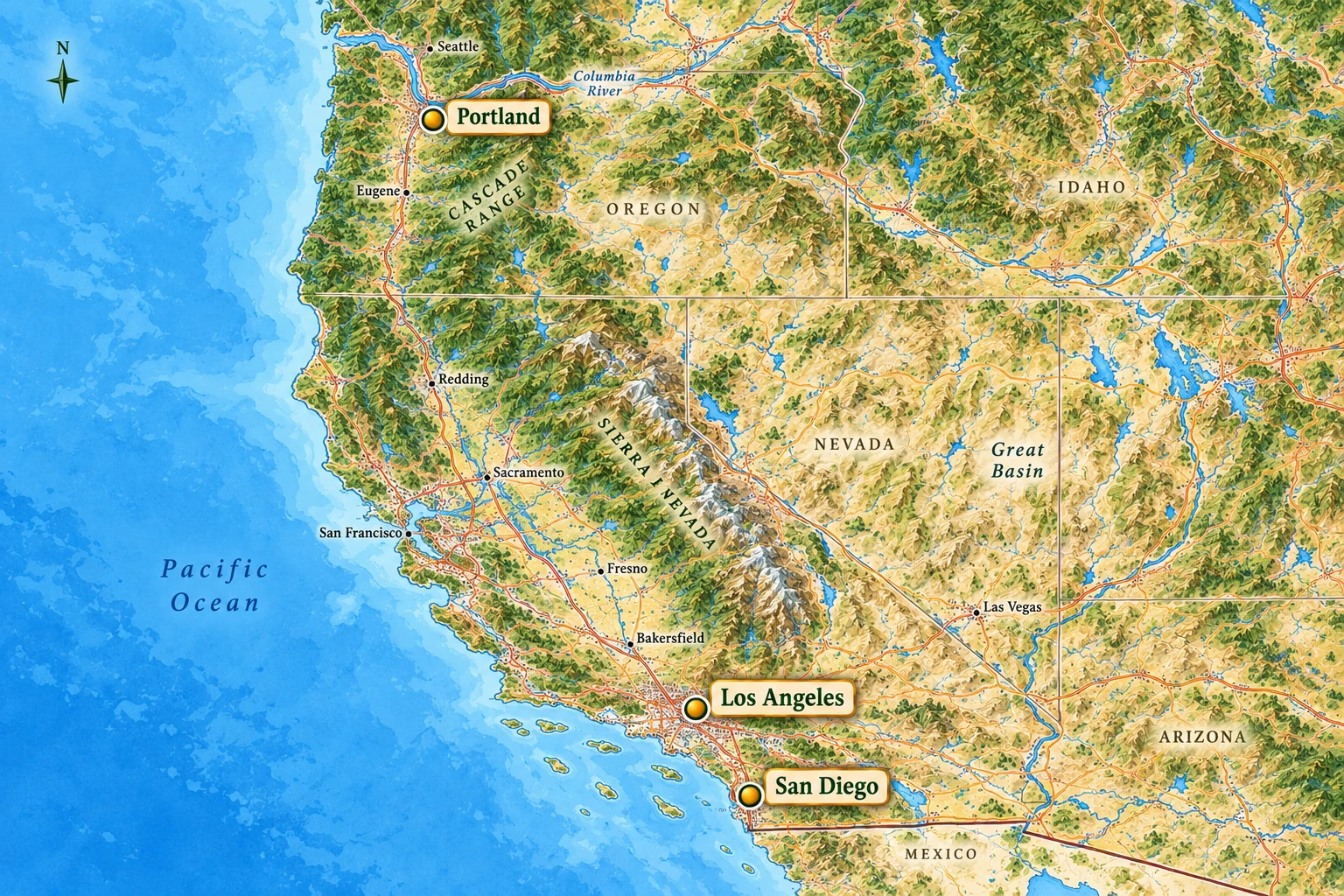
Geographic reference
Los Angeles: build a manageable life around a specific creative opportunity

Los Angeles can be a strong choice when a real creative or professional opportunity gives the move a purpose. For the sound editor and adult-education coordinator, the editing work might open a chapter that Albany cannot offer in the same form. The decision still needs a home and a second career that make the household’s life sustainable when the excitement of the first project becomes an ordinary deadline.
Treat Los Angeles as several possible daily areas. Start with the actual workplace or studio pattern, then compare homes against the coordinator’s realistic work locations too. Metro publishes bus, rail and busway schedules; use them for the journeys that fit and price the rest. A place that works well for one assignment may become awkward if the next regular work location changes, so ask how stable the attendance pattern is.
The historical city gross-rent estimate is $1,933, well above Albany’s $1,216. Use actual suitable homes and dependable project income rather than assuming a larger professional market produces a larger household surplus. Include the second search, vehicles or other travel, equipment and a reserve for gaps. A smaller home may be a fair trade if it preserves the time and financial room to take the opportunity.
The exchange is the particular career chapter and a large Pacific city for higher housing costs, complex journeys and long returns to family. Try the unglamorous workday from the home you could afford, followed by one local activity such as a lake walk. Keep Los Angeles when that smaller daily life is appealing in its own right, not only when a project is going perfectly.
Try first: Get the expected work locations and income pattern, then test two home areas against both adults’ lives and a quieter project month.
Local sources: Line Schedules and Maps - LA Metro · Los Angeles city, California Census historical gross rent.
San Diego: decide what a coastal week is worth to you

San Diego is worth considering when the coastal setting or a specific opportunity matters enough to carry a substantial housing budget. An older couple simplifying their home may want more frequent walks near water and less outdoor maintenance. Another household may be following a confirmed professional appointment. Those reasons can both be valid, but they should lead to different income and home comparisons.
MTS Trolley information gives you a concrete network to investigate around downtown, East County, UC San Diego, South Bay and other served destinations. Match the actual home with the places you need; the network does not put every coastal home beside a useful station. Add the approach, errands and return, and retain a vehicle in the budget if the full routine still needs one.
The $2,313 historical gross-rent estimate is the highest of these selected municipalities, against Albany’s $1,216. It is a survey background, not a current quote, but it makes the cost question hard to ignore. A smaller home, dependable retirement income or a suitable offer may support the choice. Include the particular home’s full costs and travel to New York before deciding what you can comfortably spend for the setting.
The exchange is the coastal routine you value for a larger housing commitment and a faraway support network. Try the ordinary outing from an attainable home, including the day you would prefer not to drive. Keep San Diego if the recurring pleasure is worth the real household trade, rather than assuming a pleasant climate makes the rest of the plan take care of itself.
Try first: Compare two homes you could sustain comfortably, then make the actual bay, work and grocery journeys with your likely transport.
Local sources: Trolley | San Diego Metropolitan Transit System · San Diego city, California Census historical gross rent.
Portland, Oregon: make a river-city routine useful in the rain too

Portland, Oregon, offers another Pacific-side urban life for someone who wants a repeatable neighborhood routine and a different setting along the Willamette. A book designer with an approved work arrangement might value reaching ordinary errands and a creative activity without planning every trip around the car. The reason to investigate is that complete local circuit, not a general label saying the city is walkable.
TriMet publishes bus, MAX and WES maps and schedules, with separate service patterns and connections. Start with the home, work or shared workspace and the activity you would attend regularly. Check the walking approach and evening return in wet weather. A useful line can make one arrangement appealing while leaving another address much less convenient. Keep regional journeys separate from the small everyday area you hope to build.
The historical gross-rent estimate is $1,655, above Albany’s. A home chosen for useful access may still need a higher payment, and the right question is what remains after the complete month. Confirm the remote arrangement if it funds the move, price the actual internet and work space, and include trips east. Removing a car is a result to demonstrate, not a saving to enter before trying the routine.
The exchange is the particular river-city and neighborhood life for a different seasonal pattern, housing costs and distant family connections. Try the activity after an ordinary working day, then the same circuit on a wet one. Portland belongs on the shortlist if the week remains attractive when the best weather and the first-visit enthusiasm are gone.
Try first: Choose a realistic home–work–errand–activity circuit and test it with the transport, weather and working hours you would actually have.
Local sources: Maps and Schedules · Portland city, Oregon Census historical gross rent.
Compare the money left, including the cost of changing course
A lower housing payment helps only if the whole month improves enough for your purpose. Start with dependable take-home income, then subtract housing and utilities, transport, food, care, insurance, debt payments and the other expenses that recur in your household. Keep the same categories for Albany and every destination. Put uncertain amounts beside the model as open questions rather than quietly using the number you hope to find.
The four examples below use chosen figures to demonstrate the arithmetic. They are not prices for Albany or any destination. The first household keeps $900 after recurring essentials. A lower housing payment combined with reduced earnings leaves only $650. A move with a confirmed income arrangement and manageable transport leaves $1,250. A fourth option looks attractive until a second vehicle and care costs leave $200. The important comparison is the result, together with the life each result buys.
Consider a stage technician and a payroll specialist who want the technician to work fewer late evenings. A $350 reduction in income may be an acceptable part of the move if the full budget and the new schedule still work. Treating every income drop as failure would miss their purpose. Treating cheaper rent as proof of success would miss the bills. Their decision needs both the amount left and the evenings recovered.
Set aside the transition money before calling a move affordable. Moving, travel, temporary accommodation, overlapping housing, setup costs and time between paychecks can consume savings even when the later month is better. In the stronger example, $1,250 left rather than $900 is a $350 monthly improvement. A chosen $4,200 in unrecoverable transition costs takes twelve such months to recover arithmetically. A refundable deposit still needs cash up front, even though it is different from a final expense.
Run a weaker month as well. Delay one paycheck, reduce freelance bookings or add a realistic repair allowance. You are looking for a plan that remains manageable if the first few months are uneven. Decide what reserve should remain untouched for your household and what would make you pause the move. This gives you an answer before a lease deadline or a promising offer adds pressure.
The historical comparison underneath the model uses the same 2020–2024 ACS release for all nineteen municipalities. Gross rent describes occupied cash-rent homes, including applicable utilities; it is not an asking-rent list. Household income is before tax and can include several earners. Published margins of error matter, particularly when two estimates are close. Use these figures to ask better questions, then replace them with the current home and income arrangement you can actually obtain.
For an overseas option, build the recurring budget in the currency in which the bills are paid. Keep the exchange assumption visible and test a less favorable one. Add return journeys, insurance appropriate to the household and any income or professional costs that change when you cross a border. A move can be worthwhile for reasons beyond saving money; it should still leave you able to explain how you will fund the life you are choosing.

Chosen monthly US-dollar inputs · examples only, not city prices
| Monthly result | Present arrangement | Lower rent, lower earnings | Work and routes line up | Extra vehicle and care |
|---|---|---|---|---|
| Money left each month | $900 | $650 | $1,250 | $200 |
| Take-home income | $6,200 | $5,500 | $6,500 | $6,100 |
| Recurring essentials | $5,300 | $4,850 | $5,250 | $5,900 |
Present arrangement
$900Money left each month
- Take-home income
- $6,200
- Recurring essentials
- $5,300
Lower rent, lower earnings
$650Money left each month
- Take-home income
- $5,500
- Recurring essentials
- $4,850
Work and routes line up
$1,250Money left each month
- Take-home income
- $6,500
- Recurring essentials
- $5,250
Extra vehicle and care
$200Money left each month
- Take-home income
- $6,100
- Recurring essentials
- $5,900
The cheaper housing example leaves $650, less than the present $900, because reduced income and other costs outweigh the lower payment. The stronger arrangement leaves $1,250. The fourth leaves $200 once transport and care are included.
See the hypothetical inputs
| Recurring expense | Present arrangement | Lower rent, lower earnings | Work and routes line up | Extra vehicle and care |
|---|---|---|---|---|
| Housing and utilities | $2,100 | $1,700 | $1,850 | $1,800 |
| Transport | $650 | $950 | $600 | $1,350 |
| Food and household basics | $900 | $900 | $900 | $900 |
| Care and insurance | $850 | $650 | $1,000 | $1,100 |
| Debt and other recurring essentials | $800 | $650 | $900 | $750 |
Present arrangement
- Housing and utilities
- $2,100
- Transport
- $650
- Food and household basics
- $900
- Care and insurance
- $850
- Debt and other recurring essentials
- $800
Lower rent, lower earnings
- Housing and utilities
- $1,700
- Transport
- $950
- Food and household basics
- $900
- Care and insurance
- $650
- Debt and other recurring essentials
- $650
Work and routes line up
- Housing and utilities
- $1,850
- Transport
- $600
- Food and household basics
- $900
- Care and insurance
- $1,000
- Debt and other recurring essentials
- $900
Extra vehicle and care
- Housing and utilities
- $1,800
- Transport
- $1,350
- Food and household basics
- $900
- Care and insurance
- $1,100
- Debt and other recurring essentials
- $750
These are invented household inputs selected to show the comparison. They describe no quoted home, city wage, insurance price or care offer. Replace them with your own verified amounts and keep uncertain income separate.
In this example, $1,250 minus $900 is a $350 monthly improvement. A chosen $4,200 of unrecoverable transition spending takes twelve such months to recover. Refundable deposits still tie up cash; keep those and your emergency reserve separate.
- Final transition spendingMoney spent on the change that will not come back.
- Cash tied upDeposits or overlap that need funding even when later recoverable.
- Reserve left availableMoney still there for an uneven first month or a real household need.
Hypothetical example · $350 more left each month · $4,200 to recover
This arithmetic assumes the monthly improvement continues. A weaker month extends the recovery period; deposits and the emergency reserve are separate.
Six household stories: what would change in your month?
These additional examples show why the same destination can work differently for different households. All figures are chosen arithmetic inputs, not Albany prices, destination quotes or promised earnings. Each example has its own assumed transition spending.
Hypothetical household comparison · USD per month
A lower home payment is outweighed by transport and the rest of the working month. Include a separate workroom if the practice needs one.
See this example’s inputs
Chosen take-home income: $3,900 present; $3,900 possible. Recurring essentials: $3,200 present; $3,320 possible.
| Expense | Present month | Possible month |
|---|---|---|
| Housing and utilities | $1,500 | $1,350 |
| Transport | $350 | $520 |
| Food and basics | $550 | $550 |
| Care and insurance | $350 | $350 |
| Other essentials and family visits | $450 | $550 |
This example produces no monthly improvement to recover the transition spending. The household would need a different reason and a funded way to carry the cost.
Hypothetical household comparison · USD per month
A confirmed higher take-home amount improves the month despite higher housing. Tuition, program charges and any debt payments must be added if they apply.
See this example’s inputs
Chosen take-home income: $2,700 present; $3,100 possible. Recurring essentials: $2,300 present; $2,480 possible.
| Expense | Present month | Possible month |
|---|---|---|
| Housing and utilities | $1,050 | $1,220 |
| Transport | $200 | $140 |
| Food and basics | $450 | $450 |
| Care and insurance | $180 | $220 |
| Other essentials and family visits | $420 | $450 |
At this chosen $220 monthly improvement, the $4,000 transition takes 19 months to recover arithmetically.
Hypothetical household comparison · USD per month
Cheaper housing comes with reduced income and higher care costs. Replace these chosen inputs with the actual care place, hours and price.
See this example’s inputs
Chosen take-home income: $7,800 present; $7,600 possible. Recurring essentials: $6,900 present; $7,100 possible.
| Expense | Present month | Possible month |
|---|---|---|
| Housing and utilities | $2,500 | $2,200 |
| Transport | $700 | $850 |
| Food and basics | $1,050 | $1,050 |
| Care and insurance | $1,900 | $2,200 |
| Other essentials and family visits | $750 | $800 |
This example produces no monthly improvement to recover the transition spending. The household would need a different reason and a funded way to carry the cost.
Hypothetical household comparison · USD per month
A confirmed pay increase can cover higher housing and after-school arrangements, but the household still needs the complete pickup and return plan.
See this example’s inputs
Chosen take-home income: $7,400 present; $7,900 possible. Recurring essentials: $5,600 present; $5,900 possible.
| Expense | Present month | Possible month |
|---|---|---|
| Housing and utilities | $2,250 | $2,400 |
| Transport | $650 | $600 |
| Food and basics | $1,000 | $1,000 |
| Care and insurance | $750 | $850 |
| Other essentials and family visits | $950 | $1,050 |
At this chosen $200 monthly improvement, the $10,000 transition takes 50 months to recover arithmetically.
Hypothetical household comparison · USD per month
Reduced paid hours and replacement support absorb the housing saving. The remaining month needs to be acceptable before the household relies on that change.
See this example’s inputs
Chosen take-home income: $9,300 present; $8,500 possible. Recurring essentials: $8,050 present; $8,300 possible.
| Expense | Present month | Possible month |
|---|---|---|
| Housing and utilities | $2,850 | $2,500 |
| Transport | $950 | $1,100 |
| Food and basics | $1,300 | $1,300 |
| Care and insurance | $1,700 | $2,050 |
| Other essentials and family visits | $1,250 | $1,350 |
This example produces no monthly improvement to recover the transition spending. The household would need a different reason and a funded way to carry the cost.
Hypothetical household comparison · USD per month
A smaller-home arrangement improves the month while leaving more for help and family visits. The entrance and independent daily circuit still need to work.
See this example’s inputs
Chosen take-home income: $4,300 present; $4,300 possible. Recurring essentials: $3,900 present; $3,700 possible.
| Expense | Present month | Possible month |
|---|---|---|
| Housing and utilities | $1,700 | $1,450 |
| Transport | $450 | $320 |
| Food and basics | $650 | $650 |
| Care and insurance | $600 | $650 |
| Other essentials and family visits | $500 | $630 |
At this chosen $200 monthly improvement, the $8,000 transition takes 40 months to recover arithmetically.
Compare historical rent and household-income estimates
Exact Census municipalities · 2020–2024 ACS five-year estimates · 2024 US dollars. Gross rent covers occupied cash-rent homes and applicable utilities, not current listings. Income is annual household income before tax, not a salary or take-home amount. The ± figure is the published 90% margin of error. Differences subtract Albany point estimates; they are not a significance test or personal saving. Scroll the table sideways on a narrow screen.
Give both careers a workable next chapter
“We can work there” is the beginning of the employment conversation. The useful version names the employer or clients, the work location, dependable income, hours and the date the arrangement can start. A household can be excited about a new city while discovering that only one adult has a clear place in it. Resolve that gap early enough to choose a different plan, rather than asking the second person to improvise after arrival.
Think of a sound editor and an adult-education coordinator considering Los Angeles. A particular editing assignment may be a good reason to explore the move. The coordinator’s life still needs room: a credible job search, realistic travel between interviews, perhaps a training period, and time to build relationships outside the editor’s network. Compare an established offer with dependable pay, not with a chain of possible projects that all have to arrive on time.
A remote job changes which homes are possible, but the arrangement has to cover the actual destination. Ask the employer to confirm the location, hours, pay and practical requirements in writing. Test the home’s internet service, a place to work and the calls you must take when other people are asleep or using the room. Abroad, the employer’s approval and the destination’s permission to live and do that work are separate questions; one does not answer the other.
Hands-on work creates another kind of search. An instrument repairer needs somewhere suitable to work, safe handling and storage, access to customers and a realistic way to establish a local practice. A bookbinder may need delivery access and a worktable more than a prestigious downtown address. A food-service manager may care most about getting home after closing. Put those requirements into the home and neighborhood search instead of leaving them beneath a broad “creative city” or “good jobs” label.
For a role that needs a local professional credential, ask the actual licensing authority what applies before treating an offer as ready to begin. If a qualification, examination or supervised period is needed, include the time and cost in the household plan. Avoid turning a possible professional path into a first-month paycheck. The same care applies to an overseas teaching, technical or research appointment: the host, the permitted work and the household arrangements need to agree.
A move for study or retraining can be a strong choice when it has a clear sequence. Find out what the program actually requires, which days you attend, how you fund the period and where the other adult’s work fits. A shorter commute or a home with a useful study space can support that change as much as a glamorous city. Compare the first year you will live through, not only the role you hope to hold at the end.
Finally, leave room for the life around work. If the new job earns more but removes the weekly activity that keeps you well, name the trade. If a lower-paid role restores predictable evenings, calculate what that buys and what it costs. You are choosing a place to live with work in it. A job opportunity has done its part when it helps make that whole arrangement possible.


Choose a place where each person can have a life
One person may be ready for a new city while another is ready only for a different home. A child may want to stay near a music teacher; an older parent may be willing to move if they can continue getting out independently. Bring those wishes into the search while there are still choices to make. A shared shortlist works better when each person can see something of their own future in it.
For a household with children, begin with the school day rather than the school’s reputation alone. Establish which school serves a candidate address, how enrollment works, the route there and the arrangements before or after lessons. Then add the activity the child wants to keep. A father finishing work in Albany and a daughter attending an evening lesson need a plan for the gap between those events, not just a home that looks close to both on a regional map.
A teenager may need more independence, not more adult driving. During a visit, try the journey they would make to a class, a friend or a part-time role, at the relevant hour and with the transport they can use. Discuss what would be comfortable for the family and what remains unresolved. A useful city center and an attractive home farther out can be two different proposals for that teenager’s week.
An older household member’s independence also belongs in the main comparison. Look at the continuous path from the home to a place they want to go: entrance, threshold, stairs or elevator, pavement, crossing and destination. Ask how groceries and appointments would work if the usual driver were away. A home with one floor can still be difficult if the front approach is awkward or every errand needs someone else’s car.
A multigenerational move can be made in stages. One adult may travel first for a confirmed appointment while others remain in Albany through a school term or until a suitable home is ready. That approach can reduce some uncertainty, but it creates two households for a time. Price the overlap, agree who carries the extra care and administration, and choose a date to revisit the arrangement. “Temporary” becomes easier to live with when everyone knows what ends it.
For someone moving alone, the household questions do not disappear. They become questions about how much work and expense one person can carry comfortably. A smaller home near everyday needs may be more valuable than a larger place that consumes every free evening. Have a plan for the first quiet weekend, a missed bus and an ordinary minor problem at home. You do not need a complete new support network on arrival, but you can choose a setting where building one is practical.
Pets, equipment and valued activities can also change the answer. Check the particular home’s rules and enough space for the things you will genuinely use. A guitar repair bench, a sewing table or a dog’s daily walk may matter more than an extra bedroom that exists mainly on paper. The aim is not to carry every detail of Albany unchanged. It is to give the people making the move a fair chance to enjoy the new life together.

- The confirmed chapterWhere work or study happens, and when income begins.
- The other person’s weekTheir own work, independence, activity and company.
- The shared homeAn address that lets those lives fit together.
Give yourself reasons to return to the same places
A new city becomes familiar through repetition. The second visit to a workshop is different from the first; after several visits, a face becomes someone you greet. When you compare homes, look for one or two activities you could attend regularly without turning every outing into a project. A place to repair books, practice music, make pottery, walk with other people or help with a neighborhood task gives a week a little structure while friendships take their own time.
Choose the activity you already enjoy enough to repeat. Moving does not have to turn a quiet person into a tireless organizer. If you prefer making something beside other people to meeting a large group, a practical class may be a better beginning than a crowded social event. Ask about the next session, the cost, any waiting list and what a newcomer needs to bring. That gives you a real first action rather than a hopeful note saying “make friends.”
Consider an adult who is starting again after a separation. A home near a recurring pottery session may contribute more to the first months than a dramatic view outside a home that is difficult to leave after work. The same person may still want privacy and evenings alone. Good connections do not require a packed calendar; they require enough accessible opportunities to choose company when you want it.
Existing relationships need a practical place in the plan too. Decide which Albany connections you want to maintain in person and which can work through calls, shared activities online or longer visits. Check where a guest would sleep and whether your leave and travel budget allow the rhythm you imagine. A spare room has value if someone will use it; it has a recurring cost if it remains empty while you struggle to afford the journeys.
Language changes the shape of joining in abroad. Everyday tasks are opportunities to learn, but housing, work and important appointments should not depend on guessing. Look for a manageable way to improve the language before the move and a reliable way to handle the first practical conversations. A host organization or an existing family connection can make a distant destination more workable than a famous city where you have no clear starting point.
During a visit, make time for one repeatable activity rather than filling the trip with landmarks. Notice whether you can get there after the kind of day you expect to have. Imagine going back when the novelty has worn off. You may discover that a place you had ranked below another feels much easier to enter as a resident. That is useful evidence for choosing a home, even when it does not appear in a city ranking.


Make a smaller home support more of your life
A smaller home can release money, time and attention. It can also remove the space that made a valued part of life possible. Start by naming the work you want to give up and the activities you want to keep. Less yard care, fewer unused rooms and a simpler cleaning routine may be welcome; losing a comfortable place to read, host a child or repair an instrument may be a poor exchange.
Measure the things that make the new arrangement work. A sewing machine needs a stable surface and somewhere for fabric. A guest needs a usable sleeping place and access to the bathroom. A person who works from home may need a door that closes for calls. Draw the room with the furniture and the everyday paths included. A promising floor area tells you little about whether the household can use it comfortably.
Storage is a recurring decision rather than a free extension of the home. If you keep belongings elsewhere, include the rent, access, travel and the work of retrieving them. Compare that arrangement with selling, donating or passing on things you are ready to release. Keep the objects that support the life you are choosing. A smaller home is easier to enjoy when you do not spend every visit to a cupboard negotiating with possessions you never use.
Look beyond the interior when comparing a home for the next stage of life. How do you receive a delivery, carry groceries, take out rubbish and reach the places you enjoy? Who handles snow, exterior repairs or shared-building maintenance, and what does that cost? A building with services can remove work from the household; it may also add charges or rules that matter to your budget and activities. Obtain the terms for the particular home before counting the benefit.
Moving closer to a relative can be one reason to choose a smaller home, but discuss what “closer” is intended to mean. It might mean sharing a weekly meal, helping with one fixed task or having someone nearby in an emergency. Those are different commitments. A home that lets the older adult maintain an independent daily circuit can protect the relationship as well as make care easier.
Compare two smaller-home options, including one in Albany if suitable homes exist. Give each the same test: a normal morning, the activity you want to retain, a visitor and the least convenient entrance or household task. Choose the arrangement that removes work you no longer want while leaving space for the things you still care about. That is a more durable improvement than simply owning or renting fewer square feet.


Choose a setting you can enjoy through the whole year
Perhaps you want the water to be part of the week, a drier landscape outside the window, or a northern trail you will use after work. Those wishes can be strong reasons to move. Make the connection specific enough to test. A home beside a useful local path changes daily life differently from a home several complicated journeys from the scenery that first attracted you.
Portland, Maine, invites a coastal conversation; Milwaukee and Cleveland a Great Lakes one; Albuquerque and Missoula different kinds of inland landscape. Anchorage adds a much more substantial seasonal and geographic change. Los Angeles and San Diego give you Pacific possibilities within large urban regions. Start with the activity you want to do, how often you want it and what you would comfortably spend to make it part of the week.
The climate table offers a small historical illustration of seasonal contrast, using NOAA 1991–2020 airport-station monthly means. A monthly mean is an average across days and nights; it does not tell you what every afternoon feels like or what a particular home needs. Treat it as a prompt for a more useful question: when would you be outdoors, how would you get there, and what would replace that activity when conditions do not suit you?
An early walk before heat builds may be a realistic choice for one person and impossible for someone working an early shift. A winter bus journey may be comfortable from a well-kept entrance and difficult from a home reached by an awkward exposed approach. The setting and the home have to agree. Visit in a season you are uncertain about when practical, or at least examine the home’s heating, cooling, shade and access arrangements with someone who can answer for that address.
Water and hills also shape daily travel. A map can show that two places sit on opposite sides of a river, but the useful question is which crossing serves your routine. A distant mountain view does not establish easy access to an outing; a coastal city does not place every home beside a beach. Try the journey with your likely transport and the time available after work, including the return when you are tired.
If a particular home raises questions about flooding, fire exposure or other property conditions, use the relevant official address-level information and ask the people responsible for the home. Regional scenery and an editorial atlas cannot answer for a building. A place can remain appealing after you understand those questions. The purpose is to choose the part of it that fits the life you want, including the weeks that will never appear in a holiday photograph.

NOAA 1991–2020 monthly means · Fahrenheit · bars use a common 0–100°F scale
Monthly means include days and nights. These are airport-station historical averages, not daily highs or forecasts.
| Station | January | July |
|---|---|---|
| Albany airport | 24.4°F | 73.1°F |
| Dallas–Fort Worth airport | 46.3°F | 85.7°F |
| Albuquerque International | 37.4°F | 78.9°F |
| Anchorage International | 16.9°F | 59.6°F |
Airport-station monthly means, not a forecast or property condition. NOAA climate normals.
Four international beginnings, with different reasons to go
An international shortlist can be much wider than a familiar cluster of European destinations. Here it opens in the Baltic, the South Pacific, the Caribbean and southeastern Africa. Riga offers a conversation about living in another language with a city transport network; Papeete about a working island life; St George’s about a specific study or professional chapter; Lilongwe about a purposeful appointment with a household plan around it. French Polynesia is a French overseas collectivity, so these are four international destinations rather than four sovereign countries.
Begin with the reason that would actually take you there. A person with an overseas host, an approved remote arrangement, a family connection or a place on a suitable course has a different starting point from someone who simply likes the scenery. You can enjoy exploring the latter idea, but the first practical step is to find whether there is a lawful and financially workable basis for the life you have in mind.
Keep the work, residence and household questions connected. A visitor’s permission does not by itself settle whether you may work or make a long-term home. One adult’s appointment does not settle the other adult’s work, a child’s education or the household’s care arrangements. Use the official routes linked in each profile for the actual nationality and circumstances involved, and establish the plan before committing to a long lease or an irreversible departure.
The day-to-day test remains familiar: where you live, how you earn, how you reach ordinary needs and how you make connections. Add language, currency and the journey back to Albany. A distant island may offer a life you value deeply while making an urgent return far more involved. A city with trams can still require a home search around the route you would really use. An appointment can be professionally exciting and still leave a partner without enough of a life outside it.
These profiles offer reasons to investigate, not a universal route into each destination. You can keep one alongside a domestic option and an improved Albany plan. Comparing them may show that you want a year of study, a supported assignment or a more lasting change. Each leads to a different set of commitments, and none has to be decided by the beauty of the first picture you see.
Latvia: a Baltic city week in Riga
Closer profile: Riga. Other city horizons: Liepāja · Daugavpils.
Riga and two other Latvian city horizons
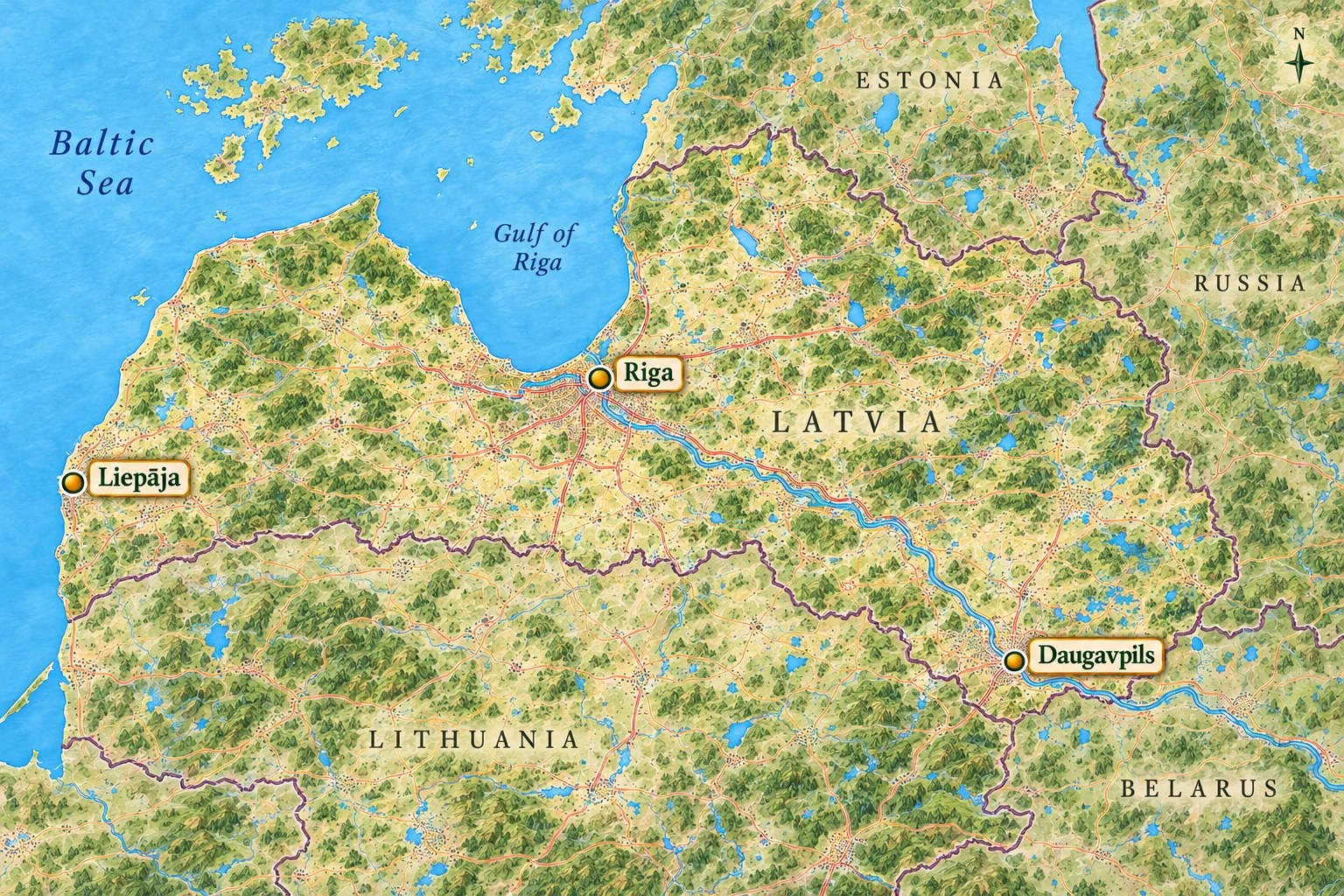
Geographic reference

Riga is worth exploring if you want a different urban daily life and have an income arrangement that can support living abroad. An Albany-based technical illustrator with an approved remote role might want to spend a chapter learning another language, using city transport and building a local routine beyond work. The reason to choose Riga would be that lived experience, rather than the assumption that any European address produces a cheaper or simpler month.
LiveRiga, the city’s investment and tourism agency, identifies trams, trolleybuses and buses and links to the operator’s journey planner. That gives the home search a concrete beginning. Compare two neighborhoods against the hours you will keep, groceries and a recurring activity. A tram in the picture does not establish that every address has a useful route, and winter still belongs in the walking-approach and home-comfort discussion.
Latvia’s migration authority describes a long-stay remote-work route for qualifying OECD-linked employment or self-employment, with specific documentation and income requirements. The remote-work route is distinct from permission to take a local job. Use the current official conditions for your nationality and arrangement, and confirm the employer’s international work terms separately. A local appointment, a course and joining family require the route that actually applies to that purpose.
Build the household month in euros with current housing terms, utilities, transport, workspace, insurance and language learning where needed. Keep any US income’s conversion assumption visible. Work through the required call hours in Riga instead of borrowing the shape of an Albany workday. The evening you hope to spend at a class may become the evening when US colleagues need you; find that out while the schedule can still change.
The exchange is a new language and Baltic urban life for learning another system, maintaining distant relationships and making a work schedule fit across time zones. A partner needs their own basis for residence, permitted activity and a life outside the illustrator’s job. For a child or older adult, settle the practical education or care arrangement before treating the household move as ready.
Use a visit to try an ordinary service conversation, the home-to-activity journey and the actual work hours you expect. Liepāja and Daugavpils are other city horizons shown on the atlas, not substitutes for Riga’s particular network or a recommendation to commute between them. Keep Riga when a lawful, funded arrangement gives you time to participate in the city rather than only look at it between calls.
Try first: Confirm the applicable residence/work route and employer terms, then test one complete Riga workday and a repeatable local activity from a realistic home area.
Local sources: Latvia migration authority: long-stay remote work route · Commuting in Riga | LiveRiga.
French Polynesia: a working island chapter around Papeete
Closer profile: Papeete. Other city horizons: Faaa · Taravao.
Papeete, Faaa and Taravao around Tahiti’s terrain

Geographic reference

Papeete is an international possibility when you want a working island chapter and have a specific reason to build it on Tahiti. Imagine a water-systems specialist considering a genuine supported appointment, or a household with an established family connection there. The appeal could be a week in which the waterfront, language and local relationships become familiar. That is a different proposal from trying to extend a resort holiday indefinitely.
French Polynesia is a French overseas collectivity with its own practical entry, residence and work conditions. Its Economic Development Agency explicitly distinguishes these from metropolitan France and explains that work requires authorization. Establish the route for the actual appointment or activity and each person moving. Do not assume that a mainland French permission, an investment or a visitor’s entry settles a long-term working life on Tahiti.
Start the home search from the workplace and daily services. Papeete, neighboring Faaa and Taravao on the isthmus offer different geographic beginnings; the atlas shows those relationships without turning them into commuting promises. A home that looks close across mountainous terrain may be reached by a much longer coastal journey. If another island becomes part of the plan, treat that connection as its own journey rather than an extension of the neighborhood trip.
The Jardins de Paofai give the waterfront idea a concrete public place to investigate. Try reaching the park from a home you could take, after the kind of working day you expect. Then make an ordinary errand and return with groceries. You are looking for an island week that works between the outings, with the time and transport to use the setting that drew you there.
Budget in CFP francs for the actual home, utilities, food, transport, communications and the household’s care arrangements. Ask the host what support is included in writing, what the household pays and what happens when the appointment ends. Include journeys back to Albany and the time they require. A distant island can be an excellent personal choice while making a spontaneous family visit much harder to arrange.
The exchange is a deeply different setting and a purposeful local chapter for distance, language learning and a more involved household transition. A partner needs more than a place to accompany the specialist: discuss their permitted activity, opportunities for company and the ordinary week they want. Keep Papeete when those plans agree and the appointment or other residence basis supports the life around it, not simply the first beautiful view.
Try first: Settle the household’s residence and work basis, obtain the actual host terms, then compare two home areas through the work–errand–waterfront routine.
Local sources: ADE | Foreign investors · Les Jardins de Paofai – SPJP.
Grenada: a defined study or professional chapter near St George’s
Closer profile: St George’s. Other city horizons: Grenville · Gouyave.
Three town horizons on Grenada’s main island
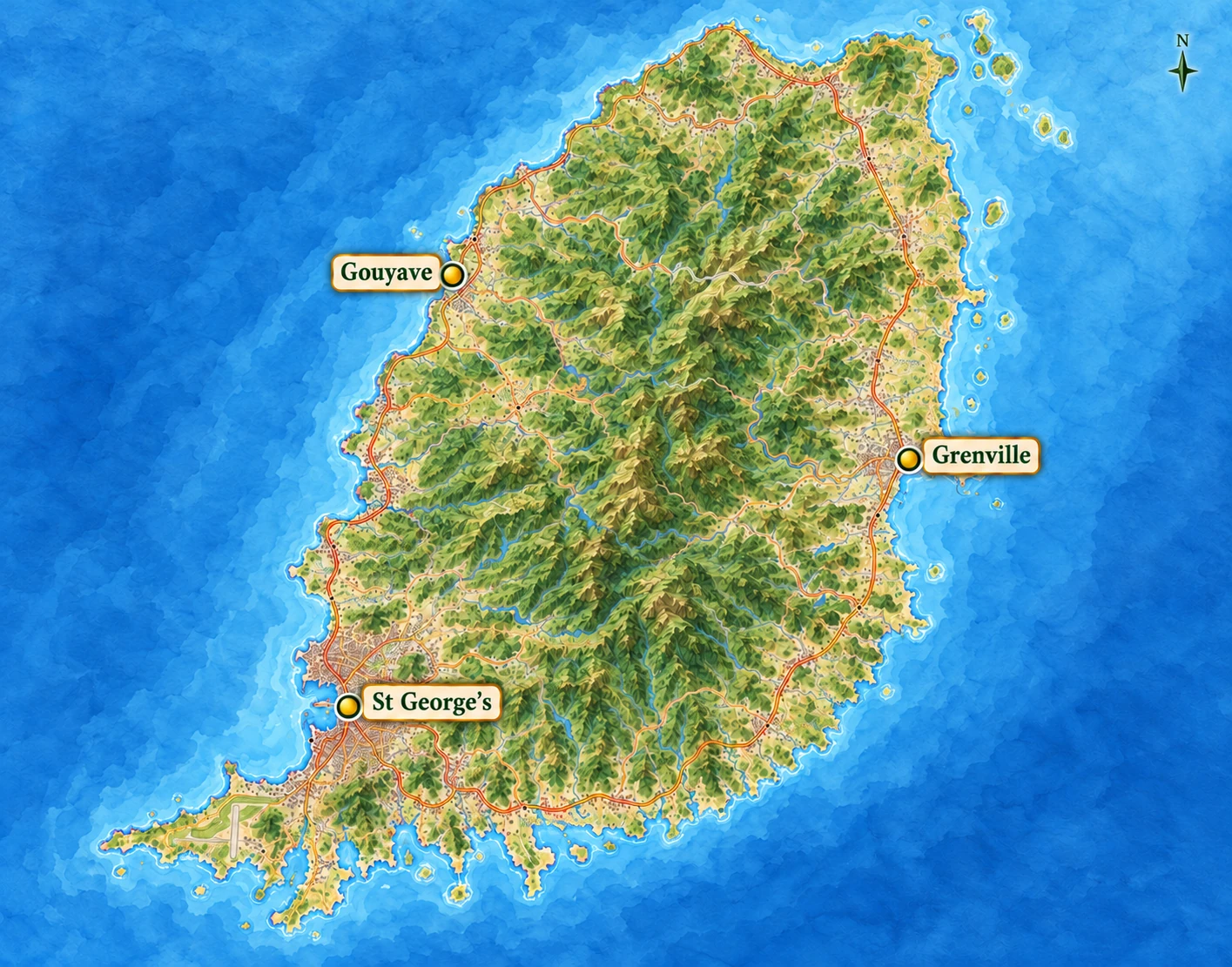
Geographic reference

St George’s and the surrounding part of Grenada can be a meaningful option when a particular course or appointment gives the move a shape. An Albany household considering an actual academic teaching appointment, for example, would be choosing a professional chapter and a Caribbean daily life together. A student is making a different financial and housing decision from a paid employee. The island setting should add something you value without concealing that distinction.
St George’s University publishes practical arrival and housing resources for its accepted students. Use the current rules for the particular program if study is your reason to go; do not transfer student housing assumptions to a faculty appointment or an unrelated job. For an employee, ask the actual employer about the role, term, pay, work location and any support. This profile does not report a vacancy, admission offer or professional outcome.
Grenada’s Department of Labour describes the work-permit process for foreign-national employees and the employer’s responsibilities. Establish the applicable permission before counting local earnings. A partner who wants to work needs their own answer as part of the household plan. If a profession requires local registration, that is an additional question for the responsible authority, rather than something a general relocation profile can settle.
St George’s sits around a harbor and hills; Grenville and Gouyave are other town horizons on different sides of the island. Choose the home from the location you need each day and try the full journey with the transport you would use. A coastal distance on the atlas is not a travel time. Include groceries, a recurring activity and the way home after a late session, not only the journey shown on an organized campus visit.
Build the recurring budget in Eastern Caribbean dollars and obtain the actual terms for the home and program or job. Keep tuition and program charges separate from ordinary household expenses when they apply. Add utilities, transport, insurance appropriate to your circumstances, the gap before earnings begin and return visits to Albany. A study year needs a funded plan even if it eventually supports a valuable next career.
The exchange is a defined island-based chapter for a new household system, a limited appointment or study timetable and longer returns to familiar support. Make sure the accompanying adult has a life beyond the campus or employer. Keep this option when the accepted course or confirmed role, the home and the household’s wider week all fit the chapter you intend to live.
Try first: Get the actual course or appointment terms and applicable permissions, then test the home–campus or workplace–grocery journey and a separate activity for the accompanying adult.
Local sources: Work Permits – Department of Labour – Grenada · Welcome to SGU | Resources for Accepted Students.
Malawi: a purposeful appointment with a household life in Lilongwe
Closer profile: Lilongwe. Other city horizons: Blantyre · Mzuzu.
Lilongwe and two other Malawian city horizons
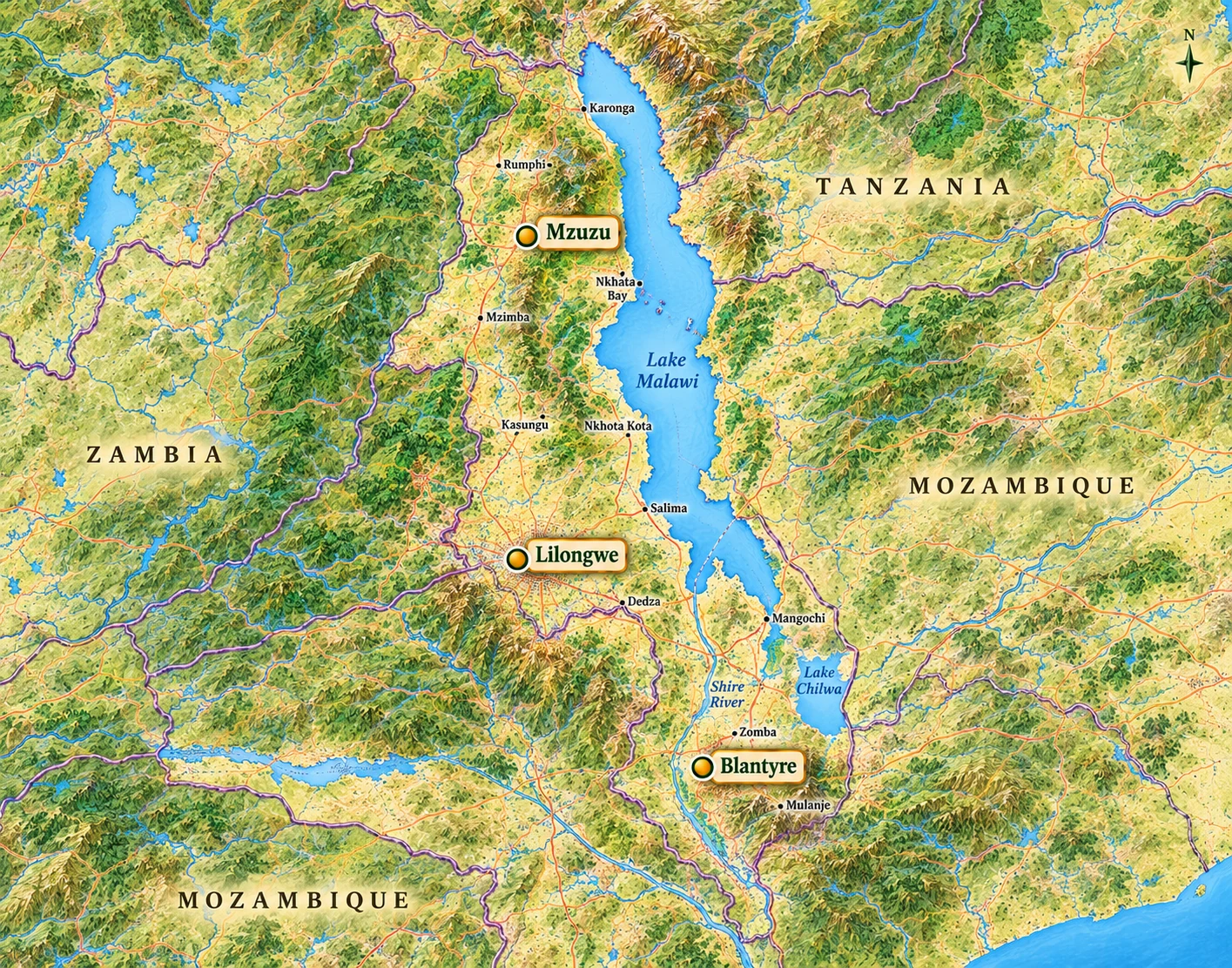
Geographic reference

Lilongwe belongs in an exploratory shortlist when there is a real purpose for being there: a supported research, technical-assistance or professional appointment, or an established family connection. Imagine an agronomy specialist considering a defined project with a host who can explain the work and the household arrangements. The reason to investigate is that particular chapter and the relationships it could build, not an assumption that an unfamiliar country offers an effortless low-cost escape from Albany.
Malawi’s official permit portal distinguishes employment, study or research, technical-assistance and other residence categories. It says the employment permit concerns specified work and is issued before entry for that purpose. Ask the host and responsible authorities which route covers the actual role and each accompanying person. A visitor’s entry, a volunteer label and an employment appointment should not be treated as interchangeable plans.
The first home search should sit beside the project’s actual workplace and travel requirements. A role described as “Lilongwe based” may involve work elsewhere; ask how often, who arranges it and what happens for the household during those periods. Then identify groceries, communications, necessary care and a repeatable activity for the person who is not on the project. A clear host arrangement can make this conversation much more concrete than an independent move built around hopes.
Budget in Malawi kwacha for local expenses and keep the currency and timing of the appointment’s pay clear. Obtain written answers about housing, utilities, work travel, insurance and any other support actually included. Price the costs that remain with the household and a workable return to Albany. Do not balance the budget with an assumed second local income or an unconfirmed promise of accommodation.
Lilongwe is an inland city; Lake Malawi is a separate journey. Blantyre and Mzuzu are other city horizons, not nearby neighborhood choices. The atlas helps you keep those relationships clear. The garden scene pictures an illustrative professional interaction, not a named project recruiting staff or a guarantee of access to a particular facility. What matters is whether the real appointment lets you participate meaningfully while the household has a comfortable life around it.
The exchange is a purposeful and substantially different chapter for a larger need to establish support, practical services and travel arrangements before arrival. The current US travel advisory calls for increased caution because of crime and unrest; use the linked current notice and the host’s actual local plan when deciding on a visit or placement. Keep Lilongwe when the purpose, permitted work, funded home and accompanying person’s week are concrete enough to assess together. If they remain vague, keep the idea as a future possibility while pursuing a more workable present shortlist.
Try first: Ask the actual host for the role, permit route and household support in writing, then assess a candidate home and daily services against the current travel advice before arranging a purposeful visit.
Local sources: Malawi e-Permit System | The Official e-Permit Application Portal of Malawi | Department of Immigration and Citizenship Services · Home - Lilongwe City Council · US State Department: Malawi travel advisory.
Make the visit answer the question that could change your mind
A useful visit has a job. Before booking it, write the question that keeps the destination uncertain. It might be whether two adults can reach different workplaces without buying another car, whether a smaller home still supports a craft practice, or whether the family could enjoy an ordinary evening there. Build the visit around that question and leave enough unplanned time to notice how the place feels between appointments.
Stay near a plausible home base when possible. Make the work journey at the relevant hour, buy the kind of groceries you buy in Albany and return after the activity you hope to keep. Try the approach to the home with a bag in your hand. Sit for a while in the place you imagine becoming a regular. You will learn more from a complete, slightly inconvenient day than from a perfectly timed tour of the best-known sights.
Choose at least two homes or neighborhood arrangements to compare. If the first does not work, the second helps you distinguish a problem with one address from a problem with the city. Record what changes between them: payment, travel time, entrance, noise, useful nearby places and the amount of household work. A smaller home with a much better daily circuit may become more attractive once you have tried both.
Bring the quieter household member’s question into the itinerary. A teenager may need to see a possible activity and the way home; an older adult may want to test a short errand independently; the person without the job offer may need time away from the employer’s tour. Allow each person to report what worked and what did not without turning every observation into an argument for the move.
For an overseas visit, establish what the visit permits and what still needs to happen before residence or employment. A good few days cannot establish legal eligibility or prove that a long-term home is ready. Use the trip to meet the relevant host, examine the daily arrangement and identify the remaining decisions. Avoid paying for commitments that depend on permissions or terms still being settled.
End with a short decision note while the details are fresh: what improved on Albany, what became harder, what remains unknown and the next action that would resolve it. Keep the destination, change the proposed neighborhood, postpone it or set it aside with a reason. You do not need to rescue a disappointing option because you spent time visiting. The visit has succeeded if it helps you make the next choice more clearly.

- AskChoose the question that could change your mind.
- TryUse a realistic home area and the actual hour.
- CompareTest a second arrangement and each person’s concern.
- DecideKeep, change or set aside the option with a next action.
Keep two to four possibilities and give each a next step
A useful shortlist is small enough to act on and broad enough to preserve a choice. Keep Albany if a better local arrangement might meet the goal. Add the nearby, farther or international options that offer a clear improvement you actually want. Write the reason beside each name so that a beautiful new listing does not quietly replace the purpose of the move.
For every option, record the income arrangement, a plausible home, money left after recurring essentials, the daily journey that matters most, and the connection or activity you want to keep. Then add the main tradeoff and the next fact that could change your decision. “Contact the employer about location and start date” is useful. “Research Dallas” is too large to tell you what to do tomorrow.
Give the next step a person and a date. One adult can check the work arrangement while another looks at two suitable homes; a teenager can choose an activity to investigate. Agree when to compare the results, including the result that a place no longer fits. This keeps the search moving without making every evening an endless discussion about where you might live.
Use the printable sheet below to hold the comparison in one place. Enter your own figures and leave an unresolved item visibly open. A destination with one crucial unknown is not necessarily a bad option; it needs that question answered before you rely on it. Once a candidate home, income and household week line up, you can turn the shortlist into a move plan with dates and a realistic transition budget.
You may finish with a different answer from the one you expected. A large city may support a surprisingly manageable local life. A nearby move may make the biggest improvement. Staying in Albany may become appealing after you change the part of the arrangement that was wearing you down. The point is to choose a next home with a reason you can still recognize after the novelty has become ordinary life.
Compare two to four places you could call home
Albany, New York origin · date:
What must change?
Three things to keep:
| My comparison | Place 1 | Place 2 | Place 3 | Place 4 |
|---|---|---|---|---|
| Place and candidate home | ||||
| Reason to keep this option | ||||
| Main tradeoff | ||||
| Income basis and start date | ||||
| Monthly take-home / currency | ||||
| Recurring essentials / month | ||||
| Money left / month | ||||
| Transition spending to recover | ||||
| Deposits and other cash tied up | ||||
| Reserve left after moving | ||||
| Question / person who can answer | ||||
| Next action and decision date |
Compare two to four real possibilities, including a better Albany arrangement when useful. Use the same currency within each monthly calculation and date any conversion. Keep uncertain income visible. Separate transition expenses, refundable deposits and the reserve you want to retain. Give each open question a person and a next action.
Questions when choosing where to move from Albany
How do I begin choosing where to move from Albany?
Name the improvement you want and three parts of your present life you want to keep. Then choose two to four places whose profiles answer that purpose. Give each a next question: a confirmed work location, a suitable home, the complete monthly budget or a route the household can actually use. Keep an improved Albany option if it could deliver the same change.
Is staying in Albany a serious option?
Yes. Try a realistic change of home, work arrangement or household routine in Albany and compare it with the proposed move. A smaller accessible home, fewer maintenance tasks or a better schedule may solve the problem. Keep staying when that arrangement meets the goal well; widen the search when another place offers something the local change cannot.
Which nearby cities should I compare first?
Troy, Schenectady and Saratoga Springs offer three different Capital Region beginnings. Start with the connection that must remain: an Albany workplace, a relative, school or an activity. Then compare actual homes and the full journey at the required hour. Their nearby location does not by itself establish a shorter commute or a lower household cost.
Does a lower city rent estimate mean I will save money?
No. The estimate describes occupied rental homes across a municipality during the survey period. Your required home, current terms, income and transport can differ substantially. Price two suitable homes and subtract all recurring essentials from dependable take-home income. A lower payment produces a useful saving only when the rest of that month still works.
Which selected cities have lower historical rent than Albany?
In the common 2020–2024 ACS comparison, the point estimates for Schenectady, Troy, Rochester, Baton Rouge, Cleveland, Milwaukee, Albuquerque and Missoula are below Albany’s $1,216. Several differences are small and the table includes published margins of error. These are prompts for a current home search, not a ranking of attainable homes or proof of personal savings.
Can a more expensive city still be the better move?
Yes, when a confirmed opportunity or a setting you value justifies the full household trade. Los Angeles and San Diego have higher historical rent estimates in this comparison. Use dependable income, actual suitable homes and complete expenses to establish what you would have left. State what the extra spending buys and whether you would still choose it in a less favorable month.
How should I compare an income drop?
Use the lower dependable take-home amount in the destination budget, then compare the money and time left. Fewer working hours can be a deliberate benefit if the household can fund the resulting month. The worked example shows why lower housing costs can still leave less money when earnings fall. Do not use a hoped-for later salary to balance the first year.
How do the worked budgets handle moving costs?
They separate the recurring month from unrecoverable transition spending. In the example, an extra $350 left each month takes twelve months to recover a chosen $4,200 transition allowance. Refundable deposits still require cash up front but are different from final expenses. Keep the emergency reserve separate and test a weaker first month as well.
Should I choose the job or the neighborhood first?
Establish the actual work or study location, income and schedule before choosing a home around it. For two adults, put both plans on the map. Then compare two plausible home areas and the journey at each person’s required hour. If only one role is confirmed, include the second search and any period with one income in the first-year plan.
Can I keep a remote job after moving?
Confirm the actual destination, pay, hours and requirements with the employer in writing. Test the home’s internet and workspace rather than relying on a citywide impression. For an overseas move, the employer’s approval and the destination’s residence and work rules are separate questions. The household plan needs both before it can rely on that job.
How do I check whether I can give up a car?
Try the complete routine from a specific home: work or study, groceries, care, appointments and the late return. Check current routes, hours, stop approaches and the journeys the network does not serve. Only remove the car when the pattern works for everyone who depends on it; otherwise include the vehicle or paid rides that remain necessary.
What should a family check beyond school reputation?
Confirm the school serving the actual address, enrollment, the route, before- and after-school arrangements and the activity the child hopes to keep. Test the gap between adult work hours and the child’s day. A teenager may also need an independent journey to a class or friend. Those practical details help turn a promising school area into a workable household choice.
How do I compare homes for an older adult?
Test the continuous path from the front door to a useful errand or activity, including thresholds, stairs, elevators, pavements and crossings. Ask how groceries and appointments work when the usual driver is unavailable. Check maintenance responsibilities and the costs for the particular home. A one-floor interior helps only when the rest of the daily route is usable too.
How can a smaller home improve the move?
Choose which household work you want to remove and which activities need space. Measure the furniture, work surface and everyday paths that make those activities possible. Include storage charges, shared-building costs and maintenance terms. Compare a visitor, a normal morning and the least convenient household task before deciding that fewer rooms will produce an easier life.
How do I start making connections in a new city?
Choose one activity you enjoy enough to attend repeatedly and can reach after an ordinary day. Ask about the next session, cost, availability and what a newcomer needs. A practical class or volunteering task can be a comfortable beginning without filling every evening. During a visit, try the activity’s journey and picture returning when the novelty has faded.
Is a coastal or mountain city enough reason to move?
It can be, if the setting matters enough to you and the household can fund the choice. Identify the actual activity, access point and time you will have for it. Try the journey from a home within budget, including the return and a less convenient season. A regional view alone does not show whether the landscape becomes part of daily life.
What does the climate table tell me?
It compares January and July monthly mean temperatures at named airport stations using NOAA 1991–2020 normals. The means include days and nights; they are not forecasts, daily highs or a description of every neighborhood. Use them to begin the seasonal comparison, then check the home’s comfort, ordinary travel and the activity you hope to repeat.
What makes an international option practical?
A clear purpose, an applicable residence and work basis, usable income, a suitable home and a workable week for each person moving. Add language, currency, care or education where relevant and returns to Albany. A visitor’s entry or one adult’s appointment does not settle the rest. Use the linked official route and the actual host terms before making dependent commitments.
Why are Papeete and Grenada treated as working lives rather than holidays?
Their profiles begin with a real appointment, accepted course, family connection or another applicable residence basis. They then examine housing, everyday travel, the accompanying adult’s life and the return to New York. French Polynesia has conditions distinct from metropolitan France. A pleasant visit can help test daily life, but it cannot establish permission to reside or work.
Can I rely on the maps for a route or a property decision?
Use them to explore relative locations, terrain and water. They are original editorial AI atlases made from geographic references, with an Alaska inset clearly at a separate scale. Use current operator information for journeys and the appropriate address-level records for a property. The city and household scenes are illustrations, not evidence that a particular home, job or facility is available.
What should I do during a comparison visit?
Choose the question that could change your decision, then test it from a plausible home area. Make the work journey at the relevant hour, an ordinary errand and a repeatable activity. Compare a second home arrangement if possible and include each household member’s main concern. Finish with what improved, what became harder and the next decision.
When should I start arranging the move itself?
When the destination, actual home, income basis and dates are clear enough to plan the transition. Keep unresolved conditions visible and obtain terms from providers appropriate to the actual route, including Alaska or overseas shipment needs where relevant. This guide’s geographic examples do not expand Sterling Oakbridge’s service coverage or promise an international moving service.
Sources and method
Primary records and official page extracts reviewed in October 2026; dated notices retain their own dates and unchanged source records retain their acquisition scope. Local primaries appear beside the profiles they support. The US comparison uses the common 2020–2024 ACS five-year release for exact Census municipalities, with published margins of error; the climate comparison uses NOAA 1991–2020 airport-station monthly means. Neither prices a current home or predicts a particular day. Budget inputs are hypothetical household arithmetic.
The city and household scenes are original AI illustrations made for this Albany edition; the two retained nearby and regional atlases were originally made for Albany. Scenes illustrate possibilities, not documented customers, available homes or job offers. The detailed AI atlas maps use checked geographic references to picture settings and relative places. Use current provider information and the actual address when choosing a home or planning a journey.
- Albuquerque city, New Mexico Census historical gross rent
- Routes & Schedules — City of Albuquerque
- Anchorage municipality, Alaska Census historical gross rent
- Municipality of Anchorage: People Mover
- Baton Rouge city, Louisiana Census historical gross rent
- Capital Area Transit System (CATS)
- CDTA: Route 450 Saratoga Springs–Schenectady
- CDTA: BusPlus Red Line 905
- CDTA: Route 22 between Albany and Troy
- Cleveland city, Ohio Census historical gross rent
- System Maps | RideRTA
- Columbus city, Ohio Census historical gross rent
- COTA Services | COTA, Central Ohio Transit Authority. Let's Go!
- Dallas city, Texas Census historical gross rent
- DART rail: official network and routes
- Work Permits – Department of Labour – Grenada
- Welcome to SGU | Resources for Accepted Students
- Latvia migration authority: long-stay remote work route
- Home - Lilongwe City Council
- Los Angeles city, California Census historical gross rent
- Line Schedules and Maps - LA Metro
- US State Department: Malawi travel advisory
- Malawi e-Permit System | The Official e-Permit Application Portal of Malawi | Department of Immigration and Citizenship Services
- Milwaukee city, Wisconsin Census historical gross rent
- Routes & Schedules
- Missoula city, Montana Census historical gross rent
- Mountain Line: Missoula route maps
- Les Jardins de Paofai – SPJP
- ADE | Foreign investors
- Portland city, Maine Census historical gross rent
- Greater Portland Metro: routes and trip planning
- Portland city, Oregon Census historical gross rent
- Maps and Schedules
- Providence city, Rhode Island Census historical gross rent
- City of Providence: transportation
- Raleigh city, North Carolina Census historical gross rent
- GoRaleigh: routes and trip planning
- Commuting in Riga | LiveRiga
- Rochester city, New York Census historical gross rent
- City of Rochester: Genesee Riverway Trail
- RTS Rochester: maps and schedules
- San Diego city, California Census historical gross rent
- Trolley | San Diego Metropolitan Transit System
- New York State Parks: Saratoga Spa State Park
- Saratoga Springs city, New York Census historical gross rent
- Schenectady city, New York Census historical gross rent
- Troy city, New York Census historical gross rent
- Downtown Troy: farmers market
Census ACS methods · 2024 Census Gazetteer
Download the comparison data (CSV) · Download the model inputs (JSON)