

Give the next week a purpose
A different home can make an ordinary Columbus week easier without making everything about that week new. You may want a quiet place to sleep after an early shift, a room where two people can work at different hours, or a shorter journey between school and the person who helps at pickup. Begin with that change. A city becomes useful when you can describe the life its addresses would let you lead.
Imagine an exhibit fabricator who works on site downtown and a payroll specialist whose employer allows two home-working days. Their seven-year-old goes swimming after school, and Thursday supper with a grandmother is one of the evenings they would most like to keep. Their present home has a cramped shared room and a difficult stair. They could look for another Columbus home, try Hilliard or Westerville, build a more independent week in Newark, or take a specific opportunity farther away. These are invented situations to help you compare; the people and homes in the illustrations are not clients or available listings.
The useful question is what each choice gives back. A level entrance could matter more than another bedroom. A nearby address could preserve a relationship yet add driving on the evenings when help is needed most. A regional city could offer a better job and a simpler school journey while making Thursday dinner an occasional visit. Write down the gain you want, the two connections you want to keep, and the tradeoff you would willingly make.
This guide follows those questions from Columbus to three nearby Ohio places, fifteen farther US cities and four international horizons. Use the sections that fit your household, then bring two to four possibilities into a real-address comparison. The maps are orientation illustrations; the data are starting context. Your next step is small enough to do: check one complete journey, ask one employer a concrete question, or view a home with the daily routine beside you.
You can begin at several points. If the main difficulty is the home, read the nearby choices and the smaller-home section. If a role or course is drawing you elsewhere, begin with work and the farther horizons. If you are moving alone, look at the ways to find a regular place among other people. For a household move, give each person a useful day of their own in the comparison.
You do not need to choose a city today. A useful first result is a short statement: we want an entrance that works, a room that can carry two home-working days, and a school-to-activity journey that does not consume every evening. That statement can guide an ordinary Columbus viewing as well as a flight to somewhere new. Keep it beside the names you explore.
Keep a Columbus connection
Compare Hilliard, Westerville and Newark, Ohio through a useful home, complete journeys and the Columbus connections you want to keep.
Compare three nearby beginnings →Make the household month work
Use dependable income and the full cost of home, travel and practical help.
See what remains after the bills →Choose a wider US chapter
Give the work, city scale or landscape a realistic home and ordinary year around it.
Explore the wider city profiles →Explore an overseas chapter
Begin with the actual purpose, applicable permissions and a funded week for each person.
Compare four overseas chapters →Put the Columbus life you value into the comparison
Begin with a Columbus week that represents your life reasonably well. Include a workday that went smoothly, the errand you can do without thinking, the person who can help when plans change, and the place you visit simply because you enjoy it. These details are resources. Giving them a place on paper lets another city compete fairly with the life you actually have.
For the invented household, the grandmother is part of a relationship, rather than a free line in a care budget. Thursday supper may be a pleasure for all three generations, but help at pickup still needs an agreement about days, notice and what happens when someone is ill. A new home could make the visit simpler; it could also preserve the miles while making the timing much harder.
Write down actual work destinations. Downtown installation work has a different starting point and equipment need from a payroll desk used at home on two agreed days. A label such as Columbus employment is too broad to explain either trip. Include the door you enter, the time you must arrive, what you carry and the latest return on a normal week.
COTA is a useful part of this picture, and its current network deserves a fresh look. The September 2026 changes introduced Line 30 from Hilliard through Upper Arlington and Ohio State to downtown, and split Line 1 Kenny and Livingston into separate services with downtown transfer points. Check the current provider map and timetable for your particular journey. An older remembered route may give the wrong comparison.
Consider a change within Columbus before asking a distant city to solve a problem that belongs to the building. Another layout could give the payroll specialist a quiet door to close. A different entrance could make groceries and visiting relatives easier. The right nearby home may preserve a good relationship with a current employer while improving the hours spent away from work.
Give the present home an honest financial baseline as well. Use the amount you actually pay and the costs your present arrangement genuinely avoids. A long-held lease, an existing mortgage or shared equipment may differ greatly from a new listing price. Carry the same food, care, insurance and transport needs into each possible month. Then the gains and compromises will be easier to see.
Finally, name something you would be happy to rebuild. You may be ready for new work, a different landscape or a social life that has room for an interest you have neglected. Keeping useful Columbus connections does not require keeping every detail of the present week. It gives you a clear starting point for choosing what to carry forward.
Columbus as the starting point
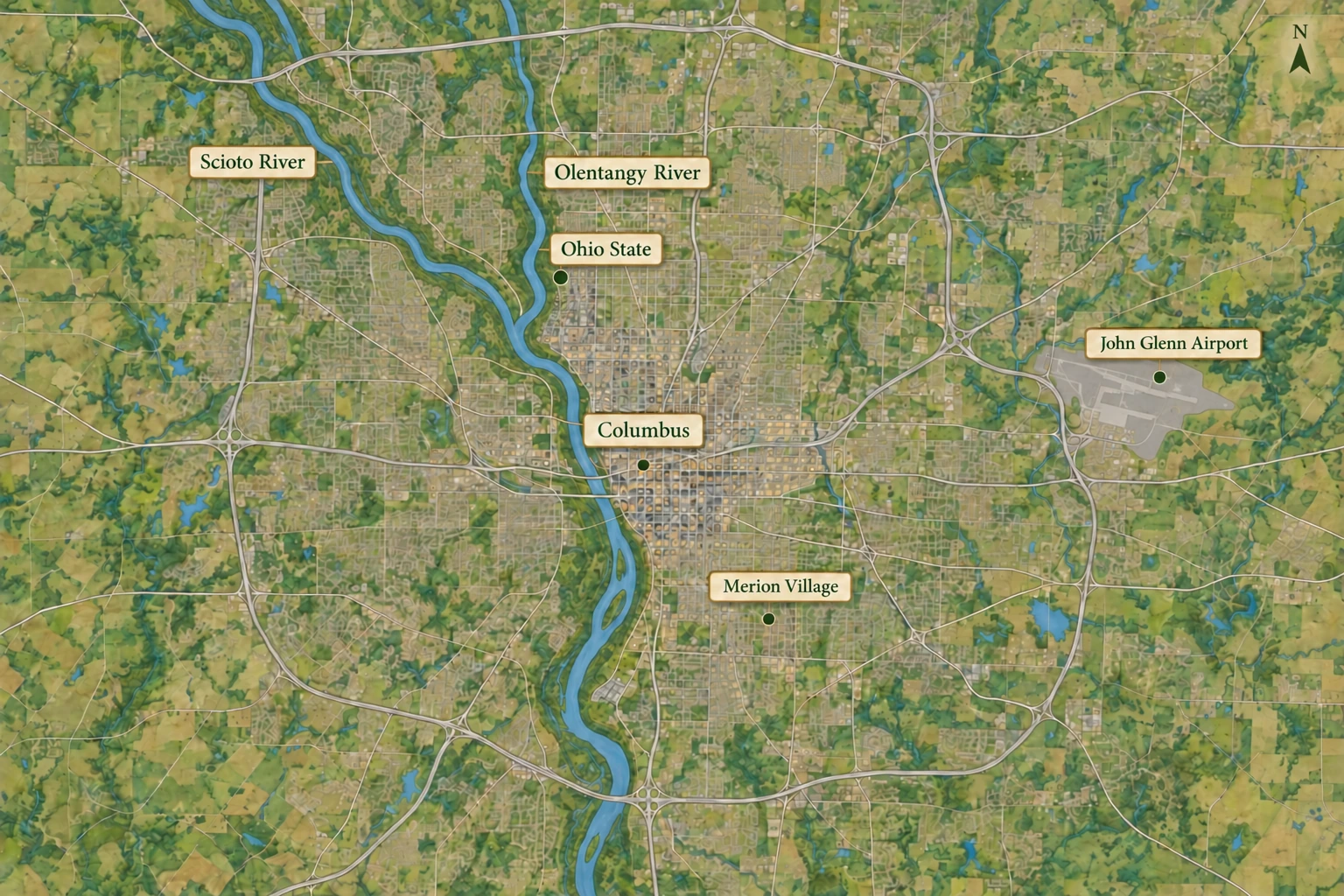
Geographic reference

- Name the gainChoose the room, entrance, time or opportunity you want to improve.
- Keep two connectionsGive the people or routines you value an achievable form in the new week.
- Map the real dayUse actual work, school, activity and home doors at the hours that matter.
- Compare the whole monthPut dependable take-home money beside the same recurring needs.
Local sources: COTA: current journey resources · COTA: current service changes.
Let the change you want set the reach of the search
A home search and a place search can lead to different answers. If the central difficulty is a narrow stair, a room that carries too many purposes or a landlord arrangement that no longer fits, begin with properties capable of changing that condition. If the purpose is a named appointment, a particular training route or living near someone in another region, the destination itself becomes part of the answer.
Try three versions of the future before choosing a distance. The first changes the home while most of the Columbus week stays familiar. The second keeps selected Columbus connections but rebuilds some daily arrangements in a nearby place. The third takes a concrete opportunity farther away and creates a new local routine around it. Each version should offer a gain you can describe in ordinary terms.
The nearby version still needs work. A home in Hilliard or Westerville may be close enough for frequent contact, but the journey from a particular address can add a second car, a transfer or a difficult handoff. Newark, Ohio can support a life centered on Licking County; it should not be treated simply as another Columbus neighborhood. The important distance is the complete day you will actually travel.
The farther version needs a reason substantial enough for the relationships and arrangements you will rebuild. A suitable job offer, a funded course, living nearer a person you want to see, or a landscape you will use every week can each be such a reason. A lower advertised home payment alone leaves the rest of the future unexplained.
For each version, ask what the first ordinary Wednesday would contain. Who leaves first? Which room is quiet? Who collects the child? Where does a person moving alone go after work? How does a relative reach an appointment? A place that answers these questions well earns more attention, even when it was not the first name that appealed to you.
Keep two to four plausible versions, with one real address or clearly defined search area attached to each. You can return to the wider maps when a version fails an essential condition. A smaller shortlist is useful when you know why its places are there and what next observation could change their order.
- Another Columbus homeTest whether a suitable property can solve the main problem.
- A nearby Ohio versionKeep selected Columbus connections and explain the additional journeys.
- A farther chapterAttach the destination to a specific opportunity or setting you will use.
- Two to four possibilitiesKeep the versions that can answer the essential conditions.
Try three different Ohio relationships with Columbus
Hilliard, Westerville and Newark, Ohio offer three ways to ask whether the improvement needs a long-distance move. They occupy different positions around Columbus and would give the invented household different relationships with work, swimming and Thursday supper. Begin with what a particular home could improve, then build the trips around it.
The historical Census comparison gives context for the home search. In the same 2020–2024 ACS release, monthly median gross rent was $1,295 for Columbus, $1,632 for Hilliard, $1,364 for Westerville and $973 for Newark. These are occupied cash-rent homes in different Census places, with published margins of error shown in the data table. They do not quote a currently available home or establish what this household would save.
Use each nearby visit to answer a different question. In Hilliard, test a more suitable home alongside the current Line 30 corridor or actual drive. In Westerville, see whether its northern position supports the separate work and school journeys you need. In Newark, ask whether enough of life can be centered locally to make the longer Columbus connection worthwhile.
The map helps you understand direction and setting. It does not make a school assignment, specify a bus itinerary or describe a boundary for services. Put a real property, its school-district confirmation and the current transport information beside it. That combination gives you something concrete to compare.
Hilliard, Westerville and Newark, Ohio
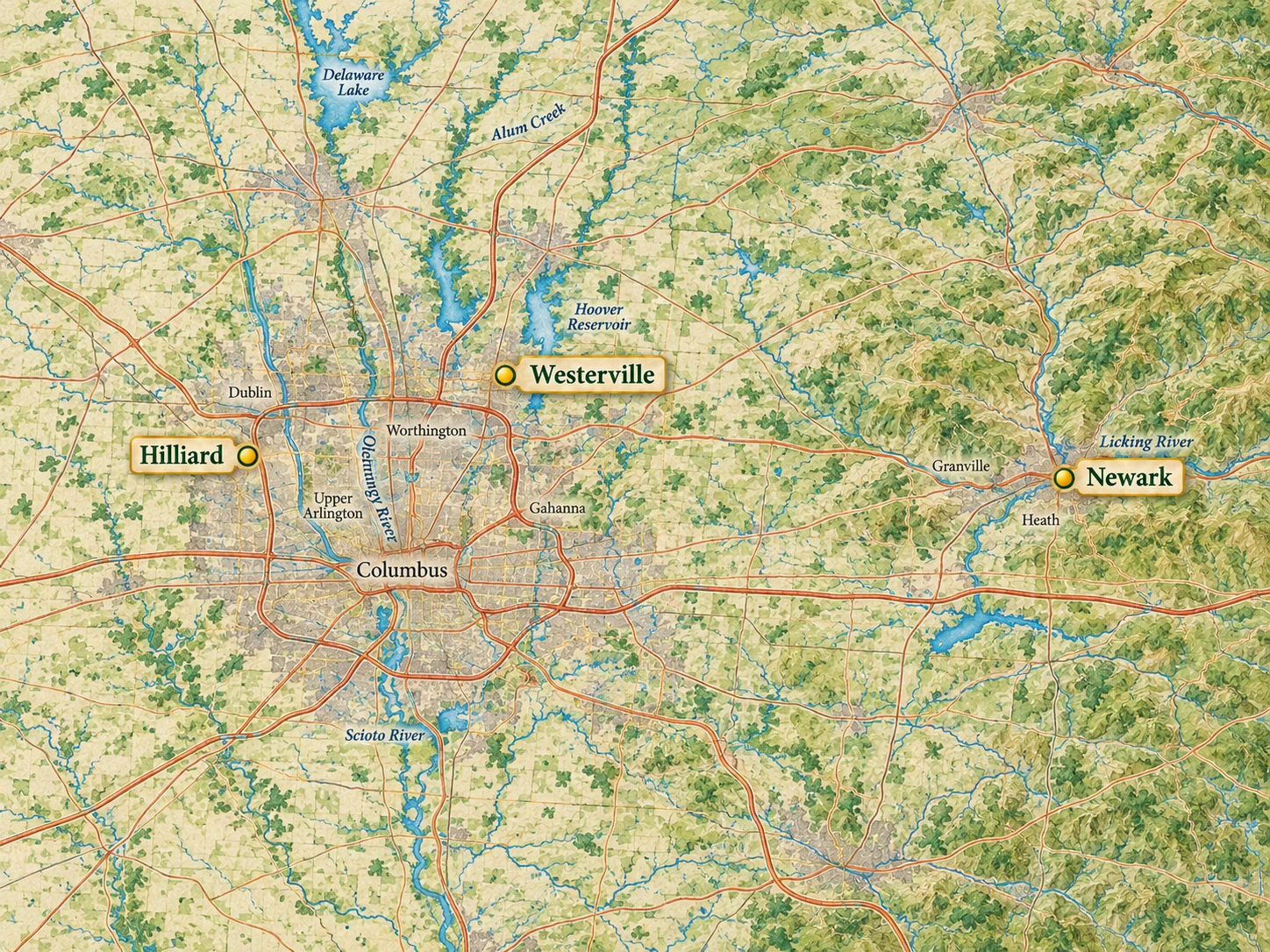
Geographic reference
Hilliard: a different home with Columbus still in the week

Hilliard gives this household a nearby question worth trying: could a more suitable home solve the cramped-room and stair problem while keeping downtown work and family contact practical? An extra usable room or a level entrance is a concrete gain. It belongs to a particular home, rather than every Hilliard address, so carry the furniture measurements and workday needs into the viewing.
There is also a nearby way to gain something outside the house. The paved Heritage Rail Trail begins in Old Hilliard and runs toward Plain City. For an adult who wants cycling or a shared walk to become a regular pleasure, that is a specific local destination to put beside the home search. Try the connection from the front door; a trail on the city map becomes useful when the approach and return fit the time you have.
The transport comparison has changed since older Columbus descriptions. COTA launched Line 30 in September 2026, connecting Hilliard, Upper Arlington, Ohio State and downtown. That creates an option to test from a home near its stops. It does not establish that an early installation shift, school pickup and an evening activity can all work on one bus. Compare the current outbound and return timetable with the exact workplace entrance, including the walk at both ends.
Keep the cost comparison open. Hilliard’s historical monthly median gross rent was $1,632 in the common ACS release, compared with $1,295 for Columbus, with the published uncertainty shown in the table. That does not price the level-entry home you want, but it gives no basis for assuming a suburban address will automatically cost less. Compare a current offer and the whole transport arrangement with the gain in usable space.
A Hilliard postal address also needs its own school-district check. Ask the district about the actual address and registration before treating a particular school as part of the move. Then give the grandmother visit and the swim session a place in the same week. If the new home fixes a daily difficulty and those journeys still feel manageable, Hilliard earns a place on the shortlist. If a cheaper payment needs another vehicle, put that vehicle into the whole-month comparison before choosing.
Try first: Choose one real home, measure the entrance and work room, and compare its Line 30 or driving journey with the actual downtown start and return times. Verify the school address with the district.
Local sources: COTA: September2026 Line30 launch · COTA: current service changes · Hilliard City Schools: enrollment · Hilliard city, Ohio Census historical gross rent · Columbus city, Ohio Census historical gross rent · Metro Parks: Heritage Trail Park.
Westerville: a northern home that must work for two separate days

Westerville is worth exploring when a specific home on the northern side of the Columbus area could give you more useful room while keeping selected relationships close. For the payroll specialist, that might be a quiet room with a door and an easy errand on a home-working day. For the exhibit fabricator, the downtown journey still happens on site. Give both people’s days a place in the address comparison.
Westerville also offers a cultural reason to make time locally: Otterbein’s Theatre & Dance department publishes performances and ticket information. An adult who misses going to theatre could make an ordinary evening performance part of a trial visit, rather than treating cultural life as another Columbus drive by default. The public programme is a starting point for an audience member; admission to a degree course or a role in a production is a separate question.
The historical rent context is fairly close at the point-estimate level: $1,364 monthly median gross rent in Westerville and $1,295 in Columbus in the same ACS release. The margins of error matter, and the numbers describe different occupied housing stocks. They do not establish a personal saving or the price of a larger home. View the property and obtain its actual terms before deciding what the extra room will cost.
Treat the northern position as a journey question. A home near the place you want to use may make a home-working day pleasant, yet the school handoff and downtown return could still require separate trips. Use the current COTA information where it is relevant, including the walk to a real stop and the evening return. Do not substitute a city name for a complete route.
Westerville City Schools asks families to verify that an address lies within its attendance boundaries before enrolling. Resolve that property-specific question with the district, then compare the school-to-swimming trip and Thursday contact with the grandmother. If the home gives each adult usable space and the child an achievable day, the northern location has a clear purpose. If it adds an unagreed daily handoff, try another address before calling the city a fit.
Try first: Take one candidate address to the district and current transport information, then put the two work patterns, school release and evening activity on one weekday timeline.
Local sources: Westerville City Schools: enrollment process · COTA: current journey resources · Westerville city, Ohio Census historical gross rent · Columbus city, Ohio Census historical gross rent · Department of Theatre & Dance - Otterbein University.
Newark, Ohio: consider a life with its own local center

Newark can make sense when the next chapter can be centered in Licking County rather than built around a daily return to Columbus. An adult pursuing a particular local appointment or the actual Newark-campus course they want could have a reason to be there. A quieter manageable home and a locally repeatable interest would give the rest of that week a positive shape.
Ohio State Newark gives a study-led move a concrete starting point. Its campus resources include academic programmes, continuing-learning routes and community events, alongside the city’s own downtown and river setting. Someone returning to study could first choose the course and its attendance requirements, then look for a home that supports that timetable. That makes Newark the centre of a purposeful new week, rather than merely the place where the housing payment happens.
The common ACS release reports a $973 monthly median gross rent for Newark city, compared with $1,295 for Columbus. That historical difference invites a home search, but it does not price the home you would take or pay for a longer commute. Keep actual earnings, full transport and the Columbus contact you want beside any attractive listing. The lower point estimate becomes useful only within a complete arrangement.
Licking County Transit describes both scheduled route service and demand response. Those services support local journeys under their current conditions; they should not be read as a general COTA connection or a guaranteed Columbus commute. Check a real home against the actual work or course location, current hours, eligibility where relevant and the return after the last obligation.
For the invented household, Newark asks whether enough of the week can move east with the home. If the fabricator still travels downtown every workday and the child keeps several Columbus activities, the cheaper home could buy a much larger travel burden. If a local role and activities become the center, Columbus might instead remain a planned family visit. Agree which version you are actually comparing.
Try first: Identify the named local role or exact Newark-campus program, one usable home and its local journeys before calculating how often you would still need to travel to Columbus.
Local sources: City of Newark, Ohio - Official Website · Ohio State Newark: campus and study resources · Licking County Transit · Newark city, Ohio Census historical gross rent · Columbus city, Ohio Census historical gross rent.
Explore a farther place through the life it could support
The farther US choices offer different kinds of change: another regional city, a warmer season, a denser network of urban journeys, a smaller interior routine, mountains or a Pacific setting. They are research starting points drawn for this edition. No destination is a general winner, and the order is not a ranking of where Columbus residents ought to go.
Carry one practical purpose into each group. An exhibit fabricator might follow a particular workshop role, while someone retraining could compare a specific program and its funding. A person moving alone might care most about a manageable home and an activity they can join weekly. The same city will look different through those purposes, which is why the profiles end with a small test rather than a verdict.
Keep the geography precise. Detroit city is not every Detroit-area workplace; Louisville’s Census balance area and Anchorage municipality cover different kinds of territory from a compact city center. A useful transport corridor does not represent an entire metropolitan area. The historical data table retains the exact named Census geography so that a city label does not silently change its meaning.
For every promising destination, bring the home, work or course, everyday travel and one source of company into the same picture. Give the less convenient season and the latest ordinary return their turn too. A place becomes a serious possibility when its attractions have a place in the week and its compromises have a workable answer.
Six US horizons from Columbus
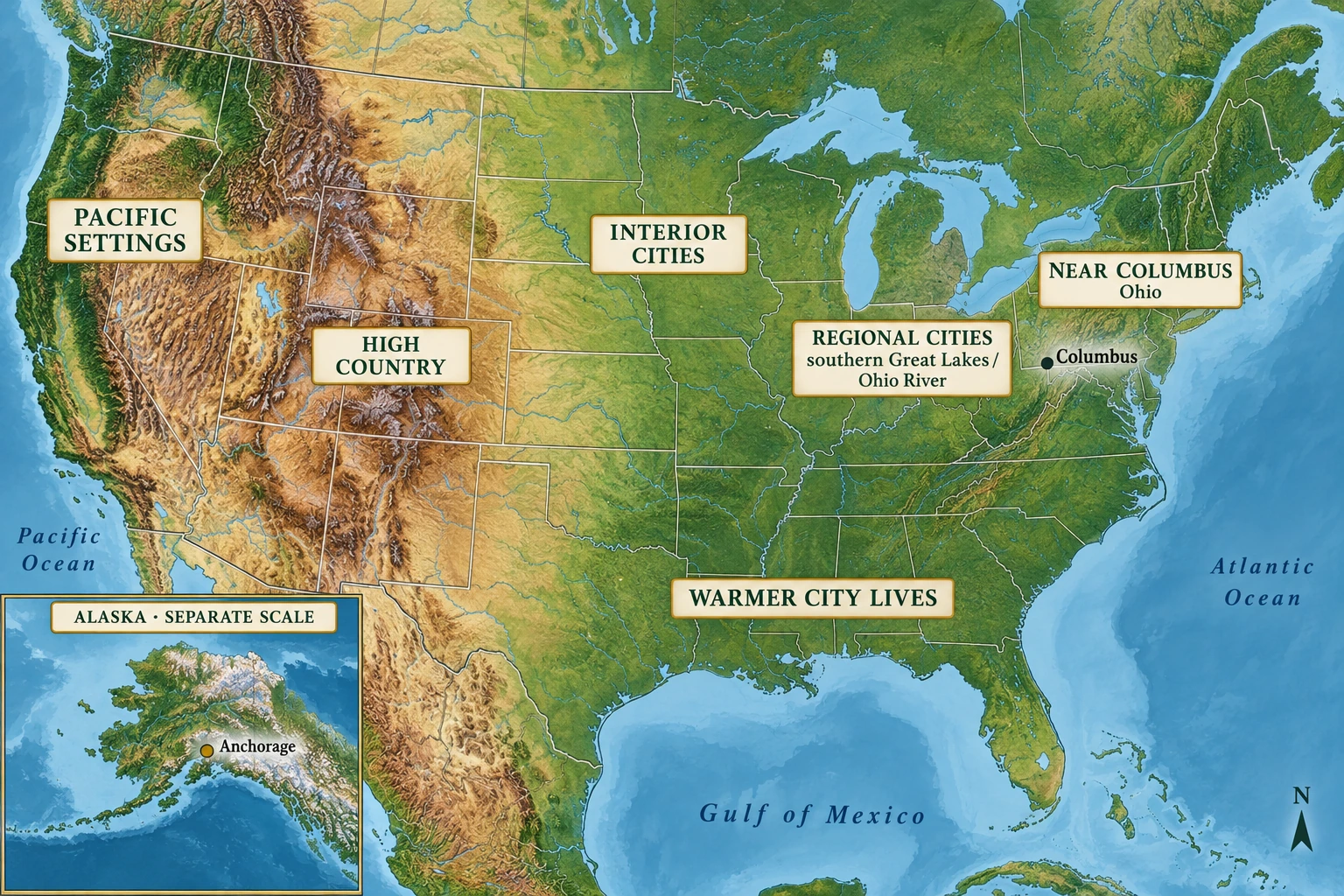
Geographic reference
Regional cities with a different local center
Follow a particular role or relationship into Detroit, Pittsburgh or Louisville, then compare the home and complete local day.
Three regional city directions
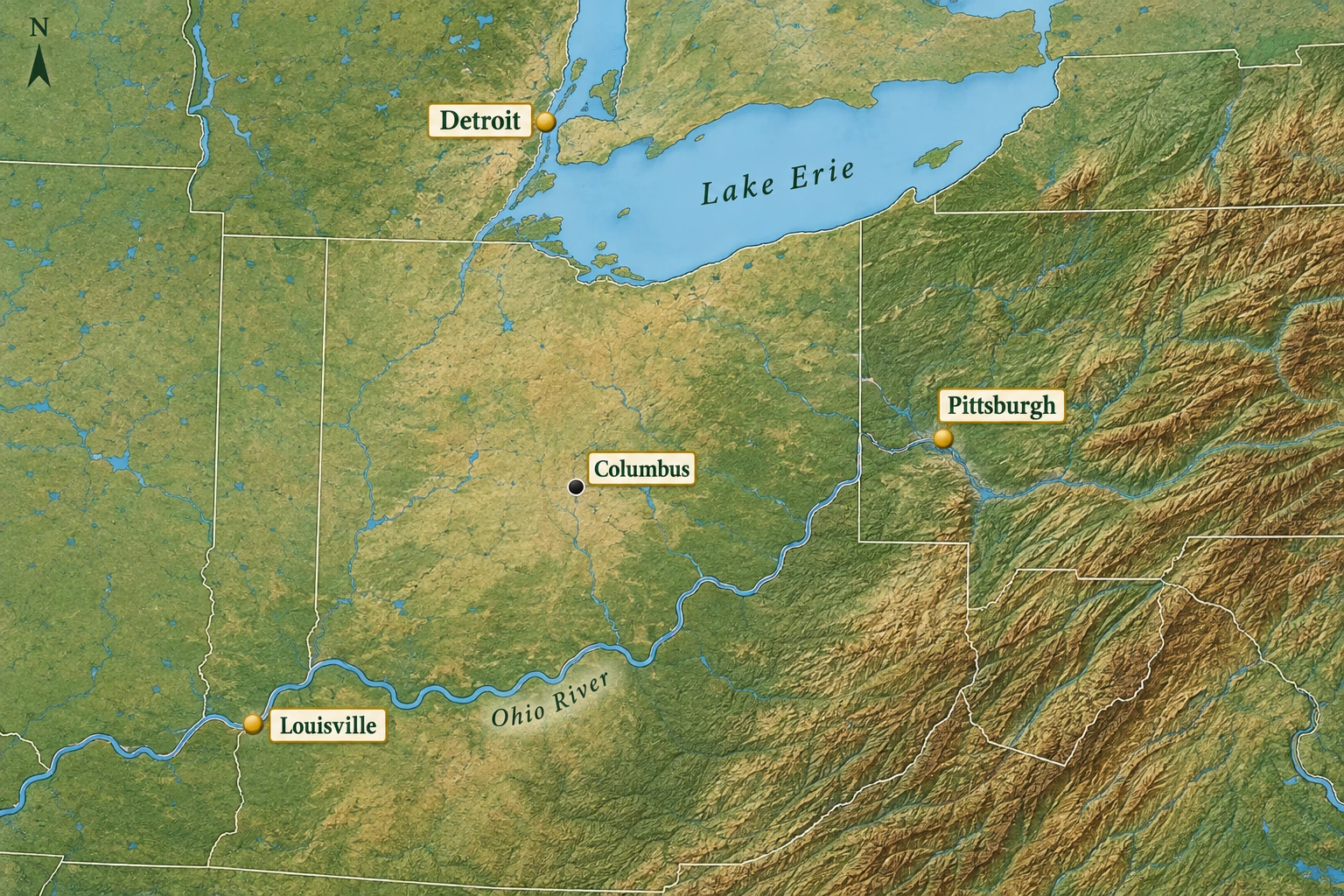
Geographic reference
Detroit: follow a real appointment into a neighborhood you can use

Detroit could be meaningful for an exhibit maker considering a particular fabrication or cultural-institution role, with a household willing to build a new local routine around it. The gain is the work itself and a home that supports the hours around it. Begin with the actual employer and worksite; a large regional employment map does not identify a suitable job or a manageable daily journey.
A riverfront routine can give this option a reason beyond the job. The Detroit Riverfront Conservancy describes parks and greenways including the Dequindre Cut and Southwest Greenway. A person who likes walking, cycling or sketching industrial and river landscapes has identifiable places to try. Use a trial outing to find the approach that suits your neighborhood and mobility, then connect that pleasure to the hours around the proposed role.
Choose the neighborhood and workplace together. Detroit’s city bus network is a useful source for routes and current service, while a job described as Detroit-area may lie in a different municipality. Check the exact entrance, shift and late return before assuming that a home inside the city connects easily to an outer-area workplace. Include parking or other transport where the real plan needs it.
The historical monthly median gross rent for Detroit city was $1,074, against $1,295 for Columbus, in the common ACS release. Annual household income is a separate population measure, not the pay you will receive. Put the actual appointment’s take-home result and the particular property’s condition, utilities and terms beside full transport. The table supplies context for questions, rather than a ready savings claim.
Keep one enjoyable repeatable part of the week visible. A workshop interest, a class or a familiar local errand can help a new neighborhood become yours. At the same time, plan the Columbus contact as visits you can actually sustain. Detroit earns a shortlist place when the named role and usable neighborhood create a better week together, with winter and the latest ordinary return included.
Try first: Confirm the worksite and roster, then test one complete neighborhood-to-work journey and obtain current terms for a home capable of supporting it.
Local sources: Detroit DDOT: bus schedules · Detroit city, Michigan Census historical gross rent · Columbus city, Ohio Census historical gross rent · Parks & Greenways | Detroit Riverfront Conservancy.
Pittsburgh: let the hills and the actual entrance shape the home search

Pittsburgh offers a different regional setting for someone following a particular role, course or relationship while keeping Columbus within reach for planned contact. A compact neighborhood life among hills can be attractive in its own right. For the exhibit-fabricator household, the opportunity would need to be specific enough to justify rebuilding school, work and the Thursday family pattern.
The Three Rivers Heritage Trail offers a specific way to use the river setting for walking or cycling among neighborhoods. A riverside outing could become the shared part of a week in which the adults otherwise work in different directions. Its sections and current alerts deserve attention: the trail map distinguishes traffic-free and shared sections. Choose an outing that works for the people involved and try the link from the candidate home.
Here the last part of a journey deserves special attention. A route may reach the right neighborhood while the home sits beyond a steep walk or stair. Use Pittsburgh Regional Transit’s current information for the complete trip, then walk the final approach with the bags or equipment you usually carry. Check the work entrance as carefully as the nearest stop.
The common ACS release gives Pittsburgh city a monthly median gross rent of $1,261, compared with Columbus at $1,295. These close historical point estimates, with uncertainty in the table, do not prove that a move will reduce housing costs. The useful question is what a particular home costs and whether its layout, slope and transport create a better arrangement.
A promising version might pair an accessible entrance with a role or funded course that the person particularly wants, plus a nearby weekly interest. A less useful version could exchange the present difficult stair for another one while adding a longer Columbus visit. Try the ordinary home-to-work and grocery return, then decide whether this setting offers the change you intended.
Try first: Walk from the actual stop or parking place to the candidate entrance, including any public stairs, and compare that journey with the home’s access purpose.
Local sources: Pittsburgh Regional Transit · Pittsburgh city, Pennsylvania Census historical gross rent · Columbus city, Ohio Census historical gross rent · Friends of the Riverfront: Three Rivers Heritage Trail.
Louisville: build an Ohio River chapter around a complete local week

Louisville can offer a regional change of setting for an adult with a particular appointment and a household ready to create a more local week there. A home with rooms that work well in sequence, time for a regular interest and a practical journey to work are concrete things to look for. The river-city appeal becomes more useful when those parts fit a real address.
Waterfront Park gives the river-city idea a practical place to begin. Its public grounds and the Big Four walking and cycling bridge toward Jeffersonville can support a regular outdoor outing without turning every free day into a major trip. For a household that wants more shared time outside, try an ordinary return from the park as well as the attractive riverfront hour. Use the current park information for works and events.
The historical comparison uses Louisville/Jefferson County metro government balance, the exact Census area shown in the table. Its monthly median gross rent was $1,120, against $1,295 for Columbus. That geography is not simply a compact downtown neighborhood, and the estimate is not a current offer. Use the specific home’s condition, utilities and terms in the budget.
TARC provides current route and rider information for the Louisville area. Test the actual workplace and the hours you need, including detours or the return after an evening obligation. For a household keeping more than one worksite, the transport plan should explain both patterns. A route near one destination cannot silently cover the other.
Give the new setting a positive activity and the old connection a realistic rhythm. A recurring local class, garden interest or walk can make the days around work satisfying; Columbus family contact may become a planned weekend rather than a weekday supper. Put those visits into the month. Louisville is a stronger option when the role, home and new local life justify that change together.
Try first: Pair a current home offer with the named worksite and TARC or driving plan, then price and agree the Columbus visits the household wants to keep.
Local sources: Home - TARC · Louisville/Jefferson County metro government (balance), Kentucky Census historical gross rent · Columbus city, Ohio Census historical gross rent · Louisville Waterfront Park.
Three warmer city lives
Miami, Memphis and Fort Worth offer different southern settings; compare the actual income, building and travel pattern that would support each.
Three different southern settings
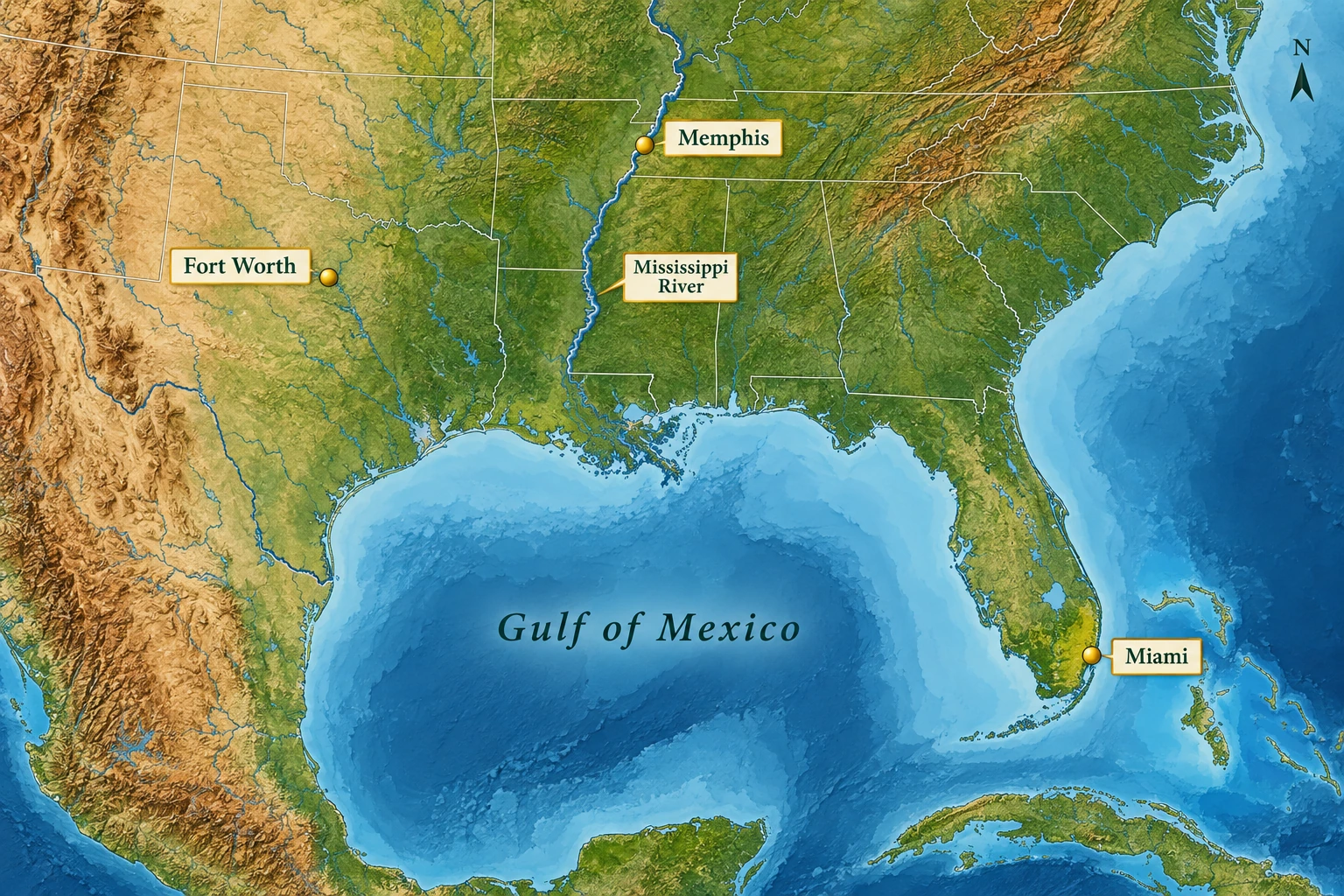
Geographic reference
Miami: choose a warm-climate city week you can actually afford

Miami could be a serious possibility for someone with a specific professional appointment, a language or family connection, and a wish to live in a much warmer setting. The positive change is an urban life you will use through the year. Begin with a neighborhood and worksite, rather than the holiday image of a beach; the home and daily obligations need to fit the same month.
The downtown waterfront has a usable civic side as well as a visitor image. Bayfront Park and Maurice A. Ferré Park offer green space, public art and walks beside Biscayne Bay. For someone whose work and home are genuinely connected to this part of the city, an early or evening waterfront walk could be a repeatable pleasure. Try it at the time you would actually go, including the shaded approach, warmer season and journey home.
Its historical monthly median gross rent was $1,758 in the common ACS release, compared with $1,295 for Columbus. That is background for a current home search, not a price ceiling or a complete cost comparison. Obtain the actual payment, utilities, insurance and transport terms. A higher salary is useful when the take-home amount leaves enough after those recurring needs.
Miami-Dade’s provider information distinguishes Metrobus, Metrorail and Metromover and publishes service and elevator alerts. A home near one system may still need a connection and a final walk to the actual role. Try the complete return at the hours you will use, including a wet or hot day. Check the current service rather than assuming a map line guarantees the journey.
The climate comparison gives the scale of the seasonal change: Miami airport’s historical January monthly mean was 68.6°F, against Columbus airport at 29.6°F. July’s Miami mean was 84.1°F. These are station means, not comfort scores. View the building’s shading, cooling and weather arrangements and ask for address-specific information relevant to its condition and exposure. The move is stronger when you want the whole year it offers.
Try first: Pair the actual offer with a current home quote and complete journey, then inspect the building in a warm or wet part of the day and compare the full monthly remainder.
Local sources: Transportation & Public Works · Miami city, Florida Census historical gross rent · Columbus city, Ohio Census historical gross rent · NOAA:1991–2020 climate normals · Bayfront Park Management Trust.
Memphis: a home and a local interest around a named opportunity

Memphis offers a different southern-city chapter for a person following a particular appointment or a relationship they want to be closer to. A manageable home, room for gardening and a repeatable local interest could give the hours around work a satisfying shape. Those are useful aims to investigate, rather than benefits every Memphis address automatically supplies.
Shelby Farms Park is a more concrete outdoor starting point than a general promise of a yard. Its trails, Greenline resources and visitor maps give a walking or cycling interest somewhere to develop, while its volunteer information offers a possible social route to investigate. The operator currently flags closures associated with seasonal preparations, so choose the date and open area from current information. The benefit is a place you can return to, on terms your week can support.
The historical monthly median gross rent for Memphis city was $1,181, against Columbus at $1,295, in the common ACS release. That difference should not carry the move by itself. Compare the actual housing terms, building condition and the income tied to the role you can take. Include the transport arrangement and the cost of keeping the Columbus contact you value.
MATA provides the local starting point for transit information. Use the particular home, worksite and roster to decide whether its current routes answer your journeys. If driving fills a regular gap, put the full cost into the month. For an adult changing shifts or traveling between locations, test those less convenient days before treating the typical journey as the whole pattern.
Give the social purpose a trial as well. Someone who enjoys growing food might ask a real local group about participation and the time it expects, then see whether the home-to-activity journey works after a normal day. Keep the hot season and return visits in the comparison. Memphis earns further attention when a specific opportunity and a usable ordinary life improve together.
Try first: Confirm the appointment’s actual location and hours, compare MATA or full driving costs from one home, and arrange one trial of the interest you want to keep weekly.
Local sources: MATA Transit - Memphis Area Transit Authority | MATATransit.com · Memphis city, Tennessee Census historical gross rent · Columbus city, Ohio Census historical gross rent · Shelby Farms Park : It's Your Park.
Fort Worth: distinguish a local day from a wider metropolitan commute

Fort Worth could suit a household with a particular job, course or family reason on that side of the Dallas–Fort Worth region. A home with useful outdoor space and a daily arrangement centered locally might give a clear gain over the present Columbus home. Begin with the destination within the region; a broad metropolitan label leaves too much of the journey unexplained.
The Trinity Trails give an outdoor ambition a local shape. The Tarrant Regional Water District, city and Streams & Valleys cooperate on the river-connected system, which links parks and recreation destinations. A couple who want cycling or walking to be their shared routine can choose a manageable section and try its access from a possible home. That is a more useful test than assuming a large yard alone will create the outdoor life they want.
The common ACS release reports $1,509 monthly median gross rent for Fort Worth city, compared with $1,295 for Columbus. Higher historical household income in the table does not establish the salary available to you. Build the comparison from the actual offer and home payment, with cooling, complete transport, care and insurance in the same categories as the Columbus baseline.
Trinity Metro is the relevant provider starting point for local route and service information. Check which parts of the actual day it can support and what still requires another arrangement. A worksite elsewhere in the region, a school in another direction and an evening activity can create three distinct trips. Put them on one timeline before deciding whether one or two vehicles are needed.
Use a visit to test shade, the home’s cooling arrangement and an ordinary outdoor trip during the warmer part of the day. For the example family, a yard could be a pleasure, but it does not replace the child’s activity or the adults’ usable workdays. Compare the gain in home life with the time and cost the regional geography asks of the household.
Try first: Mark the actual work, school and activity addresses within the region, obtain current home terms, and calculate the complete transport arrangement rather than only the commute mileage.
Local sources: Home - Trinity Metro - Tarrant County public transit service. · Fort Worth city, Texas Census historical gross rent · Columbus city, Ohio Census historical gross rent · Trinity Trails of Fort Worth - Trinity Trails.
Interior cities and a usable daily rhythm
Chicago, Des Moines and Madison ask different questions about density, manageable outings, work and learning.
Three interior city settings
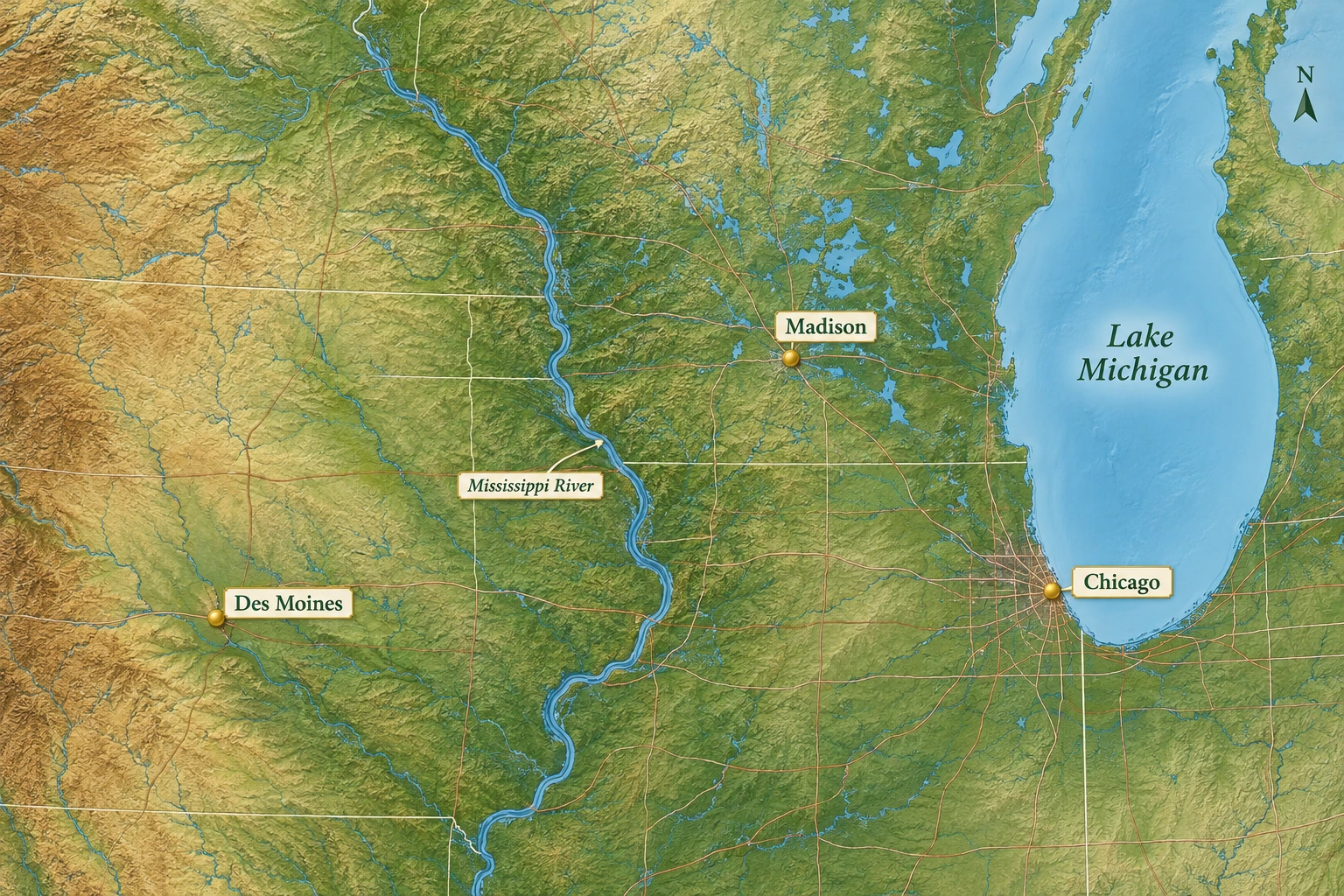
Geographic reference
Chicago: see whether a different urban pattern gives you more usable time

Chicago offers a denser city-life question for a person who wants a particular role, an available course or more of the week connected by urban transit. A smaller home could be a good exchange if it supports a simpler daily journey and time for an interest you will use. The purpose is the pattern of life, rather than collecting access to every attraction in a large city.
There is a concrete cultural opportunity to put beside the transit question: the Chicago Cultural Center publishes free exhibitions, performances and public events. A person who wants art and music to become part of ordinary life can try a programme there during a working-week visit. The decision is then whether the chosen home and return journey leave room for that pleasure regularly, rather than whether the city contains enough attractions for occasional visitors.
CTA’s current schedules distinguish bus routes and the different L lines, with service and elevator alerts. Put one actual home beside the actual work or study entrance and the evening return. A short walk on a summer visit can feel different in winter or with groceries. Include the access and late-hour conditions that matter to you.
The historical monthly median gross rent for Chicago city was $1,440, compared with Columbus at $1,295, in the common ACS release. That citywide background does not quote a transit-near apartment. Compare its actual rent, utilities and space with any complete vehicle cost you can genuinely remove. A car-free budget requires the whole ordinary week to work that way.
For someone moving alone into a documented museum role, an evening class near the return route could help the neighborhood become familiar. For the example family, school and the swimming replacement need their own workable places in the day. Plan the Columbus relationship as visits and calls with realistic time and money, while testing the Chicago week that makes the change worthwhile.
Try first: Try the actual CTA connection and final walk at the required hours, inspect the apartment’s usable space, and check whether the errands and evening you want really fit without a car.
Local sources: Schedules & Route Info - CTA · Chicago city, Illinois Census historical gross rent · Columbus city, Ohio Census historical gross rent · City of Chicago :: Chicago Cultural Center.
Des Moines: a smaller routine with the home and outings close enough

Des Moines can be worth investigating for someone who wants a more compact set of daily destinations around a particular local role, or for a household beginning a quieter next stage. A manageable home, straightforward outings and time left for people or an interest would give that move a purpose. Check those things from an address you could actually choose.
The Pappajohn Sculpture Park provides a specific outing near downtown, with pathways among large outdoor works and a visitor guide from the Des Moines Art Center. For a retiree who enjoys art, or relatives looking for a shared walk, it can be part of a manageable local week. Pair it with the current DART network, which replaced older routes and stops in June 2026; an archived route number should not decide the home search.
Its historical monthly median gross rent was $1,090 in the common ACS release, compared with $1,295 for Columbus. That difference is a starting question about available homes. It does not answer the condition of a level-entry property, the cost of utilities or the amount a new appointment will pay. Use the actual arrangement in the whole-month comparison.
DART is the provider starting point for current Des Moines-area route information. Check the home against the actual job, shops and appointments, including the return and any access requirements. If the plan relies on a particular accessible service or a relative’s help, confirm the applicable conditions and agreement directly. General availability of transport is less useful than a workable outing.
A retiring person moving with a relative might value a home that is easy to leave as much as one that is easy to clean. Try the trip to the place they would visit regularly and give both people an independent part of the week. Columbus contact will need its own rhythm at this distance. Des Moines is promising when the smaller routine creates more usable life for the people involved.
Try first: Choose one manageable home and test a complete ordinary outing, checking current DART information or the actual driving/help arrangement and the person’s access needs.
Local sources: DART: network effective June 14, 2026 · Des Moines city, Iowa Census historical gross rent · Columbus city, Ohio Census historical gross rent · Pappajohn Sculpture Park | Des Moines Art Center.
Madison: give a course or appointment a workable home base

Madison could become meaningful for an adult taking a specific funded course or professional appointment and wanting time for a more local daily rhythm. The gain might be a manageable home with a regular learning or work destination and an interest that fits after it. Start with the named program or employer, its actual location and the terms you can rely on.
Olbrich Botanical Gardens offers an identifiable pleasure for someone interested in plants or a quieter outdoor routine. Its outdoor gardens have free admission under the posted terms, and the site is connected to the Capital City Bike Trail. A study-led household might make a garden visit the shared pause in an otherwise busy week. Check the seasonal opening and the route from home, with the conservatory and special events treated under their own terms.
The common ACS release gives Madison city a historical monthly median gross rent of $1,413, compared with Columbus at $1,295. That is not a quotation for a home near the program. Put current housing terms beside dependable funding or take-home pay, including the months between terms or before work begins. A study plan should explain its whole funded period.
Madison Metro Transit provides current routes, schedules and service information. Compare the particular address with the campus building or workplace you will use, then test the evening return. If cycling is part of the attraction, inspect the actual route, storage and an alternative for weather or equipment problems. A pleasant spring ride does not settle the whole year.
For a partner, identify a positive and separately workable purpose: a suitable role, an available course, a funded interval or caring by agreement. Give each adult useful room and time in the home. Madison earns a shortlist place when the opportunity, affordable arrangement and ordinary life are all available in the version you are considering, with Columbus visits planned rather than assumed.
Try first: Confirm the program or appointment and its funding, then compare one current home offer with the actual Metro or cycle journey and a dependable winter alternative.
Local sources: Metro Transit | City of Madison, WI · Madison city, Wisconsin Census historical gross rent · Columbus city, Ohio Census historical gross rent · Olbrich Botanical Gardens: plan a visit.
High-country and Alaskan chapters
Denver, Albuquerque and Anchorage offer different landscapes and seasons; a specific opportunity and complete year give the setting its practical meaning.
Mountain regions with different city lives
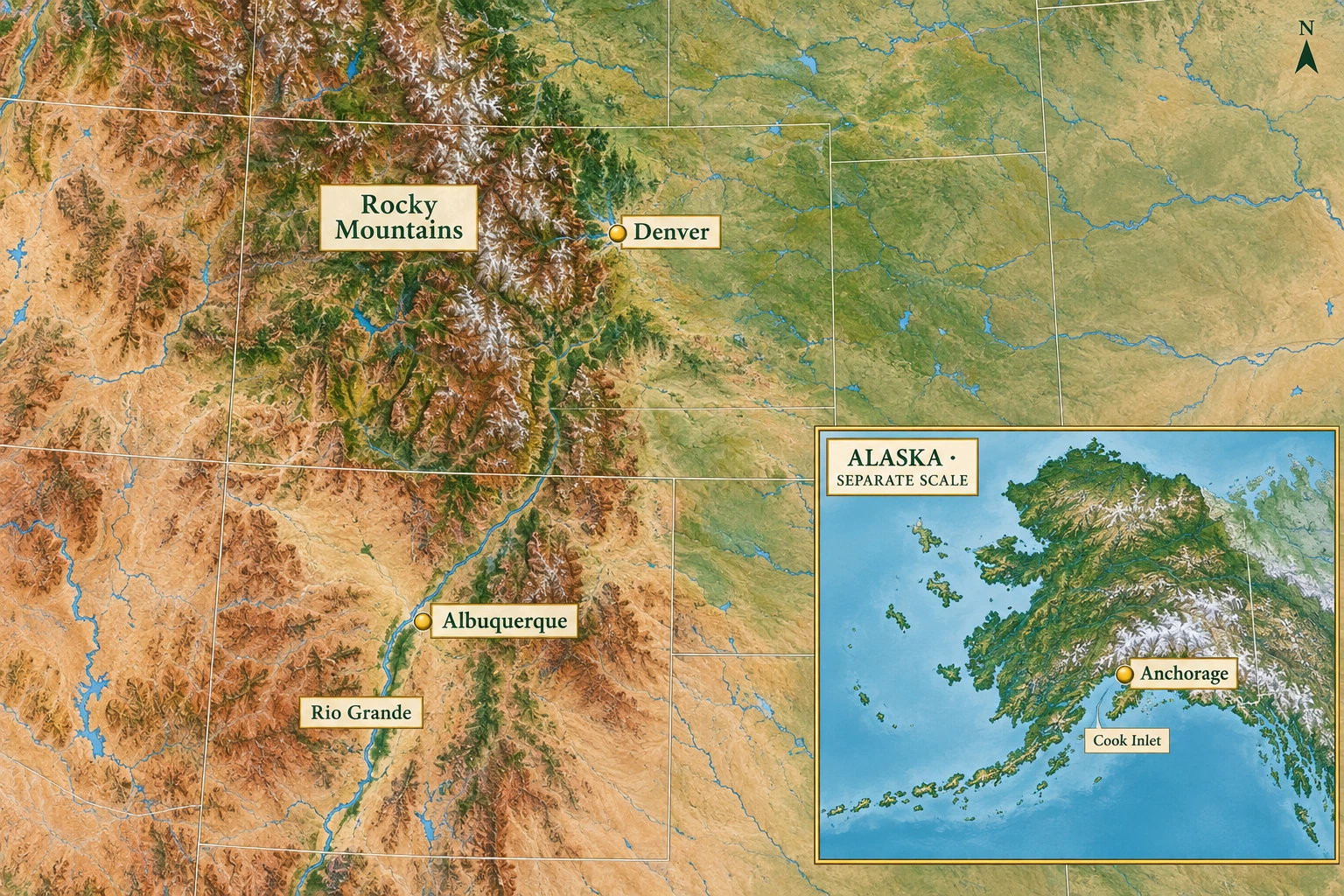
Geographic reference
Denver: choose the city day as carefully as the mountain horizon

Denver could become worthwhile for an adult with a documented role and a household that wants a drier, higher-elevation setting with mountain time as part of life. The positive question is how much of that setting you will actually use. Begin with an urban home and workday; a mountain horizon and regular mountain outings are two different benefits.
Mountain weekends need not carry the whole reason for the move. Denver Botanic Gardens’ York Street site provides an urban place for plant interest, exhibitions and a changing programme of learning activities. Someone who wants to draw, garden or spend time around plants could try that side of city life during a normal week. Choose any actual class through its current programme; the point is a repeatable city pleasure alongside the farther landscape.
The historical monthly median gross rent for Denver city was $1,831 in the common ACS release, compared with $1,295 for Columbus. A higher household-income estimate does not supply your take-home salary. Put the actual appointment and current home offer beside the complete transport, insurance and care arrangement, leaving room for the activities that make the setting attractive.
RTD’s current information is the starting point for the actual transit journey. Check the required worksite and return, including the final walk and any days that differ from the normal roster. If a car is part of reaching work or the landscape you want to use, include its whole cost. A city home near transit does not automatically make every desired mountain outing car-free.
The NOAA table uses the Denver–Stapleton reference station, with historical monthly means of 32.1°F in January and 74.8°F in July. Those figures do not describe every part of the Denver region or mountain weather. Test the specific home’s heating and cooling arrangement and an ordinary outing at the elevation and season you will use. Denver is stronger when the job, city routine and landscape purpose fit the same resources.
Try first: Confirm the worksite and home terms, make the actual RTD or driving journey, and plan one realistic mountain outing with its time, transport and seasonal limits.
Local sources: Regional Transportation District | RTD-Denver · Denver city, Colorado Census historical gross rent · Columbus city, Ohio Census historical gross rent · NOAA:1991–2020 climate normals · Homepage | Denver Botanic Gardens.
Albuquerque: explore a high-desert home with room for an interest

Albuquerque offers a different kind of western setting for someone who values the high desert, a manageable home and time for an interest such as gardening, making or walking. A retiree or an adult following a particular appointment could find a positive reason to investigate it. Keep that purpose attached to a home and daily destinations, rather than the appearance of an adobe courtyard alone.
The city’s Open Space Visitor Center gives a high-desert interest a specific beginning. Its exhibits, art gallery, demonstration garden and wildlife-viewing areas bring the landscape into an ordinary outing, with seasonal bird interest and volunteer information. For a person living alone, that can be a place to explore a recurring interest and possible participation. Try the trip from a home you could choose, including the hours you would be free to go.
The common ACS release reports $1,145 monthly median gross rent for Albuquerque city, compared with $1,295 for Columbus. That historical difference cannot price a particular home or its utilities and condition. Compare current terms, dependable income, health cover and full transport. If you are considering a garden or outdoor workspace, check the property’s actual usable space and responsibilities.
ABQ RIDE provides the local starting point for current transit routes and information. Put the home, work or appointments and regular errands beside the service you could use. A broad city map should not stand in for the actual walk or return. If support or an accessible service is essential, confirm its applicable conditions directly with the responsible provider.
Use a visit to see how the home handles sun, shade and the season, and to make the outing you hope will become regular. A high-desert setting has different practical demands from central Ohio. For an older person moving alone, an enjoyable courtyard and a way to reach people both matter. Include the greater distance from Columbus in the care, visit and starting-cash plan.
Try first: View one usable home, obtain current utility and tenancy information, and test a complete trip to an appointment, shop or repeatable activity before choosing the high-desert version of the week.
Local sources: Transit — City of Albuquerque · Albuquerque city, New Mexico Census historical gross rent · Columbus city, Ohio Census historical gross rent · Open Space Visitor Center — City of Albuquerque.
Anchorage: make the winter day and the specific opportunity work together

Anchorage could be meaningful for a person with a particular appointment and a strong wish to live with an Alaskan setting through the year. The gain might be work they want and regular access to a landscape they will genuinely use. It is a substantial new chapter from Columbus, so begin with the actual role, home and household arrangements rather than the idea of Alaska in general.
Anchorage’s municipal trail resources make the outdoor purpose more specific: the city distinguishes multi-use and winter-use trails and provides grooming updates. An adult who actually enjoys winter walking or skiing can begin with a suitable local route and learn its conditions, rather than relying on a distant mountain view. For two people, try an outing each would choose willingly; the accompanying adult needs a life they value through the same winter.
The comparison table uses Anchorage municipality, whose geography differs from a compact city-center area. Its historical monthly median gross rent was $1,489, compared with $1,295 for Columbus. Use the actual housing offer, dependable take-home income, utilities, complete transport and return-travel costs in the household month. The starting cash also needs the journey and timing specific to this move.
People Mover supplies current Anchorage route information. Check the actual home and worksite against the roster, the walk to stops and the last return. The winter version matters: a route on the map and a cleared, usable approach to the front door are separate questions. Confirm the building’s maintenance and heating arrangements and the equipment the household will use.
At the Anchorage airport reference station, the historical January monthly mean was 16.9°F and July 59.6°F, against Columbus at 29.6°F and 75.4°F. Daylight and the exact local conditions add to that seasonal change. Give a partner a useful purpose and agree how Columbus contact, care responsibilities and a possible return would work. Anchorage earns attention when those arrangements support the particular opportunity and the life around it.
Try first: Obtain the actual appointment terms, check a winter home-to-work journey and building responsibilities, and fund the beginning, Columbus contact and an exit or return plan separately.
Local sources: Anchorage People Mover: journey resources · Anchorage municipality, Alaska Census historical gross rent · Columbus city, Ohio Census historical gross rent · NOAA:1991–2020 climate normals · Anchorage municipality: trail and winter-use resources.
Pacific settings with different city scales
Oakland, Eugene and Los Angeles belong to distinct regional geographies. Choose the ordinary local week and the opportunity within it.
Three different Pacific city geographies
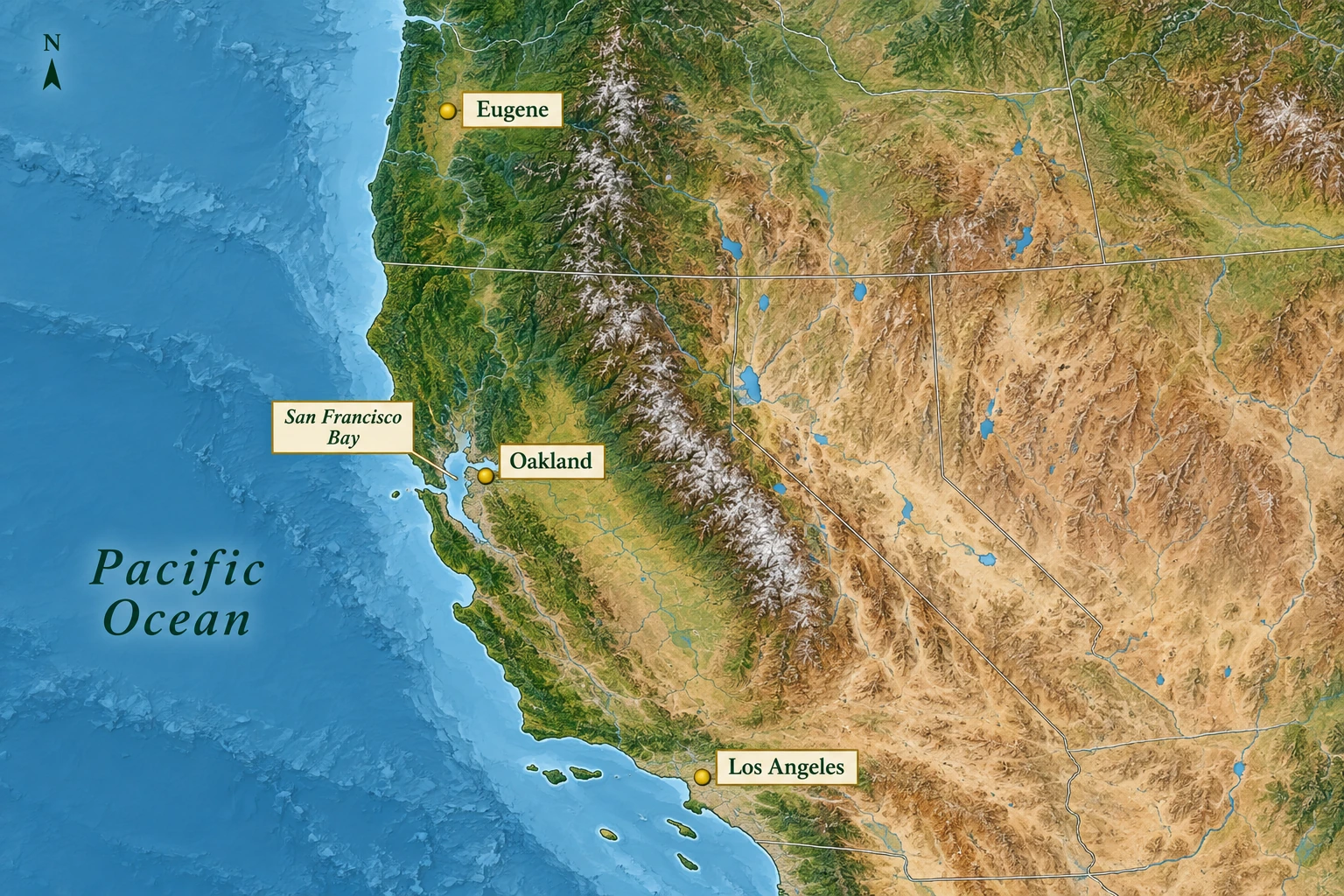
Geographic reference
Oakland: choose an East Bay routine with a clear regional destination

Oakland can be a serious option for someone with a named East Bay appointment, a family connection or a strong reason to join that region’s working and cultural life. A compact home with a useful porch, a regular local interest and a workable journey could give the move a positive shape. The regional destination matters: Oakland, another East Bay city and San Francisco are different daily arrangements.
The Oakland Museum of California brings art, history, natural science and a garden into one local cultural destination. That can give an East Bay household a shared interest to return to alongside work. Its events are seasonal—the advertised 2026 Friday-night run ends in October—so use the current calendar rather than promising a permanent weekly gathering. A visit can still show whether this local cultural life is part of the change you want.
The historical monthly median gross rent for Oakland city was $1,979 in the common ACS release, compared with Columbus at $1,295. Those figures are not current apartment quotes. Compare the actual home terms with the actual role’s take-home pay, full transport, care and insurance, then see what remains for the activities and relationships that made the region attractive.
AC Transit and BART provide different parts of the regional transport picture. Put the actual workplace entrance beside a candidate home, including any transfer, final walk and return after a late obligation. A property near one station may still ask for a different local connection. If the plan removes a vehicle, make sure the recurring errands and the other adult’s day work too.
For a person moving alone, one repeatable neighborhood activity can make the region less abstract. For the example household, useful room and the child’s school and activity are essential parts of the home search. Compare the housing condition and applicable local responsibilities using the actual property information, and put Columbus visits into the month at this distance. Oakland is a stronger choice when the opportunity and usable local life justify the resource change together.
Try first: Test one complete AC Transit/BART or driving journey from an actual home, obtain the full current housing terms, and calculate the whole household month with planned Columbus visits.
Local sources: Home | Alameda-Contra Costa Transit District · Schedules | Bay Area Rapid Transit · Oakland city, California Census historical gross rent · Columbus city, Ohio Census historical gross rent · Oakland Museum of California: galleries and garden.
Eugene: picture the valley week in the wet season too

Eugene offers a Willamette Valley chapter for someone following a particular course or role and wanting a more local rhythm around it. A home with usable space for a bicycle, a regular outdoor interest and an achievable daily journey could create a concrete gain. The useful setting is the week you would live there, rather than a generic image of the Pacific coast.
The University of Oregon’s Museum of Natural and Cultural History offers a specific local destination beyond the course or job. Its visitor information includes exhibits, access details and the approach by bicycle or LTD. For someone curious about Oregon’s natural and cultural setting, a return visit can become a modest part of getting to know the region. Try it from the candidate home alongside an ordinary errand, including the wet-weather return.
The common ACS release gives Eugene city a historical monthly median gross rent of $1,402, against Columbus at $1,295. That context does not establish that a home near the opportunity is cheaper. Put current rent, utility and property terms beside dependable pay or the whole funded study period. Include the cost of keeping equipment dry and stored where it actually belongs in the home.
Lane Transit District is the provider starting point for current route and service information. Check the particular home against the work or course building and the return after an evening. If walking or cycling is part of the attraction, try the real route and an alternative for weather, illness or a bike problem. A favorable visit should not be the only version of the year in the plan.
A solo learner might make a weekly activity near the return journey the first social step. A household should give the accompanying adult a funded and positive day as well. Plan Columbus contact at this distance in visits and calls that you can sustain. Eugene earns a shortlist place when the actual opportunity and valley routine remain appealing through an ordinary wet week.
Try first: Confirm the specific role or course and its resources, compare a real home with the current LTD journey, and test the storage and wet-season alternative for the travel pattern you want.
Local sources: Lane Transit District · Eugene city, Oregon Census historical gross rent · Columbus city, Ohio Census historical gross rent · Visit the Museum | Museum of Natural and Cultural History.
Los Angeles: make a workable district-sized life inside a very large city

Los Angeles could be meaningful for an exhibit fabricator with a specific production appointment or for someone whose work, study or family purpose is firmly attached to part of the city. The positive goal is a useful local life around that destination: a home, ordinary errands and time for an interest. Begin at that scale rather than expecting the whole metropolitan area to feel equally available.
A district-sized cultural week can begin with a public resource such as Central Library. Its current programme includes reading and language support, chess and creative activities, while the building also lists the Octavia Lab and other resources. Choose the branch and actual activity that fit the home and work journey; Central Library is an example to explore, not the inevitable destination for every Los Angeles address. That gives the local-life question a useful first answer.
The historical monthly median gross rent for Los Angeles city was $1,933, compared with Columbus at $1,295, in the common ACS release. That citywide estimate does not price a home near the site you need. Compare actual take-home pay, current home terms, complete transport and care, leaving room for the change in space and the activities the move is meant to support.
Metro’s current maps distinguish rail and bus services. Put a particular home beside the actual work entrance and ordinary start, including days when the site changes or the finish is late. A route line and a familiar neighborhood name leave the last connection unresolved. If driving fills the gap, include parking and the full vehicle arrangement rather than only fuel.
For the example household, a manageable courtyard apartment could give a useful home base, but the school, activity and each adult’s day still need their own practical places. Use a visit to make the real journeys and see the home at the hours you would use it. Columbus family contact becomes a different commitment at this distance. Los Angeles is worth pursuing when the named opportunity and district-sized week justify that exchange.
Try first: Confirm the exact site and roster, pair it with one current home offer and complete Metro or driving journey, and map the school and evening return before expanding the search area.
Local sources: Line Schedules and Maps - LA Metro · Los Angeles city, California Census historical gross rent · Columbus city, Ohio Census historical gross rent · Central Library | Los Angeles Public Library.
Compare the room left after the whole month
Begin with dependable take-home income and the recurring needs of the people who will move. Housing matters, but so do complete transport, health cover, care, debt, food and the contact with Columbus you want to keep. Put the same needs in the same categories for each place. The useful result is what remains after that month, together with the home and time it buys.
The four examples below use chosen inputs for one household. They are a way to see the calculation, rather than a price guide to the named horizons. The current Columbus arrangement leaves $900. A nearby home with a $100 lower housing cost leaves $650 after greater driving and other commitments. The regional arrangement leaves $1,300, while the farther arrangement leaves $400 despite higher take-home income.
A better monthly remainder can give you breathing room for the purpose of the move. In the regional example, an additional $400 could support a course, rebuild savings or reduce pressure on the next unexpected expense. Check that the improvement comes from dependable terms. A hoped-for overtime pattern, unconfirmed care arrangement or second salary without an available job belongs in a separate scenario.
Build full transport costs from the arrangement you would actually use. For a car, include insurance, fuel, maintenance, registration, parking and the cost of replacing it over time. For transit, add the trip to the stop, the latest return and any regular gap that needs another paid ride. A household that adds a second vehicle has changed much more than its monthly fuel bill.
Give the beginning its own cash plan. Unrecoverable transition spending, refundable deposits or overlapping payments, and a reserve for disruption have different jobs. A deposit that may come back still ties up money on moving day. An emergency reserve remains available for an unexpected event; it should not be quietly spent to make the move appear affordable.
The illustrative $10,800 of unrecoverable transition spending takes 27 months to recover from a dependable $400 improvement. That arithmetic helps you judge whether the expected stay and the reason for moving fit the expense. It does not measure the value of a safer entrance, being near a parent or accepting a role you particularly want. Record those gains alongside the financial result.
The Census table supplies a common historical background, with monthly gross rent, annual household income and their published 90% margins of error. Household income is before tax and is not a salary offer or take-home amount. Gross rent covers occupied cash-rent homes and applicable utilities. Use the table to ask better questions, then use current evidence for the particular home, offer and household you are comparing.

Illustrative monthly USD; take-home income after tax. These are planning examples, not quotations or city averages.
| Monthly result | Current Columbus home | Nearby home; more driving | Regional home; workable routes | Farther home; higher daily costs |
|---|---|---|---|---|
| Money left each month | $900 | $650 | $1,300 | $400 |
| Take-home income | $6,100 | $6,100 | $6,200 | $6,400 |
| Recurring essentials | $5,200 | $5,450 | $4,900 | $6,000 |
Current Columbus home
$900Money left each month
- Take-home income
- $6,100
- Recurring essentials
- $5,200
Nearby home; more driving
$650Money left each month
- Take-home income
- $6,100
- Recurring essentials
- $5,450
Regional home; workable routes
$1,300Money left each month
- Take-home income
- $6,200
- Recurring essentials
- $4,900
Farther home; higher daily costs
$400Money left each month
- Take-home income
- $6,400
- Recurring essentials
- $6,000
The regional example leaves $1,300 a month, compared with $900 today. The nearby example saves $100 on housing but leaves $250 less overall because the rest of its month costs more. A move helps when the arrangement as a whole gives you the room you need.
See the hypothetical inputs
| Recurring expense | Current Columbus home | Nearby home; more driving | Regional home; workable routes | Farther home; higher daily costs |
|---|---|---|---|---|
| Housing and basic utilities | $1,850 | $1,750 | $1,600 | $2,200 |
| Food and household supplies | $850 | $850 | $850 | $925 |
| Full transport costs | $650 | $925 | $600 | $800 |
| Health and insurance | $425 | $425 | $425 | $500 |
| Care and scheduled activities | $700 | $700 | $700 | $850 |
| Debt and other commitments | $425 | $475 | $400 | $450 |
| Columbus contact and return visits | $300 | $325 | $325 | $275 |
Current Columbus home
- Housing and basic utilities
- $1,850
- Food and household supplies
- $850
- Full transport costs
- $650
- Health and insurance
- $425
- Care and scheduled activities
- $700
- Debt and other commitments
- $425
- Columbus contact and return visits
- $300
Nearby home; more driving
- Housing and basic utilities
- $1,750
- Food and household supplies
- $850
- Full transport costs
- $925
- Health and insurance
- $425
- Care and scheduled activities
- $700
- Debt and other commitments
- $475
- Columbus contact and return visits
- $325
Regional home; workable routes
- Housing and basic utilities
- $1,600
- Food and household supplies
- $850
- Full transport costs
- $600
- Health and insurance
- $425
- Care and scheduled activities
- $700
- Debt and other commitments
- $400
- Columbus contact and return visits
- $325
Farther home; higher daily costs
- Housing and basic utilities
- $2,200
- Food and household supplies
- $925
- Full transport costs
- $800
- Health and insurance
- $500
- Care and scheduled activities
- $850
- Debt and other commitments
- $450
- Columbus contact and return visits
- $275
Every figure is a chosen input for the same household needs. Replace the numbers with your actual take-home pay, address-specific housing offer, complete transport, care and insurance. Census gross rent is historical context and does not supply these hypothetical home payments.
An illustrative $10,800 of unrecoverable transition spending would take 27 months to recover from a dependable $400 monthly improvement. Keep refundable deposits, money temporarily tied up and an emergency reserve separate; they still affect the cash needed at the start.
- Spent to beginRecord unrecoverable transport, setup and other transition spending.
- Temporarily tied upFund deposits and overlapping payments under the actual terms.
- Kept availableProtect a separate reserve for disruption and a workable way back.
- Monthly improvementCompare the dependable remainder; calculate recovery only from a real gain.
Hypothetical example · $400 more left per month · $10,800 transition spending
The model assumes the improvement continues each month. A delayed paycheck or extra expense changes the timing. Deposits and the reserve remain separate cash decisions.
Six household comparisons: which change resembles yours?
These invented examples keep the household circumstances visible beside the arithmetic. They describe no local price, offered salary or available care place. Replace the inputs, including the separate transition allowance, with the terms that apply to your own move.
Hypothetical household inputs · USD per month
The invented solo adult accepts a documented appointment and a smaller home near the actual daily route. The compared month leaves $1,000 instead of $800. The $150 transport reduction belongs only to a week that can use that arrangement; the trial evening activity and Columbus contact still have their own space.
Read the chosen inputs
Take-home income: $3,900 current; $4,100 compared. Recurring essentials: $3,100 current; $3,100 compared.
| Expense | Current month | Compared month |
|---|---|---|
| Housing and basic utilities | $1,200 | $1,300 |
| Food and household supplies | $600 | $600 |
| Full transport costs | $400 | $250 |
| Health and insurance | $300 | $300 |
| Care and scheduled activities | $100 | $100 |
| Debt and other commitments | $350 | $350 |
| Columbus contact and return visits | $150 | $200 |
Chosen unrecoverable transition spending: $4,000. A continuing $200 monthly improvement would recover the chosen $4,000 transition spending in 20 months arithmetically.
Hypothetical household inputs · USD per month
The chosen retirement comparison leaves $550 instead of $450. A level entrance, manageable rooms and a dependable way to reach people are the main purpose. A $100 monthly gain alone would take a long time to repay the transition, so record the home and independence gains alongside the arithmetic.
Read the chosen inputs
Take-home income: $3,400 current; $3,400 compared. Recurring essentials: $2,950 current; $2,850 compared.
| Expense | Current month | Compared month |
|---|---|---|
| Housing and basic utilities | $1,100 | $1,050 |
| Food and household supplies | $550 | $550 |
| Full transport costs | $400 | $250 |
| Health and insurance | $350 | $400 |
| Care and scheduled activities | $200 | $250 |
| Debt and other commitments | $200 | $150 |
| Columbus contact and return visits | $150 | $200 |
Chosen unrecoverable transition spending: $6,000. A continuing $100 monthly improvement would recover the chosen $6,000 transition spending in 60 months arithmetically.
Hypothetical household inputs · USD per month
The shared-home example leaves $800 instead of $400, with higher housing but less transport and a changed care arrangement. That care input is hypothetical and depends on an explicit agreement, available services and privacy for the older adult. A relationship is not a cost-free service inferred from living together.
Read the chosen inputs
Take-home income: $6,400 current; $6,600 compared. Recurring essentials: $6,000 current; $5,800 compared.
| Expense | Current month | Compared month |
|---|---|---|
| Housing and basic utilities | $1,900 | $2,100 |
| Food and household supplies | $1,000 | $1,000 |
| Full transport costs | $900 | $700 |
| Health and insurance | $650 | $650 |
| Care and scheduled activities | $800 | $550 |
| Debt and other commitments | $450 | $450 |
| Columbus contact and return visits | $300 | $350 |
Chosen unrecoverable transition spending: $10,000. A continuing $400 monthly improvement would recover the chosen $10,000 transition spending in 25 months arithmetically.
Hypothetical household inputs · USD per month
This is the main household’s regional version: $1,300 instead of $900 remains. The exhibit fabricator has an actual on-site role, the payroll arrangement is confirmed, and the school-to-swimming handoff works without an unagreed extra helper. Those conditions give the chosen monthly inputs their meaning.
Read the chosen inputs
Take-home income: $6,100 current; $6,200 compared. Recurring essentials: $5,200 current; $4,900 compared.
| Expense | Current month | Compared month |
|---|---|---|
| Housing and basic utilities | $1,850 | $1,600 |
| Food and household supplies | $850 | $850 |
| Full transport costs | $650 | $600 |
| Health and insurance | $425 | $425 |
| Care and scheduled activities | $700 | $700 |
| Debt and other commitments | $425 | $400 |
| Columbus contact and return visits | $300 | $325 |
Chosen unrecoverable transition spending: $10,800. A continuing $400 monthly improvement would recover the chosen $10,800 transition spending in 27 months arithmetically.
Hypothetical household inputs · USD per month
The adult learner’s chosen month leaves $750 instead of $900. The course is worth considering because its confirmed content and funding support the intended next stage. Fund the whole interval and the beginning; a reduced monthly remainder should remain visible rather than being called a saving.
Read the chosen inputs
Take-home income: $4,500 current; $4,200 compared. Recurring essentials: $3,600 current; $3,450 compared.
| Expense | Current month | Compared month |
|---|---|---|
| Housing and basic utilities | $1,400 | $1,300 |
| Food and household supplies | $650 | $650 |
| Full transport costs | $450 | $300 |
| Health and insurance | $350 | $350 |
| Care and scheduled activities | $200 | $250 |
| Debt and other commitments | $350 | $350 |
| Columbus contact and return visits | $200 | $250 |
Chosen unrecoverable transition spending: $6,500. This arrangement does not produce a recurring improvement to recover the transition spending. It needs a valued purpose and a funded way to carry the resulting month.
Hypothetical household inputs · USD per month
This invented interval leaves $550 instead of $1,100 even with higher income. Each adult needs an applicable residence/activity basis and a useful funded purpose. The selected inputs include greater insurance and Columbus-contact costs; they are not prices for any of the four countries. Keep the return and emergency reserve separate.
Read the chosen inputs
Take-home income: $5,900 current; $6,000 compared. Recurring essentials: $4,800 current; $5,450 compared.
| Expense | Current month | Compared month |
|---|---|---|
| Housing and basic utilities | $1,700 | $1,600 |
| Food and household supplies | $800 | $850 |
| Full transport costs | $600 | $700 |
| Health and insurance | $450 | $700 |
| Care and scheduled activities | $500 | $550 |
| Debt and other commitments | $450 | $450 |
| Columbus contact and return visits | $300 | $600 |
Chosen unrecoverable transition spending: $12,500. This arrangement does not produce a recurring improvement to recover the transition spending. It needs a valued purpose and a funded way to carry the resulting month.
Compare historical rent and household-income estimates
Exact Census places, including city and Census-designated place areas · 2020–2024 ACS five-year estimates · 2024 US dollars. Gross rent covers occupied cash-rent homes and applicable utilities, not current listings. Income is annual household income before tax, not a salary or take-home amount. The ± figure is the published 90% margin of error. Differences subtract Columbus point estimates; they are not a significance test or personal saving. Scroll the table sideways on a narrow screen.
Build around the role or course you can actually take
A useful opportunity has a workplace, an arrangement and a next step. If a role is drawing you out of Columbus, ask where the work is performed, the ordinary start and finish, the dependable pay, benefits and any probation or renewal terms. Put those details beside a home you could reasonably use. A promising regional industry does not tell you whether your own role is available.
For the invented exhibit fabricator, on-site installation work cannot travel with a laptop. A new city would need an actual appointment, a credible client base or a funded route into a different role. For the payroll specialist, two home-working days are an agreement with the current employer, not a portable entitlement. A change of state or country should be checked with the employer before those days appear in the plan.
Test the awkward journey as well as the typical one. An early workshop start may precede a useful service, while a late installation could run past the last easy return. Ask about travel between sites, equipment storage and the days that differ from the usual roster. These details can change which neighborhood works even when the salary stays the same.
A course deserves the same specificity. Columbus State’s skilled-trades information describes named qualifications and programs; it offers a local comparison for someone considering retraining elsewhere. Check the exact program, entry conditions, actual timetable, campus or training location, costs and funding. An attractive university name does not establish a place on the course you need.
For a household move, give the other adult a positive plan of their own. That may be a new role, continued permitted employment, study with its own resources, caring by agreement or a funded interval with time to explore. Put the money and the day beside that purpose. A partner should not disappear into an assumption that any destination will provide something later.
Before committing, ask the employer or program the question that would change your choice. It might be whether the role is fixed at one site, whether the salary is guaranteed at the hours proposed, or whether an evening class is actually running. Save the answer and its date. Then compare the opportunity with Columbus using the terms you can rely on, rather than the version you hope will emerge.

Local sources: COTA: current journey resources · Columbus State: skilled trades · Sterling Oakbridge: Columbus long-distance service.
Make a useful day for every person who moves
A household move works through several people’s days at once. The most convincing version gives each person something positive: a manageable room, a role they want, an activity they can reach, time with someone important or space to be on their own. Write those gains separately before trying to put them into a single address.
For a child, the address leads to a school and a set of journeys. Confirm the school district and enrollment requirements with the district using the real property. Then ask about the start, finish, transport, after-school arrangements and any support the child actually uses. A familiar postal city or an appealing building photograph cannot settle those questions.
The swimming lesson in the example household is part of the child’s life, rather than a task that must remain unchanged forever. Ask what the child likes about it: the activity, the friends, a particular teacher or simply having a reliable afternoon. Another place may offer a different version worth trying. Give the child room to take part in that discovery without making them responsible for the family’s decision.
Agree the handoffs on a busy day. Put work returns, school release and the activity into one timeline, including a modest allowance for things running late. Name the adult who covers each handoff and the person who has actually agreed to help if that plan fails. The nearby example becomes less attractive if its larger home requires a third person to bridge an unspoken gap every evening.
For an older relative who will move with you, begin with the home they will use. Check the entrance, bathroom, bedroom, comfortable place to sit, storage and the journey to regular care. Privacy and independence are positive parts of the arrangement. A separate room is useful only if the person can also enter the shared day on terms that work for them.
For a relative who stays in Columbus, describe the contact you want to keep. A weekly meal, a regular overnight visit and being available for an urgent request are different commitments. Put the travel time, cost and practical limits beside each. If a farther appointment changes the pattern, agree a new one that both sides can expect rather than promising the old frequency from a new distance.
Pets, equipment and everyday possessions also belong to the actual home search. Ask about the specific tenancy terms, entrances, storage and usable outdoor space. A household with a bicycle, workshop tools or a large instrument needs a place for those things in the floor plan. Moving less can help, but it should follow a decision about what the next life will use.
If the adults prefer different options, compare the gain and burden for each person rather than adding up a vague city score. One destination may improve the workshop role while making the payroll specialist’s day smaller. Another may give both a reasonable week at a slightly higher housing payment. The six household examples in the finances section show how the same comparison changes with the arrangement.
Before choosing, describe the first month and one ordinary month after the move has settled. Temporary accommodation, an overlap in care or a delay before employment can be manageable when they are planned and funded. Keep the continuing arrangement visible so that a solution designed for the first few weeks does not become the unnoticed permanent one.


- One useful day eachGive each adult and child a positive purpose in the new arrangement.
- The actual handoffsPlace school, care, work returns and the activity on one timeline.
- Agreed helpConfirm who can cover a disruption, when and on what terms.
- The home in useTest entrances, private rooms, storage and the route to everyday places.
Local sources: Columbus City Schools:2026–27 enrollment · Hilliard City Schools: enrollment · Westerville City Schools: enrollment process.
Give yourself a regular place among other people
If you are moving alone, begin with a life you could enter repeatedly. A room you like and a suitable role are a strong start; a weekly activity, a familiar place to stop and someone you expect to see make the hours around them more your own. Choose one interest you actually want to keep doing, rather than a long list of events you hope will make you sociable.
A person accepting a regional museum appointment might look for an evening ceramics session near home. Someone retraining could ask about a study group attached to the actual course. A retiree could try a garden group or a walking route with a regular meeting. These are possible ways to build a week, not claims that a particular place has an available space or the right people waiting.
During a visit, do one ordinary version of that interest at the time you could attend after moving. Ask the organizer about joining, attendance, cost, accessibility and whether newcomers can try a session. Then make the return journey to the candidate home. The activity is more likely to become part of life if it fits the evening you will have.
Give yourself permission to prefer a quieter social arrangement. A reliable neighborly exchange, a weekly class and occasional calls to Columbus may suit you better than a busy calendar. The useful question is whether the place lets you have enough company and enough privacy for your own temperament. Density and a full events page do not answer that by themselves.
Keep an existing connection in a form you can sustain. Decide which calls, visits or shared activities matter and what they will cost in time and money. A regular call after a shift may be more dependable than promising frequent flights. A regional move might allow planned weekends; a transatlantic move needs a different rhythm and attention to time zones.
For a partner moving with someone else’s role, the same principle applies. Work, learning, volunteering where permitted, an interest or caring by agreement can give a positive purpose to the day. Explore what is actually available and lawful in the destination. Being accompanied is not the same as already having a local life of your own.
Leave room for the first months to be unfamiliar. You can choose a home and a repeatable way to meet people without knowing exactly how friendships will develop. Record one realistic first step, such as attending an agreed trial session or arranging an introductory visit. That is a more useful preparation than expecting the city’s reputation to do the social work for you.

Choose the space and support for the next stage
A smaller home can offer a positive change: fewer rooms to maintain, an easier entrance, less equipment to manage and more time for the things you want to do. Begin with those gains. The number of bedrooms matters less than the rooms and journeys the next stage of your life will actually use.
Make a short list of daily activities and place them in the candidate floor plan. There should be a comfortable place to sleep, cook, wash, read, receive the people you want to see and store the belongings you will keep. Check the route between those places, including thresholds, doors and any stairs. A compact home can be generous in use when its layout fits.
For someone retiring from regular site work, the workshop tools may need a deliberate decision. Keep the equipment attached to an activity you will continue, find a suitable shared facility if one is available, or pass on items you no longer want to maintain. Measure the retained pieces before booking transport. A new home should not lose its useful room to possessions awaiting an unresolved decision.
Explore support without giving up independence unnecessarily. A nearby relative, a regular service, an accessible transport option and a suitable home each solve different problems. Ask the person or provider about the actual arrangement, cost, hours and limits. If help is essential on a particular day, make that day part of the comparison rather than assuming general proximity will cover it.
Put continuing care and ordinary pleasure beside each other. A convenient appointment is valuable, and so is a route to the garden, shop, class or friend that makes a day satisfying. For an older person moving alone, a home that is easy to manage but difficult to leave may fail the purpose of the move. Try the complete outing from the front door.
You can make this comparison within Columbus, in a nearby Ohio place or farther away. Keep one version that improves the home while retaining current care and relationships, then compare it with the new arrangement. Choose the change that creates a usable next stage, with the cost of beginning and the support it will depend on clearly understood.


Choose a setting you will use through the year
A different landscape can be a substantial reason to move. You may want regular access to a larger city, a river path, a garden, a drier climate, mountains or the Pacific. Picture how you would use it on an ordinary week. The attraction becomes more meaningful when it fits the time, transport and energy left after work and home life.
Compare the less convenient season as carefully as the season that first appealed to you. Miami offers a very different winter from Columbus, but a hot wet period changes the ordinary walk, cooling needs and time outdoors. Anchorage changes both the cold-season journey and the amount of winter daylight. A mountain-region city adds its own elevation, exposure and travel questions.
The NOAA comparison below uses 1991–2020 monthly mean temperatures in degrees Fahrenheit at four named stations. Columbus airport averaged 29.6°F in January and 75.4°F in July; Miami airport 68.6°F and 84.1°F; Denver–Stapleton 32.1°F and 74.8°F; Anchorage airport 16.9°F and 59.6°F. These historical station means describe a common background. They are not forecasts, daily highs, a measure of comfort or a statement about every neighborhood.
Temperature alone leaves important parts of the year unexplained. Look at humidity, rain, daylight, elevation and the actual building’s heating or cooling arrangement. Ask about the maintenance and insurance implications of the specific property and location. If a hazard could change the home choice, use current local information for that address rather than a citywide reputation.
Try the outing you hope will become regular. Can you reach the path or park from the home after an ordinary workday? Is the route usable for the people and equipment you will bring? A mountain view through a window can be lovely, but it is a different benefit from having time and transport to use the mountains. Either can be worth choosing when you know which one you mean.
Give a change of setting its proper financial and social place. Extra equipment, a different vehicle pattern or more expensive return visits can be reasonable costs for a life you want. Include them beside the gain rather than treating the landscape as a free addition. Then compare the whole year you would live with the Columbus year you know.

NOAA 1991–2020 reference-station monthly means · Fahrenheit · common 0–100°F bar scale
The means combine days and nights. They begin the seasonal comparison, without predicting a day, property condition or neighborhood temperature.
| Reference station | January monthly mean | July monthly mean |
|---|---|---|
| Columbus airport, Ohio | 29.6°F | 75.4°F |
| Miami airport, Florida | 68.6°F | 84.1°F |
| Denver–Stapleton station, Colorado | 32.1°F | 74.8°F |
| Anchorage airport, Alaska | 16.9°F | 59.6°F |
Reference-station monthly means, not a forecast or property condition. NOAA climate normals.
Give a visit the question that could change your choice
A useful visit starts with an uncertainty. You may need to know whether a home works for a visiting relative, whether a job journey is manageable, or whether you can picture a satisfying evening alone. Choose one or two questions that could change the shortlist and give them an ordinary day of observation.
For the invented Columbus household, begin at the actual candidate home and the actual start time. Make the downtown work journey, the school-to-swimming handoff and the return after the activity. If the current Line 30 is part of a Hilliard plan, use its current stops and timetable. If the plan depends on driving, include parking and the final walk to the door.
View the room that must carry the home-working days and the entrance that should improve everyday access. Measure the retained desk and the clear passage. Open the doors, inspect the usable storage and consider ordinary sound at the hours you will be there. A photograph can show an attractive room without answering how two people will use it.
For a solo move, put one practical errand and one repeatable interest into the visit. For retirement, try the outing to a shop, appointment or friend from the home. For study, travel to the actual campus or training location and check the evening return. Each version should test the reason you are considering the place.
Use conversations to resolve things observation cannot settle. Ask the district about the address, the employer about the roster, the landlord about the actual terms and the organizer about joining an activity. Keep the answer and date with the comparison. An encouraging informal comment should become a clear agreement before a commitment depends on it.
After the visit, write three short notes: what became easier to imagine, what the day asked of you, and what still needs an answer. A place can remain promising while one issue is unresolved. Name the issue and the next action so that the attractive parts do not silently stand in for the missing evidence.
If a visit is impractical, begin with a careful remote version: the current provider information, an accurate floor plan, a live viewing where appropriate and direct questions to the responsible people. Keep the limits visible. Before a major commitment, arrange the observation or professional check that matters for the property and circumstances you are actually choosing.

- Choose a questionIdentify the uncertainty that could change the shortlist.
- Try the ordinary versionMake the actual journey or outing at the time you would use it.
- Ask the responsible personConfirm the property, district, employment or permission detail observation cannot settle.
- Update the choiceWrite the gain, compromise and next unresolved condition beside the place.
Explore four international beginnings with a purpose of their own
An international move can offer a particular role, a course of learning, a family connection or the chance to build an ordinary life in another culture. Begin with that purpose, then establish the lawful way each person can live and, where relevant, work or study there. A visitor stay and a long-term household arrangement answer different questions.
The four horizons in this edition are Equatorial Guinea around Malabo, Albania around Tirana, Jersey in the Channel Islands around Saint Helier, and Bhutan around Thimphu. They offer different professional, cultural and household beginnings. Jersey is a Crown Dependency with its own relevant controls; living elsewhere in the Channel Islands would require a separate investigation of that jurisdiction.
Equatorial Guinea is a narrow employer-supported possibility for a suitably qualified person with a specific assignment and a household package that can answer practical needs. Albania asks whether a real work or other qualifying residence basis can support the urban life you want. Jersey joins an employment and immigration question to a distinct housing-status question. Bhutan begins with an approved named employment arrangement rather than a tourism itinerary.
Establish the route before turning a place into a commitment. A professional assignment, a course and a funded period accompanying another person can involve different permissions and different responsibilities. Put the actual purpose, citizenship, expected duration and household composition into the enquiry. A promising answer should identify what each person can do, the conditions it depends on and the next step toward permission.
Use each profile to build a positive day as well as an entry plan. The person following a role needs a workable home and life outside work. A partner needs their own applicable status and a funded purpose; a child needs an actual education and care arrangement. Language, health cover, transport and the cost of keeping Columbus contact belong in the same household plan.
Before paying for a commitment, check current rules with the responsible authority and the particular employer or institution. The profiles identify the important distinctions and a next step; they do not establish personal eligibility. Sterling’s geographic information here does not create an international transport service or a promise to arrange residence, employment, schooling or housing.

Equatorial Guinea: a supported professional chapter around Malabo
Closer profile: Malabo. Other place horizons: Bata · Luba.
Malabo on Bioko, with mainland context
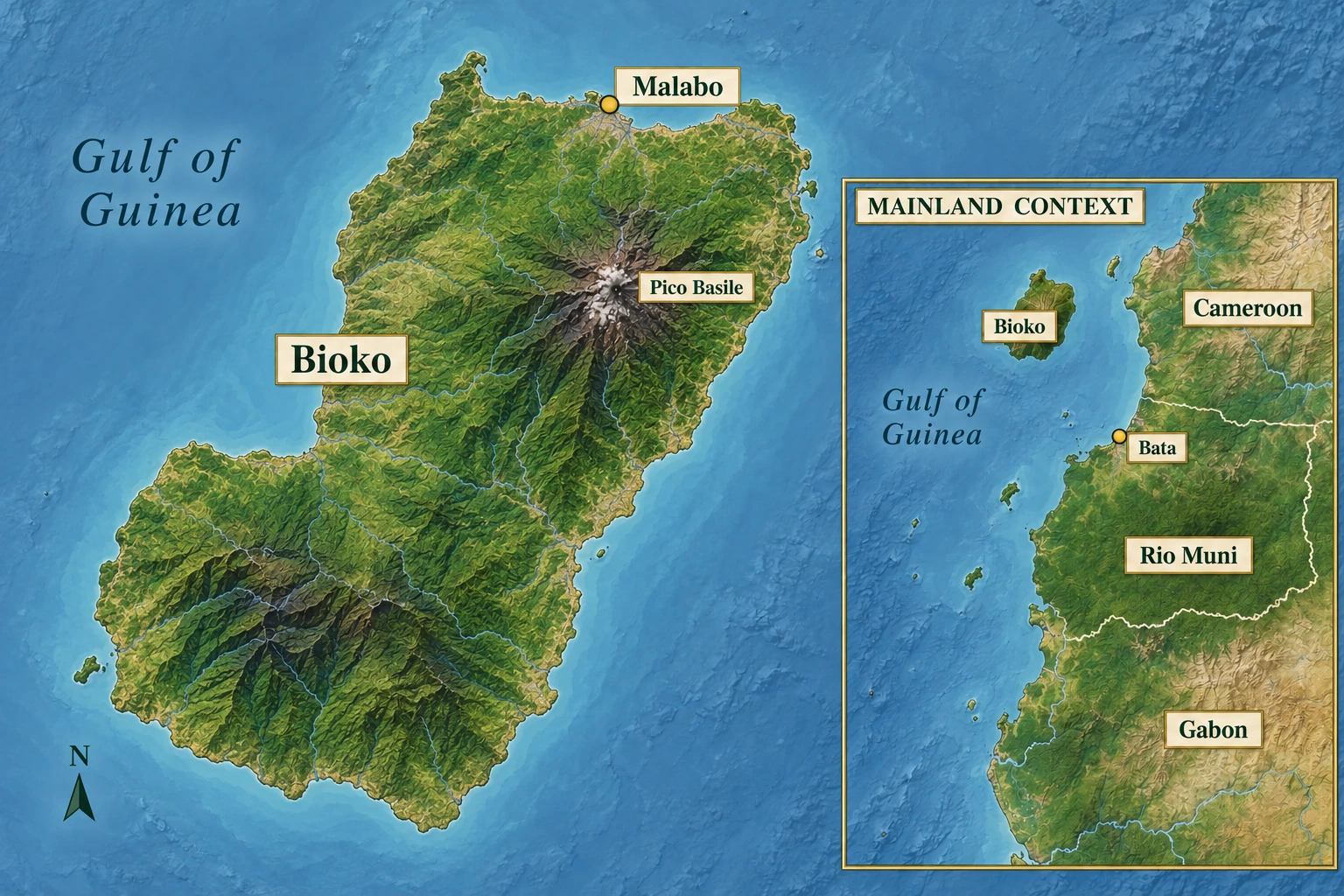
Geographic reference

Malabo could be meaningful for an experienced electrical-controls specialist considering a specific employer-supported assignment, with time to build an ordinary life on Bioko. The positive reason is the assignment and the chance to work and live in another cultural setting. It is a narrower possibility than choosing a new US city from available homes. Begin with a genuine named employer, the worksite and a household package capable of supporting the people who would go.
Keep island and mainland geography clear. Malabo is on Bioko’s northern coast, across water from the mainland region of Río Muni. Bata is a different mainland base; Luba is elsewhere on Bioko. A role described simply as Equatorial Guinea could therefore lead to a very different home and journey. Confirm the actual site, the travel it requires and where the household would live before building a Malabo budget.
The government’s published 2021 expatriate-regularization order distinguishes residence documentation and a work permit. That dated order is evidence of the distinction, rather than a current complete checklist or an open amnesty. Ask the responsible consular and employment process for the presently applicable entry, residence and work requirements for this person, role and timing. A visitor arrangement should not be treated as an alternative way to begin the assignment.
Give the accompanying adult a purpose and an applicable status of their own. A funded interval for language learning or an independent interest may be attractive, but it needs resources and a lawful arrangement; the other adult’s job does not by itself establish permission to work. If a child would move, obtain a specific education and care plan, including the language and practical journey, before treating the assignment as a household opportunity.
Build the home budget from the actual package. Ask which housing, utilities, dependable transport and communication costs are covered, which are deducted, and what the household pays directly. Compare the remaining money with the Columbus baseline and keep a reserve outside the initial move spending. A headline salary is less informative than the contract and usable home arrangement it can support.
Current US official guidance identifies limits in medical and emergency resources, as well as crime and arbitrary-enforcement concerns. The practical plan needs identified care, suitable insurance and evacuation arrangements, dependable transport and an agreed way to leave if necessary. Resolve those conditions with the employer and appropriate providers before a commitment depends on them. They can determine whether this particular assignment is workable for the household.
Give the days outside work a positive form too. Government cultural information describes a centre in Malabo with a library and reading areas. For a partner interested in language or reading, its current programme is one concrete enquiry to make, alongside the access and transport from the candidate home. Bioko’s landscape offers another interest to explore with knowledgeable local guidance. Establish the actual activity and conditions before expecting either to provide a regular place in the week.
Keep Columbus contact and the end of the assignment in the plan from the start. Agree the visit rhythm, the money and the responsibilities that continue in Ohio. Ask what happens if the contract ends early, how the home arrangement ends and what support covers departure. Malabo deserves further work when a specific opportunity and a complete, lawful household arrangement answer those questions together.
Try first: Ask the named employer and responsible authorities for the current entry/work/residence route, actual site and written household package, including care, transport and departure arrangements; compare those answers with staying in Columbus before booking a commitment.
Local sources: Equatorial Guinea government:2021 regularization order (historical) · Equatorial Guinea government: 2025 immigration communiqué · US Department of State: Equatorial Guinea advice · Equatorial Guinea government: island and mainland geography · Equatorial Guinea government: cultural-centre and library context.
Albania: an urban chapter in Tirana with the right residence and activity basis
Closer profile: Tirana. Other place horizons: Durres · Shkoder.
Tirana within Albania

Geographic reference

Tirana could appeal to a person with a real professional or family reason to live in Albania and a wish to build an urban week in another language. Imagine an architectural-conservation specialist considering a documented local appointment, with a partner planning a funded interval of Albanian learning and their own research or creative interest. The gain is a purposeful chapter for both adults, rather than a promise that an inexpensive visitor stay will turn into a long-term working life.
Begin with the applicable residence and activity permission. The Interior Ministry’s information separates residence and unique-permit procedures, and the published law defines a single permit for residence for work purposes. Take the actual employment or other qualifying purpose, citizenship, intended stay and household composition to the current responsible process. Establish the permission appropriate to each person; an application or permission to visit should not appear in the plan as approval to begin work. The published law also contains employment-authorization exemptions for specified legally resident nationals, including US nationals and their families in Article 80. That distinction may affect which work authorization is required; it does not itself settle residence, professional recognition or the current circumstances of either adult.
For the specialist, confirm the actual employer, role, workplace, pay and any qualification or professional-recognition conditions that apply to the work. The partner’s language interval needs its own available course or learning plan, funding and appropriate residence basis. If either person hopes to continue paid work for a US employer, resolve that arrangement with the employer and the relevant authorities before counting the income. A laptop does not settle the legal or employment question.
Picture a home and errands within Tirana itself. The city is inland, with higher terrain to the east and the Adriatic coast farther west; Durrës is a separate coastal city. Choosing a Tirana role does not mean that a beach-town home will support the same daily routine. Begin with the actual worksite and a neighborhood you can use, then test the walk, current local transport and the evening return.
Give the setting a practical pleasure. A regular language session, an ordinary market errand or time in one of the city’s parks could help the new week become familiar. The municipality’s information describes green and lake settings around Tirana, but a destination description does not tell you how easily your home reaches them. Try the outing from the address you are considering and check what it asks of an ordinary day.
Build a current household month rather than converting a general low-cost reputation into a budget. Use an actual housing offer with its terms and utilities, dependable after-tax resources, health cover, transport and the cost of maintaining Columbus contact. Keep currency movements and the beginning’s cash needs visible. If one person is taking a funded interval, cover its whole intended duration without relying on work they have not arranged.
For a household with a child or continuing care needs, confirm the particular education, language and care arrangements rather than assuming they follow from residence permission. Ask what is available to this person and what the actual journey, schedule and cost will be. A plan can be attractive while still needing one of these answers; mark it as an unresolved condition before paying for a home that depends on it.
Use an exploratory stay within its lawful conditions to test a normal week, while keeping a clear way back and a plan for any period awaiting permission. Compare the gains with the Columbus life you would leave: the role, the independent day for each adult and time for the new cultural setting. Tirana earns a shortlist place when those gains and the current permissions, resources and home arrangement can support the same chapter.
Try first: Confirm the current residence and activity route for each adult with the responsible process, obtain the actual appointment and home terms, and test a Tirana neighborhood week with the partner’s funded purpose included.
Local sources: Albanian Interior Ministry: residence and single-permit procedures · Albania: Law79/2021 on foreigners, English text · Tirana municipality: Kashar local context.
Jersey, Channel Islands: join the employment plan to an eligible home
Closer profile: Saint Helier. Other place horizons: Saint Aubin, Jersey · Saint Peter Port, Guernsey — a separate jurisdiction.
Saint Helier on Jersey
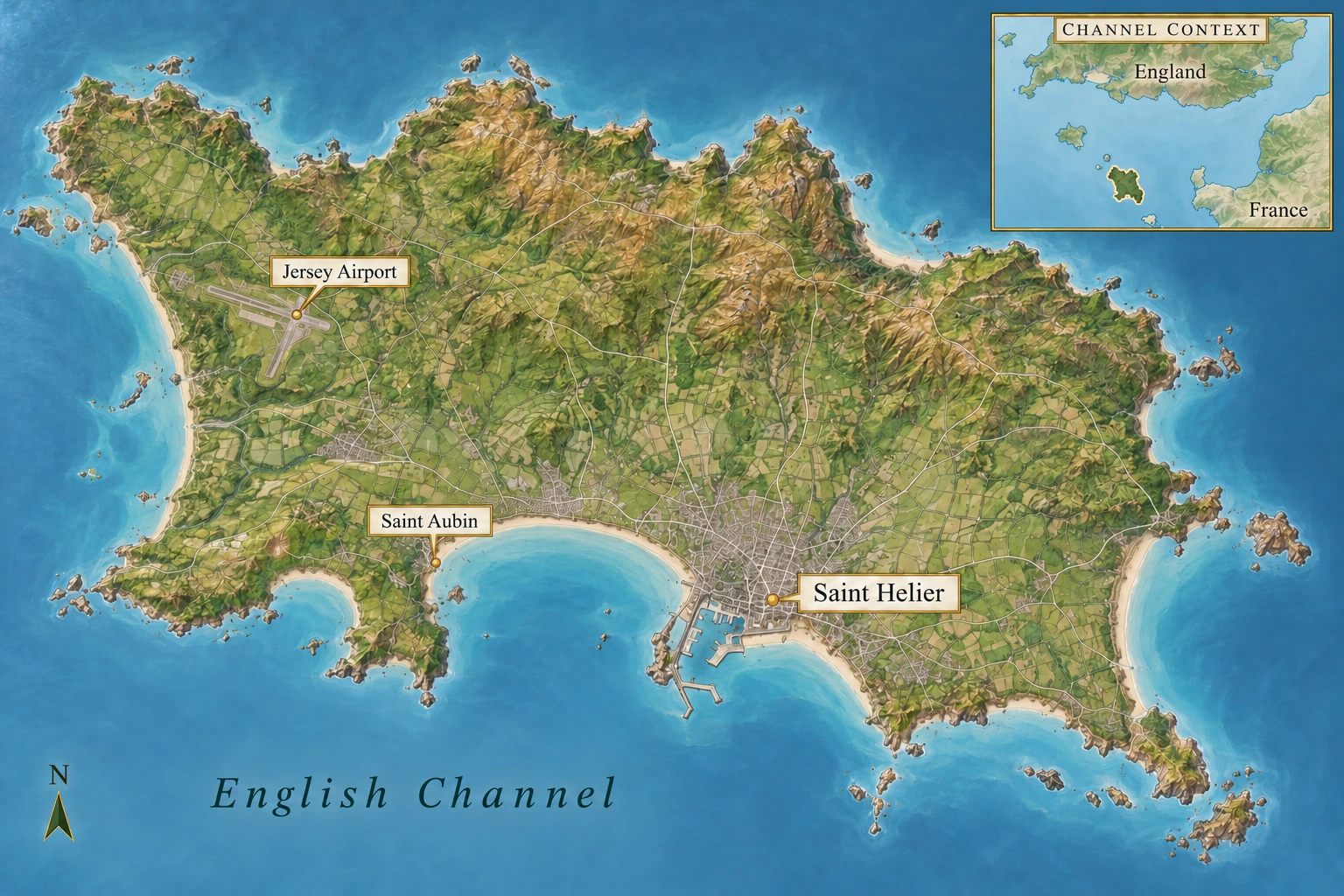
Geographic reference

Saint Helier could be meaningful for an experienced financial-reporting specialist considering a specific Jersey appointment, with a partner who wants a compact island-town chapter and has a separately workable purpose. The positive possibility is a professional role and a daily life close enough to use on foot or by a practical local journey. Jersey’s limited space also makes the actual home a central part of the choice.
Use Jersey’s own rules. It is a Crown Dependency, and a Jersey arrangement is not a general permission for the UK, the EU or another Channel Island. Jersey and Guernsey have separate jurisdictions; this closer profile is specifically about Jersey. Begin with the person’s applicable immigration and employment route and the employer’s actual permissions for the role.
The government’s current individual guidance explains that immigration requirements operate alongside Control of Housing and Work status. Its September 2026 changes include six statuses, with Standard replacing the previous Registered status and a Licensed for Lease Only category. Older introductory pages may still use the previous terminology. Check the current guidance for the actual person and appointment instead of carrying a historic four-status description into the home search.
An employer-linked Licensed status and a work permit have different jobs. The government describes Licensed status as tied to an agreed post, while its work-permit policy concerns a named employer, employee and role. Establish what is actually being arranged and what happens if the role ends. The accompanying adult’s right to work and housing position also need their own applicable answer; they should not be inferred from the main appointment.
Choose an eligible home before using an asking price in the budget. Jersey distinguishes Qualified and Registered accommodation, and the person’s status can limit what they may occupy, rent or buy. A home advertised online is not necessarily a home available under that person’s status. Obtain confirmation of the property’s category, the household’s eligibility, current terms and any link to the employment arrangement.
Then build a Saint Helier week at the scale you would live. The Central Market and Jersey Museum give the town a specific cultural and everyday focus to explore. Test the actual workplace, an ordinary shop trip and the route to the interest you want to keep. LibertyBus is the local starting point for current service information. A village or another part of Jersey may offer a different home setting, but it changes those journeys. Saint Aubin is on Jersey; Saint Peter Port is on Guernsey and requires a separate jurisdictional comparison.
Use the actual salary and home offer to calculate what remains after tax, housing, utilities, transport, health arrangements and contact with Columbus. Include the cash needed before the first dependable pay and the cost of leaving if the arrangement ends. An island setting can be worth choosing for its own qualities, but a higher nominal salary should not hide a narrow housing choice or an unplanned second adult’s day.
For the partner, identify a real activity, role or funded interval that gives the week a purpose beyond accompanying the appointment. For a child, confirm schooling, care and the home’s suitability under the actual arrangement. Saint Helier is a stronger possibility when the role, each person’s position and an eligible home are available together, and the ordinary island life is one you both want.
Try first: Ask the employer which immigration/work and CHW arrangements apply to the named role, confirm each adult’s position, and obtain eligibility and terms for one actual home before comparing the monthly result.
Local sources: Jersey: housing and work statuses fromSeptember2026 · Jersey: current housing guidance · Jersey: work-permit policy · Visit Jersey: Saint Helier · LibertyBus: Jersey journey planning.
Bhutan: an approved appointment and a Thimphu valley life
Closer profile: Thimphu. Other place horizons: Paro · Punakha.
Thimphu within western Bhutan

Geographic reference

Thimphu could become meaningful for an experienced technical educator considering a specific approved appointment, with time to take part in another cultural setting. Imagine a structural-engineering lecturer with a genuine named institution and a partner planning a funded interval for language and a permitted independent interest. The purpose is a working and living chapter in the city, rather than extending the feeling of a Himalayan holiday.
Bhutan’s labour and immigration sources begin the foreign-employment route with employer-side approval. The Department of Immigration’s employment-visa information calls for Department of Labour approval, and the published foreign-worker rules distinguish the applicable work permits. Start with the actual employer, role, qualifications, location and duration, then establish the current permission needed before entry and work. Tourism arrangements should not be treated as a route to start the appointment.
Keep each person’s position separate. A partner’s accompanying status, intended stay and any work or study activity need an applicable basis and their own resources or explicit support. If a child would move, obtain a particular education and care arrangement before treating the post as a family opportunity. The appointment’s approval does not, by itself, answer those different household questions.
Thimphu is a city in the Wang Chhu valley in western Bhutan, with residential areas extending along the valley and onto adjoining slopes. The municipality describes an elevation range of roughly 2,248 to 2,648 metres. Paro lies in another valley to the west and Punakha in a different setting northeast of Thimphu. Choose the actual work location first; a countrywide landscape image does not explain a daily home-to-institution journey.
Look at the usable home and its approach. Ask about heating, water, communication, cooking, storage and the actual route at the hours you will use. The municipality publishes city-bus information, while a transport-development project describes intended improvements. Use current service evidence for the journey you need, rather than treating a proposed corridor as already available from every home.
Give the new setting a positive place in the week. A regular language-learning arrangement, a local cultural interest and a manageable walk could make the interval purposeful for both adults. Ask the responsible people about joining and the conditions that apply. The mountain setting is a real attraction, but the city’s elevation, slopes and seasons also belong in a household’s practical and health planning with suitable professional advice where needed.
Calculate the resources from the actual package: dependable pay or funding, home terms, utilities, transport, health arrangements and the money for Columbus contact. Confirm what the institution covers, what it deducts and what remains the household’s responsibility. Fund any period before the post begins and the way to leave when it ends; the appointment may be a defined interval rather than an indefinite settlement plan.
Before making the commitment, ask for the current approvals and written terms, then compare one ordinary Thimphu week with the Columbus week you know. The role should be worthwhile, the partner should have a useful day, and the home and journeys should support both. Thimphu deserves further exploration when the particular opportunity, permissions and resources make that chapter possible together.
Try first: Obtain the employer’s current labour/immigration route and actual appointment terms, confirm the accompanying household’s position, and build a funded home-and-journey plan in Thimphu before a commitment depends on it.
Local sources: Bhutan Immigration: employment visa · Bhutan: Foreign Workers Rules and Regulations2024 · Bhutan: Immigration Rules and Regulations2023 · Bhutan government: foreign-worker employer portal · Thimphu municipality: local setting · Documents – Thimphu Thromde.
Bring two to four possibilities into a decision you can support
A useful shortlist has a reason for each place and a next decision for each reason. Keep two to four possibilities that can meet the essential conditions, rather than a long ranking of names. One could improve the home within Columbus; another could preserve selected Ohio connections; a third could follow a specific opportunity farther away.
Use the worksheet to put the same questions beside each possibility. Name the real home or search area, the purpose, dependable income, recurring essentials, cash needed at the start, work and school journeys, support and one way to build an enjoyable week. For an international option, add the applicable residence and activity basis for every person.
Give each important input a source and a date. A current offer, a district answer, a property term and a historical survey estimate have different roles. Mark an unknown as unknown and assign the next step that could resolve it. Filling a blank with a convenient assumption can make the page look complete while leaving the decision unfinished.
Let essential conditions come before preference scores. If the home cannot support an essential access need, an adult has no lawful work basis, or the daily care handoff has no agreed answer, more points for scenery do not fix the missing arrangement. You may still investigate a different address or version of that place, provided it can answer the condition.
Compare the gains that remain after those conditions are met. A suitable entrance, room for a sustained interest, a role you want or a relationship you can see more often may justify a different cost or distance. Write the gain in a sentence you can return to when the practical work becomes busy. It keeps the move attached to its purpose.
Choose the next reversible step before the largest commitment. It could be a viewing, a timetable test, a direct employer question, a permit consultation or an agreed trial activity. After that step, update the comparison. You can narrow the list or decide that another Columbus home gives the most useful improvement for the present stage.
When the destination and timing are firm enough, turn the home choice into a transport inventory and access plan. Decide what will move, measure the important pieces, record the entrances at both properties and identify any date overlap. Ask the actual carrier for written scope and terms that match those facts. The informational guide does not set a transport price or guarantee a particular service.
For a move within the company’s actual service scope, use the Columbus long-distance page to discuss the real origin, destination, inventory, access and dates. For other arrangements, identify the appropriate provider and responsibilities directly. Keep transport, property, work and residence decisions with the people who can confirm each one.
The decision can be ready without every future detail being certain. You should be able to explain the gain, the essential arrangements, the money needed, the meaningful compromises and the next responsibilities. That is a useful place to move from: a clear choice about the life you want to make possible, supported by evidence that belongs to the version you will actually use.
Columbus: compare the week you could make possible
Columbus, Ohio origin · date:
The change I want in an ordinary week
Columbus connections I want to keep
My next observation and review date
| My comparison | Place 1 | Place 2 | Place 3 | Place 4 |
|---|---|---|---|---|
| Actual home, entrance and useful rooms | ||||
| Dependable take-home income or funded period | ||||
| Recurring essentials and amount left | ||||
| Named work or course site and ordinary hours | ||||
| School, care, activity and agreed handoffs | ||||
| Complete journeys and the evening return | ||||
| A repeatable interest and independent day | ||||
| Columbus contact and planned visit costs | ||||
| Unrecoverable starting spending | ||||
| Deposits, tied-up cash and available reserve | ||||
| The gain, compromise and next condition |
Keep two to four possibilities and compare the same household needs. Use current terms for the actual arrangement, retain the source and date, and leave an unknown open with its next action. Separate the monthly remainder, unrecoverable starting spending, refundable or tied-up cash and reserve. Try an ordinary day and a less convenient season, then keep, revise or set aside each possibility with a reason.
Questions when choosing where to move from Columbus
Where should I start if I want to move from Columbus but have no destination?
Write down the change you want, two useful connections you want to keep, and a tradeoff you would accept. Then compare three versions: another Columbus home, a nearby Ohio arrangement and a farther opportunity with a real reason behind it. Keep two to four places that can answer those conditions and choose one small test for each.
Could another Columbus home solve the problem without a farther move?
Yes. If the main difficulty is the layout, a stair, a noisy shared room or the entrance, compare properties that could change that condition while keeping work and relationships. Measure what the new home must support and calculate its whole month. A farther city becomes more useful when the destination itself offers a role, relationship, setting or other gain you want.
Is Hilliard necessarily a cheaper alternative to Columbus?
No. The common ACS release gives historical monthly median gross rent of $1,632 for Hilliard and $1,295 for Columbus, with uncertainty shown in the table. Those are different occupied housing stocks, not current home offers. Compare the particular payment and complete transport with the usable space or access gain the home would provide.
Has the Hilliard transit comparison changed?
Yes. COTA launched Line 30 in September 2026, connecting Hilliard, Upper Arlington, Ohio State and downtown. Test its current stops and timetable from the actual home to the actual work entrance, including the return. The new corridor creates an option; it does not establish that every Hilliard address or shift will work on one bus.
Does a Westerville postal address settle the school assignment?
Use the exact property with the district. Westerville City Schools directs families to verify attendance boundaries before enrolling, and the address must be confirmed for the arrangement you need. After that, put the actual school day, care or activity and work returns on one timeline. A postal city name alone does not complete that plan.
Can I treat Newark, Ohio as another Columbus neighborhood?
Compare it as a place with its own local center. A particular Newark role or exact campus program, a usable home and local journeys could make a good week. If most work and activities stay in Columbus, include that longer travel pattern in time and money. Licking County Transit information supports local planning; it does not establish a general Columbus commute.
Which farther US city is best for this move?
The useful choice is the one that meets your essential conditions and offers a gain worth rebuilding the week for. Begin with a named opportunity or a setting you will use, then pair it with an actual home, dependable income, workable journeys and a way to build a local life. Use the profiles to choose the next test, rather than reading their order as a ranking.
How do I compare monthly affordability?
Subtract the same recurring essentials from dependable take-home income for each arrangement. Include housing, food, full transport, health and insurance, care, debt and the Columbus contact you want to keep. Compare what remains and what the home and time provide. Use current evidence for your own inputs; the four displayed cases are illustrative arithmetic.
Why does the nearby budget example leave less money despite cheaper housing?
Its housing input falls by $100, but other recurring costs rise enough to reduce the monthly remainder from $900 to $650. That is a chosen example showing how the full arrangement can outweigh one saving. Replace each input with the home and journeys you are considering before using the result for a decision.
How much cash belongs in the beginning of the move?
Build three separate amounts: unrecoverable transition spending, refundable deposits or money temporarily tied up, and a reserve for disruption. Add any overlap or delay before dependable income. A refundable deposit still needs funding at the start, while a reserve should remain available for an unexpected event. Use the actual terms rather than one assumed universal moving allowance.
How does the 27-month recovery example work?
The regional case leaves $1,300 a month against the current case’s $900, a $400 improvement. Dividing the illustrative $10,800 of unrecoverable transition spending by $400 gives 27 months. That calculation needs a dependable improvement and a realistic expected stay. Keep refundable cash and the emergency reserve separate, and record nonfinancial gains alongside the arithmetic.
Can I keep the same hybrid or remote job after moving?
Confirm the new location and working arrangement with the employer before counting that income. The example payroll specialist’s two home-working days are an employer agreement, not a general right that travels to any state or country. Establish the work, tax and other applicable arrangements with the responsible parties, then use the dependable terms in the home comparison.
What should an accompanying partner have in the plan?
Give the partner a positive day and resources of their own: an arranged role, an available course, caring by agreement or a funded interval with a purpose they want. Include their room, journeys and social life. For an overseas move, confirm their applicable residence and activity position separately; the main appointment should not silently stand in for those answers.
How do I compare a move with a child?
Confirm the actual school address and arrangements, then put the start, release, care, activity and adult work returns into one weekday timeline. Agree the handoffs and the person who can cover a disruption. Ask what the child values about the present activity or friendships and explore a workable new version, without making the child responsible for the decision.
How can moving alone become more than a new home and job?
Choose one interest you want to do regularly and test it during a visit at the time you could attend after moving. Ask about joining, cost and conditions, then make the return to the candidate home. Keep a sustainable form of Columbus contact too. A repeatable local step gives the week a place for company without requiring a busy social calendar.
What matters most in a smaller-home or retirement move?
Fit daily activities into the actual floor plan and outing: entrance, bathroom, bedroom, storage, cooking, a comfortable place to sit and a way to reach care and people. Decide which possessions and equipment the next stage will use. Confirm any essential help directly and compare one version that keeps current Columbus arrangements with the farther alternative.
Do the temperature figures describe the weather I will get?
They are 1991–2020 monthly mean temperatures at four named NOAA stations, not a forecast, daily high or comfort score. Use them to understand the scale of a seasonal change, then check humidity, rain, daylight, elevation and the actual home’s heating or cooling arrangements. Test an ordinary outing in the less convenient season where practical.
Can I use the maps to choose a route or establish a property boundary?
Use them for orientation: relative places, terrain, rivers and regional setting. For a journey, use current provider information and the actual address. For a school, property or service boundary, use the responsible owner’s current information. The atlases are original illustrations with checked geographic references, rather than navigation or parcel records.
Are the Census rent and income numbers comparable with my take-home salary?
They have different roles. The table keeps a common ACS period, exact Census geography and published 90% margins of error. Gross rent is monthly historical rent for occupied cash-rent homes and applicable utilities; household income is annual and before tax. Neither is a current home offer or your salary. Use actual take-home resources in the personal budget.
Why is the Malabo profile limited to an employer-supported possibility?
It is built around a specific professional assignment and a household package that can answer the local practical needs. Establish current entry, residence and work requirements, the actual site, housing, dependable transport, care and departure arrangements before committing. A general interest in Bioko or a visitor stay does not supply those conditions.
What is different about Jersey and Bhutan as relocation horizons?
Jersey needs the applicable immigration/work arrangement alongside the current housing-and-work status and eligibility for the actual home. Bhutan’s employment sources begin with employer-side labour approval and the applicable immigration/work process for a named role. In both cases, confirm each accompanying person’s position and a funded ordinary week. They are specific opportunities to investigate, rather than general permissions to settle.
When is the choice ready to discuss transport with Sterling Oakbridge?
When the actual origin, destination, timing, inventory and access are clear enough to discuss a real scope. Use the Columbus long-distance page for an arrangement within the company’s actual service scope and obtain written terms for the facts of your move. This guide supplies relocation information; it does not set a carrier price or create international residence, employment or transport services.
Sources and method
Official records and page extracts were checked for this October 2026 edition, with original dates retained where relevant. Sources sit beside the passages they support. The US table uses a common 2020–2024 ACS five-year release for the exact named Census areas and keeps the published margins of error. NOAA 1991–2020 reference-station monthly means begin the seasonal comparison. Actual home prices, offers and property conditions require their own current evidence; the household budget inputs here are illustrative arithmetic.
All city and household scenes and eleven atlases were newly made for this Columbus edition. One suitable Columbus nearby map retains its exact previously accepted image and review identity. Scenes illustrate possibilities, not documented customers, available homes or job offers. The detailed AI atlas maps use checked geographic references to picture settings and relative places. Use current provider information and the actual address when choosing a home or planning a journey.
- Tirana municipality: Kashar local context
- Albania: Law79/2021 on foreigners, English text
- Albanian Interior Ministry: residence and single-permit procedures
- Albuquerque city, New Mexico Census historical gross rent
- Transit — City of Albuquerque
- Open Space Visitor Center — City of Albuquerque
- Anchorage municipality, Alaska Census historical gross rent
- Anchorage People Mover: journey resources
- Anchorage municipality: trail and winter-use resources
- Thimphu municipality: local setting
- Documents – Thimphu Thromde
- Bhutan Immigration: employment visa
- Bhutan: Immigration Rules and Regulations2023
- Bhutan government: foreign-worker employer portal
- Bhutan: Foreign Workers Rules and Regulations2024
- Chicago city, Illinois Census historical gross rent
- City of Chicago :: Chicago Cultural Center
- Schedules & Route Info - CTA
- NOAA:1991–2020 climate normals
- Columbus city, Ohio Census historical gross rent
- Denver city, Colorado Census historical gross rent
- Homepage | Denver Botanic Gardens
- Regional Transportation District | RTD-Denver
- Des Moines city, Iowa Census historical gross rent
- Pappajohn Sculpture Park | Des Moines Art Center
- DART: network effective June 14, 2026
- Detroit city, Michigan Census historical gross rent
- Detroit DDOT: bus schedules
- Parks & Greenways | Detroit Riverfront Conservancy
- Equatorial Guinea government: cultural-centre and library context
- US Department of State: Equatorial Guinea advice
- Equatorial Guinea government: 2025 immigration communiqué
- Equatorial Guinea government: island and mainland geography
- Equatorial Guinea government:2021 regularization order (historical)
- Eugene city, Oregon Census historical gross rent
- Visit the Museum | Museum of Natural and Cultural History
- Lane Transit District
- Fort Worth city, Texas Census historical gross rent
- Home - Trinity Metro - Tarrant County public transit service.
- Trinity Trails of Fort Worth - Trinity Trails
- Hilliard city, Ohio Census historical gross rent
- Hilliard City Schools: enrollment
- Metro Parks: Heritage Trail Park
- Visit Jersey: Saint Helier
- Jersey: current housing guidance
- Jersey: housing and work statuses fromSeptember2026
- LibertyBus: Jersey journey planning
- Jersey: work-permit policy
- Los Angeles city, California Census historical gross rent
- Central Library | Los Angeles Public Library
- Line Schedules and Maps - LA Metro
- Louisville/Jefferson County metro government (balance), Kentucky Census historical gross rent
- Home - TARC
- Louisville Waterfront Park
- Madison city, Wisconsin Census historical gross rent
- Olbrich Botanical Gardens: plan a visit
- Metro Transit | City of Madison, WI
- Memphis city, Tennessee Census historical gross rent
- MATA Transit - Memphis Area Transit Authority | MATATransit.com
- Shelby Farms Park : It's Your Park
- Miami city, Florida Census historical gross rent
- Bayfront Park Management Trust
- Transportation & Public Works
- Ohio State Newark: campus and study resources
- City of Newark, Ohio - Official Website
- Licking County Transit
- Newark city, Ohio Census historical gross rent
- Oakland city, California Census historical gross rent
- Oakland Museum of California: galleries and garden
- Home | Alameda-Contra Costa Transit District
- Schedules | Bay Area Rapid Transit
- Sterling Oakbridge: Columbus long-distance service
- Columbus State: skilled trades
- COTA: current service changes
- COTA: September2026 Line30 launch
- COTA: current journey resources
- Columbus City Schools:2026–27 enrollment
- Pittsburgh city, Pennsylvania Census historical gross rent
- Pittsburgh Regional Transit
- Friends of the Riverfront: Three Rivers Heritage Trail
- Westerville city, Ohio Census historical gross rent
- Department of Theatre & Dance - Otterbein University
- Westerville City Schools: enrollment process
Census ACS methods · 2024 Census Gazetteer
Download the comparison data (CSV) · Download the model inputs (JSON)