
Virginia · Leesburg service planning
Packing and Unpacking Services in Leesburg, VA
Sterling Oakbridge packs the agreed household contents and can help unpack them at the receiving home.

Choose full packing, selected rooms or fragile items, then decide what should be usable on the last night and the first morning. Packing labor, cartons, receiving help and optional finishing work belong in the estimate as distinct parts of the job.
Explore packing, costs and local examples
Protect the time before the move
Professional packing is useful when the preparation competes with the rest of your life: work, meals, children, appointments and the move itself. A household can pack successfully on its own. The practical question is whether the available evenings cover the actual cupboards, closets and stored belongings while leaving the home usable.
Walk through one kitchen cabinet rather than starting with a room count. Take out the contents of one representative shelf, consider the protection and labeling they need, then look at everything still behind closed doors. A couple of weeks of evening preparation is one possible experience, not a standard duration. If that schedule already conflicts with work or sleep, selected packing can remove the part that is holding up the rest.
For example, you might pack clothing and everyday books yourself while the crew prepares dishes, framed pieces and a display cabinet. Another household may prefer the whole agreed inventory packed on a preparation visit. Keep a short list of what you will finish, what Sterling will handle and what must remain accessible; an unfinished item should have an owner before moving morning.
This page concerns the Town of Leesburg in Loudoun County, Virginia. A Leesburg mailing address can lie outside the incorporated Town, so send the actual address for the service plan. The Leesburg moving page covers transport and access, while the Leesburg relocation guide helps compare everyday locations and routines.
Choose full or selected packing
Full packing prepares the contents included in the agreed inventory. Partial packing covers named rooms, categories or objects. Fragile-only packing focuses on a defined list of vulnerable items. None of these labels tells the crew what to do with an unlisted cabinet, a garage shelf or personal papers, so describe the boundary in ordinary terms.
Choose the preparation you want to hand over
| Choice | Sterling prepares | You still decide or finish |
|---|---|---|
| Full agreed inventory | The listed household contents, with object-specific protection and labels. | What travels, what stays, personal essentials and any excluded or separately reviewed items. |
| Selected rooms or categories | For example, the kitchen contents and hanging clothes. | Every other category, including which cupboards remain in use until departure. |
| Fragile items | The identified dishes, glass, frames or other reviewed pieces. | Ordinary contents outside that list and any object needing a specialist method. |
| Receiving help | Opening the selected cartons and placing contents on suitable clear surfaces. | Which rooms come first and whether directed organizing or packaging removal is also wanted. |
Photographs of open cupboards are more informative than a row of closed doors. For a partial job, point out the items that should stay untouched. Keep passports, medication, keys, jewelry and other personal essentials under your own control, with a clearly separate do-not-pack area.
If you have already packed some cartons, tell the crew which ones you prepared and flag anything you are uncertain about. A closed box is not proof that its contents are adequately supported. Reviewing or repacking those cartons is additional work to include in the scope; a fragile label alone does not protect the item.
Review what is inside the rooms
Contents drive the preparation. A sparsely furnished three-bedroom home can contain less packing work than a smaller home with a full library, china cabinets and years of stored belongings. Neither bedrooms nor local housing statistics can predict your carton count.
Show kitchen cupboards and drawers, closets, bookshelves, display units, bathroom storage, the basement and any garage or attic contents that will travel. Identify items that are already boxed and those still loose. Separate dense books from bulky linens, and point out collections or pieces with unusual weight, material, glazing or condition.
It is easy to picture twenty cartons while looking at the furniture and discover enough contents for sixty or a hundred when the doors open. Those numbers illustrate underestimation; they are not an estimate for a Leesburg apartment or house. The review should establish the likely materials and labor from your actual belongings.
For hanging clothes, specify what should stay on hangers and what can travel folded. Wardrobe cartons need room to stand and load beside the closet without blocking its doors or the walking route. Shoes, loose accessories and heavy items need their own appropriate packing; the hanging-clothes carton is not a catchall for everything from the closet floor.
Choose before packing whether a damaged chair, unused shelf or duplicate appliance belongs in the shipment. Preparing an item that you then discard at the other end adds work without helping the move. Unwanted furniture, electronics, batteries and household chemicals require their own handling decisions; they should not disappear into ordinary cartons of possessions.
Keep the last night usable
A preparation visit can get most contents ready while leaving a small, clearly marked final-night group. Keep bedding, toiletries, a change of clothes, chargers, breakfast items and anything needed for children or pets accessible. Identify who will pack the remaining items and when; otherwise the most important few cartons can become the least organized part of the shipment.
A studio or one-bedroom local move may allow packing and transport on one day after a review of the contents and access. A fuller two-bedroom inventory may be harder to fit into the same day, and a larger inventory may be better prepared on a separate day. That is a scheduling choice, not a rule that a family cannot pack a larger home itself.
On a substantial job, one possible plan is four packers on a preparation day and six movers on moving day. The point is to give the two operations enough time, not to prescribe those crew sizes for your home. An elevator reservation, a closing appointment or the hour you receive the new keys can make a smaller inventory harder to schedule than a larger one with flexible access.
Consider: a family preserving the final school-night routine
Imagine a household in an Edwards Ferry Road NE area home with a kitchen still used for dinner and work clothes needed in the morning. The area contains housing from different periods; a street name does not establish the layout of this particular home. The family shows both the main rooms and the storage spaces, and selects an earlier preparation visit for most contents.
The plan leaves a small usable kitchen group, bedding and the next day's clothes aside. Hanging clothes chosen for the shipment go into appropriate wardrobe cartons while closet access remains open. After the final breakfast, the named remaining items are packed rather than swept into an unidentified last-minute box.
The benefit is a more predictable handover between family use and moving work. It comes from an agreed stopping point and a short final list; it does not require paying to organize every cupboard at the destination. Confirm the receiving key time before assigning same-day unpacking, and keep the children's immediate needs with the household.

Protect different objects differently
Packing needs to protect the item through the carry, loading, stacking, securing and travel. Paper around a dish, a blanket around furniture and a carton supporting a fragile group solve different problems. Ordinary furniture blankets, shrink wrap and tape have no separate materials charge under Sterling's current terms; packing labor uses working time and cartons are separate.
For ordinary dishware, individual wrapping and suitable cushioning keep pieces from knocking together or pressing directly against the carton walls. Match the carton and packing method to the contents and weight. A large box should not become an unmanageable container for dense books or heavy ceramics merely because more will fit.
A glass-front cabinet combines several tasks. Show the glass doors, removable shelves, loose contents and the cabinet body separately. Agree what will be removed or secured, how the vulnerable surfaces will be protected and whether any dismantling is appropriate. Framed art, mirrors and collections also need their own dimensions, materials, glazing and condition reviewed.
For valuable, delicate or unusual work, use the individually reviewed art moving and protection service. A small ordinary framed object may suit protected corrugated packaging; another object may need a specialist method. A wooden crate is a specific decision, not the default solution for every fragile possession.
Use a clean preparation area and handling suitable for the surface and grip. The same glove is not appropriate for every material. Flag loose joints, damaged frames, flaking finishes and previous repairs before protection conceals them, and retain hardware in an identified pouch tied to its own piece.
Consider: a smaller historic home with a large collection
Imagine a household near the historic King and Market area with a modest furniture inventory but full bookshelves, dinnerware and several glazed frames. Virginia's historic-district records describe varied domestic and commercial buildings; the Town's 2002 architectural survey also records narrow lots and rear additions. Those are reasons to inspect the actual route and contents, not to assume that every historic home has the same stair or door.
The customer packs ordinary linens and everyday clothing. Sterling's selected preparation covers the dishware, the reviewed frames and the contents of one glass display cabinet. The move review includes the path from the preparation room through the actual rear addition and exit, so protected cartons do not end up stacked in the only passage.
The useful comparison is this selected scope against full packing of the same inventory. The customer retains manageable work and hands over the contents that need more time and protection. The historical sources describe the district and its buildings; this is a hypothetical planning example, not a report of a completed customer job. See the Virginia DHR district record and the dated architectural survey for the local background.
Separate the receiving groups before loading
Written destination labels prevent an ordinary packing job from becoming a search through similar cartons. Give each carton a destination, receiving room, brief contents description, box number and any real opening priority. Color can reinforce the words, but it should not be the only way to distinguish a home shipment from goods going elsewhere.
Use the same room names on the cartons, the inventory and the receiving instructions. “Study” is clearer when it names one actual room than when two family members use it for different spaces. A simple contents list also helps you locate a needed item without opening every box marked miscellaneous.
Keep each destination group together during preparation, with a clear passage between the working area and the exit. Confirm the unloading sequence and access for each receiving point. A label cannot make an unbooked stop, inaccessible storage unit or absent recipient part of the move.
Consider: downsizing with goods going to a home, a relative and storage
Imagine a Leesburg household moving to a smaller home while a relative receives part of the library and a separate group goes into storage. Before packing, the customer chooses the destinations and removes items that will not be kept. The receiving home gets its own room list; the relative's books and the stored seasonal contents have distinct written labels.
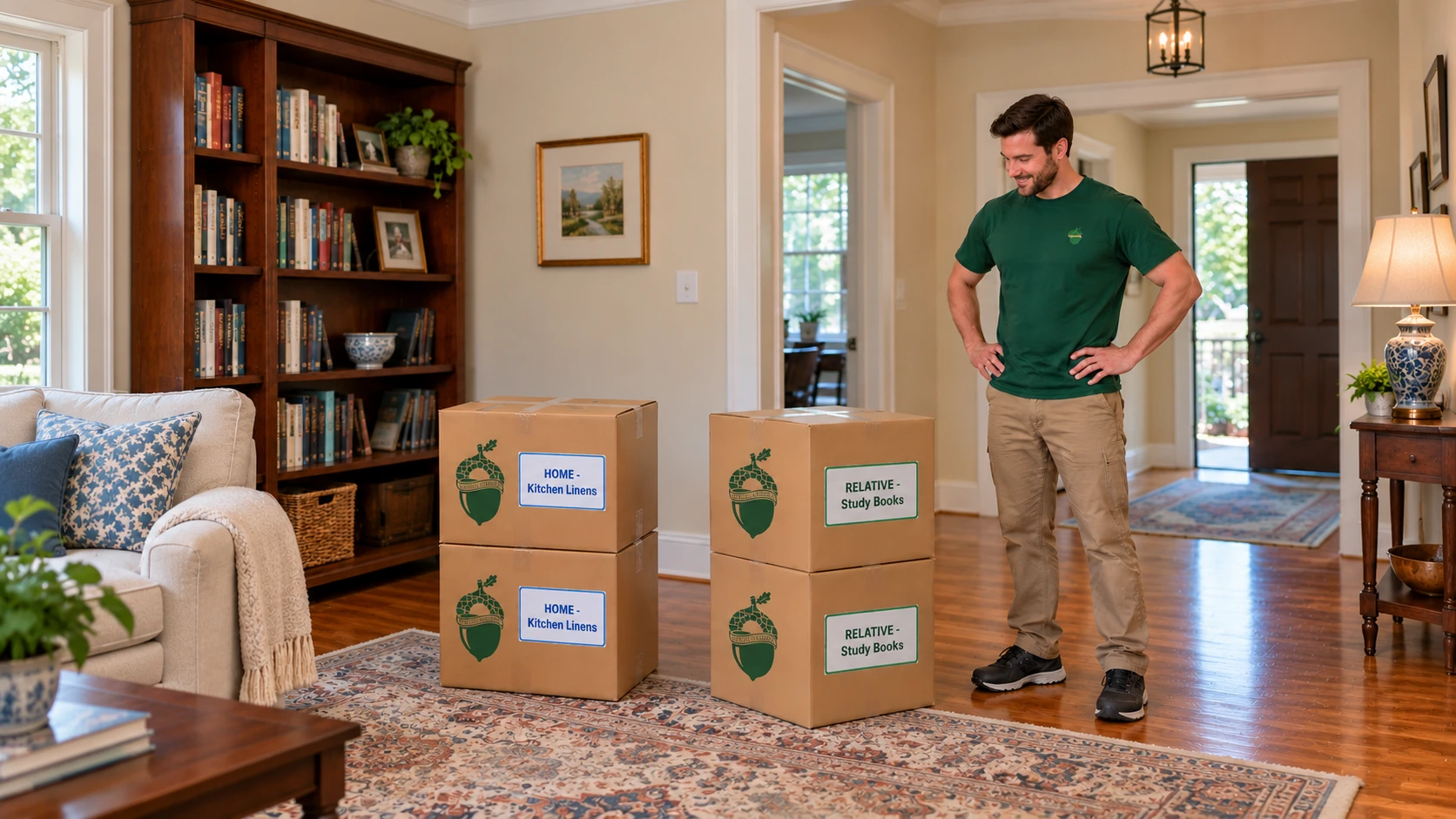
The crew can prepare those groups without mixing them, then load for the agreed sequence. In this example, the home group includes kitchen linens, while the relative receives the identified study books. Storage has a separate inventory and access plan. The photograph shows the home and relative groups.
The saving comes from avoiding preparation and transport of unwanted items and reducing later sorting. Storage, extra stops and later delivery still have their own costs. Use storage and later delivery for the holding period and access arrangements, rather than treating storage as free space between two homes.
Open selected cartons onto suitable surfaces
Basic unpacking opens the agreed cartons and places their contents on suitable clear surfaces. It can restore access to daily belongings without completing the final arrangement of every drawer and cupboard. Choose the rooms and categories that will make the receiving home usable first, then leave room for the work to happen.
For a kitchen, that might mean opening the everyday dishes and utensils onto an available counter or table. A bedroom may need bedding and selected clothing first. Keep work surfaces clear of unrelated belongings and tell the crew where opened contents can safely rest. Do not unpack into a room still awaiting flooring, painting or access approval.
Decide whether receiving help belongs on delivery day or a later visit. A substantial unpacking scope could add three or four hours to that day, or it could be better handled by a later two-person visit. These are planning examples; the actual contents, access, crew availability and work requested determine the arrangement.
Check small parts and belongings before discarding cushioning. A fitting, shelf pin or wrapped ornament can remain inside a sheet of paper after the larger item is out. Keep the belongings being retained separate from the accumulating empty materials.
Consider: returning to boxes after a first attempt at unpacking
Imagine that the furniture has arrived at a Leesburg receiving home, but several evenings later the kitchen and study remain partly boxed. The household can request a separate unpacking visit. A current list and photographs show the remaining cartons, what has already been opened and which surfaces are available.
The agreed task starts with everyday kitchen contents and the work materials needed next morning. The crew opens those cartons onto suitable surfaces while the customer identifies priorities. A room that is still being decorated remains outside the unpacking area, so its contents are not handled twice.
A separate unpacking visit can focus on the contents still boxed, without adding transport. It still requires an actual booking and availability. If the customer also wants things placed in final cupboards or the empty packaging taken away, those additions are recorded separately from basic unpacking.

Direct the final placement
Customer-directed home organizing places belongings where you want them. Basic unpacking brings contents out of cartons; organizing takes the further step into selected cupboards, drawers or shelves according to your instructions. Agree the rooms, categories and placement before counting that work as part of the visit.
Start with a manageable zone. You might direct the everyday dishes into the lower kitchen cupboards while leaving a collection on a safe surface until you choose its final display. Clear instructions make a small team easier to guide than several people asking placement questions in different rooms at once.
Keep personal papers, medication, valuables and anything you prefer to arrange privately apart. The customer decides what is kept and where it belongs; a packing visit is not permission to discard possessions or redesign the household. Use home organizing to describe the final placement you want and include it in the quoted scope.
Room readiness matters. If shelving has not been installed, leave that category safely packed or agree temporary placement on a suitable surface. Opening every carton immediately can consume the floor space needed to make the room usable.
Finish the agreed furniture work
Basic furniture disassembly and reassembly use paid labor time, with no separate basic assembly surcharge. Identify the furniture and the work needed at each end. A familiar bed reassembled after the move differs from first-time assembly of a complex flat-pack unit, which needs an individual review of the model, instructions, condition and parts.
Keep hardware identified by piece and check that small components have not been mixed with discarded paper. Do not assume that a previously wall-fixed unit can be safely used without the appropriate securing plan at the receiving home. Confirm responsibility for the wall, permissions, hardware and any technical work before the visit.
Individually scoped handyman finishing can include reviewed hanging or mounting work. It does not automatically supply a licensed electrician, appliance connection or a complete home repair service. Describe the actual task, wall or fixture and required executor so that the quote covers work Sterling can agree to perform.
Choose in-home moving for furniture already at the address that needs to change rooms during decorating or setup. Use furniture delivery for a new purchase that needs collection or a carry from its release point into the receiving room. Include packing when you want it, and add any collection or furniture rearrangement to the agreed job.
Decide what happens to empty packaging
Gathering used paper and empty cartons indoors is one stage; taking them away is another. Sterling's packaging removal is a separately priced service that must be booked. Say whether you want the material gathered at the end of unpacking, removed on that visit or collected later, and keep retained belongings clear of that group.
For household self-delivery, Loudoun County's recycling-center guidance accepts emptied, flattened cardboard and moving paper. Remove foam, plastic wrap, bubble wrap and strapping from the cartons, and keep plastic bags out of the recycling containers. Do not leave material beside a full container. These center rules are not a promise that every Leesburg address has the same curbside collection or that a commercial removal load uses a household route.
The County's A-to-Z recycling resource provides a separate starting point for cardboard and other materials. Before making a trip, use the current facility information for the selected site and quantity. For curbside collection, identify the service actually assigned to your address and follow its instructions; Town, county and building arrangements should not be treated as interchangeable.
Unwanted furniture is a different category from empty packing material. Agree the items, their condition and the accepted destination through disposal and removal. Do not leave a chair beside a recycling container or assume that a usable object has an arranged donation recipient. Chemicals, batteries, electronics and other special materials also require their own appropriate route.

Plan receiving help around the actual delivery arrangement
For a long-distance move from Leesburg, packing and receiving work need to fit the selected transport option. Direct delivery keeps the agreed shipment on a dedicated vehicle with the same crew. Consolidated delivery shares capacity and uses the agreed destination window, so receiving access cannot depend on an assumed next-day arrival.
The consolidated delivery clock starts after pickup and loading are completed. Under the current company terms, nearby domestic destinations are generally within thirty days, Florida within sixty, Canada within sixty and California within ninety; other distant destinations need individual terms. Canada's sixty-day category applies even for a geographically nearer Canadian address. These are outer planning terms, not a claim that the truck spends those days driving.
Keep the goods needed during the gap with you, and arrange access for the delivery window in writing. If unpacking is wanted at the destination, include it when reviewing the shipment and receiving address. A later local visit also needs its own booking; it is not automatically reserved by choosing a moving date in Leesburg.
An agreed long-distance flat rate for unchanged shipment and service scope does not increase merely because travel or delivery takes longer. Additional packing, storage, stops or receiving work changes the scope and must be agreed separately in writing. See the long-distance page for the detailed delivery, cross-border, estimate and protection explanation.
Compare the complete paid scope
Packing labor is charged for working time, and cartons are separate. Ordinary moving blankets, shrink wrap and tape have no separate materials charge. Include selected protection, moving labor, receiving work, optional organizing, separately priced packaging removal and any agreed specialist work when comparing plans.
For the same inventory, packing plus moving may approach twice the cost of moving it already packed; it can also fall below or rise above that illustration. It is not a standard multiplier, price cap or quotation. A kitchen collection, filled bookshelves, long carry, restricted working window or another visit can change the comparison substantially.
Partial packing can reduce the paid preparation when you complete the remaining categories yourself. Sorting before packing can avoid labor and transport for items you will not keep. Those savings require the work actually to be done; selecting a smaller scope while leaving the rest unfinished can produce additional work on moving day.
A separate preparation visit costs time and travel but can make the moving-day sequence more workable. A smaller receiving team may be easier to direct for organizing, yet it may need a longer visit. Compare complete alternatives with the same contents, addresses, access and final result rather than comparing crew counts alone.
Transport terms still depend on the actual route. Virginia-only household-goods moves have their own requirements; an interstate flat-rate description should not replace the appropriate written estimate for a move within Virginia. Review the packing and transport portions together, with the included inventory, additions and payment terms clear.
Prepare a useful packing request
Send both addresses, the move date or available range and photographs or video of the contents. Show open cupboards and closets, books and collections, storage spaces and any already packed cartons. Include stairs, elevators, the carry from the vehicle and any firm access or key-handover times.
State the boundary you want: full agreed packing, selected rooms or a list of fragile items. Add the do-not-pack group, any separate destinations and the rooms that must remain usable before departure. For unpacking, name the first receiving rooms and describe whether you want surface placement, customer-directed organizing, finishing work or packaging removal.
A building's age or neighborhood does not tell the crew its actual door widths, stairs or permitted stopping place. Show the particular route and identify the person who can open each space. Sterling coordinates the agreed moving access; a general packing request does not reserve a street space or override building rules.
Then compare a written plan that names the inventory, preparation date, final-night exceptions, transport arrangement and receiving tasks. If one part is undecided, mark that part explicitly. The rest of the plan can still be specific enough to tell you who prepares what and what will be usable when the visit ends.
Leesburg packing and unpacking questions
Can you pack the whole household in Leesburg?
Yes. Full packing covers the household contents included in the agreed inventory. Show open cupboards, closets, collections and storage spaces so the review includes more than the visible furniture. Keep personal essentials and excluded items separate. The estimate identifies packing labor, cartons and any separately reviewed objects; full packing does not automatically add unpacking, organizing or waste removal.
Can I book only the kitchen or fragile items?
Yes. Partial packing can cover a named room, category or list of fragile items while you prepare the rest. For a kitchen, identify the cupboards and dishes included and what stays in use until departure. For fragile-only work, list the actual pieces, materials, dimensions and condition. The remaining contents still need an assigned packing plan.
How many cartons will my home need?
The contents review establishes the likely carton requirement; bedrooms or square footage cannot supply a reliable count. Show filled shelves, kitchen cupboards, hanging clothes, stored items and existing boxes. Expecting twenty cartons and discovering enough contents for sixty or a hundred is an illustration of underestimation, not a formula for your home. Cartons supplied for the job are charged separately.
Are boxes, tape and furniture blankets included?
Company-supplied cartons are charged separately. Ordinary moving blankets, shrink wrap and tape have no separate materials charge, while packing itself uses paid working time. An unusual object or specialist packing method needs its own review and agreed scope. Compare the complete estimate rather than treating all materials and all packing work as one included item.
Can packing and moving happen on the same day?
They can when the contents, access and available working window fit. A studio or one-bedroom local move may suit that plan; a fuller two-bedroom or larger inventory may work better with an earlier preparation day. The review should account for elevator reservations, key times and the remaining final-night items. Room count alone does not guarantee a one-day result.
What should stay unpacked for the final night?
Keep the bedding, toiletries, medication, chargers, clothes and immediate food or child and pet supplies you still need accessible. Set aside personal documents, keys and valuables under your own control. Name who will pack the final ordinary belongings after their last use, and keep that group distinct from the already prepared shipment.
Do I need to empty every cupboard before the crew arrives?
The crew can pack the agreed cupboard contents, so emptying those cupboards into piles beforehand is usually unnecessary. Instead, show the contents during the review, remove items you will not move and identify anything that must remain untouched. Clear a workable preparation area and walking route. Personal papers and essentials should already be separated from the packing task.
Can you use or check cartons I packed myself?
Tell the crew which cartons you prepared and flag any uncertain protection, weight or closure. Reviewing or repacking them can be included as additional work. A sealed carton or fragile label does not show whether the contents are properly supported, so disclose valuable or vulnerable contents before the shipment is loaded and review the applicable protection terms.
How do you handle hanging clothes?
Selected hanging clothes can be transferred into suitable wardrobe cartons on a supported rail. The carton needs room beside the closet, outside the door swing and recess, with a clear loading route. Identify which clothes stay on hangers and which travel folded. Shoes, loose accessories and heavy closet contents need appropriate separate packing rather than being added indiscriminately below the hanging garments.
Can you pack glass cabinets, mirrors and framed art?
Sterling can prepare glass cabinets, mirrors and framed art with protection chosen for the actual piece. Show the cabinet body, glass doors, removable shelves and contents separately; for mirrors and frames include dimensions, glazing, material, condition and any loose parts. Ordinary pieces may suit protected corrugated packaging, while unusual or valuable objects can require a specialist method. Crating, dismantling and hanging are agreed individually rather than automatically included.
Does an older Leesburg home need a different plan?
Use the actual carry route to decide. Where doors, stairs, turns or a rear addition constrain access, plan smaller staging groups off the passage and review the protected item dimensions before moving day. A home with straightforward level access can use the ordinary room-by-room packing plan. Leesburg's historic buildings vary, so age alone does not establish the route. Show the path to the vehicle; the packing review does not reserve street space or override property rules.
Can the shipment go to more than one destination?
Yes, when the stops and receiving arrangements are included in the agreed move. Give each carton a written destination, room, contents description, number and opening priority, and keep the groups distinct. Confirm the recipient, access and unloading order at each stop. Storage and later delivery are separate parts of the plan; a colored label alone does not book another destination.
What does basic unpacking include?
Basic unpacking opens the agreed cartons and places their contents on suitable clear surfaces. It can make everyday belongings accessible without arranging every drawer and cupboard. Choose the rooms and categories that matter first and provide usable surfaces. Final placement by your instructions is home organizing, and taking away empty packaging is a separately priced service.
Can I request unpacking after the move is over?
Yes. A later visit can address the cartons still remaining after you have tried unpacking yourself, subject to an actual booking and crew availability. Send a current list or photographs and identify priority rooms and available surfaces. The scope can cover selected categories without restarting transport. Add directed organizing or packaging removal explicitly if you want those tasks too.
How long does unpacking take?
The time depends on the actual contents and level of placement requested. A substantial delivery-day scope might add three or four hours, or a later two-person visit might be more practical. Those are examples, not a promised duration or standard crew. Describe the remaining cartons, room readiness and whether you want surface placement or directed organizing so the visit can be planned.
Will you put everything into its final cupboards?
Final cupboard placement is available as separately agreed, customer-directed home organizing. You identify the rooms, categories and final locations. A manageable team can be easier to guide through one zone at a time. Keep private or undecided belongings separate, and leave categories packed when their shelves or rooms are not ready.
Can you reassemble furniture and hang pictures?
Basic furniture disassembly and reassembly use paid labor time without a separate basic assembly surcharge. Complex first-time assembly needs its own model and parts review. Picture or mirror hanging and other handyman finishing are individually scoped with the wall, hardware, permissions and executor considered. The booking does not automatically provide electrical work, appliance connections or a general repair service.
Will the empty cartons and paper be taken away?
Packaging removal is available as a separately priced, booked service. Agree whether the material is gathered indoors, removed after unpacking or collected on a later visit. Check the paper for small belongings and hardware before disposal, and keep retained possessions apart. Basic unpacking alone does not include taking all packaging away.
Can I put every packing material in cardboard recycling?
No. Loudoun County's recycling-center guidance accepts emptied, flattened cardboard and moving paper, but excludes plastic bags, foam and plastic wrapping from those containers. Separate the materials and do not leave them beside a full container. Curbside instructions depend on the service assigned to the actual address. A commercial removal booking needs its own accepted route and is not automatically a household self-delivery trip.
Can you remove old furniture at the same time?
Yes, when the removal work, accepted destination and separate price are included in the booked visit. Decide which pieces will leave before packing them for a move you no longer want them to make. Empty packaging and unwanted possessions are different categories; do not mix in batteries, chemicals or electronics without identifying the appropriate handling route. Donation is not assumed without a confirmed recipient.
How should unpacking fit a long-distance delivery?
Book the receiving help around the actual transport arrangement and delivery window. Direct delivery uses the dedicated truck and same crew, while consolidated delivery has a wider agreed window starting after pickup and loading are complete. Include destination unpacking in the reviewed scope and confirm who can provide access. Keep essential belongings with you during any gap, and arrange a later visit separately if that is the chosen plan.
Does full packing double the moving price?
There is no fixed multiplier. Packing plus moving the same inventory may approach twice the cost of moving it already packed, but the comparison can also be below or above that illustration. Packing time, cartons, contents, access, separate visits and receiving tasks all matter. Compare written alternatives with the same shipment and final result rather than treating the example as a rate or cap.
Can I reduce the packing work I pay for?
Yes. Sort out belongings that will not move and complete manageable categories yourself, then book the rooms or fragile items you want to hand over. Keep the remaining responsibilities realistic and written down. Leaving an excluded category unfinished can create extra work on moving day. Compare any earlier preparation visit or later receiving visit as part of the complete cost.
What should I send for a packing estimate?
Send both addresses, dates, open-cupboard and closet photos, collections, storage contents and any already packed cartons. Add stairs, elevators, carry distances and firm access times. Identify full or selected packing, final-night exceptions, separate destinations and the receiving tasks wanted. A video or in-person review may be useful even for a smaller home when its contents or full-packing scope need closer assessment.
Plan your Leesburg packing and receiving
Share the contents, both addresses and the dates, then choose the preparation and receiving work you want included.