
Hartford, Connecticut · Preparation and receiving
Packing and Unpacking Services in Hartford, CT
Choose the household contents you want us to pack and the receiving help you want after delivery.

We can prepare a full retained inventory, selected rooms or fragile groups, then open agreed cartons at the new home; organizing, finishing and packaging removal are separate choices.
Request a packing estimate Call (475) 221-2030
Explore packing, costs and local examples
Decide which preparation you want to hand over
Packing takes time before anything reaches the truck. A household may spend a couple of weeks of evenings clearing shelves, buying supplies, wrapping kitchen contents and finding somewhere to keep finished cartons. Booking help can preserve time for work, children and an ordinary final evening. The useful starting point is what you want prepared, not how many bedrooms appear in the address.
Full packing prepares the retained household contents included in the agreed plan. Partial packing names particular rooms or groups, while fragile-only preparation concentrates on selected vulnerable pieces. You can keep your clothing and personal papers and ask us to prepare the kitchen, books or a collection. Identify the remaining customer work so no group is left between two different assumptions.
| Choice | Useful boundary | What to decide |
|---|---|---|
| Full retained inventory | The contents and furniture preparation agreed for the shipment | What stays, what travels personally and when the last daily-use group is released |
| Selected rooms or items | Named cupboards, collections or room contents | Who finishes everything outside that list |
| Fragile-only preparation | The individually reviewed dishes, glass, frames or other selected pieces | Ordinary protection versus a specialist method or crate |
| Optional carton unpacking | Opening the agreed cartons onto suitable available surfaces | Priority rooms, directed placement and the separate material-removal choice |
Furniture is unwrapped as part of delivery. Opening the contents of household cartons is optional work. The Hartford moving page covers the broader carrying and transport plan; here, choose the preparation and receiving tasks around it.
Open the storage before estimating the cartons
Review the contents of cupboards, bookcases, closets and drawers, including small appliances, pantry goods intended to travel, linen, shoes, lamps and framed pieces. Add belongings kept in a basement, attic, garage or separate storage area. Show the material inside closed furniture as well as the large pieces standing in the room.
Expecting twenty cartons can become sixty or a hundred when the cupboards are opened. That is an illustration of missed contents, not an estimate for a Hartford apartment or a formula based on floor area. An open-cupboard photo or video review helps identify suitable carton sizes, cushioning, labor and preparation time.
Decide what you will keep before paying to protect it. Mark belongings staying at the property, accepted by another person or awaiting separately arranged removal. Keep keys, documents, medicines, valuables and personal arrival essentials with the household. Identify that personal group clearly so it does not become another carton to load.
Books need manageable small cartons; ordinary dishes need individual protection and supported cushioning; selected hanging clothes can use a suitable wardrobe carton. Review customer totes and cartons for condition, lids, strength and identification. Buying more of one box size does not resolve a mixture of heavy books, glass shelves and light bedding.

Keep preparation access separate from the carrying appointment
A separate packing visit can finish released rooms before the moving crew needs the stairs or elevator. Confirm whether the building permits materials and packers to enter earlier, which entrance they use, where completed groups may remain and who provides keys. A shared hall or exit is not an assumed packing area.
Keep a named final-night group usable until the agreed last pass. Start with nonessential cupboards and stored belongings, leaving bedding, everyday clothes, a few kitchen items and current work or school materials available. Full packing does not require you to complete the booked packing yourself; the release sequence belongs in the plan.
A suitable studio or one-bedroom inventory may fit packing and a local move into one day. A dense two-bedroom shipment or larger house may need an earlier preparation day. Assess the actual contents and work period. More workers cannot make a single shared staircase or a short elevator appointment hold unlimited work.
The Hartford Parking Authority requires payment for an approved reservation at least three days in advance. Match that reserved truck period to the building window, and settle earlier preparation access separately. Reservations remain subject to other City rules, including snow bans. Use the Hartford guide for the detailed curb and building procedures.
Four different Hartford preparation decisions
These are hypothetical situations to help define a request, not reports of completed customer moves. The inventory, ownership, permitted access and receiving result differ; the examples promise neither a carton count nor a completion time.
Consider: a Frog Hollow apartment before the carrying slot
Imagine a household leaving an apartment with a full kitchen, books, a small dining set and belongings stored beyond the main rooms. The entrance and stair route are shared, and the household must be ready when the agreed carrying period begins. The practical question is which preparation can happen inside the home before that period.
Show the actual cupboards and stored contents, then the stairs, landings and permitted indoor work area. Release the kitchen collections and books first, retaining the last-night and personal travel group. A partial-packing visit can address those dense contents while the customer completes a manageable clothing group. The earlier visit still needs property permission; a curb request alone does not authorize indoor access.
At the final pass, close and identify the agreed cartons, check the retained list and keep the shared route usable. The result is a prepared inventory ready for the carry, with everyday belongings kept usable until their agreed time. If that sequence cannot fit one day, review a separate preparation date rather than assuming a larger crew guarantees it.
Consider: a West End household moving to fewer rooms
Suppose a household is moving from a home with books, dining pieces and years of stored belongings to a smaller receiving apartment. Some contents will move in, some need agreed storage and a few pieces have another accepted recipient. Wrapping everything first would preserve decisions that the household has not yet made.
Start with the space and retained list. Separate what the new home can receive from the storage group and anything leaving through a different accepted route. Review ordinary fragile contents and identify artwork or antiques needing an individual specialist assessment. A municipal bulky appointment, where the property is eligible, is separate from company removal and needs its own confirmation.
Write the next destination, receiving room and useful contents on each carton, adding a number and opening priority where helpful. Colors can reinforce those words, and a customer tote needs an attached readable label. Match protected furniture, parts and hardware to the same inventory. The result is a smaller chosen shipment and distinct receiving groups, rather than paying to prepare belongings that have no agreed place to go.

Consider: separating a student’s belongings in a shared suite
Trinity College’s current Jarvis residence description identifies upper-year suites with common rooms and varied room arrangements. Imagine one student leaving such a shared home while roommates remain. A room-by-room inventory alone could mix personal possessions with shared kitchen goods or belongings staying for someone else.
Agree ownership before packing: the student’s books, clothing, study equipment and selected shared items whose next owner has been decided. Keep residence property and roommates’ belongings outside that list. Obtain the actual housing checkout, access and outside-help instructions; a residence description or academic date is not approval for a particular moving visit.
A focused packing group can then prepare the personal inventory without treating the whole suite as one household. Keep current coursework, documents and arrival essentials separate, and check storage areas with the people who share them before handover. The result is an accurately owned shipment and a clear remaining responsibility, with no implied removal of residence furniture or guaranteed campus appointment.
Consider: unpacking only the rooms that are ready
Imagine delivery to a managed Hartford apartment where the kitchen and one bedroom are usable, but work in another room is unfinished. The household wants a working first evening without opening cartons into a space that will soon need clearing again. Give the receiver a room plan and identify which carton groups should remain closed.
Confirm the manager’s permitted visit and unloading arrangements, then release clean kitchen and bedding surfaces. Basic unpacking can open those agreed groups onto suitable surfaces. If final cupboard placement is wanted, keep the household decision-maker available and select a crew they can comfortably direct. Renovation and low-priority groups stay identified and closed until their rooms are ready.
Keep empty paper, cardboard and film away from retained contents and the walking route. Larger buildings need their management’s collection instructions instead of an assumed City cart. A later unpacking visit can be reviewed once more rooms are released; confirm its availability, access and charges separately. The useful result is usable priority rooms and a defined remaining list, rather than repeated opening and repacking.
Make the protection work through loading and travel
Wrapping is one part of protecting the shipment. Ordinary plates and glass need individual preparation, suitable cushioning and a sound carton that closes without forcing its flaps over protruding contents. Books need supported manageable groups. Framed pieces, lamps, removable glass and high-value collections require methods suited to their construction and condition.
Protection must continue through carrying, supported loading, restraint and vehicle movement. Review carton strength, weight distribution, the route and how vulnerable surfaces are handled. Clean handling and suitable gloves should match the object and grip; no single glove or wrapping method suits every material. A representative photograph cannot select the method for an unseen collection.
Basic furniture disassembly and reassembly use moving labor time without a separate basic assembly fee. Complex furniture needs its own assessment and quote. Protect the body first, safely remove detachable long legs where appropriate, and keep the complete protected part set and matching hardware associated. Empty ordinary dresser drawers while retaining them in the protected body; identify genuinely loose pieces separately.
A separate purchase belongs with furniture delivery, while rearranging pieces already inside a home belongs with in-home moving. Name those tasks when requesting an estimate instead of assuming they are part of opening household cartons.
Choose surfaces, final placement and finishing separately
Basic box unpacking opens the agreed cartons and places their contents on suitable available surfaces. Choose a useful order: everyday kitchen items, bedding, clothing or another priority group. Make those surfaces usable and protect them appropriately. Paper still inside an open carton and items on a counter show work in progress, not a completely organized room.
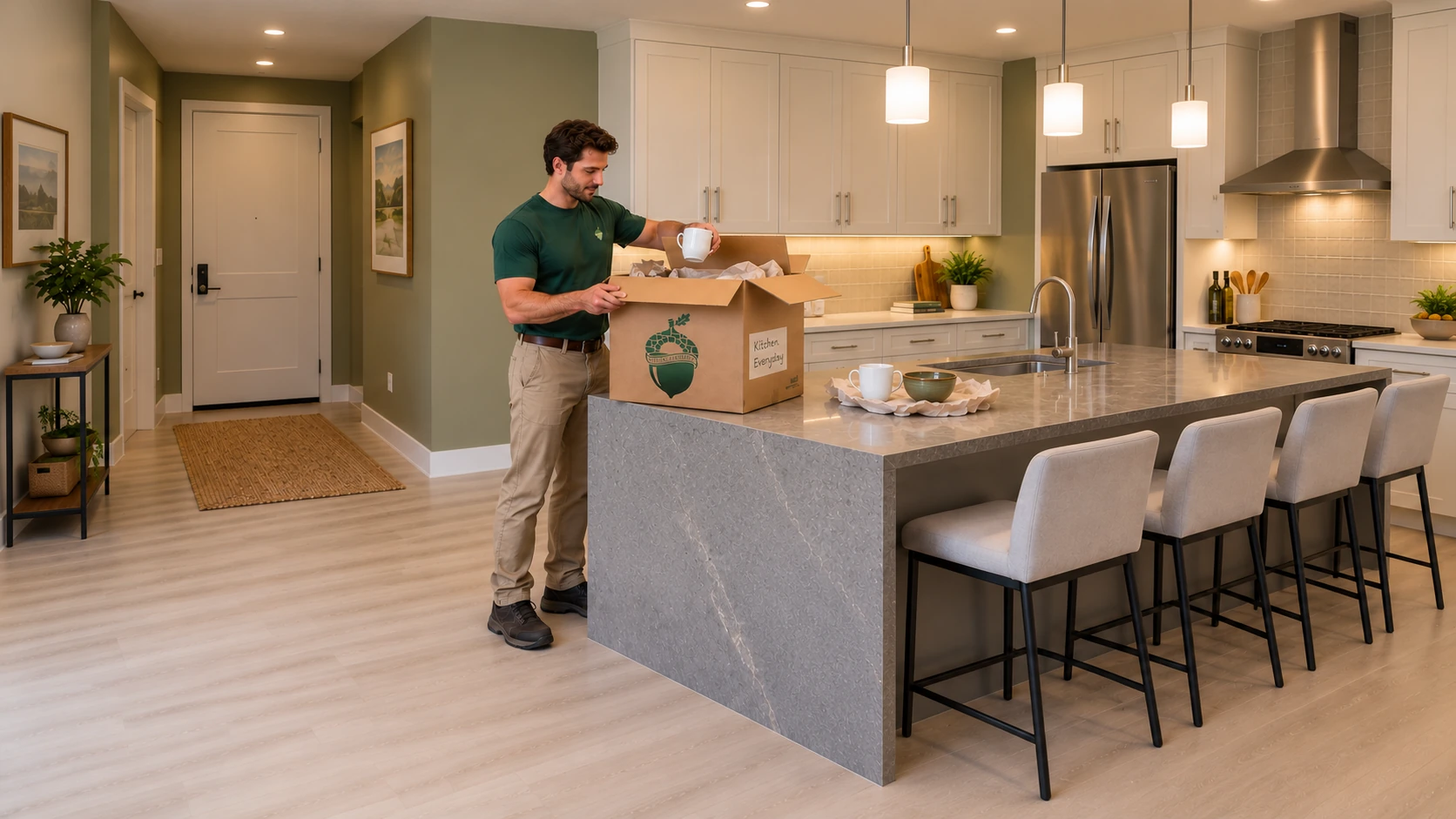
Home organizing adds directed placement in the cupboards, drawers and shelves chosen by the customer. Identify undecided items and have one person able to make those decisions. A smaller crew may be easier to guide than several people asking for different placements at once. Agree this work and its price individually.
Handyman and finishing tasks need another clear boundary. Identify a picture, mirror, television or other requested installation, its wall material, fixings, permissions and intended result. Review technical or electrical work and who performs it separately. A selected finishing task does not promise a fully ready home, and ordinary cupboard placement does not authorize equipment connection.
For a longer shipment, the Hartford long-distance page explains direct service with a dedicated truck and the same moving crew, and suitable consolidated transport with its wider agreed window. The delivery window starts after pickup and loading are complete. Confirm unloading before relying on a separate unpacking appointment or tradesperson.
If possession or room readiness changes, review an actual storage and later-delivery arrangement, including intake, access, extra handling and the person authorizing release. Keep daily essentials outside the stored inventory. A possible storage contact or a convenient date is not a confirmed receiving stage.
Compare the whole paid plan, including the return visit
Packing is charged for working time, and supplied cartons are separate. Moving blankets, shrink wrap and tape have no separate basic protection-material charge. Optional carton unpacking is also charged for working time. Directed organizing, complex furniture, specialist preparation, finishing and packaging removal need their own reviewed scope and terms.
| Part of the plan | What to include |
|---|---|
| Preparation labor | Retained contents, fragile handling, sorting completed and usable working area |
| Cartons and special methods | Types and quantities, customer materials and separately reviewed crates |
| Visits and access | Earlier preparation, the final pass, carrying window and building or curb charges |
| Receiving help | Groups to open, suitable surfaces, directed placement and any later visit |
| Additional stages | Storage, another recipient, extra handling and accepted packaging or item removal |
Packing plus moving can approach twice the cost of moving the same shipment already prepared. It can also be below or above that illustration. Compare the same inventory and access with cartons, labor, visits, optional work and external charges included; there is no standard multiplier for every Hartford home.
For a substantial inventory, four packers on an earlier day and six movers for carrying might be one assessed plan. Receiving help might add three or four hours to a suitable delivery day, or use two people on a separate confirmed visit. These are staffing and time illustrations, not promises. Contents, access, available surfaces and the customer’s ability to direct placement determine the actual arrangement.
The benefit may be reclaimed evenings, less household disruption and usable priority rooms, rather than a lower cash total. For an unchanged long-distance shipment and agreed services, the agreed flat price remains the same when travel or delivery takes longer. Added contents, extra packing, another stop or changed access can change scope; review the affected work in writing. A time illustration does not cap a separately agreed time-based packing service.
Give used materials an agreed next route
Before clearing cartons, check folds, paper and corners for retained parts. Keep empty cardboard, used paper, plastic film and foam in separate indoor groups, away from intact belongings and the active route. Taking those materials away needs its own agreed scope and price.
The City’s Waste & Recycling guidance distinguishes eligible smaller residential properties from buildings that need management arrangements. Follow the actual property’s collection instructions and present accepted recycling loose and clean. Do not assume a shared cart accepts every packing material or a company load.
Connecticut DEEP keeps plastic bags and film out of single-stream bins. Separate film from accepted cardboard and paper, remove mixed material and confirm the route for foam or other exclusions. A temporary indoor sack used to gather material is not the way to present accepted loose recycling.

Unwanted furniture is a different inventory. Request junk removal and disposal for the actual items, access and accepted destination. If using the separate municipal bulky program, confirm eligibility, listed items and the appointment before setting anything out. The Hartford guide gives the detailed resident procedure; a voicemail or form submission is not a confirmed collection.
Send the decisions that make the estimate useful
Send both addresses and municipalities, dates, the retained inventory and the packing boundary. Include open-cupboard and access photos, floors, stair or elevator details, the proposed legal loading place and building instructions. Add separate storage or recipient groups at the start.
Tell us which parts of the home can be released for preparation, what must stay usable for the final night, who completes the remaining customer packing and which receiving rooms will be ready. Name the person who can direct placement and any deadline that is firm. We can then recommend the appropriate inventory review and put the selected labor, materials and stages into an estimate.
The Hartford moving page, local relocation guide and Connecticut moving page cover the wider planning decisions. You do not need to solve every method or choose a survey format before contacting us.
Hartford packing and unpacking questions
Can I book only the kitchen and books?
Yes. Partial packing can cover named rooms, cupboards or item groups while you prepare the rest. Identify what belongs to the crew and what remains with you, including stored contents. Fragile-only preparation and optional unpacking are separate choices.
Does full packing mean I must finish the boxes first?
No. The crew prepares the retained contents included in the agreed packing plan. You identify what stays, what travels personally and when daily-use belongings can be released. Keep the final-night group usable until its agreed last pass.
What should be included in the inventory review?
Show open cupboards, books, clothes, kitchen goods and small appliances as well as furniture. Include basement, attic, garage or other storage contents. Identify fragile, heavy and unusually shaped pieces so the material and preparation plan follows the actual shipment.
Can you estimate cartons from the number of bedrooms?
Bedrooms and floor area cannot determine the contents. A household expecting twenty cartons may discover sixty or a hundred; that illustrates undercounting, not a forecast for your home. Open-storage photos or a video review help choose types, quantities and labor.
What should I keep out of the moving shipment?
Keep keys, documents, medicines, valuables and personal travel or arrival essentials with the household. Identify that group clearly. Also mark belongings staying at the property, accepted by someone else or awaiting a separately arranged removal.
Can packing happen before the moving day?
Yes, an earlier preparation visit can be reviewed for the inventory and dates. Confirm the building permits entry for materials and packers, the usable work area and where prepared groups may remain. The carrying or elevator appointment does not automatically authorize that earlier visit.
Can a small Hartford move be packed and moved in one day?
That can suit a smaller inventory when the actual work and access fit. Dense cupboards, fragile groups or a short carrying period can justify an earlier preparation day. Neither bedrooms nor extra workers guarantee completion within a restricted slot.
What is HPA’s payment deadline for a moving-space reservation?
Payment for an approved HPA reservation is required at least three days in advance. Obtain approval and the quoted charge early enough to meet that deadline, then match the curb period with building access. A request is not approval, and snow bans still apply.
Do household parking permissions settle the packing visit?
No. Confirm the actual truck position and the property’s separate entrance, preparation and carrying permissions. Materials, packers and moving vehicles may need different arrangements. Keep shared exits and the agreed walking route usable.
Should I sort belongings before paying for packing?
Yes. Decide the retained shipment, storage group, accepted recipient items and separately arranged removal before those belongings receive paid protection. Sorting is different from completing the packing that you booked the company to do.
How do I label goods going to different places?
Write the next destination, receiving room and useful contents, with a number and opening priority where helpful. Colors can reinforce the words. Attach readable labels to customer totes and keep furniture parts and hardware matched to the same inventory.
Can you prepare one student’s belongings from a shared suite?
A focused personal inventory can be reviewed for packing. Separate the student’s property from roommates’ belongings, shared contents and residence property before the visit. Obtain the housing program’s actual access, checkout and outside-help instructions; a room description does not approve a booking.
How are fragile dishes and valuable collections handled?
Define the selected items and review their construction, condition and route. Ordinary dishes need suitable individual protection and cushioning; artwork, antiques or items needing a crate require specialist assessment. A representative photo cannot determine the method for an unseen piece.
Are furniture preparation and protection materials separate fees?
Basic furniture disassembly and reassembly use moving labor time without a separate basic assembly fee. Blankets, shrink wrap and tape have no separate basic protection-material charge. Supplied cartons are separate; complex furniture and specialist methods need individual quotes.
What does basic box unpacking include?
It opens agreed cartons and places their contents on suitable available surfaces. Choose useful priority rooms and prepare those surfaces. Directed cupboard placement, complete organizing, technical finishing and taking away materials are separate choices.
Can some receiving rooms stay packed during renovation?
Yes. Identify rooms that are usable and groups that should remain closed. Review priority unpacking around the actual delivery and access arrangement. If more rooms are released later, a further visit needs its own availability, scope and charges confirmed.
How is organizing different from unpacking?
Organizing places belongings in the cupboards, drawers or shelves chosen by the customer. Keep a decision-maker available and identify undecided items. Agree the work and price individually; a smaller crew may be easier to direct through final placement.
Does receiving help include mounting a TV or connecting equipment?
Only individually agreed finishing work is included. Identify the object, wall, fixings, permissions and intended result. Review technical or electrical tasks and who performs them separately; opening a carton or placing items in cupboards does not authorize equipment connection.
How are packing labor and optional receiving work priced?
Packing and optional carton unpacking are charged for working time, while company-supplied cartons are separate. Organizing, specialist preparation, finishing and removal have their own reviewed terms. Compare the complete selected scope, including visits and external property or curb charges.
Is packing always twice the moving price?
No. Packing plus moving can approach twice moving the same shipment already prepared, but may be below or above that illustration. Compare the same contents and access with labor, cartons, visits and optional work included. It is not a standard multiplier or a time ceiling.
When should I arrange unpacking after a long-distance move?
Plan it around the selected delivery arrangement and confirm unloading before relying on a separate receiving appointment. Direct service uses a dedicated truck and the same crew; suitable consolidated transport has a wider agreed window. The delivery window begins after pickup and loading complete.
Does a longer journey change the agreed flat rate?
For the same long-distance inventory, access and agreed services, travel or delivery taking longer does not change the agreed flat price. Added contents, packing, stops or changed access can change scope. Review the affected work separately in writing.
Can paper, cardboard and shrink film go out together?
Keep accepted recycling separate from mixed material and present it loose as the property requires. Connecticut DEEP excludes bags and film from single-stream bins. Confirm the actual collection route, especially in a managed larger building, and agree any paid removal separately.
What should I send for a Hartford packing estimate?
Send addresses, dates, retained contents, open-cupboard and access photos, plus the preparation and receiving choices. Identify final-night essentials, separate destinations, usable receiving rooms and the placement decision-maker. Tell us which deadline is firm and which dates have flexibility.
Plan your Hartford packing and receiving
Tell us what you want prepared, what must remain usable and which receiving rooms will be ready.