Virginia / City relocation guide

Moving to Danville

Compare the actual Danville home and the routines around it. This guide connects six local settings with school registration, utility handoffs, transport, disposal and the City permissions that can affect arrival.

People walking or resting along a riverside path beside brick buildings and a metal railing.
Try the ordinary walking connections around the home you are considering.

01 /

Choose the part of the guide you need first

Begin with the decision in front of you. Someone comparing homes needs different information from a household that already has keys and a delivery date. Use these three routes, then join the arrangements into one arrival plan.

Keep one address sheet with the full street address, unit, municipality, possession date, property contact and unresolved items. Providers may use different boundaries. A building's familiar name or a Danville postal address does not answer every question.

02 /

Separate the independent city from the mailing address

This guide covers the independent City of Danville in southern Virginia. It does not apply another Danville's procedures or treat nearby Pittsylvania County addresses as City addresses. Start with the City's GIS resources and new-resident information, then ask the relevant provider about the exact address.

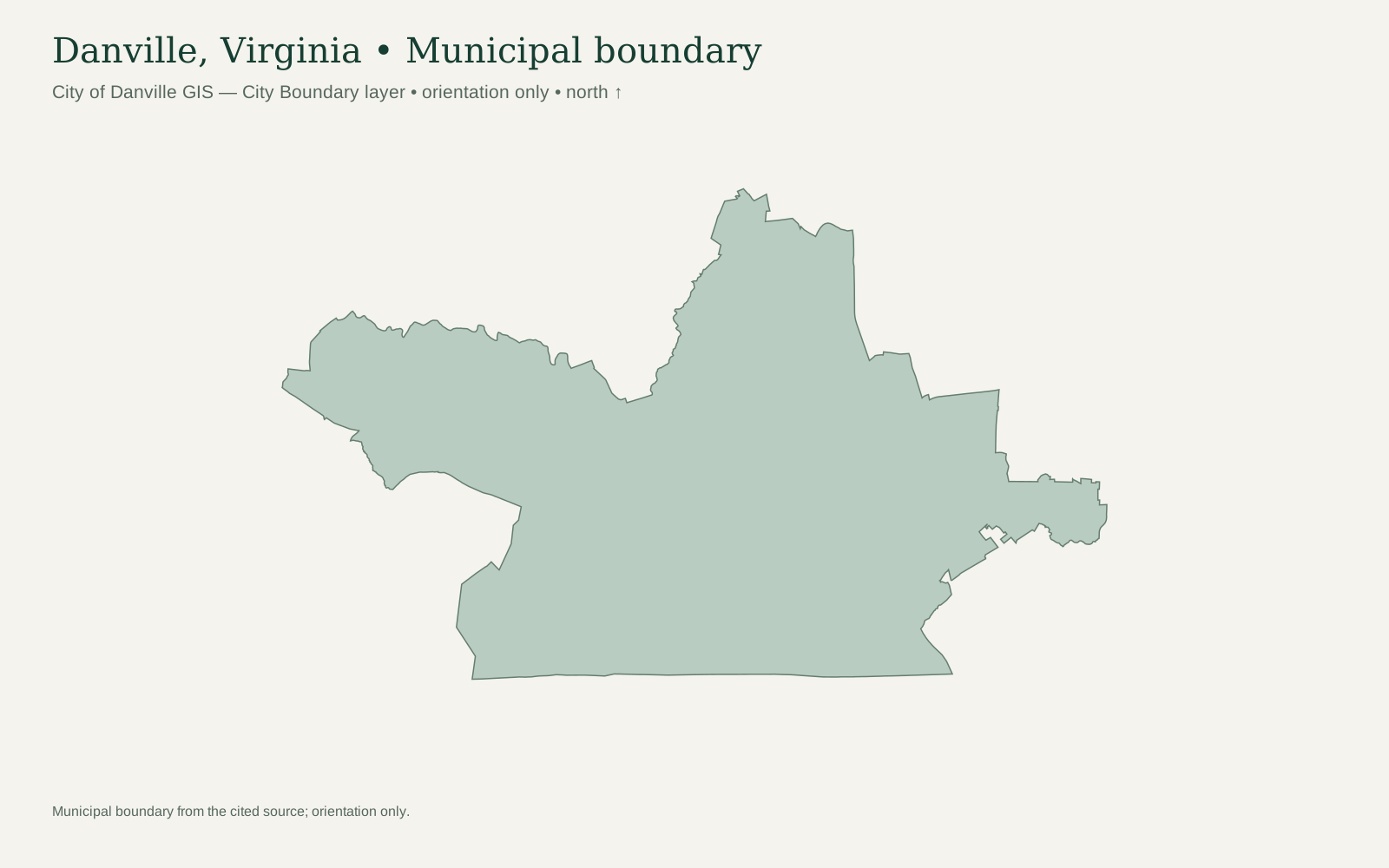
The map uses the official City Boundary GIS layer. It shows the municipality only. The six written comparisons below use Virginia Department of Historic Resources descriptions of historic districts; their names and scope are a different layer of information. The map does not assign schools, identify flood conditions or approve a truck route.

The river and the connections between different parts of the city matter to daily travel, but a short straight-line distance does not establish a convenient journey. Test the route to work, groceries, school and appointments in the direction and at the time you will use it. Include the walk to a stop, the return trip and any transfer.

For each property, distinguish public space from the area controlled by an owner, landlord or association. A rear drive may look usable while belonging to another parcel. An entrance near a shop may serve a separate unit. Ask for the authorized receiving route and confirm who can give access.

Use historical character as a prompt for inspection, not a description of every interior. An old building can contain a recently changed layout; a newer building can still have a restricted loading window. Record what the actual property offers, what is included in the lease or purchase and what needs a separate arrangement.

Municipal boundary of Danville, Virginia, from the official City GIS layer
City of Danville GIS municipal boundary, for orientation. This map does not show the six historic districts, parcels, school assignments, flood zones or approved truck routes. Open full-size map.

03 /

Find the area that fits your routine

These six comparisons use historic districts documented by Virginia's Department of Historic Resources. They describe local character, not current listings, demographic preferences, school quality or mutually exclusive modern neighborhood boundaries. Use each setting to ask better questions about the particular home. The map shows the City boundary only.

Old West End and Millionaires Row

DHR describes a residential area south of downtown with Victorian and early twentieth-century houses, churches and varied architecture along Main Street and nearby streets.

Danville Historic District: Old West End and Millionaires Row ↗
Housing & setting
Inspect the actual layout, storage and stairs. A historic exterior does not establish the condition, size or accessibility of an individual interior.
Daily travel
Try the exact route to daily destinations and the return trip. Check how a vehicle reaches the property without treating a prominent frontage as a loading space.
Before choosing
Measure porch steps and internal turns; confirm any side entrance, protection requirements and authorized parking. Ask which property work must be complete before possession.

Downtown Danville

The historic-district record describes a commercial and administrative core with buildings dating mainly from the late nineteenth and early twentieth centuries.

Downtown Danville Historic District ↗
Housing & setting
If considering a residence in a commercial building, verify the unit entrance, floor, storage, stairs or lift and management arrangements rather than assuming a standard loft layout.
Daily travel
Test errands and transit from the residential door, including after business hours. Free public parking can still have time limits.
Before choosing
Coordinate shop deliveries and common exits. Ask who controls the service route and whether the proposed moving footprint needs City review.

Tobacco Warehouse and Residential District

DHR documents a broad historic mix of tobacco warehouses, factories, shops and workers’ dwellings. The industrial history and residential streets are both part of its recorded character.

Danville Tobacco Warehouse and Residential District ↗
Housing & setting
Distinguish the actual property type: a dwelling and a converted industrial building may have very different access and maintenance arrangements. Historic use is not proof of current conversion or availability.
Daily travel
Walk from the unit to the relevant street and daily destination. Include crossings, loading activity and the last part of the return route.
Before choosing
For a conversion, check freight access and the path beyond the lift. For a house, check outside levels and tight turns. Confirm the receiving route for the specific unit.

Holbrook–Ross

The official record describes a historic neighborhood of houses, churches and institutions, with Queen Anne and bungalow forms among its architectural features.

Holbrook–Ross Street Historic District ↗
Housing & setting
Compare room arrangement, storage and maintenance at the individual property. The area’s documented history does not establish a uniform housing type or current resident profile.
Daily travel
Test walking, driving and any bus connection from the actual entrance at the times you need. Do not assign a route or stop from a district label alone.
Before choosing
Measure the entrance and the turn into the main living space. Identify which drive or side path is authorized and who can approve access or any temporary use of shared space.

North Danville

DHR describes a primarily residential district with a commercial section on North Main Street, including brick commercial buildings and late nineteenth- and early twentieth-century houses.

North Danville Historic District ↗
Housing & setting
Separate a home along a commercial frontage from one on a side street. Ask about the individual building’s layout, parking, storage and utility arrangements.
Daily travel
Rehearse the connections across the city for work and appointments. Use the current route schedule rather than assuming every North Main service has the same timing.
Before choosing
Check the curb on the correct side of the street, pedestrian space and the entry-to-room route. A commercial frontage can require coordination with other occupants.

Schoolfield

The historic-district record describes a former mill company town southwest of downtown, with worker housing, a commercial core and a planned landscape.

Schoolfield Historic District ↗
Housing & setting
Use the historic housing pattern as context while checking the actual home and current surroundings. The historical mill description does not establish present industrial operations or services.
Daily travel
Try the daily journey from the property rather than estimating it from proximity to a major road or destination. Confirm the stop, direction and return timing if using transit.
Before choosing
Inspect the approach, porch, storage and carrying distance. Ask about owner or association responsibilities and confirm where a vehicle or container could be placed with permission.

04 /

Read citywide housing figures alongside the actual home

The ACS 2024 five-year estimates, covering 2020–2024, describe Danville city, Virginia, as a county-equivalent geography. They provide consistent background for comparing housing types. They are not September 2026 listings, asking prices or a forecast of what a particular household will pay.

MeasureDanville estimateHow to read it
Owner / renter occupancy47.8% / 52.2%9,109 owner-occupied and 9,957 renter-occupied units; 19,066 occupied units total
Median gross rent$836 per monthHistorical ACS gross-rent measure, not a current advertised rent
Median owner-occupied home value$119,100Estimated value in the survey, not a sale appraisal
Detached units65.5%14,655 of 22,376 total housing units
Built before 194018.2%4,067 of 22,376 total housing units

The tenure denominator is occupied housing units; the structure and age denominators include all housing units. These are survey estimates with margins of error. The underlying tables are B25003, B25064, B25077, B25024 and B25034. None establishes a district's vacancy, quality, safety or current availability.

Compare properties using the same practical questions: total recurring costs, lease terms, heating and cooling, storage, parking, laundry and maintenance responsibility. Ask which utilities are individually metered and which remain in an owner's account. An apparently lower rent is not a full comparison if the included services differ.

Inspect clearance, stairs, floor transitions and the place where cartons can be unpacked without blocking the home. Record any furniture that may need agreed disassembly or a different room arrangement. Building age alone does not tell you what fits, what condition it is in or which alterations are allowed.

Before signing, identify any condition that must be resolved before delivery: keys, repairs, a lift booking, utility activation or approval for a storage container. Keep those conditions beside the move date so an outstanding property task does not become a surprise at the curb.

Laundry and utility room with two appliances, a sink, shelves and branded cartons, including an open carton of towels.
Compare storage, usable floor space and the route through the home.

05 /

Test fixed routes and reservation services separately

Use the Danville Transit route directory and the February 2026 service guide for the actual route and direction. The guide's filename still says January 2025, but its cover identifies February 2026. It distinguishes fixed-route service, generally Monday–Saturday from 6 a.m. to 6 p.m., from longer reservation-service hours.

The published fixed-route base fare is $1. A half-fare program applies to eligible riders, with identification or certification requirements. Have the required fare ready and check the payment method before boarding. An immediate transfer is different from saving a transfer for a later journey.

Check both directions at the times you need them. Route names and numbers do not guarantee that every run follows the same segment. Some stops or service segments require a request. The last outward bus may not provide a useful return connection, particularly if an appointment ends after the regular service period.

Reserve A Ride is a separate door-to-door reservation service. Its web page lists a $4 one-way base fare, Monday–Saturday service from 4 a.m. to 1 a.m., and a last boarding time of 12:45 a.m. The ordinary service area includes the City and Cane Creek Centre Industrial Park. Confirm any extension, companion or student arrangement for the trip rather than assuming the fixed-route fare applies.

The reservation instructions disagree in material ways. The web page says prior-day requests by 11 a.m.; the February 2026 guide says called-in requests by 3 p.m. The published cancellation and no-show instructions also differ. Call 434-799-5144 to confirm the current booking deadline, cancellation rule and pickup window. Keep the confirmation rather than relying on the more convenient version.

The separate same-day page describes an online request at least four hours before the desired trip, subject to availability. The guide gives same-day request hours. A request is not a guaranteed ride: have another workable arrangement until Transit confirms the trip, and ask how the return journey will be scheduled.

Handivan serves people whose disability prevents use of the fixed-route system. Its application has an applicant section and a section completed by a qualified health or rehabilitation professional. The linked brochure describes a decision within 21 days of a completed application, presumptive eligibility if no timely decision is made, and written reasons and appeal rights for denial or conditional eligibility.

The brochure describes Handivan service within one mile of the city limits and a $2 one-way fare during its stated daytime period. Confirm the address, hours, assistance needed and any companion or attendant arrangement with Transit. Door-to-door transport is not a promise of assistance inside a home. Senior and veteran programs have their own arrangements; ask Transit which program fits before depending on it for the first week.

Passenger boarding a local bus from the sidewalk while another person waits beside a bus-stop sign.
Check the relevant route, stop, return journey and any reservation requirement.

06 /

Register for the right year and confirm the first day

Start with Danville Public Schools' 2026–27 registration page. New-student registration, returning-student updates and program choice are separate processes. Confirm the city address and the child's grade, then use the district locator and school office to establish the assigned school. A historic-district name or property advertisement does not establish placement.

The current new-student PowerSchool link reaches the Danville City School District sign-in and account-creation page. The public start was checked; the private application was not completed for this guide. Keep the correct school year, save any application reference and distinguish a saved draft from a submitted registration.

The district's two-page document checklist includes birth documentation, parent or guardian identification, school health records and applicable custody information. Its ordinary residency route requires one item from List 1 and one from List 2, showing the current address. Two convenient documents from the same list do not automatically satisfy that route.

Document groupExamples in the district checklistPreparation
List 1Deed, property-tax record, mortgage, signed lease or notarized shared-housing disclosureCheck the name, complete address and relevant dates
List 2Current utility evidence, tax or insurance record, qualifying agency document, pay statement or bank statementObserve each document's recency requirement; utility evidence is within 30 days, pay and bank statements within 60
Shared housingShared-housing disclosure and the host's address evidenceThe checklist calls for the homeowner to attend with the parent; ask the school how the procedure fits the household

Do not assume that a future utility bill is the only possible second document. Read the alternatives and contact the school if the household's circumstances do not fit the standard checklist. Use the district's secure process for personal records; a moving-company estimate does not need a child's school or health file.

Kindergarten eligibility on the current page uses age five by September 30. The document checklist describes the physical-examination requirement for initial public kindergarten or elementary enrollment and an acceptable prior report; do not interpret it as a new physical required for every transferring secondary student. Ask the registrar about applicable immunization documentation, exemptions or conditional enrollment.

The registration page provides separate help for families whose home language is not English, kindergarten appointments and unusual custody or enrollment circumstances. For routine assistance, contact the district at 434-799-6400. If housing is unstable or ordinary evidence is unavailable, contact the listed homeless-education liaison, Sheree Walker, 434-268-9605, promptly. Do not postpone that conversation while trying to assemble an ordinary lease packet.

Program choice uses another calendar. The choice page currently describes 2027–28: a fall application window of October 5–November 6, 2026, followed by later rounds. That is not the registration window for a child arriving during 2026–27. Programs may have entry criteria and limited seats. The district tells new families to register at their zoned school while waiting for a choice decision.

A transfer between zoned schools also has its own rules and transport implications. The page's March–April 2026 transfer window is already past at this guide's check date. Ask the district about the current situation rather than treating an old window or an unapproved choice request as a confirmed school place.

Finish with transportation. The school enters an address change in PowerSchool; the transportation department does not make that record change itself. After a move during the year, the school sends the relevant information for routing. The page describes a possible 24–36-hour routing interval, not a guaranteed first-day bus. Confirm eligibility, stop, pickup, return and start date at 434-799-6451, and keep an interim plan until those details are settled.

07 /

Match the service account to the address and the move dates

Ask the owner which services exist at the property, which are individually metered and which remain under the lease or association arrangement. Danville Utilities provides several services, but that does not establish that every address has natural gas or that every charge belongs in a tenant's name. Confirm the exact unit and account responsibility before requesting changes.

The Apply for Service page provides an online application route and Customer Accounts assistance at 434-799-5155. Prepare identification, address and contact details, the requested service date and the lease or proof of occupancy or ownership requested by the utility. A mailed contract has signature and notarization requirements; use the current instructions for the route you select.

The page says service can be established the same day in most cases when requested before 2 p.m., otherwise the next business day. This is conditional, not a guarantee that a particular property can be activated without access or other work. Confirm the appointment, meter access and what must be ready. An application receipt does not demonstrate that the lights, water or heating are operating.

The security-deposit page generally bases deposits on twice the address's recent average monthly bill, with minimum amounts when suitable history is unavailable and specific waiver conditions. A previous utility credit reference may help in qualifying circumstances. Ask for the actual amount and required evidence; do not assume every newcomer owes the same deposit or receives a waiver.

Arrange the old address separately through Terminate Service. The current instructions provide Forms → Stop Service / Move Out in the customer portal, or a request through Customer Accounts. Include the account, location, requested termination date, telephone contact and new mailing address. A request to put an account in another family member's name can need additional documents and is distinct from simply changing where a bill is sent.

Coordinate the service dates with possession, cleaning and any remaining work. If the two addresses overlap, ask Customer Accounts to explain the transfer and billing treatment for the actual situation. The linked service policies are dated February 2021; they describe deposit and final-balance reconciliation, but current account instructions should settle the household's arrangement.

Finally, review the first and final bills. The billing page warns customers using bank bill-pay to update the account number after relocation. Preserve the closing or move-out confirmation, forward any final correspondence and verify that a recurring payment is attached to the intended account. Separately schedule internet or other providers needed for work, school or household equipment.

08 /

Separate weekly collection from the move-out cleanout

Confirm whether the property uses municipal residential collection or a building's private arrangement. The City's refuse instructions call for an approved cart at the curb by 7 a.m. on the collection day, or the evening before. Ask for the address's route day and bin location before cartons accumulate.

The linked rolling-cart instructions say to bag household garbage inside the cart, keep the cart clear of obstructions and store waste on private property between collections. They date from December 2015 and agree with the current page on the basic set-out time and cart responsibility. A moving truck should not block collection access, and loose extra bags are not an unlimited overflow arrangement.

The bulk-debris page allows up to four large items per week with the regular garbage pickup at no extra charge. Mattresses and box springs are included in the examples. Place items behind the curb or property line as directed, keep sidewalks and drainage clear and break down material where instructed. Confirm the count if several household members are discarding furniture together.

A large quantity of small debris from a cleanout is a different problem. The City offers residential trailer or bucket-truck rentals by reservation, with charges depending on use. Call 434-799-5245 to describe the load and arrange the appropriate service. The rental option excludes listed materials such as tires, batteries, appliances, contractor debris and hazardous waste.

Appliances require a scheduled pickup, rather than inclusion in the ordinary four-item allowance. The page lists $40 for an appliance that may contain refrigerant and $15 for one without refrigerant. Confirm the item and current charge when arranging collection. Review the excluded-waste list before mixing paint, chemicals, building debris or other special material into a pile.

Curbside recycling is an enrolled service with a $52 annual fee for July 2026–June 2027, collected on the first and third Thursday of each month. The current agreement gives the payment and submission route through Public Works and prorating terms. Confirm enrollment and cart provision; ordinary refuse service does not by itself establish a recycling subscription.

The recycling page also lists drop-off sites and accepted materials, including cardboard and specified plastics. Flatten moving cartons and follow the actual material list; not every plastic or packing material is accepted. Keep reusable cartons dry while deciding whether to retain, give away or recycle them, and arrange the last disposal before the old property must be empty.

09 /

Choose the approval for the actual use of public space

Start with the receiving address, side of the street, vehicle dimensions, ramp or liftgate, proposed hours and a drawing of the pedestrian route. Identify whether the operation stays on authorized private property or uses public parking, sidewalk or roadway. Send that description to Public Works Engineering at 434-799-5019, using the permit-information page for current forms.

Ordinary downtown public parking is currently described as free on the River District page, with time limits in some locations. This is not a moving reservation. Ask who may apply for the specific use, which controls are required, how much notice is needed and how an occupied space is handled. A building manager's permission cannot by itself settle the City's requirements.

The temporary right-of-way closure application asks for the responsible person, location, dates, hours, type of work and type of closure. A full street closure requires an approved traffic-control or detour plan and property-owner notifications; the application, plan and notifications must be submitted at least 14 days before the start. Partial closures also need the applicable plan and notifications.

The form calls for an approved pedestrian-control plan when a sidewalk obstruction lasts more than 48 hours, while accessibility and traffic-control requirements apply to closures generally. A shorter duration is not permission to obstruct a sidewalk without review. The form also describes construction use of parking spaces. Because ordinary household moving is not a separate checkbox, ask Engineering to identify the applicable path instead of labeling every parked moving truck a construction closure.

The current Chapter 35 supplies the wider framework. Section 35-31 concerns written right-of-way use agreements; section 35-62 protects safe passage; section 35-182 contains parking restrictions. Do not turn the more extensive permanent-encroachment procedure into a universal household-moving requirement. Engineering needs the real footprint to determine which process applies.

A POD or similar portable storage container has a distinct route. The August 31, 2026 policy prefers placement on private property and allows right-of-way placement only when the City approves the need and conditions. Its portable-storage-unit definition excludes licensed or registered motor vehicles, trailers and semitrailers; it is not the operating rule for every moving truck.

The container application asks for the type and dimensions, provider, address, dates, use, site photograph or sketch and the reason private property cannot be used. A non-owner applicant needs the required owner authorization. The policy also calls for the relevant insurance certificate naming the City as an additional insured. Identify who will provide it before ordering delivery.

Under the policy, a POD is normally limited to seven consecutive days; a dumpster normally has a 15-day limit. The City can impose a shorter duration, and renewal or an exception is not automatic. The fee schedule uses 15-day blocks: business areas pay $50 for the first block and each additional block; residential areas have no charge for the first block and pay $50 for each additional block. A fee block is not an approved stay. Confirm the location's classification, placement period and any further approval.

Approved placement must preserve the required pedestrian and traffic space, hydrants, driveways, drains and access. The policy describes marking, contact and removal responsibilities and says a street closure needs separate approval. Keep the agreement available and arrange removal before expiry. Do not assume the supplier's delivery confirmation is the City's authorization.

For the truck itself, check the approach and posted restrictions. The current code's two-hour provision concerns RVs, boats, trailers, semitrailers and similar conveyances in specified areas, with an active-loading exception; it is not a universal two-hour rule for all box trucks. Local delivery provisions likewise do not waive hydrant, curb-ramp, pedestrian or traffic restrictions. If the original plan fails, use an approved alternative or revised window rather than blocking the route while deciding.

10 /

Turn the receiving permission into a measured route

Walk the route from the lawful vehicle position to the final room. Measure clear doors, turns and stairs, including hardware and railings. Photograph the point where the route changes direction or level. Compare those measurements with the actual furniture rather than relying on the size of the room.

For a shared building, confirm the authorized entrance, elevator reservation, permitted hours, protection requirements and person who can release the space. Ask whether a service entrance passes through an area controlled by another tenant. For a house, clarify possession and any route through a side yard or adjoining drive.

Confirm every lift and transfer point, including a second lift beyond a lobby or garage. Ask management whether a certificate of insurance, union labor or building staff is required, who arranges it, and whether a deposit or fee applies. Obtain the written basis, payee, refund conditions and responsible contact before paying.

For a short reserved slot, agree which materials, protection and disassembly may be prepared beforehand. Keep carrying and use of shared facilities inside the authorized period. Plan pickup, travel and unloading in sequence; the two properties do not need identical time windows.

Make the pickup and receiving windows work together. Someone needs to answer access questions at both properties and decide what happens if keys, a closing or a lift are delayed. An elevator reservation is incomplete if the front door or intervening corridor remains locked.

Agree where unpacking can begin without filling the escape route or common hall. Keep essential items separate, identify furniture that needs prior preparation and arrange the protection appropriate to the surfaces. Resolve any uncertainty before the vehicle arrives with a load that cannot enter the building.

11 /

Try the ordinary routines from the exact home

Walk the grocery-carrying route, find the actual mail and parcel arrangements and identify where carts or recycling can be stored between collections. Test these tasks with the household's mobility and carrying needs in mind. A nearby service is useful only if the whole route works.

In a central mixed-use setting, distinguish the residential entrance from customer access. Ask where delivery drivers may wait, how visitors enter and what happens outside shop hours. Check the return home after work as carefully as the outward journey.

For a house with a yard or private drive, establish who maintains the approach, handles snow and keeps bins accessible. Determine whether vehicles can turn or must reverse, and whether that movement is compatible with people using the property. These are address observations, not characteristics guaranteed by a district name.

Keep the first week manageable: confirm keys, essential services, school communication, transport and collection before arranging optional installations. If belongings arrive in stages, decide what must be in the first delivery and leave usable space for the later one.

Shopper carrying a green grocery bag through the open left door beside a closed glass door.
Test routine errands and the complete walk home from the actual address.

12 /

Prepare the private route as well as the street

The City's snow-removal page prioritizes bridges, primary roads and other key routes before residential streets. It does not promise that every residential street will be clear at a particular hour. Private streets and driveways remain separate responsibilities; verify who handles the receiving route.

The page still cites an older section number for sidewalk clearing. The current code, section 35-62(b)(4), retains the requirement for an owner or occupant to remove adjoining sidewalk snow within 24 hours after snowfall ends. Ice and sleet have the corresponding deadline, with safe covering where removal would damage the sidewalk. Assign that work and inspect the route before it is used.

The snow FAQ asks residents to move vehicles off streets or cul-de-sacs during snow so equipment can work effectively. Check current notices and the actual parking arrangement; do not assume a usual spot remains useful during an operation.

For rain or hot weather, plan protection, drinking water, breaks and where sensitive belongings wait. Keep doorways, electrical access and indoor circulation usable. These are practical moving preparations, not a prediction of weather or a claim about the company's seasonal workload.

If conditions change enough to affect safe access, contact the property manager and mover before the original window is lost. Review a revised time or another permitted route, and confirm any change in the work rather than improvising it after unloading starts.

Resident wearing rain boots on a porch mat and holding a folded umbrella beside a wet approach.
Inspect the surface and keep the receiving route usable as conditions change.

13 /

Join the confirmations into an arrival plan and Plan B

Use a short list of decisions with an owner, a date and a confirmation. The purpose is to identify the dependency that can stop arrival: possession, a receiving route, public-space permission, utility activation or a first-day school arrangement.

WhenResolveKeep available
Before committing the moveMunicipality, property terms, inventory, access and any approval lead timeAddress sheet, measurements, photographs and open questions
Once dates are usableRequired City applications, building window, utility requests and school registrationApplication references and named contacts; distinguish pending from approved
Before deliveryKeys, lawful loading position, cleared route, actual service status and household transportApproved documents, confirmation messages and first-night essentials
During the first weekSchool start and bus details, first bill, collection and packing-material disposalFinal-account correspondence and any outstanding provider tasks

If possession slips: contact the person controlling keys and the mover before committing delivery. Establish the next realistic access window and discuss any separately agreed storage or schedule change. A possible option is not booked until its terms are confirmed.

Name one household coordinator and set a decision cutoff before the crew departs or an access window expires. If keys, a lift or permission remain unconfirmed at that cutoff, the coordinator contacts the property representative and mover to activate the agreed alternative. Confirm actual storage capacity, opening hours, access to essentials, transport and a place for people and pets. Record any waiting, handling, storage or re-delivery charges and who authorizes them; availability and cost must be confirmed, not assumed. Notify everyone affected, including building staff. Resume delivery only when possession, the receiving route, required permissions and a new crew window are confirmed in writing.

If the curb is unavailable: use the official contact and approved instructions for the site. Review another lawful position, changed equipment or a later window with the responsible parties. Do not block a hydrant, bus stop or pedestrian route while waiting, and do not place unofficial controls as a substitute for permission.

If a utility is not operating: contact the provider with the service reference and arrange access or follow-up. Decide which household activities can wait and which need an interim arrangement. Avoid making the first night depend on an unconfirmed activation estimate.

If school or transport is unresolved: call the school or district with the application reference and explain the arrival date. Resolve missing information, assignment and the first day separately from bus routing. For unstable housing or missing ordinary documents, use the district's assistance contact promptly.

Use the Danville moving page when the inventory, access and requested services are ready to discuss. Share unresolved dependencies as well as confirmed dates so the estimate and schedule can account for the actual work.

14 /

Questions before you arrive

Does this guide apply to any Danville mailing address?

No. It covers the independent City of Danville, Virginia. Use the City GIS resources and confirm the exact address with each provider. Postal, school and service boundaries may differ.

Are the six comparisons current real-estate or school districts?

They use officially documented historic settings to organize practical property checks. They are not rankings, listings or school-assignment areas. The map shows the municipal boundary only.

Do I wait for program choice before registering a child?

The district choice page tells new families to register at their zoned school while awaiting a choice decision. Its current choice calendar is for 2027–28; ordinary new-student registration also serves families arriving in 2026–27.

Does a utility application guarantee same-day activation?

No. The utility page describes same-day service in most cases before its cutoff, not an unconditional promise. Confirm the address, required documents, access and actual service date.

Can a mattress go with regular collection?

The bulk-debris page includes mattresses and box springs within the allowance of up to four large items on the regular collection day. Appliances and large cleanout loads have different arrangements.

Which Reserve A Ride booking deadline should I use?

The web instructions and February 2026 guide differ. Call 434-799-5144 to confirm the current deadline, pickup and cancellation terms; a submitted request is not a confirmed trip.

Where should I start if the home and date are already chosen?

Resolve the truck or container permissions, receiving route and arrival dependencies. Then provide the inventory, access and required services for an estimate.

Your next step

Bring the plan together

Use the Danville moving page to prepare the inventory, access details and questions for your estimate.

Sources & useful local resources

Official procedures and local resources are linked beside the answers above. Reopen the relevant page when arranging a date: fees, schedules and application requirements can change.

Place, housing and maps

Parking, access and winter operations

School enrollment and transport

Utilities and account handoffs

Waste and recycling

Public transportation