Virginia / City relocation guide

Moving to Lynchburg

Choose a Lynchburg home with its daily routines and arrival conditions in view. This guide connects documented neighborhood character with school registration, utilities, transport, disposal and the access decisions that can affect a move.

People walking along a sloping downtown sidewalk beside brick shop fronts and parked cars.
Try both directions of the routine walks around a potential home.

01 /

Choose the decisions that matter first

Begin with the address: confirm school, utilities, receiving entrance and truck position independently.

Your situationResolve firstWhat to confirm
You are comparing homesHousing terms, daily journeys and physical accessUsable rooms, total recurring costs, the actual entrance and the return trip
You are arriving with childrenAddress, grade and school registrationEnrollment documents, receiving school, first day and a separate bus plan
You have a delivery datePossession, building access and curb arrangementsKeys, an approved loading operation, utility start and a workable alternative

Record the unit, municipality, manager and service contacts. Separate applications from approvals; identify unresolved scheduling issues.

Use these comparisons to plan a visit.

02 /

Distinguish the city, the postal address and the historic districts

Lynchburg is an independent city in Virginia. The James River, its tributary valleys and hillside streets shape the historic districts described by the City. Nearby places in Amherst, Bedford and Campbell counties have their own jurisdictions; a Lynchburg postal label does not make their procedures interchangeable.

The City district directory is the basis for the comparisons below. These are documented historic settings, not a complete division of modern residential neighborhoods. Their architectural descriptions can explain why one street has raised porches or compact lots while another has larger setbacks. They do not establish current vacancies, property condition or who should live there.

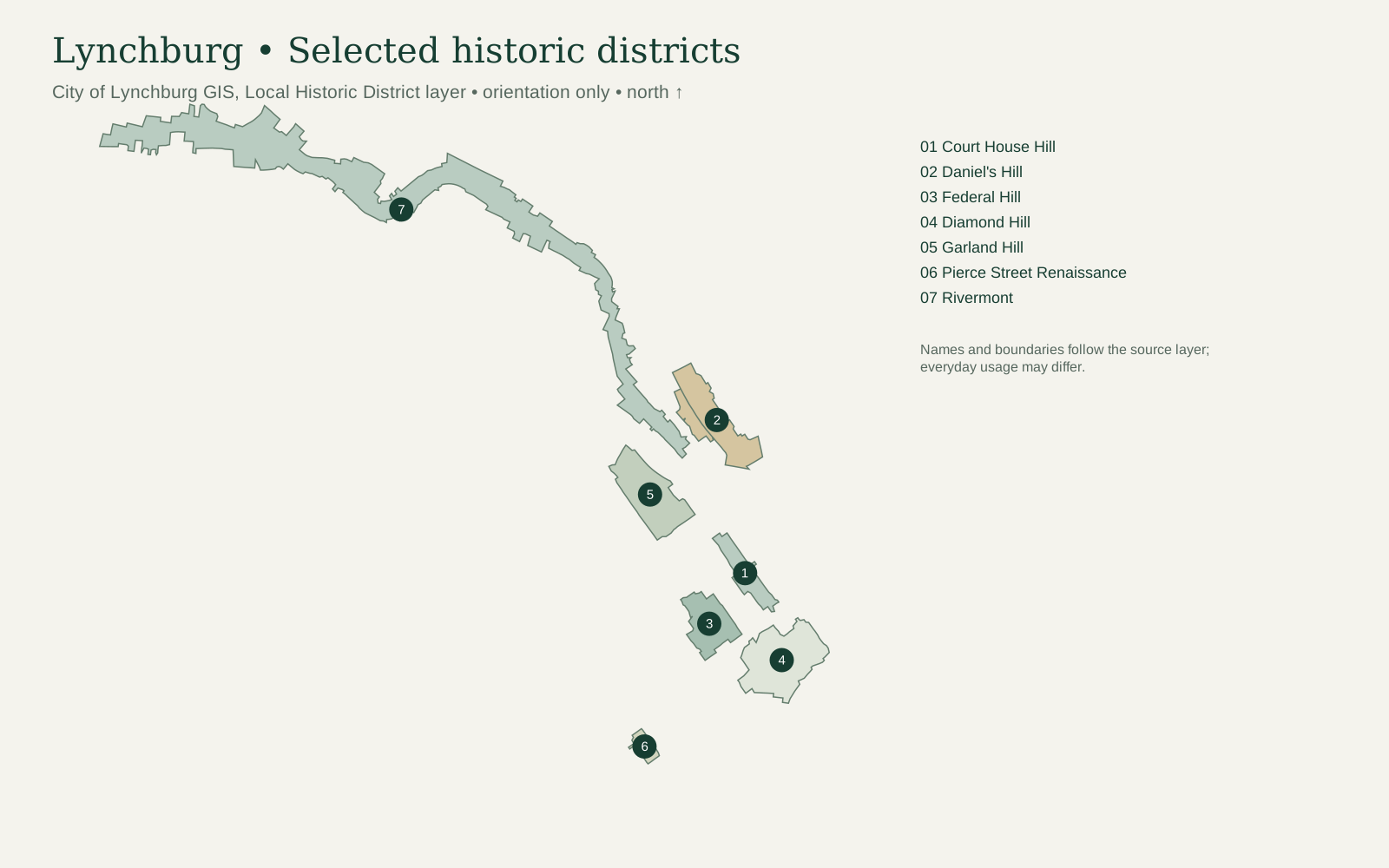
The map uses the City's Local Historic District GIS layer. It shows the seven selected districts, grouping the two source polygons named Daniels Hill under one key. Individual landmark sites and the separate Virginia University of Lynchburg district are outside this selection. White space on the map is not a city boundary or an absence of neighborhoods.

Use the appropriate parcel, school and utility tools. This map establishes neither school assignment, flood risk, access rights nor truck permission.

Seven selected Lynchburg historic districts from the City GIS Local Historic District layer
Selected historic districts from City of Lynchburg GIS, for orientation. Daniels Hill’s two source polygons share one key. Other districts and individual landmark sites are omitted; this is not a city boundary, school map or truck-route approval. Open full-size map.

03 /

Find the area that fits your routine

These seven comparisons describe documented historic character, not current vacancies, school quality, safety or demographics. The selected historic outlines do not cover every neighborhood.

Court House Hill

Court House Hill follows the Court Street area between Fifth and Twelfth streets, with a historic concentration of civic, religious and business buildings.

Court House Hill — City historic-district description ↗
Housing & setting
Compare the actual dwelling with the surrounding institutional or commercial frontage. Verify the residential entrance, unit layout and responsibility for shared spaces.
Daily travel
Test the downhill and uphill parts of everyday trips separately. A nearby downtown destination may still involve steps or a steep return.
Before choosing
Check the loading frontage, time restrictions and complete receiving route. Coordinate a shared entrance and any building window with the person responsible.

Daniels Hill

The City describes a ridge along Cabell Street between the James River and Blackwater Creek, with larger houses and more modest workers’ cottages on its slopes.

Daniels Hill — City historic-district description ↗
Housing & setting
The neighborhood extends beyond its historic designation. Check the individual home, alterations, porch, storage and recurring costs instead of assuming one housing form throughout.
Daily travel
Walk the connection from the address to daily destinations and the actual bus stop. Include grade changes and the return direction in the comparison.
Before choosing
Photograph steps, retaining walls, side passages and any driveway. Confirm which approach is available with permission and where the vehicle can stand lawfully.

Federal Hill

Federal Hill’s City description contrasts larger houses along Federal Street with smaller buildings on the Jackson and Harrison slopes, across several historic architectural periods.

Federal Hill — City historic-district description ↗
Housing & setting
Inspect the particular floor plan and current condition. Ask whether a property has separate units, shared meters, common access or restricted storage.
Daily travel
Check how the home connects to work, shopping and transit in both directions. Do not infer a current bus frequency from the historic street pattern.
Before choosing
Measure stair landings and door turns, and establish the full carrying distance. A side entrance may change the move only if it is authorized and suitable.

Diamond Hill

Washington Street forms a main spine of this historic residential setting. The City describes steep slopes, varied house sizes and streets affected by the expressway and topography.

Diamond Hill — City historic-district description ↗
Housing & setting
Look at the actual house and block rather than using the older district survey as a statement of today’s vacancies or property condition. Check outdoor storage and drainage.
Daily travel
Rehearse the route across larger roads and from any dead-end section. A short line on the map does not establish a direct vehicle or pedestrian connection.
Before choosing
Confirm the approach direction, usable turning space and receiving steps. Do not assume a truck can turn around where an ordinary car can.

Garland Hill

Garland Hill’s description centers on Madison Street’s brick paving, trees, larger lots, stone walls and iron fences, with smaller houses in neighboring street patterns.

Garland Hill — City historic-district description ↗
Housing & setting
Compare setbacks, porches and the rooms you will use. Historic architectural character does not establish present maintenance or the right to use a side route.
Daily travel
Try the actual walk to routine destinations, including the slope and street crossings. Confirm current transit separately from the district’s historical development.
Before choosing
Inspect the loading surface, gates and path around walls or fences. Measure the entire route and ask who can authorize access through any shared area.

Pierce Street Renaissance

The City identifies the Pierce Street area between Thirteenth and Fifteenth streets, with houses, churches and historic cultural sites including the Anne Spencer House.

Pierce Street Renaissance — City historic-district description ↗
Housing & setting
Use the documented mix of frame houses and other buildings to guide a viewing. Ask about the actual unit, usable rooms, heating, storage and property responsibilities.
Daily travel
Walk the practical connection to errands and the selected bus stop. Historic sites provide orientation but are not a measure of the convenience of every address.
Before choosing
Check the frontage, porch and receiving room, and coordinate around neighboring access. A place’s historic significance does not establish a moving reservation.

Rivermont

Virginia’s historic-register record describes a planned streetcar community with residential, commercial and institutional buildings and substantial early twentieth-century architecture.

Rivermont Historic District — Virginia historic register ↗
Housing & setting
Compare the actual building type and its current use. The district’s streetcar history does not establish a present streetcar service or a particular home’s amenities.
Daily travel
Check current bus routes, crossings and the full journey to work or school. Test the final walk rather than assuming that an avenue address makes every trip direct.
Before choosing
Confirm the vehicle approach, parking rules and any steps, drive or shared entrance. Ask about the property’s access arrangements before agreeing a delivery window.

04 /

Compare the building and the recurring costs

Check lease or purchase terms, usable layout and household costs. Confirm metering, refuse service, parking, storage and maintenance obligations; in a converted building, establish the legal unit and entrance.

The ACS 2024 five-year estimates, covering 2020–2024, give historical citywide context. They are survey estimates, not current asking rents, sale prices or neighborhood rankings.

MeasureLynchburg city estimateHow to use it
Occupied homes28,701; about 48.9% owner-occupied and 51.1% renter-occupiedBoth tenure types matter; inspect actual availability and terms
Median gross rent$1,073 per monthA survey-period measure, not a present listing or your complete budget
Median owner-occupied value$229,800Historical context, not an appraisal or purchase quote
Detached homesAbout 54.9% of all 34,208 housing unitsBuilding type varies; do not assume every address is a detached house
Homes built before 1940About 19.6% of all housing unitsCheck the individual building's condition and alterations

Tenure uses occupied homes; structure and age use all units. These estimates have margins of error and cannot establish a particular property’s layout, costs or condition.

Measure the actual openings and ask about drainage, heating, cooling, internet, laundry and the waste-cart route. Allocate responsibilities between resident, owner and association.

Inspect vehicle and furniture access separately on hillside lots: a parking pad may still leave stairs or retaining-wall passages. For apartments, confirm elevator booking, loading access and shared entrances before delivery.

Compare possession with the old home’s move-out deadline. Confirm accommodation for people and pets, storage for belongings, availability and costs during any gap.

Open medium carton of linen with complete full-length flaps stands beside a wooden bed under a dormer window.
Compare usable room dimensions, storage and the route for bringing furniture inside.

05 /

Check the route, day and return journey

Greater Lynchburg Transit Company provides local fixed-route buses, FLEX service in a defined zone and paratransit for eligible riders. Start with the route guide effective May 2026 and the actual origin and destination. The transfer station is at 800 Kemper Street; reaching it is only one part of a complete journey.

For example, the weekday Route 1A timetable identifies Kemper Station, 16th and Grace, 7th and Main, Lynchburg General Hospital and The Plaza among its timepoints. The same guide marks its Sunday table suspended. Other Sunday pages also retain printed times beneath a suspension label. Do not interpret those times as operating service; check the current day and route with GLTC before making a recurring commitment.

The current fare page lists a $2 full-fare single ride with no transfers issued, a $4 same-day pass, $25 for 14 days and $50 for 31 days. Half fares require the applicable identification. Consider the number of boardings, not just the distance, when comparing a fare with a pass. Confirm the payment method before boarding and the last usable return connection.

GLTC FLEX operates Monday through Saturday, 5:15 a.m.–7:15 p.m., within its designated service zone and transfer points. The page lists locations including Wyndhurst, Cornerstone, Timberlake Road and the airport area. It is not a citywide substitute for any fixed route. Book through the Flex app or call 434-455-5099; confirm both endpoints and the offered pickup. Its stated fare follows the regular bus fare, and bicycles are not permitted aboard FLEX vehicles.

For disability-related travel needs, use the paratransit eligibility process. Eligibility, the service area and the actual trip must all fit. The linked rider guide describes full, conditional and temporary eligibility, a decision within 21 days after the application process is complete, and a $4 one-way fare. Reservations are accepted up to 14 days ahead and no later than 5 p.m. the day before the trip, through 434-455-5098. Ask that office for current application forms if an older website link fails; do not send personal records to a stale host.

Test hills, crossings, shelter and lighting at travel times, including the last return and weekends. Arrange separate moving-day travel if the usual journey cannot accommodate children, pets or essentials.

Blue-and-white city bus beside a curbside stop, with two people waiting on the passenger-door side.
Check the actual route, operating day, stop and return journey.

06 /

Complete registration, then confirm the first day and transport

Confirm that the property is inside Lynchburg City Schools, then use SchoolFinder and the district to establish the school for the exact address and grade. A neighborhood label, historic-district outline or nearby school building is not an assignment. Ask separately about an alternative program or transfer; ordinary registration does not secure a requested placement.

The online registration instructions distinguish returning LCS families, including those adding another child, from families entirely new to the district. Returning families use Infinite Campus Parent Portal. New families follow the new-parent registration route, provide an email address and receive a link to continue. The public application opened for 2026–27 when checked; no application or family information was submitted for this guide.

Prepare the required enrollment documents: birth information, applicable health records, custody documents where relevant, and residence evidence. The district requests two proofs of residence from both new and returning families. Listed options include current utility bills, a mortgage or rental agreement, addressed rent receipts, closing papers and City vehicle registration. A driver's license is specifically not accepted as residency proof.

For a family living in another person's home, the ordinary shared-housing route calls for a notarized letter from the homeowner naming the parent and child, address and move-in date, plus two matching residence documents in the homeowner's name. Ask the school which documents fit the actual situation before arranging notarization. Keep copies accessible instead of packing them with household goods.

Children entering kindergarten must be five by September 30. The kindergarten instructions describe screening for new students who were not in the LCS pre-K program; the listed June 2026 dates have passed, so contact the school for a current appointment. Pre-K has its own application and eligibility process. Its families should use general online registration only after the program tells them to proceed.

The registration checklist places the physical-exam requirement in its elementary-entry section and lists birth and immunization records for grades 6–12. Ask the receiving school which records apply to an out-of-state or older student; do not assume every secondary transfer needs a new physical. Arrange any required professional documentation through the appropriate provider.

The district's August 11, 2026 enrollment day was a calendar event, not an instruction to wait until another August if you arrive midyear. Contact the school after submitting online registration to confirm review of records, assignment and the actual first attendance day. Kiosks are available by school appointment. Registration assistance is available at 434-515-5090, with Spanish assistance at 434-993-8201, through the help page.

If housing is temporary or ordinary documents are missing, contact the homeless education liaison promptly at 434-515-5043. The district explains that eligible children cannot be denied enrollment because records or normal enrollment documents are not immediately available. School-of-origin and transport arrangements need individual discussion; lack of a permanent address should not be treated as a reason to postpone asking for help.

Confirm school transport separately. Assigned routes are available through Infinite Campus or My Ride K–12; call Transportation at 434-515-5100 if the new stop is unresolved. The linked Transportation Request Form allows 7–10 school days for specified alternate-location or stop-change requests. That is not a blanket timeline for every new registration. Its instructions direct IEP or 504 transport accommodations through the school using a separate form. Keep an interim first-day travel plan until the actual bus arrangement is confirmed.

07 /

Set up each account and check that the service is operating

Ask the owner which services the home uses, which are included and which accounts you must open. The City's regional utility directory identifies AEP, Columbia Gas and City water resources, but it is not an address-level service guarantee. A property may have no gas connection, a shared water meter or landlord-managed accounts.

For an existing City water and sewer connection, contact Utility Billing at 434-455-3840 or its City Hall office at 900 Church Street. Under the start-service instructions, provide the service and mailing addresses, account names, contact information and requested date. A tenant needs a lease, the applicable deposit and a completed owner authorization before service begins. The page explicitly says service does not start the same day, on weekends or holidays; plan for the next business day after the requirements are met and confirm the actual start.

The landlord authorization form must be completed and signed by the legally recorded owner or authorized agent. It also says the new tenant must call or visit Utility Billing during business hours to establish service. Sending that form alone does not complete the account. Coordinate it with the landlord before the last working day preceding arrival.

The Water Resources new-service page quotes a $180 water and sewer deposit, while the account provisions in chapter 39 describe tenant deposits tied to three months of typical charges and an exception involving documented need-based rental assistance. The start page also describes possible owner waivers using bank draft or a utility credit letter. Ask Billing to confirm the amount and documents for your account; do not assume one flat deposit or an automatic waiver.

The billing FAQ says the first bill takes about six weeks and includes a $15 setup fee. The current billing page explains that bills may include water, sewer, the account charge, stormwater and trash. Rates shown there took effect July 1, 2026. Check the meter, named account holder and allocated costs rather than comparing only the water-use charge with another home.

For electricity in Appalachian Power's territory, its start, stop or transfer service page provides the residential online path. Have the address, desired date, account and identity information, billing details and any requested deposit ready. A transfer can retain both addresses for an overlap period; business requests use the provider's contact route. Keep the confirmation and check whether any access or other work remains before assuming that submitting the request turns the power on.

For a home served by gas, Columbia Gas of Virginia requests the account holder's information, service addresses and desired start and stop dates. Its stated minimum notice is one business day; that is not a guaranteed appointment for every property. Confirm the offered date, access requirements and who will be present if needed. Review recurring payments and account preferences for the new account instead of assuming they all transfer.

Close the old accounts deliberately. Give each provider the stop date and final mailing address, reconcile the deposit and final bill, and coordinate any overlap with the property agreement. Lynchburg does not set out a complete residential move-out submission timetable on the start page; ask Billing for the required notice and any service-call charge. Its bank bill-pay guidance warns that moving changes the utility account number. Update the payee details from the new bill so a standing payment does not continue toward the wrong account.

Book internet against the actual unit, wiring and owner permissions. Keep essential work and school activities independent of an unconfirmed activation.

08 /

Arrange the route for cartons, furniture and the final cleanout

Confirm whether the building receives City collection or uses an owner-arranged contractor. The collection code excludes various properties, including buildings with five or more living units and mixed-use developments, from ordinary City service. Do not move bags to another property's curb to use its collection.

Eligible households use an approved 32- or 64-gallon City cart. The trash guidelines charge $10 per cart per month on the water bill; overflow above a closed lid needs prepaid blue bags. Use the address lookup and holiday calendar for the actual collection day. The code permits regular setout from 6 p.m. the prior evening, requires it by 7 a.m., and requires cart removal by 7 p.m. that day. Keep carts clear of vehicles and pedestrian paths.

For a missing, damaged or different-size cart, contact Citizens First at 434-856-2489. The cart-service page asks residents to allow 5–7 business days for requests. Confirm the existing cart arrangement when taking possession rather than assuming a new account brings a cart immediately.

Bulk and brush collection follows a monthly week linked to regular trash day: Monday routes use the first full week, Tuesday the second, Wednesday the third and Thursday the fourth. Full weeks begin on the month's first Monday. Set material out no earlier than 7 a.m. Saturday before that week and no later than 7 a.m. Monday. The 2026 map and calendar identifies a downtown area with Tuesday/Friday trash and no brush or bulk collection. Confirm a downtown building's disposal arrangement before leaving furniture.

Separate bulk, brush and white goods as instructed. The code limits a bulk pile to six feet high and eight feet long; construction or remodeling debris, hazardous materials and items containing glass are excluded. A move-out date does not create an extra collection week. Ask Citizens First about an eligible additional collection or another arrangement before placing material out.

Mattresses and box springs: the current City pages describe furniture and beds without giving a mattress-specific acceptance or wrapping rule. Tell Citizens First the exact items, condition and property type, and confirm collection eligibility, preparation and date. If collection does not fit the move-out deadline, arrange a confirmed disposal service or ask the regional facility about that load. A general donation list does not establish that a particular charity will accept a used mattress.

Flatten clean corrugated cartons for the City's drop-off recycling system. Its accepted list includes paper, cans and plastics numbered 1–7; it excludes glass, plastic bags and film, and foam. Use the five-location directory to choose a current drop-off point. Keep packing film and contaminated material out of the recycling load.

The Concord Turnpike Convenience Center at 2525 Concord Turnpike has an important eligibility limit: apartment-complex residents are prohibited. It also excludes commercial loads, box trucks, tandem-axle trailers, appliances and construction waste. Eligible residents must show the stated address evidence; the page provides a 500-pound monthly household-trash allowance and separate bulk/brush conditions. Do not arrive with the moving truck assuming it can enter.

Published center hours differ between the division overview and its dedicated page. The regional material guide also differs from the City on some appliance acceptance. Confirm hours and the exact material before travel. The City's current bulk page directs refrigerant appliances to the regional landfill, not Concord Turnpike. The Livestock Road Regional Landfill is at 361 Livestock Road in Rustburg; its contact is 434-455-6086. Ask about preparation, charges and payment for the actual load.

The next City household hazardous-waste and electronics event is listed for April 10, 2027; the April 2026 event has passed. This is a separate scheduled service with residency, identification and form requirements, not everyday drop-off. Plan an appropriate alternative for material that cannot wait until that event.

09 /

Follow the parking and right-of-way paths in order

First describe the operation, not just the truck. Record the exact frontage, date, start and finish time, vehicle dimensions, ramp or liftgate extension, container if any, carrying path and pedestrian clearance. Establish whether the space is private property, a City parking space or another part of the public right-of-way.

  1. Check ordinary loading rules. Under chapter 25, Article VIII, downtown loading uses designated loading zones or an issued right-of-way permit; when a loading zone is unavailable, a designated parking space can be used within its posted time limit. Active loading in a marked loading zone is limited to 30 minutes while the posted restriction applies. Longer accommodation requires the temporary CBD parking-permit process.
  2. Contact Parking Management for temporary space. The City permit page directs temporary requests to 434-455-4045. Section 25-270 allows the designated official to issue short-term on- or off-street parking permits near a residence, worksite, business or event. Supply the footprint and ask which spaces, hours and vehicle fit. A resident's normal permit or a construction permit is not automatically the correct document for a household mover.
  3. Route public-space restrictions to Engineering. Use the right-of-way instructions where a POD, temporary storage, equipment, sidewalk restriction or traffic-control operation occupies the right-of-way. The current public application lists separate temporary-use, maintenance-of-traffic and dumpster/storage-POD categories. Its Engineering contact is 434-455-3931. Ask whether parking approval and a ROW permit are both needed for the proposed arrangement.
  4. Prepare the requested documents. The City calls for the application, indemnity agreement, drawings and a certificate naming the City as an additional insured. A maintenance-of-traffic plan must follow the Virginia Work Area Protection Manual and may need a professional seal. The form asks for applicant and site details, responsible contacts, attachments and signature. Arrange the applicant, insurer and property representative before the planned start.
  5. Confirm the actual fee and duration. The fee schedule lists temporary storage/POD use at $50 for the first 30 days and $100 for each further 30-day period. Maintenance-of-traffic permits are $100 per 30 days, with extensions requiring contact. The overview's general $100 statement does not resolve every category. Obtain the applicable invoice and approved placement period; paying for a period does not grant all of it automatically.
  6. Obtain the issued conditions and space-control instructions. Confirm the application cutoff, who installs approved signs or controls, any advance notice, the point at which permission is effective and the response to an occupied space. The public pages do not establish a universal household-moving lead time or a complete posting-and-enforcement procedure. An application's submission ID is a receipt, not permission to occupy the street.

Several instruction and insurance PDFs linked inside the current form returned unavailable pages when checked. Ask Engineering for the current exhibits and insurance specification before filing. The example certificate does not supply a universal coverage amount; do not infer one from its blank fields.

The traffic-sign rules prohibit unauthorized imitation of official signs. The same article allows a written, discretionary one-way-street variance for demonstrated loading hardship, specifying the place, period and permitted variation. It is not a general right to drive against traffic or a permit granted merely for convenience. Describe a difficult approach to the responsible official rather than improvising it.

General restrictions still protect sidewalks, crosswalks, driveways and hydrants; the code specifies 15 feet from a hydrant. The residential oversized-vehicle provision allows loading or service exceptions but sets an outer 48-hour limit even for those activities. That is not permission to store a moving truck for two days or to obstruct traffic. Follow the actual signs, permit and conditions for the site.

The City's special-event street-closure page has its own 30-day process. It should not be treated as the default deadline or cost for every household move. If a full closure is needed, ask Engineering how to classify it. Before delivery, keep the issued documents, official contact and a lawful fallback position or revised window with the household's coordinator.

10 /

Agree the receiving route with the person who controls it

Trace the approved vehicle-to-room route. Measure doors, turns, stairs, landings and low points, including fixed rails and fittings. Photograph gates and changes in level; compare furniture with the narrowest passage.

For elevators, confirm car and door dimensions, rated capacity, moving hours and reservation. Establish padding, floor protection, operator and security requirements. Ask which alternative lift, if any, may be used.

Obtain insurance wording and document deadlines. Confirm dock appointments, staff or union requirements, deposits, inspections and moving fees. Record each charge’s basis and payer; building requirements are not automatically included moving services.

Record the authorized entrance, keys or codes, crew check-in and escalation contact. Allow for customer access and other deliveries at mixed-use buildings. Confirm permission and vehicle suitability for private drives and rear passages.

Compare the slot with the workload; discuss sequencing or a separate visit if needed. Name who stops work, where undelivered goods may remain with permission and who arranges another window. Obtain both building access approval and the mover’s handling assessment.

Report new gates, failed lifts or occupied bays promptly: they can change equipment, carrying distance and time. Keep the final access sheet with the estimate and booking.

11 /

Try the first week’s ordinary journeys

Test groceries, pharmacy, laundry, school, work and delivery collection from the address. Walk back carrying a normal bag; slopes and crossings can change the practical journey.

Lynchburg Public Library currently reports that its Main Library is closed for renovation. Check the renovation updates and the actual branch or mobile-service schedule before relying on the usual location. The Downtown Branch page is a separate source for that branch's current arrangements. Do not apply an old Main Library opening time to every library service.

For outdoor routines, the City's trail directory describes the paved Blackwater Creek route and connections, RiverWalk toward Percival's Island and Amherst County, and other trails with different surfaces and grades. Use its current trail-status link and obey closures. A recreational trail does not establish a year-round school commute, an accessible route for every user or permission for moving vehicles.

Confirm mail, packages, emergency contacts and shared-area rules. Keep records secure and first-night essentials accessible.

Two people walking a leashed dog on a paved creekside path, with cyclists farther away.
Try everyday outdoor routes and check their current access and condition.

12 /

Separate date availability from street and weather conditions

Confirm the route and date with the mover and the receiving window with the building. Weekends, month-end and school calendars do not establish availability, demand or prices.

The City publishes snow and ice control information and a street-priority map. Plowing a nearby road does not clear a private drive, porch or shaded path. Assign responsibility for those surfaces and check the receiving route before the vehicle arrives.

Under section 35-6, the occupant must remove snow from the adjoining sidewalk within four hours after snowfall stops; snow that falls overnight must be removed by noon the following day. The owner or agent handles an unoccupied property. Ice or sleet that cannot be removed without damaging the surface must be treated with the specified safe-covering alternative within the same period. Make the route safe when it will be used, even if a statutory deadline has not yet arrived.

Check traction on wet leaves, steps and slopes. Assign drainage checks, clearing and agreed indoor protection. In heat, arrange drinking water and breaks. These preparations do not predict moving-day weather.

Report failed access or unsafe conditions before unloading and agree a revised route or window. Neither a permit nor a forecast replaces usable access and confirmed keys.

Homeowner sweeping wet fallen leaves from a paved approach beside the porch steps.
Assign clearing and inspect the actual approach before delivery.

13 /

Put the confirmations and Plan B in one place

List each arrival dependency with an owner, deadline and confirmation: possession, receiving access, public-space permission, utilities and first-day school arrangements.

WhenResolveKeep available
Before committing the moveMunicipality, property terms, inventory, access and any approval lead timeAddress sheet, measurements, photographs and open questions
Once dates are usableRequired City applications, building window, utility requests and school registrationApplication references and named contacts; distinguish pending from approved
Before deliveryKeys, lawful loading position, cleared route, actual service status and household transportApproved documents, confirmation messages and first-night essentials
During the first weekSchool start and bus details, first bill, collection and packing-material disposalFinal-account correspondence and any outstanding provider tasks

If possession slips: contact the key holder and mover before delivery. Confirm a realistic access window and the terms of any storage or schedule change.

Name one household coordinator and set a decision cutoff before the crew departs or an access window expires. If keys, a lift or permission remain unconfirmed at that cutoff, the coordinator contacts the property representative and mover to activate the agreed alternative. Confirm actual storage capacity, opening hours, access to essentials, transport and a place for people and pets. Record any waiting, handling, storage or re-delivery charges and who authorizes them; availability and cost must be confirmed, not assumed. Notify everyone affected, including building staff. Resume delivery only when possession, the receiving route, required permissions and a new crew window are confirmed in writing.

If the curb is unavailable: follow the official contact and issued conditions. Agree another lawful position, different equipment or a later window. Keep hydrants, stops and pedestrian routes clear; do not improvise official controls.

If a utility is not operating: give the provider the service reference and arrange follow-up. Identify activities needing an interim solution, especially before the first night.

If school or transport is unresolved: provide the district with the application reference and arrival date. Confirm records, assignment and attendance separately from bus routing. Seek prompt assistance for unstable housing or missing documents.

Use the Lynchburg moving page when the inventory, access and requested services are ready to discuss. Share unresolved dependencies as well as confirmed dates so the estimate and schedule can account for the actual work.

14 /

Questions before you arrive

Does every Lynchburg mailing address use City procedures?

No. Confirm the municipality for the exact property. County addresses can use a Lynchburg postal name while having different schools, utilities, waste service and street authorities.

Are the historic districts school attendance zones?

No. The map is for orientation. Use LCS SchoolFinder and the district to establish the receiving school for the address and grade.

Can I use a driver’s license as one of the school residency proofs?

LCS explicitly excludes a driver's license from the ordinary residency evidence. Use the two documents described in the registration checklist, or ask about the appropriate shared-housing or unstable-housing route.

Does the landlord’s water form start service on its own?

No. The authorization form also requires the tenant to call or visit Utility Billing. Complete the other account requirements and confirm the business-day start before arrival.

Can I take a moving truck of unwanted furniture to Concord Turnpike?

The Convenience Center rules exclude box trucks, commercial loads and apartment-complex residents, among other restrictions. Confirm eligibility and material acceptance before choosing a vehicle or loading it.

Does a printed Sunday bus timetable mean that service is running?

Not by itself. The May 2026 GLTC guide retains several Sunday tables labeled suspended. Confirm the actual route and operating day with GLTC.

What needs to be confirmed before delivery?

Confirm possession, the authorized receiving route, necessary public-space approvals, utility status and the household’s travel arrangements. Set a decision cutoff and an agreed alternative with real availability, named responsibility and known charges.

Your next step

Bring the plan together

Use the Lynchburg moving page to prepare the inventory, access details and questions for your estimate.

Sources & useful local resources

Official procedures and local resources are linked beside the answers above. Reopen the relevant page when arranging a date: fees, schedules and application requirements can change.

Place, housing and maps

Parking, access and winter operations

School enrollment and transport

Utilities and account handoffs

Waste and recycling

Public transportation