
Connecticut / City relocation guide
Moving to Norwalk, CT
Compare Norwalk’s harbor centers, coastal villages and residential streets, then put transport, schools, household services and the move itself into a workable order.

01 /
Choose the home around the week you want to live
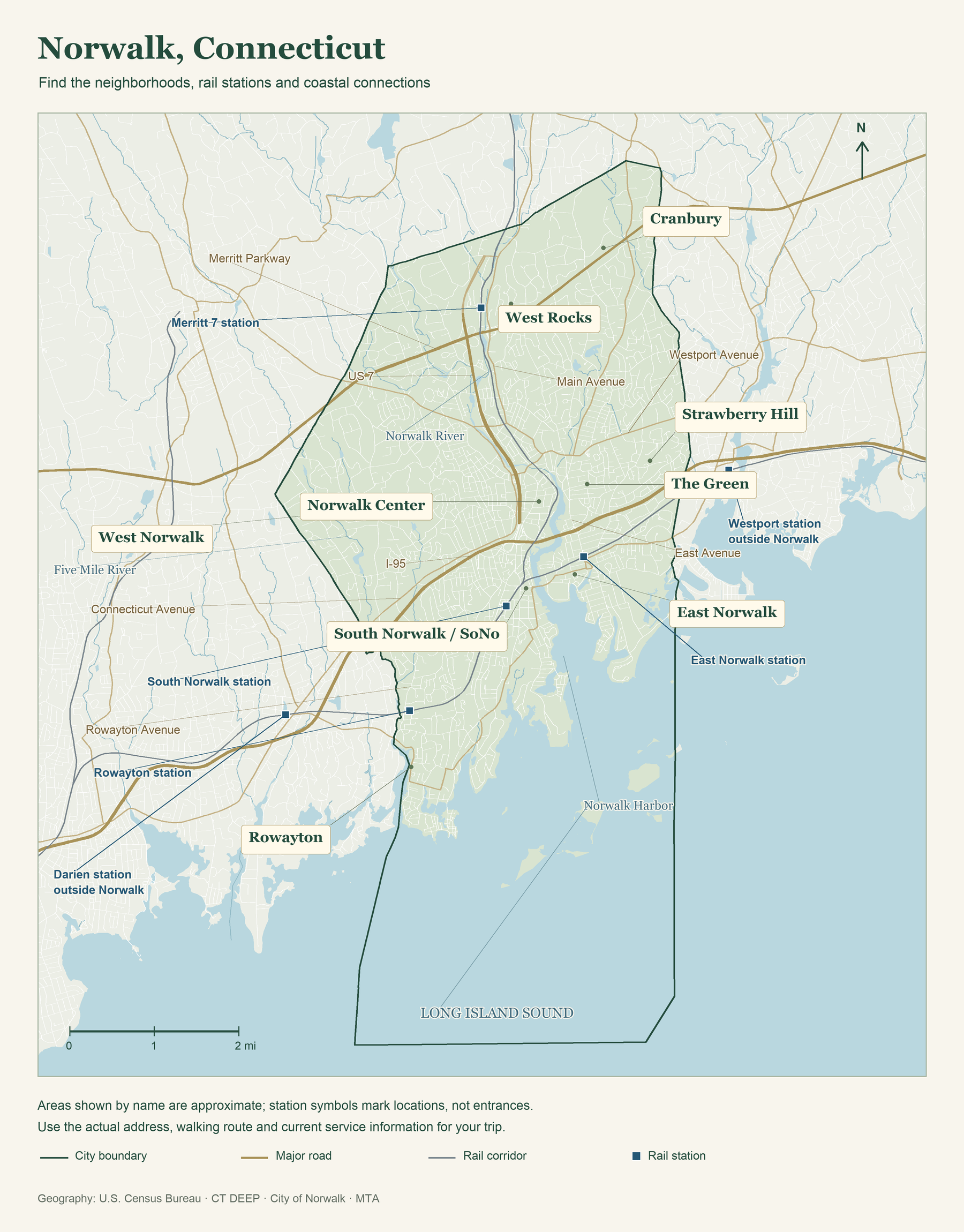
Norwalk offers both an active harbor city and quieter residential settings within the same municipality. Start near South Norwalk Station or a useful bus corridor if everyday trips without a car matter most. Compare East Norwalk or Rowayton for a coastal setting, then check the actual walk to the station and local services. Compare Cranbury or West Norwalk when a residential setting and the particular house or lot matter more than a short walk to central destinations. These are starting points for a housing search; the home, street and weekly routine determine whether the choice works.
South Norwalk, East Norwalk, Rowayton and the other areas below are parts of Norwalk city, Connecticut. Their names do not establish a school assignment, utility company, beach entitlement or a place to park a moving truck. Keep the full street address and unit number at the center of those checks.
- Still choosing a home? Begin with the six area comparisons, housing and costs, and the whole-week transport plan.
- Moving with children? Read the current registration process, then match school and care hours to your transport and workday.
- Already have an address? Work through utilities, collection and move-out items, street-to-room access, and the arrival sequence.
The map locates the city boundary, selected areas, roads, waterways and stations for comparing addresses. It does not establish a truck route, an accessible entrance, a flood zone or a current service timetable.
Sources for this section
- Norwalk city official municipal entry
- South Norwalk area introduction
- East Norwalk area introduction
- Rowayton area introduction
- Citywide Plan 2019–2029, neighborhood profiles based on March 2018 workshops, printed pp347,350,352,358,360,362,364
- Route 1 timetable, effective August 11, 2025
- Route 3 timetable and map, effective May 3, 2026
- City of Norwalk GIS and mapping
- Census TIGERweb roads, water and railway geography
- Connecticut town geography
- MTA rail station locations
02 /
Six places to begin the search
Compare these areas by the type of home and the journeys you need. The City's 2019–2029 planning profiles, based on its 2018 neighborhood work, provide background on building patterns; the current visitor pages help identify the places, and current operator information governs the transport details below. The old profiles' population figures, project forecasts and resident concerns are not current listings or a measure of today's service quality.
South Norwalk / SoNo
The harbor, dining and business activity give SoNo a city-center starting point. The planning profile distinguishes a central concentration of apartments and mixed-use buildings from house streets west of the railway and toward the water. Start here when a station connection and an active center are priorities: South Norwalk Station is a hub on the current bus network, including Route 3. Compare the exact home on a weekday evening and at the time you expect to sleep. Ask about sound, the bedroom's position, deliveries, parking and whether the building has a usable elevator and loading appointment. A harbor address does not automatically provide a short, step-free walk to the train.
East Norwalk
East Norwalk combines a shoreline setting with residential streets and smaller business areas. It is a useful comparison if you want a home near coastal parks while keeping a rail option. Check the front-door trip to the station, shops and your regular bus, rather than measuring only distance on a map. Route 1 and Route 4 serve East Norwalk Station, but Route 4 does not run on Sundays. MTA also warns that the station has ramps to the platforms without an accessible path between them. For a household needing that connection, the side of the station and the complete return journey can change the housing decision. Check the property and approach roads for flood exposure separately from the neighborhood's appeal.
Rowayton
Rowayton's coastal village, shops, restaurants and parks offer a different setting from central SoNo. The City's older profile describes its broader Rowayton/Wilson Point area as principally detached-house neighborhoods. For a particular Rowayton home, compare the walk to the village with the separate walk or ride to Rowayton Station; those are different destinations. MTA identifies Rowayton as a New Haven Line station and warns that its ramped platforms have no accessible path between them, identifying Darien and South Norwalk as nearby fully accessible alternatives. Verify any claimed private beach or association rights in the property's documents. Inspect the carrying route, driveway and road approach before assuming a truck can reach a coastal house in the same way a car can.
Cranbury / West Rocks
Cranbury is in the northeastern part of Norwalk toward Wilton and Westport. The broader planning profile pairs residential streets, trees and open space with the Main Avenue and Westport Avenue corridors. Compare a particular house here when its rooms, outdoor space and residential setting fit your priorities; then price the time and transport needed to reach work, shopping and activities. A home near the Main Avenue bus corridor can have a different routine from one farther into residential streets. Route 3's current map specifically marks the end of service on West Rocks Road. For a house with a long driveway or a private system, establish turning space, snow clearance and the actual water and wastewater arrangements from the property records.
West Norwalk
The City's visitor site describes a largely residential area by the Five Mile River toward Darien and New Canaan. The planning profile also places the Connecticut Avenue commercial corridor alongside its residential setting. Compare detached-house options here when the property itself is the main attraction, and inspect the route to the services you will use. Proximity to Route 1 shopping does not settle the walk from a particular front door. If you plan to use Route 1 buses, test that connecting walk as well as the timetable. Check driveway width, overhead branches, turns and where a truck can stop without occupying a neighbor's entrance. Ask for records confirming public connections or any well and septic system, rather than applying a city-center utility assumption.
The Green / downtown / Strawberry Hill
This broader central comparison includes the Wall Street and Burnell Boulevard side of downtown and residential areas toward the Green and Strawberry Hill. The planning profile distinguishes mixed uses along central corridors from residential streets farther east. It is worth comparing when access to the central library and bus hub matters: the main library is at 1 Belden Avenue, while Burnell Boulevard is a current WHEELS hub. Treat a bus connection and a railway station as separate parts of the journey. Walk the route from the proposed home with its actual slopes and crossings, and compare a quieter side street with a main-road home. For an apartment, settle parking, stairs, delivery access and the receiving room before committing to furniture that may not fit.
Sources for this section
- Citywide Plan 2019–2029, neighborhood profiles based on March 2018 workshops, printed pp347,350,352,358,360,362,364
- South Norwalk area introduction
- East Norwalk area introduction
- Rowayton area introduction
- Cranbury area introduction
- West Norwalk area introduction
- Route 1 timetable, effective August 11, 2025
- Route 3 timetable and map, effective May 3, 2026
- Route 4 timetable and map, effective May 3, 2026
- East Norwalk station and accessibility
- Rowayton station and accessibility
- Library card identification, branches and current hours
03 /
Compare the housing cost you will actually pay
Norwalk has substantial owner-occupied and rental housing, and the monthly cost must be compared for the particular home. The 2020–2024 ACS estimates 36,011 occupied homes (margin of error ±779): 20,028 owner-occupied (±789) and 15,983 renter-occupied (±891). Its housing-type table records detached homes as well as buildings with multiple units. That mix makes it more useful to compare an actual apartment, condominium or house with your routine than to treat the entire city as one housing product.
| 2020–2024 ACS measure | Norwalk city estimate | How to use it |
|---|---|---|
| Median gross monthly rent, renter-occupied homes paying cash rent | $2,073; margin of error ±$87 | A background measure across the survey period. It does not quote a new lease or a particular bedroom count. |
| Median value of owner-occupied homes | $558,000; margin of error ±$21,287 | An estimated housing value, not a current asking price, sale appraisal or amount available to borrow. |
For a rental, get the current proposed lease and a written breakdown of what the quoted rent includes. For an owner-occupied purchase, use the property's actual tax and association information alongside the proposed financing and insurance costs. The same advertised monthly number can represent very different obligations.
| Cost or obligation | Information to obtain for this home |
|---|---|
| Heat, electricity and water | Which accounts you open, which costs the owner includes, the heating fuel and available usage history. |
| Parking and commuting | Whether a space is included, whether an additional vehicle is allowed, and the actual rail/bus/parking cost for your work pattern. |
| Internet and building access | Unit-level service availability, installation access, move-in reservation, any required deposit or building charge and its refund terms. |
| Outdoor and property work | Who handles snow, the driveway, grounds and any private water/wastewater system, and the scope of an association's responsibilities. |
| Up-front cash and overlap | Lease or closing amounts, deposits, accepted utility start costs, moving work and the days both homes must remain usable. |
Before signing, inspect the rooms and the route to them: door openings, stair turns, floor level, elevator dimensions and the space for beds or desks. In an older or altered home, room dimensions alone do not prove that a large item can pass through the entrance. For coastal or riverside property, look up the exact address in FEMA's flood information and ask about the building's history, affected storage areas and access during a storm. The neighborhood name and a dry viewing day do not settle those questions.
Sources for this section
- 2020–2024 ACS B25003, Tenure: Norwalk city, Connecticut
- 2020–2024 ACS B25064, Median Gross Rent: Norwalk city, Connecticut
- 2020–2024 ACS B25077, Median Value: Norwalk city, Connecticut
- 2020–2024 ACS B25024, Units in Structure: Norwalk city, Connecticut
- Citywide Plan 2019–2029, neighborhood profiles based on March 2018 workshops, printed pp347,350,352,358,360,362,364
- Official Flood Map Service Center address search
04 /
Living without a car: choose a useful corridor, then plan the whole week
A car-free household can make Norwalk work, especially near South Norwalk Station or a useful section of the Route 1 or Route 3 bus corridors. It is a more demanding choice at an address with a long walk to those services, for late shifts, or for trips outside the transit network. The reason is practical: these corridors connect stations, shopping and other daily destinations, with service beyond the weekday commute. They still do not provide an all-night, door-to-door network. Choose the home around your actual work, food shopping, care and social trips, rather than treating proximity to any station as enough.
The current WHEELS schedules are the place to start. Route 1 links the Connecticut Avenue shopping corridor and the college with Norwalk Hospital, Burnell Boulevard Hub, City Hall and East Norwalk Station. Route 3 links South Norwalk Station, The SoNo Collection, Burnell Boulevard Hub, Main Avenue shopping and Merritt 7. Both run seven days a week, but the Sunday timetable is shorter than the weekday timetable. Route 3's May 3, 2026 schedule replaces the older network-launch version. Its map also marks the end of service on West Rocks Road; a nearby former stop is not evidence of a current bus.
| Service | What the current timetable provides | Practical limit |
|---|---|---|
| Route 1 | Weekday and Saturday evening trips, plus a separate Sunday timetable. | On Sunday the last listed departure from the college toward Rogers Square is 7:25 p.m., reaching Rogers Square at 8 p.m. Do not plan an 11 p.m. Sunday return from the weekday service description. |
| Route 3 | Sunday departures from South Norwalk toward Walmart run half-hourly from 8 a.m. through 8 p.m. The last listed return leaves Walmart at 9:02 p.m. and reaches South Norwalk at 9:30 p.m. | These are scheduled timepoints, not a promise about traffic, a train connection or shop opening hours. Include the walk from your stop and a missed-bus buffer. |
| Route 4 | The May 3, 2026 route serves South Norwalk Station, Calf Pasture Beach, East Norwalk Station and Norwalk High School/Westport Avenue on weekdays and Saturdays. | There is no Sunday service. A beach or East Norwalk trip that works on Saturday may need another plan on Sunday. |
For local trips away from a fixed route, Wheels 2U serves all of Norwalk. Its published hours are Monday–Wednesday 7 a.m.–7 p.m., Thursday–Friday 7 a.m.–11 p.m., Saturday 1 p.m.–midnight and Sunday 1 p.m.–9 p.m. The price is $2 per person per ride, or $6 for a group of three to eight; children five and under ride free with an adult. Request and pay by credit card through its phone app; drivers do not take cash. It is a shared, requested ride with an estimated pickup, so leave time for the vehicle rather than treating an unrequested ride as a reserved appointment. It does not solve an early weekend shift or a late Monday return after its operating hours.
For people who do not drive, WHEELS offers a useful cash option: the current full fare is $1.75 for 120 minutes, and a one-day unlimited fare is $4 on the bus. Token Transit is another payment option. The fare page marks the Yankee Doodle Garage ticket counter temporarily closed, so do not make a move-day trip there solely to buy a pass. Bus fares, Wheels 2U fares and rail tickets are separate products. For transit help, NTD lists 203-299-5161; Wheels 2U Norwalk lists 203-852-0000, option 3.
Metro-North provides the regional rail part of the plan. Use its schedules or TrainTime for the actual station, direction and date, including the return after an evening out; add the local bus or walk at each end. East Norwalk is on the New Haven Line. Its MTA station page warns that the platforms have ramps but no accessible path between the platforms; it identifies South Norwalk and Westport as the nearest fully accessible stations on that line. A ramp at the entrance therefore does not settle the whole accessible journey. Arrange the correct drop-off side or an appropriate alternative station and check current station and elevator information.
Before signing, try the proposed front-door route on a weekday evening and a Sunday. Include carrying groceries, a pharmacy visit, a child's activity or a medical appointment, and the return after your latest regular commitment. Look at crossings, sidewalk continuity, lighting and the distance while carrying bags. For cycling, inspect the whole route rather than assuming every connecting street has protected space. A bicycle may cover some trips, but needs a route and storage you can actually use in bad weather. For trips beyond the timetable or outside the service area, budget an arranged paid ride or an agreed lift. A rental car is an option only for someone able and authorized to drive; it is not the fallback for a person without a license.
Sources for this section
- WHEELS schedules and current route links
- Route 1 timetable, effective August 11, 2025
- Route 3 timetable and map, effective May 3, 2026
- Route 4 timetable and map, effective May 3, 2026
- Current fares and ticket purchase options
- Norwalk service area, hours, fares and FAQ
- East Norwalk station and accessibility
- Metro-North schedules, station information and TrainTime
- Rowayton station and accessibility

05 /
Register for school using the October 2026 requirements
Start with the 2026–27 School Assignments by Street Name list, then complete NPS online registration and take the supporting documents to the Family Center at 46 Concord Street. Its registration page gives Monday–Friday hours of 8 a.m.–4 p.m., telephone 203-854-4100 and familycenter@norwalkps.org. A neighborhood name or a nearby school does not establish the assignment for a particular home. School choice is a separate application and does not guarantee a place; a successful choice application also does not replace registration for a family new to NPS.
For ordinary new registration, NPS asks for the child's original birth certificate, parent/guardian photo identification, the Connecticut Health Assessment Record and three residency documents. Its October 5, 2026 update changes several details still found in older instructions. Bring the current checklist and update together: the first normally establishes the home through an ownership document, current lease or applicable notarized affidavit; the other two are accepted current documents supporting the name and address. The checklist includes account-setup confirmation, bank statements and certain other non-utility documents as alternatives to bills. Utility bills must be from the last 30 days. Expired documents and shutoff notices are not accepted.
| Situation | What the October update says to prepare |
|---|---|
| You have a current lease and are opening utilities | Bring the current lease and proof that utility accounts have been established at the new address at registration. There is no ordinary 30-day period to supply missing residency documents later. |
| Your lease includes utilities | Bring two current non-utility statements or documents showing the registering parent's or guardian's name and new address, along with the housing evidence. |
| You do not have a current lease | Use the applicable landlord affidavit and two required residency proofs. The update requires one bill or statement in the affidavit signer's name and the second in the registering parent's or guardian's name. |
| A caregiver will register the child | Bring the appropriate guardianship documentation or authorization, such as the court order or notarized parent/guardian letter described in the update, as well as the other applicable records. |
NPS now states that a passport is not a substitute for the birth certificate in its ordinary process. Contact the Family Center before arrival if that record is unavailable or your living arrangement does not fit the checklist. The general registration FAQ still contains older advice about two bills in a host's name and 90-day bills; the specifically dated October update requires the newer name and 30-day rules. The kindergarten page also retains an older 1 Park Street instruction farther down, while its current opening instructions and the new-student page direct families to 46 Concord Street. Use the current address, and call before a trip if you need help assembling the records.
Arrange the health assessment early and have the receiving school nurse review the records. NPS Health Services says new students need the completed assessment and immunization compliance on file before ordinary attendance, with no ordinary grace period. Send existing IEP or 504 information through registration so the receiving school can arrange the next steps. Ask the school about medication forms and its actual handover procedure; putting medicine in a moving carton or a child's backpack does not arrange school administration. Confirm the school start date and transportation separately from completing the online form.
Families experiencing homelessness have a different protected route. Connecticut's education department explains that eligible children and unaccompanied youth have a right to immediate enrollment without the usual residency, school, immunization or other records. Temporary sharing of someone else's home because of housing loss or hardship can require an eligibility review; simply living with relatives does not by itself settle the question. Tell the Family Center about the housing situation and ask to be connected to the district's McKinney-Vento liaison for enrollment, records and transportation help. Do not wait to collect an ordinary lease package before seeking that help.
For kindergarten in 2026–27, the normal cutoff is age five on or before September 1, 2026. For a younger child, ask Early Childhood at 203-854-4113 about the district's applicable 2026–27 process before relying on admission: the General Assembly explains that an early-entry waiver became optional for districts on July 1, 2026. That waiver route ends July 1, 2027; NPS gives age five by September 1, 2027 for first kindergarten entry in 2027–28. The former 2024 transition arrangement is not a current entitlement. Childcare and before/after-school care need their own accepted place, hours and pickup plan; neither a home purchase nor school registration reserves them.
Sources for this section
- 2026–27 new-student registration
- School assignments and the 2026–27 street list
- New-student and residency checklist
- Family Center registration 2026–27 updates, linked October 5, 2026
- Kindergarten entry in 2026–27 and 2027–28
- Health assessment information
- Registration and school-choice FAQ
- 2026 Acts Affecting Children, kindergarten waivers, page 16
- Homeless Student Support FAQ
06 /
Make the first week’s ordinary trips easy
Choose a grocery trip, a pharmacy trip and a place to spend time near the home before filling the calendar with extra journeys. Routes 1 and 3 connect shopping destinations, but the return with groceries and the route's evening or Sunday hours matter as much as the outward trip. For a family, add the actual care pickup and school activity locations. Arrange any needed new-patient appointment and transfer of your own records separately; an address near a facility does not reserve an appointment.
The main Norwalk Public Library at 1 Belden Avenue and South Norwalk branch at 10 Washington Street are useful first-week destinations. For your own library card, the library's current page accepts a qualifying current ID with a Norwalk address, or an accepted photo identity document plus a current residency document. Its examples include an employer or school photo ID and a lease, recent utility bill or recent personal mail. You do not have to wait specifically for a new driver's license. Without photo ID, its published rule limits the card to two items. Check the location's hours and any program booking before making a special trip: the two branches have different weekday opening patterns.
For outdoor time, Cranbury Park offers wooded trails, while Calf Pasture and Shady Beach provide the shoreline option. The City's current park information makes an important distinction for dog owners: Veterans Park does not allow dogs; Cranbury has areas where dogs are permitted and areas, including the playground and Great Lawn, where they are not. Choose the actual permitted area rather than assuming every park follows the same rule. A rental or association can also have its own rules for keeping an animal at home.
If you drive, arrange the park-parking step before the first seasonal visit. The City posts a May 15–October 15 parking-fee season and annual plate verification after April 1 for Norwalk-registered vehicles on its Grand List. A new resident with an out-of-town plate should contact Recreation and Parks or residentpass@norwalkct.gov for the applicable pass process instead of assuming that a lease automatically makes the vehicle eligible. The public pages currently identify the 2025–2026 pass period; check the next period when planning a later move. Parking permission does not reserve an event space or establish private beach rights.
Sources for this section

07 /
Set up each household service for the exact address
Identify water and electricity separately before scheduling a start or stop. The City identifies two public water systems: First District Water Department and South Norwalk Electric and Water, or SNEW. SNEW and the Third Taxing District also provide electricity in their respective service areas. A postal neighborhood, taxing-district name or water bill is not enough to assume the same electric provider. Ask the seller or landlord for the provider names and current service addresses, then have those providers confirm the unit, start date and whose name belongs on each account. Also establish whether heat is gas, oil or electric and which utilities the lease includes.
| Provider shown for the property | Useful first action | Keep this distinction |
|---|---|---|
| SNEW electricity or water | Call 203-866-3366. Its FAQ directs an electric account on an existing service to customer service at 1 State Street in South Norwalk Station, and an existing water-account transfer to the same phone number. Its residential forms include electric service and disconnection forms. | The electric customer of record is responsible for the electric bill; SNEW says the property owner of record is responsible for water. Ask about the documents, any deposit and effective date before attending the office. |
| Third Taxing District electricity | Use its Residential Service Policy/new-service route and contact customer service at 203-866-9271, 2 Second Street, for the required application, documents and accepted service date. | For an outgoing account, its FAQ says to call customer service to arrange disconnection; this can be scheduled weeks ahead or two to three days before moving. Opening a payment portal account is not confirmation that electric service has transferred. |
| First District water | Use Forms & Applications: Name/Address Change is for the owner name on an existing property. For a bill to be sent to a tenant, the property owner submits Tenant Connection; the published application charge is $10 on the next billing cycle. Customer service: 203-847-7387, 12 New Canaan Avenue. | A new or modified physical water hookup is a different job with its own connection forms. Do not use that construction process or its lead time as the rule for every ordinary move. |
| Eversource on the property's account | Use its Start, Stop or Transfer Service page, select the actual service area and follow the new- or existing-customer branch. | Use the service area for the exact home and obtain the accepted start date and any deposit from the provider before handover. |
Coordinate the outgoing account with the handover rather than cutting power before the last agreed access. SNEW requires a written electric stop request with customer and account numbers, service address, disconnection date, forwarding address and phone; its FAQ describes weekday disconnection and a final bill. For a SNEW property sale, the owner or attorney should contact it once the closing date is selected, giving seller, buyer, closing and both attorneys' contact information so it can arrange the final water reading. Do not treat a sale-related reading as an instruction to shut off a rental building's water.
For an incoming rental, obtain written confirmation of which services remain in the owner's name and which you must open. Save the account-start confirmation: it can also help with the school's residency-document process. Arrange internet for the unit and installation access separately, and find out who can admit the technician if you are still moving. Before move day, have the start confirmations, heating responsibility, emergency contacts and a working way to enter the home. If a provider has not accepted the requested date, arrange with the landlord or closing parties how the home will be usable before sending people and belongings there.
Sources for this section
- Public water systems serving Norwalk
- Account setup, billing responsibility and moving procedures
- Customer service and emergency contacts
- Residential start/stop forms
- Electric service and disconnection FAQ
- Residential Service Policy entry
- Owner name change and tenant billing forms
- Customer service contact and office hours
- Start, Stop or Transfer Service location-selection entry
08 /
Separate regular collection, packing waste and bulky items
Establish the property's regular collection first; keep move-out furniture and packing materials out of that ordinary plan until their route is arranged. The City's solid-waste page limits its collection to residential properties with four or fewer dwellings on public roads that are connected, or can be connected, to the City sewer. Its single-stream recycling page also limits City collection to properties with four or fewer dwellings. Use MyNorwalk and Customer Service at 203-854-3200 to confirm the actual property's eligibility and collection day. For a larger building or an address outside City collection, ask the manager which private service and waste area the property uses.
For City garbage collection, put waste inside the proper cart; material beside it is not collected. The City requires three feet between a cart and objects such as cars, trees and mailboxes, with wheels and handles facing away from the road. Keep carts clear of the moving truck and carrying path. In an apartment or shared driveway, have the manager identify the permitted collection point before unloading packaging or old possessions there.
Use the blue City cart for eligible curbside recycling, not garbage. Empty and clean containers and cardboard/boxboard belong in the accepted stream. Plastic bags, plastic film, bubble wrap, packing peanuts and foam packaging do not. Keep those materials separate while unpacking, and arrange their appropriate reuse or disposal route rather than bagging them into the blue cart. Take apart bulky cartons so usable cart space is not lost to empty boxes, without obstructing the collection point or assuming extra piles beside it will be taken.
City bulky collection is a scheduled program for eligible Fourth Taxing District residents receiving City garbage collection, not an on-demand mover pickup. Its published program allows two collections per calendar year, limits each to one cubic yard and uses zone-specific sign-up windows. All listed 2026 sign-up windows have already passed as of October 20. Do not plan an immediate move around one of those past windows or infer a 2027 date. Ask Customer Service what route is currently available for your address and items; otherwise arrange an accepted alternative before leaving furniture at the curb.
The transfer station at 61 Crescent Street is another route for accepted materials. Published hours are Monday–Friday 7:30 a.m.–3 p.m. and Saturday 7:30 a.m.–2 p.m., with Sunday closed and holiday changes possible. Residential vehicles need a valid City Residential Disposal Pass. Pickups, cargo vans and trailers have an additional permit process; commercial vehicles require a commercial permit. A resident's disposal benefit does not automatically cover a moving company's truck. The page lists commercial acceptable-waste pricing of $125 per ton effective July 1, 2026 and credit/debit-card payment only, but special items and vehicle categories can carry other charges.
If you will use an SUV, rental or company vehicle, resolve the category before loading. The transfer-station page's prose includes SUVs among vehicles needing an additional residential permit, while its table groups SUVs with resident cars needing a disposal pass. That conflict prevents a reliable blanket promise of pass-only or free SUV entry. Give Customer Service the vehicle's registration type, whether you are using a trailer, and the materials; obtain the required pass/permit instructions and charges for that trip. A permit may require the empty vehicle to be weighed first, so arriving loaded can be the wrong first step.
Keep mattresses separate from ordinary recycling and furniture assumptions. The City listed resident mattress-recycling events on April 18, June 6 and September 12, 2026 at 15 South Smith Street, with dry, intact mattresses required. Those dates are past; they do not establish a standing free drop-off. Ask about a newly announced event or another accepted mattress route before transport. Likewise, electronics, refrigerant appliances, hazardous waste, wet paint and construction debris need their applicable category; the station's accepted-material list is not permission to put every item in the household garbage cart.
09 /
Prepare for snow and storm access before the truck arrives
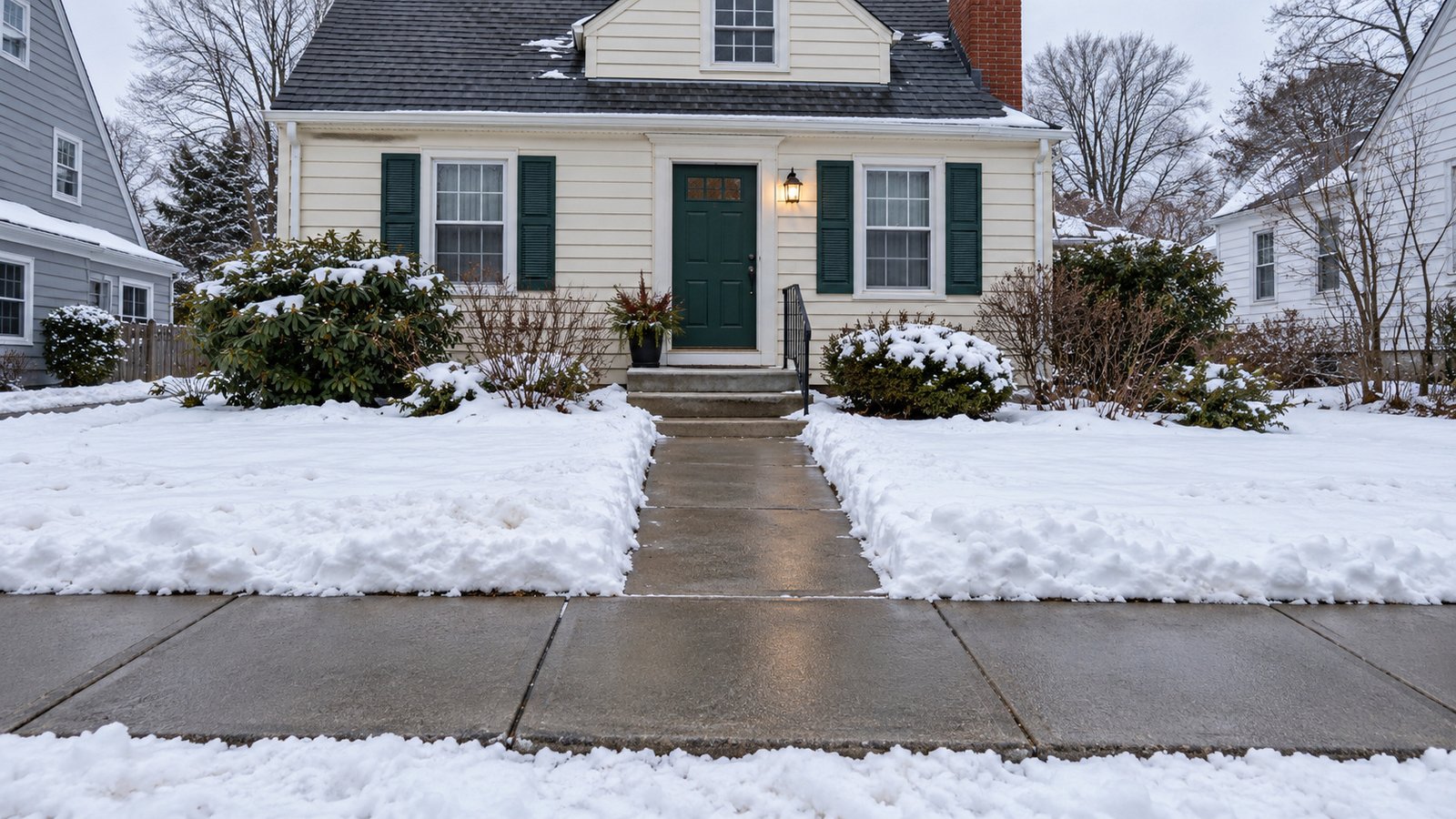
For a winter move, have someone responsible for the entire cleared carrying route before loading or dispatch. Include the public sidewalk, driveway, steps and the receiving entrance, then agree who will return if plowing or refreezing makes the route unusable. DPW's snow policy prioritizes main roads and can require repeated plowing before side streets are finished. A cleared main road is not confirmation that the last driveway or unloading space is ready.
Under current Code §95-10, owners and occupants in control share responsibility for the adjoining public sidewalk. Keep its paved width usable; treat ice as needed and renew treatment. The code presumes noncompliance when snow or ice remains more than 24 hours after the weather event ends. That is not a reason to leave the route unsafe until a moving crew arrives. Do not put cleared snow into the street or onto another public sidewalk. During a declared snow emergency, the City's marked emergency routes have parking restrictions; check the current declaration and signs rather than relying on a past storm's arrangements.
For heavy rain or a coastal storm, review the home and its approach separately. FEMA's Map Service Center lets you search an exact address for official flood information, which can change as maps are updated. Ask the owner or manager how access, lower-level storage and building systems are handled during an alert. If the route is closed or unsafe, the customer and move planner should choose an accepted postponement or alternative before the truck reaches it. Keep essential medicines, documents, chargers, weather clothing and overnight supplies with the people who need them; do not depend on immediate access to every carton.
Sources for this section
10 /
Confirm the truck position separately from building access
If the plan uses public space beyond ordinary travel, Norwalk Code §96-3F calls for the Public Works Director's determination of whether a permit is needed. An encroachment permit does not automatically authorize parking. Give DPW the actual location, equipment and proposed use; contact it at 203-854-4161 or DPWPermits@norwalkct.gov. For Parking Authority-managed space, contact Park Norwalk at 203-831-9063 about the particular arrangement. Payment at a meter is not permission to occupy extra spaces, block traffic or reserve a loading zone yourself.
Code §98-26 limits commercial vehicles over 1¼ tons of rated capacity to four hours in public places; shorter posted restrictions still matter. Rated capacity is not the vehicle's gross weight, and the threshold is strictly over 1¼ tons. The code also restricts two or more commercial vehicles or trucks parked simultaneously in a residential district or an adjacent street. These rules can affect a two-truck or long unloading plan before the first vehicle arrives. Have the planner settle a lawful arrangement; do not treat a service estimate or a City permit as an automatic exception.
11 /
Plan the route from a lawful truck position to each room
Settle both the truck's lawful stopping position and the building's carrying route before reserving the move. Send the planner the full address and unit, floor, entrance photographs, furniture dimensions and any time limits. Walk from the proposed unloading point through the gate, exterior steps, vestibule, doors, stairs or elevator to the receiving rooms. Measure clear openings and tight turns, not just the width of the finished room. Identify overhead branches, awnings, wires or low entrances on a driveway approach for the vehicle planner.
For a managed building, ask the manager which entrance and elevator may be used, who reserves them, how padding is arranged, and whether a certificate of insurance or building deposit is required. Get the accepted date, hours and contact for admission. Ask who can authorize a change if the elevator fails or another delivery occupies the loading area. A building's loading instruction does not itself authorize a truck to obstruct a public road or sidewalk.
The vehicle route matters too. CTDOT prohibits box trucks and rental trucks on the Merritt Parkway and other named parkways. Give the planner the actual truck dimensions and require an appropriate non-parkway route where those restrictions apply. A passenger-car navigation shortcut is not a truck route. At the home, label receiving rooms and identify the person who will direct placement so a clear entrance stays clear as unloading proceeds.
12 /
Put the move and first week in a workable order
| Stage | Finish this step | Who needs the result |
|---|---|---|
| Before committing to the home | Try the weekly journeys, inspect the entry and rooms, identify school and utility procedures, and compare the full recurring cost. | The household and the landlord or purchase team. |
| Once the address and handover are agreed | Arrange accepted utility dates, building access and moving scope. Families should begin registration and assemble the current residency evidence. | Providers, Family Center, building manager and move planner. |
| Before dispatch | Confirm keys, safe lawful truck position, the cleared carrying route, elevator/window and a receiving contact. Separate essentials and documents from the shipment. | The customer, building contact and crew lead. |
| At arrival | Check that the entrance and utilities are usable, direct furniture to the intended rooms, keep exit routes open and record any issue through the agreed moving process. | The receiving household and crew lead. |
| During the first week | Complete school start/transport arrangements, organize ordinary collection and packing waste, make the needed service appointments, and try the everyday trips from the new front door. | The household, school and relevant local services. |
If keys or the receiving window fail, decide before dispatch whenever the problem is known. Agree in advance who can authorize a change and a decision time that leaves the crew an actionable plan. The customer and move planner should first obtain a confirmed alternative access time from the landlord or closing parties. If that does not work, choose postponement, another accepted receiving address or storage only after the receiving facility has accepted the shipment and its hours, access, unloading and later release are settled. Get the effect on waiting, transport, storage and redelivery charges in writing; a phone number for a warehouse is not a booking.
Keep people, pets and the essentials bag in a usable place while belongings wait. Tell the driver and receiving contact the revised destination or time before they proceed. Resume delivery only when keys, the carrying route, the receiving person and the lawful unloading arrangement are confirmed again. For the moving work and an estimate, use the Norwalk moving page; the exact inventory and both addresses determine the work to be arranged.
Sources for this section
- 2026–27 new-student registration
- Family Center registration 2026–27 updates, linked October 5, 2026
- Account setup, billing responsibility and moving procedures
- Owner name change and tenant billing forms
- Collection eligibility and cart placement
- Excavations and encroachments, especially §96-3F and §96-19
- Traffic and parking, especially §98-26
13 /
Questions before you arrive
Can I live in Norwalk without a car?
Yes, a household with suitable trips can make it work near South Norwalk Station or a useful part of the Route 1 or Route 3 corridors. These provide seven-day links to shopping, stations and other destinations. A distant address or late shift is harder: Sunday buses have shorter hours, and Wheels 2U starts only at 1 p.m. on weekends and ends at 7 p.m. Monday–Wednesday. Test your groceries, work, care and evening return before choosing the home, and budget an arranged ride for gaps. A rental is not a fallback for someone who cannot drive.
Do Norwalk buses run on Sunday?
Some do. Routes 1 and 3 have Sunday schedules; Route 4 has no Sunday service. For example, Route 1's last listed Sunday trip from the college toward Rogers Square leaves at 7:25 p.m. and reaches Rogers Square at 8 p.m. Use the actual route's Sunday table and both directions, rather than applying weekday evening hours to every bus.
Can Wheels 2U replace a car throughout the week?
It helps with local trips but cannot cover every hour. It serves all Norwalk Monday–Wednesday 7 a.m.–7 p.m., Thursday–Friday 7 a.m.–11 p.m., Saturday 1 p.m.–midnight and Sunday 1 p.m.–9 p.m. Request and pay through its app with a credit card; the fare is $2 per person or $6 for three to eight people, and children five and under ride free with an adult. Allow time for a shared pickup. Arrange another option for a weekend morning or a return after closing.
Can I use transit without a smartphone or credit card?
WHEELS fixed-route buses accept cash: the current full fare is $1.75 for 120 minutes and the day fare is $4 on the bus. Wheels 2U is different: its published booking and credit-card payment are through the phone app, with no cash accepted by drivers. Build a cash-based plan around suitable fixed routes rather than assuming the on-demand service has the same payment method.
Is East Norwalk Station fully accessible for a return trip?
MTA says its platforms have ramps but there is no accessible path between platforms. Plan the appropriate drop-off/pickup side or use a suitable alternative; MTA identifies South Norwalk and Westport as the nearest fully accessible stations on the line. Check the current station and elevator information for the complete trip, not just the first platform.
Where do I complete public-school registration?
Complete the NPS online form, then take hard copies or original supporting documents to the Family Center, 46 Concord Street, Monday–Friday 8 a.m.–4 p.m. NPS says documents are reviewed, copied and returned; uploading them does not complete this step. Call 203-854-4100 or email familycenter@norwalkps.org for help. Use the current 2026–27 street-assignment list for the actual address, and confirm the start date and transport with the receiving school.
Can I enroll with a new lease before my first utility bill arrives?
For ordinary registration, the October 2026 update requires the current lease and proof that utility accounts have been established at the new address at the time of registration; it removes the former 30-day period for missing residency proofs. The checklist includes account-setup confirmation. If utilities are included in rent, provide two current non-utility statements or documents with the registering parent's or guardian's name and new address. Contact the Family Center if your documents do not fit those branches.
What if we live temporarily with another household?
Tell the Family Center the actual arrangement. The ordinary landlord-affidavit route now requires one supporting bill or statement in the affidavit signer's name and the second in the registering parent's or guardian's name. If housing loss or hardship may make the child eligible under McKinney-Vento, ask for the district liaison instead of waiting to satisfy the ordinary lease package: eligible children have immediate-enrollment rights even when normal records are missing.
What is the kindergarten age cutoff?
The normal 2026–27 cutoff is age five by September 1, 2026. For a younger child, contact NPS Early Childhood at 203-854-4113 about the applicable 2026–27 process; state law made a waiver optional for districts that year, so admission is not automatic. The waiver route ends July 1, 2027, and the 2027–28 cutoff is age five by September 1, 2027.
Does one utility company serve every Norwalk home?
No. The City identifies First District Water Department and SNEW as the two public water systems, and electricity can have a different provider. Get the water and electric names for the exact unit from the seller or landlord, then confirm them with the providers. Use the SNEW, Third Taxing District, First District or Eversource account route that applies to the property; a neighborhood name alone does not assign all its utilities.
As a tenant, should I open the water account myself?
First establish the lease arrangement and water provider. SNEW says its water bill is the property owner's responsibility. First District's Tenant Connection form, used to send the bill to a tenant, must be submitted by the property owner and has a published $10 application charge. These differ from opening an electric account in your own name. Ask the owner to complete the applicable water step before handover.
Will the City collect the boxes and furniture from my move?
Do not put them into one curbside pile. Eligible clean cardboard goes into the blue recycling stream; bubble wrap, film, plastic bags, foam and packing peanuts do not. City garbage collection does not take material left outside the cart. Bulky collection is a separate eligible-address program with sign-up windows, and all published 2026 windows have passed. Arrange a currently accepted bulky-item or transfer-station route before leaving furniture outside.
Can a mover use my residential disposal pass?
Do not assume so. The transfer-station page requires a commercial permit for commercial vehicles; residential benefits do not automatically apply to a moving company's truck. Its SUV prose and table also conflict about the additional permit. Before loading, give Customer Service at 203-854-3200 the vehicle registration type, any trailer and the exact materials so the correct pass, permit and charges are established for that trip.
Is mattress recycling available whenever I arrive?
The City's listed 2026 mattress events were April 18, June 6 and September 12 at 15 South Smith Street; all are past. Those events required dry, intact mattresses and do not establish an ongoing free drop-off. Ask Customer Service about a newly announced event or another accepted route before bringing a mattress, and keep it separate from ordinary recycling.
Which part of Norwalk should I compare first?
Start with SoNo and useful Route 1 or Route 3 corridors if station access and everyday trips without a car are your priority. Compare East Norwalk and Rowayton for coastal settings, then check the actual station walk and return trip. Compare Cranbury and West Norwalk when the house, lot and residential setting are more important, while budgeting the trips to work and services. Around the Green/downtown, compare the bus hub and central amenities with the exact street and slopes. Visit the particular home at the hours you expect to use it.
Does the Census rent figure tell me what a new lease will cost?
No. The $2,073 median gross rent, with a margin of error of ±$87, is a citywide 2020–2024 ACS estimate for renter-occupied homes paying cash rent. It is not a quote for a new lease, a neighborhood or a bedroom count. Obtain the current lease terms and compare included utilities, heating, parking, internet and any building charges alongside the advertised rent.
How do I find out whether a house has public water and sewer?
Ask for the property’s current water and wastewater records, provider bills and any well or septic documentation before committing. The City’s older neighborhood profiles identified places without public connections in parts of Cranbury and West Norwalk; they do not prove the system at a particular home today. Have the owner identify the actual system and arrange any needed inspection or maintenance review. Do not open a generic city-center utility account in place of that check.
Can I get a library card before I have a Norwalk driver’s license?
Yes. The library lists alternatives: for example, an accepted employer or school photo ID plus current residency evidence such as a lease, a utility bill from the last three months or recent personal mail. It also lists qualifying ID with a current Norwalk address. Its published no-photo-ID rule limits the card to two items. Bring the applicable documents to the library and check the chosen branch’s hours.
Does being a new resident automatically give my car free beach parking?
No. The City’s seasonal parking program requires the applicable vehicle and residency verification. It posts annual Grand List verification after April 1 for Norwalk-registered vehicles. With an out-of-town plate, contact Recreation and Parks or residentpass@norwalkct.gov for the applicable pass route before a seasonal visit. The pages currently identify the 2025–2026 period, so check the next period for a later move. A parking pass does not reserve a private beach or event space.
Is Rowayton Station fully accessible between both platforms?
MTA says its platforms have ramps but no accessible path between the platforms. Plan the correct drop-off and pickup side or an appropriate alternative; MTA identifies Darien and South Norwalk as the nearest fully accessible stations on the line. Check current station and elevator information for the complete journey.
Who must clear the sidewalk before a winter move?
Norwalk Code §95-10 places responsibility on owners and occupants in control of the abutting property. Keep the paved sidewalk width usable, treat ice and renew treatment as needed. The code presumes noncompliance after snow or ice remains 24 hours beyond the end of the weather event. Arrange who will clear and recheck the route before the crew arrives; that period is not permission to use an unsafe route.
Can a rented moving truck use the Merritt Parkway?
CTDOT prohibits rental trucks and box trucks on the parkway. Have the move planner use a route appropriate to the actual truck and its dimensions, rather than a passenger-car navigation shortcut. A rental agreement or a short journey within Norwalk does not remove the parkway restriction.
Does a street permit or meter payment reserve my unloading space?
Do not treat either as an automatic reservation. An encroachment permit does not itself authorize parking, and meter payment does not permit occupying extra spaces or blocking traffic. Give DPW the proposed use for its determination, and contact Park Norwalk for a Parking Authority-managed space. The planner must also account for posted restrictions, the four-hour public-place limit for commercial vehicles over 1¼ tons rated capacity and the rule affecting two simultaneous commercial vehicles in residential areas.
What should I do if the keys or unloading appointment are delayed?
Tell the move planner before dispatch as soon as the problem is known. The customer and planner should obtain a confirmed new access time or choose an accepted postponement, receiving address or storage arrangement. Confirm the facility’s hours, unloading and later release, and the effect on waiting, storage and redelivery charges in writing. Keep people, pets and essentials in a usable place; resume delivery only after keys, a receiving contact, the safe carrying route and lawful unloading are confirmed.
Your next step
Bring the plan together
Bring both addresses, the inventory and your confirmed access arrangements together. Our Norwalk moving page explains the work you can request and the written estimate process.
Sources & useful local resources
Official procedures and local resources are linked beside the answers above. Reopen the relevant page when arranging a date: fees, schedules and application requirements can change.
Sources and local resources
- Norwalk city official municipal entryCity of Norwalk
- South Norwalk neighborhoodCity of Norwalk — Visit Norwalk
- East Norwalk neighborhoodCity of Norwalk — Visit Norwalk
- Rowayton neighborhoodCity of Norwalk — Visit Norwalk
- Citywide Plan 2019–2029, neighborhood profiles based on March 2018 workshops, printed pp347,350,352,358,360,362,364City of Norwalk
- Route 1 timetable, effective August 11, 2025Norwalk Transit District
- Route 3 timetable and map, effective May 3, 2026Norwalk Transit District
- City of Norwalk GIS and mappingCity of Norwalk
- Census TIGERweb roads, water and railway geographyU.S. Census Bureau
- Connecticut town geographyConnecticut DEEP
- MTA rail station locationsMTA / New York State Open Data
- 2020–2024 ACS B25003, Tenure: Norwalk city, ConnecticutU.S. Census Bureau
- 2020–2024 ACS B25064, Median Gross Rent: Norwalk city, ConnecticutU.S. Census Bureau
- 2020–2024 ACS B25077, Median Value: Norwalk city, ConnecticutU.S. Census Bureau
- Norwalk city — Units in Structure, ACS 2020–2024U.S. Census Bureau
- Official Flood Map Service Center address searchFederal Emergency Management Agency
- WHEELS schedules and current route linksNorwalk Transit District
- Route 4 timetable and map, effective May 3, 2026Norwalk Transit District
- Current fares and ticket purchase optionsNorwalk Transit District
- Norwalk service area, hours, fares and FAQWheels 2U / Norwalk Transit District
- East Norwalk station and accessibilityMetropolitan Transportation Authority
- Metro-North schedules, station information and TrainTimeMetropolitan Transportation Authority
- Rowayton station and accessibilityMetropolitan Transportation Authority
- 2026–27 new-student registrationNorwalk Public Schools
- School assignments and the 2026–27 street listNorwalk Public Schools
- New-student and residency checklistNorwalk Public Schools
- Family Center registration 2026–27 updates, linked October 5, 2026Norwalk Public Schools
- Kindergarten entry in 2026–27 and 2027–28Norwalk Public Schools
- Health assessment informationNorwalk Public Schools Health Services
- Registration and school-choice FAQNorwalk Public Schools
- 2026 Acts Affecting Children, kindergarten waivers, page 16Connecticut General Assembly, Office of Legislative Research
- Homeless Student Support FAQConnecticut State Department of Education
- Library card identification, branches and current hoursNorwalk Public Library
- Parks, permitted dog areas and parking informationCity of Norwalk Recreation and Parks
- Beach and seasonal parking verificationCity of Norwalk Recreation and Parks
- Resident Pass portal entryCity of Norwalk
- Public water systems serving NorwalkCity of Norwalk Health Department
- Account setup, billing responsibility and moving proceduresSouth Norwalk Electric and Water
- Customer service and emergency contactsSouth Norwalk Electric and Water
- Residential start/stop formsSouth Norwalk Electric and Water
- Electric service and disconnection FAQThird Taxing District Electric Department
- Residential Service Policy entryThird Taxing District Electric Department
- Owner name change and tenant billing formsFirst District Water Department
- Customer service contact and office hoursFirst District Water Department
- Start, Stop or Transfer Service location-selection entryEversource
- Collection eligibility and cart placementCity of Norwalk
- Curbside recycling eligibility and accepted materialsCity of Norwalk
- 2026 bulky collection: eligibility and schedulingCity of Norwalk
- 2026 resident mattress-recycling eventsCity of Norwalk
- Transfer station vehicle permits, hours, items and feesCity of Norwalk
- Code §95-10, Snow and ice removal; amendment April 28, 2026City of Norwalk / General Code
- DPW Snow Removal PolicyCity of Norwalk Public Works
- Snow Center and Cold Weather ResourcesCity of Norwalk
- Chapter 96: Encroachments and separate parking authorizationCity of Norwalk Code — eCode360
- Chapter 98: Vehicle and Traffic, including § 98-26City of Norwalk Code — eCode360
- Connecticut parkway vehicle restrictionsConnecticut Department of Transportation
- Cranbury area introductionCity of Norwalk / Visit Norwalk
- West Norwalk area introductionCity of Norwalk / Visit Norwalk
Plan your Norwalk long-distance move
Review direct and consolidated delivery, pickup access and receiving dates before choosing your moving plan.
- Long-distance moving
Long-distance household moving from Norwalk, Connecticut, to destinations in the United States and Canada.
- Full packing and unpacking
Norwalk household packing with a usable final night, property-specific preparation visits, split-destination labels and optional receiving help.