Virginia / City relocation guide

Moving to Virginia Beach

Choose a Virginia Beach home with its daily routines and arrival conditions in view. Compare documented neighborhood character, then follow the school, utility, parking and collection procedures for the actual address.

People walking through a landscaped shopping plaza, with cafe tables, bicycles and apartments above the shops.
Try the everyday walking route and crossings around a potential home.

01 /

Start with a usable address and a realistic first week

Virginia Beach includes an older coastal grid, mixed-use Town Center, established inland neighborhoods and a rural south. Compare the actual home and the household’s school, work and shopping journeys, including the return trip at the hours you will use it.

Confirm that the property is in the independent City of Virginia Beach. Identify who controls enrollment, utility service, building access and public-space permissions. A postal address or real-estate neighborhood name cannot settle every assignment.

List unresolved school, service and access arrangements with a responsible person and confirmation date. Decide which temporary arrangements the household needs and which uncertainty would require changing the move.

02 /

Understand the city’s different physical settings

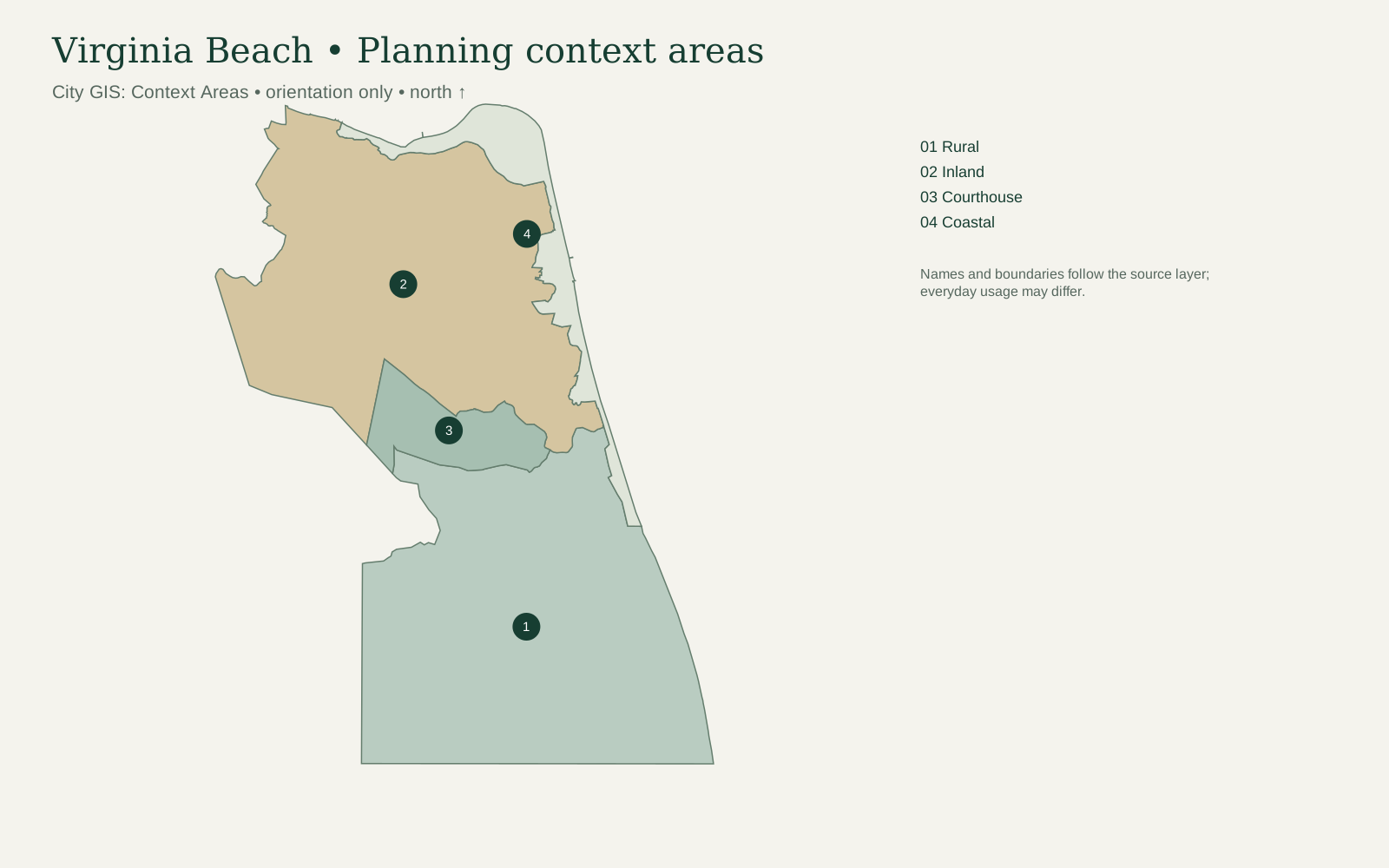
The Imagine VB 2040 comprehensive plan, adopted in April 2026, distinguishes Inland, Coastal, Courthouse and Rural context areas. The map uses the corresponding City GIS boundaries. These are broad planning areas, not school, flood or neighborhood zones or approved truck routes.

The six comparisons below use documented physical character to guide a viewing. Historical records do not certify a property’s current condition, availability or access rights. Pembroke’s future transit proposals and Pungo’s village policies do not establish completed facilities or uniform services.

Inspect the coastal home’s route to its living floor, the inland home’s everyday crossings, or the rural property’s driveway and water/wastewater arrangements as applicable. Confirm the actual address rather than assuming every home fits its area’s general pattern.

Four City of Virginia Beach planning context areas from the official GIS layer
City GIS planning context areas: Rural, Inland, Courthouse and Coastal. For orientation only; these are not neighborhood boundaries, school attendance zones, flood or evacuation zones, or approved truck routes. Open full-size map.

03 /

Find the area that fits your routine

These six comparisons use separate official planning or historic sources. They describe established physical patterns, with viewing and travel questions added for a prospective household. Historic study dates are retained; planned improvements, present-day prices and the condition of individual homes are not inferred from them.

Old Beach

The 2005 City design study describes a residential resort neighborhood with a street grid, alleys and relatively narrow lots.

Old Beach design guidelines — 2005 physical-character study ↗
Housing & setting
Its documented mix includes houses, duplexes and smaller multifamily buildings. Confirm the current unit layout and which entrance and outdoor spaces belong to it.
Daily travel
Walk the actual connection to Oceanfront destinations and the correct transit stop; a close destination can still involve a busy crossing.
Before choosing
Photograph the frontage, alley if relevant, shared access and interior turns. Historic alley descriptions are not proof of present vehicle access.

Town Center / Pembroke

The City describes a broad suburban commercial and industrial growth area, with Town Center standing out for mixed office, residential, retail and cultural uses.

Pembroke strategic growth area and Town Center ↗
Housing & setting
Distinguish a home in a larger mixed-use building from another property elsewhere in Pembroke. Ask about the actual loading door, lift and parking arrangement.
Daily travel
Test the exact route around Virginia Beach and Independence boulevards. Future transit proposals in a growth plan are not existing service.
Before choosing
Obtain the building’s receiving instructions, reservation conditions and service route before deciding how the shipment will arrive.

Chesapeake Beach

The historic-district record describes a bayfront residential community with an early street grid and closely spaced cottages, shaped by the Bay and Pleasure House Lake.

Chesapeake Beach Historic District ↗
Housing & setting
The district’s historic cottages do not describe every current Shore Drive property. Check the particular home’s additions, storage and stair layout.
Daily travel
Inspect the walk to your routine destinations and the appropriate crossing. Do not confuse this Virginia Beach neighborhood with the separate City of Chesapeake.
Before choosing
Establish the permitted vehicle position and the full carrying route; a compact frontage may serve several different access needs.

Historic Kempsville

DHR identifies Pleasant Hall as one of the few surviving buildings of the old village in an area substantially redeveloped since its colonial period.

Pleasant Hall and the historic Kempsville village ↗
Housing & setting
Use the historic core as an orientation point, not a claim that surrounding homes are all old or Georgian. Compare the actual house or apartment, alterations and storage.
Daily travel
Try the journey through the Kempsville and Princess Anne road area at the hours that matter to the household.
Before choosing
Check the driveway or shared loading arrangement and the path indoors. The historic landmark is not a public loading area or a moving-company location.

Pungo / rural south

The adopted 2026 plan places Pungo among the rural villages of a southern context area characterized by agriculture, protected land and scattered settlement.

Imagine VB 2040 — adopted April 2026 comprehensive plan ↗
Housing & setting
Confirm the specific property’s water, wastewater and access arrangements. Rural planning guidance is not a promise that every home has identical services or lot conditions.
Daily travel
Try the whole drive to school, shopping and work, including the return at a different time. Do not infer a bus stop from a citywide route map.
Before choosing
Measure gates and the usable drive, identify turning space and confirm where a loaded vehicle may stand with the property owner.

Sandbridge

The 2020 DHR survey describes a narrow coastal strip between Back Bay and the Atlantic, with predominantly mid- to late-twentieth-century beach residences and limited commercial development.

Southern Virginia Beach architectural survey — 2020, Sandbridge and Pungo excerpts ↗
Housing & setting
Check the actual living-floor elevation, exterior stairs and any elevator, as well as storage and the conditions of a long-term tenancy. The survey is not a current rental listing.
Daily travel
Test everyday errands and the route back to the home; access to the beach is different from access to routine services.
Before choosing
Confirm stair turns, the authorized standing area and current frontage restrictions. A historical survey does not establish a truck route or an individual home’s flood risk.

04 /

Compare the home, its costs and its access

The ACS 2024 five-year estimates for Virginia Beach city describe the 2020–2024 period. They estimate 179,851 occupied homes, of which approximately 65.1% were owner occupied and 34.9% renter occupied. Median gross rent was $1,714; median value of owner-occupied homes was $382,500. These are historical survey estimates with margins of error, not current asking prices or a budget for a particular lease.

Housing measureACS 2024 five-year estimateHow to use it
One-unit detached54.6% of all housing unitsStill inspect driveway, steps and storage.
One-unit attached18.5% of all housing unitsCheck shared access and association rules.
Units in buildings with two or more homes25.9% of all housing unitsAsk about service doors, lifts and delivery hours.
Built before 1940About 1.0% of all housing unitsCitywide age says little about one historic street.

The structure and age percentages use all 191,294 housing units, including unoccupied units; tenure uses occupied homes. The remaining structure share includes mobile homes and other arrangements. Do not use these denominators interchangeably or treat a citywide percentage as a neighborhood profile.

At a viewing, connect the monthly price with what it includes. Establish responsibility for water, electricity, gas where present, trash, parking and common-area costs. Ask where carts or shared bins are kept and whether any move-in charges, deposits or lift reservations apply. Get those conditions from the lease or manager rather than inferring them from another unit.

Measure the rooms and the furniture route together. A room may fit the sofa even though a stair turn does not. Photograph the loading approach, every doorway and any change of level. At an elevated property, confirm the route to the living floor; at a large building, check whether the visitor entrance is also the authorized delivery entrance.

Before committing to a flood-sensitive property, use the City’s floodplain information and address-determination service. The City can provide a verbal or written flood-zone determination at 757-385-4621. An address outside a mapped Special Flood Hazard Area is not a promise that flooding will never occur. Discuss the actual property and coverage with the appropriate professional.

Furnished sunroom with wicker seating, plants and two branded medium cartons, one holding cushions and a knitted throw.
Measure rooms, storage and the route for bringing belongings indoors.

05 /

Test the actual route, direction and operating day

Use the Hampton Roads Transit Virginia Beach route list to identify possible trips, then inspect the schedule for the date and direction you need. The current list includes Route 20 as an express connection between Downtown Norfolk Transit Center and the Virginia Beach Oceanfront. Route 33 links TCC Virginia Beach, the Parks Avenue area and the Atlantic Avenue corridor. A route name alone does not establish the stop nearest your door or the time of the last return.

The Route 33 page provides named stops and a date selector. Check the walking approach to the correct side of the road, transfers and the return trip with groceries or other belongings. The page’s live “service done” message can reflect the selected day and time; it should not be read as a permanent withdrawal of the route. Recheck alerts shortly before travel.

The HRT fare page lists a regular $2 single ride and $4.50 one-day fare. Cash requires the exact amount; fareboxes do not make change. Confirm the product for an express journey, any discount and your chosen payment method before boarding. The published fare page contains inconsistent legacy wording about express upgrades, so do not assume a regular fare covers every service.

The VB Wave and Bayfront shuttle is seasonal. The 2026 brochure gives Route 30 daily service from May 10 through Neptune Festival; Routes 31 and 35 run daily through Labor Day and Friday–Sunday from September 11 through the festival. That schedule cannot support a promise of year-round neighborhood transport. Use the regular network when testing a home’s routine winter or weekday journeys.

For disability-related travel needs, HRT paratransit requires eligibility certification. ADARIDE handles applications at 1-877-232-7433, with online and mailed paths. The linked service policy limits the standard service area to within three-quarters of a mile of current fixed-route service, with hours tied to those routes. Confirm both endpoints and the particular trip; eligibility is not a citywide taxi entitlement.

Once certified, reserve ordinary trips one to seven days ahead at 757-455-8010, during the published 8 a.m.–5 p.m. reservation hours. The riding guide explains the pickup window, shared rides and how to request assistance. Arrange the return journey and any companion or personal care attendant when booking. If you already use paratransit elsewhere, contact HRT before relocation to establish the applicable transition arrangements.

Passengers seated inside a city bus, with an open aisle, wheelchair space and a stop-requested display.
Check the actual stop, direction, operating day and return journey.

06 /

Complete enrollment and transportation as separate steps

Begin with the actual residence in Virginia Beach City Public Schools. Use the school locator and confirm the assignment with the school during registration. A neighborhood name or a nearby school does not guarantee placement. School Administration lists 757-263-1055 for locator questions.

The registration requirements call for residence evidence, the child’s identity and school records, health documentation and emergency contacts. The ordinary residence path uses a lease or mortgage document and a current gas, electric or water bill. Handwritten leases and leases not prepared by a licensed agency must be notarized under the published instructions. Ask the registrar about your actual documents before assuming that another kind of bill will work.

  1. Confirm the school and account. Follow the online registration instructions. New families create a ParentVUE enrollment account; families already associated with VBCPS should contact the school to activate or use their existing account rather than create a duplicate.
  2. Prepare the records. Bring the original certified birth certificate or the applicable affidavit route, prior school records and two current emergency contacts. Identify custody or shared-residence circumstances early.
  3. Arrange the school appointment. Online submission begins the process. The school appointment and document review complete it; the registration page explicitly directs families to contact the school afterward.
  4. Resolve health requirements. Elementary entry generally needs the qualifying physical completed within the preceding 12 months, alongside immunization documentation. Have the school nurse review the actual grade, records and any applicable exception. Do not apply the elementary physical requirement universally to every secondary transfer.
  5. Confirm the first day and transport. Keep the school’s confirmation and settle how the child will arrive and return before attendance starts.

For kindergarten, the child must be five on or before September 30 of the school year. The 2026–27 kindergarten handbook explains the assigned-school registration appointment and the need to finish enrollment before attendance. It also asks families to make a transportation request during registration and annually. An unfinished online entry should not be treated as permission to begin attending.

If the parent and child live with another household, use the district’s actual shared-residence procedure. The admission regulation, revised September 2025, requires a genuine residence; using someone’s address solely to obtain a school assignment is not the same arrangement. Ask the registrar which shared-housing affidavit and evidence apply to K–12 enrollment. The detailed preschool checklist below has its own document instructions.

Where someone other than a biological parent has court-ordered custody, follow custody registration: the school forwards the required form and court documents to the Office of Student Leadership. An out-of-state order must follow the district’s Virginia-registration requirement; a pending court date is not an approved custody document. Kinship care uses a different form, affidavit, power-of-attorney and verification path. Contact the school or Office of Student Leadership at 757-263-2020 for the actual case.

Families lacking fixed, regular and adequate housing should contact Project HOPE at 757-263-2300, option 1. Eligible students have an immediate-enrollment and support route when ordinary records or residence evidence are unavailable. Explain the circumstances to the liaison; do not postpone asking for help because a standard utility bill is missing. Eligibility and school-of-origin decisions are made through that process.

Transportation needs its own follow-up. The bus FAQ says missing or inaccurate ParentVUE transport information should be resolved through the school and that assigning a bus and stop may take 5–10 business days. Students in a non-transportation zone cannot simply use a nearby stop. Stop-change requests use the written review process; the FAQ distinguishes new move-in stops from ordinary changes to established stops. For questions, Transportation lists 757-263-1545. The main transportation page still includes a 2025–26 closure notice, so confirm the current request route with the school instead of treating that old notice as the current year’s decision.

Preschool is a separate, limited-place application. The 2026–27 eligibility page requires Virginia Beach residence, age four by September 30 and qualifying risk factors; acceptance is not first come, first served. The application procedure separates initial eligibility, document screening, placement or waitlist notification, and final school registration. It requests household income evidence and specific residence documents, with a notarized shared-housing route when needed.

There is a current deadline conflict: the overview invites waitlist applications, while the detailed procedure says the waitlist window ends September 1, 2026. For a later move, call the Pre-K office at 757-263-1492 to establish whether a request can currently be considered. Do not plan on an available seat. The eligibility page also says families provide their own transport to an out-of-zone preschool placement.

07 /

Arrange service dates, account ownership and access

Before requesting changes, ask the owner or manager which services are individually metered, which stay in the owner’s name and which are included in the lease. A City address does not prove that every utility is available at the building. In the rural south, establish whether the property uses public connections or private water and wastewater systems. Keep each provider’s service confirmation separate from the moving reservation.

For City water accounts, Public Utilities customer service handles start, stop and transfer requests at 757-385-4631, Monday–Friday, 8 a.m.–5 p.m. The online request service also provides registered-account requests and status messages. Weekend requests are not reviewed until the next business day; submitting one is not confirmation that water will be on for a weekend arrival.

The first-time user instructions describe email registration, a temporary password, a completed profile and enrollment of the account using its number and street information. The existing-user guide leads to the service-request functions. If you are a new resident without the account details needed to enroll, use customer service to establish the correct start path rather than borrow a previous occupant’s login. The customer portal is the account entry point.

Give the exact service address and unit, desired start or stop date, billing address and contact details. A transfer needs both properties and the intended dates. Confirm whether access, documents or charges are required for your circumstances, and retain the response. Do not assume that a requested date has been accepted or that the new account closes the old one automatically.

The City billing FAQ says Public Utilities shares start and stop information with HRSD, so a separate HRSD start/stop call is not required for that City process. It also distinguishes active empty homes from inactive accounts: several daily service charges continue while an account is active, whereas stormwater charges remain on an inactive account. Ask about the actual billing arrangement rather than assuming that zero water use means no bill.

If Dominion supplies the address, its Virginia start-service page requests the service address, start date and account-holder information; the meter number is helpful. It lists a $5.70 connection charge and possible security-deposit requirements. Orders are worked Monday–Friday during published business hours, excluding holidays. Request the date early and follow the instructions supplied for the particular connection.

For an existing Dominion customer, the transfer procedure needs the new start and old stop arrangements. Keep the meter accessible; if entry is needed because it cannot be reached, an adult may need to be present. Coordinate dates with possession and the other services instead of allowing an avoidable gap while the household or contractors still need electricity.

For a property served by Virginia Natural Gas, distinguish an existing meter from a new installation using its start, stop and transfer options. The public start form asks for the service address, requested date, identity and billing information. Supply sensitive account information only through the provider’s own secure process. Service availability and any deposit depend on the actual request.

The transfer form asks for both addresses, meter access and service dates, and says processing can take up to 48 hours; same-day and past-date requests are not accepted. It specifically requires water and electricity to be active before gas turn-on. Confirm access to appliances and the appointment conditions. If only ending service, use the stop form and provide a final-bill address. Keep the old account’s closure confirmation as well as the new start confirmation.

08 /

Plan ordinary collection and move-out disposal separately

First establish who collects waste at the property. The City’s solid-waste code limits municipal service for multiple-unit buildings: the ordinary exception requires each unit to be on a separate lot abutting a publicly maintained street. An apartment or condominium may instead use a private arrangement. Ask the manager where household waste, recycling and unwanted furniture belong before leaving anything outside.

For an eligible City-served address, curbside services provide weekly trash and alternate-week recycling. Confirm the address schedule and any holiday adjustment. Establish whether the required carts are present and who supplies them; City carts are available for purchase, so do not assume a missing cart will arrive free with a new account.

The standard trash instructions say set out after 5 p.m. the previous day, with bagged trash inside a closed-lid cart and three feet of clearance. A newer August 24, 2026 notice continues a 6 a.m. collection start for trash, recycling and yard debris. Use the evening-before window or have these materials ready before 6 a.m.; the older 7 a.m. wording should not cause you to miss the truck. Remove carts from public view after collection that day.

Follow the recycling instructions for loose accepted materials in the cart, without plastic bags. Keep lids closed and maintain collection clearance. Flatten moving cartons and choose the appropriate recycling stream; cardboard boxes are explicitly excluded from the bulky-item list. A pile of packing material left beside a bin is not the same as an accepted collection.

Book bulky items before the handover. The bulky-item page offers requests through VB311, Waste Management at 757-385-4650, email or an in-person visit. Its stated minimum is three days before the weekly collection day, but the Waste Management overview asks for two weeks or more. Plan at least two weeks ahead where possible and ask which date is actually available; neither published wording guarantees a last-minute pickup.

The VB311 request begins with service and location, followed by item details, scheduling and contact confirmation. Keep the confirmed date and item list. The City instructs setout after 5 p.m. the prior day, clear of the street, sidewalk and overhead obstructions, with space around the pile. Beds must be disassembled and waterbeds drained. Ask about the exact preparation for an appliance or other unusual item before setting it out.

Mattresses are named in Code section 31-28. The online bulky-item examples do not name them, so identify the mattress and any box spring explicitly when requesting service and confirm preparation. No universal mattress-bagging instruction was established from these published pages. Glass, construction materials, carpet, cabinets and several other items have exclusions; describe the item rather than assume “large” means eligible.

The Landfill and Resource Recovery Center at 1989 Jake Sears Road is a possible resident disposal route only when the person, material and vehicle qualify. Published hours are Tuesday–Saturday, 7 a.m.–4:30 p.m., subject to conditions. Bring physical residence proof: the City accepts specified identification or matching photo ID and current supporting evidence, and says digital identification is not accepted.

The vehicle restrictions matter on moving day. Permitted private household vehicles include ordinary passenger vehicles and qualifying unmodified low-sided pickups; cargo or panel vans, commercial signage and work-equipment configurations are excluded, even for household waste. Do not plan to take the moving truck through as your fallback. Call 757-385-1980 about the exact vehicle, trailer and load before loading it.

The Resource Recovery Center separates recyclable materials and household hazardous waste from ordinary disposal. Ask about each material and its preparation, including paint or other leftovers from the property. If collection or resident self-haul cannot meet the key-return deadline, arrange a suitable private removal service or another confirmed lawful option. Include the cost and receiving conditions in that plan.

09 /

Follow the responsible office through to an approved setup

Begin with a description that the City and building can assess: exact address and frontage, date, hours, truck dimensions, rear working area, ramp or lift, and any proposed occupation of a sidewalk or lane. Say whether this is ordinary loading, an exclusive space request, a container placement or an oversize road movement. These are related questions with different rules.

SituationStarting contactWhat to establish
City-managed parking or a Resort parking locationParking Management, 757-385-2900Vehicle eligibility, time limits and whether a separate arrangement is needed.
On-street questions in the locations referred by Parking ManagementTraffic Engineering, 757-385-4131Frontage, traffic effects, approved signs or restrictions.
Occupation or work affecting City right-of-wayPermits & Inspections, 757-385-4211Permit category, application, lead time, fees and required plan.
Private loading area or drivewayOwner or building managerPermission, usable footprint and the route into the building.

Parking Management’s jurisdiction page specifically sends on-street questions at Chick’s Beach, Croatan neighborhoods and Sandbridge to Traffic Engineering. A municipal lot near the home may have different rules from the street itself. The oversized parking page describes buses, charter vehicles and RVs at named lots; it does not establish that an ordinary moving truck is eligible there.

The commercial-vehicle parking rule includes normal delivery or service activity among its residential exceptions. Treat that as a distinction from storing a commercial vehicle at a residence, not as permission to occupy any frontage you choose. Do not borrow the page’s separate recreational-vehicle loading window for a moving truck.

The Residential Parking Permit program operates in much of the Resort residential area during stated overnight hours, with special holiday periods. A resident or guest permit allows qualifying parking under that program; it is not an exclusive loading reservation. Confirm the actual block and dates, including any current conditions that differ from older examples on the page.

For public-space impacts, follow the right-of-way permit instructions. The July 2025 application asks for the applicant, location and scope, and includes categories such as a parking pass, dumpster and traffic-control plan. Tell Permits & Inspections exactly what will happen and ask which category applies. The Accela portal allows public record viewing, but an application or inspection request requires a registered account.

Before submitting, establish the actual lead time, fee, required insurance or supporting plan, and whether a closure variance applies. The published material reviewed here does not establish one universal household-moving reservation deadline or price. Ask who supplies and places any approved temporary signs, how far in advance they must be posted, and what to do if the approved area is occupied when the crew arrives. Keep the issued instructions with the move plan.

Chapter 33 Article II addresses street work and traffic-control approval when work affects public travel. Its construction permit fees are not automatically the price of every furniture delivery. The separate sidewalk rules prohibit general obstructions and restrict packing, unpacking or storing goods on sidewalks. A narrow exception for a package too large to enter a doorway does not create a general staging area; the code requires prompt removal of the packaging.

The right-of-way page’s May 1–September 30 restriction concerns construction activity with sidewalk or lane closures in Oceanfront and Sandbridge areas unless a variance is obtained. It is not a blanket prohibition on household moves. Similarly, moving/hauling permits cover oversize or overweight vehicles and loads. The carrier should determine whether the actual vehicle and route require that permit; its lead times and seasonal travel conditions should not be applied to every normal-size moving truck.

A roll-off container raises another question. Ordinance 3843, adopted April 21, 2026, limits residential-district roll-off placement to one container and 30 total days in a consecutive six-month period, with a building-permit exception. That ordinance does not by itself prove that every enclosed moving-storage unit has the same classification or may occupy the street. Describe the equipment to Zoning and confirm both the private-property rules and any separate public-space approval.

If the preferred setup cannot be authorized, agree a workable alternative with the owner, City and mover as applicable. That might change the vehicle position, carrying distance, time or equipment. Confirm the alternative’s permission and cost before relying on it; cones placed by the household do not create an authorized reservation.

10 /

Trace the route through the actual property

Trace the authorized route from the vehicle to the final rooms. Record distance, surfaces, gates, steps, door openings and turns with photographs and measurements.

At an elevated house, check exterior stairs and landings; establish any elevator’s dimensions, permitted use and availability. At an apartment, obtain written receiving instructions covering the service door, lift reservation, hours, documents, fees and contact who can resolve changes. A passenger garage may not accommodate the moving vehicle.

At a rural property, confirm gate clearance, surface, turning space and the approved standing area. Ask about vulnerable or buried features; neighboring land and verges are not assumed access.

Identify removable furniture components, specialist handling and unresolved routes. Agree an alternative that preserves shared exits. Send these details with the estimate using the Virginia Beach moving page.

11 /

Build a few useful routines near the new home

Test shopping, prescription collection and regular appointments from the actual entrance, including crossings, parking and the return trip with purchases.

The library card page and June 2026 policy provide City residents aged 18 and over with online identity verification or a branch application. Bring required identification and address evidence; an old address needs current supporting documentation, and electronic versions are accepted. Youth, teen and unverified-address cards have separate conditions or limits. Ask staff which route applies at 757-385-0150.

Pleasure House Point Natural Area lists its entrance at 3957 Marlin Bay Drive. The City currently says trails are open, with temporary fencing protecting new planting. Stay on trails and check notices before visiting. The proposed accessible kayak launch is not presented as an existing facility.

Parent and child using a library self-checkout station, with a staff member and book cart nearby.
Confirm the correct library card and address-verification route for the household.

12 /

Prepare for the address, not just the coastal label

Use City floodplain resources for the property and Know Your Zone for address-based evacuation information. The City preparedness plan distinguishes these; neither is replaced by this guide’s planning-area map.

Ask the owner about water entry, drainage and low storage areas. Keep essential records, medication and immediate supplies with the household. Arrange accommodation and travel if official directions or access conditions interrupt delivery.

Register or update VBAlert for relevant text, email or phone notifications. Reverse 911 landline calls are separate and do not replace mobile registration.

City Code section 33-14 requires the owner or occupant to clear sidewalk snow and ice within six hours after removal can first reasonably be effected. Assign responsibility and inspect both approaches before arrival.

Resident in waterproof boots moving a folded patio chair onto a covered porch after rain.
Prepare the approach for wet conditions and follow current official directions.

13 /

Keep a workable alternative for the first days

Sequence tasks around dependencies: gas may need water and electricity first; school and bus assignment can finish separately; disposal may follow key return. Distinguish confirmed dates from requested dates.

If this remains unresolvedConfirm before arrivalPractical alternative to arrange
Possession or building accessKeys, approved entrance, receiving contact and hoursAvailable storage or revised delivery, with responsibility and costs agreed.
School transportSchool start, assigned stop and first usable tripA household transport arrangement until the assignment is confirmed.
UtilitiesAccepted service date, prerequisites and required accessA suitable place for the household if the property is not ready to occupy.
Unwanted furnitureAccepted item, collection date or eligible facility tripA confirmed lawful removal route that meets the handover deadline.

Before departure, check remaining belongings, key return, service stops and final bills. Keep immediate supplies with you and a decision-maker reachable.

After arrival, check essential services and address assignments. Inspect receiving rooms and belongings before unpacking; report unresolved delivery questions through the agreed process.

Bring inventory, access and outstanding service questions to the Virginia Beach estimate discussion.

14 /

Questions before you arrive

Is the guide’s map a school or flood-zone map?

No. It shows four City planning context areas for orientation. Use VBCPS to confirm the school assignment, City floodplain resources for the property and Know Your Zone for evacuation information. These boundaries serve different purposes.

Can I rely on the VB Wave for a year-round commute?

No. The published 2026 service is seasonal and differs by route and date. Check the regular HRT network, your actual stop, the operating day and the return journey before choosing a home around public transport.

Does an online school application complete enrollment?

No. VBCPS directs families to contact the assigned school and complete its document-review appointment. Confirm the first attendance date separately from the transportation request; assigning a bus and stop can take additional time.

Do I need to call HRSD separately when starting City water?

The City FAQ says Public Utilities passes its start and stop information to HRSD, so a separate HRSD start/stop call is not needed for that process. Still confirm your account and billing arrangement with Public Utilities.

Can I take move-out waste to the City facility in the moving van?

Do not assume so. The facility rules exclude cargo and panel vans and certain commercial or work-vehicle configurations, even with household waste. Confirm the exact vehicle, residency proof and material before planning a trip.

How early should I request a bulky-item pickup?

The City overview says two weeks or more, while the detailed page says three days or more. Request at least two weeks ahead where possible and obtain the actual available date and preparation instructions. Arrange another confirmed option if the handover must happen sooner.

Can a guest parking permit reserve space for a truck?

No exclusive reservation is established by a guest permit. Give Parking Management, Traffic Engineering or Permits & Inspections the actual frontage and loading footprint as appropriate. Confirm any required signs, timing, fees and alternative before the move.

Your next step

Bring the plan together

Use the Virginia Beach moving page to prepare the inventory, access details and questions for your estimate.

Sources & useful local resources

Official procedures and local resources are linked beside the answers above. Reopen the relevant page when arranging a date: fees, schedules and application requirements can change.

Place, housing and everyday life

Parking, access and seasonal conditions

Schools and family registration

Utilities and account handoffs

Waste and recycling

Public transportation