

What would make your next week better than this one?
You can love Portland and still be ready for a change. Perhaps you want a home that leaves more money at the end of the month, a job with room to grow, or fewer journeys between the people who depend on you. You might want a warmer winter, a much bigger city or mountains instead of the Maine coast. Begin with the part of an ordinary week you want to improve. That gives the search a purpose before an attractive destination gives it a direction.
If the problem is the home rather than Maine, start with another Portland address and the three nearby comparisons: Westbrook, South Portland and Biddeford. Westbrook gives you an inland city and specific bus corridors. South Portland changes the harbor-side routine but does not automatically reduce housing costs. Biddeford opens a different Saco River housing search and a longer Portland connection. Keeping your workplace, friends or family nearby may be worth more than a distant saving that replaces all of that support.
For a larger change, Tulsa, Indianapolis and Albuquerque deserve an early housing comparison when you can take reliable earnings with you or secure suitable work. Boston, Seattle and San Diego need a reason strong enough to support their higher historical city rent estimates. Chicago offers a bigger connected-city search, while Rapid City and Anchorage ask quite different questions about landscape, season and distance from people in Maine. Raleigh belongs on a career or household shortlist; the historical rent figures here give almost no reason to call it cheaper than Portland.
The international examples are Toronto, Edinburgh, Lisbon and Guadalajara. Each represents a possible change of city life and culture, with its own residence and work arrangements. An international option becomes useful when your household can actually live there and support the month, rather than because it looks close on a map or less expensive in a travel story.
Keep two to four possibilities, including a local alternative when it could solve the problem. Beside each name, write what gets better, what becomes harder and the answer you need next. You do not need to choose a moving company or register to use the guide. The printable comparison sheet gives you a place to bring those answers together once the broad horizons become a few homes and workable lives.
Keep Portland involved
Compare another Portland home with Westbrook, South Portland and Biddeford through the journeys you want to keep.
Try the nearby routines →Improve the whole month
Put actual housing, full transport and usable income into the same comparison.
Compare the money left →Choose another setting
Explore a regional, southeastern, interior, mountain-region or western week through its less convenient season too.
Explore US horizons →Begin in another country
Match a lawful residence and work plan with an ordinary week in one of four countries.
Explore four countries →Keep the Portland advantages you actually use
Before comparing another city, describe the Portland you live in. A Congress Street apartment, a mainland home and an island address create different weeks. The peninsula can put shops, activities and useful buses within a small area. A mainland address may make a particular hospital, campus or driveway easier to reach. An island home adds a sailing to journeys that another household makes on foot or by road. Start from your actual arrangement so the comparison preserves its useful parts.
South Portland and Westbrook are separate cities, and Biddeford is another municipality farther southwest. “Greater Portland” does not give those addresses the same school process, local rules or daily connections. Portland, Maine and Portland, Oregon are also different places throughout this guide. If your current home is on Peaks, the Diamond Islands or Cliff Island, the Portland municipal connection does not remove the ferry stage. Long Island and Chebeague have their own municipal identities.
Metro Route 1 connects the Transportation Center and Congress Street with peninsula destinations; Route 21 connects downtown Portland with Millcreek and Southern Maine Community College in South Portland. Westbrook has Route 4 and the limited-stop Husky Line. These are useful starting corridors, not a citywide guarantee. Someone beginning an early hospital shift needs a different comparison from a person attending an afternoon class. Record the arrival you need and the return after work, including the walk between the stop and the actual entrance.
For an island household, use the season in which you will live. The current Peaks winter schedule runs October 13, 2026 through May 20, 2027. It lists a last Portland departure of 10:30 p.m. Sunday through Thursday and 11:30 p.m. Friday and Saturday. That difference can decide whether an evening activity is practical. A passenger sailing also does not settle furniture freight, vehicle carriage or the trip between the island pier and your home.
Add the support that is easy to overlook because it already works. A neighbor who keeps a key, a relative who collects a child, a familiar clinician and a friend you see without making a special trip all contribute to the household. Put any paid replacement, extra travel and time off beside the proposed saving. You may still choose to leave, but the new city should earn its place against the life you have rather than against an empty description of Portland.
The existing Portland relocation guide covers neighborhoods, school enrollment, parking, household services and island freight in detail. Use it when another local address remains a serious option. Here the aim is to decide whether changing the address, the region or the whole setting gives you the improvement you want. A nearby solution is a useful result when it leaves you with a better week and the connections you value.
Local sources: Portland local relocation guide · Portland moving services · Metro routes and current notices · Metro Route 1 — Congress Street · Metro Husky Line — Portland, Westbrook and Gorham · Metro Route 21 — South Portland and SMCC · Casco Bay Lines — Peaks winter schedule · Casco Bay Lines — furniture and freight · USM — Portland, Gorham and Lewiston campuses.
Choose the size of change that solves the problem
Give a local option a fair comparison before assuming that a large problem needs a long move. If stairs have become difficult, a more accessible home may matter more than another state. If the rent is the problem but your work and childcare fit well, a different unit or housing arrangement could preserve that advantage. If the household is missing an attainable career path or wants a fundamentally different climate, changing a Portland neighborhood is less likely to be enough.
Write one concrete improvement and one limit. “Spend less” becomes more useful as “keep another $300 after essentials without adding an unreliable school pickup.” “Live near nature” could mean a trail you use three evenings a week or a longer mountain outing twice a month. Those choices need different addresses. A limit might be a particular treatment, a partner's work, an animal you need to house or the ability to visit a parent in Maine regularly.
Compare staying, a nearby move and a farther move using the same ordinary month. Staying has benefits and costs too: you may avoid transition expenses but retain a home that no longer works. A nearby move can improve the building, payment or route while leaving much of the support intact. A farther move can change the job market, surroundings or season, but asks more of the first months. The right distance follows the benefit that remains after those changes.
Consider a household leaving an island because the final sailing restricts work and evening life. A mainland Portland or South Portland home could remove that constraint without changing every friendship and provider. Another household may have a confirmed Indianapolis role and a partner able to work there; its useful comparison is between actual Indiana homes and the full Portland month. Treating both as the same search would hide what makes either move worthwhile.
You can also make the decision more reversible. A suitable lease may let you test a new city before buying; carrying fewer possessions can reduce the commitment. Price the extra handling, storage or temporary housing that such a plan actually needs. Reversibility is valuable when it protects a real uncertainty, such as whether a role or household routine works. It is less useful when the temporary arrangement costs so much that it creates the financial pressure you wanted to leave.
Three nearby moves that change different parts of life
Look around the broader southern Maine horizon before narrowing it. Falmouth, Scarborough, Gorham, Yarmouth, Freeport, Brunswick and Saco may all belong in a local search, depending on where work, study and family life happen. They are not interchangeable extensions of Portland. This guide goes more deeply into Westbrook, South Portland and Biddeford because they let you test three distinct changes: an inland bus corridor, another harbor-side city and a separate river-city base farther south.
Use the nearby map to group visits around the journeys you need to keep. Westbrook lies inland west of Portland. South Portland is across the harbor, with different parts of the city serving different routes. Biddeford lies southwest on the Saco River, opposite the separate city of Saco. A line between city labels is not your door-to-door journey. The home, worksite and final return will decide whether a local move makes the week easier.
For work or study around Westbrook and USM, the Husky Line and Route 4 deserve a practical trial. For a South Portland search, compare Route 21 through Millcreek and SMCC with the routes serving other parts of that city. For Biddeford, distinguish a Portland-bound express or bus connection from a local errand, and add the trip to the Saco rail station if you intend to use the Downeaster. An occasional regional journey and a daily shift are different transport needs.
Brunswick and the communities north of Portland require a current service check too. Metro BREEZ lists its Portland–Yarmouth–Freeport–Brunswick express service Monday through Saturday. The operator says its pilot extension to Bath Iron Works ended after October 2, 2026. If a job is at BIW, an old route description does not provide the commute. Work out the remaining connection before using the northern corridor as the household solution.
Housing figures can change the first impression of a nearby move. South Portland's historical gross-rent estimate is higher than Portland's, while Westbrook's and Biddeford's are lower. Those are citywide occupied-home estimates with margins of error, not available equivalent apartments. Compare attainable homes, heat, parking and the travel that changes. The useful local answer is the one that improves the whole month while keeping the people and practical connections that make staying in Maine attractive.
Three nearby beginnings in southern Maine
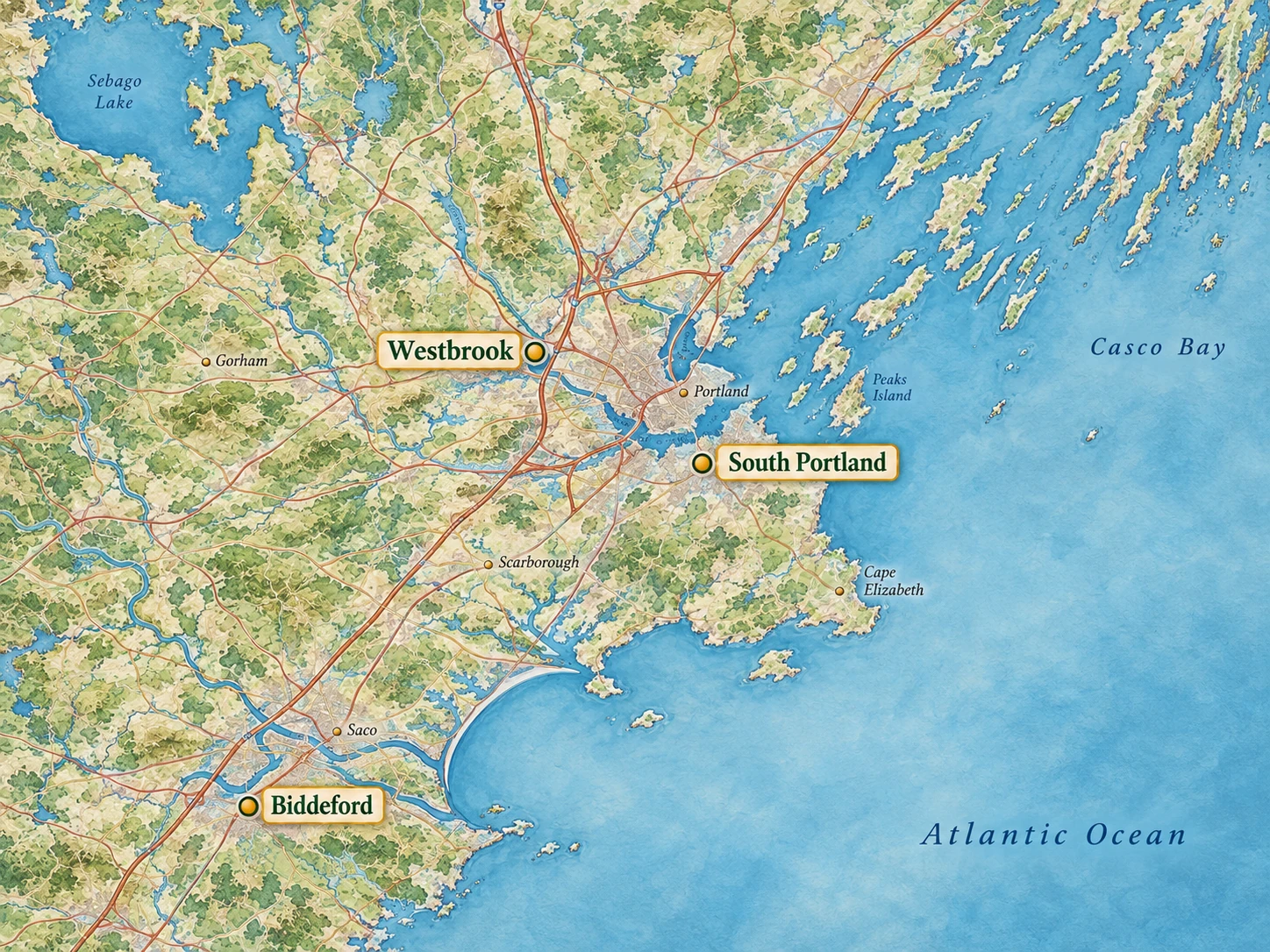
Geographic reference

Westbrook: an inland home with a specific Portland connection
Westbrook is a useful first comparison if you want to change the housing arrangement while keeping much of your Portland life. The gain might be an attainable home, a different entrance or a week centered on an inland workplace rather than the peninsula. It offers a smaller change than rebuilding work and support in another state. That becomes valuable when the people and services you already use are part of what keeps the household working.
Begin with the part of Westbrook that supports your actual journey. Metro Route 4 connects Westbrook with Portland via Brighton Avenue and USM's Portland campus; its listed destinations include the Brighton campus and specific employment stops. The limited-stop Husky Line provides a different Portland–Westbrook–Gorham connection. A home convenient for one is not automatically convenient for the other. Try the stop, the walk and the return for the actual workplace or class, including the day with the least flexibility.
The historical city gross-rent estimate is $1,392, compared with Portland's $1,577. The $185 point-estimate gap is a reason to compare homes, not enough on its own to justify new vehicle costs or lost care. Choose comparable rooms, heat, parking and access in the live search. If a suitable Westbrook address lets you keep one useful bus journey and familiar help, the improvement can be larger than the payment difference suggests. If it adds driving in several directions, the apparent saving may disappear.
Use a weekday visit from an attainable home area to combine work, shopping and the Portland connection you will keep. Include an evening return and any regular island or peninsula visit. Westbrook stays on the shortlist when the home and this repeated week both improve. If the attraction is mainly a larger property but the household still spends much of its day crossing the region, compare another corridor or a Portland address before deciding that the city boundary is the answer.
Try first: Try the actual Route 4 or Husky journey from a Westbrook home area, then price the complete month.
Local sources: Metro Route 4 — Westbrook · Metro Husky Line — Portland, Westbrook and Gorham.
South Portland: change the harbor-side routine, not just the city name
South Portland deserves a nearby visit when your work, study or everyday preferences already lead you across the harbor. It is a separate city with several different home-and-travel patterns. A choice around Millcreek and the Route 21 corridor asks a different question from a property serving the mall area or a more dispersed workplace. The benefit is the particular week that becomes easier, rather than a general promise that moving outside Portland will lower the payment.
Metro Route 21 connects downtown Portland, Millcreek Transit Hub and Southern Maine Community College. Other South Portland routes serve different areas, so begin with the home and destination you need. Someone attending SMCC may value a connection that does little for a household whose work is elsewhere. If you will keep returning to a Portland hospital, course or evening activity, include the final stop and entrance as well as the harbor crossing. Test the return after the actual finish time.
The housing comparison is a useful corrective: South Portland's historical city gross rent is $1,812, which is $235 above Portland's $1,577 point estimate. If saving money is your main reason, compare actual equivalent homes rather than assuming this city will cost less. Look instead for a home whose space, accessibility or daily connection is worth its complete cost. A smaller transport requirement can help when a cost genuinely disappears; keeping a car payment while driving slightly less is a different result.
Choose a visit around one or two actual home areas and the errand or class you would repeat. Walk the approach with shopping or mobility equipment where that reflects your needs, then make the Portland return you expect to keep. South Portland is a strong local candidate when it joins those parts of the day more comfortably while preserving Maine support. If the main goal is a large housing reduction, keep Westbrook, Biddeford and a different Portland unit in the comparison too.
Try first: Compare an attainable South Portland home with its actual bus corridor and the Portland trips you will retain.
Local sources: Metro Route 21 — South Portland and SMCC · Metro routes and current notices.
Biddeford: a different river-city base with a longer Portland tie
Biddeford can be useful when you want a different housing search and a local routine in its own right, while remaining in southern Maine. It lies on the Saco River opposite the separate city of Saco. Treat it as a possible new base, not merely a lower-priced bedroom for every Portland job. The move makes more sense when work, shopping, care or an activity can become local, or when the Portland journeys you retain are occasional and manageable.
Keep the transport pieces distinct. BSOOB Transit provides local and Portland connections, including its Route 60 Saco–Portland and Route 70 Zoom Express information. The Downeaster's Saco station is in Saco; a Biddeford home still needs a journey to it. A regional train, an express bus and a short local errand do not run on the same pattern. Try the outward and return service for the actual day and shift rather than borrowing a convenient departure from a weekend visit.
Biddeford's historical city gross-rent estimate is $1,292, $285 below Portland's point estimate. That makes a live housing comparison worthwhile, particularly when you can keep reliable income without adding a costly daily commute. Include the full home cost, winter travel and any extra vehicle or paid journey. If two adults must continue separate Portland-area jobs, draw both routes together. A lower payment can be useful, but it should not depend on an unpaid driving workload that the household cannot sustain.
Visit a home area, make one ordinary local errand and test the Portland or Saco connection you plan to use. Give the return as much attention as departure, especially after an evening activity or a late finish. Biddeford remains a useful nearby candidate when you would enjoy living there and the retained connections fit. If the whole week stays centered on Portland and every journey becomes longer, compare a different local home before committing to the river-city change.
Try first: Test a Biddeford home as a local base and add the actual Saco station or Portland bus connection you would need.
Local sources: 60 Saco Portland | Biddeford Saco Old Orchard Beach Transit · 70 Zoom Express | Biddeford Saco Old Orchard Beach Transit · Amtrak Downeaster — current schedule.
Look beyond another version of the same coastal week
The next groups widen the search in distance and in the kind of life they invite you to imagine. Concord, Boston and Northampton keep the comparison in New England while changing city size or setting. Richmond, Raleigh and Savannah bring a southern alternative. Tulsa, Indianapolis and Chicago test different interior-city arrangements. Rapid City, Anchorage and Albuquerque put landscape and season near the center of the choice; the western group separates Portland, Oregon, Seattle and San Diego.
These groups are a way to discover possibilities, not a requirement to visit all eighteen US places. Choose the change that matters first, then compare the places that offer a plausible way to make it. A Boston role might justify a higher housing commitment. A Tulsa home search might be useful with retained income. Anchorage needs a deliberate appetite for its colder season and the return to Maine. The same attractive feature can carry a very different household price.
For each destination, keep the benefit and compromise together. “Lower home payment” needs dependable earnings and the transport bill. “A bigger city” needs a home with the actual connections you will use. “Mountains nearby” needs a realistic outing, workday and season. A destination deserves a place on the shortlist when that combination improves your life. The chapters below give you a starting conclusion and a visit or conversation that can make the choice more concrete.
Three New England changes without starting over everywhere
Concord, Boston and Northampton let you compare an inland capital, a much larger connected city and a Pioneer Valley base. Keep the actual workplace and Maine return beside the new home.
Three different New England city lives
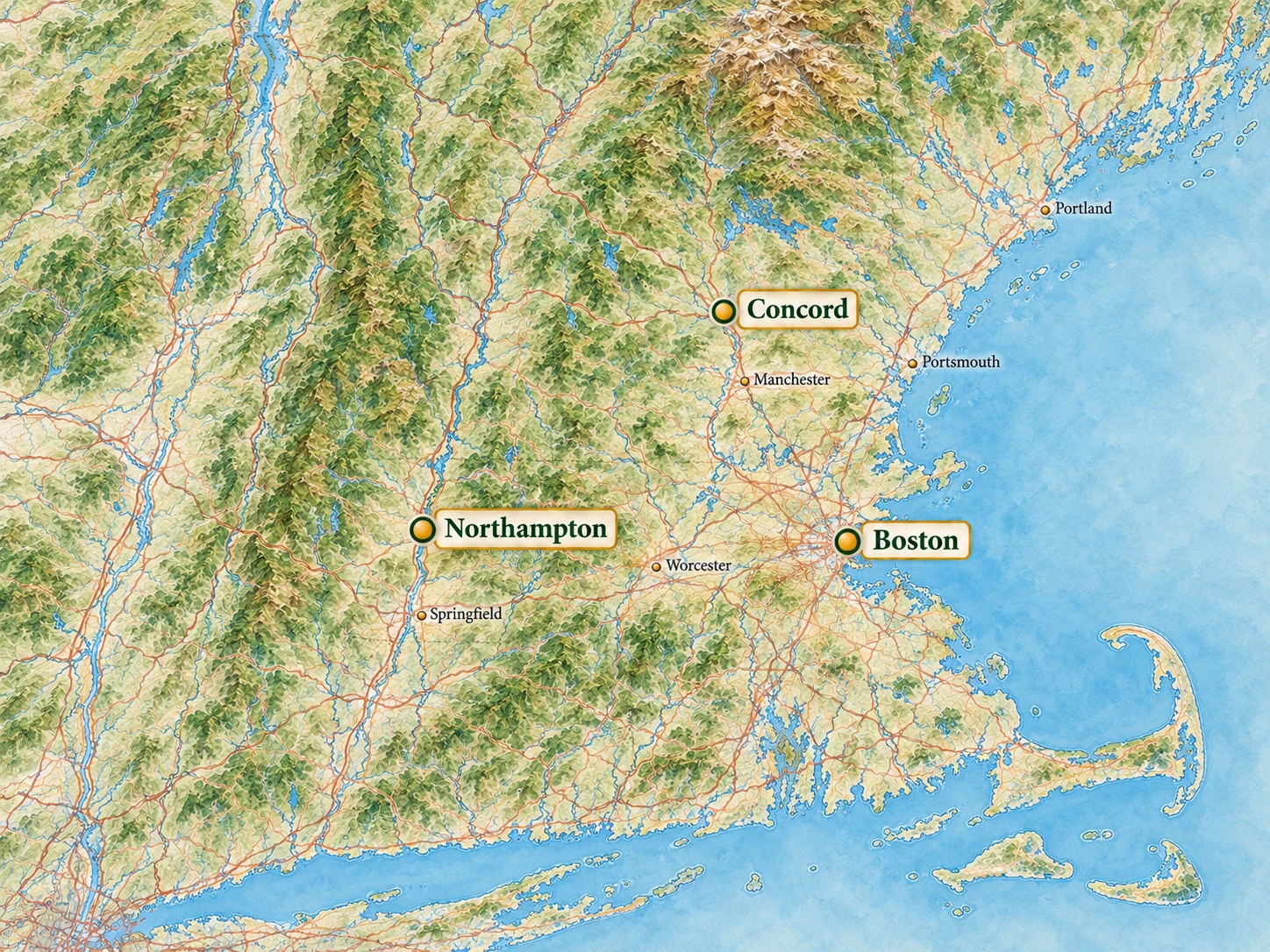
Geographic reference
Concord, New Hampshire: try a smaller inland capital week
Concord offers a New England change of setting without making a very large city the starting assumption. It can suit a search for an inland home and a week organized around a particular role, course or family connection in central New Hampshire. You keep a seasonal northeastern setting while giving up the immediate Portland coast and the familiar Maine routine. Choose it because the new arrangement works, rather than because an inland label automatically means a simpler or cheaper life.
Concord Area Transit provides route information and separate services for eligible riders. Use the actual ordinary service and its day of operation in the housing search. A senior or paratransit option has its own eligibility and arrangements; it is not a substitute to assign to every home. If work or care is outside the useful local network, identify the vehicle or paid travel the household needs. A compact destination downtown does not show how a home elsewhere in the region will function.
The historical city gross-rent estimate is $1,441 against Portland's $1,577, a $136 point-estimate difference. That is a modest housing starting point rather than a large cushion for new travel or a gap in earnings. Compare the attainable property, heating and the Maine visits you intend to retain. If you have a confirmed local opportunity and a home that joins the necessary parts of the day, the move may improve life for reasons the city median cannot measure.
Try an ordinary workday from the proposed home area, including a shopping trip and the return. Then price a realistic journey to the people you will keep seeing in Maine. Concord belongs on a shortlist when the smaller inland base itself appeals and those connections are manageable. It is less convincing when the only argument is a small historical rent difference while the household still needs frequent Portland trips and has not established the new income.
Try first: Match a Concord home with the actual role, local transport day and affordable Maine return.
Local sources: Concord Area Transit – Where Will You Go Today?.
Boston: move for the opportunity and connected city life you can support
Boston is a serious comparison when a particular role, course or metropolitan way of living could give you something Portland does not. The useful gain may be a specialized program, a larger employer search or a neighborhood where more of the week can happen without a household car. It asks you to choose a workable city home and transport arrangement. A bigger city is not an improvement by itself if the household cannot afford the address that makes those benefits usable.
Begin with the actual workplace or campus and the MBTA connection from homes you could obtain. A rail station near a listing is useful only when the line, transfer, walking entrance and operating day suit the journey. If accessibility matters, consult the station and current service information as well as the network map. Compare the return after the time you will really finish. A suburban address outside Boston may create a different school, transport and cost arrangement from the Boston city figures shown here.
Boston's historical city gross-rent estimate is $2,147, $570 above Portland's. A new salary or genuine reduction in vehicle costs may support that commitment, but the increase needs an actual household calculation. Add deposits, any care change and trips back to Maine. The Downeaster connects Portland with Boston North Station; using it for a visit does not prove that a daily home-to-work journey is practical, particularly when another Boston connection remains after the train.
Test a normal weekday from an attainable Boston home area, then include the activity or course that makes you want to be there. Keep a second worker's path beside the main opportunity. Boston earns a place when the particular benefit and functioning city week justify the larger commitment. If the household would pay more while spending much of its time on a long outer commute, compare another neighborhood or a smaller regional base before choosing on reputation.
Try first: Try the actual Boston home-to-work or campus route and compare the higher home commitment with confirmed earnings.
Local sources: Subway | Schedules & Maps | MBTA · Amtrak Downeaster — current schedule.
Northampton: a Pioneer Valley life with a course and local connections
Northampton offers an inland Pioneer Valley comparison for someone who wants a different small-city routine, particularly when a course, role or regular cultural activity gives the move a practical beginning. It is not a Portland waterfront substitute. You would be choosing a valley setting and a new set of nearby people and destinations. That can be a meaningful change for someone seeking a different community pattern without needing the scale of Boston or Chicago.
PVTA is the regional transport starting point, but a regional network does not make every home and campus equally connected. Identify the building you will attend, the route and the term or day pattern relevant to your trip. A class that finishes after the convenient service, or a placement outside the usual corridor, can change the housing choice. Keep ordinary shopping and an evening return beside the main course or work journey when deciding whether one household vehicle is enough.
The historical Northampton city gross-rent estimate is $1,439, $138 below Portland's point estimate. That small difference should not carry the decision. A suitable home near the activity you want may cost something different; leaving familiar care or introducing more driving can matter more. Compare the total course or employment path and a realistic Maine visiting budget. If a paid opportunity or genuine daily connection supports the move, it can make sense without pretending the city median is a personal saving.
Use a visit to attend the kind of activity you would continue, try the actual home route and ask the program or employer about its normal calendar. Leave some ordinary time for errands rather than making the entire trip a special event. Northampton stays on the list when you can picture a repeatable week there and the housing and income fit. It is a weaker choice when the attraction is a pleasant college-town visit without an attainable way to participate in that life.
Try first: Combine an attainable Northampton home, the actual program or job and a repeatable local activity in one trial.
Local sources: PVTA — regional routes and notices.
A river city, a career change or a different southern coast
Richmond, Raleigh and Savannah answer different questions. A milder winter alone does not tell you whether the home, summer and household month will suit you.
River, work and southern coast
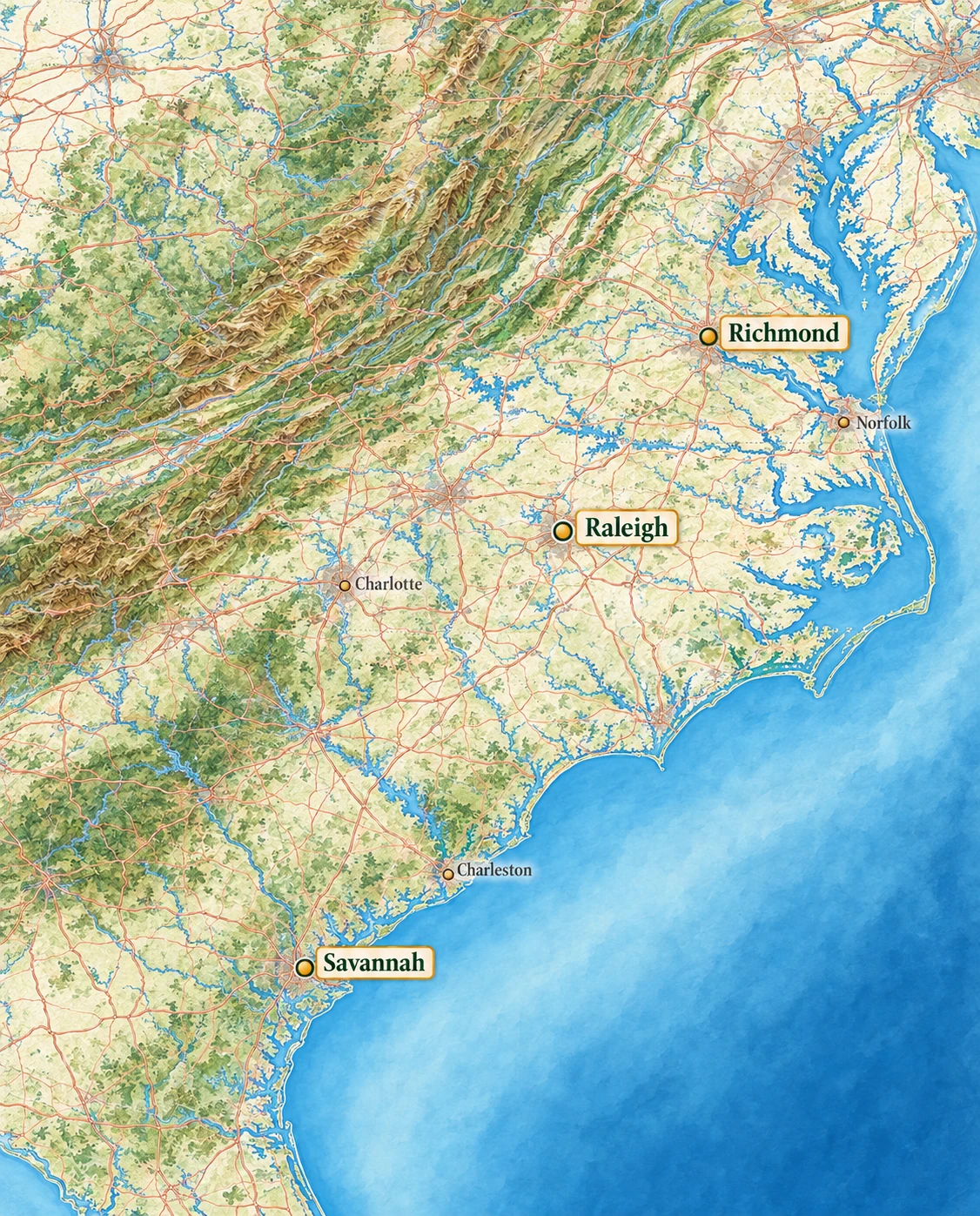
Geographic reference
Richmond: trade the Maine coast for a river-city routine

Richmond can appeal when you want a southern city change without making an oceanfront home the goal. A home connected to the particular work, course or river activity you value can create a different ordinary week. You would exchange immediate Maine coastal access for an inland James River setting, a new social network and a different seasonal experience. Begin with that desired change rather than assuming that every southern move must be a beach or retirement decision.
GRTC's Pulse corridor connects Willow Lawn and Rocketts Landing, alongside a broader bus network. Use the corridor as a concrete housing question: can the actual home, workplace and daily errands fit it or another usable route? An address outside the useful connection may need a vehicle even when a city map looks well supplied. Include the final walk, service day and late return. For a household retaining trips to Maine, compare how those visits fit around the new work and care responsibilities.
The historical Richmond city gross-rent estimate is $1,372, $205 below Portland's point estimate. That creates a housing comparison, not a complete savings claim. A suitable home and reliable earnings can matter more than the difference; insurance, cooling, transport and replacement support belong in the monthly plan. If the purpose is leaving Maine winter, try the summer you would live through too. The attractive river outing should be something the household can actually reach and enjoy regularly.
Choose a home area you could afford and spend a weekday joining the work journey, a necessary errand and an ordinary activity. Treat a second adult's role as part of the same plan. Richmond deserves a place when the new city week and home improve the household, with a manageable Maine return. If the projected saving depends on retaining all the old income while ignoring new travel or care, revise the numbers before treating the southern setting as the solution.
Try first: Test an actual Richmond corridor and home, including the hotter season and the Maine visits you will keep.
Local sources: GRTC — Pulse and other services.
Raleigh: choose the role or household opportunity, not an assumed rent saving

Raleigh belongs on the shortlist when a particular career, course or household connection makes the region useful. For a Portland resident, it can represent a larger change in work possibilities and seasonal routine. The strongest reason is an actual role or permission to retain your income in a home that suits the week. Avoid making the move depend on a general belief that a southern city must be dramatically cheaper than coastal Maine.
The historical figures make that caution concrete. Raleigh's city gross-rent estimate is $1,572, only $5 below Portland's $1,577 point estimate. With the published margins of error and different mixes of occupied homes, that is not a useful rent-saving argument. Compare actual equivalent properties and your full transport and household costs instead. A higher reliable income or a better home arrangement may still improve the month, but it needs to be shown through your circumstances.
Identify the actual employer site, campus or client area before choosing a home. A job described using a regional name may not put the work at the city address you imagined. GoRaleigh is the local bus starting point; a workable car-free week needs the routes and finish times that connect your own destinations. If the household needs two vehicles, include both. Try summer comfort as well as the winter change you may be looking forward to, and keep visits to Maine in the annual plan.
Make a trial around the ordinary workday and a home you could obtain. Ask the employer about the worksite, attendance and pay terms before treating a possible role as retained income. Raleigh becomes a good candidate when the particular opportunity and housing arrangement create the improvement. If the only benefit you can name is lower rent, keep looking at the alternatives with a clearer housing difference rather than forcing that expectation onto this comparison.
Try first: Establish the actual Raleigh-area role and home first, then compare reliable take-home income and the complete month.
Local sources: GoRaleigh — routes and services.
Savannah: another coastal culture with a different year to live through
Savannah is a southern coastal-region comparison for someone who wants more than a small adjustment to the Maine winter. The attraction may be a different streetscape, a river-city activity and a warm-season pattern you would enjoy. Make that a year-round living choice rather than extending a holiday image. An attainable home, suitable work and the actual summer and property conditions need to support the setting that first drew your attention.
Chatham Area Transit distinguishes its regular bus network from downtown DOT loops and the Savannah Belles Ferry. A visitor connection around attractions or a short river crossing does not establish the journey to every workplace, school or home. Use the ordinary route and return you will need, including the walk in the season you find harder. A home farther from the place you want to spend time can change both the transport budget and how often you enjoy the city.
The historical Savannah city gross-rent estimate is $1,382, $195 below Portland's point estimate. That modest gap should sit beside reliable earnings, cooling, insurance, transport and the Maine return. A property close to water also needs its own hazard and insurance check. Do not substitute a broad coastal description for the actual address. If you can secure suitable work and a manageable home, the move may be worthwhile for the new way of living without needing a large financial saving to justify it.
Try an ordinary week during the season that could challenge the move, including time indoors and the full work journey. Visit the activity you hope to make regular, not only the attractions you would show a guest. Savannah stays on the list when that life appeals after the cost and summer tradeoff are visible. If your main aim is a lower home payment with no other commitment changing, compare inland alternatives and the local Maine options alongside it.
Try first: Try the attainable Savannah home and regular transport in the harder season, then price property coverage and the Maine return.
Local sources: CAT — regular buses, DOT and ferry.
Three interior cities with different reasons to move
Tulsa and Indianapolis make a larger historical housing difference visible; Chicago opens a bigger transit-connected city search. Dependable work and the particular home decide the useful comparison.
Three interior city comparisons
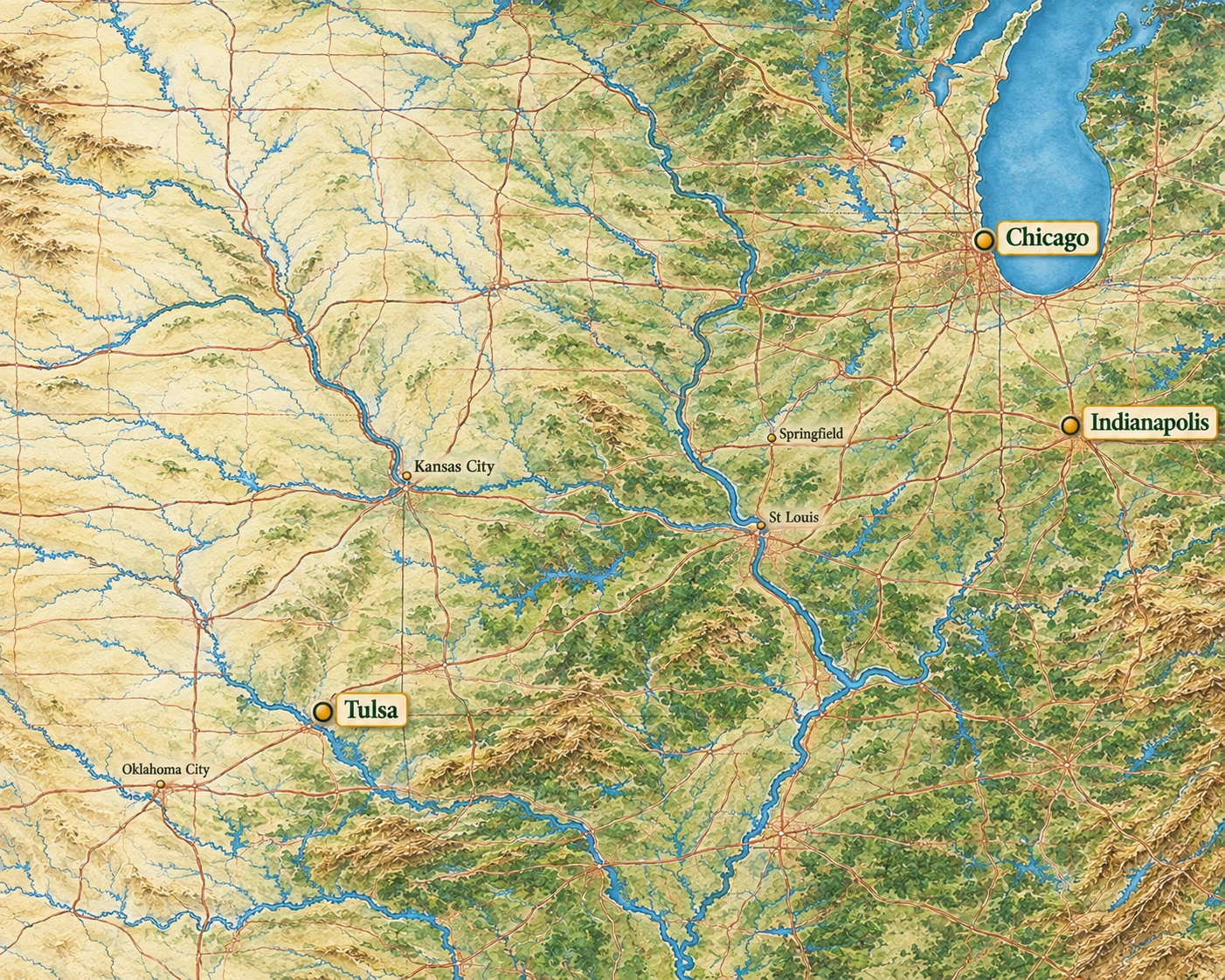
Geographic reference
Tulsa: give the larger housing difference a complete household test
Tulsa is worth an early housing comparison if the Portland payment is the main pressure and you can keep reliable income or secure suitable work. It offers an interior-city change rather than another New England coast. That gives you a clearer question than simply moving somewhere cheaper: can an attainable Tulsa home create enough monthly improvement to justify the new work, transport and Maine return? The answer depends on the whole household, including any adult rebuilding local earnings.
The historical city gross-rent estimate is $1,052 against Portland's $1,577, a $525 point-estimate gap. That is one of the larger housing differences in this edition. Use it to investigate equivalent live homes, with applicable utilities and the entrances or rooms you need. It is not a rent quote or a $525 personal saving. A car payment, care replacement, lower earnings or more frequent travel can consume much of the difference, especially during the first months.
MetroLink Tulsa's network includes its Peoria AERO corridor and other fixed routes. Begin a transit-led home search with the route connecting the actual worksite, shopping and return, rather than a citywide assumption about car-free life. A household taking a remote job needs the employer's location permission and a working home connection. Someone taking a local role needs the actual pay and work hours. Add the summer and the change from immediate Maine coastal access to the trial.
Spend an ordinary weekday in a home area you could obtain, making the work or study journey and a necessary errand. Then price the visits to Maine that would keep the move emotionally and practically comfortable. Tulsa stays on the shortlist when the reliable month shows a meaningful gain and the new daily setting appeals. If the saving only survives by ignoring one worker's lost income or the vehicle the household would need, revise the plan before booking the long move.
Try first: Compare equivalent Tulsa homes with confirmed earnings, the actual transport bill and a realistic Maine visiting pattern.
Local sources: MetroLink Tulsa — routes and Peoria AERO.
Indianapolis: compare a workable worksite and home, not a generic metro bargain
Indianapolis can be useful when you want a larger inland work search and a housing arrangement that may leave more room in the month. Make the actual role or retained income the starting point. A home near a useful work and errand pattern can improve the household more than a larger property that creates several daily journeys. The attraction needs to survive the move from Portland's particular peninsula, mainland or island routine to the Indiana week you would actually live.
The housing figure here covers Indianapolis city balance, a defined Census geography rather than the entire metropolitan area or every community with an Indianapolis mailing address. Its historical gross-rent estimate is $1,156, $421 below Portland's point estimate. That supports a live housing comparison without pricing every suburb or equivalent property. Keep the municipality and actual address consistent when asking about the school, local services and the route to the worksite.
IndyGo provides the bus and rapid-transit starting point for a connected home search. Use the actual route, transfer and service day; a line elsewhere in the city does not support an unrelated home-to-work trip. The operator also publishes future network changes, so distinguish today's working service from an improvement planned for a later year. Include a second worker, practical shopping and the return after a late finish in the same trial, with any necessary vehicle costs retained.
Try the ordinary workday from an attainable address and compare what remains after the whole month's essentials. Include the transition and a realistic return to Maine. Indianapolis remains a strong housing-led candidate when suitable earnings and a workable route allow a meaningful improvement. If one person's commute improves while the other adult loses a job or carries all the extra driving, compare another home or employment arrangement before declaring the city a household win.
Try first: Use the exact Indianapolis city-balance comparison, then test the current routes and the actual workplaces for both adults.
Local sources: IndyGo — routes and current network.
Chicago: investigate a bigger connected-city life before calling it cheaper
Chicago is the interior choice to investigate when you want a much larger urban setting, a particular career path or more of the week connected by public transport. The benefit could be access to a role, course or recurring activity that changes what life feels like. It is a different proposition from moving chiefly for a large rent reduction. Begin with the Chicago neighborhood and actual home that would let you participate in the city life you want.
CTA gives you rail and bus corridors to test against work, study and errands. A useful station or frequent route can change a household's transport needs, but the complete journey still includes the entrance, transfer, service day and final return. If a job is beyond that workable connection, a car may remain necessary. Look at current alerts and accessibility information during the trial. Choosing a place where you can reach the routine matters more than being near a line you would seldom use.
Chicago city's historical gross-rent estimate is $1,440, only $137 below Portland's point estimate. That is not the kind of difference that should carry a long-distance financial decision by itself. An attainable connected home may cost more than the median; genuine removal of a vehicle expense or higher reliable earnings could matter more. Keep trips back to Maine and any change in care or household support in the calculation. A city income median is not a personal salary offer.
Use a weekday trial from homes you could actually choose. Make the work journey, shop and attend the activity that makes Chicago appealing, then return at the real finish time. Chicago earns a place when the particular opportunity and connected urban week justify the commitment. If the budget relies mainly on a small city-median rent difference while retaining all the car costs, compare Tulsa, Indianapolis and the smaller New England alternatives alongside it.
Try first: Try the attainable Chicago neighborhood and complete transit week, then calculate the costs that truly change.
Local sources: CTA — trains, buses and service notices.
The Black Hills, Alaska and the high desert
Rapid City, Anchorage and Albuquerque change the landscape in three distinct ways. Anchorage appears in its own Alaska inset; these are separate settings with different seasons and routes home.
Rapid City, Anchorage and Albuquerque
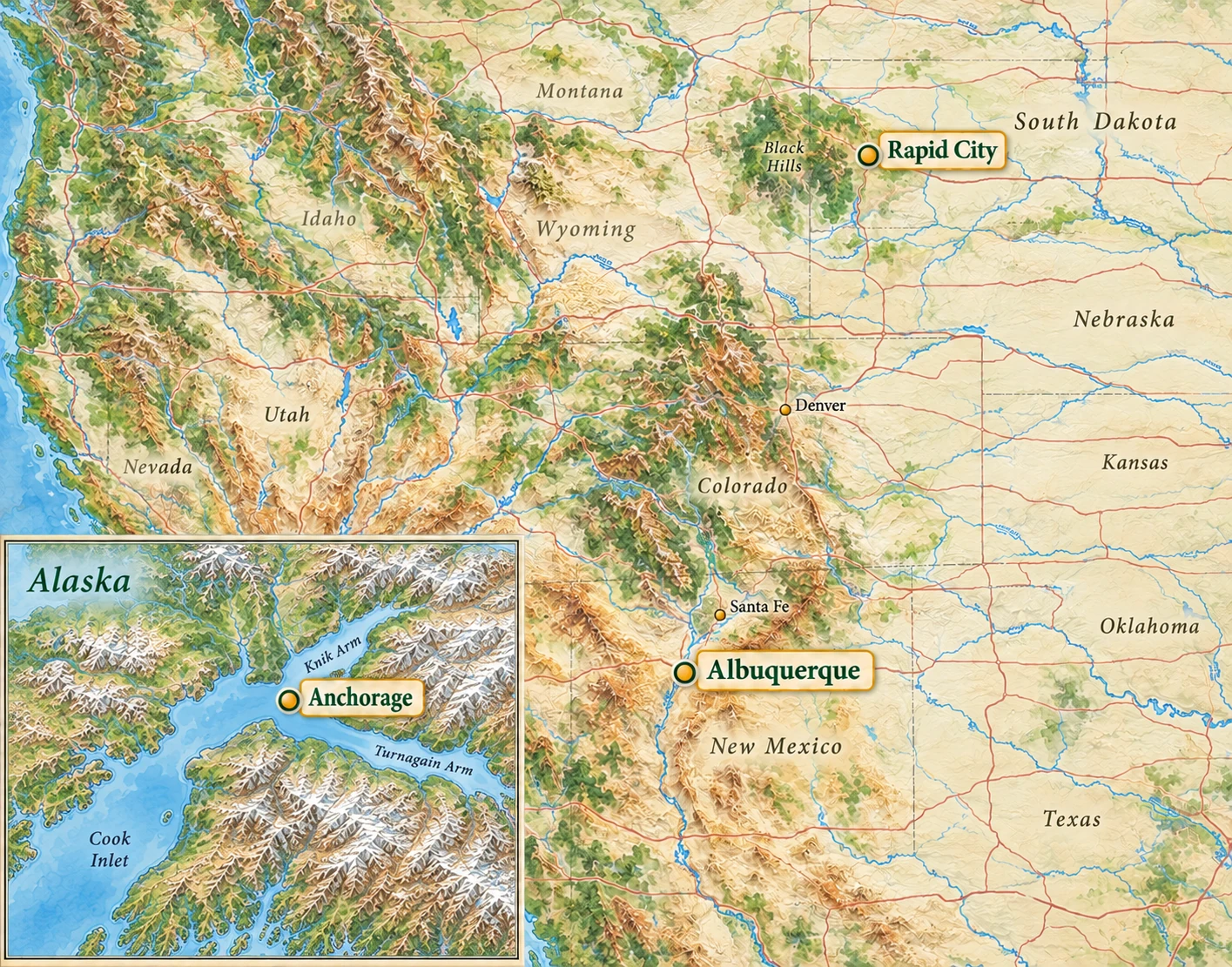
Geographic reference
Rapid City: choose the Black Hills setting with winter still in view
Rapid City opens a different outdoor-led idea: an inland city beside the Black Hills rather than another coast or a much larger metropolis. It can be worth a serious look when regular access to that landscape is a leading reason to move and a suitable work or income arrangement supports the choice. Begin with the activities you want to repeat. A weekend you enjoy and a home that lets you keep doing those things need the same practical plan.
The historical city gross-rent estimate is $1,109, $468 below Portland's point estimate. That is a housing difference worth testing against equivalent live homes. Add the actual transport required for work, shopping and the outings you hope to make. A lower-priced property on a difficult daily route can weaken the result. If local work is part of the move, get the occupation, pay and worksite into the comparison rather than assuming the housing gap leaves the whole amount available.
The climate gives an important correction to a simple western-move story. Rapid City Regional's January mean is 24.3°F, very close to Portland International Jetport's 24.0°F in the same 1991–2020 normals. July is 72.4°F against Portland's 70.4°F. These monthly means do not describe wind, snow, extremes or the conditions on a particular trail. Choose the Black Hills for the landscape you want to use; if a warmer January is the goal, compare places with a different winter pattern.
Visit during a season that would challenge the move, using the home and transport you could afford. Combine an ordinary workday with the route to a real outdoor destination; include the travel to people you want to keep seeing in Maine. Rapid City belongs on the shortlist when that repeated landscape access and a supported household month are worth the distance. If warmth is the main need, compare a genuinely different annual temperature pattern before choosing the region for its scenery.
Try first: Test the Black Hills outing and ordinary workday in the harder season; compare the complete month and Maine return.
Local sources: Rapid City — transit information · NOAA — monthly climate normals.
Anchorage: a deliberate Alaska choice, with the journey home included
Anchorage is the strongest change of distance and northern setting in this group. It belongs in a search led by an actual Alaska role, a wish for its mountain-and-inlet surroundings or a life change you have tested through a full season. It is not another nearby mountain city on a continuous road trip through the lower forty-eight. Put the household's connection to Maine and the way people and belongings would travel near the beginning of the decision.
The data here cover Anchorage municipality, a broad administrative geography with different urban and outlying settings. Its historical gross-rent estimate is $1,489, only $88 below Portland's point estimate. That is no convincing cheap-housing basis for this move. Compare the actual home, reliable earnings, utilities, transport, coverage and visits. A higher municipal household-income estimate is not a job offer, and it cannot pay for the transition or replace the work a partner would need to establish.
The season is substantially different on the station comparison. Anchorage International's January mean is 16.9°F and July mean 59.6°F, versus Portland's 24.0°F and 70.4°F. These are monthly means, not daily highs or a complete winter description. Try the darker, colder part of the year as well as the outdoor season that attracts you. People Mover provides specific urban bus connections; choose an attainable home with the actual route and return rather than assigning the same access to the whole municipality.
Price a realistic Maine return using dates you would travel, including transfers, ground transport and accommodation. Discuss the Alaska shipment with a carrier that can confirm the actual mode, scope and receiving arrangement; the general US service description does not settle a particular Alaska route. Anchorage stays on the shortlist when the supported Alaska life is worth those commitments. If the plan depends on a small rent difference or on frequent effortless returns to Maine, reconsider the assumptions before making it a permanent move.
Try first: Try an Anchorage home and winter routine, price the Maine return and obtain an actual Alaska shipment plan.
Local sources: Anchorage People Mover · NOAA — monthly climate normals.
Albuquerque: a high-desert alternative with a real housing comparison
Albuquerque is worth exploring when you want a high-desert city and a warmer winter than the Portland station pattern, with a meaningful historical housing difference to investigate. The Rio Grande and Sandia setting gives it a different everyday landscape from the Maine coast. The useful question is whether that setting, a home you could obtain and dependable income make life better together. A dry-air or mountain preference should become a week you can actually live rather than a description on a destination list.
The historical city gross-rent estimate is $1,145, $432 below Portland's point estimate. Compare equivalent current properties and what they include, then add work travel, insurance, heating and cooling, care and trips to Maine. If you plan to keep remote earnings, obtain permission for the location before building the budget around it. If you need local work, use the actual role and start terms. The city income figure cannot fill an employment gap for either adult.
ABQ RIDE provides fixed-route information and separately described on-demand and eligible paratransit services. Choose the service that actually applies to your home and trip; a special service is not a universal substitute for a missing route. The climate comparison is also specific: Albuquerque International's January mean is 37.4°F and July mean 78.9°F in the 1991–2020 normals. That is warmer than Portland's station in both months, while saying little on its own about a particular home's comfort or the day's extremes.
Use the visit for an ordinary workday, an indoor afternoon in the proposed home area and the outdoor access you hope to repeat. Give the more difficult season and the Maine return a real place in the plan. Albuquerque stays on the list when the high-desert routine appeals and the reliable monthly result improves. If the main attraction is a scenic outing but the home, job or transport remains hypothetical, settle those pieces before treating the lower historical rent as money already saved.
Try first: Try the actual Albuquerque home and transport week, including summer comfort and reliable income, before counting the housing gap.
Local sources: ABQ RIDE — current services · NOAA — monthly climate normals.
Two northern city settings and a Southern California coast
Portland, Oregon is inland; Seattle sits beside Puget Sound; San Diego offers a different Pacific coastal choice. Put the attainable home and work arrangement beside the landscape.
Seattle, Portland, Oregon and San Diego
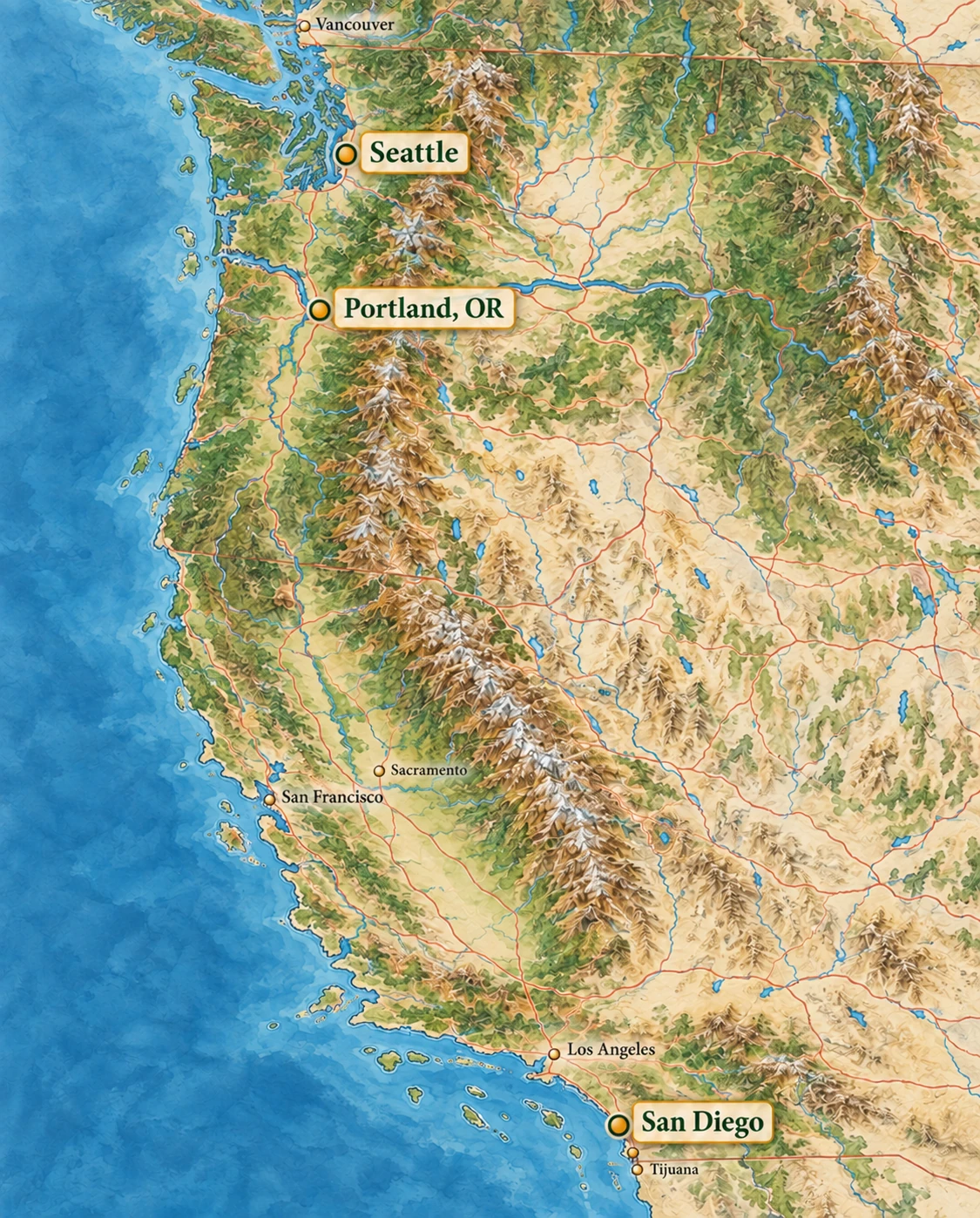
Geographic reference
Portland, Oregon: the other Portland is an inland city choice
Portland, Oregon offers a different connected-city and Pacific Northwest search from Portland, Maine. Keep the state in the name while comparing it. Oregon's Portland is inland in the Willamette and Columbia river setting, not an oceanfront version of the Maine peninsula. It can be a useful candidate when a specific role, neighborhood routine or regional landscape makes sense for you. The shared city name does not preserve the work, people or daily coastal access you have now.
Use TriMet's current maps and schedules to join an attainable home with the actual worksite, errands and evening return. A useful rail or bus corridor can matter greatly to a one-car or no-car household, while another address may not support that pattern. If the attraction is a coast or mountain outing, add its separate travel rather than drawing it into the ordinary urban journey. A home that lets you enjoy a regular city week may be more valuable than a farther property chosen for occasional trips.
The historical Oregon city gross-rent estimate is $1,655, $78 above Portland, Maine's point estimate. There is no large rent-saving argument in that comparison. A particular job or genuine reduction in vehicle costs could support the move, but it needs a household budget based on attainable homes and dependable pay. Include the transition, care changes and the cross-country Maine return. A similar city median does not make equivalent apartments, utility arrangements or earnings the same.
Spend an ordinary weekday in a neighborhood you could choose, using the transport mode you intend to keep. Try a recurring activity and plan a realistic Maine visit. Portland, Oregon belongs on the shortlist when that life offers an improvement worth the distance. If the appealing part is mostly a regional holiday, compare the frequency and cost of those outings with the home and work commitment required to live there.
Try first: Test the Oregon home and TriMet week separately from the coast or mountain outing and the trip back to Maine.
Local sources: TriMet — Portland, Oregon · TriMet — maps and schedules.
Seattle: support the connected home that makes the larger city useful

Seattle can be a strong comparison when a particular role, course or Pacific Northwest city routine offers a substantial reason to leave Maine. The gain might be a different employer path, a neighborhood activity or a home linked to the destinations you use. Start with that supported city week rather than a general skyline or mountain preference. The landscape can matter, but the household still needs an attainable place to live and a reliable way to earn its month.
Sound Transit's route and schedule tools distinguish Link, Sounder and express-bus services. Use the relevant mode and actual stops for your journey, including the operating day, transfers and return. A workplace outside the usable connection may leave a vehicle in the budget even if the home is near rail. Choose the specific location where work happens and the entrance you will use. A regional employer or campus name does not put every destination on the same easy route.
Seattle city's historical gross-rent estimate is $2,030, $453 above Portland, Maine's point estimate. A higher reliable salary or a real transport reduction could support that increase, but neither should be assumed. Add deposits, insurance, care and the flights or other travel needed to keep Maine connections. If two adults work, compare both paths; a strong offer for one may coexist with a long search or an inconvenient journey for the other.
Make a weekday trial from a home area you could obtain, including an errand and the activity you want to attend regularly. Try the season that concerns you rather than relying on a clear summer visit. Seattle earns a place when the actual opportunity and city life justify the higher commitment and distance. If the budget only works with an unconfirmed pay rise or an imagined car saving, establish those terms before choosing the destination.
Try first: Connect a real Seattle home with the exact worksite and service day, then compare the higher housing cost with confirmed earnings.
Local sources: Sound Transit — routes and schedules.
San Diego: decide what the Pacific coastal preference is worth each month
San Diego is the western coastal comparison for someone who wants a substantially different outdoor and seasonal pattern from Maine. It may be attractive for a particular role, family connection or a way of spending ordinary days near the Pacific. Give that preference a clear place in the budget. You are choosing a supported home and working week, not obtaining a holiday setting independently of the housing commitment that allows you to stay there.
MTS's Trolley network connects specific corridors, including downtown, UC San Diego, South Bay and the border. Match the actual home and workplace to the route you would use; a citywide Trolley map does not put every beach, job and errand on one convenient journey. Check the final walk and the return after work. A household that still needs a vehicle should keep its actual costs rather than counting transit savings because a line exists somewhere nearby.
The historical San Diego city gross-rent estimate is $2,313, $736 above Portland, Maine's point estimate. That is the largest housing increase among this edition's US city point estimates. It may be worthwhile with the right earnings and household priorities, but it should be visible from the start. Compare the property you could choose, deposits, coverage, travel and the Maine visits you intend to retain. Another adult's income and any care arrangement belong in the same calculation.
Try a weekday from an attainable home, with work, shopping and the outdoor activity you hope to repeat. Include the less convenient day and price a realistic trip to Maine. San Diego remains a useful choice when the Pacific routine and a concrete opportunity are worth the larger supported commitment. If it leaves the household short each month, compare a different property, timing or destination before treating the climate preference as a reason the budget will somehow resolve itself.
Try first: Put a real San Diego home, work journey and Maine return beside reliable income before committing to the coastal change.
Local sources: MTS — San Diego Trolley.
Compare the money left, then the cost of changing homes
The useful result is the money left after the household's necessary month. In the worked examples, the current arrangement leaves $650. The lower home payment leaves $550 after additional transport; the connected home leaves $850 despite costing more to occupy. When income falls, the lower-home arrangement has a $450 shortfall. These are chosen planning inputs, not four city prices. They show why the home payment needs the rest of the week beside it.
Start with take-home income you can reasonably depend on. A remote salary needs permission for the new location and any changes to pay or benefits. A new role needs its actual written terms and start date. Separate a partner's confirmed income from earnings you hope they will find later. With irregular work, use a cautious ordinary month and keep a separate plan for the gap before the first reliable payment. A city's household-income median cannot supply any of those answers.
Add the costs that continue after unpacking: housing, applicable utilities, transport, insurance, childcare, necessary care, food, debt commitments and the visits to Maine you intend to keep. Avoid counting a utility twice when it is included in the home payment. A home outside a useful corridor may need a second vehicle or more paid journeys. A smaller property may reduce maintenance but introduce an association fee. Include the change that belongs to your actual choice.
Treat the car decision as its own decision. Selling one vehicle can remove costs; merely using it less will not remove its payment or every insurance charge. Someone unable to drive needs a usable service with a driver, rather than a rental-car allowance. A household that keeps a Maine vehicle or a car for work should retain those costs. This matters when moving from a walkable peninsula routine to a lower-priced home with longer errands.
Now add the transition. Moving, travel, lease overlap, setup, fees and temporary accommodation may be money you will spend and not recover. A refundable deposit is a separate cash commitment, and an emergency reserve should remain available after the move. Do not describe all three as a single moving fee. Name any storage or staged delivery you actually need, including island freight and the receiving arrangements if the old or new home requires them.
At $200 more left each month, a chosen $4,000 unrecoverable transition takes twenty full months to recover. If the new arrangement leaves $100 less, it has no financial payback while those conditions continue. You might still value the new role or daily life enough to choose it, but lower rent would not be the financial reason. Use a longer stay, a smaller transition or a different home only when those are realistic alternatives.
The historical housing comparison helps you decide where to begin looking. Portland's city estimate is $1,577 gross rent; Tulsa's is $1,052 and Indianapolis city balance's is $1,156. Raleigh's is $1,572, almost the same as Portland's, while South Portland's is $1,812. All belong to the same 2020–2024 ACS period and carry published margins of error. They describe occupied homes of different kinds, not equivalent current listings or a promise that your household can keep the difference.
Bring two or three actual homes into the final comparison. Record what each payment includes and the commuting arrangement that makes it usable. Keep an unfavorable result visible: a place you love may need a higher reliable income, a smaller home or another timing choice. Finding that before signing is useful progress. It leaves you with a shortlist that the household can support instead of a destination that depends on every hoped-for saving arriving at once.
Hypothetical monthly US dollars · chosen inputs, not destination quotes
| Monthly result | Current arrangement | Lower home payment, more travel | Connected home, less transport | Lower income, more travel |
|---|---|---|---|---|
| Money left each month | $650 | $550 | $850 | −$450 |
| Take-home income | $5,400 | $5,400 | $5,400 | $4,400 |
| Recurring essentials | $4,750 | $4,850 | $4,550 | $4,850 |
Current arrangement
$650Money left each month
- Take-home income
- $5,400
- Recurring essentials
- $4,750
Lower home payment, more travel
$550Money left each month
- Take-home income
- $5,400
- Recurring essentials
- $4,850
Connected home, less transport
$850Money left each month
- Take-home income
- $5,400
- Recurring essentials
- $4,550
Lower income, more travel
−$450Monthly shortfall
- Take-home income
- $4,400
- Recurring essentials
- $4,850
The lower home payment leaves $100 less after additional transport. The connected home leaves $200 more despite a higher housing payment. With the income drop, the lower-home arrangement has a $450 monthly shortfall.
See the hypothetical inputs
| Recurring expense | Current arrangement | Lower home payment, more travel | Connected home, less transport | Lower income, more travel |
|---|---|---|---|---|
| Housing and applicable utilities | $2,100 | $1,650 | $2,200 | $1,650 |
| Transport, vehicles and paid journeys | $500 | $1,050 | $200 | $1,050 |
| Other recurring household essentials | $2,150 | $2,150 | $2,150 | $2,150 |
Current arrangement
- Housing and applicable utilities
- $2,100
- Transport, vehicles and paid journeys
- $500
- Other recurring household essentials
- $2,150
Lower home payment, more travel
- Housing and applicable utilities
- $1,650
- Transport, vehicles and paid journeys
- $1,050
- Other recurring household essentials
- $2,150
Connected home, less transport
- Housing and applicable utilities
- $2,200
- Transport, vehicles and paid journeys
- $200
- Other recurring household essentials
- $2,150
Lower income, more travel
- Housing and applicable utilities
- $1,650
- Transport, vehicles and paid journeys
- $1,050
- Other recurring household essentials
- $2,150
Chosen arithmetic inputs. Replace every category with attainable housing, reliable take-home pay and the full household essentials. A vehicle saving applies only when the cost actually disappears.
A chosen $4,000 unrecoverable transition takes twenty full months to recover at $200 more left each month. The lower-home case has no financial payback while it leaves $100 less. Refundable deposits and your emergency reserve remain separate cash needs.
Compare historical rent and household-income estimates
Comparable Census places · 2020–2024 ACS five-year estimates · 2024 US dollars. Gross rent covers occupied cash-rent homes and applicable utilities, not current listings. Income is annual household income before tax, not a salary or take-home amount. The ± figure is the published 90% margin of error. Differences subtract Portland point estimates; they are not a significance test or personal saving. Scroll the table sideways on a narrow screen.
Choose around the actual role, course and second worker
Start a career-led move with a role or course you can name. Boston or Chicago may widen the search beyond Portland's scale, but a larger job market does not give every household a better outcome. Compare the occupation, the employer or program, the worksite and the home you could use. The important number is your reliable pay after the move, alongside the costs and time needed to earn it.
For a healthcare role, the campus and shift matter. A MaineHealth employer name does not identify one Portland entrance or one work journey; the local network includes distinct locations. For a new city, get the worksite used by the actual team and the shifts you must cover. A day-shift bus connection may not get you home after a late finish. Professional registration, onboarding and an insurance change can also affect when the new earnings become usable.
For USM study, begin with the course timetable rather than the university name alone. Its Portland, Gorham and Lewiston campuses are different places. The Husky Line connects Portland, Westbrook and Gorham with limited stops; that is useful for a particular class pattern, not every campus journey. Before leaving Maine for a different program, compare the qualification, attendance, clinical or practical placement, total tuition and housing over the whole course.
A first independent move needs a first-year plan as well as a monthly budget. Add deposits, the time before the first paycheck, basic household setup and the travel needed to keep support. A shared home can change the cost, but it also needs a workable agreement about the lease, bills and what happens when someone leaves. A student benefit or housing place belongs in the plan only when the program confirms eligibility and availability for you.
For a licensed profession, ask the destination licensing authority how your actual qualification transfers and what remains before you may practice. This could involve documents, an application, an examination or supervised experience. Keep that timeline beside the employer start date. A state boundary can matter even when the city feels familiar; another country adds its own recognition and work-rights decisions. Do not build the first months around full earnings before that path is settled.
Remote work can make Tulsa, Albuquerque or another farther home search practical without changing the job. Obtain the employer's location permission before relying on that advantage. Ask about payroll, hours, required visits and any pay adjustment. Then test the actual home connection, a suitable workspace and the backup you would use during an interruption. Moving overseas also needs the right residence and work basis; a laptop does not supply either.
When two adults work, compare their jobs together. A higher salary for one person may be outweighed by a long employment gap for the other or a school-and-childcare arrangement that only one can cover. Put both workplaces, work hours and earnings in the same ordinary week. The better city may be the one that gives the household two workable paths, even when it is not the strongest single career offer.
If you own a business or work across several client locations, separate the home preference from the service area. Identify the clients you retain, the travel or premises you need and the approvals belonging to the work. A picturesque new base is useful when the business can operate from it and the household still has a livable week. Keep income that depends on rebuilding local demand in the uncertain column until there is a concrete basis for it.

Local sources: USM — Portland, Gorham and Lewiston campuses · Metro Husky Line — Portland, Westbrook and Gorham · MaineHealth — locations.
Make the choice work for everyone who is moving
A family move works when the adults' work, the children's day and the help between them fit together. Start with the household's least flexible requirement. That might be a treatment, an early shift, a child who needs a particular support or a relative who cannot manage stairs. Give that requirement a real home-and-journey comparison before letting a citywide housing figure set the direction. A larger property will not solve a week that nobody can carry out.
For a family with a preschooler, a confirmed care place can matter more than the town line. Portland Public Schools uses a Pre-K application and placement process; a neighborhood home does not guarantee a seat. Its current page gives the 2027–28 lottery as January 8 through February 7, 2027, and directs 2026–27 enquiries to the program manager. If you are moving during the current year, ask about your child's actual situation before relying on public Pre-K in the work budget. Include another confirmed care arrangement until the place is settled.
Compare the entire care day in a new city: arrival, collection, school holidays, early dismissals and the time between work and the setting. A single parent may need nearby backup more than an extra bedroom. Two adults with overlapping shifts may need a different combination of care and work hours. Ask who can collect a child when the normal arrangement changes. A place on a map and a provider accepting an application do not supply that person or an available place.
For school-age children, use the address, grade and program you actually need. Portland's high-school preference system, including Casco Bay's lottery, differs from a simple neighborhood assumption. Another district may organize placement differently. Bring the child's courses, services, language support and activities into the conversation with the receiving school. Keep records and the start-day arrangements accessible during the move, especially when keys and school calendars do not line up neatly.
For a teenager, include the journeys that let them keep growing independent: getting home after an activity, seeing a friend and reaching a course or part-time job. A house that requires an adult to drive every trip may change the whole family week. An island student's ferry pass in Portland covers a particular school arrangement; it does not make every weekend or evening activity simple. Compare what the young person will be able to do, alongside the adults' housing preference.
For several generations sharing a home, draw an ordinary day for each person. Consider privacy, bathing and sleeping arrangements, entrance steps, noise, storage and the route to regular care. A spare room upstairs may not help someone who needs a usable bedroom and bathroom on the entry level. Shared housing can reduce some costs and increase others, including alterations, transport and the time spent helping. Agree which help is offered and which needs another provider.
Use six household views when comparing the final shortlist: one adult renting; a student or early-career worker; a family with preschool care; a family with school-age children; several generations; and a person on fixed retirement income. They are planning scenarios, not customer stories or promises about where those groups belong. The same city may pass for one and fail for another because the income, home and help change. Your own household determines which view matters.
Age, gender and nationality can help you name a practical need, but they do not choose the city. Ask directly about the language you want to use, the community you hope to join, the people you support and the circumstances that affect getting home comfortably. A person moving alone, with children or after a separation may have a different support requirement from someone of the same age. Keep the need visible without assuming their preferences from a label.

Local sources: PPS — high-school preference and school assignment · PPS — enrollment and address information · PPS — current Pre-K application and placement · PPS — student ferry passes.
Build a life when you move on your own
When you move alone, choose a place where ordinary contact can become regular. One pleasant weekend with a full itinerary does not show how the first quiet Tuesday will feel. Look for something you would return to: a class, a shared project, a library group, a volunteering role or a familiar outdoor activity. Put it near the home or a route you can actually use. A social opportunity becomes more valuable when you can keep attending after the novelty wears off.
Portland gives you a useful starting comparison. You may already have a walk, a cafe, a library or a neighbor you encounter without arranging everything in advance. Name that pattern before leaving it. In Boston or Chicago, a useful connected neighborhood may offer more choices but also ask for a larger housing or transport commitment. In a smaller inland city, the attainable home may be easier while the activities you want need more deliberate travel.
Plan housing on one dependable income. Include the deposit, utilities, transport and enough reserve to handle a disrupted first month. Sharing can make a destination workable, but choose the actual household arrangement as carefully as the city. Ask about the lease, guests, work space, pets, bills and an exit if someone changes plans. A room that is cheap but leaves you unable to sleep or work can undermine the reason you moved.
Try the evening return from an activity you would realistically attend. Walk the final streets, observe lighting and crossings, check the last useful service and have a workable paid alternative where needed. Your own comfort and access needs belong in the choice. Avoid treating a citywide reputation as proof about a particular trip. The home, time, route and available help are more useful than a broad label about who the city is for.
Give the first month a few anchors. Arrange a recurring activity before arrival where possible, find the practical place for groceries and prescriptions, and make one connection with someone you can ask about an ordinary local problem. Stay in touch with the people you want to keep in Maine, with a travel budget that supports those intentions. Rebuilding a life does not require cutting every familiar link at once.
For someone who does not drive, the housing search should follow the whole week rather than a single successful commute. Test food shopping, a medical appointment, an evening activity and a Sunday return. The attractive neighborhood at the end of one bus line may still need an expensive gap elsewhere. Someone who cannot drive needs a taxi, accessible service or other arrangement with a driver for that gap; a car-rental price is not the answer.
After a separation, bereavement or another difficult change, make the move manageable enough to support you while new routines form. An attainable lease near a useful activity may be a stronger beginning than a demanding property far from help. If the main problem is isolation, give the new place an actual connection plan. A different setting can make contact easier, but it cannot attend the class, ask the neighbor or keep the appointment for you.
Downsize without shrinking the life you want to keep
A smaller home can reduce the work of living there and free money for the things you use. Start with what you want less of: cleaning, stairs, yard work, unused rooms or a high fixed payment. Then name what needs to remain easy: seeing family, reaching care, pursuing a hobby or having a guest stay. That gives a downsizing search a positive purpose instead of reducing it to the fewest rooms or the cheapest town.
Compare two realistic homes, including one in or near Portland when it could meet the need. A more accessible mainland address might remove an island transfer or a difficult stair without separating you from familiar help. A farther city could make a smaller property or different climate possible, but add visits to Maine and the effort of finding new providers. The useful result is a home you can keep using, not simply a smaller square-foot figure.
Look beyond whether a person can enter the building once. Try the daily route to the bathroom, laundry, kitchen and outdoor space. Ask about the lift, door controls, snow clearing and the alternative during an interruption. Include carrying groceries, receiving a delivery and getting to a regular appointment. If someone uses mobility equipment, use its actual dimensions and needs. A property advertised with a convenient feature still needs to work as a whole.
On a fixed income, keep recurring obligations predictable enough for the household. A lower mortgage balance may sit beside taxes, insurance, maintenance or an association payment. A rental may change responsibility for repairs but still need a realistic renewal plan. Separate the cost of the home from the money released by selling possessions or a property. A one-time receipt does not automatically make a recurring monthly shortfall comfortable.
For care, begin with the services you need and how you will reach them. Ask the insurer and provider about the actual plan, participation and new-patient process before treating a nearby building as continuity of care. Include therapy, prescriptions and any regular assistance as well as a main medical practice. Another state or country can change those arrangements. The important answer is whether you can continue the necessary help on a routine you can manage.
Price the family connection you intend to keep. A move to Albuquerque or San Diego can make visiting Maine a different undertaking from a southern Maine address. Anchorage needs an even more deliberate return plan. Compare real dates, transfers, ground travel and where you will stay; avoid assuming a current flight or fare will always be available. Decide what frequency is affordable and emotionally acceptable before using distance as a minor detail.
Finally, choose possessions for the life and rooms you expect to use. Measure the pieces that matter, identify what can be given or sold with a confirmed recipient, and avoid paying to store things indefinitely without a purpose. Keep the favorite chair, equipment or guest arrangement that supports daily life where it fits. Downsizing works best when the home becomes easier and the useful parts of your life remain recognizably yours.
Choose the everyday landscape and the whole year
Be specific about the nature you want to be closer to. A waterfront walk after work is different from a mountain trip on a free weekend. Portland already gives some households a peninsula trail, a mainland woodland route or an island setting; if you rarely use the access you have, ask whether time, transport or the location of your home is the real obstacle. Another landscape helps most when it changes what you can regularly do.
Rapid City, Anchorage and Albuquerque illustrate three different outdoor-led decisions. The Black Hills sit beside Rapid City's western edge, Anchorage combines an Alaska city week with nearby mountains and inlet geography, and Albuquerque brings a Rio Grande and high-desert setting. None makes every home a trailhead or every outing possible in every season. Try the route to the particular activity you want, with the parking, equipment, access rules and time it actually requires.
The temperature comparison gives a useful surprise. Portland International Jetport's January mean is 24.0°F in the 1991–2020 normals; Rapid City Regional's is 24.3°F. Moving toward the Black Hills is not a clear warmer-January answer on that measure. Albuquerque's January mean is 37.4°F and July mean 78.9°F, compared with Portland's July 70.4°F. Anchorage is colder in January at 16.9°F and cooler in July at 59.6°F. Choose which change you want rather than treating every western or mountain setting as the same climate.
Those are airport-station monthly means, including nights. They are not daily highs, a forecast for your home or a description of snow, humidity, smoke, daylight and wind. Use the season that challenges the proposed move in a trial visit. A person tired of Maine winter may find a southern summer harder than expected; someone wanting a cooler summer may value Anchorage while finding winter light and the longer family return demanding.
Keep the building beside the climate. Ask about heating and cooling, insulation, an exposed entrance, responsibility for clearing snow and the bills or maintenance the actual property requires. A dry regional description does not describe every room, and a pleasant outdoor temperature does not make a top-floor apartment comfortable. Where the proposed activity depends on a trail, shoreline or water access, confirm the usable entrance and the days or seasons you would attend.
Separate scenic attraction from property exposure. For a coast, river, steep site or woodland edge, consult the relevant official hazard information for the actual address and obtain insurance information for that property. Flood mapping and an evacuation instruction answer different questions. The home you can support and leave when needed matters more than a generic statement that a city is coastal, inland or near mountains. Keep unknown costs visible until a provider can price the real case.
A rural home can put fields or woodland beside the door while making groceries, work and care farther away. Consider private services, maintenance and the practical help available when something fails. You can also keep a connected city home and arrange regular outings; that may give you more time in the landscape than a property that takes the weekend to maintain. Compare the pattern you would enjoy living with after the first beautiful photograph.


| Station | January mean | July mean |
|---|---|---|
| Portland International Jetport, Maine | 24.0°F | 70.4°F |
| Rapid City Regional, South Dakota | 24.3°F | 72.4°F |
| Anchorage International, Alaska | 16.9°F | 59.6°F |
| Albuquerque International, New Mexico | 37.4°F | 78.9°F |
Regional-station monthly means, not a forecast or property condition. NOAA climate normals.
Local sources: NOAA — monthly climate normals.
Could another country fit the life you want next?
Another country can offer a new city routine, language and way of spending the year. Begin with a place you could live and work in, and a household month you could support there. Toronto, Edinburgh, Lisbon and Guadalajara provide four different beginnings. The wider Canadian, British, Portuguese and Mexican city lists help you orient yourself; each detailed example follows one particular city rather than pretending that a national description fits every address.
Start with citizenship, existing residence rights and the purpose of the move. Work, study, family and retirement can lead to different requirements. A visit does not supply a long-term residence or work permission, and permission for one adult does not automatically settle another adult's job or a child's schooling. Use the immigration authority and the consulate responsible for your application to establish the route for your household before making a housing commitment that depends on it.
Build the budget in the currency you will pay. Toronto uses Canadian dollars, Edinburgh pounds, Lisbon euros and Guadalajara Mexican pesos. Record reliable income, the exchange assumption and what happens if the conversion moves against you. Add healthcare arrangements, applications, travel, setup and any tax or payroll work appropriate to your circumstances. A low converted rent from a travel story cannot settle the household's full cost or the right to retain a US job abroad.
The journey back to Maine is part of the choice. Compare the actual dates you would travel, how you reach the airport or station, transfers, arrival time and where you stay. A Canadian city being in a neighboring country does not make every trip short; a European city being walkable does not shorten the flight. Decide how often you want to return and what the household can sustain, including a visit at short notice.
For a first trial, live an ordinary working week in a home area you could choose. Shop, travel, work only within the permission you have, and try a regular social activity. Notice the language needed for the landlord, health appointment and paperwork as well as a restaurant visit. A useful result may be a longer trial or another city in the same country. You do not need to turn an appealing short stay into a permanent move before those answers exist.
Canada: use Toronto to test a much larger connected-city life
Start with Toronto. Other cities to explore: Montréal · Ottawa · Calgary · Vancouver.
Canada: begin with a Toronto city week
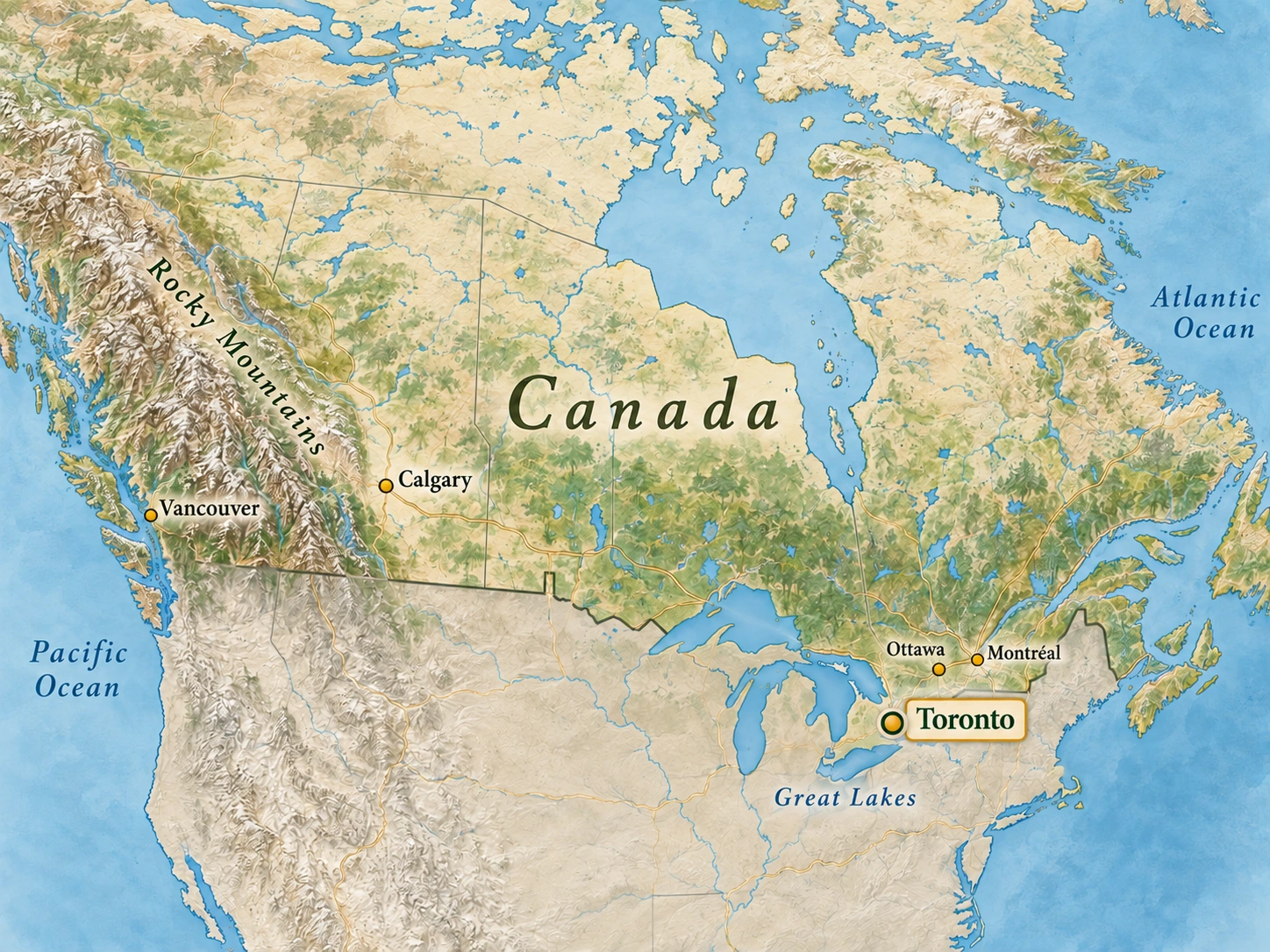
Geographic reference

Toronto is the Canadian example for a Portland resident who wants a much larger city, a particular work or study opportunity, or a household routine organized around urban transport. It is a different starting question from a move mainly for mountains or a milder winter. Montréal, Ottawa, Calgary and Vancouver remain useful horizons, but they would create different language, work, landscape and return-to-Maine comparisons. Begin with the city that fits your actual reason rather than treating Canada as one uniform next step.
Establish the residence and work basis before making the Toronto home a commitment. IRCC distinguishes employer-specific work permits from open permits available in particular circumstances; the requirements are different, and a job offer alone does not settle every part of the application. Family members may need their own visit, study or work arrangements. A short visit and a household move are separate decisions. Citizenship or an existing right can change your path, so use the route applying to each person rather than a general account from another mover.
Use the TTC map to make the city idea concrete. Join an attainable home with the actual worksite, everyday shopping and a regular activity. Include the service day and last useful return, not only the closest station. A home elsewhere in the wider region can create another operator, transfer and cost arrangement. Toronto's overnight network can help with some journeys, but the actual stop-to-door trip still matters. The point is to find a week you can use, not simply a city with more lines on a map.
Build the month in Canadian dollars. Price the actual home and utilities, reliable take-home earnings, transport, childcare, coverage and the Maine visits you want to maintain. If income remains in US dollars, state the conversion assumption and allow the plan to survive an unfavorable change. Employer permission, payroll and tax arrangements need their own review for the actual work. Do not import a US city rent estimate into a Toronto budget or assume that a higher converted salary leaves more after the whole month.
Try a weekday in the home area you could choose, including an evening return and the activity that makes the larger city appealing. Price an actual Maine journey with the departure point, transfers and final ground travel included. Toronto stays on the shortlist when the authorized work or household basis, attainable home and city routine support the change together. Its location in a neighboring country can make the idea feel familiar, but the legal, currency and family decisions still need to be yours.
Try first: Establish the Canadian basis for every household member, then try an attainable Toronto home and full TTC week.
Local sources: Canada — applying for a work permit from outside Canada · TTC — Toronto transit maps.
United Kingdom: an Edinburgh life built around an actual role or course
Start with Edinburgh. Other cities to explore: Manchester · Birmingham · London.
United Kingdom: begin with Edinburgh
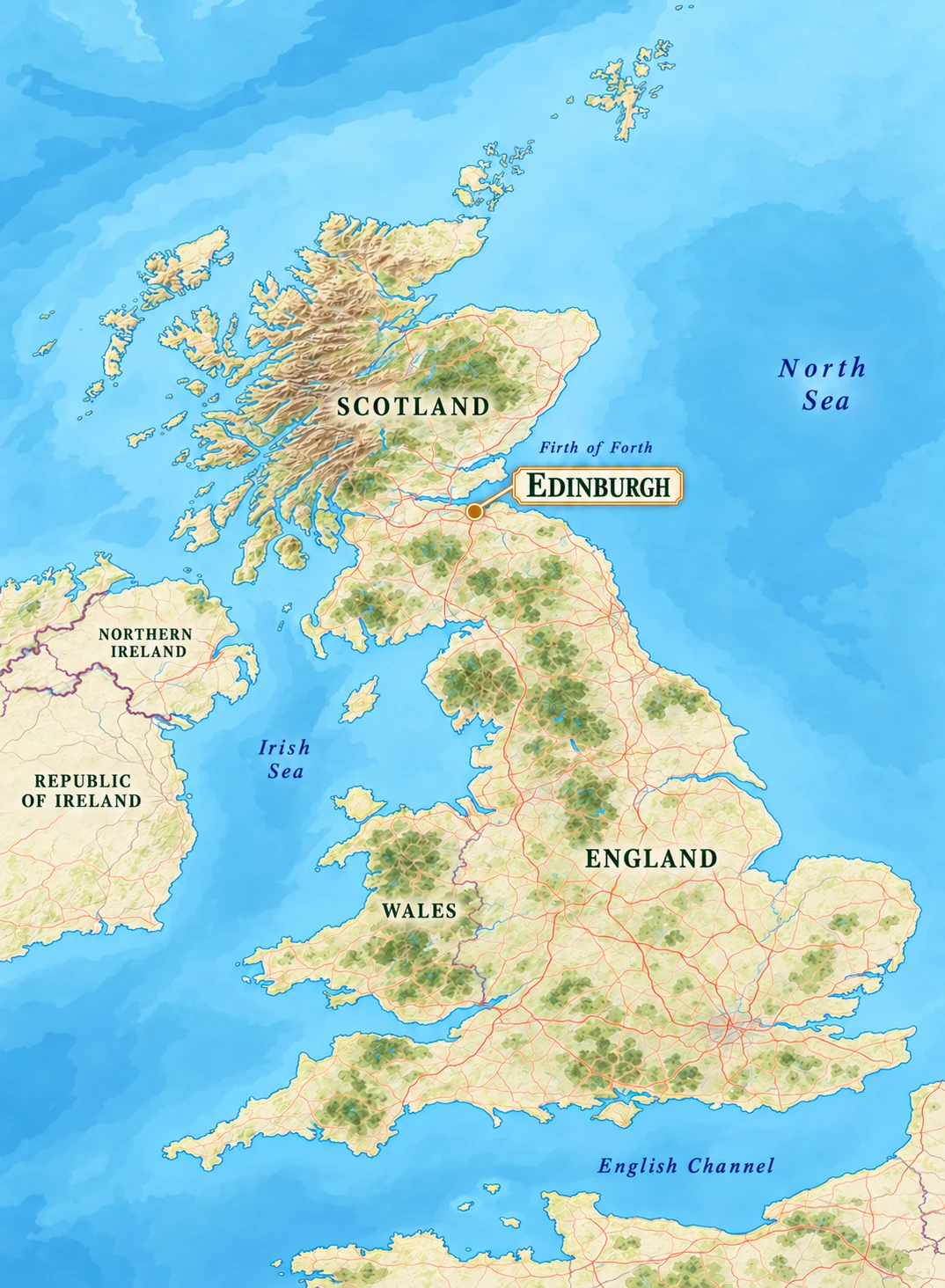
Geographic reference

Edinburgh is the British example when a specific role, course or Scottish city life gives you a reason to cross the Atlantic. It offers a different urban and cultural setting from a small Maine coastal city. Manchester, Birmingham and London may suit other work and housing questions; they are not substitutes to rotate into the budget without research. Choose Edinburgh because you can identify how you would participate in everyday life there, rather than because English removes every part of the transition.
For a Skilled Worker route, GOV.UK requires an eligible job with an approved employer and the necessary sponsorship, salary and English conditions. The confirmed role and your actual eligibility come before the move. A partner's or child's arrangements require their own check; they are not an automatic extension of a favorable job conversation. A study or other residence basis follows its own rules. An English-speaking setting does not permit you to bring any job or work pattern simply because you can communicate comfortably.
Connect the particular workplace or campus with an attainable home. Edinburgh's tram route provides an airport–city–Leith/Newhaven corridor, alongside separate bus journeys, but a line on the map does not serve every class building, shift or home entrance. Inspect the walking route, gradient and the return after the actual finish time. If the attraction is cultural life, choose an ordinary activity you would attend regularly and try getting home afterward. A special visitor itinerary can conceal a daily journey you would find tiring.
Price the household in pounds. Include the actual home, recurring charges and utilities, transport, reliable after-tax income and the immigration or healthcare-related costs applying to your status. Keep tuition and its earning limits separate when study is the purpose. If a US employer is involved, confirm the permitted location and work arrangement rather than assuming that a laptop or familiar language settles it. Keep any second adult's unconfirmed earnings out of the reliable-income total until there is a concrete path.
Use a trial for a working or study-shaped week and the season that concerns you. Spend ordinary time at the home as well as in the city, and price a Maine return on dates you would actually travel. Edinburgh belongs on the shortlist when the role or household basis, supported month and daily city life are worth the larger distance. It is less convincing when the only firm part is a memorable trip and the housing, permission and income all depend on plans still to be made.
Try first: Confirm the applicable UK role or study basis, then compare the actual Edinburgh home, daily route and Atlantic return.
Local sources: Skilled Worker visa: Overview - GOV.UK · Edinburgh Trams — route map and stops.
Portugal: test a Lisbon home and working day beyond the short stay
Start with Lisbon. Other cities to explore: Porto · Braga · Coimbra · Faro.
Portugal: a Lisbon beginning
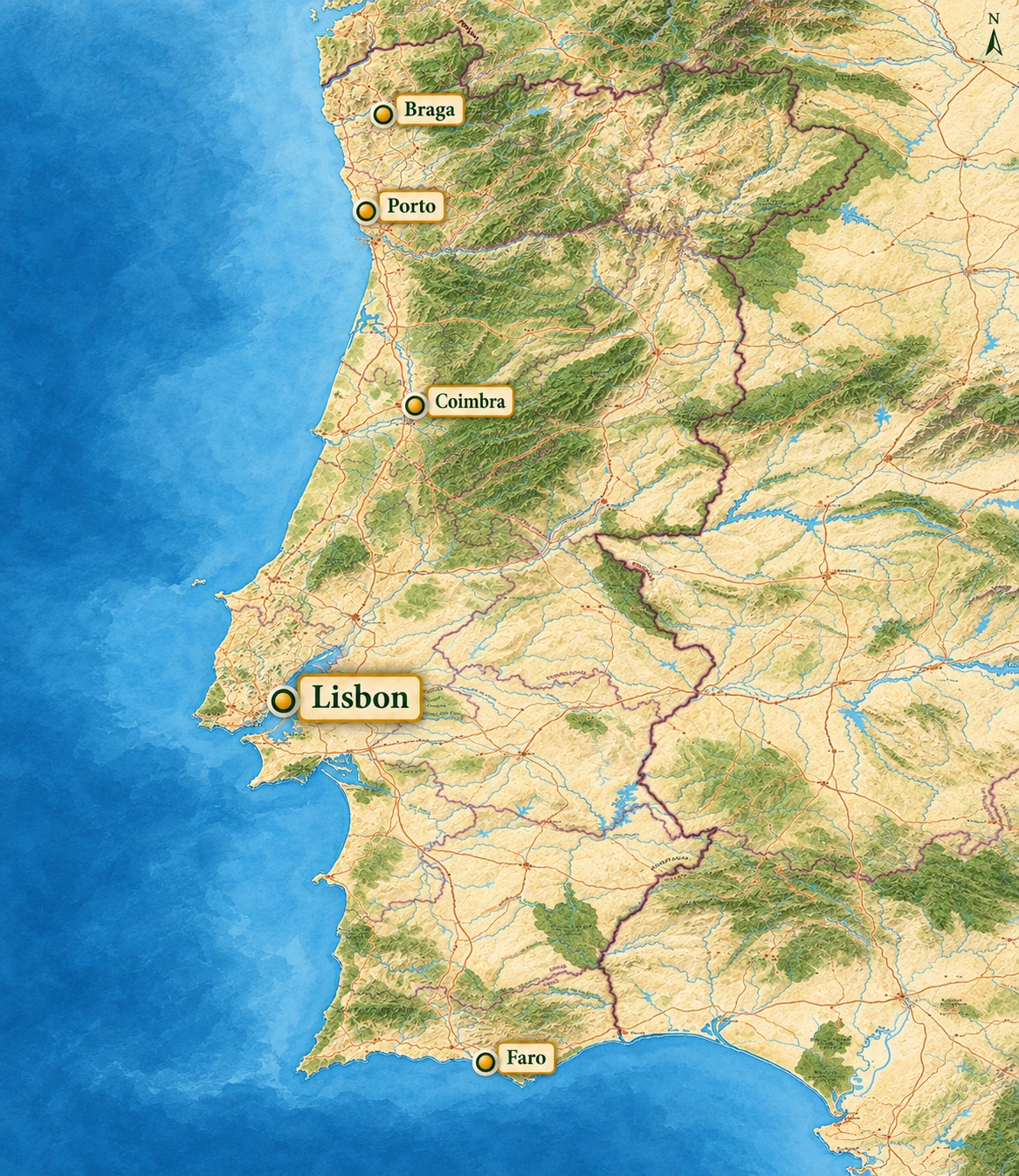
Geographic reference

Lisbon is the Portuguese example for someone considering a European city routine, a different annual climate or a household with work that can lawfully continue there. Porto, Braga, Coimbra and Faro remain separate possibilities with their own housing, transport and seasonal questions. Lisbon's place beside the Tagus is not the same as living on a beach. Begin with the neighborhood and workday you could support, including the everyday errands and connections that make a city useful after the first visit.
Identify the Portuguese residence route that applies to your citizenship and purpose. Remote professional activity has a distinct route, but a US remote job or a visitor entry does not establish eligibility for a long-term move. Use the responsible consulate and AIMA for the current requirements, the residence stage and the household's circumstances. If one adult plans to take local work, ask about that arrangement separately. Do not assume that the basis supporting one person and one job covers every earning plan in the family.
Give the work hours a real trial. If you will continue a Maine-centered schedule, account for the actual date's time difference and how the hours meet local shopping, care and social life. An apartment with a good view may still lack a comfortable work area, dependable connection or suitable indoor temperature. Ask about the actual lease, bills and building access. Inspect hills, stairs and the walking connection to the transport you would use, especially if daily access or mobility is a leading reason to move.
Metropolitano de Lisboa's journey and map information provides a starting point for a connected home search; some journeys will require other services and their own terms. Price the month in euros using an attainable property, reliable income, utilities, transport, care and healthcare arrangements. If income stays in US dollars, make the exchange assumption visible. Add the immigration, setup and professional tax or payroll work appropriate to the case, rather than treating a converted accommodation price as the whole cost of living.
Spend an ordinary week in a realistic home area and try the season that could challenge your comfort. Use Portuguese for the practical tasks you can, and identify the support needed for a landlord, provider or official process. Then price the Maine return, including transfers and a short-notice visit if family needs make that important. Lisbon stays on the list when the residence basis, working day and full household month make sense together; a pleasant temporary stay can remain a useful trial without becoming a premature permanent decision.
Try first: Resolve the applicable Portuguese residence and work basis, then test a Lisbon home, schedule, indoor comfort and Maine return.
Local sources: AIMA — residence for remote professional activity · Lisbon Metro — journeys and maps.
Mexico: an inland Guadalajara week, with status and earnings settled
Start with Guadalajara. Other cities to explore: Querétaro · Mérida · Mexico City.
Mexico: an inland Guadalajara beginning

Geographic reference

Guadalajara provides an inland Mexican city comparison for a Portland resident who wants a different language and urban setting rather than another beach destination. Querétaro, Mérida and Mexico City remain other horizons, with different climate, home and work questions. Give the Guadalajara idea a daily purpose: a household connection, suitable role, study or a lawful retained-income arrangement. The useful result is a life you could support and take part in, not simply a smaller converted accommodation figure.
Separate permission to visit, residence and permission for the work you intend to do. Mexico's immigration processes distinguish employment-authorized routes from other residence or visitor situations. Use the consulate responsible for the application and INM for the actual arrangement; a financial residence basis does not automatically establish permission for every local earning activity. Remote work needs the applicable treatment and the employer's approval too. Ask those questions before signing a home on the assumption that one adult's income can continue unchanged.
SITEUR's current Mi Tren information describes four lines, including the newer Line 4. The system serves parts of the wider Guadalajara metropolitan area, so keep the actual municipality and neighborhood in the home search. A city label does not put the home, worksite, medical appointment and social activity on one easy train trip. Try the complete route and the evening return. Spanish ability and reliable local help can affect how comfortably you manage the ordinary tasks that a short visit handles for you.
Build the month in Mexican pesos, with actual housing terms, utilities, transport, reliable income and the care or coverage the household needs. A local salary and retained US earnings create different comparisons; do not combine the housing assumption from one with the income assumption from the other. Make exchange rates explicit and retain room for setup, applications, professional tax or payroll questions and trips to Maine. A low converted payment is less helpful if the household cannot lawfully earn the income supporting it.
Try a regular week rather than a resort-shaped stay. Shop, make the necessary journeys, spend time inside a home you could choose and ask about its actual services and lease. Price the Maine return with the full travel day and current connections, without assuming a nonstop flight. Guadalajara earns a place when the legal basis, working arrangement and daily life support the cultural change. If those remain open, keep it as a research or trial option while a more concrete household choice develops.
Try first: Settle the Mexican residence and actual work arrangement, then test an attainable Guadalajara-area home and full ordinary week.
Local sources: Mexico INM — employment-offer visa authorization · SITEUR — Guadalajara-area Mi Tren.
Test an ordinary week before you commit
Choose the visit that could change your decision. If the uncertainty is a late-shift return, stay where you could actually live and make that journey. If it is summer comfort, visit during the season that worries you and spend time inside an attainable home. If a child's program is decisive, arrange a conversation with the receiving school before arriving. A successful trip gives you an answer that a scenic afternoon or a list of attractions could not.
Begin at the prospective home area, with the transport mode you intend to use. Make the outward journey, an errand and the return, including waiting, parking or transfers. Carry groceries or use the equipment that belongs to your real day where appropriate. Try the least flexible day too: a Sunday evening, an early start or a school collection after work. Record the total time and the alternative when the normal service cannot carry the plan.
Ask the employer for the worksite, normal hours, required attendance, start date and written pay or location terms that matter to you. Ask a course provider about the timetable, placement and qualification. Give the landlord or seller your actual questions about heat, included bills, pets, access and possession. Keep promises that affect the choice in the appropriate written agreement. A helpful conversation is a beginning; the home and job still need their own confirmations.
Use one unstructured period to find the ordinary place you might return to. Visit the library, a neighborhood activity or the walking route rather than filling every hour with exceptional outings. If you are moving alone, see whether you can attend something regularly from that address. If you are moving with a family, give each person a part of the trial. Someone else's difficult journey may otherwise remain invisible until the household has moved.
Bring a workable comparison home from the visit: the home you could obtain, the month it creates, the improvement you observed and the compromise that remains. Keep an unsuccessful test too. A missed last bus, an inaccessible entrance or a care arrangement that cannot cover the workday can remove a city or lead to a better neighborhood within it. That is useful evidence, not a reason to force the original idea through.
If you choose a trial lease or staged move, define when you will review it and what would justify staying, changing the arrangement or returning. Budget the separate travel, shipment and storage stages that make it possible. Keep the people and resources needed for the fallback confirmed. A reversible plan should help you learn while preserving a livable household month, rather than leaving all the furniture, work and accommodation decisions unresolved.
Turn two to four places into a move you can carry out
Your shortlist is ready when each place has a reason to be there. Keep the home and reliable income beside the benefit, the hardest compromise and the answer still needed. You might compare Westbrook with Indianapolis because both could improve the month in different ways, or Boston with Toronto because a particular role matters more than climate. The list does not need to contain cities of the same size or distance; it needs to contain choices you can explain.
Use the printable worksheet for two to four places. Enter the actual home or home area, take-home income, complete recurring essentials and the amount left. Record unrecoverable transition spending, refundable deposits and the reserve you want to keep separately. Write the person or organization who can resolve the remaining question, then add a next step and a date. Leave an unknown visible rather than filling it with an average that belongs to a different household.
Make the move operational once the choice and timing are real. Establish possession, keys, the receiving person and the access at both homes. A peninsula pickup may need a legal curb arrangement and a stair review; an island shipment may need a distinct freight or vehicle stage and a receiver beyond the pier. Give the mover the whole inventory, including storage locations, and say what packing or unpacking you want handled.
Sterling Oakbridge's Portland long-distance service covers household moves across the United States and Canada. Use the service page to compare direct dedicated and consolidated delivery around your shipment and receiving dates. Ask for the actual scope and delivery arrangement in writing. The international life comparisons for the UK, Portugal and Mexico are informational; arranging a shipment there requires a provider serving that country and its own transport and import plan.
Keep a first-arrival group with you: essential documents, keys, medication, chargers, basic clothing and what the household needs before the main delivery. Agree who can receive, answer placement questions and resolve access at the new home. If the destination is temporarily unavailable, arrange the alternative before dispatch, including where people, pets and belongings can stay and who may authorize the additional work. An unconfirmed friend's address is not a delivery plan.
Recheck the information that sets the date. A school application, employment start, lease handoff, building slot or border process can change independently of the truck booking. Keep the current contacts and written terms together. You can move the shipment well and still have a difficult arrival if essential housing or care remains unresolved. Finish those household decisions alongside the transport so the new place can begin to function as home.
The figures and maps are there to help you ask a better, smaller set of questions. Housing comparisons use exact Census geographies and the common 2020–2024 ACS period, with published margins of error. They are historical occupied-home estimates; the budget examples use chosen inputs. Climate uses named airport stations and 1991–2020 monthly means. The method and sources below let you trace those limits while using current homes, providers and work terms for your final choice.
Compare two to four places you could call home
Portland, Maine origin · date:
What must change?
Three things to keep:
| My comparison | Place 1 | Place 2 | Place 3 | Place 4 |
|---|---|---|---|---|
| Place / actual home | ||||
| What gets better? | ||||
| Hardest compromise | ||||
| Must-haves and support | ||||
| Take-home income / month | ||||
| Essentials / month | ||||
| Money left / month | ||||
| One-time costs you will spend | ||||
| Refundable deposits | ||||
| Cash kept for emergencies | ||||
| Answer still needed / who to ask | ||||
| My next step / when |
For each place, write what gets better, the hardest compromise and the monthly amount left after essentials. Keep the home and reliable income together. Note the answer still needed, who to ask and your next step and date. Leave unknowns visible. Record one-time spending, refundable deposits and cash kept for emergencies separately.
Questions when choosing where to move from Portland
Where should I start if I want to leave Portland, Maine?
Start with the change you need. Compare Westbrook or Biddeford and another Portland home if the main issue is the housing arrangement while work and support still fit Maine. For a larger housing-led search, Tulsa, Indianapolis and Albuquerque have clearer historical rent differences in this edition. Boston, Chicago and Toronto need a concrete city, work or study benefit; Anchorage needs a deliberate northern-life and family-return plan. Keep two to four options whose improvement and compromise you can explain.
Is South Portland a cheaper version of Portland?
The historical city comparison does not support that assumption. South Portland’s 2020–2024 gross-rent estimate is $1,812, compared with Portland’s $1,577, with published margins of error. A particular home or smaller transport requirement can still improve your month. Compare equivalent current homes, the costs included and the work or school journeys you would actually make.
Which nearby places does this guide compare in detail?
Westbrook, South Portland and Biddeford. They test an inland bus corridor, another harbor-side city and a separate Saco River base farther southwest. Falmouth, Scarborough, Gorham, Yarmouth, Freeport, Brunswick and Saco are additional local horizons. Choose around the actual home, work, care and return journeys rather than treating all of Greater Portland as one arrangement.
Can a mainland move solve an island transport problem?
Yes, when the ferry is the limiting part of the week. A suitable mainland Portland or nearby city home may remove the sailing while keeping much of your work and support in Maine. Compare the full new home cost and transport against the island routine you have. Passenger travel, furniture freight and vehicle transport are separate arrangements; a different mainland address still needs a workable building and daily route.
Does Metro BREEZ still serve Bath Iron Works?
The operator says the pilot extension ended after service on October 2, 2026. Its Portland–Yarmouth–Freeport–Brunswick express remains the relevant published corridor. If the actual job is at Bath Iron Works, establish the remaining connection and return for your shift before relying on an older route description.
Does the Downeaster give every Biddeford home a convenient train commute?
No. The Saco station is in the separate city of Saco, and a Biddeford home needs a journey to it. Add that leg, the actual train, any connection at the other end and the return. An occasional regional trip and a daily work shift can produce different answers. Use the current operator schedule for the day you need.
Is Raleigh a clear rent-saving move from Portland?
No. Raleigh’s historical city gross-rent estimate is $1,572, only $5 below Portland’s $1,577, with margins of error and different mixes of occupied homes. A particular role, retained income or better home may still improve the household. Use actual properties and the complete monthly budget instead of making that small point-estimate difference the reason to move.
Which examples show a larger historical housing difference?
Tulsa is $525 below Portland’s city gross-rent point estimate, Rapid City $468, Albuquerque $432 and Indianapolis city balance $421. These are common-period 2020–2024 occupied-home estimates, not current equivalent listings or personal savings. Keep actual earnings, transport, care, property costs and the Maine return beside an attainable home before deciding whether the difference helps you.
Are the Census figures current rental listings or job offers?
No. The housing figures describe occupied cash-rent homes in the 2020–2024 ACS five-year estimate and include applicable utilities under the gross-rent measure. Household income is annual before-tax survey context in 2024 dollars, not an occupation’s wage or a job available to you. The comparison shows the exact geography and published 90% margins of error. Use live homes and your own reliable pay for the final budget.
How can a cheaper home leave me with less money?
Additional transport or other costs can exceed the home saving. In the chosen example, housing falls from $2,100 to $1,650, but transport rises from $500 to $1,050. With the other inputs unchanged, money left falls from $650 to $550. A connected-home example leaves $850 despite a higher home payment. Replace these illustrative inputs with costs that actually change for your household.
How much cash should I keep for the transition?
Separate unrecoverable moving and setup spending, refundable deposits and the emergency reserve you want available afterward. Add any actual lease overlap, storage, travel or gap before reliable income. In the chosen model, a $4,000 unrecoverable transition takes twenty full months to recover at $200 more left each month. It has no financial payback while the new arrangement leaves less.
Which places should I compare if I do not drive?
Begin with connected home areas: another Portland peninsula address, the actual Westbrook or South Portland corridor, or a supported Boston, Chicago or Toronto city option. Test work, groceries, care, an evening activity and a Sunday return from the same attainable home. Keep paid journeys for gaps in the budget. Someone unable to drive needs a usable service with a driver; a rental-car allowance does not solve that gap.
Can I count on a Portland Pre-K seat after choosing a home?
No. PPS uses an application and placement process, and an address does not guarantee a seat. Its current page announces the 2027–28 lottery for January 8 through February 7, 2027; for 2026–27 it directs families to the Pre-K program manager. Confirm your child’s actual placement, hours and transport before relying on it in the work budget, and keep another confirmed care arrangement until needed support is settled.
Should I move around the university name or the actual course location?
The actual course location and timetable. USM has Portland, Gorham and Lewiston campuses, and the limited-stop Husky Line connects the Portland–Westbrook–Gorham corridor. Another program or clinical placement may create different trips. Compare the qualification, total costs, attendance and earning arrangement over the whole course, with the home that makes that schedule workable.
Is Rapid City a clearly warmer winter choice?
Not on the January station mean shown here. Rapid City Regional is 24.3°F, close to Portland International Jetport’s 24.0°F in the common 1991–2020 normals. That does not make snow, wind, extremes or trail conditions identical. Choose Rapid City for a tested Black Hills and household routine rather than treating a western destination as an automatic escape from a cold January.
Why include Anchorage in a Portland moving guide?
It makes a distinct northern landscape and life change visible. Anchorage is colder in January and cooler in July on the named airport-station comparison, with a much longer Maine return to plan. Its historical municipal rent estimate is only $88 below Portland’s point estimate, so cheap housing is not the argument. Keep it for a supported Alaska role or life you have tested, with an actual shipment and visiting plan.
Is Portland, Oregon on the ocean?
No. It is an inland city in the Willamette and Columbia river setting. Compare the attainable home and TriMet-connected city week separately from a coast or mountain outing. The Oregon city’s historical gross-rent estimate is $78 above Portland, Maine’s point estimate; the shared name and a similar city median do not preserve the same job, people, bills or coastal routine.
Can I keep a remote job after a US or international move?
Only if the actual work arrangement permits it. Obtain the employer’s location permission and any changes to pay, attendance, hours or payroll before relying on the earnings. An international move also needs the residence and work basis applying to your circumstances, including other household members. Test the actual home connection and workspace, then budget required visits and a practical backup.
What if another Canadian city interests me more than Toronto?
Use the city that fits your own reason. Montréal, Ottawa, Calgary and Vancouver offer different language, work, landscape and travel comparisons from Toronto. Establish the Canadian basis for each household member, then build the actual city’s Canadian-dollar budget and ordinary week. A favorable Canadian residence or work path does not make every city’s housing, daily transport or Maine return the same.
Does Sterling Oakbridge move households to all four countries in this guide?
The Portland long-distance service describes household moves across the United States and Canada. The UK, Portugal and Mexico comparisons help with choosing a place to live; a shipment there needs a provider serving that country and its own transport and import plan. For any complex US or Canadian route, including Alaska or an island transfer, confirm the actual shipment scope and receiving arrangement before committing.
What should I test during a scouting visit?
Test the uncertainty that could change your decision: the actual shift return, a school or care arrangement, the harder season or a regular activity from an attainable home. Include an ordinary errand, indoor time and the least flexible day. Bring back the home, budget, observed improvement, hardest compromise and answer still needed. A failed route or unavailable care place can usefully remove an option or redirect the neighborhood search.
How do I use the comparison worksheet?
Keep two to four places. For each, write the actual home or area, what improves, the hardest compromise, reliable take-home income, complete essentials and money left. Record transition spending, refundable deposits and the reserve separately. Add the unanswered question, who can answer it and a next step with a date. The PDF is available without registration; unknowns should remain visible until you have a useful answer.
Sources and method
Local operators, public agencies and institutions are linked beside the comparisons they support. Information was checked in October 2026; service notices and data releases have their own dates. The US comparison uses the common 2020–2024 ACS five-year release for exact Census places, including separate Maine cities, Indianapolis city balance and Anchorage municipality, with published margins of error; the climate comparison uses NOAA 1991–2020 regional-station monthly means. Neither prices a current home or predicts a particular day. Budget inputs are hypothetical household arithmetic.
The city and household scenes are original AI illustrations. The detailed AI atlas maps use checked geographic references to picture settings and relative places. Use current provider information and the actual address when choosing a home or planning a journey.
- ABQ RIDE — current services
- Anchorage People Mover
- Subway | Schedules & Maps | MBTA
- 60 Saco Portland | Biddeford Saco Old Orchard Beach Transit
- 70 Zoom Express | Biddeford Saco Old Orchard Beach Transit
- Canada — applying for a work permit from outside Canada
- Casco Bay Lines — furniture and freight
- Casco Bay Lines — Peaks winter schedule
- CTA — trains, buses and service notices
- NOAA — monthly climate normals
- Concord Area Transit – Where Will You Go Today?
- Amtrak Downeaster — current schedule
- Edinburgh Trams — route map and stops
- IndyGo — routes and current network
- Lisbon Metro — journeys and maps
- MaineHealth — locations
- Metro Route 1 — Congress Street
- Metro Route 21 — South Portland and SMCC
- Metro Route 4 — Westbrook
- Metro Husky Line — Portland, Westbrook and Gorham
- Metro routes and current notices
- Mexico INM — employment-offer visa authorization
- SITEUR — Guadalajara-area Mi Tren
- PVTA — regional routes and notices
- Portland moving services
- Portland local relocation guide
- TriMet — Portland, Oregon
- AIMA — residence for remote professional activity
- PPS — high-school preference and school assignment
- PPS — enrollment and address information
- PPS — student ferry passes
- PPS — current Pre-K application and placement
- GoRaleigh — routes and services
- Rapid City — transit information
- GRTC — Pulse and other services
- MTS — San Diego Trolley
- CAT — regular buses, DOT and ferry
- Sound Transit — routes and schedules
- TTC — Toronto transit maps
- TriMet — maps and schedules
- MetroLink Tulsa — routes and Peoria AERO
- Skilled Worker visa: Overview - GOV.UK
- USM — Portland, Gorham and Lewiston campuses
Census ACS methods · 2024 Census Gazetteer
Download the comparison data (CSV) · Download the model inputs (JSON)