

Begin with the change you would welcome
You may still love Boston and find that the life you want no longer fits the arrangement you have. Perhaps the children have left and the house holds more work than pleasure. Perhaps your partner is changing careers while you are working evenings. Or perhaps a practical interest has grown beyond a corner of the dining table. Start by naming the change you would welcome. A useful destination gives that wish somewhere to happen while keeping the things you still value in view.
This guide begins close to home, then opens eighteen US possibilities and four overseas chapters. The examples ask different questions about work, living space, people and the seasons. Use them to form a shortlist of two to four places whose actual homes and ordinary days you can investigate. The purpose is to help you recognize a good next chapter, with enough detail to take a useful first step.
Try completing one plain sentence: “Our next home should give us more room for…” The answer might be a teenager’s independent afternoon, a quiet work surface, an easier entrance or time for a person you want to see more often. Add the part of Boston life you would be sorry to lose. A good comparison can hold both wishes together. You can be ready for a different arrangement without having to decide that everything about the present one has failed.
Different motives deserve different searches. Someone accepting a confirmed role in Fort Worth needs a funded household around the appointment. Someone drawn to Burlington may be choosing a smaller city and a lake in the ordinary year. A couple considering Valencia may be building a life in another language around a qualifying work arrangement. Let the purpose lead, then examine the home and day that would support it. The same destination can be a good fit for one household and an expensive distraction for another.
Keep the first step small enough to do. Choose the two or three changes that matter most, and one uncertainty that could alter the decision. Then follow the relevant part of the guide. You do not need to settle every possible city before investigating a promising one. A first comparison becomes useful when it brings a real home, dependable income and a recognizable day into the same conversation.
Keep a Boston connection
Compare Framingham, Quincy and Salem through suitable work space, two schedules and the Boston ties you want to keep.
Compare three nearby beginnings →Make the household month work
Use dependable income and the full cost of home, travel and practical help.
See what remains after the bills →Choose a wider US chapter
Give the work, city scale or landscape a realistic home and ordinary year around it.
Explore the wider city profiles →Explore an overseas chapter
Begin with the actual purpose, applicable permissions and a funded week for each person.
Compare four overseas chapters →Give the Boston life you value a place in the comparison
Before you leave a familiar arrangement, look at what it is already doing for you. Perhaps an evening music group near Back Bay gives the week a social anchor. Perhaps a relative in Dorchester is easy to see without planning a whole day. Someone else values a Jamaica Plain walk or the practical connection from an East Boston home. These are examples of different relationships to the city, not a ranking of neighborhoods. Your own useful geography may look quite different.
Write down the connections you actually use, with their real frequency. A monthly dinner, a work journey repeated four days a week and a course you attend one evening make different demands on the next home. Include the small conveniences that are easy to overlook: a familiar shop, someone who can collect a child, a class you can join without thinking about the journey. A new place can provide alternatives, but they need time and effort to become part of ordinary life.
Then decide what you want to do with each connection. Some may stay at the same frequency after a nearby move. Others may become less frequent but longer visits. A third group may be replaced by something you are willing to establish locally. Treat that as a choice for each person in the household. One adult’s occasional Boston visit may be another adult’s essential weekly commitment, and the comparison should keep both visible.
For the lighting programmer and bookbinder, the present city provides work contacts, familiar travel and friends who understand irregular hours. Their dining-table problem is real, but it does not erase those strengths. A different Boston home with a separate work area deserves comparison with Framingham. If that option solves enough of the problem, the couple may choose it. If the wider move offers a fuller life, they can name what it adds instead of assuming distance itself supplies the benefit.
Begin with one week you have recently lived, including the inconvenient day. Notice what you would keep, what you would happily stop doing and what someone else currently makes possible. This gives the next home a fair baseline. It also leaves room for staying while changing the building, work schedule or use of space, if that proves to be the most satisfying answer. A destination earns its place by supporting the life you want to live.
Boston: keep the connections that still work
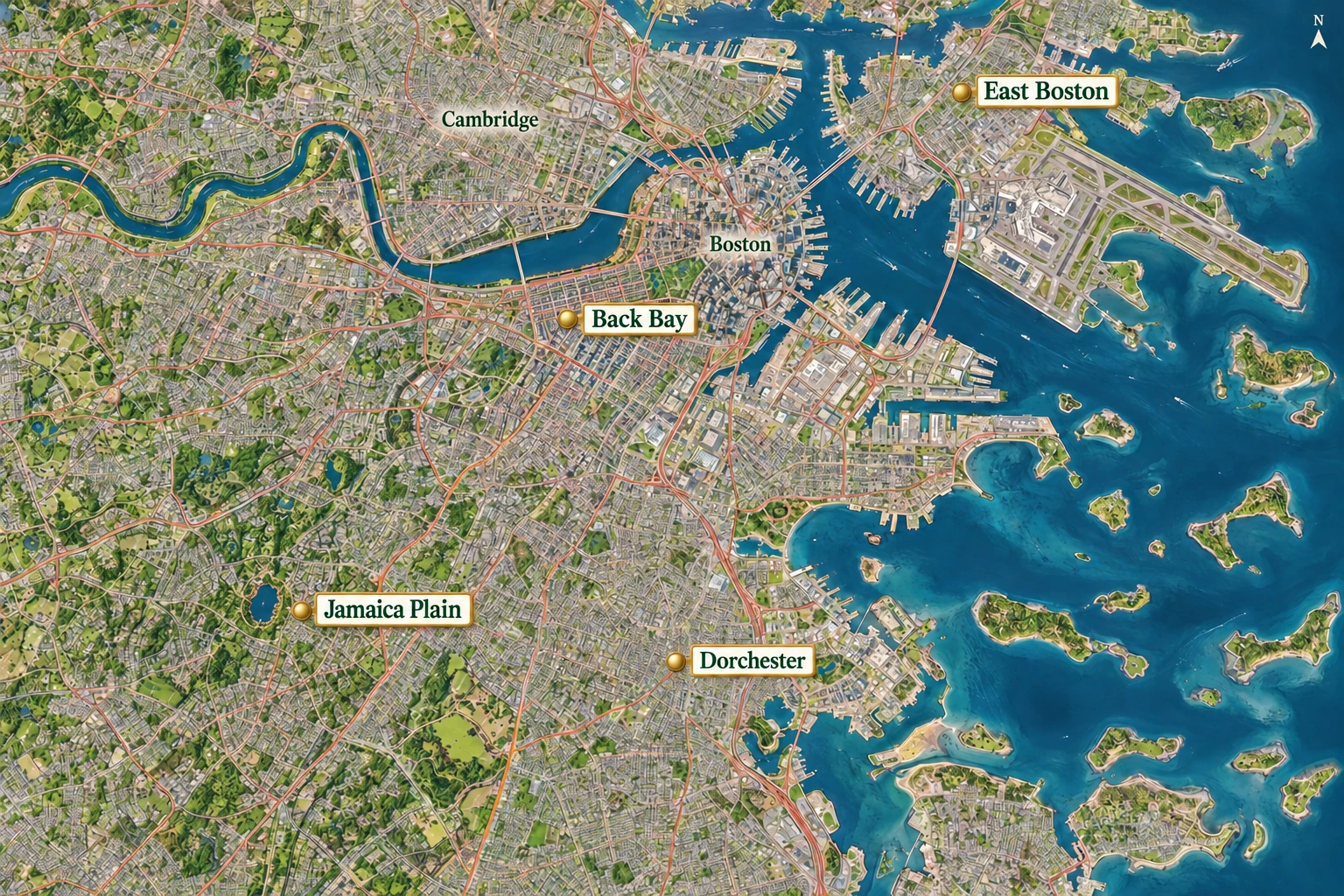
Geographic reference

- The present strengthsName the people, interests and journeys that already make the week work.
- The welcome changeChoose the task, space problem or missed opportunity the next arrangement should improve.
- A fair comparisonGive one plausible Boston alternative and the farther favorite the same questions.
Let the purpose choose the distance
Choose the scale of move that gives the intended change a workable home. A different apartment may be enough when the problem is the room layout or entrance. A nearby municipality may offer the right space while preserving a Boston connection. Another US region may be exactly what you want when the opportunity, landscape or family purpose belongs there. An overseas chapter can be equally serious when its legal and household foundations are established.
These possibilities do not form a ladder you must climb in order. Keep a nearby option beside a farther favorite if the comparison helps you understand what the distance buys. A bookbinder may discover that a suitable local workshop solves the main problem. A teacher approaching retirement may still prefer Burlington because the smaller-city and lake routine matter in their own right. A confirmed appointment elsewhere may settle the distance question before the home search begins.
Separate journeys that continue frequently from visits you can plan differently. Quincy may preserve a Boston work pattern through a relevant Red Line connection. Providence could support a new local week with occasional travel back. Los Angeles asks for a much more deliberate calendar and budget for the people you keep seeing in Massachusetts. Compare the complete journey from the home, including the return, instead of using a map distance as a measure of how close you will feel.
The change also has a beginning. A nearby move can still require overlapping housing, a new deposit and time off work. A farther move may involve a temporary first home while you learn the real geography of the job. An island or foreign-country chapter adds different transport and administrative questions. Give the transition enough money and flexibility that the household does not have to defend an unsuitable first arrangement simply because changing it would be difficult.
Use distance to serve a positive purpose. If a place offers the work, people or setting you want and the full arrangement is funded, it can be worth the disruption. If the evidence remains uncertain, compare another home, change the timing or keep the option for a later chapter. The useful result is a reasoned choice about the life around the address, with the important commitments visible.
- A different home nearbyKeep frequent Boston connections while changing the usable space or local day.
- Another US baseBuild a funded household around the particular opportunity, people or landscape.
- An overseas chapterEstablish each person’s status and ordinary life alongside the reason to go.
Three nearby beginnings, with different reasons to choose them
Framingham, Quincy and Salem give the Boston household three different starting perspectives. Framingham turns the search west toward a home and working arrangement with more usable space. Quincy asks how a different home base could fit an early shift and an evening class. Salem offers a North Shore center in which a changed working life might develop. Each can preserve some Boston relationships, with a different local day around them.
The transport distinctions matter. Framingham and Salem have different commuter-rail corridors; Quincy has Red Line stations. The current provider information, service changes and complete journey decide whether those connections fit your hours. A rail connection alone does not establish the final walk, an evening return or a trip that requires carrying equipment. Use the map to understand the setting, then investigate the actual service and home together.
Nearby also does not guarantee a large saving. In the common 2020–2024 ACS release, the median gross-rent point estimates are $2,033 for Framingham city, $2,118 for Quincy city and $1,836 for Salem city, beside Boston city’s $2,147. The table keeps margins of error and the exact geography. These historical occupied-home figures begin a comparison; current homes with the space, access and location you need have their own prices.
Give each nearby candidate a benefit worth the move. It might be room for two different activities, a more independent afternoon or a town you would enjoy using locally. Then carry the continuing Boston trips and any added transport into the budget. A modest change in geography can create a substantial improvement when the particular home fits. It can also add inconvenience without changing enough, which is a useful finding while you still have alternatives.
Three nearby beginnings from Boston
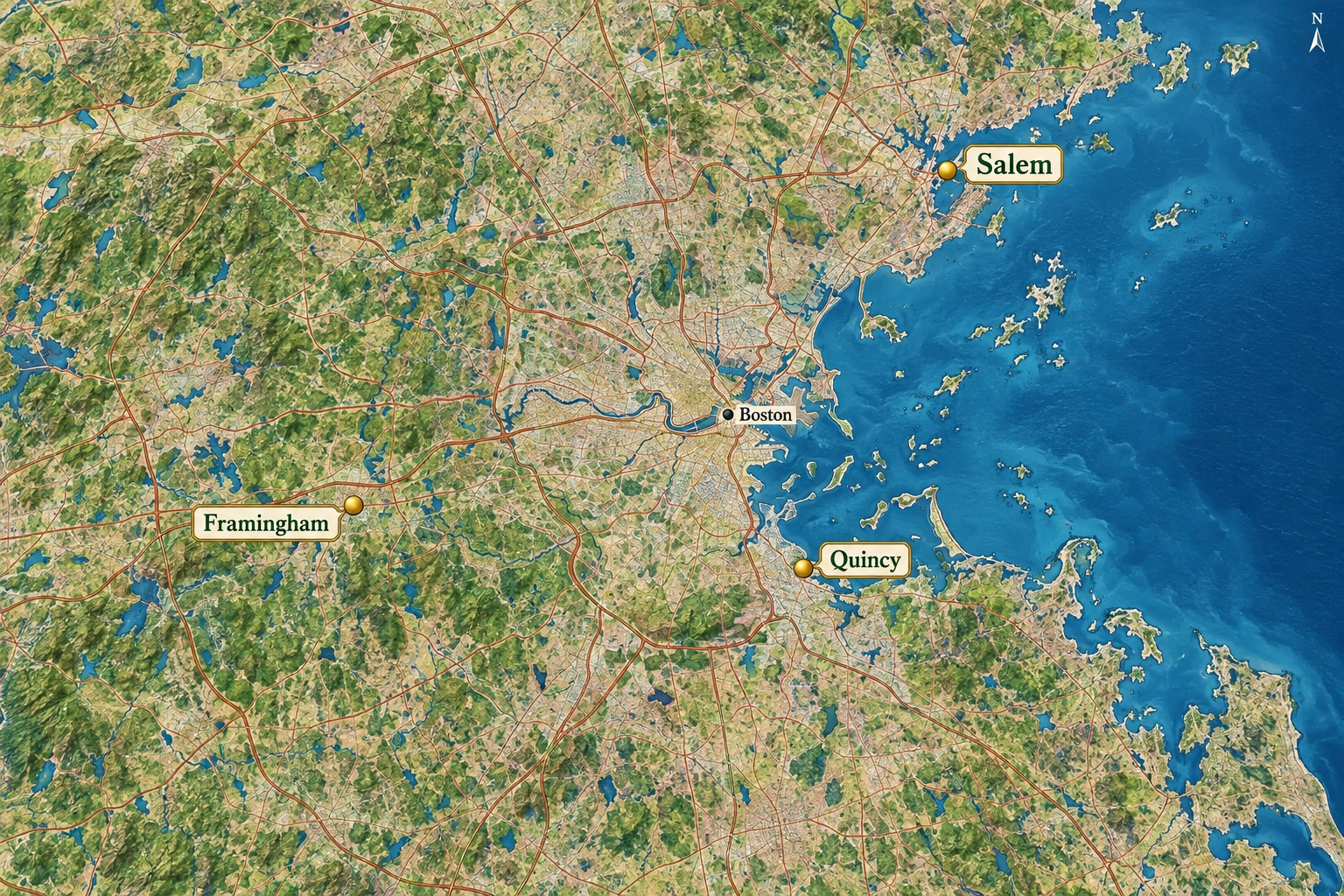
Geographic reference
Framingham: keep the Boston relationship and change the space

Framingham could suit a household whose reason for staying near Boston remains strong, but whose present home has become too small for what they actually do. Imagine a theatrical lighting programmer and a bookbinder sharing a dining table for two incompatible tasks. One needs a quiet place to prepare a show file; the other needs a clean work surface that can stay set up. The attraction is a workable home and a less improvised evening, rather than a general promise that life outside Boston will be simpler.
Their first comparison is between two real arrangements: a home with suitable work space in Framingham, and a different Boston home that would solve enough of the same problem. A spare room helps the programmer only if it is quiet during the hours they need. The bookbinder may still require a separate approved workshop for activities that do not belong in an apartment. Establish the property terms, storage and any relevant operating permission before treating extra floor area as a functioning business space.
Framingham has an MBTA Framingham/Worcester Line connection. That gives the couple a route to investigate, not a complete answer to the evening return after a performance. Use the actual workplace, current timetable, walk to the station and final journey home. If the programmer needs a car on late nights, put the full recurring and occasional cost into this version of the month. The partner’s daytime trips deserve their own check; the station may be useful to one person and irrelevant to the other.
The common Census background is less dramatic than an imagined move from city prices to country prices. Framingham city’s 2020–2024 median gross-rent point estimate is $2,033 a month, compared with Boston’s $2,147. These are historical occupied-home estimates with margins of error, not offers for a home with a studio. The difference cannot establish that this household would save money. What it does establish is the need to find the specific usable space and price that make the move worthwhile.
Give the bookbinder one local reason to leave the work surface. Framingham History Center uses Edgell Memorial Library on Centre Common for programs and changing exhibitions. A program that interests them can make the comparison more concrete: try the journey from the prospective home, spend time there and see whether the evening still leaves room for the couple. Centre Common and the downtown rail connection are different places; investigate the trip between the places they would actually use.
Give the surrounding day some attention too. Where would the bookbinder buy supplies, take a break and meet someone after working alone? Does the new home let the couple share a meal on the nights when the programmer is free? A larger room at the cost of every shared evening would answer only part of the problem. Framingham stays on their shortlist if the extra space supports the work while the journeys leave enough of their life together intact.
Try first: Compare one attainable Framingham home with one Boston alternative, then rehearse the late return from the actual performance venue.
Local sources: Framingham city, Massachusetts Census historical gross rent · Framingham/Worcester Line | Commuter Rail | MBTA · Edgell Memorial Library, Framingham History Center.
Quincy: a different home without abandoning the city connection

Quincy may be worth exploring when the household wants a distinct home base and still needs Boston regularly. Picture a laboratory technician who starts early and a partner beginning evening classes in accounting. Their present arrangement works for the technician but leaves the student with too little room and too many awkward trips. Quincy enters the conversation because they want a better fit for both schedules, with a town and neighborhood they can enjoy in their own right.
Begin around two actual home areas rather than treating every Quincy address as equivalent. The MBTA Red Line provides a real Boston connection; the remaining walk or bus trip and service at the relevant hours still matter. An early laboratory shift and an evening class create different journeys. Check both directions for each person, including the return when the class finishes late. A home convenient to one station is useful only if the station and onward route serve the places they actually use.
The water can be part of the attraction. An ordinary walk near the shore, a small gathering with friends or a quieter morning may be a meaningful gain. Give that wish an accessible location and a place in the working week. A home described broadly as coastal may still leave the couple driving to every waterside outing. Look at the property’s actual setting and relevant flood information when comparing homes; the appeal of a shoreline and the conditions of a particular building are separate questions.
Quincy city’s historical median gross-rent point estimate is $2,118 in the common 2020–2024 comparison, close to Boston’s $2,147. The table retains each estimate’s margin of error. This is a useful warning against assuming a large automatic saving, while leaving room for a specific home that suits their budget better. Include tuition, transport and the income pattern during the course in the household month. The class should have a funded beginning rather than depending on an immediate career improvement.
Quincy becomes a strong option if both people gain something they can name: a home that handles studying, a dependable route to work and time to enjoy the place around them. If the arrangement mainly transfers travel difficulty from one partner to the other, try a different address or retain another option. A nearby move can be modest in distance and substantial in effect, provided the improvement belongs to the whole household.
Try first: Try the early work journey and the late class return from the same plausible home area, then compare the two people’s remaining free time.
Local sources: Quincy city, Massachusetts Census historical gross rent · Red Line | Subway | MBTA.
Salem: let a North Shore home have its own ordinary year

Salem, Massachusetts, offers a different question from the western and southern options. It may attract a Boston household that wants a compact center, an older coastal setting and a life organized more around its own town. Consider a costume maker leaving a full-time production role to combine part-time employment with a small repair practice. Their partner wants to stay involved with a Boston music group. The move would be about a new balance of work and personal life, with some city ties continuing.
Salem has an MBTA Newburyport/Rockport Line connection. Use the current timetable and the actual home-to-station leg when deciding how often the Boston rehearsal remains comfortable. A weekly outing and five commuting days create different burdens. The costume maker should compare the place of employment and permitted work space separately. Neither a picturesque storefront nor a spare bedroom establishes that a particular business can operate there, or that the household can replace its former income quickly.
Spend time in the center during the ordinary hours you expect to use it. Then investigate the seasonal visitor pattern around the specific home and work area. A lively autumn can be a pleasure for one household and a difficult working environment for another. Ask the property owner about access, parking and noise at the address, and observe more than a holiday weekend. The choice is easier when Salem is being considered as a year-round home rather than a single attractive visit.
The city’s 2020–2024 median gross-rent point estimate is $1,836, below Boston’s $2,147 in the same historical release. That background does not price an accessible home, a workshop or the next tenancy. Set the real housing payment beside the reduced dependable income, materials, transport and any Boston work still required. A smaller recurring surplus can be an accepted choice when it buys a valued change and leaves the household funded; it should be visible in the calculation.
For the costume maker, the Peabody Essex Museum’s event calendar offers a specific way to explore the local creative life, including art-making and talks. Choose a current event for its subject, check its terms and make the return journey at the time it ends. Then spend a quiet weekday nearby too. An occasion worth returning for is more useful to this household than assuming that the visitor season will provide a year-round social circle.
The positive test is whether Salem gives the costume maker a workable new chapter while the partner can keep a meaningful connection without resenting the journey. Look for an activity and a regular social contact inside Salem too. If every interesting evening still requires a trip to Boston, the household may be paying the disruption of relocation without gaining the independent local life it wanted. A clearer routine can make this a deliberate move rather than an attractive address with unfinished arrangements.
Try first: Compare an ordinary weekday with a busier autumn day around the same home area, and price a cautious first year of the changed work plan.
Local sources: Salem city, Massachusetts Census historical gross rent · Newburyport/Rockport Line | Commuter Rail | MBTA · Events | Peabody Essex Museum.
Open the wider US search through the life you want
The eighteen US profiles in this guide include the three nearby places and the five groups below. They widen the question from keeping a Boston connection to choosing a new local life. Some begin with work, others with a smaller home, a practical interest or a different outdoor year. Use the group that resembles your purpose, then look closely at the individual city and the household situation behind it.
You may recognize the return to work after family care, the wish to keep a creative interest alive or the choice to spend more of a dependable retirement income on a place you would enjoy. Follow the situation that resembles yours, then compare the actual arrangement it would require. The career opening needs a real workplace; the practical interest needs usable space; the smaller-home choice needs a day that still feels full.
Compare the gain with the change it asks of you. Burlington’s lake routine still includes winter; a practical home in Tulsa needs its own work and transport plan; San Diego may ask for a higher actual housing payment in return for the outdoor year you want. None of those compromises settles the decision alone. Keep the positive purpose beside the household month and the time left to enjoy it.
Keep two to four serious candidates once you have explored the range. Give each one a sentence about the gain you want and the evidence that would decide it. A place with a clear purpose is worth a closer visit. A place you merely find attractive can remain an interesting future idea without absorbing the effort needed to settle your next home.
Six US horizons for a different ordinary week
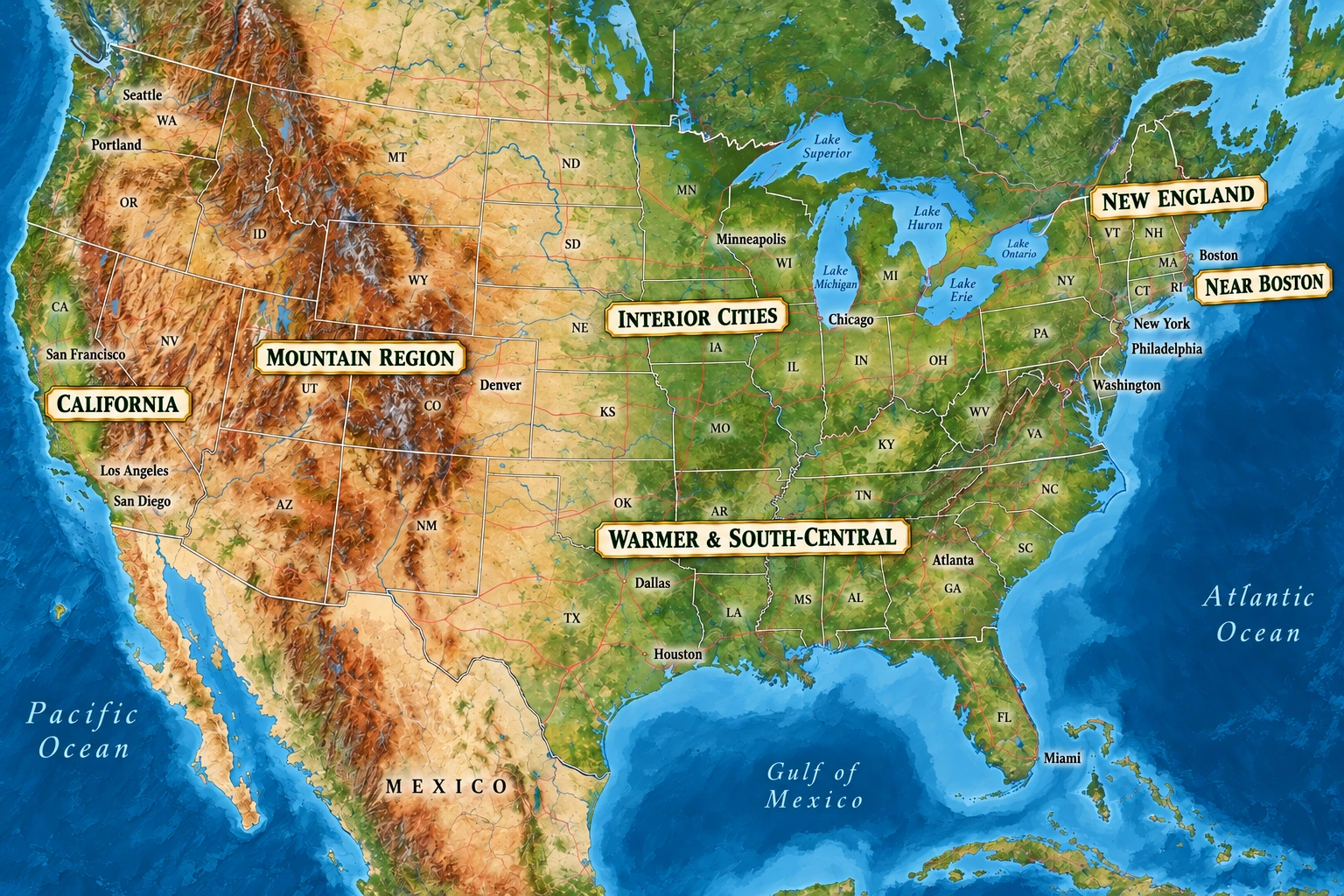
Geographic reference
Another New England center
Burlington, Providence and New Haven offer a smaller lake city, a new creative working base and a funded learning chapter. Keep the different purposes visible beside the familiar regional setting.
Burlington, Providence and New Haven
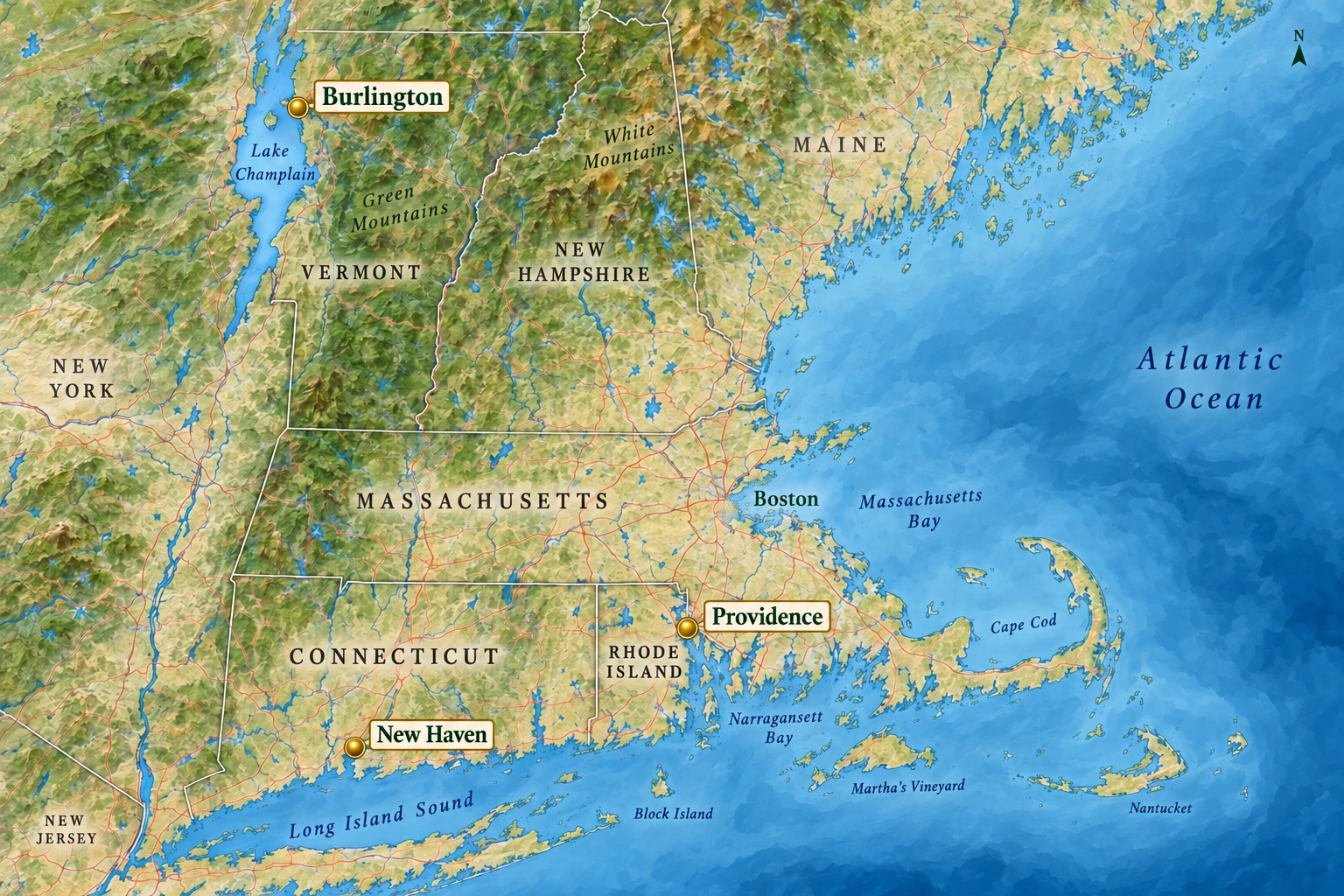
Geographic reference
Burlington: a smaller city with a lake in the working year

Burlington, Vermont, may appeal when you want the scale of daily life to change as much as the address. Consider a pair of teachers approaching a gradual reduction in work. They want time for birdwatching, adult learning and ordinary walks, with a smaller home to maintain. Lake Champlain gives that wish a concrete setting. The important question is whether they can make a comfortable year around the lake, their continuing income and the services they actually need.
Begin with two attainable home areas and the journeys that would remain after work becomes less central. Green Mountain Transit provides local routes, a current map and trip-planning information. Try the grocery trip, the evening return from an activity and the connection to any continuing workplace separately. A small city can still leave a particular household driving frequently. Establish how each person would manage an independent day before assuming that a more compact setting removes the need for a second car.
The outdoor attraction deserves a full-year view. A lakeside morning in early autumn may be precisely what the couple wants more of, while winter asks different things of the home and their routine. Look at the entrance, the walk they would actually use and the heating terms of the particular property. A convenient indoor activity matters as well. They should be able to enjoy a week when the weather makes their favorite outdoor plan less inviting, without feeling that the reason for the move has disappeared.
Burlington city’s historical median gross-rent point estimate is $1,649 a month in the common ACS release, below Boston’s $2,147. That comparison describes occupied cash-rent housing, with the published margins of error, and says nothing about the price or availability of a suitable lower-maintenance home. Compare actual housing, transport, insurance and the chosen reduction in earnings. If one teacher stops work earlier, put that first-year income into the model instead of the later arrangement both hope to reach.
Burlington’s municipal waterfront information distinguishes Waterfront Park, beaches and the Community Boathouse and Perkins Pier settings. Choose the part that suits the outing you want, then travel there from a plausible home area. A lakeside pause with binoculars can be an ordinary pleasure without requiring every day to be a long excursion. Compare that comfortable repeatable outing with the winter routine and the indoor activities you would also enjoy.
The couple’s strongest next step is a stay shaped around their future weekday, including an ordinary appointment and one recurring interest. Their lake walk should be easy enough to repeat, and their social life should have a beginning beyond the visitor itinerary. Burlington can remain a meaningful choice even if the financial gain is modest. The gain then needs to be the life they would use: less upkeep, a workable independent routine and a setting that continues to matter outside the most attractive season.
Try first: Try a plausible home area in the less comfortable season and compare the month after the first actual reduction in work.
Local sources: Burlington city, Vermont Census historical gross rent · Schedules | Green Mountain Transit, VT · Waterfront | Burlington, VT.
Providence: give a small creative practice a local beginning

Providence can enter a Boston search through the work you want to keep doing differently. Imagine a textile conservator who wants to reduce institutional hours and develop a small teaching practice, while their partner works in building maintenance. They like an active urban setting, older buildings and the possibility of making local connections through practical work. Their aim is a more balanced working week, with a home and workspace they can afford during a cautious beginning.
Separate the conservator’s confirmed income from the hoped-for practice. A class idea is valuable, but it becomes household income only when there are real terms, a suitable space and dependable participation. Establish what the property and relevant authorities allow for the particular activity, then price any separate work area, insurance and materials. The maintenance worker’s location and hours belong in the same calculation. A move that helps the new venture while making the other person’s work much harder needs a different address or timing.
RIPTA’s route information is a useful place to investigate local bus journeys. Choose the home area in relation to the actual work and teaching locations, and check the hours that apply. If the conservator retains occasional Boston commitments, treat those as an additional journey with its own time and cost. Being within a wider New England region does not make an intercity trip interchangeable with a local errand, especially when equipment must travel too.
Providence city’s 2020–2024 median gross-rent point estimate is $1,408 a month, compared with Boston’s $2,147. The full table gives the geographic scope and uncertainty. That historical difference can justify looking carefully for a viable arrangement; it cannot fund the practice by itself. Use actual housing and work-space terms, a conservative first-year income and a reserve that can carry the planned development period. Keep any refundable deposits separate from final spending.
AS220’s Community Studios at 131 Washington Street give the creative-life question a real starting point. Its adult studios include printmaking, fabrication, media and apparel work, with access and training terms to investigate for the particular activity. The conservator might find a personal project or an evening interest there, separately from the imagined teaching appointment. Check the current process and availability before building a regular week around it; a public resource is not a promised job or reserved work space.
Try the place as a participant as well as a home seeker. Attend an appropriate public class, event or meeting that you would enjoy repeating, and observe whether the journey fits after work. Speak with the owner of a real potential space about its practical terms. Providence earns a place on the shortlist if it supports both working lives and a plausible local beginning. Its attraction should remain worthwhile even if the new teaching practice takes longer than hoped to become dependable.
Try first: Price the home and permitted work space together, then test one recurring local activity and both adults’ work journeys.
Local sources: Providence city, Rhode Island Census historical gross rent · RIPTA 2026 system map · AS220: AS220 Community Studios: Community Makerspace in Providence, Rhode Island.
New Haven: make a funded learning year into an ordinary home

New Haven could suit a household with a specific educational or cultural reason to move. Picture a sound editor beginning a funded specialist program while their partner continues a confirmed job with agreed remote terms. The change is exciting because it could deepen a skill and create a different professional circle. It also asks the household to turn an academic or training calendar into a workable year of housing, work, rest and visits to Boston.
Start with the actual funding letter and calendar. Which payments are dependable, which charges remain yours, and what happens during a break or after the program ends? Put those answers beside the partner’s written work arrangements. If the partner needs calls at particular hours, a shared studio apartment may create a conflict that a lower advertised rent conceals. The student’s quiet practice or editing needs may require a separate room or an approved facility. Compare the usable arrangement rather than bedroom count alone.
CTtransit’s current routes and schedules provide a basis for checking New Haven bus journeys. Give the relevant campus or training site, partner’s occasional workplace, grocery trip and late return their own locations. A city-center visit can make everything appear close together while the affordable home area creates a different daily pattern. Walk the last leg and check service at the hour the program actually finishes. If the household keeps a car, include its continuing cost rather than assuming a central location makes it disappear.
New Haven city’s historical median gross-rent point estimate is $1,488 a month in the same ACS comparison as Boston’s $2,147. That background covers occupied cash-rent homes across the exact Census city, not a current furnished tenancy near a particular institution. Compare actual lease dates with the funded period. Overlapping housing, a shorter first term or a summer gap can matter more to the first-year cash requirement than the difference between two historical medians.
Creative Arts Workshop in the Audubon Arts District offers a separate local possibility for the partner: visual-arts programs, exhibitions and disciplines including book arts, fiber arts and printmaking. This is a starting point for a chosen personal interest, not the funded sound program in the example. Look at the current calendar and participation terms, then try the trip from home. The year becomes more balanced when the partner has an activity they would choose even without the other person’s course.
Give the partner an independent reason to enjoy the year too: a local activity, a comfortable working space and people they can see without waiting for the student’s free evening. Then consider the next decision after the program. A review point before the lease renews can keep a temporary learning chapter flexible. New Haven becomes a strong candidate when the funded purpose and the shared daily life fit together, with enough room to choose the following chapter when more is known.
Try first: Put the funding and lease calendars side by side, then try the late program return and the partner’s actual working day.
Local sources: New Haven city, Connecticut Census historical gross rent · Routes and Schedules | CTtransit · Creative Arts Workshop, Audubon Arts District.
A warmer or south-central chapter
Fort Worth begins with a particular appointment, Tulsa with space for a practical interest, and Tampa with a different outdoor year. These places change the routine in different ways; they are not interchangeable lower-cost answers.
Fort Worth, Tulsa and Tampa

Geographic reference
Fort Worth: put a confirmed opportunity beside the other person’s chapter

Fort Worth may be worth considering for a real appointment or a family connection that gives the move a beginning. Imagine a stage production electrician offered a specific role, with a partner who wants to continue teaching textiles part time. The electrician’s opportunity could improve the household’s prospects, but it should not become the only life described by the move. The partner needs workable teaching arrangements, a place for preparation and a way to form local connections.
Locate the confirmed workplace before choosing a broad area. Fort Worth is part of a much larger urban region; a job described casually as being in the area may imply a very different journey from the home you first like. Trinity Metro’s current information helps you investigate the services that apply. Check the actual shift and return, any tools that must travel and the last leg to the home. If one or both adults will drive, price the vehicles, insurance, parking and maintenance they will actually keep.
The textile teacher’s first-year income should follow real commitments rather than a general belief that a larger market will supply work. Compare confirmed sessions, the cost of suitable space and a funded search period. The home may still be attractive if it offers a comfortable room for preparation and a better recurring month. Give that gain its own terms: quiet, usable storage, permission for the intended activity and enough time after the two journeys to enjoy being there.
Fort Worth city’s 2020–2024 median gross-rent point estimate is $1,509, below Boston’s $2,147 in the common release. That historical city comparison is a starting perspective, with margins of error retained. It does not establish the cost of the neighborhood, home size or transport pattern this couple needs. Set current quotations beside dependable take-home pay and the extra travel to people they want to keep seeing in Massachusetts.
A performance at Amphibian Stage on South Main Street can give the couple a specific evening to explore together. Pick something from its current program and compare the journey from a likely home area with the electrician’s actual working timetable. The theatre is an example of a local cultural occasion, not the employer in this imagined household. The textile teacher should also choose an independent daytime activity so that the move offers more than evenings arranged around someone else’s shift.
Try a normal workday in the season that most changes your routine. The appeal of a shaded porch or an evening outside can be real, while the heat and the specific building determine when those pleasures are comfortable. The couple should also try a day when the electrician is working and the partner is free. Fort Worth stays on the shortlist if both can describe a worthwhile ordinary week and the appointment is supported by a household arrangement they can fund.
Try first: Use the real appointment location and hours to compare two home areas, with a separate first-year plan for the partner’s work.
Local sources: Fort Worth city, Texas Census historical gross rent · Home - Trinity Metro - Tarrant County public transit service. · Amphibian Stage, South Main Street.
Tulsa: make space for a practical interest without relying on hoped-for income

Tulsa may appeal to a Boston household that wants a more spacious home routine and a practical interest with room to grow. Consider a cabinetmaker who would like to reduce employed hours and spend more time restoring small furniture, while their partner keeps a dependable administrative role. They want a garden, a modest workshop and time for friends. The attraction is a different use of the week, with the new activity allowed to develop at a realistic pace.
Begin by distinguishing a hobby space from a working business. A garage or shed may look ideal in a listing while its access, power, ventilation, noise conditions or property terms make the planned activity unsuitable. Establish the actual use with the owner and relevant authority. If a separate permitted workshop is necessary, compare that full arrangement with the Boston option. Extra area only adds value when the household can use it comfortably for the purpose that prompted the search.
The partner’s work is the dependable beginning of this example. Confirm its location, hours and terms before counting it in the destination month. The cabinetmaker can model a cautious first year using committed employed hours, with restoration income treated separately until it becomes reliable. MetroLink Tulsa’s route and trip information helps investigate relevant bus options. If the real pattern requires driving, include it directly instead of interpreting a lower housing payment as a complete cost-of-living result.
Tulsa city’s historical median gross-rent point estimate is $1,052 a month, compared with Boston’s $2,147 in the same 2020–2024 release. That substantial difference in occupied-home estimates is a reason to investigate, while the exact home and workshop still need current terms. Include property upkeep, tools or supplies, utilities, insurance and the visits the household wants to make. A new garden can bring pleasure and a new maintenance task; decide how much of that task you actually want.
River Parks’ maps distinguish the paved riverside trail system from Turkey Mountain’s separate trails. The couple can choose a modest paved stretch along the Arkansas River for a first ordinary outing, then check the trip from the home they are considering. That gives the partner a pleasure outside the workshop-and-garden project. It also keeps a walk after work and a more demanding outdoor day as different choices rather than assuming every trail serves the same purpose.
On a visit, spend time around two plausible home areas during an ordinary afternoon, then test the journeys needed by each adult. Ask what the cabinetmaker would do on a day when the workshop project is waiting on a part, and how the partner would enjoy an evening independently. Tulsa becomes a stronger candidate when the wider home routine offers something to both people. A change in scale should create a fuller life rather than making one person’s absorbing project the household’s entire social plan.
Try first: Compare the complete permitted home-and-workshop arrangement using only dependable first-year earnings, then try both adults’ independent day.
Local sources: Tulsa city, Oklahoma Census historical gross rent · Home | MetroLink Tulsa · River Parks: trail maps.
Tampa: change the outdoor year, with a home that handles it

Tampa may appeal when you want more of your ordinary year to happen outside. Imagine a retired school administrator and a partner who still does part-time bookkeeping. They like the thought of morning walks, gardening in a different climate and seeing relatives who already live in the region. Their wish has a practical shape: a comfortable smaller home, a useful local circle and an outdoor routine that does not wait for a brief Boston summer.
Give the warm-weather day its own timetable. Where would they walk in the morning, find shade later and spend time when staying outside is less comfortable? The NOAA comparison in this guide puts Tampa International Airport’s historical monthly mean at 62.0°F in January and 83.8°F in July. Those averages combine days and nights; they do not describe a particular afternoon. The home’s cooling, shaded access and indoor space matter because they determine how much of the appealing year the couple can enjoy comfortably.
Choose the home from the actual recurring journeys. HART’s current maps and schedules can help investigate relevant local bus routes. Relatives living elsewhere in the region may still require a separate driving journey. Ask how often the couple wants to see them, who travels and what happens when one person would prefer not to drive. A family connection is a real benefit when the pattern is welcome on both sides; it becomes fragile when it silently assumes someone is always available.
Tampa city’s 2020–2024 median gross-rent point estimate is $1,701, below Boston’s $2,147. Use that historical background alongside actual housing, cooling, insurance and transport terms. Investigate flood and storm information for the particular property and the arrangements you would follow, rather than treating an attractive waterside area as one uniform condition. Keep the cash for setup and an unexpected change of plan outside the recurring monthly comparison.
Tampa’s Bayshore Trail is a waterfront sidewalk running from the Platt Street area toward Gandy Boulevard; the city distinguishes it from the on-road bicycle lane. Choose a manageable stretch for an ordinary morning and test the journey from the possible home. The shore is a concrete pleasure to compare, while shade, indoor activities and the warmer part of the day still need their own place in this retired administrator’s routine.
The most useful visit would include the home at the warmest relevant part of the day, an ordinary errand and an evening on which the relatives have other plans. The couple should be able to enjoy that independent evening too. Tampa stays on the shortlist if it offers the outdoor life and relationships they want, with a home and household month that support them through the full year.
Try first: Try the shaded and indoor parts of a normal day, then compare actual cooling, insurance and transport costs for the chosen property.
Local sources: Tampa city, Florida Census historical gross rent · HART: maps and schedules · Bayshore Linear Park Trail - Bayshore Greenway | City of Tampa.
Interior cities with different scales of life
Kansas City, Missouri, opens a creative local circle; Indianapolis gives a family afternoon its own question; Rapid City changes the scale around work and the Black Hills. Compare the ordinary home area as carefully as the attraction.
Kansas City, Indianapolis and Rapid City

Geographic reference
Kansas City, Missouri: make a new creative circle part of the week

Kansas City, Missouri, could interest a Boston resident who wants a broader home routine around a creative practice. Consider a printmaker who has a dependable job in exhibition preparation and wants an affordable place to live near a suitable shared studio. They are moving alone, with enough enthusiasm for the work but a clear wish to avoid spending every evening at home. The next place needs to support the practice and a social beginning.
The city named here is on the Missouri side of the state line. A job or studio elsewhere in the metropolitan area may change the home search, so put its actual location on the comparison before choosing a neighborhood. RideKC provides current route information, including the services that apply to different corridors. A streetcar or bus route can be useful for a particular journey while leaving another trip difficult. Test the evening return with the materials the printmaker would normally carry.
Look for the part of the week that could become familiar. A repeated studio session, a neighborhood food shop and a regular meeting with other practitioners can make the new place feel lived in. The best first contact is an activity the printmaker would enjoy even without making a useful professional connection. Ask about actual access, fees, storage and working hours at the shared space. Its social promise matters only if the person can attend comfortably after their paid work.
The historical median gross-rent point estimate for Kansas City city, Missouri, is $1,238 a month in the common ACS release. It gives a different housing background from Boston, while the real studio fee, transport and dependable job terms decide the usable month. Include trips to the people the printmaker wants to keep seeing in Massachusetts. Moving alone can make flexibility easier, but it also leaves the person funding and organizing every part of the beginning themselves.
The Crossroads Arts District’s First Friday brings galleries, studios and local arts activity into a specific recurring evening. The printmaker could visit for the work on show, then choose a quieter follow-up occasion or activity they would enjoy after the working day. Use the current event listings for the date and venues. A public art evening can help them begin exploring a circle; it does not establish a studio tenancy, paid commission or ready-made group of friends.
Try one likely home area and one real studio session on the same visit. Walk the route after the session ends and notice whether the ordinary food, exercise and social arrangements feel repeatable. Kansas City belongs on the shortlist if it provides a richer week around the work, with a funded home and room to build relationships at a human pace. A lower payment is helpful; the lasting gain is the routine it makes possible.
Try first: Compare the actual Missouri-side home, paid workplace and studio corridor, then attend a session you would choose to repeat.
Local sources: Kansas City city, Missouri Census historical gross rent · Routes In Service | RideKC | Kansas City Area Transportation Authority · First Friday in the Crossroads.
Indianapolis: give a family’s afternoons more room

Indianapolis may suit a household whose next chapter is about family time rather than a dramatic career leap. Imagine an instrument repairer and a school employee with a teenager who has become interested in drawing and design. They want a home where work materials can be kept sensibly, the teenager can have friends over and the adults can share more of the afternoon. The move would earn its disruption by improving an ordinary week for all three people.
Begin with the two real work locations and the teenager’s likely school arrangement. Confirm the school assignment and any program access with the responsible district for the actual address. A city’s broad reputation cannot answer those questions. IndyGo’s route information gives a basis for investigating relevant bus journeys, including current rapid-service corridors. Check the complete trips and the hours involved. If a car is part of the plan, decide who has it when the teenager’s activity and an adult’s work end at different times.
The instrument repairer needs a suitable work arrangement as well as a room. Some tasks may belong in an employer’s workshop or separately permitted space, with storage and insurance that do not fit a domestic corner. The teenager’s interest also deserves somewhere specific to develop: an available class, a school opportunity or an activity that can be reached without a daily rescue by a parent. Ask about current enrollment terms before relying on it in the family plan.
Indianapolis city (balance), the exact Census geography used here, has a 2020–2024 median gross-rent point estimate of $1,156. The table keeps that scope visible rather than calling it an entire metropolitan price. Compare actual housing with the two earnings, transport, insurance and any care or activity payments. A less expensive home can give the family more margin, provided a much larger travel requirement does not use the time and money they hoped to gain.
The downtown Canal Walk gives the young person a real afternoon to help plan: a waterside promenade extending from White River State Park toward 11th Street. Choose a short section, work out the journey from a possible home and let the teenager decide what would make the outing enjoyable. Keep that experiment separate from the eventual school and after-school arrangements. A good visit can show a shared pleasure without proving that every part of the school week is settled.
The teenager should help choose one question for the visit. It might be the route to an activity, the feel of a public space or whether the home offers enough independence. Try a regular afternoon and a day when an adult is delayed. Indianapolis remains attractive if the family can describe more shared time and a workable independent routine, with the practical details settled enough that the teenager’s new life is more than an adult promise.
Try first: Rehearse the school-day handoff and one teenager-chosen activity from the same realistic home area.
Local sources: Indianapolis city (balance), Indiana Census historical gross rent · Routes - IndyGo · Canal Walk | Visit Indy.
Rapid City: a smaller base near the Black Hills

Rapid City can represent a deliberate change in scale. Consider a couple leaving a demanding period of hospitality work, with one accepting a confirmed local facilities role and the other planning a funded break before returning to work. They want quieter evenings, space for small woodworking projects and more regular access to the Black Hills. The attractive image is a usable home and an outdoor year with a smaller city around it.
The confirmed role should carry the first version of the household month. Establish its location, hours and benefits, then set a clear allowance for the partner’s planned break. A hoped-for second job should not be used to make the starting budget work. Think about what the partner would do during an ordinary week without that job: a class, a recurring volunteer commitment or a practical project that provides structure without being required to produce immediate income.
The Black Hills are a real setting to the west of Rapid City, but living nearby does not make every outing easy from every address. Choose the actual access point, travel time and activity you expect to repeat. Investigate the less comfortable season and the home’s ordinary heating and upkeep requirements. If the new property has a workshop or outbuilding, establish that its condition and permitted use support the intended activity. A building that needs substantial work may recreate the pressure the couple wanted to leave.
Rapid Transit System information is a starting place for relevant local service. Test the specific trips and establish what driving the household will keep. Rapid City city’s historical median gross-rent point estimate is $1,109 a month in the common ACS release; that does not price the home with work space the couple imagines. Include vehicle costs, the reduced first-year income and visits to their Boston circle before deciding how much margin the change produces.
The Dahl Arts Center downtown gives the partner a local cultural starting point alongside the Black Hills idea. Its current calendar includes exhibitions, performances and adult art activities. Pick an event or class for its actual subject and terms, then compare the trip from the possible home. That is a more useful test of the funded break than assuming that every free day will be spent on a major outdoor excursion.
On a visit, spend a normal day in the home area before making the outdoor excursion. The couple should enjoy the town routine on a day when they do not go into the hills. If that day feels comfortable and the job, home and first-year funding are real, Rapid City may offer the change of pace they want. If the whole attraction depends on being away from town every free day, compare another base or a different scale of move.
Try first: Price the one-income beginning, try the ordinary home-area day and make one realistic Black Hills outing from it.
Local sources: Rapid City city, South Dakota Census historical gross rent · Rapid City Rapid Transit System · Dahl Arts Center: current programs.
Mountain-region bases for an actual working week
Salt Lake City, Albuquerque and Denver put different valley, high-desert and Front Range routines on the map. Choose the activity and access you would use, with a comfortable home and funded working life beside it.
Salt Lake City, Albuquerque and Denver

Geographic reference
Salt Lake City: bring the mountain idea down to a usable weekday

Salt Lake City may enter the search when you want an outdoor interest to become more regular without giving up an urban base. Imagine a materials-testing technician with a specific job offer and a partner who runs a small, already established editing practice. They want early walks, room to work separately and a place where an evening can feel different from their current Boston routine. The mountain setting is part of the purpose, with the two working lives providing its foundation.
Put the actual workplace and the editor’s practical requirements beside each potential home. UTA publishes TRAX, FrontRunner and bus schedules and maps. Those are useful tools for comparing the routes that apply, not evidence that every valley address works without a car. A shift that starts early, a connection between services or the walk from the final stop can decide the experience. The editor needs a quiet room, suitable internet terms and an independent errand routine rather than simply the ability to stay home.
The Wasatch lie east of the city, but the household’s recurring outdoor activity needs a particular access point and realistic timing. Try the weekday outing you could do after the actual shift, including the return. A favorite trail reached only on a long weekend may still be a pleasure, while a modest local walk could contribute more to ordinary life. Consider both without asking the dramatic landscape to solve every reason for dissatisfaction with the present home.
The common ACS rent point estimate for Salt Lake City city is $1,414 a month. Actual housing and transport terms determine whether this couple gains room in its month. The NOAA station comparison also shows a distinct seasonal pattern: Salt Lake City International’s January monthly mean is 31.4°F and July’s is 81.1°F for 1991–2020. These historical means combine days and nights. Check current air-quality information, the building and the household’s own health needs when planning the periods they expect to spend outside.
The mountain setting also has a winter air-quality question. Utah’s Division of Air Quality explains how cold air can become trapped beneath warmer air during inversions, allowing pollutants to build up near the valley floor. Compare the current AQI and official guidance for the days you would be outdoors, with an indoor alternative you enjoy. A clear photograph or a pleasant summer visit cannot establish the air conditions of the household’s ordinary winter.
A useful visit includes the work journey, the editor’s ordinary day and a less comfortable outdoor period. Each person should have a way to enjoy the place independently. Salt Lake City stays on the shortlist if the confirmed opportunity and the home arrangement leave enough time and money to use the landscape. The setting then becomes part of a funded life, with the practical compromises understood before the lease or purchase.
Try first: Compare one home near a useful UTA corridor with another arrangement, and rehearse the outdoor outing after the real shift.
Local sources: Salt Lake City city, Utah Census historical gross rent · Schedules and Maps · Utah DEQ: inversions.
Albuquerque: make a quieter practical life in a different landscape

Albuquerque could appeal to a Boston household looking for more room around a practical interest and a different outdoor rhythm. Imagine a retired laboratory manager and a partner who continues part-time technical writing. They want a modest home, space for seed starting and painting, and mornings that invite them outside. The high-desert setting offers a real change in landscape, while the home and daily arrangements decide whether that change feels comfortable.
Begin with the ordinary year rather than a festival visit. Think about the mornings, the hotter part of the day, the cooler season and the activities you would use in each. A shaded courtyard may be valuable if it is comfortable at the hours you are free. A garden plan needs to suit the particular site and water conditions. The painting interest needs usable light and storage rather than a larger unused room. Those details help distinguish a home that supports the wish from an attractive photograph of a different climate.
ABQ RIDE’s published routes and schedules provide a way to investigate relevant local journeys. Set the actual grocery trip, medical appointment and any continuing work location beside the home. Decide what happens when the technical writer is occupied and the retired partner wants to go out independently. The Sandia Mountains sit east of the city; their visual presence and the journey to a particular outing are different benefits. Give each its appropriate place in the comparison.
Albuquerque city’s 2020–2024 median gross-rent point estimate is $1,145 a month, compared with Boston’s $2,147. The full comparison retains uncertainty and the common historical basis. Use actual housing, heating and cooling, transport and insurance terms for the household calculation. If moving releases money from a previous home, separate that capital decision from the continuing monthly income. The same savings should not be counted both as a transition fund and as a reserve kept available afterward.
Albuquerque’s Sandia Foothills Open Space has named access points, including Menaul and Embudo Canyon, with picnic areas and connections into the trail system. Select a modest outing from the city’s current map and access information, then travel there from a plausible home. The foothills include steep slopes and gravelly drainages; a nearby mountain view does not mean the route suits everyone. A comfortable, repeatable visit gives the retired lab manager a more useful comparison than the largest possible expedition.
Try a day that includes an ordinary appointment, a local interest and time at the prospective home during the less comfortable part of the afternoon. The couple should be able to enjoy the landscape without organizing every day around a drive into it. Albuquerque becomes a stronger option if its ordinary routine is satisfying, the property supports the intended interests and both people can describe a comfortable independent day as well as the life they share.
Try first: Test the particular home’s shade and ordinary journeys, then cost the full year on dependable retirement and part-time income.
Local sources: Albuquerque city, New Mexico Census historical gross rent · Routes & Schedules — City of Albuquerque · Sandia Foothills Open Space — City of Albuquerque.
Denver: compare the real work network and the time left for the mountains

Denver can appeal when a household wants a larger regional work base with a different landscape nearby. Consider a building-services engineer considering a specific offer and a partner returning to paid work after a period of family care. They enjoy walking and want more occasions to be outside together. The move could create a professional opening and a new shared interest, provided the second person’s return to work has a funded and realistic beginning.
Locate the confirmed role precisely. A job described as Denver may be in a different part of the region from the home that first attracts you. RTD’s current route and service information helps investigate relevant rail and bus journeys. Check the shift, transfers, final walk and occasional late return. If a vehicle remains necessary, include it directly. The household should compare the time left after both working days, not only the journey that serves the person with the offer.
Give the returning worker’s chapter its own plan. Which skills or credentials are current, what work is actually being sought and how long can the household support the search? If family care continues from a distance, include the visits and practical arrangements rather than assuming relocation ends the responsibility. A smaller first-year surplus may be acceptable when the opportunity is strong and the reserve can carry it. Make that choice visible before relying on a second salary.
The Front Range lies west of Denver, but a mountain outing has a separate journey and timetable. Try the modest activity you could repeat during a normal working week, then consider the longer trip you would make less often. Denver city’s historical median gross-rent point estimate is $1,831 a month in the common ACS release. That background is below Boston’s point estimate, while the real home, commuting pattern and first-year earnings may produce a very different household result.
Denver Public Library’s ideaLAB makerspaces give the partner returning to work a separate place to investigate for a personal project. Equipment varies by location, so begin with the project and the current lab information rather than assuming every branch has the same tools. Try the journey and access process before treating it as a weekly commitment. The resource can support an interest and local contact; it is not a promised qualification, job placement or replacement for the household’s income plan.
Spend the visit around two plausible home areas and include a day when the engineer is at work. The partner needs an independent routine and a way to build a local circle during the search. Denver stays attractive if the professional opening is supported by a workable home and enough free time to use the setting. If the mountain idea is the only appealing part of an otherwise tiring week, compare a different address or another destination before committing.
Try first: Rehearse both adults’ likely weekday, using only the confirmed salary at first, and add one realistic outdoor outing.
Local sources: Denver city, Colorado Census historical gross rent · Routes and Services | RTD-Denver · ideaLAB | Denver Public Library.
Three California routines
Los Angeles follows a specific creative opportunity, Sacramento explores a smaller home with a generous neighborhood life, and San Diego asks what a milder outdoor routine is worth. Their housing, travel and work arrangements deserve separate comparisons.
Los Angeles, Sacramento and San Diego
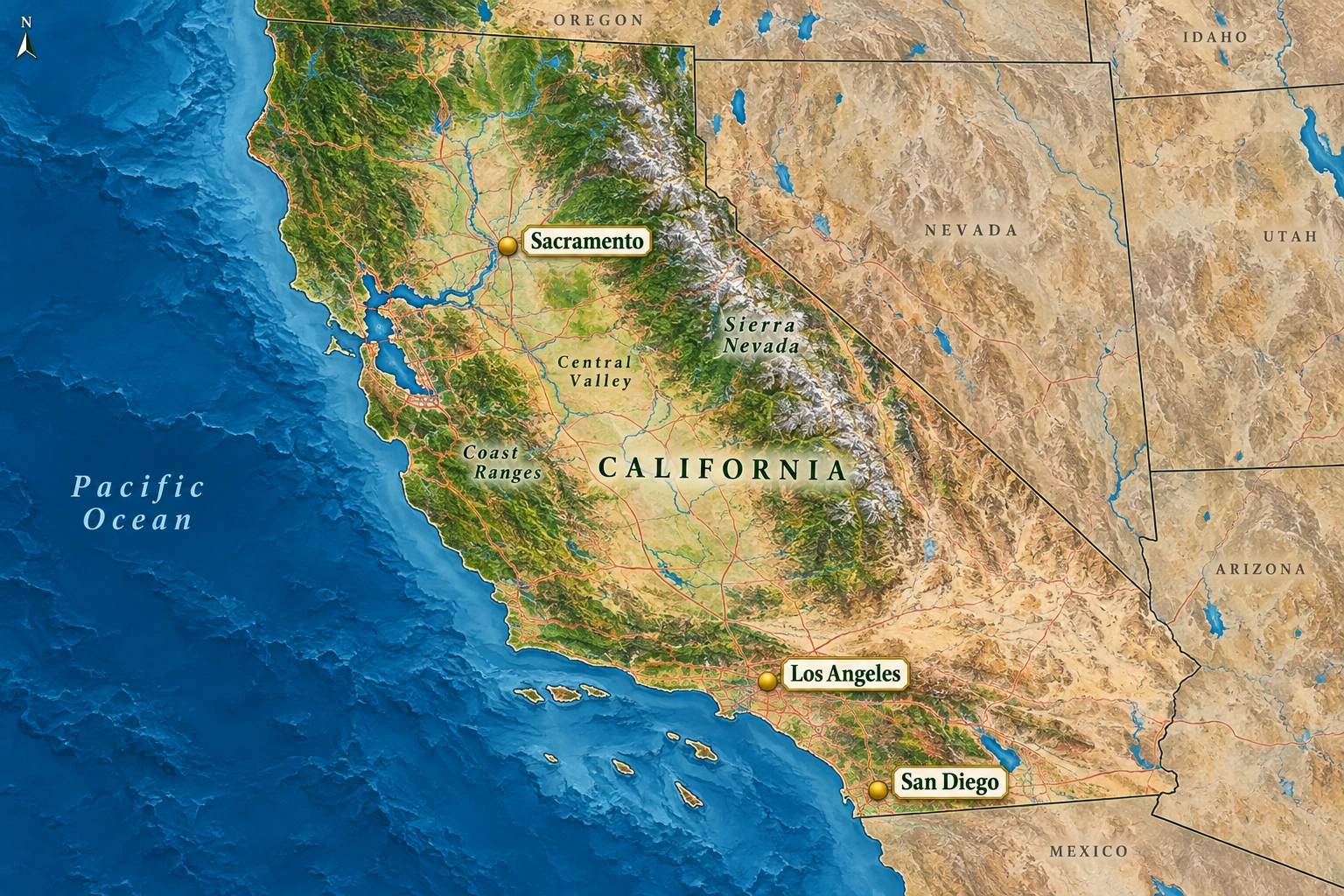
Geographic reference
Los Angeles: follow a specific creative opportunity into a neighborhood life

Los Angeles may be a serious choice when your work or personal purpose belongs to a particular network there. Imagine a costume pattern cutter with a confirmed project and a partner who teaches online under agreed arrangements. The cutter wants to develop their practice; the teacher wants a home that supports calls and a life beyond the screen. Their next chapter needs a neighborhood and two working days, rather than a broad promise about living in a creative city.
Start with the project’s actual terms, location and expected duration. A short confirmed engagement and a continuing salary support different housing decisions. Model the period after the project as well as the first paycheck, with a reserve and a review point. The teacher’s employer or clients must agree to the real location and working arrangement; an online role does not remove those obligations. Quiet, cooling, internet and the overlap between work hours belong in the home comparison.
Metro’s current maps and schedules show the rail, busway and bus services to investigate. Los Angeles covers many different daily geographies. A route useful to one work site may not serve another assignment or the place the partner wants to go. Test the actual work journey with the materials that travel, and decide whether the household keeps one or two vehicles. Neighborhood choice can change the ordinary week more than a citywide label such as convenient or walkable.
The city’s 2020–2024 median gross-rent point estimate is $1,933 a month, below Boston’s $2,147 in the common historical release. That figure describes occupied cash-rent housing across Los Angeles city, not a current tenancy near this project or a comfortable two-workspace home. Compare actual rent, transport, insurance, work-space costs and any income gap. A favorable historical point estimate cannot turn a short project into a funded long-term arrangement.
For an independent practical interest, the online teacher could investigate the Central Library’s Octavia Lab. Its own FAQ describes self-directed equipment use for eligible members and occasional demonstrations; it does not offer classes or one-to-one instruction. Check the membership, reservation and materials terms for the actual project. This keeps a possible personal activity distinct from the costume cutter’s paid work space and gives the partner a question of their own to pursue during the comparison visit.
Try an evening the couple would have after an ordinary working day. Can the pattern cutter meet a colleague without making the partner’s only option another evening alone at home? Is there a local class, walk or repeated activity for the teacher? Los Angeles belongs on their shortlist when the specific opportunity and neighborhood life reinforce one another. A flexible first housing choice may help them learn the real working geography before making a more durable commitment.
Try first: Compare a flexible first home with the confirmed project’s calendar and location, then try both adults’ ordinary evening.
Local sources: Los Angeles city, California Census historical gross rent · Line Schedules and Maps - LA Metro · Octavia Lab - FAQ | Los Angeles Public Library.
Sacramento: let a smaller home keep a generous daily life

Sacramento may interest a Boston household that wants to reduce the work of maintaining a larger home while keeping a full local life. Imagine a retired civil engineer and a partner who still teaches a few adult classes. They would like a manageable home, a small garden and an ordinary neighborhood where they can see people regularly. Their aim is to spend less time caring for unused rooms and more time using the place around them.
Begin with what should survive the smaller floor plan. The teacher needs preparation space and storage for a limited set of materials. The retired partner wants a comfortable reading area and somewhere to grow a few things without recreating the maintenance burden of the former property. Measure those activities against actual rooms, entrances and outdoor areas. A smaller home is successful when it removes unwanted tasks while keeping the activities that make the day enjoyable.
SacRT publishes bus and light-rail system maps. Use the actual teaching location, food shop and regular appointments to investigate the relevant journeys. A leafy street and a central address do not establish that every outing is easy without driving. Compare one person’s independent day with the shared day, including the return from an evening class. If the household can reduce driving, confirm the practical arrangement before removing a vehicle cost from the budget.
Sacramento city’s historical median gross-rent point estimate is $1,779 a month in the common ACS comparison. The current payment for a suitable home, any ownership or association costs, transport, cooling and visits to Boston belong in the actual calculation. Try the home and nearby walking route during the warmer part of the year. Shade and indoor comfort matter because a garden or tree-lined block may be most enjoyable at different hours from those the couple first imagines.
The county’s American River Parkway resources distinguish places such as Discovery Park and River Bend Park from the Jedediah Smith Memorial Trail. Choose a particular park or trail entrance for the couple’s ordinary outing, then test the journey and check current access notices. The river landscape can be part of their new week without assuming that every prospective home sits beside it or that one summer visit represents the whole year.
The visit should include an ordinary shopping trip, one activity they could repeat and a day without a special excursion. If that day feels generous enough, the move may serve its purpose even when the new home is quite modest. Sacramento remains a good candidate when less property work leads to more useful time and both people keep an independent routine. The right smaller home can feel like an expansion of the life around it.
Try first: Fit the activities you want to keep into two actual smaller homes, then try the teaching return and warm-season neighborhood day.
Local sources: Sacramento city, California Census historical gross rent · SacRT system maps · American River Parkway.
San Diego: decide what a milder outdoor routine is worth to you

San Diego may appeal when a more consistent outdoor routine is a central reason to move. Imagine a recently retired couple, one keen to paint outside and the other wanting regular walks and a smaller home. They are comfortable with a modest amount of space if the surrounding day is rewarding. Their question is how much of their dependable income they are willing to devote to a location that supports those pleasures.
Begin with the actual activity rather than the word coastal. Where would the painter sit, how would materials travel and at what hour would the walkers leave home? A glimpse of water from a visit is different from a route they can use several times a week. San Diego’s neighborhoods have different terrain and connections. MTS’s Trolley and bus information helps investigate relevant journeys, while the final walk, slope and return with supplies still need a practical check.
The housing comparison deserves particular care. San Diego city’s 2020–2024 median gross-rent point estimate is $2,313 a month, above Boston’s $2,147 in the common release. Neither figure prices the home this couple needs, but the comparison gives no basis for assuming an automatic housing saving. Use actual home, insurance, transport and continuing care terms. A higher payment may be an accepted choice if the dependable month and reserve support it and the recurring outdoor gain is worth the difference.
The NOAA station comparison puts San Diego’s 1991–2020 monthly mean at 58.4°F in January and 70.7°F in July. These airport means combine day and night and do not describe every neighborhood or individual day. Try the precise area in the conditions that would most affect your intended routine. The property’s access, shade and indoor comfort remain important even when the broad seasonal pattern is attractive.
Balboa Park gives the painter a second outdoor setting to compare with the coast: gardens, shaded groves and paths among the cultural buildings. Choose a modest route and check current access and any venue terms rather than assuming the whole outing is interchangeable or free. Try it from the home area under consideration. The gain is time to paint in a place they enjoy repeatedly, with the housing payment and the journey still visible in the same decision.
Spend a normal day from a plausible home area, with a food shop, a painting session and the route back after the afternoon outing. The couple should also consider how family visits fit the year and the month. San Diego stays on their shortlist if they can comfortably afford the actual arrangement and use the outdoor life often enough to justify the commitment. The next chapter can be about a positive pleasure, with its cost chosen clearly rather than disguised as a saving.
Try first: Price the real smaller-home arrangement, then repeat the intended walk and painting outing from that area at ordinary hours.
Local sources: San Diego city, California Census historical gross rent · Trolley | San Diego Metropolitan Transit System · Balboa Park | City of San Diego Official Website.
See what the whole month leaves you
Begin with dependable take-home income minus every recurring essential. The home payment matters alongside transport, food, care, insurance, debt and the commitments you will keep. Use the same categories for the present arrangement and each candidate. The useful first result is the amount remaining after that month, followed by the home, time and support the arrangement would provide.
The four examples below show why a lower housing payment can produce different outcomes. The current illustrative Boston arrangement leaves $1,200 a month. A candidate with lower housing but less dependable pay leaves $850. A better-funded fit leaves $2,000, while lower housing combined with more paid support leaves $300. All figures are chosen household inputs, not observed prices or offers. They help you see the mechanism before you replace the inputs with your own terms.
Be specific about a change that creates a new expense. A teenager’s independent route may require a transport payment; an adult’s evening work may require paid support. A home-based practice may need separate permitted space or insurance. Visits to people in Boston remain a continuing commitment if you intend to make them. Include each expense in the arrangement that needs it, rather than quietly dropping it from the attractive candidate.
The transition uses a separate part of the budget. Moving, travel, temporary housing, setup, overlapping payments and an earnings gap may consume savings before the improved month begins. In the stronger main example, the recurring gain is $800: $2,000 rather than $1,200 left. A chosen $12,800 of unrecoverable transition spending takes sixteen continuing months to recover arithmetically. A refundable deposit still ties up cash, and the emergency reserve should remain available for its own purpose.
The six smaller household models show how the same method changes with circumstances. A course, an independent adult, a family with a teenager and a gradual retirement do not share the same expense pattern. Read the chosen inputs and change the categories or amounts that differ for you. A move can be worthwhile for reasons other than a larger surplus, but a smaller surplus needs a funded and accepted place in the decision.
The historical Census table gives context for where to investigate. It uses the same 2020–2024 five-year release for exact places and retains each published 90% margin of error. Gross rent describes occupied cash-rent homes and applicable utilities; annual household income describes existing households before tax. Neither is a current home quote, an offered salary or take-home pay. Use actual terms to choose the home, and keep close estimates from being mistaken for a meaningful personal saving.

Hypothetical inputs · USD per month · no city price or salary claim
| Monthly result | Current Boston arrangement | Lower housing, less dependable pay | A funded change with a better fit | Lower housing, more paid support |
|---|---|---|---|---|
| Money left each month | $1,200 | $850 | $2,000 | $300 |
| Take-home income | $7,800 | $6,800 | $8,200 | $7,600 |
| Recurring essentials | $6,600 | $5,950 | $6,200 | $7,300 |
Current Boston arrangement
$1,200Money left each month
- Take-home income
- $7,800
- Recurring essentials
- $6,600
Lower housing, less dependable pay
$850Money left each month
- Take-home income
- $6,800
- Recurring essentials
- $5,950
A funded change with a better fit
$2,000Money left each month
- Take-home income
- $8,200
- Recurring essentials
- $6,200
Lower housing, more paid support
$300Money left each month
- Take-home income
- $7,600
- Recurring essentials
- $7,300
The lower housing payment leaves $850 in the second example, compared with $1,200 now. The third leaves $2,000 after allowing for every chosen expense. Begin with that result, then decide whether the home, time and practical support around it serve the life you want.
See the hypothetical inputs
| Recurring expense | Current Boston arrangement | Lower housing, less dependable pay | A funded change with a better fit | Lower housing, more paid support |
|---|---|---|---|---|
| Housing and utilities | $2,850 | $2,100 | $2,400 | $2,250 |
| Transport | $550 | $850 | $450 | $1,250 |
| Food and household basics | $1,050 | $1,050 | $1,050 | $1,050 |
| Care and insurance | $900 | $900 | $950 | $1,700 |
| Other continuing essentials and Boston visits | $1,250 | $1,050 | $1,350 | $1,050 |
Current Boston arrangement
- Housing and utilities
- $2,850
- Transport
- $550
- Food and household basics
- $1,050
- Care and insurance
- $900
- Other continuing essentials and Boston visits
- $1,250
Lower housing, less dependable pay
- Housing and utilities
- $2,100
- Transport
- $850
- Food and household basics
- $1,050
- Care and insurance
- $900
- Other continuing essentials and Boston visits
- $1,050
A funded change with a better fit
- Housing and utilities
- $2,400
- Transport
- $450
- Food and household basics
- $1,050
- Care and insurance
- $950
- Other continuing essentials and Boston visits
- $1,350
Lower housing, more paid support
- Housing and utilities
- $2,250
- Transport
- $1,250
- Food and household basics
- $1,050
- Care and insurance
- $1,700
- Other continuing essentials and Boston visits
- $1,050
These invented household amounts illustrate a method. They are not observed Boston rents, destination quotes, employment offers or a forecast. Replace them with the actual terms and keep the same categories in every option.
An $800 monthly improvement would take sixteen continuing months to recover a chosen $12,800 of unrecoverable transition spending. Moving, travel, temporary housing and setup belong in that separate allowance. A refundable deposit still ties up cash, while an emergency reserve remains available for its own purpose. Do not count either as money already recovered.
- The continuing monthSubtract every recurring essential from dependable take-home income.
- The transitionSeparate final spending from refundable deposits and other cash tied up.
- The available reserveFund the unsettled beginning and return option without spending the same savings twice.
Hypothetical example · $800 more left per month · $12,800 transition spending
The model assumes the improvement continues each month. A delayed paycheck or extra expense changes the timing. Deposits and the reserve remain separate cash decisions.
Six household comparisons: which change resembles yours?
These invented examples keep the household circumstances visible beside the arithmetic. They describe no local price, offered salary or available care place. Replace the inputs, including the separate transition allowance, with the terms that apply to your own move.
Hypothetical household inputs · USD per month
The confirmed pay and home arrangement leave more while allowing a larger transport and visit budget. Add the real studio or activity payment if your own arrangement requires it.
Read the chosen inputs
Take-home income: $4,600 current; $5,000 compared. Recurring essentials: $3,800 current; $3,750 compared.
| Expense | Current month | Compared month |
|---|---|---|
| Housing and utilities | $1,850 | $1,600 |
| Transport | $250 | $350 |
| Food and household basics | $650 | $650 |
| Care and insurance | $400 | $450 |
| Other essentials and Boston visits | $650 | $700 |
Chosen unrecoverable transition spending: $8,100. A continuing $450 monthly improvement would recover the chosen $8,100 transition spending in 18 months arithmetically.
Hypothetical household inputs · USD per month
The learning chapter leaves slightly less despite higher dependable funding. It can still serve a valued purpose when course charges, breaks and the reserve are funded explicitly.
Read the chosen inputs
Take-home income: $3,300 current; $3,500 compared. Recurring essentials: $2,700 current; $2,910 compared.
| Expense | Current month | Compared month |
|---|---|---|
| Housing and utilities | $1,400 | $1,500 |
| Transport | $200 | $180 |
| Food and household basics | $500 | $500 |
| Care and insurance | $250 | $280 |
| Other essentials and Boston visits | $350 | $450 |
Chosen unrecoverable transition spending: $6,600. This arrangement does not produce a recurring improvement to recover the transition spending. It needs a valued purpose and a funded way to carry the resulting month.
Hypothetical household inputs · USD per month
The lower housing payment does not recover the reduced income and extra care and travel. Confirm the actual care place and hours before treating the changed working week as practical.
Read the chosen inputs
Take-home income: $8,900 current; $8,700 compared. Recurring essentials: $7,650 current; $7,800 compared.
| Expense | Current month | Compared month |
|---|---|---|
| Housing and utilities | $2,900 | $2,300 |
| Transport | $650 | $950 |
| Food and household basics | $1,200 | $1,200 |
| Care and insurance | $1,900 | $2,300 |
| Other essentials and Boston visits | $1,000 | $1,050 |
Chosen unrecoverable transition spending: $14,000. This arrangement does not produce a recurring improvement to recover the transition spending. It needs a valued purpose and a funded way to carry the resulting month.
Hypothetical household inputs · USD per month
The example leaves more after allowing additional transport and support. The gain in time still depends on a real route the teenager can use and a workable late-day handoff.
Read the chosen inputs
Take-home income: $8,200 current; $8,500 compared. Recurring essentials: $6,300 current; $6,250 compared.
| Expense | Current month | Compared month |
|---|---|---|
| Housing and utilities | $2,850 | $2,300 |
| Transport | $550 | $800 |
| Food and household basics | $1,150 | $1,150 |
| Care and insurance | $750 | $900 |
| Other essentials and Boston visits | $1,000 | $1,100 |
Chosen unrecoverable transition spending: $9,800. A continuing $350 monthly improvement would recover the chosen $9,800 transition spending in 28 months arithmetically.
Hypothetical household inputs · USD per month
The smaller-home arrangement leaves more while allowing extra help and visits. Check that entrance, storage and the painting routine survive the reduced space and actually remove unwanted upkeep.
Read the chosen inputs
Take-home income: $4,800 current; $4,800 compared. Recurring essentials: $4,500 current; $4,150 compared.
| Expense | Current month | Compared month |
|---|---|---|
| Housing and utilities | $2,100 | $1,650 |
| Transport | $500 | $400 |
| Food and household basics | $750 | $750 |
| Care and insurance | $650 | $700 |
| Other essentials and Boston visits | $500 | $650 |
Chosen unrecoverable transition spending: $9,100. A continuing $350 monthly improvement would recover the chosen $9,100 transition spending in 26 months arithmetically.
Compare historical rent and household-income estimates
Exact Census places, including the named cities and CDPs · 2020–2024 ACS five-year estimates · 2024 US dollars. Gross rent covers occupied cash-rent homes and applicable utilities, not current listings. Income is annual household income before tax, not a salary or take-home amount. The ± figure is the published 90% margin of error. Differences subtract Boston point estimates; they are not a significance test or personal saving. Scroll the table sideways on a narrow screen.
Give each person’s work a real beginning
Start with the income and working arrangement you can actually use. A confirmed offer, an agreed continuation with your employer and a funded course have different foundations. Put the real location, start date, dependable payment and attendance requirements beside the home search. A city’s industry, reputation or household-income median can suggest where to investigate; it cannot provide the offer that funds your move.
Give both adults a chapter when the household has two. The stage electrician considering Fort Worth may have the confirmed role, while the textile teacher needs a cautious first year of local work. The Denver household may be supporting a return to employment after family care. Name the search period, any training or credential work and the amount the household can carry. The second person’s plan deserves more than an assumption that opportunities will appear after arrival.
For a practical or creative activity, separate the wish for room from the terms of doing the work. A bookbinder needs a usable surface and storage; some processes may require an approved workshop. A costume maker may need to keep materials away from the room used for online teaching. Establish the property conditions and the requirements that apply to the actual activity. The home can then be chosen for a purpose you are allowed and equipped to carry out.
Remote work also has a real location and timetable. Obtain the employer’s or client’s relevant agreement, then investigate the employment, tax, insurance and authorization questions that apply to the arrangement. Write meeting hours in the destination’s local time on the dates you would use them. A western US home or overseas address may leave a different part of the day free. Decide whether that is compatible with the relationships and interests you are moving to gain.
Keep the first year and the settled year separate. A confirmed short project in Los Angeles may justify a flexible first tenancy while the next engagement is uncertain. A funded program in New Haven needs a plan for breaks and the period after funding ends. A new practice may grow more slowly than hoped. A review point and a reserve let you respond to what you learn without pretending that every part of the future is already settled.
The most useful next step is often one specific conversation or document: the written location agreement, the actual offer, the program calendar or the permitted use of a work space. Obtain that before making a housing commitment that depends on it. Once the work foundation is clear, the search becomes more enjoyable because you can concentrate on the home and daily life the opportunity will support.


Give everyone an ordinary day they can use
A household move works better when each person can describe a day of their own. Begin with work, learning, care, rest and the activities that make the week feel worthwhile. Put the fixed hours together, then look at what happens between them. A home may be spacious and attractive while placing every handoff, errand and journey on the same adult. The comparison should make that load visible before the move makes it harder to change.
For a teenager, the useful question may be independence rather than an extra room. Can they reach a real activity, see a friend or get home after school without a complicated pickup? Confirm the relevant school assignment, current enrollment terms and transport for the actual address. Let the teenager choose one question for the visit. The Indianapolis example begins with that afternoon because a new family routine needs to offer something the young person can recognize too.
A younger child asks a different set of questions. Establish the actual care place, payment, hours and arrangements during closures before using them in a work plan. Nearby relatives may be happy to help occasionally without agreeing to become a daily service. Ask what support they want to provide and retain a funded alternative for the times they cannot. The value of family proximity can then remain a relationship the household enjoys rather than an unspoken obligation.
An older adult also needs an independent part of the day. Look at the entrance, room arrangement, ordinary appointment and an errand or interest they can manage on their own terms. A relative’s presence does not answer access or continuing care needs. Establish the relevant provider and payment arrangements with the responsible people. Keep the practical details beside the person’s preferences, including the familiar contacts they want to retain and how often they wish to see them.
Try two versions of the week. The expected version shows the main gain. The difficult version shows what happens when someone is delayed, away or unable to drive. For the Quincy technician and evening student, that may be the night a shift runs late. For the Boston family considering Indianapolis, it may be the afternoon the teenager’s activity and a parent’s work finish in different places. A useful adjustment might be another address, paid support or a different start date.
Finish with a change each person values and a compromise they understand. Agreement does not require everyone to want the same thing. It requires a shared arrangement that can carry the different wishes without depending on one person’s constant availability. A home that supports those independent and shared days is a stronger candidate than one chosen from the room count or one adult’s commute alone.
- Their own routinePut work, learning, care and one chosen interest on the shared calendar.
- The shared handoffTry the ordinary day and the version when someone is delayed or away.
- The useful changeAdjust the address, support or timing before the commitment becomes difficult to change.
Build a local circle and keep the relationships you choose
A local life can begin with one activity you would enjoy repeating. A printmaking session, an evening class, a practical volunteering task or a walking group gives people another occasion to recognize you. Choose something that fits your interest and the hours you actually have. Start with one current session you can attend comfortably after the working day, then add a second attainable commitment at the weekend if that suits you. The two occasions give the week more than one social beginning without filling every free hour.
The Kansas City printmaker may find a shared studio valuable for both work and company. The teacher approaching retirement in Burlington may prefer an activity unrelated to the former profession. Someone moving with a partner should have a beginning that does not depend entirely on the partner’s colleagues or enthusiasm. A new circle takes time. Give it a repeatable place in the week while allowing room for quiet days and a slower pace of getting to know people.
Keeping Boston relationships can be equally deliberate. Decide which visits matter, who travels, where they stay and how often the arrangement remains comfortable. An adult child visiting a parent may want longer, less frequent stays after a faraway move. A friend who rehearses with you weekly may be a connection you can preserve more easily from a nearby home. Neither pattern is automatically better; the value lies in choosing it together and funding the travel it requires.
Put visits in the ordinary annual budget rather than treating them as an exceptional expense every time. Include time off work, accommodation where needed and the support someone may need while you are away. If a spare bedroom is mainly for occasional visitors, compare its year-round housing cost with other comfortable ways of hosting. The smaller-home choice may still work well when the visit has a different arrangement.
For an overseas chapter, talk about communication hours before distance makes them inconvenient. Use both local calendars and the dates involved, including seasonal clock changes where they apply. A call that fits one person’s afternoon may interrupt another’s sleep or working day. Choose a rhythm people can keep gladly, and make a separate plan for an urgent family situation. The purpose is to preserve the relationship, with a practical form that suits the new geography.
During a comparison visit, try one recurring activity without asking it to prove that you will immediately belong. Notice the journey home and whether you would return after a tiring day. Then plan one ordinary contact with someone in Boston from that place. The new and continuing relationships can support each other. A move becomes more comfortable when it has room for both, with expectations that real people have agreed to.


Choose less upkeep while keeping the activities you love
A smaller home can give you more usable life when it removes tasks you no longer want. Start with the work you would be pleased to stop: maintaining rooms rarely used, carrying laundry between floors, tending more garden than you enjoy or storing possessions you no longer use. Then name what must stay. The reading chair, sewing table, painting materials or occasional shared meal may matter much more than an extra room kept ready for an imagined future.
Measure activities against real space. The Sacramento couple need a manageable garden and preparation area for adult classes. The San Diego painter needs a place to store materials and return comfortably after an outing. A Boston home with fewer rooms might satisfy some of the same wishes. Compare those arrangements before assuming that a different region is necessary, then decide whether the new setting adds something you want in its own right.
Inspect access and upkeep as practical terms. A level entrance can be useful without establishing that the whole home suits a person’s needs. Look at the bathroom, laundry, storage, circulation and the routes outside. Confirm who handles the work you expect to give up and what the payment covers. A smaller property with substantial repair obligations can leave you managing a different version of the burden you hoped to remove.
Keep the social part of home too. If people often gather around a table, try how that would work in the smaller layout. If a hobby supplies much of the day’s satisfaction, give it a place that can remain ready. You may choose fewer possessions, a separate shared work space or a different way of hosting visitors. Each can work when it supports the activities you value, rather than turning simplicity into an obligation to give things up indiscriminately.
Model the dependable income that will support the settled month and any gradual change in work. Include actual housing charges, maintenance, insurance, transport, care and visits. Proceeds from a previous home are a separate capital question, not a recurring paycheck. Keep transition spending, cash tied up in deposits and the reserve distinct. The six household examples show how a smaller-home arrangement can improve the month or still require a deliberate trade.
On a visit, live through an ordinary morning and evening from the home area. The gain should be visible in the time and effort the day asks of you. If fewer rooms leave enough space for your interests and the surrounding routine feels generous, the change may be well judged. The useful smaller home is one you can enjoy using, with less unwanted work and enough room for the life that remains.

Choose the outdoor year you will actually use
A different landscape can be a substantial reason to move. You may want a lake walk on ordinary mornings, a high-desert courtyard, a mountain-region base or more chances to paint outside. Make the pleasure specific enough to compare: which activity, from what place, at what hour and how often? A dramatic view on a visit and a modest outing you repeat every week can both matter, with different roles in the decision.
The four NOAA stations below help frame the seasonal contrast. Boston Logan’s 1991–2020 monthly means are 29.9°F in January and 74.1°F in July. Tampa International’s are 62.0°F and 83.8°F; Salt Lake City International’s are 31.4°F and 81.1°F; San Diego’s are 58.4°F and 70.7°F. Monthly means combine day and night. They are historical airport-station averages, rather than daily highs, a forecast or the temperature of every neighborhood.
Use those differences to choose what to investigate. A Tampa household seeking winter outdoor time also needs a comfortable warm-season routine. The San Diego couple may accept a higher actual home payment for an outdoor year they use often. Salt Lake City and Denver offer different mountain-region settings, while access to an outing remains a separate trip from the workplace and food shop. The right comparison follows your activity and practical needs rather than a universal ideal climate.
The property has its own conditions. Ask about heating, cooling, shade, ventilation and the payments that apply. Investigate current flood, storm, fire or air-quality information where it bears on the particular address and intended routine. A broad city description cannot settle a building’s condition or an individual health decision. Keep those questions with the relevant official source, property evidence and professional advice when needed.
Try the less comfortable part of the day or year before allowing the most attractive visit to decide the move. That may be a winter entrance in Burlington, a warm afternoon in Tampa or the working-day journey before an outdoor evening near Denver. You need not dislike the compromise to acknowledge it. The question is whether the ordinary year, including the periods spent inside, still feels like a life you would choose.
Give yourself an attainable first experiment. Make the walk from a plausible home, take the materials for the activity you care about and return at the hour you would normally finish. Then notice what is left of the day. Landscape becomes a stronger reason when the outing and the home around it support each other, leaving enough time, comfort and money to repeat the pleasure.

NOAA 1991–2020 airport monthly means · Fahrenheit · common 0–100°F bar scale
The means combine days and nights. They begin the seasonal comparison, without predicting a day, property condition or neighborhood temperature.
| Named airport station | January monthly mean | July monthly mean |
|---|---|---|
| Boston Logan International (USW00014739) | 29.9°F | 74.1°F |
| Tampa International (USW00012842) | 62.0°F | 83.8°F |
| Salt Lake City International (USW00024127) | 31.4°F | 81.1°F |
| San Diego International / Lindbergh Field (USW00023188) | 58.4°F | 70.7°F |
Airport-station monthly means, not a forecast or property condition. NOAA climate normals.
Four overseas chapters with different foundations
An overseas move can begin with a real appointment, joining family, a funded course or a wish to build a life in another language. Start with that purpose and the status that applies to each person. A visitor stay, a work arrangement and a long-term home have different requirements. Establish the lawful foundation and dependable income before choosing a tenancy that relies on them, then give the rest of the household an ordinary day worth living.
This selection includes three sovereign countries—Tunisia, Spain and Kuwait—and the Commonwealth of the Northern Mariana Islands, a US territory under US sovereignty. Saipan is included for its overseas island setting, with that status kept explicit. The territory is not a fourth foreign country, and a US citizen should not be assigned a foreign work-visa process merely because the destination is far from Boston. Other citizenship or immigration circumstances require their applicable route.
Each profile opens a wider geographic horizon and looks closely at one place. Tinian and Rota are separate islands from Saipan. Sousse and Sfax are different Tunisian city settings. Bilbao and Seville widen the Spanish comparison around Valencia. Hawally and Salmiya are parts of the Kuwait urban area, rather than distant independent cities. Those distinctions help keep a useful map from turning different legal or local settings into interchangeable addresses.
Current conditions also belong in the decision. Kuwait’s US advisory is Level 3, Reconsider Travel, dated October 23, 2026; the profile keeps that limitation beside its conditional appointment example. Tunisia’s May 21, 2026 advisory is Level 2 overall, with higher-risk areas separately identified. Read the current destination and area information before acting. This guide does not establish an individual’s travel, residence or work eligibility, or make arrangements with an employer or host.
The deeper comparison remains human. Where will the second adult spend a working day? How will a child learn and make friends? What language support, household services, medical arrangements and return reserve are actually available? Put the answers beside the positive reason for the chapter. A convincing overseas option is one in which the exciting purpose and the ordinary life can both be described and funded.
Northern Mariana Islands: an island appointment with an ordinary home on Saipan
Closer profile: Saipan. Other place horizons: Tinian — a separate island · Rota — a separate island.
Saipan and the southern Northern Mariana Islands

Geographic reference
Saipan may become a serious possibility when a particular island appointment or family connection gives the move a foundation. Imagine a water-systems technician considering a documented role and a partner who wants to pause employed work for a funded period of study and family time. They are drawn to a smaller island setting and an outdoor year very different from Boston’s. The purpose is a real chapter of life, with the job and household arrangements established before the appealing view is allowed to carry the decision.
Keep the status clear from the beginning. The Commonwealth of the Northern Mariana Islands is a US territory under US sovereignty, not a separate foreign country. A US citizen does not need a foreign work visa merely to take a job on Saipan. For a person with another citizenship or immigration status, applicable federal and CNMI-specific provisions may matter; USCIS and the responsible authority must settle the actual route. The official US code and State Department resources describe that framework. Do not treat visitor entry, a particular worker category or another person’s status as your own permission.
The appointment needs practical terms as well as a title. Establish the actual work location, payment, start date, any credential requirements and what the employer will arrange. Ask which items are included in housing or support and which remain the household’s responsibility. A smaller local setting may make a particular role worthwhile while leaving fewer alternatives if it ends. Give the first agreement a review point and enough funded flexibility to change the arrangement or return if the purpose no longer holds.
Saipan’s west-coast lagoon neighborhoods provide one setting for an ordinary home search. Garapan and Chalan Kanoa are areas on Saipan; Tinian and Rota are separate islands with their own journeys and services. The Commonwealth transit authority publishes current fixed-route and other service information. Use the actual home and work locations, operating days and hours to determine what is useful. A smaller island does not make every trip easy without a vehicle, and a visitor’s coastal outing does not describe the household’s work, shopping and appointment routine.
The partner’s day deserves equal attention. A funded period away from paid employment can support study, family or a practical interest, with a structure and local contacts of its own. Investigate the actual course or activity, internet and household-service terms, healthcare arrangements and access to the supplies the household uses. Ask the property owner and employer about current utilities, cooling and disruption arrangements for the specific home. Spring 2026 recovery notices are historical evidence, not proof of the condition at an October address.
Model the island transition separately from the later month. Obtain current route, baggage, household-goods and temporary-housing terms from the relevant providers. Decide which possessions are worth taking, what can be obtained locally and what a return would require. Visits to Boston and an urgent family trip need a realistic annual allowance and available cash. Do not assume a mainland insurance, delivery or employment arrangement applies unchanged merely because Saipan is a US territory.
A useful research stay would begin only after the status and appointment questions are sufficiently established. Try the work journey, an ordinary food shop and a day the partner spends independently. Then consider a week when a service or journey is less convenient than expected. Saipan remains a strong candidate if the particular role, island life and funded household routine reinforce one another. The distance is then serving a clear purpose, with practical room to respond to what the first year teaches you.
Try first: Obtain the actual appointment and status-specific guidance, then compare one Saipan home with the full independent day of each adult and a funded return plan.
Local sources: Office of Insular Affairs | U.S. Department of the Interior · US Code 48 USC 1806: CNMI immigration framework · US State Department: CNMI-specific worker framework · Commonwealth Office of Transit Authority.
Tunisia: build a family-and-language chapter around a real Tunis routine
Closer profile: Tunis. Other place horizons: Sousse — a separate coastal city · Sfax — a separate coastal city.
Tunis, Sousse and Sfax along the Tunisian coast

Geographic reference

Tunis could interest a Boston household whose reason to move combines family and a life in another language. Imagine a museum collections assistant joining a spouse with an established Tunis family connection, while exploring an actual study program and a possible later return to paid work. The attraction is the chance to participate in family life more often and develop a language beyond occasional lessons. A comfortable home and an independent routine for both people would turn that purpose into more than an extended visit.
Begin with the status that applies to each person. Tunisia’s Ministry of the Interior publishes residence-card categories and supporting-document guidance, including distinct employment, study and family circumstances. Its older published guidance is a starting resource, not a determination of current eligibility or processing time. For paid activity, it identifies an approved work contract or a relevant exemption. Establish the present requirements with the responsible authority for the actual nationality, relationship and intended work or study. Family ties and a visitor stay should not silently become a right to perform any paid activity.
Give the study plan an actual institution, calendar, language of teaching and funded cost. The collections assistant may want language development or specialist learning before seeking work. A course that is interesting on paper may have a timetable or admission condition that changes the home search. The spouse’s work and family responsibilities also need real hours. Put both days beside each potential address, with a modest first-year budget that does not rely on a job that has not been offered or authorized.
Tunis provides an urban setting distinct from the separate coastal-city horizons of Sousse and Sfax. TRANSTU operates buses, light metro and the TGM railway, with official information for the services and stations involved. Use the actual home, institution and family address to investigate which journey applies. A home near one line is not a general promise about every errand or evening return. Try the last walk, the shopping trip and a day when the spouse is occupied elsewhere. The newcomer should have a routine that does not depend on being accompanied for every task.
The family connection can make the beginning richer, while still requiring clear expectations. Discuss how often people want to visit, what help is welcome and what the household will arrange independently. A shared meal or practical introduction can be valuable without turning relatives into a daily transport or translation service. Give the newcomer a repeated local activity and a realistic language-learning plan. Familiarity grows through ordinary participation, with room for the slower or more tiring days as well as the exciting ones.
Use current information for the specific place and travel plan. The US Tunisia advisory dated May 21, 2026 is Level 2 overall and identifies higher-risk border, mountain and desert areas separately. That is not a single description of every Tunis street or a guarantee for an individual journey. Read the current area guidance before arranging travel, and establish the healthcare, insurance and household-service arrangements that apply to the people moving. A family home’s existence does not settle those questions for a new resident.
Compare actual housing, utilities, local travel, course costs and dependable income in a common household calculation, including currency conversion at the time you act. Avoid translating an attractive local price into a Boston saving without the income side. Keep setup, administrative spending, temporary accommodation, deposits and the return reserve distinct. A useful first stay should rehearse the study or work day and one independent errand from a plausible home. Tunis remains a strong option when the family-and-language purpose has a funded, lawful everyday form that both people want to share.
Try first: Confirm the applicable residence and study or work route, then rehearse a Tunis day that includes the newcomer’s independent activity and the agreed family rhythm.
Local sources: Tunisia Ministry of Interior: residence-card guidance · TRANSTU: Tunis transport · TRANSTU: service information · US State Department Tunisia advisory, May21 2026.
Spain: let a Valencia language chapter fit the work you can actually keep
Closer profile: Valencia. Other place horizons: Bilbao — a northern urban horizon · Seville — an inland southern horizon.
Valencia, Bilbao and Seville
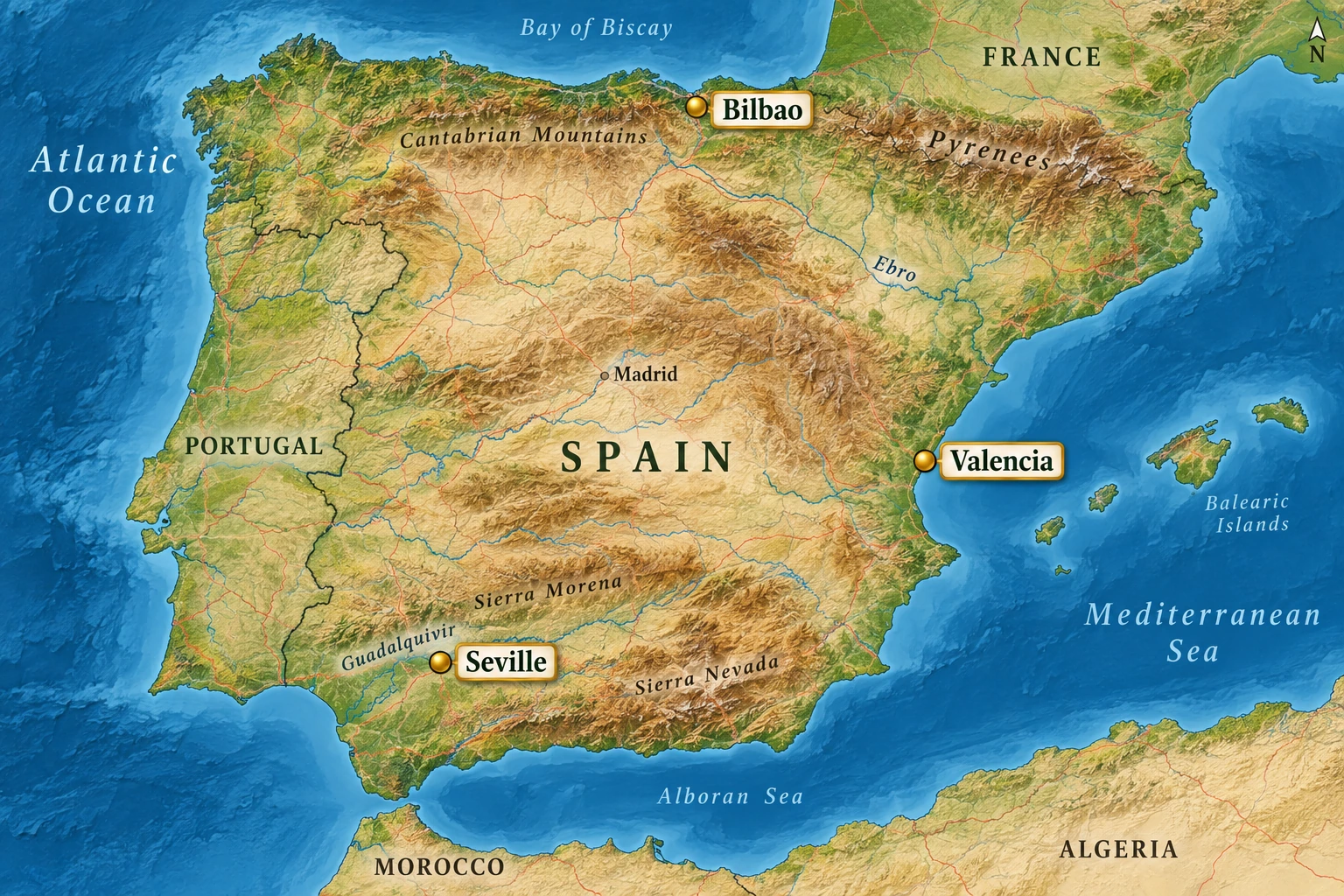
Geographic reference

Valencia may appeal to a Boston household that wants to build a life in Spanish while keeping a qualifying and agreed remote working arrangement. Imagine a technical illustrator with established overseas clients and a partner planning a funded period of language study before deciding on the next professional step. They want a neighborhood routine with room for work, learning and ordinary evenings outside. Their purpose is a shared chapter in another language, with the income and lawful basis made concrete before the home is chosen.
Spain has an international telework route for qualifying non-EU circumstances, with requirements that depend on the applicant and whether the activity is employment or professional work. The official ministry guidance and Boston consulate information distinguish those cases. For an employee, the route concerns work for an enterprise outside Spain; qualifying professional activity has different conditions. A remote job title, visitor entry or non-working residence category is not a substitute for the applicable authorization. Establish the actual route, social-security obligations, family position and current documents with the responsible authority before relying on the work to fund the stay.
The illustrator’s existing clients give the example a beginning, but they still need to agree to the actual location and practical terms. Write the working hours in local time on the dates involved, including the relevant seasonal clock changes. An afternoon serving Boston commitments may use time the couple had imagined spending together. The partner’s language program needs an actual place, calendar and cost, with a separate lawful basis for any later work. Both people should know what the first year can support before assuming that their settled routines will emerge immediately.
Valencia’s urban neighborhoods offer a different home search from a holiday base near the beach. Metrovalencia’s official network resources help investigate metro and tram connections; the actual home-to-work or course journey determines their usefulness. Try the grocery trip, the return after a class and the route to the outdoor place you would use regularly. Bilbao in northern Spain and Seville inland in the south are separate geographic horizons, not adjacent alternatives with the same climate or local day. Compare another city only if its particular purpose deserves investigation.
Give the home enough quiet and usable work space for the arrangement that pays for it. A balcony or attractive street can be a pleasure while calls, summer comfort, building access and the actual service terms decide how the day feels. Ask about the conditions of the specific property and relevant current local information, including flood considerations where they apply. A broad image of Mediterranean living cannot establish the suitability of a building or the terms of a tenancy for this household.
Make the financial comparison in a common currency using current terms when you act. Include dependable after-tax income as it applies to the actual arrangement, housing, services, insurance, study, transport and visits to Boston. Establish cross-border tax and employment questions with the appropriate responsible sources and advisers. Keep document preparation, setup and other final transition spending apart from refundable deposits and the reserve. A favorable exchange rate on a visit should not be required to keep the ordinary month workable.
Valencia’s Turia Garden follows the river’s former course through the city, with paths and areas for outdoor activity. The illustrator and language student can choose a section and entrance near a plausible home for a short weekday outing, then make a separate comparison of the journey to the sea. The garden is not a flowing riverside walk to the beach. Trying those two different pleasures helps the couple choose a home for the week they would live rather than for an undifferentiated idea of Mediterranean life.
The first research stay should test a workday and a study day from the same plausible home area, with an independent activity for each person. Attend a real recurring language or neighborhood session if its current terms allow, and notice whether you would return after the day you expect to have. Valencia stays on the shortlist if the lawful work foundation, household month and local participation support the purpose together. The move can then be about a positive new life, with enough practical detail to enjoy learning it.
Try first: Establish the actual telework or other applicable route and agreed client terms, then try the work-and-language timetable from one realistic Valencia home area.
Local sources: Spain Ministry: international telework questions · Spain Consulate Boston: international telework visa · Metrovalencia official zonal network map · Turia Garden, Visit Valencia.
Kuwait: examine a supported Kuwait City appointment before committing the household
Closer profile: Kuwait City. Other place horizons: Hawally — part of the urban area · Salmiya — part of the urban area.
Kuwait City, Hawally and Salmiya
Geographic reference

Kuwait City can become a serious question when a specific supported appointment and family purpose are already present. Imagine a building-services engineer considering a documented project role, with a spouse who has a Kuwait family connection and wants a funded period away from paid work. They are interested in time with relatives and a new professional chapter. This is a conditional appointment example: the current security situation and the actual support arrangements must be assessed before a research trip or household commitment is treated as practical.
The US advisory dated October 23, 2026 is Level 3, Reconsider Travel. It identifies serious risks including armed-conflict concerns and limited US assistance. Some locations have additional specific risks. Read the current advisory and the information relevant to the actual workplace, residence and travel route. Conditions imposed on US government employees are not general residence rules for every reader, but the advisory’s stated risks cannot be replaced by a reassuring view of a shaded courtyard. If the actual employer and household cannot establish a current, credible support and departure arrangement, retain this as a future possibility and choose another candidate for the present move.
Establish the legal foundation separately. Kuwait’s Ministry of Interior provides official residence services, and the government’s Article 18 information concerns private-sector work residence. The applicable category, sponsor, documents and any family arrangement depend on the actual appointment and each person’s circumstances. An offer, family tie or entry visa should not be interpreted as permission for every form of work. Obtain current responsible guidance before relying on the engineer’s role or any later paid activity by the spouse. The profile gives starting resources, not an individual eligibility decision.
Read the appointment as a whole household arrangement. What work location and hours apply? Which housing, transport, insurance, administrative or return costs will the employer actually cover, and which remain yours? What happens if the project is delayed, interrupted or ends earlier than planned? Put the written answers beside the dependable income and available cash. A favorable headline package is useful only when its real obligations and limits support the people who will live with it.
Kuwait City, Hawally and Salmiya form related parts of a wider urban area. They are not three widely separated city bases with identical journeys. Use the actual work and family addresses to compare a home. CityBus’s official information provides a starting point for relevant bus travel, while the particular route, hours, final walk and current conditions decide its usefulness. Establish employer transport or any driving arrangement explicitly. The spouse’s independent day should not depend entirely on a relative or the engineer being available to provide every journey.
The home’s shade, cooling and indoor space have a practical role in the year the household would live. Investigate the actual property, service terms, healthcare arrangements and activities the spouse would use while the engineer works. Family visits can be a real source of meaning, with their frequency and expectations discussed on both sides. Give the spouse a chosen purpose and independent contacts, alongside the funded period away from employment. The appointment should not become one person’s professional gain supported by another person’s unexamined isolation.
Keep transition and return funding available independently of the hoped-for settled month. Compare current housing and living terms, any currency and payment arrangements, the costs excluded from the package and the actual terms for leaving or changing employment. A research visit should follow the current security, entry and host assessment rather than being used to substitute for it. Kuwait City remains a candidate only if that responsible assessment supports the specific chapter and both adults want the life around it. Otherwise another destination can serve the present purpose while this possibility waits.
Try first: Obtain current employer, residence and security-support terms for the actual household and route before planning a visit or tenancy; keep an independently funded return option.
Local sources: General Directorate of Residency - Ministry of Interior - Kuwait · Kuwait government: private-sector work residence Article18 · Citybus – Digital – City Group Co. · US State Department Kuwait advisory, October23 2026.
Make the visit answer a decision
A useful comparison visit begins with one uncertainty that could change your shortlist. For Framingham, it may be the late return from a performance. For the Indianapolis family, it may be a teenager’s independent afternoon. For a smaller home in Sacramento, it may be whether the preparation space and ordinary errand route feel comfortable. Choose the question first, then arrange the day around a plausible home area and the hour that matters.
Spend part of the visit doing things you would repeat. Buy food, make the relevant journey, carry what you normally take and return to the home area when you expect to be tired. Include the small final leg from stop, parking place or street to the entrance. A good ride across a city can still end in a difficult walk or an awkward building. A quieter address may make that last part easier while changing the rest of the journey; compare both effects.
Give each household member a task or question of their own. The partner working from home can investigate the room and local activity while the other person tries the work journey. A teenager can choose a relevant place and take part in checking the route. An older adult can consider an independent errand on their own terms. Bring those observations together afterward, with time for the less enthusiastic person’s concern to change the home search.
Try a second arrangement when the first result is mixed. Another home area, a different route or a more flexible first tenancy may solve the difficulty without abandoning a destination whose purpose still matters. Conversely, a beautiful afternoon cannot settle a work, funding or permission question that remains unanswered. Keep the attractive experience and the unresolved fact in the same note, then identify what would provide the missing evidence.
For an island or foreign-country chapter, plan the research visit only when current conditions, entry terms and the relevant host arrangements support it. The Kuwait example needs a current security and support assessment before an ordinary exploratory trip is treated as practical. Some questions can be settled with responsible institutions before travel. Do not sign a durable housing commitment merely to make an uncertain visit feel more decisive.
Leave with an action and a reason. You might keep the candidate and request a particular document, compare another address, change the timing or set the option aside. A visit has done useful work when it makes the next decision clearer. The aim is a home and routine you can use, with the important compromise understood before the physical move becomes difficult to reverse.

- One uncertaintyChoose the fact that could change the shortlist.
- An ordinary trialUse an attainable home area, real hours and the things you normally carry.
- Another arrangementTry a second address or route if it could solve the concern.
- A next actionKeep, revise or set aside the candidate with an explicit reason.
Keep a small shortlist with a clear next decision
Keep two to four places you have a reason to investigate. Give each one a sentence with three parts: the gain you want, the compromise you are prepared to examine and the next evidence that would change your decision. “Framingham could give us usable work space if the late return leaves enough shared time” is a useful beginning. So is “San Diego may be worth a higher payment if we can comfortably fund and repeat the outdoor routine.”
Use the worksheet to compare the same questions across the candidates. Add the actual home and access, dependable income, remaining month, transition spending and reserve. Include each person’s ordinary journeys, work or learning plan and a local interest. Leave a field open when the answer is unknown, with a next step beside it. An honest unknown is more useful than a favorable number borrowed from a city average.
Choose a review point while you still have alternatives. A job or funding decision may determine when to continue. A flexible first tenancy may let you learn the real neighborhood pattern before choosing a durable home. A change in family circumstances may make the timing different from the original hope. Revisit the purpose as well as the details: does the candidate still offer the life you wanted it to support?
Begin arranging the physical move when the destination, real home, funding and dates are sufficiently established. Sterling Oakbridge reviews household moves from Boston within its United States and Canada coverage. Prepare the inventory, note what will stay behind and gather the current property’s access instructions. With both addresses, dates and receiving arrangements, those details support a route-specific written plan for the shipment and any agreed packing or storage. Confirm an island route separately; the informational Saipan profile does not establish shipment coverage. For Tunisia, Spain or Kuwait, use a provider whose confirmed services cover the actual route.
You may finish the comparison ready to go, with a better nearby arrangement or with a decision to wait for a particular opportunity. Each can be a useful result. The next home should have a positive role in your life, with enough evidence to understand what the move asks of you and what it is likely to make possible.
Compare places that could support your next chapter
Boston, Massachusetts origin · date:
What would you welcome?
Three Boston things to keep:
| My comparison | Place 1 | Place 2 | Place 3 | Place 4 |
|---|---|---|---|---|
| Gain and important compromise | ||||
| Dependable income and dates | ||||
| Actual home and complete costs | ||||
| Money left after the month | ||||
| Each person’s ordinary day | ||||
| Work, learning and care journeys | ||||
| Space, entrance and upkeep | ||||
| Season and a repeated pleasure | ||||
| Status, support and Boston ties | ||||
| Transition, deposits and reserve | ||||
| Next evidence and review date |
Choose two to four real options, including a different Boston home if useful. Add the gain, the compromise and the evidence that could change the choice. Use actual dated terms, keep hoped-for income separate and revisit the sheet after the comparison visit.
Questions when choosing where to move from Boston
Where should I begin if I want to move from Boston but do not know where?
Begin with the change you want your next home to support and three parts of Boston life you would keep. Then compare two to four places with different ways of meeting that purpose. Framingham, Quincy and Salem are nearby beginnings; the wider profiles open other work, household and landscape questions. Use one real home and ordinary day to make the first serious comparison.
Could another Boston home be enough?
Yes. A different room layout, entrance or permitted work-space arrangement may solve the main problem while keeping useful people and journeys close. Put one realistic Boston alternative beside a farther favorite. Choose the wider move when its own setting, opportunity or relationships add something you want, with the transition funded.
Which nearby places does this guide compare?
It looks closely at Framingham, Quincy and Salem, Massachusetts. Framingham turns west toward a different space-and-work arrangement; Quincy explores a Red Line connection around two schedules; Salem considers a North Shore local life with continuing Boston ties. The current service, actual home and complete trip determine whether each fits you.
Are Framingham, Quincy and Salem automatically cheaper than Boston?
No. Their common 2020–2024 median gross-rent point estimates are $2,033, $2,118 and $1,836 a month, beside Boston’s $2,147. The table gives margins of error. These historical occupied-home estimates do not price a current suitable home or its transport. Compare actual terms and the specific gain you want.
What are the six US perspectives in this guide?
The guide begins near Boston, then explores another New England center, a warmer or south-central chapter, interior cities, mountain-region bases and three California routines. There are eighteen detailed US profiles in total, including the three nearby places. Each perspective opens a different household purpose rather than ranking places from best to worst.
Which selected places have lower historical rent estimates than Boston?
Seventeen of the eighteen selected US destinations have lower median gross-rent point estimates than Boston in this common historical table; San Diego is higher. Quincy and Framingham are relatively close to the Boston estimate. Read the margins of error and exact geographic scope, then compare actual suitable homes and the complete household month. The table does not rank current homes or promise savings.
What should I compare before rent alone?
Compare dependable take-home income minus all recurring essentials, using the same categories for the present arrangement and each candidate. Include housing, transport, food, care, insurance, debt and continuing commitments. Then decide whether the home, time and support around the remaining amount offer the change you want.
What do the four main budget examples show?
The hypothetical current arrangement leaves $1,200 a month. Lower housing with less dependable pay leaves $850; a funded better fit leaves $2,000; lower housing with more paid support leaves $300. The inputs are invented to show the arithmetic. Replace them with your own actual terms rather than treating them as city prices.
How does the sixteen-month transition calculation work?
The stronger example leaves $800 more each month: $2,000 rather than $1,200. Dividing the chosen $12,800 of unrecoverable transition spending by $800 gives sixteen continuing months. An earnings delay or extra expense changes that timing. Refundable deposits and an emergency reserve are separate cash decisions.
Can I use the Census household-income median as my salary after moving?
No. It describes the annual before-tax income of existing households in the exact Census area. It is not an offered salary, an individual wage or take-home pay. Use a real offer or established income arrangement for your own budget, and use the common Census table only as historical context for investigation.
How should two adults compare work after the move?
Put both work locations, fixed hours and attendance needs on the same calendar. Give a job search, return to work or new practice a funded first-year plan instead of assuming an immediate second salary. Then compare homes that support both days and a workable household handoff.
Does working online make any destination practical?
It provides one possible work arrangement, with its own conditions. Obtain the employer’s or client’s relevant agreement and establish the location, hours and applicable legal, tax, insurance and authorization questions. Check the home’s actual work space and service terms. Write the schedule in destination local time on the dates you would use it.
How can a teenager take part in choosing the next home?
Let them choose a question about their own afternoon, such as an activity, friend visit or route home. Confirm school assignment and current access terms for the real address, then rehearse the relevant journey. Their independent routine deserves a place beside the adults’ work and housing preferences.
What makes a smaller home a good change?
It removes upkeep you no longer want while retaining usable space for the activities you value. Test the entrance, laundry, storage, work or hobby area and the ordinary journeys outside. Confirm who handles maintenance and what the payment covers. Fewer rooms help when the resulting day feels easier and still full.
How do I begin a local social life after moving?
Choose one activity you enjoy enough to repeat and can reach at your real free hour. A class, shared studio, volunteering task or walking group can provide another occasion to meet people. Add a second attainable occasion at the weekend if useful. Give each adult an independent beginning, and allow time for familiarity instead of expecting a first visit to establish belonging.
Do the climate figures show daytime highs?
No. They are NOAA 1991–2020 monthly means at the named airport stations, combining days and nights. Boston Logan is 29.9°F in January and 74.1°F in July; the table compares Tampa, Salt Lake City and San Diego on the same basis. They frame seasonal questions, without forecasting a day or describing every neighborhood.
Are all four overseas profiles foreign countries?
No. Tunisia, Spain and Kuwait are sovereign countries. The Commonwealth of the Northern Mariana Islands is a US territory under US sovereignty; Saipan is included for its overseas island setting. The applicable residence and work questions depend on each person’s actual status. Do not assign a foreign work-visa process to a US citizen solely because the destination is Saipan.
Why does the Kuwait profile require a current support assessment?
The US advisory dated October 23, 2026 is Level 3, Reconsider Travel, citing serious risks and limited US assistance. The example is a conditional, supported appointment, with the actual employer, household arrangements and return funding established. It is not a suggestion that an unsupported exploratory trip or ordinary tenancy is presently suitable for everyone.
Can a visitor stay be used as proof that I may work abroad?
No. Establish the residence and work basis that applies to the person and intended activity with the responsible authority. The profiles identify official starting resources and practical questions; they do not determine individual eligibility. A host, offer or attractive home should not be treated as a substitute for the applicable permission.
What should a comparison visit accomplish?
It should answer a question that changes the shortlist: the late return, the usable work room, an independent errand or the less comfortable season. Use a realistic home area, actual hours and normal belongings. Try a second arrangement if it could solve the concern, then leave with a reasoned next action.
How do I use the printable shortlist?
Choose two to four places. For each, write the gain you want, the important compromise and the next evidence that could change the decision. Add the real home, dependable income, complete month and ordinary journeys. Keep the transition, reserve and review date visible. The downloadable PDF and on-page print view use the same comparison rows.
When should I arrange the physical move?
Begin when the destination, actual home, funding and dates are sufficiently established. For a shipment within Sterling Oakbridge’s reviewed US and Canada coverage, send both addresses when known, the inventory, dates and building access and receiving instructions for a route-specific written plan. You can prepare the inventory and current-property instructions earlier. Confirm an island shipment separately and use a suitably confirmed provider for the foreign-country routes.
Sources and method
Official records and page extracts were checked for this October 2026 edition, with original dates retained where relevant. Sources sit beside the passages they support. The US table uses a common 2020–2024 ACS five-year release for the exact named Census areas and keeps the published margins of error. NOAA 1991–2020 airport monthly means begin the seasonal comparison. Actual home prices, offers and property conditions require their own current evidence; the household budget inputs here are illustrative arithmetic.
All city scenes, household illustrations and twelve atlases were newly made for this Boston edition. Scenes illustrate possibilities, not documented customers, available homes or job offers. The detailed AI atlas maps use checked geographic references to picture settings and relative places. Use current provider information and the actual address when choosing a home or planning a journey.
- Albuquerque city, New Mexico Census historical gross rent
- Sandia Foothills Open Space — City of Albuquerque
- Routes & Schedules — City of Albuquerque
- Sterling Oakbridge: Boston long-distance moving coverage
- Burlington city, Vermont Census historical gross rent
- Waterfront | Burlington, VT
- Schedules | Green Mountain Transit, VT
- Office of Insular Affairs | U.S. Department of the Interior
- US Code 48 USC 1806: CNMI immigration framework
- US State Department: CNMI-specific worker framework
- Denver city, Colorado Census historical gross rent
- ideaLAB | Denver Public Library
- Routes and Services | RTD-Denver
- Fort Worth city, Texas Census historical gross rent
- Home - Trinity Metro - Tarrant County public transit service.
- Amphibian Stage, South Main Street
- Framingham city, Massachusetts Census historical gross rent
- Edgell Memorial Library, Framingham History Center
- Framingham/Worcester Line | Commuter Rail | MBTA
- Indianapolis city (balance), Indiana Census historical gross rent
- Canal Walk | Visit Indy
- Routes - IndyGo
- Kansas City city, Missouri Census historical gross rent
- First Friday in the Crossroads
- Routes In Service | RideKC | Kansas City Area Transportation Authority
- US State Department Kuwait advisory, October23 2026
- Citybus – Digital – City Group Co.
- General Directorate of Residency - Ministry of Interior - Kuwait
- Kuwait government: private-sector work residence Article18
- Los Angeles city, California Census historical gross rent
- Octavia Lab - FAQ | Los Angeles Public Library
- Line Schedules and Maps - LA Metro
- New Haven city, Connecticut Census historical gross rent
- Creative Arts Workshop, Audubon Arts District
- Routes and Schedules | CTtransit
- Providence city, Rhode Island Census historical gross rent
- AS220: AS220 Community Studios: Community Makerspace in Providence, Rhode Island
- RIPTA 2026 system map
- Quincy city, Massachusetts Census historical gross rent
- Red Line | Subway | MBTA
- Rapid City city, South Dakota Census historical gross rent
- Dahl Arts Center: current programs
- Rapid City Rapid Transit System
- Sacramento city, California Census historical gross rent
- American River Parkway
- SacRT system maps
- Commonwealth Office of Transit Authority
- Salem city, Massachusetts Census historical gross rent
- Events | Peabody Essex Museum
- Newburyport/Rockport Line | Commuter Rail | MBTA
- Salt Lake City city, Utah Census historical gross rent
- Utah DEQ: inversions
- Schedules and Maps
- San Diego city, California Census historical gross rent
- Balboa Park | City of San Diego Official Website
- Trolley | San Diego Metropolitan Transit System
- Spain Consulate Boston: international telework visa
- Spain Ministry: international telework questions
- Tampa city, Florida Census historical gross rent
- Bayshore Linear Park Trail - Bayshore Greenway | City of Tampa
- HART: maps and schedules
- Tulsa city, Oklahoma Census historical gross rent
- River Parks: trail maps
- Home | MetroLink Tulsa
- TRANSTU: Tunis transport
- TRANSTU: service information
- US State Department Tunisia advisory, May21 2026
- Tunisia Ministry of Interior: residence-card guidance
- Turia Garden, Visit Valencia
- Metrovalencia official zonal network map
Census ACS methods · 2024 Census Gazetteer
Download the comparison data (CSV) · Download the model inputs (JSON)