

What would make your next week better than this one?
You may be ready to leave Rochester, or simply ready to live differently. Perhaps the flat has too many stairs, your work has moved, or the daily trip between home, campus and care has become tiring. Perhaps you want a warmer winter or a landscape you can enjoy more often. Begin with the change you would notice on an ordinary Tuesday. It gives you a much clearer search than deciding that the next city has to be better in every way.
If Rochester work, study or family still shapes the week, compare a better City home with Fairport, Pittsford and Brockport. Each gives you a different village beginning, with different costs and connections beyond it. If the household can establish a new base, Buffalo, Syracuse and Erie offer three regional comparisons. The farther groups then open up a southeastern season, a larger transit city, a different mountain or plains setting, and the West. You can put a nearby village and a distant city on the same shortlist when both answer your real question.
For lower spending, investigate Erie first among these examples, then compare an attainable home with Brockport, Buffalo or Syracuse if the relevant work and support fit. Their historical rent estimates are below Rochester's, but the smaller gaps may disappear in an actual housing search or a more expensive transport week. Fargo also has a lower estimate, with a much colder January station average. If climate is the reason to move, begin instead with what the southeastern or western setting would change and whether your income can support it.
Aim to keep two to four options, not to finish researching every place on the map. For each one, be able to say what gets better, the compromise you would accept and the answer you still need. The household sections help you decide what belongs in that comparison. The printable sheet at the end keeps it together without an account, a registration form or a moving date you are not ready to choose.
Keep Rochester involved
Compare another Rochester home with Fairport, Pittsford and Brockport village routines.
Try the nearby routines →Improve the whole month
Put actual housing, full transport and usable income into the same comparison.
Compare the money left →Choose another setting
Explore a regional, southeastern, interior, mountain-region or western week through its less convenient season too.
Explore US horizons →Begin in another country
Match a lawful residence and work plan with an ordinary week in one of four countries.
Explore four countries →Give the Rochester life you would leave a fair value
Notice the parts of your current life that already work. A manageable home payment, a direct bus, a relative who helps with pickups or a familiar provider can be easy to overlook because they no longer feel like advantages. Write them beside the things that frustrate you. A worthwhile move may replace some of them. It is easier to judge the trade when you know what would have to be rebuilt, bought or reached less often.
Think about the actual home rather than only its neighborhood name. Rochester's older houses and divided homes can give you useful rooms, light and a setting you enjoy, while the entrance, shared stairs or heating arrangement make the same address difficult. Another unit with fewer steps or a more suitable layout may change the day without changing your work and support network. Compare that real alternative before deciding that the only answer to the building is a different region.
Give useful City connections the same attention. A home near everyday errands and a direct RTS route can support a different week from an address that needs a booked suburban ride or another vehicle. The current RTS directory separates the fixed Connect network from On Demand zones. The September 2026 change ended weekend On Demand and set an earlier weekday finish. That makes the route home after an activity, a Sunday shift or a weekend appointment a real part of choosing the next address.
The university name also needs an actual destination. RIT's main campus is in Henrietta, outside Rochester City. The University of Rochester lists separate River, Health Sciences and Eastman locations, among others. A Rochester mailing address is not a promise that two courses or workplaces share the same journey. Keep the building and required hours in view if you stay in the region, and take the same habit with you when comparing another university city.
Before deciding you need to leave for water or outdoor time, try the Rochester version you could use more often. The Port of Rochester is where the Genesee reaches Lake Ontario, north of downtown. Follow the river trail or investigate the lakefront branch of RTS 22, whose current serving list includes Ontario Beach Park. Try that outing from the home you could actually choose. It gives you a local alternative to compare with a distant coastal setting you may still reach mainly on weekends.
Keep the people behind the routine visible too. Who can help when you cannot drive, work ends late or a child is unwell? How often do you see the relative you would be moving away from? You may welcome the chance to build a new life elsewhere, and those connections do not oblige you to stay. They belong in the comparison because losing proximity can introduce care charges, travel or a different division of household time. The local Moving to Rochester guide helps if the better answer is another City home.
Local sources: Moving to Rochester · Rochester moving services · RTS — September 2026 routes and service pattern · RTS — Lake route and Ontario Beach Park · Rochester — Port of Rochester · RIT — campus location and connections · University of Rochester — campus addresses.
Choose the size of the change around the problem
Start with the smallest change that could actually deliver the improvement. An easier entrance may solve a home problem. A different location within the metro may solve a particular work or school journey. A new regional base may be necessary for an opportunity or the people you want to live near. A warmer winter may require a much larger geographic change. You can investigate each possibility without deciding in advance how far you are supposed to go.
Turn a broad wish into something you can test. Instead of “a nicer place,” try “a home where I can bring groceries inside without the upstairs turn.” Instead of “better transport,” try “a workday, an evening class and Sunday errands without depending on a second car.” Instead of “closer to nature,” decide whether you mean a daily river walk or a mountain outing twice a month. Those answers point toward different properties and places, even when the original wish sounds similar.
For an address problem, visit two suitable Rochester homes using the same needs. Ask about included heat, the real entrance, storage and who handles winter clearing. A higher payment may buy a useful reduction in effort, while another low payment may reproduce the difficulty you already have. Make the comparison concrete enough that staying is a serious option, rather than an imagined perfect home used to dismiss every destination.
For a nearby move, put the home and the journeys outside the village together. Fairport's canal setting, Pittsford's center and Brockport's university connections can be attractive for different reasons. Their names do not tell you how an RIT class, a City hospital shift or the other adult's job would fit. A village can improve local errands while increasing the effort of the rest of the week. Find out which part of that trade matters most to your household.
For a larger move, give the new setting a clear job to do. Erie might make a lower complete budget worth investigating; Chicago might offer an actual opportunity and a rail-supported week; Raleigh might give you a different winter. Those are different reasons, and each can be sound. A place need not win every category to deserve a visit. It should improve the thing that matters enough to justify its costs and the Rochester connections you would change.
Leave a way to learn without committing beyond the evidence you have. A first rental, a staged move or a later purchase can help when the role and region look promising but the neighborhood is still unfamiliar. Establish the real lease terms, deposits, pets and temporary arrangements. Flexibility has a cost, and an unresolved job, care place or work permission should remain an unresolved decision until the right person confirms it.
Three village comparisons with Rochester still in the picture
Fairport, Pittsford and Brockport give you three focused nearby visits. Fairport and Pittsford let you compare a canal-centered local routine southeast of Rochester; Brockport introduces a western village with a university of its own. Brighton, Henrietta, Irondequoit, Greece, Webster, Gates and other regional communities may belong on your personal list when the workplace, relative or actual home points there. You do not need to investigate every nearby name equally before finding three useful comparisons.
Keep the village and wider address separate. Fairport village is within Perinton; the Town has several school districts and includes places outside the village. Pittsford's village center is a smaller geography than the surrounding town and the wider Pittsford home search. Brockport's campus, village center and the journeys beyond them need their own locations. Use the full address for municipal, school, utility and lease questions instead of treating a postal name as the answer to all four.
The housing backgrounds differ enough to change the advice. Fairport's historical gross-rent estimate is $1,165, Pittsford village's $1,734 and Brockport's $995, against Rochester City's $1,081. These are the same survey period, with uncertainty shown in the full comparison. They do not price a current rental. Brockport's small lower point estimate may be worth testing if the local life fits; Pittsford needs a benefit and budget that justify a higher starting point, rather than an assumption that a village move will be cheaper.
Make each visit include the part of the week that leaves the center. Fairport has a fixed bus connection with a relatively wide gap between trips; Brockport uses a booked-zone connection for the Rochester link described by the university. A college shuttle, a canal walk and a commuter journey do different jobs. Trying the right one is how you find out whether the new home would make daily life easier.
Three nearby village beginnings
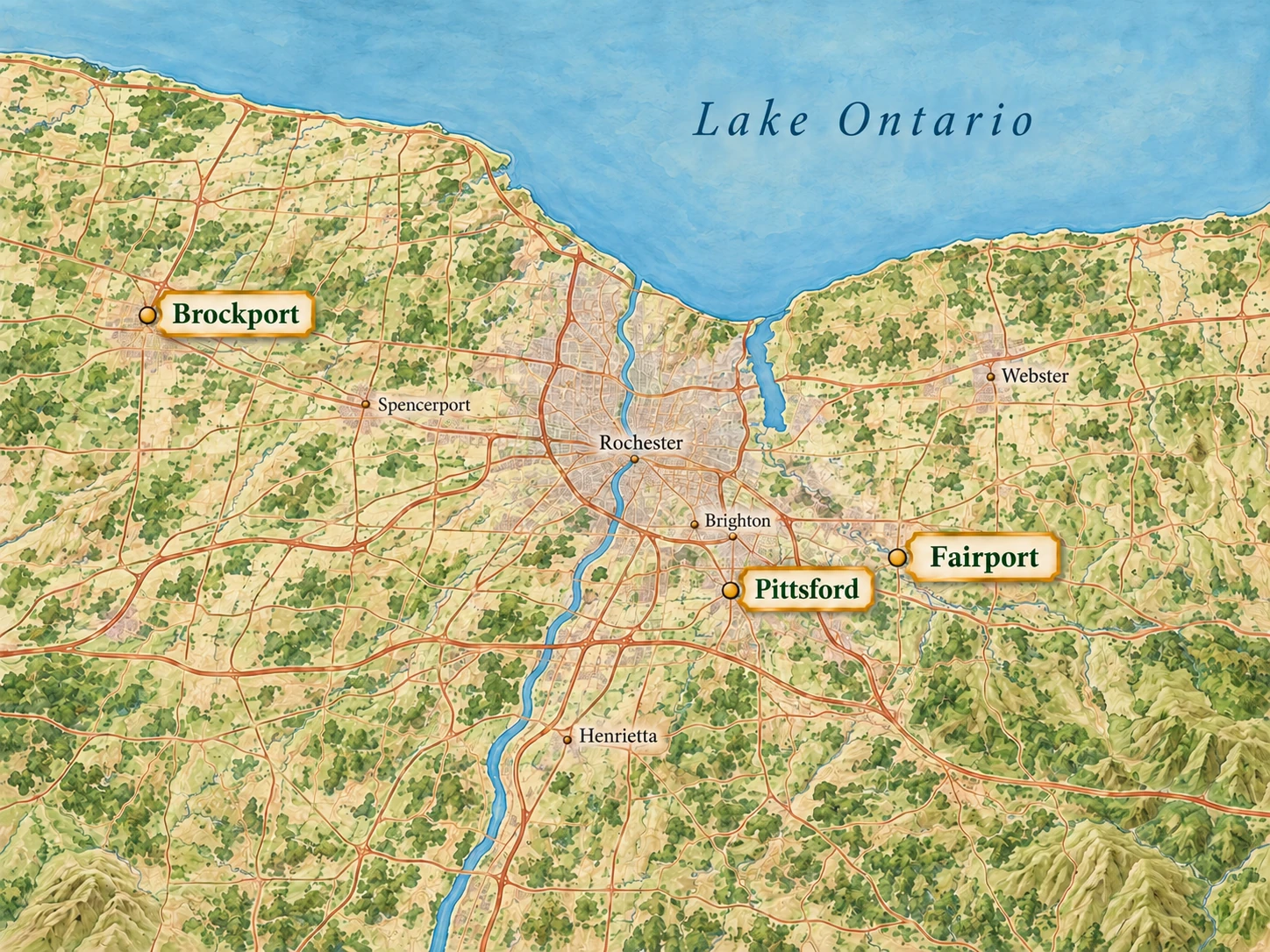
Geographic reference

Fairport: choose the canal village and price the journeys beyond it
Fairport is worth visiting when a canal-centered local routine is part of the change you want, while Rochester people or work still matter. Begin at the village center, then walk from a home you could actually choose to the errands and activities you would use. The surrounding Town of Perinton includes other settings and several school districts. A Fairport mailing address should not stand in for the village location, the school arrangement or the trip back to the City.
For a bus-supported week, look closely at RTS 50 Fairport/Penfield. The current linked timetable includes Fairport Village Hall and the Blossom Loop connection, with a published 120-minute frequency and service on seven days. That is a different proposition from a frequent central Rochester corridor. A missed return can matter, and a workplace beyond the connecting route introduces another part of the journey. Try the exact day rather than count a stop as a complete solution.
Fairport's historical gross-rent estimate is $1,165, $84 above Rochester City's $1,081, with a substantial village margin of error. The figure does not give a strong reason to expect your next home to be cheaper. A suitable layout, local connections and a setting you enjoy may still make the move worthwhile. Include the actual home costs and any additional driving or paid travel before deciding how much the village changes the household month.
Make the visit include a village errand and the least flexible journey out of it: a shift, a course, a care pickup or the other adult's work. If those parts fit, the canal setting can become an everyday pleasure. If the center is the only easy part, compare another address or a Rochester home that preserves a more useful connection. The village name alone cannot tell you which version of the week you would have.
Try first: Try the actual home, a canal-center errand and the required RTS50 or driving return at your hours.
Local sources: Perinton — village and town geography · RTS — Fairport/Penfield route50.
Pittsford: make the village benefit worth the larger housing commitment
Pittsford gives you a historic canal-village comparison southeast of Rochester. It can appeal when the center, attainable home and nearby connections are the kind of local change you want. Keep the village itself separate from the surrounding town and the much wider home search using the Pittsford name. A village walk is a useful first visit; it is not evidence about every property, campus or workplace in that wider area.
The historical village gross-rent estimate is $1,734, $653 above Rochester's. That is the largest housing gap among these three nearby examples. It does not price one available home, but it makes the purpose of paying more worth stating early. You may gain an entrance, space, a local setting or proximity to someone important. Identify the actual benefit rather than assume that a smaller place on the map means a smaller payment.
RTS 11 Monroe provides a concrete southeastern corridor to investigate, including Pittsford Plaza and the Nazareth and Fisher connections in its serving list. The route, its outer branch and the separate Pittsford/Eastview On Demand zone do different jobs. A Pittsford address is not automatically convenient for RIT in Henrietta or a particular University of Rochester site. Place the real destination and return beside the home before deciding that proximity to Rochester settles the commute.
Try the property and the ordinary village activity you expect to enjoy, then make the trip that takes you outside the center. Include another household member whose destination differs from yours. Pittsford is a stronger choice when the useful home and local life justify the larger commitment without making the rest of the week harder. If the payment mostly buys a name while the necessary trips remain awkward, keep looking at the actual addresses.
Try first: Compare the village home with a suitable Rochester alternative, using the same entrance, income and actual campus or work journey.
Local sources: Pittsford — village setting · RTS — Monroe and Pittsford corridor · RTS — bookable zone journeys · RIT — campus location and connections · University of Rochester — campus addresses.
Brockport: a college-village beginning, with the Rochester link solved separately
Brockport offers a more distinct western village routine around the canal, Main Street and SUNY Brockport. It deserves attention when the university or a genuinely local role and social week can anchor life there. A household whose main obligations remain in Rochester needs a different test. Enjoying Brockport's center and managing a repeated City journey are two separate reasons to examine the move.
Its $995 historical gross-rent estimate is $86 below Rochester's, with a $127 margin of error around the village estimate. That small point gap cannot establish a saving on an available rental. It can be a reason to inspect an actual home when the village or campus arrangement already fits. Add the complete transport plan before treating a lower property payment as room left in the household budget.
The university describes RTS On Demand as the connection from Rochester Tech Park to Brockport, requiring a booked trip. The September 2026 zone information provides a weekday pattern, not an unrestricted seven-day ride back to any City address. Eagle Run is a separate student service with its own stops, eligibility and term calendar. A campus shuttle can be helpful without replacing the Rochester commute, a holiday journey or transport for every village resident.
Visit during the ordinary university week if that is relevant to you, and try the route that would remain when classes or shuttle service are not operating. A locally supported campus life can make the village a useful new base. A City job with late or weekend hours may call for a vehicle or another arrangement that changes the apparent saving. Keep Brockport for the local life you can actually build, with that wider connection made explicit.
Try first: Test the campus or local work week and the full Rochester return, including the day or break when the usual shuttle does not help.
Local sources: Brockport — village community · SUNY Brockport — public transportation · SUNY Brockport — transportation FAQ · RTS — Brockport zone · RTS — bookable zone journeys.
Look farther when you want a genuinely different next chapter
Once the household can change its work or study base, a wider search becomes useful. The five groups below introduce different kinds of change rather than five levels you must complete. A regional city can preserve some visiting possibilities while a new role changes the week. A southeastern home changes the season. A larger inland city, a Black Hills base or a western coast asks another set of questions about money, transport and the life you want outside work.
Choose the group that addresses the wish you have named. For lower commitments, begin with the complete home-and-income comparison rather than a southern or western city's reputation. For a car-light life, compare actual neighborhoods and necessary journeys in the regional or larger transit cities. For another landscape or season, let the less convenient part of the year into the visit. The maps help you see the setting; the ordinary day helps you decide whether you want to live in it.
The eighteen US examples share one historical housing comparison so that different data periods do not quietly decide the answer. Your own rent, income and support costs still need current information. Keep a place for the benefit it could realistically give a Rochester household, then give it a trial that could change your mind. A shorter list with clear reasons is more useful than a ranking that hides why one household would choose differently from another.
Three regional bases, with winter still included
Buffalo changes the city and campus possibilities to the west, Syracuse moves the search east within New York, and Erie offers a lower historical housing background beside Lake Erie. The work or household benefit needs to justify a new base; none is a simple escape from a northern winter.
Three independent regional bases
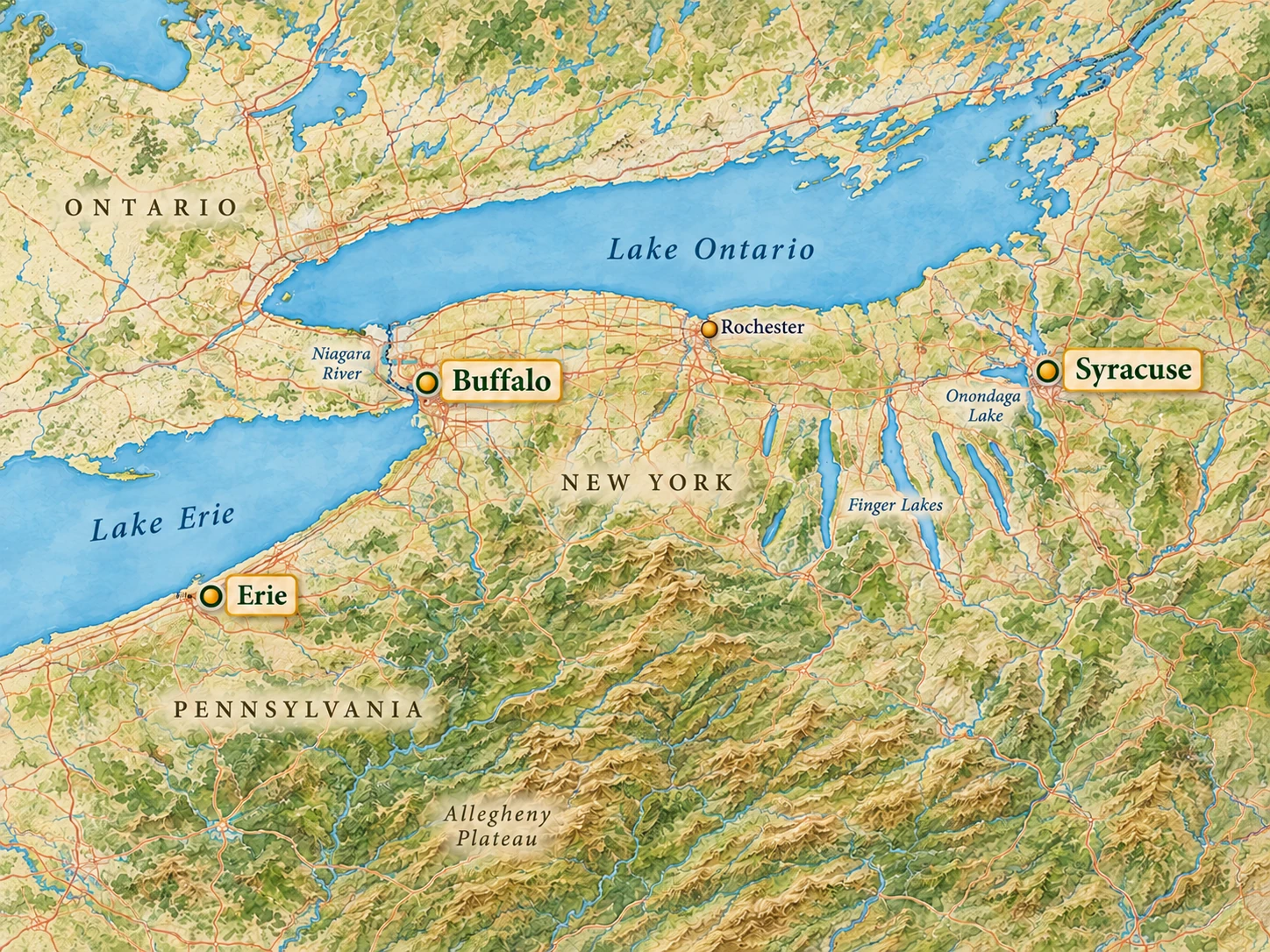
Geographic reference

Buffalo: another city base, with a precise campus and home in view
Buffalo is a regional comparison when an actual role, course, family connection or suitable home gives you a reason to move west. It can preserve a Western New York visiting pattern while changing the local opportunities and routines around you. Choose it for that concrete gain. Another Great Lakes city is a different base, not a large seasonal escape from the life you know in Rochester.
The housing background is close: Buffalo's historical gross-rent estimate is $1,046, only $35 below Rochester's. That gap is too small to make a personal saving the default story. Use the real home and income instead. A more useful entrance, a job that fits or help nearby can justify the change, while an added car or lost Rochester support could outweigh the apparent housing difference quickly.
For transit or university life, be specific. NFTA Metro Rail serves the Main Street connection between downtown, the medical corridor and UB South. UB North Campus is in Amherst and needs another part of the journey. The household may use both. Compare the correct building and return rather than a home generally described as near the university or close to a train.
Try a workday from an attainable home and the Rochester visit you want to keep making. Include the winter arrangement and another household member's destination. Buffalo becomes a useful choice when the new local week stands on its own and keeping the connection east remains manageable. If the move recreates the same home and income difficulty, another Rochester address deserves a fair place beside it.
Try first: Connect one real Buffalo opportunity with a plausible home and the actual NFTA, campus or driving week.
Local sources: NFTA — current rail corridor · University at Buffalo — three campuses.
Syracuse: move for the actual opportunity, not an assumed cheaper winter
Syracuse shifts the regional search east into another Central New York city. A specific role, program or personal connection can give you a sound reason to establish a new base without changing every part of the state framework. Start with that destination and the home you could choose around it. The benefit needs to be more definite than a wish to move somewhere vaguely similar but better.
Its historical gross-rent estimate is $1,039, $42 below Rochester's. That small point difference does not tell you whether a current rental will cost less, or whether the household will have more left after the move. Include transport, heat, care and the earning arrangement. A suitable home may still be a good find, but the actual property has to supply the saving that a broad city comparison cannot establish.
Centro provides the bus network and current trip information to investigate. Its planning material also discusses future system work; keep that separate from the route you would use on arrival. Place the actual worksite or campus and the evening return around the home. A student trip and a healthcare shift can need different connections even within the same city search.
Make a trial include an ordinary errand and the season that could make the choice less comfortable. Keep a realistic Rochester visiting pattern in the budget as well. Syracuse earns a place when the opportunity, home and local week give the household a useful change. It is less convincing when the only expectations are a large rent reduction or an escape from a northern winter that the move has not established.
Try first: Choose the real role or program first, then test an attainable home and operating Centro return.
Local sources: Centro — current service network.
Erie: investigate the clearest lower housing background in this selection
Erie is the first place in this selection to examine when reducing required housing spending is a leading reason to leave Rochester. Its historical gross-rent estimate is $870, $211 lower than Rochester's $1,081. That is still a survey comparison rather than an available home, but it gives you a clearer opening than the much smaller Buffalo or Syracuse gaps. Begin with an attainable property and a reliable earning arrangement.
Ask what the lower payment would allow the household to keep. You may want more room after essentials, a better layout or enough flexibility to reduce working hours. Add the transport and support that would change, rather than spend the rent difference before calculating the rest of the month. A lost income, more driving or new care charges can matter more than the historical housing gap.
EMTA's fixed-route service provides the practical bus framework, with a different role from the downtown Bayliner offering or eligibility-based assistance. Match the actual workplace, shops and return to the home. The Lake Erie setting can be part of the appeal, while a useful waterfront outing and a sustainable everyday journey remain separate questions. A central visit cannot establish the routine of every lower-cost address in the area.
Try the home and ordinary workday, including a winter journey and the Rochester visits you would like to maintain. Erie should remain on the list when the real property and income leave useful room in the month and the local life appeals on its own. If the full costs absorb the difference, keep it only for another benefit you can explain. The lower number is an invitation to investigate, not the conclusion of the move.
Try first: Calculate one real Erie home-and-income month, then try its EMTA or driving week and a realistic return to Rochester.
Local sources: Erie Metropolitan Transit Authority.
A southeastern workday, city routine or coastal week
Richmond, Raleigh and Wilmington give you different southeastern comparisons. An actual role, a more appealing winter or regular coastal time can explain the move. All three begin with higher historical rent estimates than Rochester, so put the income and less familiar summer beside the benefit.
Three southeastern changes of setting
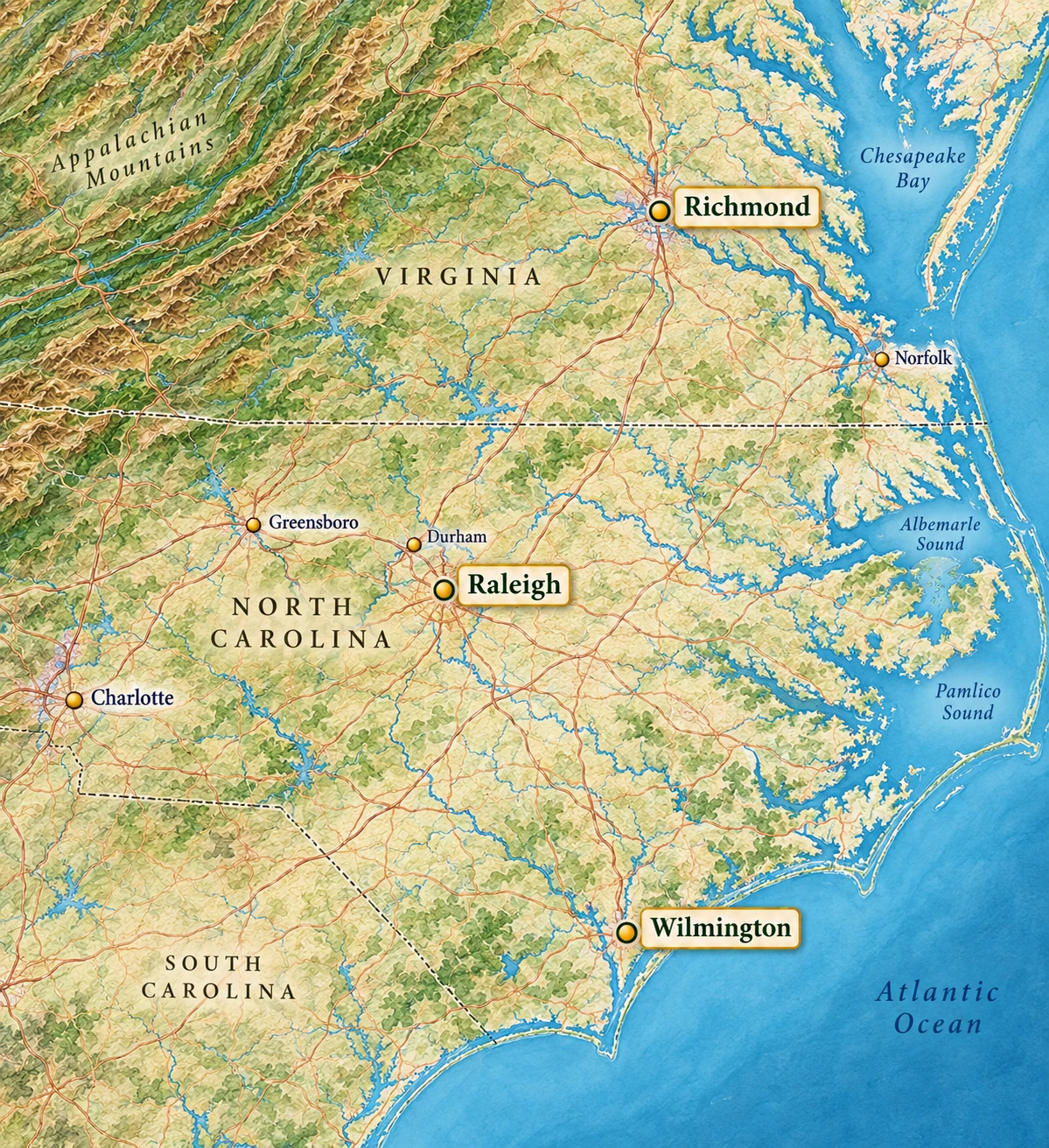
Geographic reference

Richmond: choose a new city week with the income to support it

Richmond offers a southeastern city comparison when a real opportunity or desired local setting gives you a reason to move farther from Rochester. Start with the actual work or study destination and the neighborhood you could choose. A different season may be part of the attraction, but it should sit beside a credible home, earnings and household arrangement rather than replace them.
The historical gross-rent estimate is $1,372, $291 above Rochester's. A confirmed role, appropriate home or valued personal connection needs to explain that larger housing starting point. Add the transport, summer operating costs and visits north. A raise can improve the picture, but use the take-home income you would actually receive and the other adult's work position, not a general expectation of opportunity.
GRTC distinguishes the Pulse bus rapid-transit corridor, local and express routes, and defined LINK microtransit zones. The Pulse's Willow Lawn–Rocketts Landing framework gives you a concrete place to begin a car-light search. The wider region still needs the correct route, destination and return. A home near one useful corridor does not make every county workplace or care journey equally easy.
Try the ordinary neighborhood week and a less familiar seasonal day. Include groceries, an activity and the journey for the household member with the least flexible hours. Richmond works better as a choice when the new local routine is the gain you want and the full month can support it. If the main aim is lower mandatory spending without an income change, establish the actual home calculation before keeping the city for that purpose.
Try first: Pair a real role and attainable home with the specific GRTC corridor or driving routine, including the second adult and visits north.
Local sources: GRTC — transit connections.
Raleigh: a warmer winter, with the summer and higher housing included
Raleigh deserves an early look when the household wants a substantial winter-temperature change and has an actual way to earn there. The common station comparison makes the seasonal exchange clear: Raleigh-Durham's January mean is 41.9°F against Rochester airport's 26.2°F, while July is 80.5°F against 72.3°F. These monthly means include nights. A winter visit can show the attraction without testing the hotter part of the year.
Choose the real worksite before narrowing the housing. A Raleigh job, a Durham program or another Triangle destination can produce a different daily route. GoRaleigh's operating buses give you specific City connections to investigate, with other operators serving other journeys. Do not treat the whole Triangle as one short commute or assume a downtown outing solves a dispersed regional workday.
Raleigh's historical gross-rent estimate is $1,572, $491 above Rochester's. A confirmed income arrangement needs to carry the attainable home, cooling, transport, applicable coverage and Rochester visits. If one person is still looking for work, show that interval in the transition case. Warmer weather can be a real gain, but it cannot fill an earnings gap or keep a new payment affordable by itself.
Try an ordinary summer day from the home area you could choose, including the walk or wait outside and the return after work. Keep Raleigh when the seasonal benefit and actual opportunity support a life you would enjoy throughout the year. If a very low housing payment or effortless car-free access to the whole region is essential, the home and journey need to establish that case rather than the city's name.
Try first: Test the actual Triangle worksite, an attainable home and the hot-season GoRaleigh or driving week at confirmed income.
Local sources: GoRaleigh — current routes · NOAA — climate normals.
Wilmington, North Carolina: make the coastal life part of the real week
Wilmington is the coastal North Carolina comparison here, not Wilmington in Delaware. It can be worth the larger move when regular access to that setting is one of your main reasons for leaving Rochester. Begin with the home you could afford and the journeys between it, work and the water you want to use. An inland neighborhood can still support enjoyable coastal outings, but it is a different daily arrangement from a home beside the beach.
The historical gross-rent estimate is $1,395, $314 above Rochester's. Include the actual property payment, cooling, necessary vehicles and applicable insurance or risk-related costs. Keep the income arrangement and visits north in view. A coastal environment may be worth paying for, while the household still needs enough room after essentials to enjoy the life that drew it there.
Wave Transit provides the fixed-route network to investigate. Its current notice says the seasonal Port City Trolley finished on September 26, 2026 and is due to return in spring 2027. That makes a pleasant trolley outing a poor substitute for checking the bus or driving routine needed through the rest of the year. Use the actual workday, return and current service alerts from the home area you could choose.
Make the trial include a normal workday and the less comfortable season, then make the coastal trip at the hour you would actually take it. Investigate the particular home's risks and coverage before committing. Wilmington is a stronger option when the ordinary local life and supported budget make the water a regular pleasure. If the coast remains an occasional long outing while the payment removes flexibility, compare the benefit with Rochester's lakefront alternative.
Try first: Connect the attainable home to work and a regular water outing, using year-round transport rather than the seasonal trolley.
Local sources: Wave Transit — current services.
A colder plains city, another Great Lakes region and Chicago
Fargo, Grand Rapids and Chicago ask three different questions. Fargo has a lower historical rent estimate and a much colder January; Grand Rapids changes the regional city week; Chicago can make a larger transit-supported life worth investigating at a higher housing background.
Three inland city routines
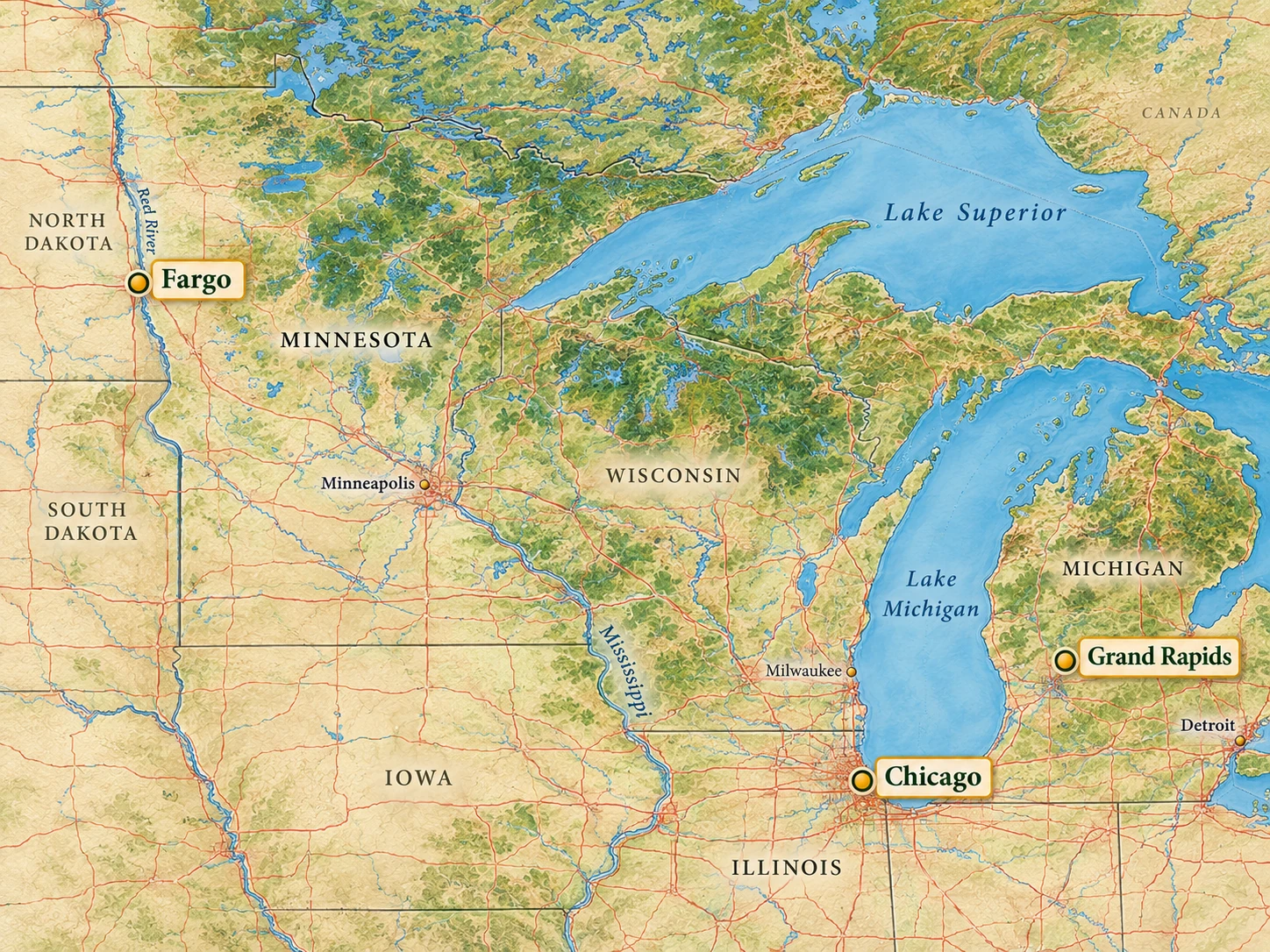
Geographic reference
Fargo: a lower housing opening paired with a much colder January
Fargo makes you decide how much climate matters to the reason for moving. Its historical gross-rent estimate is $946, $135 below Rochester's, while the Fargo airport January mean is 9.2°F against Rochester's 26.2°F. The July means are much closer. It may suit a genuine role, family connection or preferred inland life. It is an unusual choice if the main goal is less winter discomfort, even when the housing background looks attractive.
Use an attainable home and the full income-and-transport month to test the financial case. The historical gap does not price the property, winter operating costs or the household's vehicles. A suitable role can make the relocation work, while an added car or less nearby help can absorb the apparent housing advantage. Keep the cold-season entrance, clearing and necessary trips in the calculation from the start.
MATBUS serves Fargo and nearby North Dakota communities, as well as Moorhead and Dilworth across the state line in Minnesota. Its operating framework is Monday through Saturday. Try the actual route and the Sunday arrangement you would need rather than assuming a network map describes the whole week. If the home or job is across the river, recognize the actual state and relevant household rules as well as the urban connection.
Visit in a season that tests the choice and make the ordinary journeys before adding regional recreation. Include a realistic Rochester visiting pattern. Fargo belongs on the list when the household wants the whole year, the opportunity is credible and the complete month works. A lower survey estimate by itself is not enough reason to exchange a climate difficulty for a much colder version of it.
Try first: Test the winter home and MATBUS-supported week, including Sunday and the actual state of the property and job.
Local sources: MATBUS — metro service · NOAA — climate normals.
Grand Rapids: another regional city life without assuming a cheaper month
Grand Rapids changes the search to western Michigan and another scale of city work, study and local activity. It is worth investigating when an actual role, connection or preferred home arrangement gives you a reason to establish a new base. It is inland, rather than a home on the Lake Michigan shore. Give the local week and any desired lake outing their own places in the decision.
The Rapid's network lists the Silver Line, Laker Line and other City and campus routes. Those give you concrete corridors to compare with the home and destination you need. A campus connection, a local errand and a regional outdoor trip are not interchangeable. Use the current route and return, and include the second adult or child whose necessary journey differs from the one that first attracted you.
Grand Rapids' historical gross-rent estimate is $1,266, $185 above Rochester's. A move may still work well when a better role, useful home or valued local setting supports the full month. Add transport, home operating costs, care and Rochester visits. A reputation for a manageable regional city is less useful than the amount you would have left after the particular arrangement you can attain.
Try an ordinary neighborhood day and a winter routine, then one activity you would return to regularly. If Lake Michigan access is important, make that journey from the same home area. Keep Grand Rapids for a new city life that stands on its own. If the expected improvement depends mostly on a distant outing or a housing saving you have not found, another address or destination may answer the wish more directly.
Try first: Choose the actual opportunity and home, then test The Rapid connection and the outdoor trip separately.
Local sources: The Rapid — Grand Rapids transit.
Chicago: see whether a larger transit city makes the extra commitment useful
Chicago is worth considering when you want a larger city life and have a credible work, study or household reason to support it. A real rail-and-bus week may give you a different way to organize work, activities and errands from the Rochester arrangement you would leave. Begin with the destinations that must work, then choose the home around them. A large network is useful because of the journeys it can provide, not simply because it is large.
CTA lists its operating rail and bus services, current work and elevator alerts. Use the actual home, line, walking approach and return at your hours. A step-free trip needs the relevant entrances and operating equipment, while a late shift needs the right timetable. For a journey beyond CTA's useful network, establish the appropriate regional operator rather than assuming one City map solves the whole metro.
The historical gross-rent estimate is $1,440, $359 above Rochester's. A confirmed role or a household arrangement using fewer vehicles may help support that commitment, but the actual numbers need to demonstrate it. Add the home, fares, coverage, care and Rochester visiting plan. Do not spend an assumed transport saving before trying the workday and errands that would allow you to live with fewer cars.
Try an attainable neighborhood as a resident would: work or campus, groceries, an evening activity and a Sunday return. Include the season you find harder and the people or services you need to reach. Chicago becomes a useful next chapter when the larger city life is something you will participate in and the whole month remains sustainable. If the budget only buys a home far from the connections that made the move appealing, revise the home search before committing.
Try first: Try a complete CTA-supported week from an attainable home and calculate any actual vehicle reduction against the higher housing payment.
Local sources: CTA — Chicago bus and rail.
The Black Hills, a Wasatch valley and a high-desert city
Rapid City, Salt Lake City and Albuquerque offer very different relationships with terrain. Choose the outdoor life you want to use and the city week that would support it. The Black Hills edge is not the same setting as the Wasatch or the Rio Grande and Sandia landscape.
Black Hills, a Wasatch valley and the Rio Grande
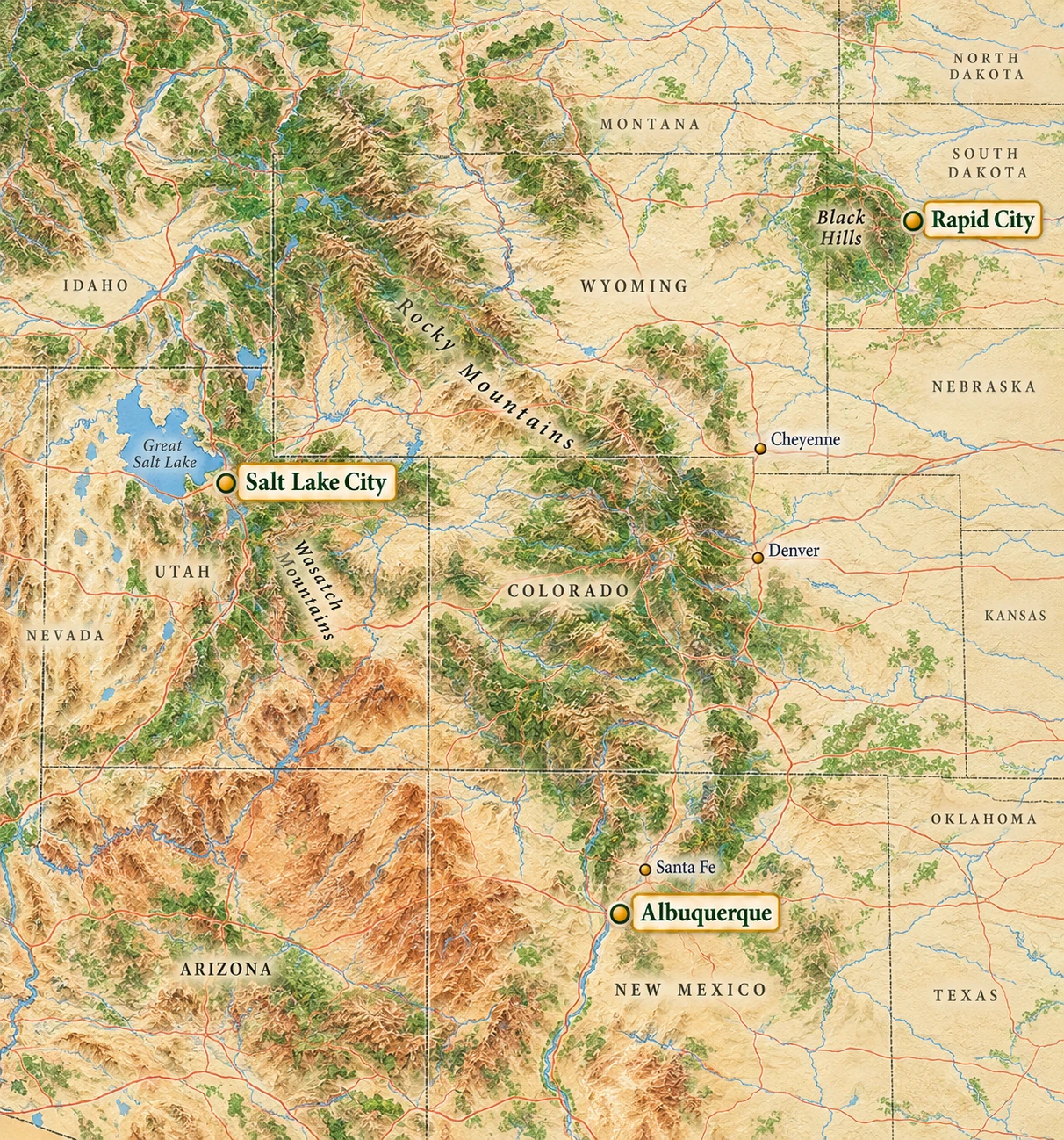
Geographic reference
Rapid City: choose the Black Hills life with the ordinary City week first
Rapid City gives the search a Black Hills-edge setting, rather than another Great Lakes or coastal base. It may suit someone who wants that landscape as a regular part of life and has an actual opportunity or approved income to support it. Start with where work happens, the home you could choose and the outdoor destination you would realistically use after the necessary parts of the day.
The historical gross-rent estimate is $1,109, only $28 above Rochester's. That small point difference gives little reason to predict either a saving or a major housing increase for your own home. Use the attainable property, income and operating costs. The distance from Rochester and the travel needed to enjoy the wider setting can matter more than the small gap in historical housing background.
RapidRide provides a local bus framework with Monday-through-Saturday operation. The home-to-work route and the Sunday arrangement need their own check. The bus network is not a transport promise to every Black Hills place you want to explore. Establish the city errands first, then the vehicle, seasonal access or other arrangement for the outdoor life that motivates the move.
Try a normal workday and the less familiar season, not only a scenic trip. Keep the cost and time of Rochester visits visible. Rapid City belongs on the shortlist when the Black Hills setting is the life you want and the everyday household can support it. If frequent eastern visits or a seven-day transit-only routine are essential, those practical needs may narrow the home or decide the destination before the scenery does.
Try first: Test the local RapidRide or driving week, Sunday and the actual seasonal Black Hills trip from a realistic home.
Local sources: RapidRide — fixed routes and days.
Salt Lake City: connect a valley home with the Wasatch life you want
Salt Lake City introduces a Wasatch and valley comparison when you want a different relationship between work, city life and outdoor time. It deserves a closer look when an actual role, program or supported income makes the new base plausible. Begin with the ordinary valley week. A mountain view is a reason to explore, while the home and necessary destinations determine how much of that setting becomes life outside work.
UTA's bus, TRAX and FrontRunner services have different roles, with other services or defined zones answering other journeys. Use the actual mode and return for the address and destination you need. A rail connection can support a particular City routine without taking you to every trail, slope or regional workplace. Keep the outdoor trip separate until you have established how it would really happen.
The historical gross-rent estimate is $1,414, $333 above Rochester's. Price the attainable home alongside retained earnings, transport, home operating costs and eastern visits. If the plan includes a higher-paid role, use the confirmed offer and the second adult's situation. A smaller or farther-out property may change the payment while introducing another journey that affects the time you hoped to spend outdoors.
Try a workday from the home area you could choose and a season that tests your comfort. Then make one specific outdoor trip as you would during a normal week. Salt Lake City makes a stronger choice when the local arrangement leaves the household both time and money to use the setting. If the mountain life depends on travel you would rarely make, another home or a different landscape base may fit better.
Try first: Pair the actual opportunity and valley home with a current UTA week and one realistic Wasatch outing.
Local sources: UTA — Salt Lake region · UTA — distinct transit modes.
Albuquerque: a high-desert city, with the useful corridor and season included
Albuquerque brings a high-desert and Rio Grande setting into the comparison. It is worth exploring when that environment and a credible work or household arrangement answer the change you want from Rochester. Start with the home area and daily destinations, then the outdoor time you would use. A different landscape can be a real gain without making every part of the City equally convenient for the life you need.
ART, operated by ABQ RIDE, runs primarily along Central Avenue, linking a specific east–west set of destinations through Downtown and Nob Hill. The wider fixed routes and defined Connect service answer different journeys. Do not treat a future project or a bookable zone as service already available everywhere. Try the actual walk, transfer and return from the attainable home before deciding how much driving the household can avoid.
The historical gross-rent estimate is $1,145, $64 above Rochester's. That close housing background does not demonstrate a cheaper move or price a particular rental. Compare the full home, heating and cooling arrangement, transport, coverage and Rochester visits at the income you would have. A real environmental or work benefit can justify the relocation; a broad low-cost-city label cannot establish the household result.
Try an ordinary day in the season you least understand, then the journey toward the outdoor place that motivates you. Keep the actual property and the household's comfort in view. Albuquerque belongs on the shortlist when the high-desert city week itself appeals and the supported budget lets you enjoy it. If the plan only works by overlooking necessary driving or an earnings gap, revise those parts before treating the landscape as the answer.
Try first: Test the actual Central Avenue or other ABQ RIDE connection and the less familiar seasonal week from the home you could choose.
Local sources: ABQ RIDE — current services · Albuquerque — ART corridor.
Two Pacific Northwest bases and an inland western contrast
Seattle and Portland introduce different Pacific Northwest city networks. Reno adds an inland Great Basin and Sierra-edge comparison rather than another coastal beginning. Each has a higher historical housing background than Rochester and needs a credible home, income and visiting plan.
Three western settings to explore
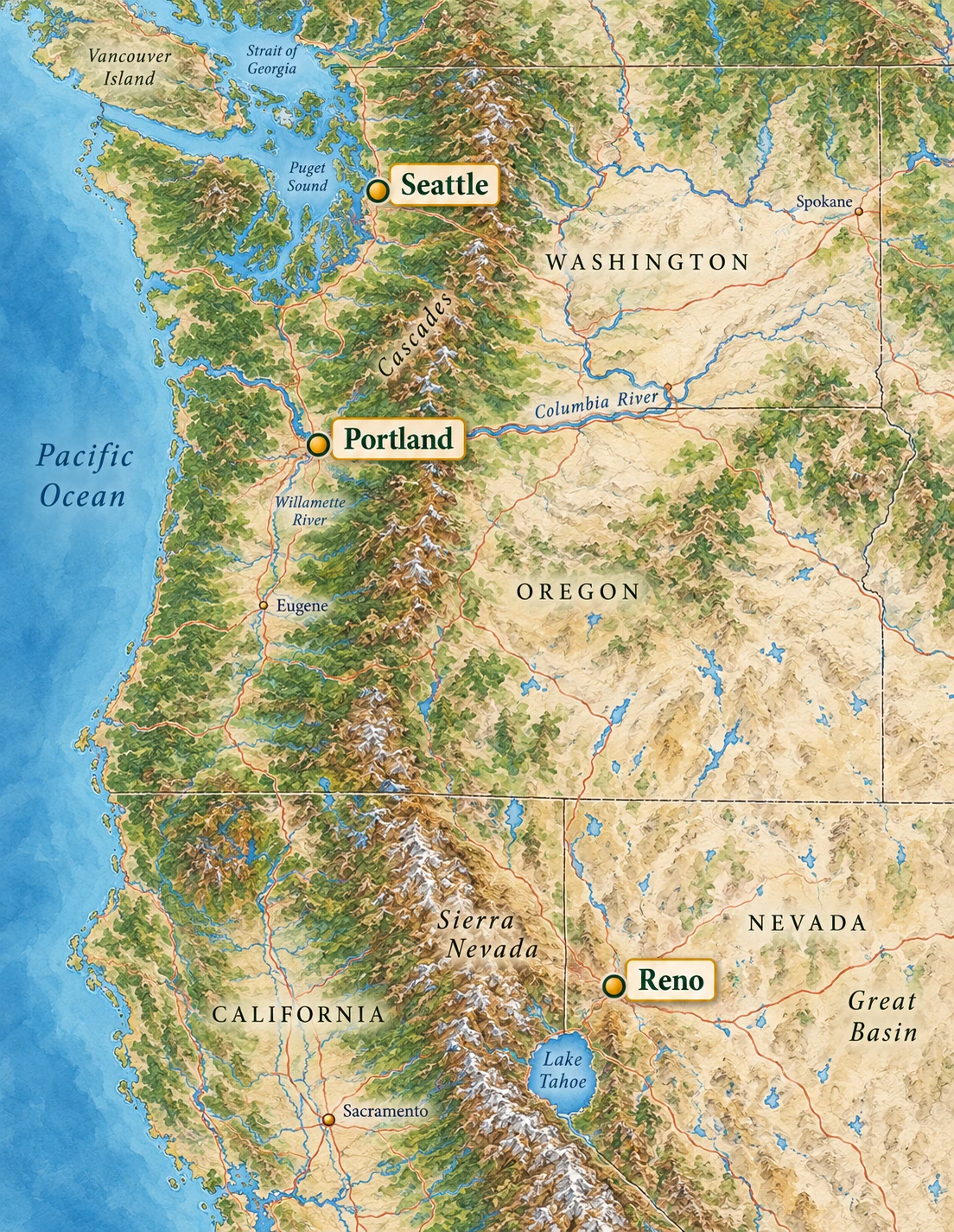
Geographic reference

Portland, Oregon: choose the local week rather than the idea of the whole Northwest
Portland is the Oregon comparison here. It may appeal when you want a Pacific Northwest city base and have a real role, program or location-approved income to support it. Begin with the home you could attain and the ordinary destinations around it. The wider region's coast, forests and mountains can open the search without becoming daily surroundings from every home in the metro.
TriMet's MAX network links Portland City Center with specific regional communities and the airport, with buses and other connections completing different trips. Match the actual worksite or campus and an evening return. A line near a home is a useful starting point, not proof of a complete car-free week or effortless access to every outdoor place you hope to visit.
Portland's historical gross-rent estimate is $1,655, $574 above Rochester's. Use a firm income arrangement and current property costs before relying on a portable salary to make the change easy. Add transport, care, coverage, setup and Rochester visits. A household changing jobs or beginning a course also needs the interval before earnings become dependable.
Spend time in the neighborhood and weather you would actually live with, make the workday and try one regular activity beyond it. If the coast or a particular outdoor destination matters, make that separate journey from the same home area. Keep Portland when the local City life is the benefit you want and the full month supports it. A distant regional attraction you would rarely reach may point toward another base instead.
Try first: Try an attainable home, the actual TriMet-supported work week and one realistic outdoor journey before committing to the wider region’s appeal.
Local sources: TriMet — MAX geography.
Seattle: make the larger housing commitment buy a life you will use
Seattle can be a serious option when a confirmed opportunity or desired City setting is worth a larger western commitment. It is the highest historical housing comparison in this Rochester selection: gross rent is $2,030, $949 above the origin. That does not price one home, but it makes the income-and-property question too important to leave until after a pleasant visit.
Start with the actual role or course and two home areas you could afford. Sound Transit's operating Link and regional services provide specific connections to investigate, with the local bus leg and walking route still part of the journey. Use the current network and alerts, rather than an old map or a future extension. A useful rail line can change the week without making every neighborhood or regional workplace equally accessible.
If the household expects to use fewer vehicles, try the errands and returns that would make that possible before entering the saving in the budget. Include care, provider access and the second adult's trip. A higher salary can help support the home, while the confirmed take-home amount, coverage and Rochester visiting pattern decide how much flexibility remains after the move.
Give the local week a proper trial in a season that could change your preference. Include an activity you would return to and the actual outdoor or waterfront outing that draws you west. Seattle becomes more persuasive when the household can participate in the City life it is paying for. If the payment leaves little room for that life, revise the home, opportunity or timing rather than let the destination name settle the decision.
Try first: Compare a real Seattle opportunity and attainable home at confirmed income, then test work, errands and a weekend return on the current network.
Local sources: Sound Transit — operating network.
Reno: an inland western base with the Sierra trip kept separate
Reno gives you an inland contrast to Seattle and Portland. It is east of the Sierra Nevada and near, rather than on, the regional lake and mountain destinations that may first attract you. It deserves investigation when a real role, supported income or household connection gives the move a purpose. Choose the ordinary Reno home and week alongside the wider outdoor setting.
RTC Washoe lists local routes and the RAPID Virginia and Lincoln lines, giving you specific corridors for a City travel comparison. Match the actual worksite, errands and return to the home you could choose. A useful urban bus does not establish the trip to every Sierra destination or make the wider area one easy transit journey. Establish the outdoor transport and season separately.
Reno's historical gross-rent estimate is $1,556, $475 above Rochester's. A credible income arrangement needs to support the property, necessary vehicles or fares, home operating costs, applicable coverage and eastern visits. If the outdoor plans require another vehicle or equipment, include them honestly. A move can be worthwhile for the life it offers while still costing more than the arrangement you would leave.
Try a workday in the home area you could choose, then make the specific regional outing at a realistic hour and in the season that matters. Investigate the actual property's access, risks and services. Keep Reno when inland western City life and the supported outdoor routine are what you want. If a Pacific waterfront home is the wish, recognize that this move offers a different answer before committing to the larger distance.
Try first: Test one actual RTC-supported or driving week and the separate seasonal Sierra trip, with the attainable home and full income in view.
Local sources: RTC — Reno and Sparks corridors · RTC — RAPID Lincoln Line.
Compare the money left after the whole month
Put the amount left after essentials at the top of the calculation. Housing matters, but so do the income you can keep, the vehicle arrangement, care, health coverage, utilities and the Rochester visits you want to make. A lower rent can be a useful opening. It becomes a household saving only after the other necessary changes fit into the same month. Use the current Rochester arrangement as one of the cases, with its actual costs rather than an average household's budget.
Rochester's historical gross-rent estimate is $1,081. Erie is $211 lower in this selection; Fargo is $135 lower, Brockport $86 lower, Syracuse $42 lower and Buffalo $35 lower. These point differences do not establish available homes or personal savings, particularly where the margins of error are large relative to the gap. They tell you where an actual housing search may be worth beginning. They do not justify losing a useful income or adding a car without counting it.
The four worked cases show the mechanism. In the chosen current arrangement, $650 remains each month. A home costing $150 less, paired with transport costing $450 more, leaves $350 at unchanged income. A confirmed better-paid role changes the remainder to $950. If take-home income falls instead, the same new expenses leave a $50 monthly shortfall. These are hypothetical inputs chosen to explain the calculation, not Rochester prices, destination quotes or a claim about your household.
Keep confirmed and possible earnings in different cases. An actual offer can support a home decision; the salary you hope to find after arrival cannot yet do the same work. A city's household-income median is also not a job offer or your likely take-home pay. For a remote role, ask whether the employer permits the actual state or country, whether pay or benefits change and which office trips remain necessary. For local employment, use the real worksite, hours and applicable qualification.
Give both working adults a transition. One person may receive a raise while the other loses earnings or needs time to transfer a qualification. A household can also gain a better schedule that reduces paid care, or lose nearby help and need to buy it. Show the changes explicitly. A budget is more useful when it explains why the result changes than when it squeezes all of these decisions into one general cost-of-living score.
Keep the first weeks separate from the settled month. Moving, travel, temporary housing and overlapping payments can use money before normal earnings and routines are established. Refundable deposits require cash but are different from spending you will not recover. Emergency money is another line again. A destination can look manageable once settled and still need a different timing or first housing choice because the household cannot comfortably fund the transition.
In the higher-income example, the improvement is $300 a month over the current $650 remainder. Chosen unrecoverable transition spending of $3,600 takes twelve full months to match that improvement. Deposits and emergency cash stay outside that recovery calculation. A move leaving $350 instead of $650 has no saving-based recovery period; it is a more expensive monthly arrangement. You may choose it for another benefit, but name that benefit rather than calling the move a financial saving.
Before committing, replace the examples with one attainable home and your own income and recurring costs. Ask the owner what is included, the employer what is confirmed and the care or coverage provider what actually applies. Include the journeys the household makes beyond work. If the result is a shortfall, change the home, work arrangement, timing or destination while you still have options. Finding that answer before a lease is signed is useful progress.
Hypothetical household · USD per month · chosen inputs, not city prices
| Monthly result | Current arrangement | Lower housing, more driving | Confirmed better-paid role | Lower income after moving |
|---|---|---|---|---|
| Money left each month | $650 | $350 | $950 | −$50 |
| Take-home income | $4,700 | $4,700 | $5,300 | $4,300 |
| Recurring essentials | $4,050 | $4,350 | $4,350 | $4,350 |
Current arrangement
$650Money left each month
- Take-home income
- $4,700
- Recurring essentials
- $4,050
Lower housing, more driving
$350Money left each month
- Take-home income
- $4,700
- Recurring essentials
- $4,350
Confirmed better-paid role
$950Money left each month
- Take-home income
- $5,300
- Recurring essentials
- $4,350
Lower income after moving
−$50Monthly shortfall
- Take-home income
- $4,300
- Recurring essentials
- $4,350
Housing saves $150, but transport adds $450. The same income leaves $300 less each month. A confirmed better-paid role leaves $950, a $300 improvement over the current arrangement; lower income produces a $50 shortfall.
See the hypothetical inputs
| Recurring expense | Current arrangement | Lower housing, more driving | Confirmed better-paid role | Lower income after moving |
|---|---|---|---|---|
| Housing and included home costs | $1,150 | $1,000 | $1,000 | $1,000 |
| Transport | $350 | $800 | $800 | $800 |
| Other recurring essentials | $2,550 | $2,550 | $2,550 | $2,550 |
Current arrangement
- Housing and included home costs
- $1,150
- Transport
- $350
- Other recurring essentials
- $2,550
Lower housing, more driving
- Housing and included home costs
- $1,000
- Transport
- $800
- Other recurring essentials
- $2,550
Confirmed better-paid role
- Housing and included home costs
- $1,000
- Transport
- $800
- Other recurring essentials
- $2,550
Lower income after moving
- Housing and included home costs
- $1,000
- Transport
- $800
- Other recurring essentials
- $2,550
These are chosen household calculations, not observed city prices, job offers or a moving estimate. Replace the inputs with your own complete recurring costs and confirmed income.
A $300 monthly improvement takes twelve full months to match $3,600 of unrecoverable transition spending. Keep refundable deposits and emergency money separate. A worse monthly result has no saving-based recovery period.
Compare historical rent and household-income estimates
Comparable Census places · 2020–2024 ACS five-year estimates · 2024 US dollars. Gross rent covers occupied cash-rent homes and applicable utilities, not current listings. Income is annual household income before tax, not a salary or take-home amount. The ± figure is the published 90% margin of error. Differences subtract Rochester point estimates; they are not a significance test or personal saving. Scroll the table sideways on a narrow screen.
Let the actual workplace or campus shape the search
Choose a home around the place you will attend, not only the city name on an offer or prospectus. Establish the building, required days, start time and return, then add the person whose work or study is different from yours. A good opportunity can be the reason to move, but it needs a household arrangement that lets you use it. The university, hospital or industry's general reputation cannot replace the actual role or course.
Rochester gives you a useful example of why this matters. RIT's main campus is in Henrietta. The University of Rochester's River Campus, Health Sciences location and Eastman School of Music have different addresses and functions. A home convenient for one may be awkward for another, even while all belong to the Rochester search. Ask which site the classes, laboratory, placement or shift actually use. If a future course changes campuses, include that possibility before taking on a long lease.
For a student or someone leaving the family home, compare the first year as well as the monthly payment. Count deposits, travel, equipment, the gap before the first wage and any institution's housing requirements that apply to you. Ask about the transport service you are eligible to use and its term-time calendar. A campus shuttle can be a real advantage while leaving a holiday, placement or off-campus evening trip unresolved.
Brockport illustrates another useful distinction. A home near its university can support a local campus week, while regular travel back into Rochester is another task. The university describes a booked RTS connection and a student shuttle with its own stops and calendar. Do not use the shuttle as a general village bus for everyone or assume the college name makes a City job easy to reach. Choose around the actual program and the journeys that remain outside it.
If you are changing professions, write down the path to earning in the new role. Compare admission, tuition, time in study, placements, equipment and the work you can realistically combine with the course. A shorter credential and a longer degree create different transition budgets. For a regulated profession, confirm the destination authority's licensing requirements and the employer's start conditions. Being invited to interview is different from having the approval needed to practice.
For remote work, establish the permitted location before counting the salary as portable. Include internet available at the address, a usable workspace, working hours and recurring office travel. A coast or mountain setting may still suit you when colleagues' hours differ, but decide when you would actually enjoy it. An international move adds the applicable residence, work, coverage and tax arrangements; keeping the same laptop does not settle them.
Put the second adult's route and opportunities on the same map. If one person will pause work, give the pause a budget and a point to reconsider it. If both need new jobs, a staged move may be more manageable than assuming two suitable offers will arrive quickly. Preserve useful Rochester help during the change when possible. The household should be able to explain how the next place supports everyone whose income or care makes the plan work.
Keep the opportunity and the home together in the shortlist. A confirmed role in Buffalo, a course in Syracuse or a rail-supported Chicago week can each be a good reason to investigate a different base. The farther settings need the same concrete beginning. Choose the real work or study destination, then two plausible home areas and one ordinary-day journey to test. That gives the search something firmer than a list of cities said to have good jobs.

Build the comparison around the people sharing the move
Begin with the household member whose day has the least room to change. A child may need a particular program, an adult a fixed shift, or a relative regular treatment and help. Put that person's essential journey, hours and support into the comparison before adding the attractive extras of the new place. A home can look right for the household as a whole while giving one person a day that is much harder to manage.
For younger children, match the real care place with the adults' hours and the date you need it. Ask about availability, age group, charges, pickup and the arrangement when a child cannot attend. A provider near the home is useful only if the place and hours work. If a Rochester relative currently supplies flexibility, decide how the next household would preserve or replace it. The effect can be different from a simple change in childcare fees.
For a school move, establish the district and the actual process before relying on a nearby building. RCSD uses online registration and separates it from applicable school selection and placement. The current registration page directs families to grade-specific steps. A Rochester postal address may be outside the City district, and the same named village or town can raise a different district question. Ask about the full address, grade, required support and start date.
Give teenagers a chance to name what matters to them. It may be a course sequence, music group, team, part-time job, friendships or the ability to travel without an adult. Check the actual program and calendar rather than ask them to judge a city from a sightseeing day. A move can bring worthwhile opportunities while still requiring a careful handoff for the parts of their present life that cannot restart instantly.
For one parent, draw the complete pickup chain: home to school or care, then work and back. Add an appointment, a late finish and an evening when the usual helper is unavailable. This makes the value of a nearby move or a more flexible distant role easier to see. A smaller home close to dependable help can be more useful than extra space that makes every pickup difficult. The answer follows the actual day, not a general rule about which city suits single parents.
For several generations, agree how rooms and responsibilities would be shared. Look at bedrooms, bathrooms, entrances, quiet space and the person who needs privacy at different hours. Establish the actual lease, occupancy and property rules for the arrangement. Include who drives, buys care, maintains the home and handles an unexpected interruption. Several incomes or more floor space do not automatically make the daily arrangement easier for everyone.
If treatment, disability support or a particular service is essential, obtain confirmation from the provider and coverage source that matter to the person. A city having a large medical institution does not establish an appointment, an accessible trip or the relevant insurance arrangement. Plan records, medicines and any gap between providers. Ask the person receiving support which changes would preserve independence and comfort, rather than treating them only as another journey to organize.
Your stage of life helps you name what the next home needs to support. An eighteen-year-old beginning work and an older adult retraining may both need affordable housing, a useful bus and room to study. Put your own language preferences, citizenship, community connections and family ties into the search when they matter. Choose the people and activities you want within reach, then see which home and routine let you take part.

Local sources: RCSD — registration and school selection.
If you are moving alone, give the new week a few anchors
A move on your own can be a chance to choose a setting around your interests and working life. It also means the full home payment and many practical decisions rest with you. Begin with a sustainable one-income month and a few dependable anchors: work or study, groceries, a recurring activity and someone you could contact when the usual plan fails. You do not need a ready-made friendship group before moving; you need a credible way to build regular contact.
Choose one activity you would actually attend. A library group, class, volunteer role, faith community, sport or creative workshop can bring you back to the same people. Check the location, cost, eligibility and journey home at the time it happens. A long list of attractions is less useful than one commitment that fits after work. If you are choosing between a village and a larger city, compare the participation you would manage rather than only the number of venues.
Try the return to the home area after your usual evening finish. Include the walk from the stop or parking place, crossings, lighting and the entrance. Name what would make you comfortable and what you would do if the usual journey failed. You may prefer a more direct route, a building entrance you can use easily or someone nearby who could help. Test those particular needs from the home instead of relying on a broad impression of the city.
Compare Rochester's useful central week honestly with the next place. A nearby canal village may offer a pleasant center while the bus you need runs much less often. A booked suburban connection may work during its hours and leave the weekend unresolved. A larger transit city can offer more possibilities while still requiring care about the exact home and return. Test groceries, an evening activity and a Sunday journey before removing a car or regular paid ride from the budget.
Leave room in the month to participate in the life you moved for. A home that consumes the entire margin can make an interesting city feel restrictive. If sharing housing is part of the plan, establish privacy, lease responsibility, guests, payments and what happens when someone leaves. A roommate's contribution should be an agreed arrangement, not an assumption used to make a payment look affordable.
Keep some Rochester relationships in a form you can sustain. Decide whom you would like to visit and how often time and money make it realistic. Buffalo or Erie changes that pattern differently from Seattle, Vancouver or Mérida. Include the actual travel day and ground connections, rather than one appealing fare. The plan can also include regular calls and visits to you. Distance changes how you maintain a connection without deciding whether it still matters.
Give the first ninety days a modest structure. Establish the home and essentials first, then make the recurring activity part of the week and add another connection once the routine feels manageable. Notice what repeatedly costs time or effort. If you rent first, those observations can guide a better next address. A new city cannot guarantee friends or a relationship; it can give you a setting where the things you value are reachable and you have the independence to take part.
Let a smaller home remove the work you no longer want
Downsizing is most useful when you decide what should become easier. You may want fewer stairs, less cleaning, less maintenance or a smaller payment. You may want more time with people, easier appointments or the freedom to travel. A smaller floor area can help, but it does not guarantee any of those results. Compare the daily work the home asks of you with the life you want it to support.
Walk the complete entrance before counting bedrooms. Start at the legal parking or drop-off point, bring the grocery trip to mind and follow the route to the rooms you would use. Look at thresholds, doors, steps and the bathroom. An elevator can help, while its access and the alternative during an outage still matter. An attractive first-floor listing needs a usable route from the street and a layout that suits the person, not only a ground-floor label.
Give a more suitable Rochester home a place beside the distant options. Staying near familiar care, friends and errands can remove the upheaval of rebuilding those connections. A nearby village may provide another useful arrangement when its home and journeys fit. A farther move can be right when family, an opportunity or the preferred season is there. Measure what the distance gives you against what it asks of you and the people who help.
Use actual recurring costs for a fixed income. A paid-off house can still bring maintenance, insurance and operating expenses; a rental may reduce some work while adding a regular payment and uncertainty at renewal. A managed property can add fees and rules. Include care, transport and visits. Another state's reputation for retirement does not establish your own tax, coverage or provider position, and a much warmer winter can introduce a different summer routine.
Try a week with less driving if you expect that part of life to change. Reach the provider, groceries and an enjoyable activity by the method you would actually use. Confirm appointments and coverage with the relevant people. A free downtown service does not replace every necessary journey, and a student shuttle is not a general retirement transport service. The useful home preserves independence by making both essential and enjoyable trips manageable.
Choose the possessions that belong in the next home and measure them against the rooms and carrying route. Allow time for family decisions and any agreed sale, donation or separate removal. Basic furniture preparation, placing and unwrapping furniture, unpacking boxes and removing unwanted material are different tasks to agree. A smaller shipment can make the arrival calmer when the decisions are made before loading, rather than leave a sorting project at the receiving address.
Keep the option that removes effort where you feel it most. It may be another Rochester unit, a village near family, a regional city with the right support or a faraway setting you have tried in the difficult season. The aim is a home you can manage and enjoy, with the people and services that let you remain independent. The number of rooms is one part of that outcome.
Choose the whole year, including the weeks you would rather skip
Decide how often the landscape needs to be part of your life. A daily lake walk, a mountain outing at weekends and more land around the home lead to different searches. Rochester already offers a river-to-Lake Ontario setting, while the nearby canal villages offer another local rhythm. Those may satisfy part of the wish. A larger move becomes more compelling when the environment you want is genuinely missing from the week you can build here.
For a seasonal change, name the difficulty you want to reduce. Less snow clearing, an easier walk to a bus and more comfortable winter outdoor time are related but different wishes. The common NOAA comparison uses Rochester airport, Raleigh-Durham airport and Fargo airport. January means are 26.2°F, 41.9°F and 9.2°F respectively; July means are 72.3°F, 80.5°F and 70.7°F. These are 1991–2020 whole-month station averages including nights, not afternoon highs or a forecast for your home.
That makes Fargo a particularly clear tradeoff. A lower historical housing estimate may be worth investigating for a real role or preferred inland life, while the winter is a much colder comparison. Raleigh offers a warmer January background with a hotter July background and a higher housing estimate. You can prefer either setting. Try the practical benefit and the difficult season together so that a housing or climate advantage does not hide the part of the year you would struggle to enjoy.
For a nearby move, keep the regional winter in the plan. Changing from Rochester to a village does not promise a snow-free route. An easier entrance, someone else handling clearing or a more dependable arrangement for a necessary trip may remove more daily difficulty than a small geographic shift. Ask about the actual property and winter responsibilities. The task is to improve the part of winter that troubles you, rather than assume every address experiences the season in the same way.
For water, connect the attainable home with the shore you would use. The Rochester lakefront, Erie, Wilmington and Seattle give very different relationships between city life, water and weather. A coastal destination can still leave you with a separate drive to the beach. Include the day and hour you would go, the return and the household budget. It is easier to judge the extra commitment when you know whether the view would be a daily pleasure or an occasional outing.
For mountain and open-land life, put the real outdoor destination beside the home and worksite. Rapid City sits by the Black Hills, Salt Lake City has the Wasatch and a wider valley, and Albuquerque brings a high-desert city and Sandia setting. They are not one interchangeable mountain lifestyle. Local transit can help with the city week while outdoor access remains another journey with seasonal conditions, equipment or vehicle needs.
Reno gives a useful western contrast to Seattle and Portland. It is inland, east of the Sierra, rather than a Pacific waterfront base. Choose the local climate, work and ordinary errands as well as the regional outdoor attraction. A beautiful weekend near a lake or mountain cannot establish the home area's whole year. When a property is promising, investigate the actual risks, access, utilities, coverage and maintenance that apply to it.
For a rural home, give the necessary services the same attention as the space. Internet at the property, utilities, work, school, treatment and shopping may need separate arrangements or drives. Land is easier to enjoy when time and money remain after maintaining it. Keep the place when the whole year supports the way you want to live, including the less comfortable season and the ordinary errands between the photographs.

| Regional weather station | January mean | July mean |
|---|---|---|
| Rochester Greater International Airport, New York | 26.2°F | 72.3°F |
| Raleigh-Durham International Airport, North Carolina | 41.9°F | 80.5°F |
| Fargo Hector International Airport, North Dakota | 9.2°F | 70.7°F |
Regional-station monthly means, not a forecast or property condition. NOAA climate normals.
Could another country be the change you want?
An international move can change the language around you, the workday, household arrangements and the way you keep Rochester relationships. Those differences may be part of the appeal. Begin with a credible way for each accompanying person to live and, where relevant, work there. Then investigate the ordinary home and local week. Familiarity from a holiday or a short visit does not by itself settle the right to make a home.
Canada is one of four examples, with Vancouver as the detailed beginning. Toronto, Montréal, Ottawa and Calgary offer other Canadian horizons when a role, family connection or setting points elsewhere. The three other examples are Braga in Portugal, Manchester in the United Kingdom and Mérida in Mexico. One is an inland northern Portuguese city, another a larger English-language regional base, and another a Yucatán city whose local life needs to appeal beyond a beach holiday.
Keep the household budget in the currency of the arrangement you are considering. Use Canadian dollars for Vancouver, euros for Braga, pounds for Manchester and the actual Mexican-peso or other stated contract terms for Mérida. Record the currency of income and the conversion on which the plan depends. Add coverage, setup, administration, transport and visits to Rochester. The US rent table supplies no housing price or offered wage in any of these places.
Give the household's work, school and care arrangements separate attention. One adult's eligibility does not automatically settle everyone else's rights or services. Confirm any employer permission for remote work and the applicable status for the actual activity. Sterling Oakbridge's Rochester long-distance page covers review of US and Canada routes. Portugal, the United Kingdom and Mexico are informational examples here, not additional company shipment offers.
Canada: a Vancouver week between the water and the mountains
Start with Vancouver. Other cities to explore: Toronto · Montréal · Ottawa · Calgary.
Canada: a Vancouver beginning
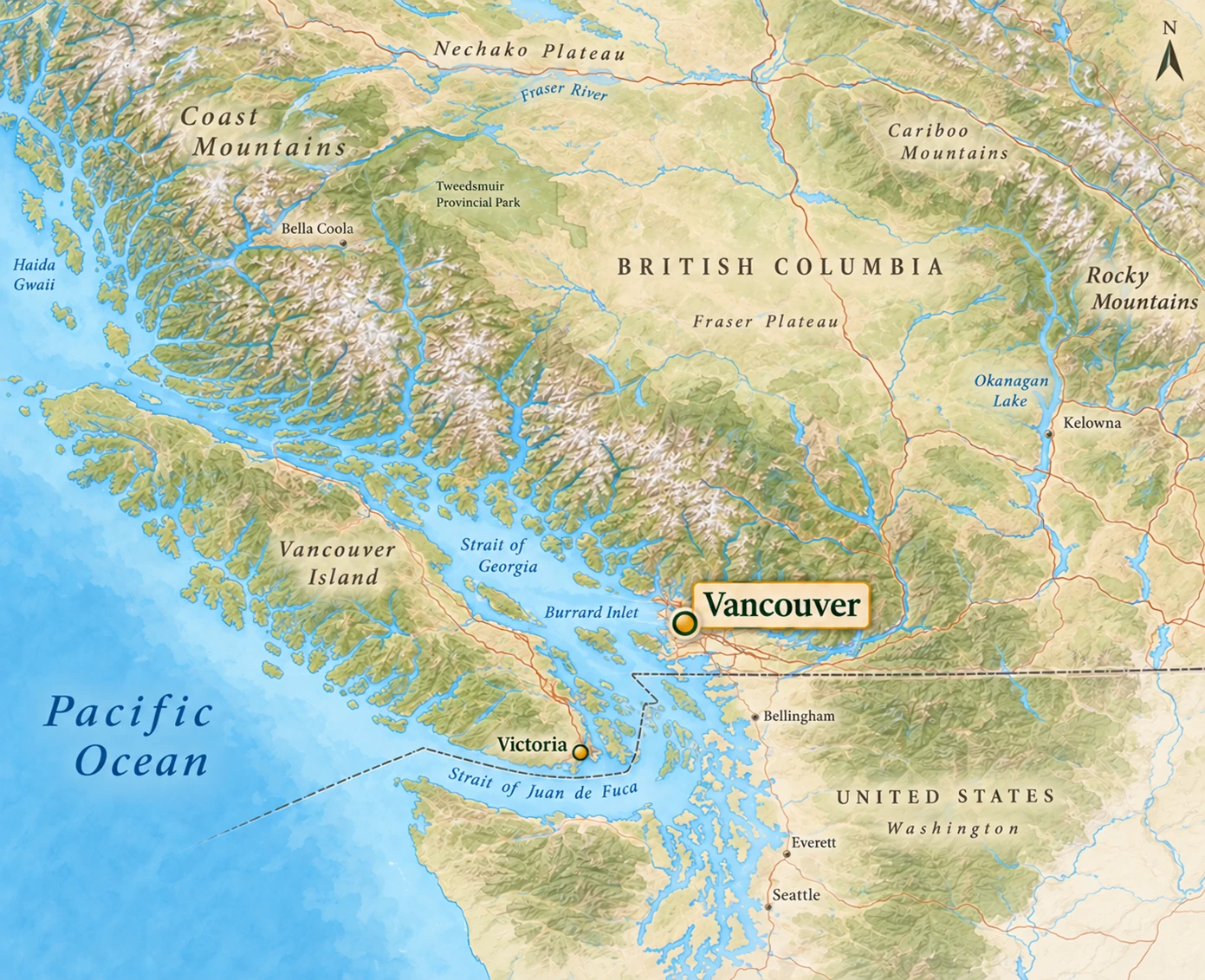
Geographic reference

Vancouver changes the Rochester question in two ways at once: a Pacific-side urban setting and a household life in another country. It is worth investigating if a real role, course or family connection supports the move, or if an applicable residence and work arrangement lets you choose the setting. Start with a home area that would make the city week enjoyable. The mountains and waterfront can be a reason to explore without becoming a substitute for the home, income and relationships you would need.
TransLink's operating SkyTrain network gives the search concrete corridors: the Expo, Millennium and Canada lines connect particular city and regional destinations. Add the bus, walking and other connections the actual home requires. Vancouver City, Burnaby, Richmond and the other regional municipalities are different housing and service contexts. The Broadway Subway is a future connection, with a planned 2027 opening at the checked date; do not choose an arrival-day home as though the extension is already carrying you to work. Check the current trip and its accessible return.
Canada's immigration authority separates employer-specific permits, open permits and applicable exceptions or other routes. Establish the arrangement each adult can actually use. An open permit is not available to everyone simply because that category does not require a specific employer. If you intend to retain US employment, confirm the employer's location decision and the applicable basis for working from the Canadian home. A visit across the border, a course admission and a work arrangement answer different questions.
Build the household month in Canadian dollars around an attainable home, with the actual income currency visible. Include transport, medical coverage, care, household setup and Rochester visits. A transcontinental return to western New York is a larger part of this choice than a casual trip to nearby Ontario. Compare the flight and ground legs, leave needs and the person who could help if a family member needs you. The US rent table in this guide supplies no Vancouver listing price or Canadian salary.
Try a normal workday from the area you could afford, then one outing you hope to repeat. Include the weather and early or late return you would live with, rather than only a clear-day waterfront visit. Keep Vancouver when that supported ordinary week is appealing. Toronto, Montréal, Ottawa and Calgary can widen the Canadian search for another opportunity or family connection; their seasons, services and housing arrangements need their own comparison.
Try first: Confirm the household work and residence basis, then test an operating-network Vancouver week, a Canadian-dollar budget and the Rochester return.
Local sources: IRCC — work routes · TransLink — operating and future network · TransLink — SkyTrain corridors.
Portugal: begin with a Braga home and the life around it
Start with Braga. Other cities to explore: Porto · Lisbon · Coimbra.
Portugal: Braga in the north
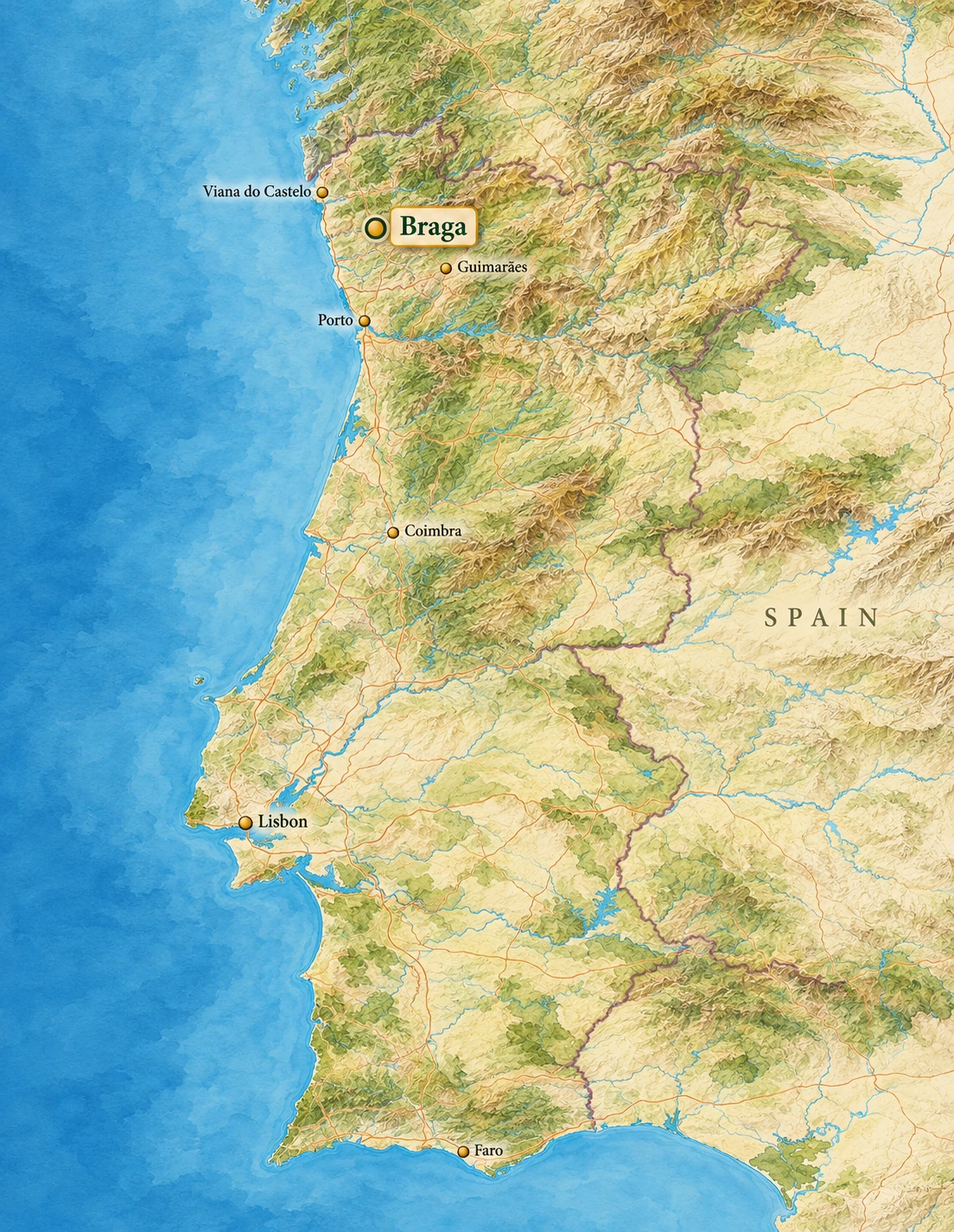
Geographic reference

Braga offers a northern Portuguese city beginning when a different language and cultural setting is part of what you want next. It can be worth exploring with a supported job, course, family or overseas-income arrangement. Start with the neighborhood week rather than the idea that Portugal must be inexpensive. A local home, regular activity and usable route to work or study give you something concrete to compare with Rochester.
TUB's network map provides city and campus connections to investigate, including the University of Minho's Gualtar area. Use the actual campus or workplace address, not just the name of the institution or the center of Braga. Trace the grocery trip and return in the hours you need, and check the current timetable before a housing commitment. A network map helps locate a corridor; it does not establish frequency, availability or a step-free journey for every home. Porto and an Atlantic outing are separate trips rather than features of the front door.
Portugal's AIMA information distinguishes residence and work categories, including a route involving professional activity performed remotely for outside Portugal. Confirm the applicable visa and residence process with the responsible official authority for your citizenship, employment and household. A remote US job alone does not complete that process. Avoid basing the plan on an old waiver or an assumption that a route once discussed online is still open in the same form. Ask the employer whether the location, hours and obligations are supported before treating the income as retained.
Price the actual home and recurring needs in euros. Include transport, coverage, communications, any care or school arrangement, and trips back to Rochester. Show any currency conversion separately from the underlying rent or income. Deposits, initial setup and the interval before the household is established need their own cash plan. Obtain current housing terms and the requirements for the work or residence arrangement you would use. Keep an unanswered amount visible until the owner, employer or responsible authority can confirm it.
Try the language you would use with a provider, one work or study day and an activity you could attend regularly. Consider how the household would manage a difficult week and a visit home. Braga belongs on the shortlist when that everyday life appeals and the legal and financial arrangement supports it. Porto, Lisbon and Coimbra remain other Portuguese starting points if the actual opportunity points there; they do not inherit Braga's commute or home choice. The discussion helps compare living arrangements and does not offer a Sterling Oakbridge shipment to Portugal.
Try first: Match the official residence and work route, then price and try a Braga home area, its actual TUB journey and one regular local activity.
Local sources: AIMA — working and residence categories · TUB — Braga urban bus network.
United Kingdom: Manchester around the actual role or course
Start with Manchester. Other cities to explore: Birmingham · Edinburgh · London.
United Kingdom: a Manchester beginning
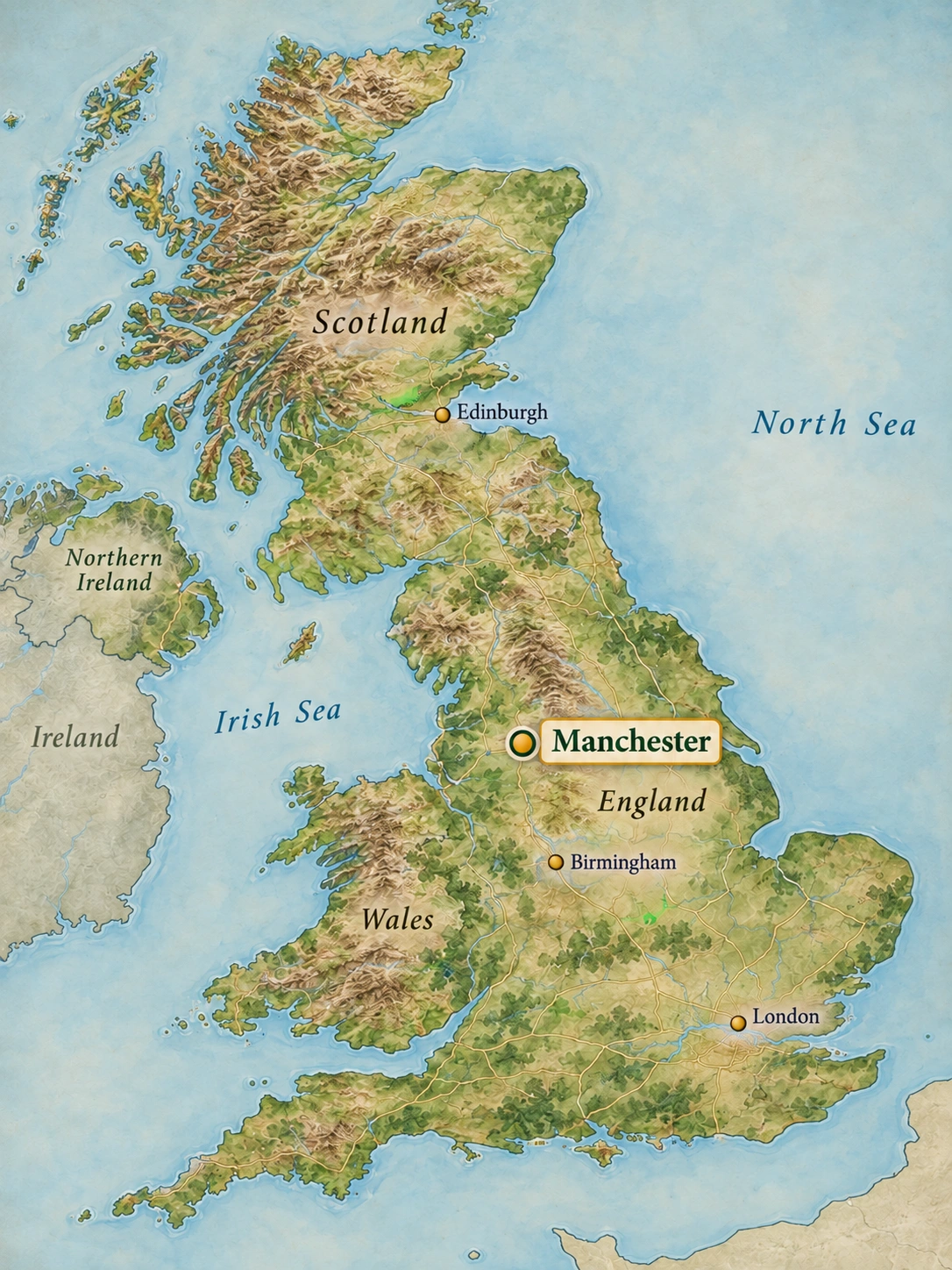
Geographic reference

Manchester is a useful English-language international comparison when an actual role, course or household connection gives the move a purpose. It offers a different urban and cultural setting rather than a general answer to the cost of leaving Rochester. Begin with the building where you would work or study and the home areas that could support that week. A visit to the center can spark interest without showing what the daily return and household month would be.
The Bee Network's bus and Metrolink maps let you investigate particular connections across Greater Manchester. City of Manchester and the surrounding boroughs are different administrative and housing references. Locate the home, work or teaching building, essential errands and the return at your actual hours. Walking from the final stop, service changes and access through the building matter to the result. Treat other rail journeys and their ticket arrangements separately instead of assuming every service on a regional map is covered by one fare or works all night.
For someone considering the Skilled Worker route, the official requirements include an approved employer, a certificate of sponsorship, an eligible role and applicable pay and English-language conditions. It is a specific route, not permission supplied by being an experienced English speaker or receiving an informal expression of interest. Establish the route for the actual job, your existing citizenship or status and any accompanying family. A student route has its own work conditions; do not build the household budget around unrestricted earning without checking the permission that applies.
Make the recurring budget in pounds from a real home and supported income or study funding. Include the actual transport arrangement, coverage and care if needed, household setup and Rochester visits. Keep a deposit and emergency cash apart from money that will be spent on the transition. If another adult expects to work, establish their applicable permission and a realistic earning plan too. The US city rent table cannot supply a Manchester rent, a British pay offer or the household's right to a service.
Try the ordinary commute and evening return, a grocery trip and one regular activity outside work. Ask how you would maintain Rochester relationships over a transatlantic distance, including a return at short notice. Keep Manchester when the supported opportunity and home week justify that change. Birmingham, Edinburgh and London can become different comparisons for their own roles or family needs; their housing, administrative context and transport need separate research. A familiar language can make some tasks easier while a move still asks you to establish a new working and social life.
Try first: Confirm the specific work or study and household route, then test a pound-budgeted Manchester week from a home you could choose.
Local sources: United Kingdom — Skilled Worker route · Bee Network — bus and Metrolink maps.
Mexico: Mérida as an inland Yucatán home, with the hot season included
Start with Mérida. Other cities to explore: Querétaro · Guadalajara · Campeche.
Mexico: Mérida in northern Yucatán
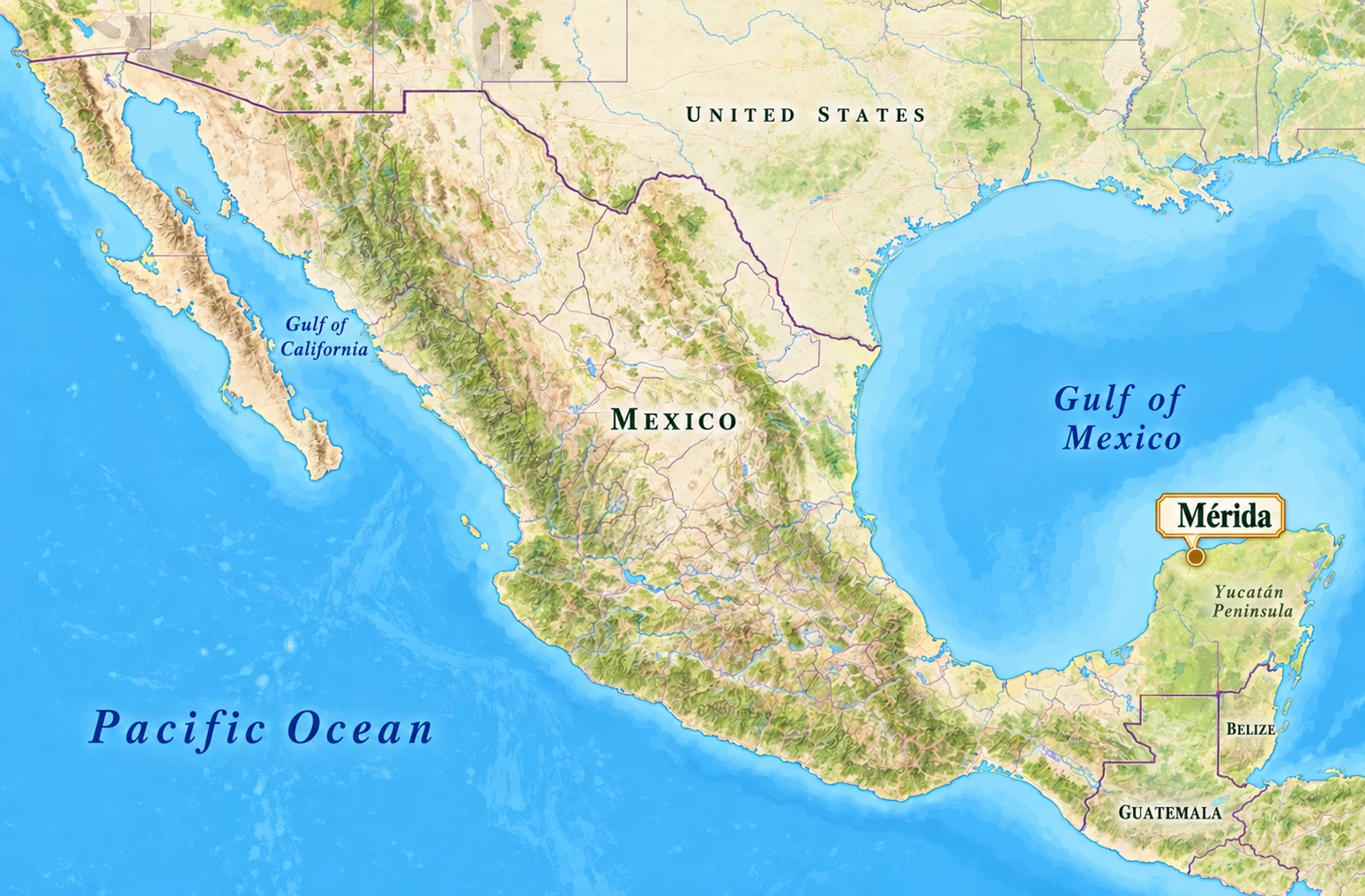
Geographic reference

Mérida opens a different climate and language comparison from Rochester: an inland city in northern Yucatán, rather than a home on the beach. Explore it when the city life itself appeals and you have a credible way to live and earn there. Begin with the ordinary week you want to build, including a local activity, services and the home you can actually use. A coastal outing can add to that life without becoming an assumed daily benefit of every address.
Yucatán's transport authority publishes Va-y-Ven and IE-TRAM route information for particular city and regional connections. Put the home and required destinations on the operating network and check the current return. A route through the region does not make every wider-area home convenient without a car. Include the walk in the conditions you would experience, an errand with bags and the return after a regular evening activity. If the coast is the reason you are looking, make that trip separately from the routine that must work on a weekday.
The Mexican consular information separates a visitor arrangement, work-related entry and temporary, student or permanent residence categories. Confirm the route that matches your citizenship, expected length of stay, work and accompanying household. Permission to enter for a visit does not settle permission to live and work there, including an assumed arrangement involving a US laptop. Use the responsible consulate and current official requirements for your case. Do not plan around an old income or fee number taken from a previous year's application sheet.
Make the home budget in Mexican pesos with the income currency explicit. Include utilities and cooling, transport, coverage, any care, communications, household setup and Rochester visits. Ask what the particular rental includes and who arranges the services. An advertised payment is only one part of the month. Keep conversion assumptions visible and allow for the period when you are establishing the household. Use the home you could actually rent and the services you need to see how much flexibility the income would leave.
Try the hotter part of the routine you expect to find challenging, not only the most comfortable travel season. Use the language needed with providers and try an activity where you could become a regular. Keep Mérida when the supported household arrangement makes the inland city week attractive. Querétaro, Guadalajara and Campeche can be later searches for a different role, setting or connection; none inherits this example's route or seasonal experience. Mexico remains a living-choice discussion here, with no company moving-service offer implied.
Try first: Establish the applicable residence and work arrangement, then try an actual Mérida home area, its current journeys and the less comfortable seasonal routine.
Local sources: Mexico — New York consular visa categories · Yucatán — transport authority.
Make the visit answer the question that could change your choice
Choose a trial that could rule the place out as well as confirm its appeal. If commuting is the problem, make the actual home-to-work journey and return. If living alone is the concern, include groceries, an activity and the evening trip to the building. If weather is the reason to move, experience the season you least understand. A comfortable weekend around the main attractions can be enjoyable while leaving the deciding question untouched.
Find one or two plausible home areas before the trip. A real property, workplace or program can provide the anchor even if you are not ready to apply. Allow time to reach those areas from your accommodation and to use the ordinary routes. A hotel beside a central attraction may produce a very different week and payment from the home you could choose. Your comparison should be with an attainable life rather than the visitor's most convenient version.
For the workday test, include the walk, wait, transfer and correct entrance. Try the return after the hours you expect, with any care pickup in the chain. Use the operator's current service and accessibility information for the day. A fixed bus, a booked shared ride and a campus shuttle have different conditions; an easy journey on one does not prove the others will fill the remaining gaps.
Do ordinary errands while you are there. Buy the groceries you use, find a pharmacy, try the walk to a library or recurring activity and notice what remains open at the right hour. Ask the provider or property manager a specific question. If you are comparing a village center, make the trip from the actual home as well as enjoying a walk around the shops. The two can be very different distances.
For a serious home possibility, establish the complete payment, included utilities, heating and cooling, pets, deposit, repairs, clearing and lease terms. Follow the entrance and the route the largest furniture would take. If accessibility matters, inspect it with the person who will use it whenever practical. A listing image helps you choose a visit; it cannot settle dimensions, condition or the arrangement with the owner.
For children or a dependent relative, make the contacts that affect the moving date. Ask about the actual address, program, care availability and start. Let teenagers see the places and journeys that would become theirs. If an essential provider or helper cannot confirm the arrangement, leave that answer visible. A household visit is useful when it helps people understand the ordinary life they are choosing, not only approve its most attractive afternoon.
Test the return to Rochester in the form you would really use. Include the drive or flight, ground connections, time off and the frequency you can afford. Do not rely on one unusually low fare or ideal road journey. Vancouver or a European home asks a different visiting commitment from Buffalo. Decide whether that pattern suits the people involved before treating distance as a detail the moving date will somehow solve.
After the visit, write down observations and remaining questions separately. “I reached the campus for the required start” is an observation; “every return will be easy” is an assumption. Keep the home area that worked, the season still untested and the answer you need from an employer, owner or provider. A first rental or another short trial can be worthwhile when the place remains promising and the unresolved question is too important for a long commitment.
Keep two to four places and a next step for each
Choose the options you can explain clearly enough to act on. Each needs a particular benefit, a manageable household month and an ordinary week you can picture. Another Rochester home is a valid option. So is a much larger change when it gives you something you value and the household can support it. The shortlist does not need a winner today; it needs a small number of real possibilities with a useful next decision.
Write the reason in plain language. “A home with an easier entrance near the person who helps” is more useful than “a good retirement town.” “A confirmed role with a workable return by bus” is more useful than “a strong job market.” “A warmer winter with a summer routine we have tried” is more useful than “better weather.” If the reason remains vague, clarify it before adding another group of cities.
Put the hardest compromise beside the benefit. It may be a higher payment, less frequent Rochester visits, another vehicle, a different language environment or a more demanding season. Add the recurring amount left and the transition cash separately. Where a number remains unknown, identify who can answer it. A blank attached to a question is more useful than replacing your own rent or salary with an unrelated city median to make the sheet look finished.
Give each place one next action and a time to revisit it. You may need the employer's location decision, a property viewing, a school response or a journey in another season. If the answer removes the place, keep the finding and make the list smaller. Research has done useful work when it helps you stop pursuing a poor fit. Time already spent looking does not oblige you to keep an unsuitable option.
When the home and direction become real, turn to the move itself. Send both addresses when available, the inventory, likely dates, the work you want handled and the building and truck access at each end. Rochester's older porch, apartment stairs and shared driveway can require different arrangements from a managed building. Establish who can receive the shipment and when the furniture can enter the next home. The destination city alone does not define that job.
Use the Rochester long-distance page for the actual shipment and service discussion. Keep immediate essentials, medicines and important documents with you through the transition. Agree packing, basic furniture preparation, any optional box unpacking, storage gap and separate removal work for the tasks you need. A clearer choice of home is worth carrying through into a clear departure and arrival plan, with the receiving arrangement confirmed before the shipment depends on it.
The sheet below can be printed or downloaded without signing in. Use it for your own household and the places that remain on the list. The common-period data and source notes follow so you can understand the basis of the comparisons. The useful result is a next step you can take, together with a clear view of what still needs an answer.
Compare two to four places you could call home
Rochester, New York origin · date:
What must change?
Three things to keep:
| My comparison | Place 1 | Place 2 | Place 3 | Place 4 |
|---|---|---|---|---|
| Place / actual home | ||||
| What gets better? | ||||
| Hardest compromise | ||||
| Must-haves and support | ||||
| Take-home income / month | ||||
| Essentials / month | ||||
| Money left / month | ||||
| One-time costs you will spend | ||||
| Refundable deposits | ||||
| Cash kept for emergencies | ||||
| Answer still needed / who to ask | ||||
| My next step / when |
For each place, write what gets better, the hardest compromise and the monthly amount left after essentials. Keep the home and reliable income together. Note the answer still needed, who to ask and your next step and date. Leave unknowns visible. Record one-time spending, refundable deposits and cash kept for emergencies separately.
Questions when choosing where to move from Rochester
Where should I start if I want to leave Rochester but do not know where to go?
Choose one part of your week to improve and three useful Rochester connections to keep. Compare Fairport, Pittsford or Brockport when work or people still anchor you locally; use Buffalo, Syracuse or Erie for a separate regional base. Look farther when a different role, season or landscape is the real reason. Keep two to four places you can explain through a benefit, a tradeoff and the next practical test.
Which examples offer the clearest housing-cost opening from Rochester?
Erie has the largest lower historical gross-rent estimate among these examples: $870 against Rochester City’s $1,081, a $211 difference in the common 2020–2024 ACS period. Fargo is $135 lower but adds a much colder January comparison. Brockport, Syracuse and Buffalo have smaller point-estimate gaps. These figures identify homes worth investigating; actual rent, retained income and the full transport and care costs decide your saving.
Would a nearby village usually reduce my rent?
The data do not support treating the three villages as a general cheaper option. Historical gross rent is $1,165 in Fairport, $1,734 in Pittsford and $995 in Brockport, against $1,081 in Rochester City. Brockport’s $86 lower estimate has a $127 margin of error. Choose a particular home for the improvement it offers, then compare its complete payment and required journeys.
Does a Rochester mailing address mean the home is in Rochester City?
No. Use the full address and the municipality responsible for the question. A Rochester postal name can refer to a home outside the City, just as a Pittsford or Fairport mailing address can extend beyond the named village. Municipal services, school placement and a campus connection need their own address-specific answer. The ZIP code alone cannot supply those answers.
Could another Rochester home solve the problem without a distant move?
Yes, when the main issue is stairs, room arrangement, upkeep or a particular journey. Compare a home that fixes that issue while preserving useful work, care and people nearby. A local change cannot provide a job or family connection in another region, or a fundamentally different seasonal setting. Keep the local alternative in the shortlist when it solves the actual problem.
Can I use RTS on weekends from Fairport?
The current RTS 50 Fairport/Penfield timetable shows service seven days a week, with a published 120-minute frequency and a connection at Blossom Loop. That is separate from RTS On Demand, whose weekend service has ended. Test the actual stop, connection and return for the day you need; a two-hour route is a different household proposition from a frequent central corridor.
Can Brockport’s student shuttle replace a general Rochester commute?
Plan a Rochester commute separately. Eagle Run is a campus service with its own calendar, stops and access arrangements. RTS On Demand in Brockport is a separate bookable service with defined weekday hours and connection points; it is not an all-day direct ride to every City destination. Test your eligibility, booking and complete return before making either service essential to the home.
Is RIT’s main campus in Rochester City?
RIT’s main campus is in Henrietta. University of Rochester also has distinct River, medical and Eastman locations. Use the actual work or teaching building and required hours when comparing a home. A regional institutional name or a Rochester postal address does not establish the journey, and a useful route for one campus may not serve another.
Which places should I compare if Rochester winter is the main reason to leave?
Begin with Raleigh or the other southeastern examples when a warmer winter is the aim, then include their summer routine in the decision. The checked station normals show January and July monthly means of 41.9°F and 80.5°F at Raleigh–Durham, against 26.2°F and 72.3°F at Rochester’s airport. Those are long-term monthly averages, not daily highs or a forecast for a home. Try the harder season as well as the attractive one.
Would Fargo make sense as a cheaper escape from winter?
Fargo is a cost-and-opportunity comparison that asks you to accept a colder winter. Its historical gross rent is $135 below Rochester City’s, while the airport’s January mean is 9.2°F against Rochester’s 26.2°F in the same normals period. Keep it for a real job, home or northern-plains preference. If reducing winter effort is the leading goal, the lower housing estimate alone is a poor reason to choose it.
Can these examples help me live without a car?
Yes, if an attainable home and your required destinations fit an operating network. Chicago, selected western rail corridors and useful Rochester RTS routes provide concrete trials. Compare work, groceries, a regular evening activity and the weekend return from the actual building. A station nearby, a bookable zone or a student shuttle does not establish a complete car-free week for everyone.
What does the worked household budget show?
At unchanged chosen income, a $150 housing reduction is outweighed by $450 more transport spending: the monthly remainder falls from $650 to $350. A confirmed higher-income case leaves $950, while the lower-income case has a $50 monthly shortfall. The numbers are arithmetic examples, not quotes or typical local costs. Replace them with your complete household month before choosing the move.
How long would a move take to recover its initial spending?
Divide the unrecoverable transition spending by the actual monthly improvement. In this guide’s chosen higher-income case, $300 more remains each month, so $3,600 takes twelve full months to match that improvement. Keep refundable deposits and emergency cash separate. A move that leaves less money each month has no saving-based recovery period, even if it offers another worthwhile benefit.
What should I do if my income will fall after moving?
Use the lower confirmed income at the start of the comparison. Price the full month, including transport, care, coverage and visits, and keep the first weeks’ cash needs visible. If the result is a continuing shortfall, change the home, earning arrangement, timing or destination before committing. An unsecured second job or hoped-for raise should not be the item that makes the budget balance.
How should I compare schools and childcare?
Start with the child’s actual program, grade or age, support needs and required care hours. Ask the responsible district or provider about the full proposed address, registration, placement, availability and start date. RCSD selection and a neighboring district’s process can differ. A city reputation, mailing name or closest school on the map cannot confirm the child’s place or the household’s pickup plan.
How should I choose when I am moving alone?
Choose a sustainable one-income home and a week with reachable work or study, errands and one activity you would attend regularly. Test the evening return and the backup if the usual journey fails. Keep useful Rochester relationships through visits and regular contact. The practical beginning is a life you can afford and join repeatedly, rather than a promise that a particular city automatically supplies friendships.
What matters most when downsizing or planning retirement?
Identify the daily effort you want to remove: stairs, upkeep, an awkward trip or too much responsibility for the property. Compare the full entrance and layout, recurring payments, necessary providers and people you want to reach. A smaller floor area can help without automatically creating lower costs or independence. Try an ordinary day from the home before committing to the move.
Can I move to Canada because I can already visit it?
A visit does not establish a right to live or work in Canada. Confirm the applicable residence and work arrangement for the actual household, including any retained US employment. Vancouver is this guide’s one detailed Canadian example. Its Canadian-dollar home budget, operating network and return to Rochester need their own comparison; the US rent table cannot answer them.
Does having a remote job make Portugal, the UK or Mexico straightforward?
It gives you an income question to investigate, not automatic permission to work from another country. Obtain the employer’s location decision and match the official residence and work route to the actual job, citizenship and household. Portugal has specific residence categories, the UK Skilled Worker route has job and sponsor requirements, and Mexican visitor and residence categories are distinct. Confirm the arrangement before a long housing commitment.
What should I do on a first scouting visit?
Choose a home area you could actually use and run a normal workday, essential errand, evening activity and the return. Include the season or journey most likely to make life difficult, and speak with the provider or institution your plan depends on. Come home with a smaller shortlist, actual costs and named unanswered questions. A pleasant center or waterfront visit is a reason to explore further, not the whole trial.
Why do I see only three nearby villages in detail?
The wider Rochester area is a useful starting horizon, but this guide gives detailed attention to Fairport, Pittsford and Brockport before opening genuinely different regional and distant choices. The three villages test different local routines. You can still compare another Rochester-area address when it fits your work or family better; the selection is a way to investigate, not a ranking or a complete directory of places to live.
When should I ask Sterling Oakbridge about the move?
Once the likely route and household plan are clear enough to describe, share the pickup and receiving addresses when available, belongings, access, dates and any storage or delivery gap. The published Rochester long-distance service reviews US and Canada moves. Agree the actual shipment and work requested. The Portugal, UK and Mexico lifestyle examples do not imply a company shipment offer to those countries.
Sources and method
Local operators, public agencies and institutions are linked beside the comparisons they support. Information was checked in October 2026; service notices and data releases have their own dates. The US comparison uses the common 2020–2024 ACS five-year release for exact Census places, including the three nearby villages separately from their wider towns or postal names, with published margins of error; the climate comparison uses NOAA 1991–2020 regional-station monthly means. Neither prices a current home or predicts a particular day. Budget inputs are hypothetical household arithmetic.
The city and household scenes are original AI illustrations. The detailed AI atlas maps use checked geographic references to picture settings and relative places. Use current provider information and the actual address when choosing a home or planning a journey.
- Albuquerque — ART corridor
- ABQ RIDE — current services
- TUB — Braga urban bus network
- SUNY Brockport — public transportation
- SUNY Brockport — transportation FAQ
- Brockport — village community
- University at Buffalo — three campuses
- IRCC — work routes
- CTA — Chicago bus and rail
- Erie Metropolitan Transit Authority
- Perinton — village and town geography
- MATBUS — metro service
- The Rapid — Grand Rapids transit
- Bee Network — bus and Metrolink maps
- Yucatán — transport authority
- Mexico — New York consular visa categories
- NFTA — current rail corridor
- NOAA — climate normals
- Rochester moving services
- Moving to Rochester
- Pittsford — village setting
- TriMet — MAX geography
- AIMA — working and residence categories
- GoRaleigh — current routes
- RapidRide — fixed routes and days
- RTC — Reno and Sparks corridors
- RTC — RAPID Lincoln Line
- GRTC — transit connections
- RIT — campus location and connections
- Rochester — Port of Rochester
- RCSD — registration and school selection
- RTS — Monroe and Pittsford corridor
- RTS — Lake route and Ontario Beach Park
- RTS — Fairport/Penfield route50
- RTS — Brockport zone
- RTS — September 2026 routes and service pattern
- RTS — bookable zone journeys
- UTA — Salt Lake region
- Sound Transit — operating network
- Centro — current service network
- United Kingdom — Skilled Worker route
- University of Rochester — campus addresses
- UTA — distinct transit modes
- TransLink — operating and future network
- TransLink — SkyTrain corridors
- Wave Transit — current services
Census ACS methods · 2024 Census Gazetteer
Download the comparison data (CSV) · Download the model inputs (JSON)