
Pennsylvania · Philadelphia service planning
Long-distance moving from Philadelphia PA
Sterling Oakbridge plans direct and consolidated household moves from Philadelphia throughout the United States and Canada. Start with the inventory, both addresses, pickup dates and receiving availability. A rowhouse stair, a managed apartment reservation and a shared driveway create different work even when the destination is the same. We review the actual shipment and access before agreeing the delivery model and flat price.
Put both properties and the household's dates in one plan
A departure date and a receiving date describe different obligations. You may need to return keys in Philadelphia before the other home is available, travel ahead of the shipment or protect a first working day. Identify the lease or closing deadline, the pickup window and when someone can receive the belongings. An elevator booking at the origin does not establish access at the destination.
For each property, send the unit, floor, entrance, stairs or elevator, proposed truck position and carrying distance. A rowhouse plan should include the stoop, front hall, landing turns and route into the receiving rooms. If an alley or driveway is proposed, confirm permission, usable width, surface, grade, turning room and overhead clearance. A photograph of the facade does not show the whole carrying route.
Ask a managed property which rules actually apply: elevator reservations, corridor protection, a certificate of insurance, loading hours, a particular entrance or a property charge. Collect the written instructions and contact details for both ends before finalizing the job. Neighborhood descriptions and citywide housing statistics do not determine an individual building requirement.
The Philadelphia moving page covers the wider service choices. The relocation guide helps with housing, daily travel and arrival planning. This page concentrates on the long-distance shipment, its delivery model and the preparation and receiving work around it.
Review direct and consolidated delivery against the actual inventory
Direct delivery uses a dedicated truck for your shipment and the same crew for the agreed pickup and delivery. It can suit a substantial furniture inventory or a household whose receiving plan benefits from a dedicated journey. The inventory and carrying routes determine the appropriate truck and preparation; a room count alone does not establish the shipment volume or reserve a vehicle.
Consolidated delivery can suit a smaller shipment with receiving dates that accommodate a shared transport schedule. A group around 300–400 cubic feet is a useful example, not a minimum or automatic qualification. Identify furniture, sealed cartons, customer totes, fragile pieces and awkward items as a separate inventory. State when the receiver and property will be unavailable before choosing the window.
For unchanged inventory, access and services, the agreed long-distance flat price remains the same when travel or delivery takes longer. Added inventory, a different entrance, extra packing or a storage stage changes the scope and is reviewed and agreed separately in writing. Share a change while the plan can still be adjusted.
The four cases below are hypothetical planning examples, with distinct pickup and receiving constraints. They are not reports of actual customer jobs or measured booking patterns. The photographs are representative illustrations of their stated stages.
Example 1: a Philadelphia rowhouse shipment to Hagerstown, Maryland
Imagine a household downsizing from a Philadelphia rowhouse and taking a compact sofa, a dresser, a small desk, sealed cartons and a few customer totes to Hagerstown. The initial request describes a smaller shipment, but it still needs an actual inventory review. A smaller home at delivery does not establish which belongings will leave the origin or how much room they occupy.
The pickup route includes a stoop and a turning interior stair. Identify the pieces coming from upstairs, the narrowest passage and the truck position proposed for that block. The compact desk's safely detachable long legs are prepared separately before carrying. If the household requests reserved street space, assign the TNP application, payment, police-district sign collection and advance posting rather than treating the application as the completed arrangement.
At Hagerstown, the receiver has keys to a ground-floor unit, but the landlord has not yet confirmed driveway use. Review the actual truck approach and permitted standing area at that address. A ground-floor room may still involve a longer carry if the approved truck position is farther away. Identify who will unlock the entrance and direct furniture placement.
The illustrative direct window is 1–2 days after pickup and loading finish. For a suitable smaller close job, a faster same-day or next-day arrangement may be possible after review of pickup completion, the truck route and receiving availability. That possibility is not an automatic appointment. A consolidated plan may use up to 30 days, so it needs a different receiving arrangement.
Record the inventory, packing responsibilities, stair route and destination access in the estimate. If another storage room or extra furniture is added later, review it in writing. If the household chooses consolidated delivery, identify first-night essentials that travel with them instead of assuming those items will arrive with the truck.
Prepare furniture and build a supported mixed load
Protect the furniture body before accessing the joints and removing safely detachable long table or desk legs. Keep the removed parts protected together with their hardware and associated with the piece. Integral supports and furniture that cannot be safely dismantled need individual review. Vulnerable short feet and corners stay inside the main protection; tape secures the cloth or wrapping rather than touching exposed furniture surfaces.
A completed substantial direct load contains supported mixed pieces arranged from the front of the selected body toward the rear. Furniture, cartons, totes and awkward pieces have different shapes. The final rows need stable support, appropriate retaining material and tensioned restraints that bear against the load. Side supplies should be secured and organized so they cannot become loose objects during transport.
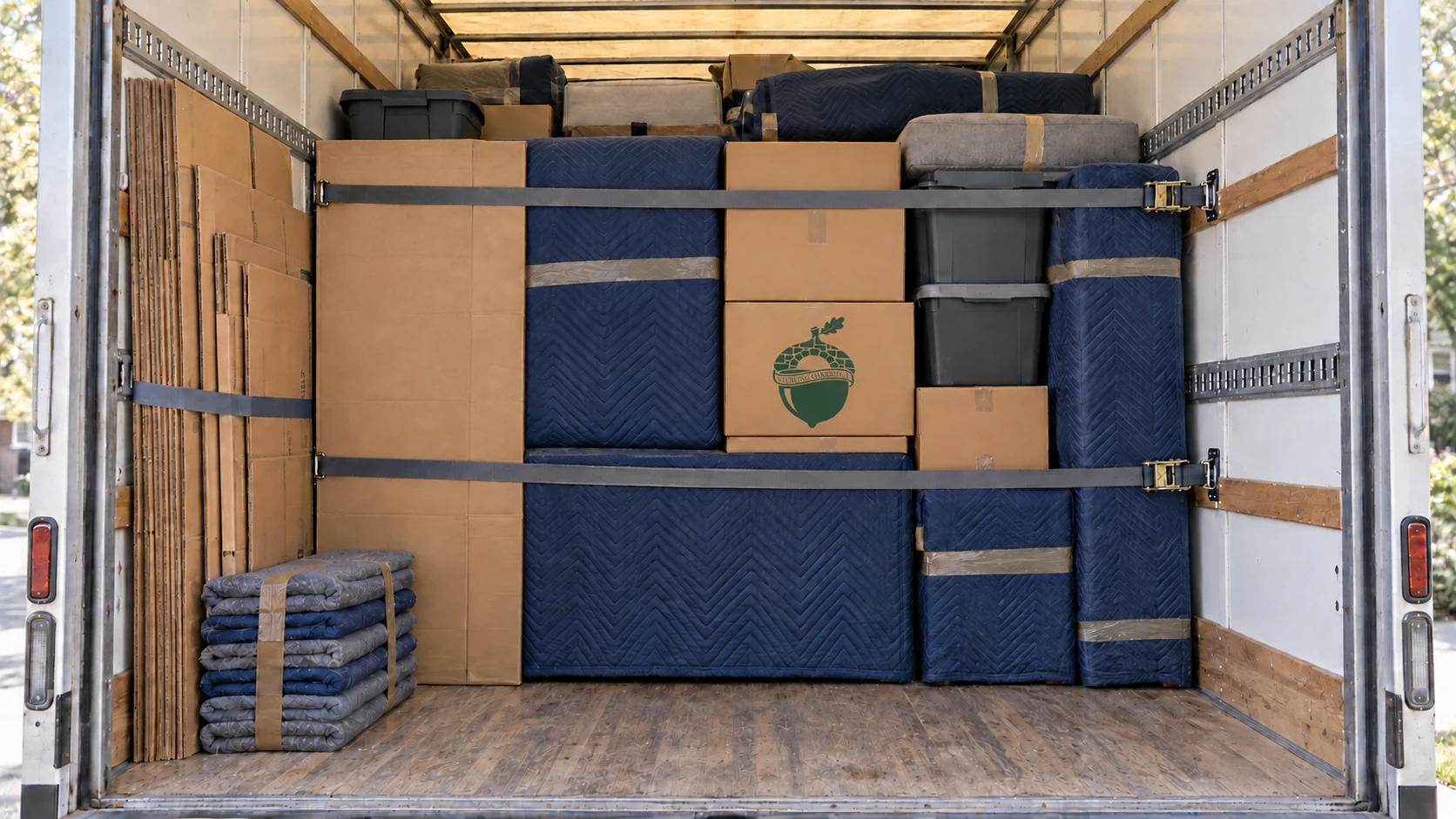
This illustration shows a completed substantial direct shipment, with mixed protected pieces, a partial plain retaining panel, contact restraints and secured side supplies. A smaller pickup group is a different stage. Choose the truck and loading arrangement from the actual inventory rather than using one visual pattern for every household.
Basic blanket protection, wrapping and tape have no separate surcharge. Cartons are separate. Basic working furniture disassembly and reassembly also have no separate surcharge; complex, fragile or specialist construction needs review. Decide who will pack loose contents and finish sealing the packed cartons before the carrying window.
Example 2: a South Philadelphia household to Gainesville, Florida
Consider a South Philadelphia rowhouse household moving sofa sections, bedroom pieces, a dining table, kitchen and book cartons, customer totes and protected fragile items to Gainesville. This example uses direct delivery for a dedicated shipment and a receiving plan reviewed with the household. The selected truck follows the actual inventory, not the number of bedrooms stated in the first message.
At pickup, the usable entrance is reached from the street over short stone steps. Review the stoop, handrails, doorway, hall and any upstairs landing turns. Identify which pieces need basic disassembly and protect their bodies before removing detachable long legs. If reserved curb space is requested, confirm the approved length and hours and arrange the signs early enough for the City's process.
The household can prepare loose contents before the appointment while requesting help with selected fragile pieces. Agree that division in the scope. A dining table with detachable long legs is prepared as a protected body and associated parts before transport; it is not left fully wrapped on tall installed legs. The completed load is a mixed, supported shipment with restraints contacting the actual front surfaces or retaining panels.
At Gainesville, the receiving home has an available room but a shared driveway. Confirm the property permission, truck position, clearance and route into each room. If the family travels ahead, nominate a receiver who can obtain keys and approve placement if the family's journey is delayed. A Florida destination does not determine the entrance or parking rules of every property there.
The illustrative direct window is 2–3 days after pickup and loading finish. A reviewed smaller consolidated Florida shipment may use up to 60 days. Choosing the direct example does not convert the consolidated window into a fixed arrival date. For unchanged inventory, access and services, a longer journey or delivery does not change the agreed flat price.
Keep travel essentials outside the shipment
Before loading, set aside keys, documents, daily medicines, chargers, essential clothing and first-night needs that travel with the household. Keep that group separate from packed shipment cartons and tell everyone preparing the home which items must remain accessible. A document folio beside moving cartons should not disappear into the last packed room.
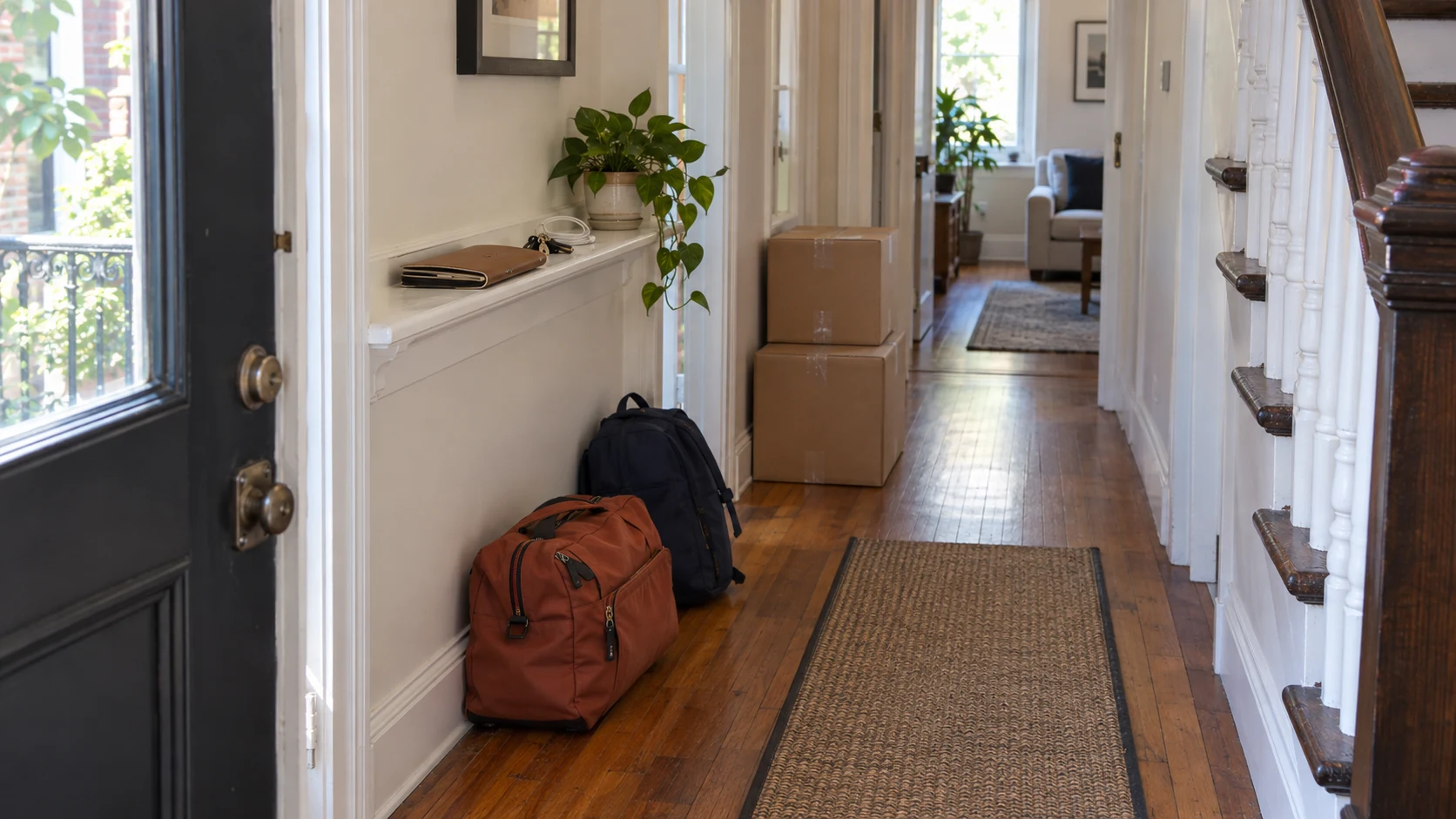
The receiving person should have access instructions and a working contact number. Arrange keys without leaving readable private information on exposed cartons. If children, pets or a work commitment determine the household journey, make their first-night plan independently of the truck's expected arrival. Confirm what the receiver needs to open the property and direct placement while the household is travelling.
Example 3: a Center City apartment shipment to Hamilton, Ontario
Imagine a Center City apartment sending a compact furniture inventory, clothing cartons, books, protected fragile pieces and customer totes to Hamilton, Ontario. The household is comparing direct and consolidated delivery and has a limited range of days when the receiving apartment can be used. Identify that range before making a building reservation or choosing a shared transport window.
The Philadelphia manager supplies written loading and elevator instructions. Collect the actual hours, entrance, insurance wording and shared-area protection requirements. If the proposed position is on the street, review the City's TNP process and any restrictions that could change the requested location. A residential parking permit does not reserve a truck loading position.
The receiving address is in Hamilton, Ontario, Canada. Confirm the actual municipality, unit, truck approach, carrying route and person authorized to receive. A familiar regional name does not settle the property rules or border paperwork. Identify stairs, an elevator booking or a driveway restriction at that exact address.
Before booking, review the actual inventory, relevant shipment and personal documents, household travel plans and any contents needing additional review. Agree which party will provide the needed information and keep personal travel documents accessible. Do not assume that every item is admissible, one document list fits every household or border processing has a guaranteed duration.
The illustrative direct window is 1–2 days after pickup and loading finish. Consolidated Canada delivery may use up to 60 days, including for a relatively close destination. Review the actual commercial truck route, document preparation, border processing and receiver's availability before agreeing dates. If the destination will not be ready, discuss a separately agreed storage stage rather than silently adding it to the original scope.
Complete the Philadelphia street-space arrangement
The Temporary No Parking service page describes the process for requesting reserved street space. For a moving truck, the posted rate is $50 per 40 feet per day in Center City and University City and $25 elsewhere. Forty feet is roughly two parking spaces; provide the actual truck length, address and start and end times for review.
The residential application portal requires at least four full business days of notice and does not accept short-notice applications. Apply early enough for review and the later steps. Use one address per permit and one permit per address. A reviewer sends an invoice or requests information, then verifies payment before issuing the final permit. The approved location may change if local restrictions affect the requested position.
Assign sign collection and posting. The published process tells the applicant to print the issued permit and take it to a Philadelphia police district for temporary signs. The portal advises posting 24–48 hours before the move, or as soon as possible after receiving the permit; the public service page specifies at least 24 hours. Plan the earlier posting where possible and confirm the actual permit instructions. If assistance is needed, arrange it before the carrying appointment.
The permit does not guarantee that the zone will be immediately empty. If another vehicle occupies it during the permitted dates, contact the local police district for the stated enforcement process. Keep the approval, signs and property instructions in the plan and review any needed access change with us. A residential permit is a separate PPA program and does not reserve a loading position.
For a driveway, alley, lot or dock, obtain property permission and review the usable geometry, vehicle approach and carrying route. Check whether a ramp or loading would still affect public travel. Private access should be assessed for the actual vehicle and work rather than treated as an automatic exemption from every requirement.
Check winter access and the actual municipality
During a declared snow emergency, vehicles must leave designated snow-emergency routes until the emergency ends. Check the actual street and declaration; the rule is tied to designated routes. Review the truck position and carrying route again if weather changes the plan.
Philadelphia's sidewalk rules require snow and ice clearance within six hours after snowfall stops, normally along a path at least 36 inches wide. The Code provides a narrow-pavement exception where the width from property line to curb is less than three feet and assigns multifamily compliance to the owner or agent. Do not pile removed snow or ice in the street. Agree who clears and treats the sidewalk, curb cuts, stoop and entrance, and confirm a usable route for the pieces being moved.
The City of Philadelphia and Philadelphia County share the same boundaries, while nearby townships, boroughs and cities have their own procedures. PHL spans Philadelphia and Tinicum Township in Delaware County, so an airport-area or regional label does not establish the municipality of a particular property. Use the actual address when collecting local rules at both ends of the move.
Illustrative delivery windows from Philadelphia
| Illustrative destination | Direct planning window | Consolidated window |
|---|---|---|
| Hagerstown, Maryland | 1–2 days | Up to 30 days |
| Gainesville, Florida | 2–3 days | Up to 60 days |
| Hamilton, Ontario | 1–2 days | Up to 60 days |
| San Diego, California | 4–5 days | Up to 90 days |
These windows start after pickup and loading are complete. An earlier packing day, household departure or elevator appointment is separate from the transport stage. Review the final truck route, actual addresses and both properties' availability before using a window to book receiving access. The table does not reserve an appointment.
Nearby domestic consolidated shipments may use up to 30 days, Florida and Canada up to 60 days, and California up to 90 days. Other farther destinations have individually agreed windows. San Diego is in California and uses that example; a different western state does not automatically inherit it. A smaller close direct job may sometimes fit a faster arrangement after review, but the actual dates still need agreement.
Example 4: a Northwest Philadelphia home to San Diego, California
Consider a Northwest Philadelphia household sending bedroom furniture, a dining table, sofa sections, book and kitchen cartons, protected fragile pieces and customer totes to San Diego. The household requests direct delivery for the dedicated shipment and wants furniture preparation reviewed around departure. The home size does not establish which belongings are going or how much space they occupy.
The pickup home has a driveway, but it is shared and changes grade near the entrance. Confirm the permission, width, surface, overhead clearance and turning area before choosing a truck position. A driveway is not automatically the easiest carrying route. If the selected vehicle cannot use the proposed area, identify a different standing, carrying or shuttle arrangement in the estimate before the day.
At San Diego, the receiver confirms the actual entrance, truck position and available rooms. Identify which pieces need reassembly and where they should finish, and keep the route clear. If the household arrives ahead of the shipment, decide how daily needs will be met during the agreed delivery period. A receiving room being available does not establish every access requirement at the property.
The illustrative direct window is 4–5 days after pickup and loading finish. A reviewed smaller consolidated California shipment may use up to 90 days. Those models need different receiving plans. Check the authorized receiver's availability and how a schedule change will be communicated before committing to a property appointment.
At delivery, remove furniture protection and complete the agreed basic reassembly and placement. Carton unpacking, putting away contents and removing that packaging are separate tasks with time in the scope. If a receiving room or entrance changes after booking, review any additional handling or storage stage in writing. With unchanged inventory, access and services, a longer journey or delivery does not change the agreed flat price.
Treat a smaller consolidated pickup as a distinct inventory
A smaller shipment may consist of sealed cartons and customer totes with selected protected furniture. List the pieces separately from items staying in the home or travelling with the household. Match carton type and cushioning to the actual contents and finish closing and sealing packed cartons before loading. Identify any fragile, awkward or unusually heavy piece for review.
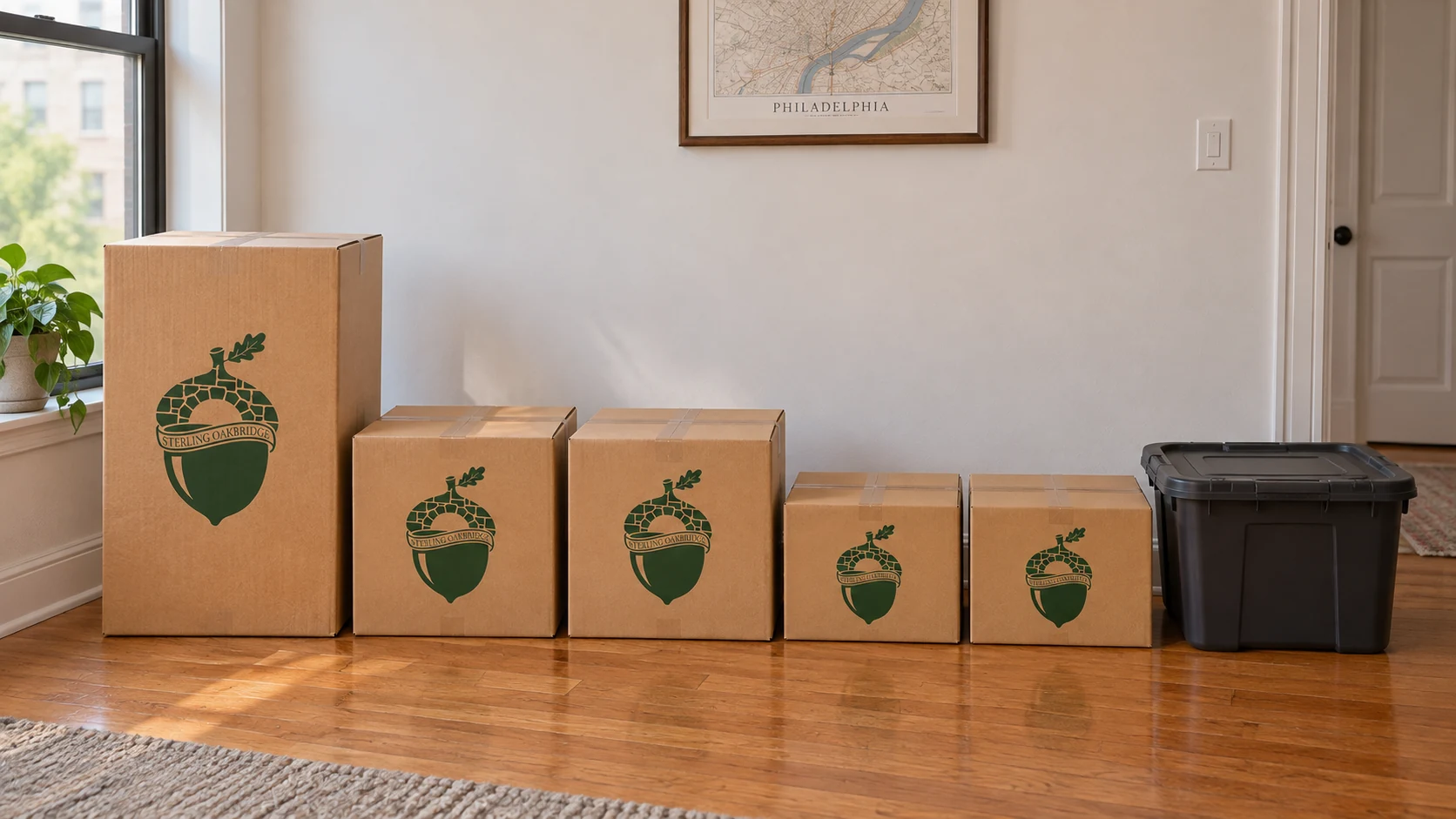
This illustration shows a smaller consolidated group. The actual inventory and estimate determine the work and receiving window; a carton brand or a single photograph does not establish the model. If the household needs some belongings immediately, identify them before choosing a shared schedule and keep travel essentials accessible.
If a gap between properties remains, ask about a separately agreed storage stage. Confirm the inventory, handling, later delivery and anything the household needs to access during storage. A receiving room being unavailable does not automatically include storage in the original price.
Receive, unwrap and complete the agreed placement
Before the delivery period, confirm the receiver, keys, entrance, approved truck position and route into each room. Keep the doors and floor clear and identify who can approve placement. Furniture protection is removed at delivery; basic working reassembly follows the agreed plan. Legs removed for transport can be installed on the now unwrapped receiving furniture.
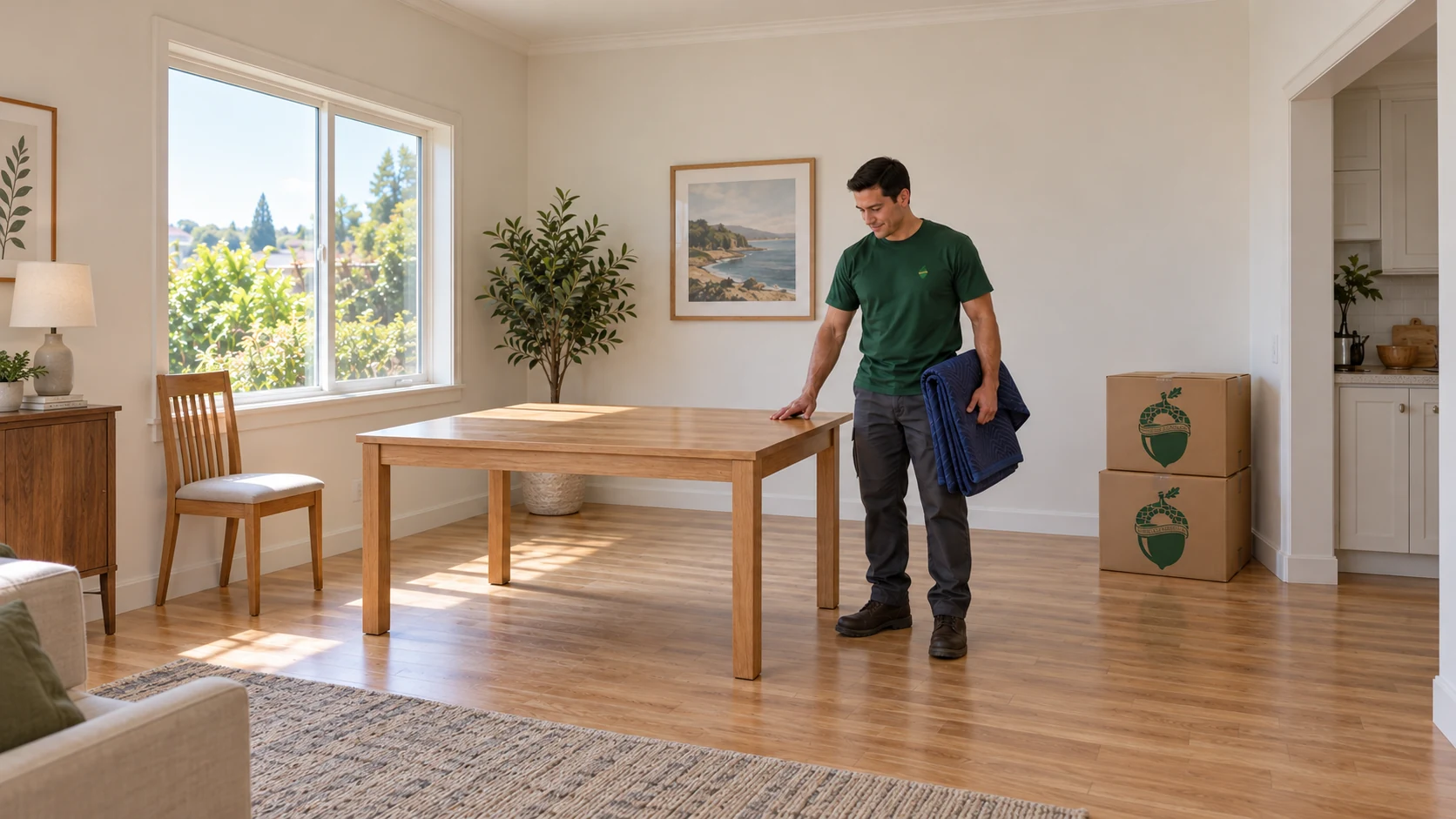
A completed furniture-placement stage does not automatically include emptying every carton. Request unpacking, putting contents away or packaging removal separately if needed. For belongings already delivered that later need to move between rooms or floors, the existing in-home and in-building service in Philadelphia provides a different scope to review.
Plan unwanted belongings before pickup. Philadelphia's regular collection rules allow eligible households up to two compactible large items per week, with mattresses and box springs bagged and sealed in plastic. Other listed items use a separate bulk appointment program or an appropriate hauling route. The City's bulk service page excludes larger apartment buildings, condominiums and commercial properties from that program. Confirm the actual item, property eligibility, collection day, set-out time or private hauler; disposal remains separate from a standard moving scope.
Review the pickup area and destination
We can review long-distance pickup in Philadelphia and nearby addresses in Montgomery, Delaware and Bucks counties. The City of Philadelphia and Philadelphia County share the same boundaries. Nearby townships, boroughs and cities have their own procedures; Camden across the Delaware River is in New Jersey. Confirm the actual municipality, property, entrance, truck position and dates before applying Philadelphia rules.
Explore long-distance destinations from Philadelphia
These destinations illustrate household shipments from Philadelphia, Pennsylvania. Sterling serves routes throughout the United States and Canada. Review the actual inventory, truck approach, property access and receiving dates. A destination listing does not reserve an appointment or rank bookings.
Northeast
- Hagerstown, Maryland
- New York City, New York
- Buffalo, New York
- Boston, Massachusetts
- Washington, DC
- Baltimore, Maryland
- Pittsburgh, Pennsylvania
- Portland, Maine
Southeast and Florida
- Charlotte, North Carolina
- Raleigh, North Carolina
- Charleston, South Carolina
- Atlanta, Georgia
- Gainesville, Florida
- Jacksonville, Florida
- Tampa, Florida
- Miami, Florida
Midwest and Texas
- Chicago, Illinois
- Columbus, Ohio
- Dallas, Texas
- Houston, Texas
- Austin, Texas
Mountain West and Southwest
- Denver, Colorado
- Phoenix, Arizona
- Salt Lake City, Utah
- Las Vegas, Nevada
- Albuquerque, New Mexico
West Coast
- San Diego, California
- San Francisco, California
- San Jose, California
- Seattle, Washington
Canada
- Hamilton, Ontario
- Toronto, Ontario
- Montreal, Quebec
- Québec, Quebec
- Vancouver, British Columbia
Long-distance moving questions
Where can I arrange long-distance pickup around Philadelphia?
We can review long-distance pickup in Philadelphia and nearby addresses in Montgomery, Delaware and Bucks counties. The City of Philadelphia and Philadelphia County share the same boundaries. Nearby townships, boroughs and cities have their own procedures; Camden across the Delaware River is in New Jersey. Confirm the actual municipality, property, entrance, truck position and dates before applying Philadelphia rules.
Can a move within Pennsylvania be long-distance?
Yes. Crossing a state line is not the only consideration. Send the actual addresses, inventory, dates and access details so we can review the appropriate scope and delivery model. A move farther within Pennsylvania may need a long-distance plan; a nearby interstate address does not by itself determine that plan.
What does direct delivery include?
Direct delivery uses a dedicated truck for your shipment and the same crew for the agreed pickup and delivery. Review the actual inventory, truck arrangement, both property schedules and receiving person before choosing it. The travel window starts after pickup and loading finish, with packing and property reservations planned separately.
Can a smaller shipment use consolidated delivery?
Yes, subject to inventory, route and date review. A group around 300–400 cubic feet is one useful smaller-shipment example, not a minimum or automatic qualification. Consolidated shipments share a planned transport schedule; identify receiving availability before choosing that window.
When do these delivery windows start?
After pickup and loading are complete. The illustrations use direct windows of Hagerstown 1–2 days, Gainesville 2–3 days, Hamilton 1–2 days and San Diego 4–5 days. An earlier packing appointment or elevator reservation is a separate stage. Review the actual truck route, addresses and receiving availability before agreeing dates.
What are the consolidated windows for these examples?
The Hagerstown example uses up to 30 days, Gainesville in Florida and Hamilton in Canada up to 60 days, and San Diego in California up to 90 days after pickup and loading finish. Other farther destinations have individually agreed windows. These examples are not reserved delivery appointments.
Could the close Hagerstown example arrive sooner?
A smaller close direct job may sometimes fit same-day or next-day arrangements after review of the inventory, truck route, pickup completion and receiving schedule. The illustrative 1–2-day table entry does not promise that faster arrangement. Agree the actual dates before booking property access.
Does a journey delay change the agreed flat price?
No. For unchanged inventory, access and services, the agreed long-distance flat price holds when travel or delivery takes longer. Extra inventory, a changed entrance, storage or other added work changes the scope and is reviewed and agreed separately in writing.
How do I request reserved Philadelphia street space?
Use the Streets Department Temporary No Parking process. Moving-truck rates are $50 per 40 feet per day in Center City and University City, $25 elsewhere. The residential portal requires at least four full business days of notice. Allow time for review, payment, issuance, police-district sign collection and advance posting; confirm the actual approved location and hours.
Does the City automatically put up TNP signs?
The published process tells the applicant to print the issued permit, take it to a Philadelphia police district and collect temporary signs. Assign their posting. The portal advises 24–48 hours before the move or as soon as possible, while the public service page specifies at least 24 hours. Confirm the actual permit instructions and arrange assistance early if needed.
Will a TNP permit guarantee an empty truck position?
No. The approved location can change because of local restrictions. If another vehicle occupies the zone during the permit dates, contact the local police district for the stated enforcement process. Keep the permit and property instructions available and review any needed access change with us.
Does a residential permit settle the truck arrangement?
A residential permit is a separate PPA program and does not reserve a loading position. Review the actual vehicle, signs, proposed truck position, ramp and carrying route. Obtain property permission for any private driveway, alley or dock arrangement and check whether loading would affect public travel.
Does every managed building require an elevator or COI reservation?
Ask the particular property. It may require an elevator booking, certificate of insurance, corridor protection, loading appointment or a property charge. A neighborhood name or building type does not establish every requirement. Send the written instructions and contact details for both properties before the estimate is finalized.
What if snow changes access before pickup?
Check current restrictions on the actual street. A declared snow emergency requires vehicles to leave designated snow-emergency routes until it ends. Philadelphia requires sidewalk snow and ice clearance within six hours after snowfall stops, normally 36 inches wide; the Code has a narrow-pavement exception and assigns multifamily compliance to the owner or agent. Arrange a safe carrying route and review any schedule change.
Are detachable long table legs left on during transport?
Safely detachable long table and desk legs are normally removed before transport. Protect the body first, then access the joints, remove the legs and keep the protected parts and hardware associated. Integral supports or pieces that cannot be safely dismantled need individual review. Basic working disassembly and reassembly have no separate surcharge; complex work is reviewed.
Are packing materials and basic reassembly included?
Basic blanket protection, wrapping and tape have no separate surcharge. Cartons are separate. Basic working furniture assembly and disassembly also have no separate surcharge; complex or specialist construction needs review. Agree which loose contents you pack and which you want us to prepare before pickup.
Will delivery include emptying and putting away every carton?
Furniture protection is removed during delivery and agreed basic reassembly and placement are completed. Carton unpacking, putting contents away and removing carton packaging are separate tasks with time in the scope. Identify them early if you need more than furniture placement.
Can Sterling plan a shipment to Hamilton, Ontario?
Yes. Canada is within reviewed household coverage, and Hamilton, Ontario is one illustration here. Confirm the actual inventory, relevant shipment and personal documents, household travel plans, dates and authorized receiving contact before booking. Border processing and document review can affect the plan; do not assume universal customs clearance or admission of every item.
What if unwanted furniture or a storage gap remains?
Identify those tasks before pickup. Storage is a separately agreed stage when the receiving dates do not align. Disposal is separate from standard moving: eligible regular Philadelphia collection allows up to two compactible large items per week, with mattresses and box springs bagged and sealed in plastic; other items have a separate bulk program or hauling route with property restrictions. Confirm the actual method, dates and charges in the scope.
Request an estimate for the actual Philadelphia shipment
Send the origin and destination, inventory, desired pickup dates, receiving availability and access details for both properties. Identify packing responsibility, furniture needing preparation, fragile or specialist pieces and any separate storage, disposal or unpacking stage. Include the written property instructions and proposed truck arrangements so the estimate can describe the actual scope, delivery model and dates.