
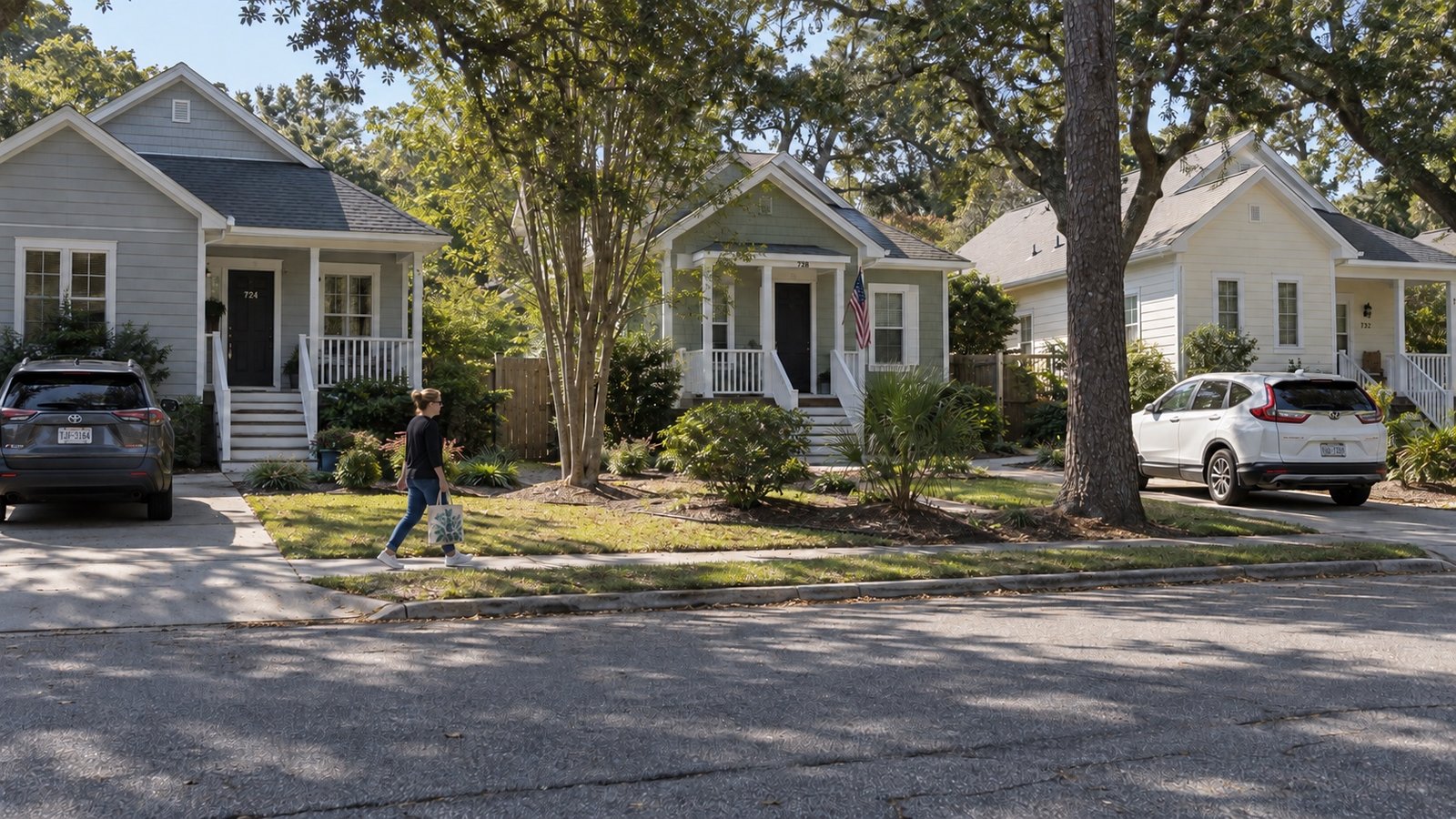
You already have the coast. What would make the next place better?
Leaving Virginia Beach does not have to mean leaving something behind that you dislike. You may love the water and still want a week with less driving, a smaller housing commitment or work that takes you in a new direction. You may be ready for mountains, a different summer or another country. Start with the improvement you would notice when the holiday feeling has worn off: getting home earlier, keeping more of your income, seeing people more often or enjoying a home that is easier to manage.
For a more connected week close to the people you know, compare an attainable Town Center or Old Beach home with Norfolk. Put Hampton on the list when the Peninsula is where the important work or family connection is; a cross-harbor journey can otherwise undo the attraction. Chesapeake offers another Southside home search, but its large footprint makes the particular address more useful than the city name. These are three different local decisions, not three interchangeable suburbs.
If lower spending leads the search, Greensboro, Huntsville, Wichita and Tucson deserve an early look among the farther examples. Their historical city rent estimates are well below Virginia Beach's. They still need an income and a workable transport plan. Charlottesville offers an inland foothill and university-city comparison; Baltimore and Columbus let you investigate a different city routine. Denver and San Diego need a clear reason to support a larger housing commitment. Charleston is a change of coastal life, not an obvious rent-saving answer.
You do not need eighteen US visits or four international applications. Use the groups to discover possibilities, then keep two to four that answer your own question. A useful shortlist can contain Norfolk and Tucson, or Charlottesville and Calgary, if each changes something important in a different way. Beside each name, write what improves, the compromise you accept and the next answer that would let you decide. The printable sheet at the end gives you somewhere to keep those comparisons without registering or choosing a moving date.
Keep Virginia Beach involved
Compare another Virginia Beach home with Norfolk, Hampton and Chesapeake through the journeys you want to keep.
Try the nearby routines →Improve the whole month
Put actual housing, full transport and usable income into the same comparison.
Compare the money left →Choose another setting
Explore a regional, southeastern, interior, mountain-region or western week through its less convenient season too.
Explore US horizons →Begin in another country
Match a lawful residence and work plan with an ordinary week in one of four countries.
Explore four countries →Keep the Virginia Beach advantages you actually use
Before comparing another city, describe the Virginia Beach you live in. An Oceanfront apartment, a Kempsville house, a Town Center home and a place near Pungo create different daily lives. Count the beach walk you really take, the friend who helps with a pickup, the particular workplace and the doctor you already reach. A destination can look better in a broad comparison while requiring you to rebuild something that currently saves time, money or effort.
Town Center is a compact mixed-use exception within the wider Pembroke area. It offers a sensible local comparison if your goal is more errands and activities near home. That does not make every Pembroke address equally connected. Walk the crossing, locate the actual entrance and make the journey to the place you cannot rearrange. A home close to shops but awkward for your shifts or care arrangement may solve only the enjoyable part of the week.
Old Beach gives you another local housing and street pattern to investigate. The attraction might be an ordinary walk or a smaller place near familiar activities, rather than another region. Bayfront settings around Chesapeake Beach provide a different relationship with the water. Keep the names straight: Chesapeake Beach is a Virginia Beach neighborhood; Chesapeake is a separate independent city. The same word on a housing search does not settle municipal services, a school assignment or the trip to work.
Virginia Beach also includes rural and southern settings where the house, land and quieter surroundings can come with longer errands. If you are tired of maintaining a property, moving farther into a rural setting may increase the work you meant to reduce. If the land itself is the pleasure, losing it for a cheaper small apartment is a real compromise. Include the recurring upkeep, entrance and travel effort alongside the monthly payment.
HRT's ordinary routes and the seasonal VB Wave do different jobs. Route 20 provides a corridor between Downtown Norfolk, the Newtown Road connection, Pembroke and the Oceanfront area. The Tide's Newtown Road terminus is in Norfolk; a Virginia Beach Town Center journey involves the appropriate onward connection. The Wave's 2026 Oceanfront and Bayfront schedules run through their published season. A summer trolley experience is not a winter commuting plan. Use the current service for the day and return you would actually need.
Keep a short list of the connections that make staying valuable. It might include a relative, a regular activity, a campus or an employer-approved location. Put a replacement beside each connection when you compare another home. Paid childcare, trips back to Hampton Roads and time off for family visits belong in the decision. For the detailed local arrangements, use our Virginia Beach moving guide; here the question is which parts of that familiar life your next place should preserve.
Local sources: Moving to Virginia Beach: Neighborhoods & Relocation Guide | Sterling Oakbridge · Movers in Virginia Beach, VA | Sterling Oakbridge · Virginia Beach – Routes – Hampton Roads Transit · HRT — The Tide light rail · Route 20 – Hampton Roads Transit · VB Wave & Bayfront Bus – Hampton Roads Transit · Pembroke SGA | City of Virginia Beach · Hampton Roads bridges and tunnels | Virginia Department of Transportation.
Decide how much change the problem needs
Compare three possible outcomes before booking a distant trip: a different arrangement in the home you have, another home within reach of the life you know, and a new regional base. If the difficulty is a staircase, a large yard or the route from one address, another Virginia Beach home deserves a fair comparison. If the confirmed work or family destination is elsewhere, local housing will not solve it. The right distance follows the improvement rather than proving how serious you are about changing your life.
For someone who wants fewer car trips, begin by moving the everyday destinations closer together. A compact home area can make shopping or an evening activity easier even if a car remains useful for something else. Compare the cost of keeping one car, sharing one, paying for occasional travel or living entirely without one. If you cannot drive, include an essential appointment, shopping and the backup journey in the trial before choosing the home.
For a household trying to lower spending, price the local alternative before assuming the savings require a different state. You may gain more by reducing an unused room, a vehicle or maintenance than by moving to a lower-rent home with longer journeys. Conversely, if the whole current arrangement is too expensive, a distant place with a supported income may create an opportunity that another nearby address cannot. The budget section shows why both outcomes are possible.
For a new job or course, place the actual entrance and required hours first. A home in Hampton can be a sensible Peninsula beginning and an awkward choice for repeated Southside travel. Norfolk and Chesapeake create their own address-level choices. When the opportunity is in another region, compare the household's second worker, care and housing before accepting the appealing part of the offer. A move can be right for one adult while making the other adult's week much harder.
There is also room for a move whose main purpose is a different experience. Wanting a cold high-plains winter, a desert setting or a Spanish-speaking inland city does not need to be disguised as a financial necessity. Give the preference a practical form: the season you hope to enjoy, the home you can support and the ordinary activity that would make you feel part of the place. A clear personal reason is more useful than a vague claim that another city is better.
Keep one realistic local alternative beside the distant favorite until the comparison is settled. It helps you see what the travel, transition costs and lost support are buying. You are not obliged to choose the least expensive or nearest option. You should be able to explain why the change is worth its cost, and which parts of the decision remain reversible while you learn the new place.
Three nearby moves that change different parts of the week
The wider local horizon includes Portsmouth, Suffolk and Newport News as well as the three places below. Within Virginia Beach, another neighborhood may change the home and daily route without changing your municipal base. For a first round of visits, Norfolk, Hampton and Chesapeake show three useful contrasts: a Southside city connection, a Peninsula beginning and a large Southside city with varied home-to-work journeys.
Do not sort these homes by straight-line distance alone. Hampton Roads is shaped by water and the crossings that connect its parts. VDOT's bridge and tunnel overview identifies the Hampton Roads Bridge-Tunnel and the farther-west Monitor-Merrimac connection, while its 511 tools show current conditions. The route, hour and repeated direction matter. A pleasant weekend visit cannot answer the same question as a weekday return after a shift.
Their historical rent estimates are below Virginia Beach's, with different gaps: Norfolk $393, Hampton $287 and Chesapeake $128 per month in point-estimate comparisons. Those differences describe the common survey background, not the amount you will save. A particular home, another vehicle or repeated paid travel can change the result. Use the figures to decide which housing search deserves attention, then replace them with actual options.
Take the person with the least flexible journey on the visit if possible. Make that journey first, then explore the part of the place you hope to enjoy. It is much easier to assess a waterfront, a local activity or extra room after you know the essential week can work. Each profile below gives a different starting reason and an equally important reason to keep another option on the shortlist.
Three nearby beginnings across Hampton Roads
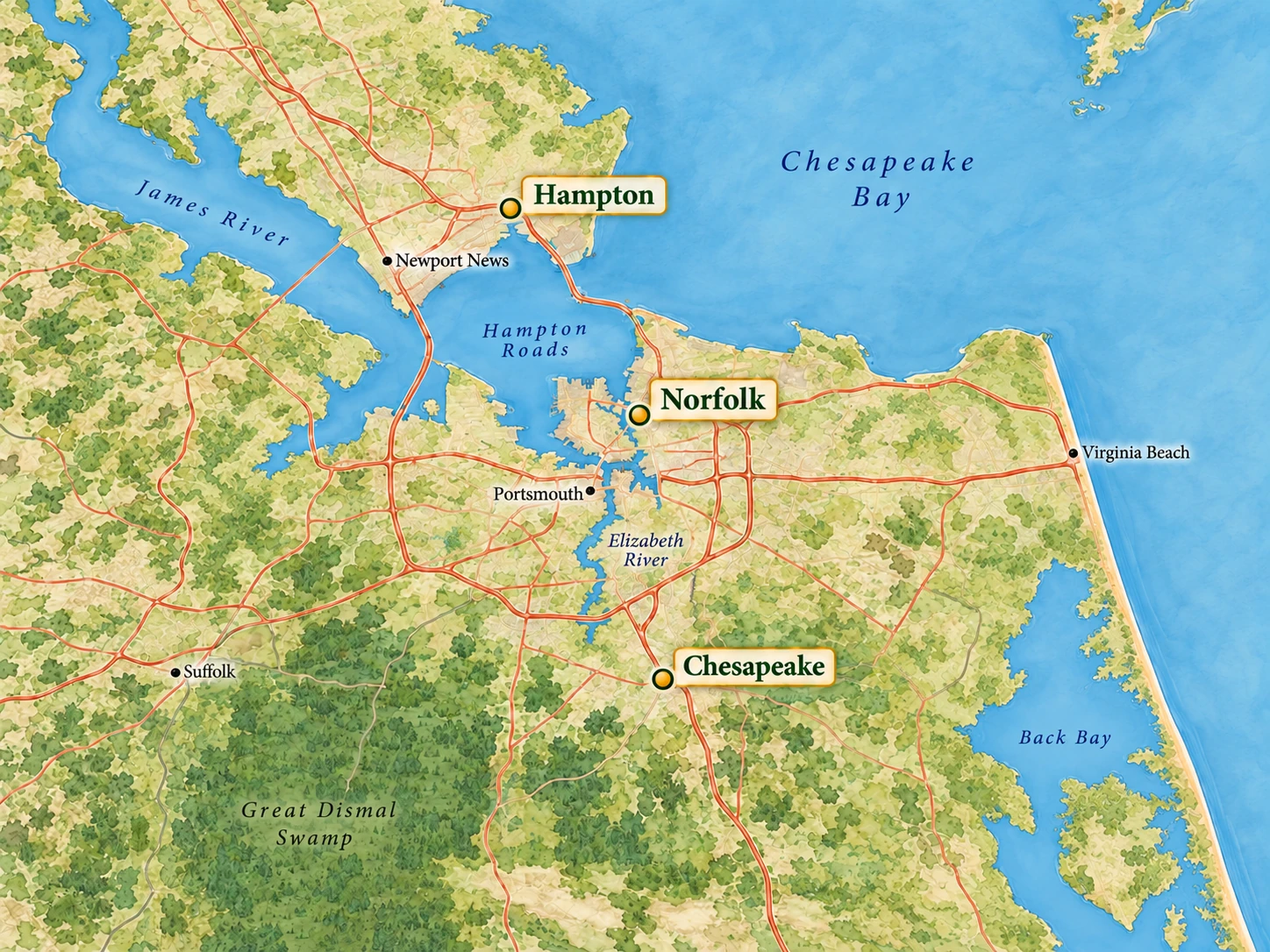
Geographic reference
Norfolk: try a more connected city week without losing Hampton Roads
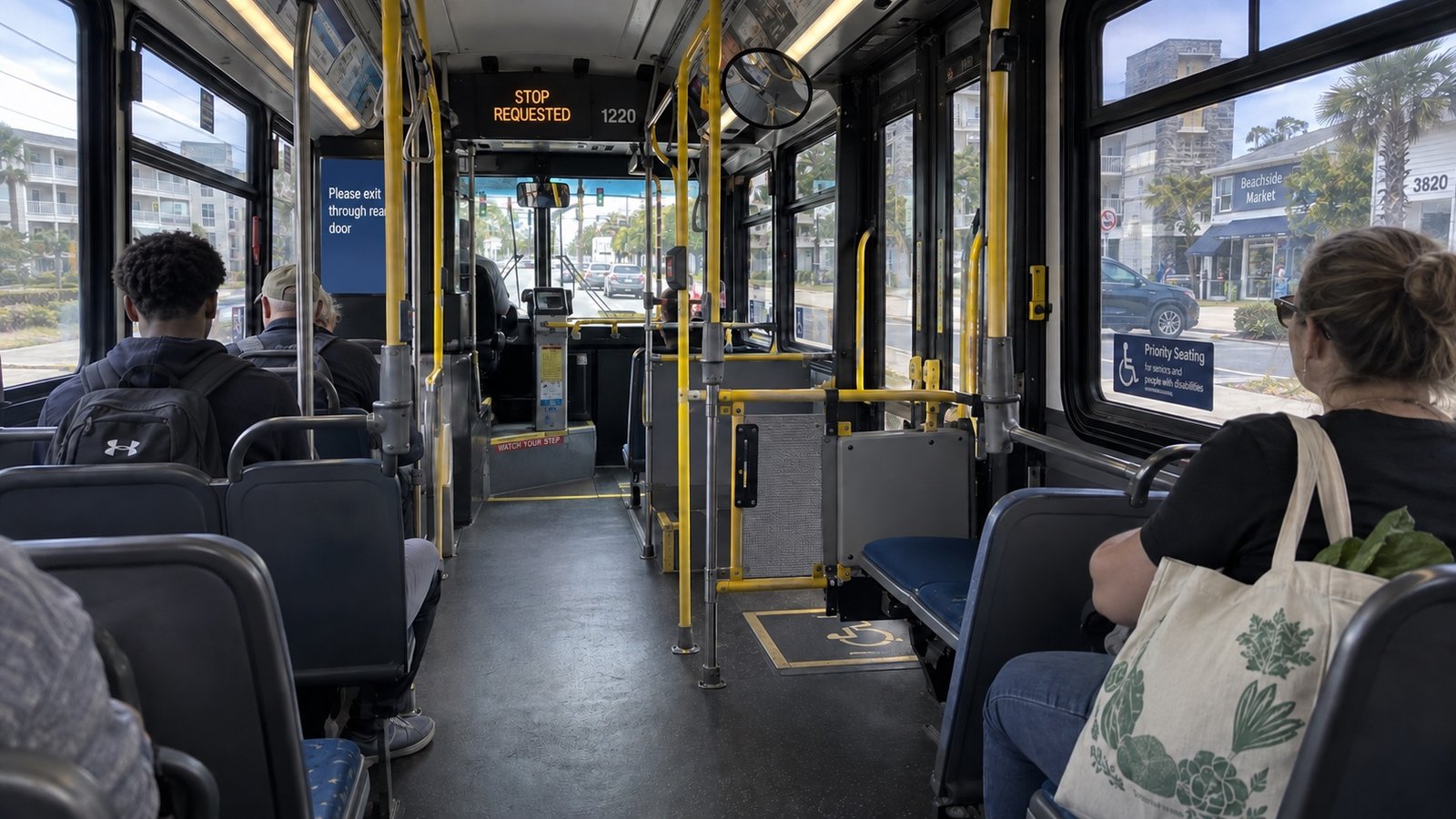
Norfolk belongs near the top of the nearby list if you want more of your daily life to happen around a connected city home. The gain is not simply being closer to a rail line. It is the possibility that work, shopping and an activity you enjoy can fit together with fewer separate car trips. You can investigate that change while keeping access to familiar people in Hampton Roads, rather than rebuilding every connection in another region.
Begin with the actual worksite and a home you could choose. The Tide and HRT buses give you particular corridors, not a promise for every address. Newtown Road is the light-rail terminus in Norfolk; it does not place a train station in Virginia Beach Town Center. If you still need regular Virginia Beach trips, include the onward bus or driving arrangement, the return and the time between the stop and the door. A Norfolk home can improve a Norfolk-based week and complicate one still centered elsewhere.
The historical city gross-rent estimate is $1,321, compared with Virginia Beach's $1,714. That $393 point-estimate gap makes a housing search worthwhile, but it is not a quote for equivalent homes. A suitable connected address may differ from the city median. Count the vehicle and coverage costs that genuinely change, and keep any Virginia Beach visits, care or paid travel in the month. Otherwise a lower home payment may buy less improvement than you expect.
Use a weekday visit to try the necessary journey, an ordinary errand and an evening activity from the same home area. Include the least flexible return. Norfolk is a strong nearby candidate when those parts make the week easier and the attainable home fits the budget. If the only gain is a pleasant downtown outing while the household still drives in several directions, compare a different address before treating the city move as the answer.
Try first: Try a Norfolk home area, the actual work journey and an evening return, including the Virginia Beach connections you will keep.
Local sources: Virginia Beach – Routes – Hampton Roads Transit · Route 20 – Hampton Roads Transit · Hampton Roads bridges and tunnels | Virginia Department of Transportation.
Hampton: put the Peninsula opportunity before the cross-harbor commute
Hampton makes sense when an important part of your next life is on the Virginia Peninsula: a confirmed workplace, family connection or home arrangement you want to be near. It lets you keep the wider Hampton Roads setting while changing which side of the harbor anchors the week. That is a more useful reason to visit than assuming every nearby home gives equally easy access to the whole region.
The harbor is the central compromise. The Hampton Roads Bridge-Tunnel connects the Peninsula with Norfolk and Virginia Beach; the Monitor-Merrimac provides a farther-west Peninsula-to-Southside connection. VDOT links its current 511 information for these journeys. Try the crossing you would actually repeat at the necessary hours, including the return. Do not let a clear weekend drive stand in for an inflexible weekday schedule, or assume that a road project will remove every future delay.
Hampton's historical monthly gross-rent estimate is $1,427, $287 below Virginia Beach's point estimate. That gap gives you a reason to compare homes, not a reason to ignore additional travel. Include the time and full cost of the trips that remain on the Southside, as well as a second adult's destination and care arrangements. A smaller payment can still be worthwhile; make sure it is buying a week you want to repeat.
Visit the attainable home and the Peninsula destination first, then the connection back to the people or services you intend to keep. Hampton is a stronger choice when the essential week moves with you to that side of the water. If almost everything still happens in Virginia Beach, compare Norfolk, Chesapeake or a different Virginia Beach home before accepting a repeated cross-harbor journey just to obtain the house.
Try first: Try the actual Peninsula-based day and the necessary Southside return, with the household’s least flexible hours.
Local sources: Hampton Roads bridges and tunnels | Virginia Department of Transportation · Virginia Beach – Routes – Hampton Roads Transit.
Chesapeake: choose the actual Southside home, not the wider city label
Chesapeake offers another nearby search when you want a different home arrangement while keeping a Southside base. The useful change might be space, an entrance, proximity to a relative or a better position for a particular workplace. Start with that benefit rather than assuming the name means a compact suburb of Virginia Beach. The city's different settings can create very different trips.
Keep Chesapeake City separate from Chesapeake Beach, the Bayfront Virginia Beach neighborhood. A Chesapeake address also does not put every daily destination nearby. Place the exact worksite, school or care location and ordinary shopping beside the attainable home. If the household travels toward Norfolk, Virginia Beach and another part of Chesapeake, test the combined week rather than treating each individual drive as short enough.
The city gross-rent estimate is $1,586, $128 below Virginia Beach's $1,714 point estimate. That relatively small historical gap can disappear in the specific home search or additional driving. A suitable house may still justify the move through its layout or connection to people who matter. State that improvement clearly and count the recurring transport, coverage and maintenance that come with it. A larger property should not quietly undermine a plan to reduce upkeep.
Make the visit include the least convenient required journey and the return home, followed by one everyday activity in the area. If transport is essential, establish the current route serving the actual location rather than assuming the HRT regional network reaches every home equally well. Keep Chesapeake when the home and the full Southside week fit together. Keep another address in play when the benefit exists mainly inside the property and the rest of the day becomes harder.
Try first: Compare an attainable Chesapeake home with a Virginia Beach alternative using the same work, care and household requirements.
Local sources: Virginia Beach – Routes – Hampton Roads Transit · Hampton Roads bridges and tunnels | Virginia Department of Transportation.
Open the search beyond another version of the same coast
The next groups widen the choice by the kind of life they offer. The first keeps an eastern regional connection while changing the city or inland setting. Then come southern river, employment and coastal comparisons; interior cities; high country and desert; and three western settings. These are horizons for thinking, not rings promising equal mileage, travel time or weather. Some choices change the landscape much more than the distance suggests.
Use the strongest reason for moving to enter the list. If your income can travel and you need a smaller required month, start with a supported lower-rent comparison. If the new opportunity has a fixed location, start there and test whether the rest of the household can build a life around it. If the goal is a different summer, a mountain landscape or a particular community, keep that preference visible while examining the less attractive season and the home you could afford.
The city figures below use the same Census release and exact city geographies. They are a common background, not a ranking of available apartments, wages or neighborhoods. The operator links supply an operating transport starting point; they do not make every home convenient. Let a profile earn its place on the shortlist through a specific improvement and a workable ordinary week. You can stop reading a group when it clearly does not answer your question.
An eastern regional base with a different daily life
Charlottesville, Baltimore and Greensboro offer three ways to leave the immediate coastal routine without making the West the starting assumption.
Three eastern regional bases
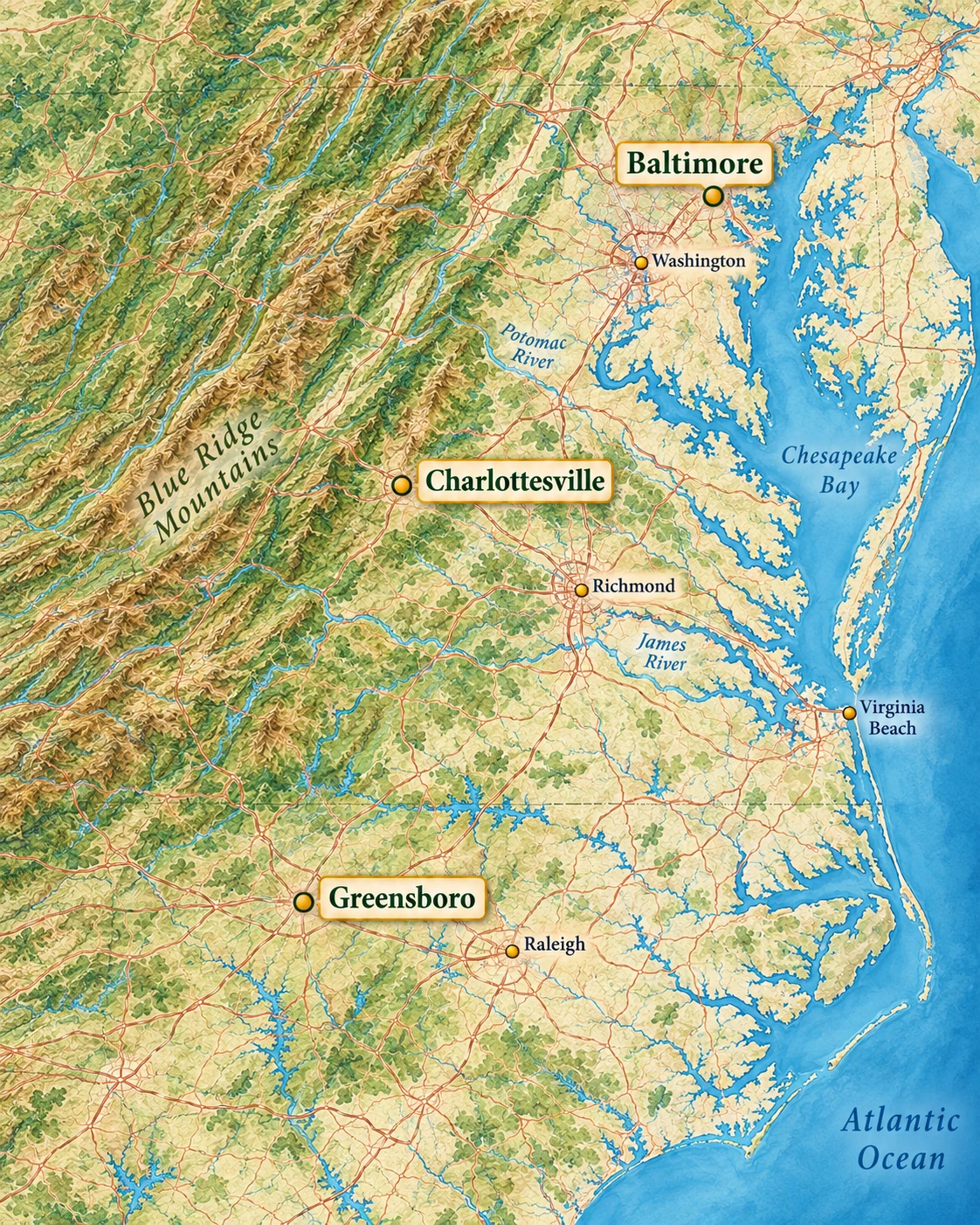
Geographic reference

Charlottesville: an inland university-city beginning near the foothills
Charlottesville is a useful first inland comparison if you want a smaller city setting near the Blue Ridge rather than another version of beach life. It is especially worth investigating when a real role, course or household connection gives the move a purpose. You exchange the familiar Hampton Roads coast for a different landscape and city routine without making the transcontinental move the starting assumption.
The home still needs to match the particular destination. Charlottesville Area Transit provides a local network and current trip-planning information, while campus and regional journeys have their own arrangements. Do not equate being in a university city with convenient access to every building, shift or course. Try the required entrance, the walk from the stop and the return at your hours. The nearby hills should add something to a workable week rather than replace it.
The historical city gross-rent estimate is $1,540, $174 below Virginia Beach's point estimate. The city estimate also carries its own published margin of error. That is a modest background gap, not a compelling savings promise for a particular home. A compact attainable address might help the transport budget; another address might keep the same vehicle costs. Compare the money left and the home features you need before deciding what the inland setting is worth.
Use the first visit to combine the actual work or study journey, a neighborhood errand and one foothill or city activity you would repeat. Include the route back to Hampton Roads at the frequency you expect to maintain. Charlottesville earns a place when the supported opportunity and inland life fit together. If the attraction is mostly a weekend outing, compare whether another Virginia Beach home could preserve the everyday arrangement you already value.
Try first: Try the actual role or campus day from an attainable home, then one repeatable inland activity and the Hampton Roads return.
Local sources: Transit | Charlottesville, VA.
Baltimore: use a city opportunity and a connected home to reshape the week
Baltimore offers a different city-scale comparison when work, education or an established connection gives you a reason to move north. It can be useful for someone seeking a more urban routine than their current Virginia Beach address provides. Begin with the particular opportunity and home corridor rather than a broad idea that a larger city will automatically provide more independence or better work.
Maryland's MTA directory separates Metro SubwayLink, Light RailLink, CityLink, LocalLink and other services. Those connections do different jobs. Put the actual home and required work or campus entrance on the operating network, including a transfer, evening return or accessibility need. Baltimore City and the surrounding county are also different geographies. The city housing figures here do not describe every regional address or school arrangement you might find in a search.
The historical Baltimore City gross-rent estimate is $1,331, $383 below Virginia Beach's point estimate. That makes it worth exploring whether a usable home can improve both housing and transport. It does not price a particular connected neighborhood or establish what you will earn. Keep the actual income, home condition, recurring charges and trips back to Hampton Roads in the month. The result can differ considerably between two addresses carrying the same regional label.
Visit from the kind of home area you could support, then make the essential trip and a normal evening return. Add an ordinary activity you want the city to make easier. Baltimore is a stronger candidate when a supported opportunity and that repeatable routine arrive together. If the job is elsewhere in the region or the home requires the same driving you hoped to reduce, compare another corridor before deciding that the city name supplies the benefit.
Try first: Match the actual role, home and operating MTA connections, then try the least flexible return.
Local sources: Schedules | Maryland Transit Administration.
Greensboro: test a smaller required month in an inland Piedmont city
Greensboro deserves an early housing comparison when you can establish reliable income and want the household month to take less of it. It moves the search inland to the North Carolina Piedmont rather than repeating a coastal lifestyle at another address. The point is the complete arrangement you could support there, not a claim that every home or job is less expensive than its Virginia Beach equivalent.
The historical city gross-rent estimate is $1,172, $542 below Virginia Beach's point estimate. That is a meaningful reason to investigate attainable homes, while keeping the limitations of city medians in view. The available bedroom count, entrance, lease terms and work location still set your actual choice. If earnings fall or another vehicle becomes necessary, the household may keep much less of the housing difference than the first comparison suggests.
Greensboro Transit Agency operates fixed-route service with different weekday and weekend schedules. Use its current route information for the particular day and destinations you need. A useful central connection does not settle a job or care trip beyond it. For a household reducing driving, compare the home, grocery trip, work and evening return as one chain. For a household retaining a car, count the full vehicle arrangement rather than assuming transit removes a cost you will still pay.
Try the attainable home area with the actual role or household destination, then an inland activity you would enjoy regularly. Include the Hampton Roads visits you intend to keep and the second worker's position. Greensboro belongs on the shortlist when the lower required month survives those additions. If the financial case depends on a city median rather than a home and income you can obtain, keep it as a research possibility while a more supported option leads.
Try first: Put an attainable Greensboro home, confirmed income and complete transport week beside your current month.
Local sources: Greensboro Transit Agency — riding and service days.
Southern river, work and coastal alternatives
Chattanooga and Huntsville open inland comparisons; Charleston tests whether another coastal city gives you something worth the move.
River, inland work and another coast
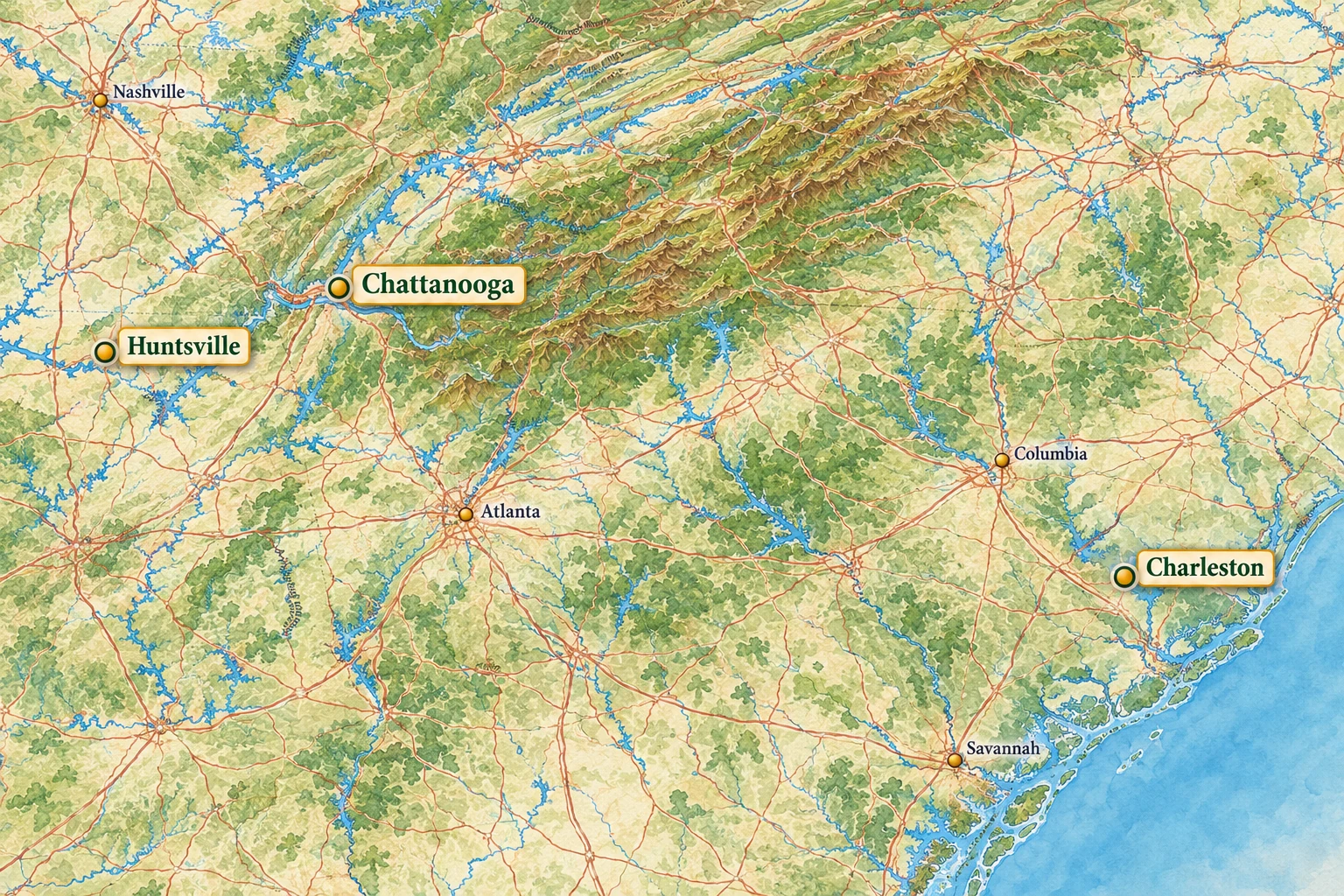
Geographic reference
Chattanooga: replace the beach routine with a river-and-hills city week
Chattanooga is a different landscape question: a city on the Tennessee River with surrounding hills rather than Virginia Beach's coastal plain. Explore it when that setting, a supported role or a home arrangement gives the move a purpose. The appealing part should be something you can repeat in ordinary life, such as a nearby walk or activity, rather than only a sightseeing trip made during the first visit.
CARTA provides the local transit starting point and separately identifies its Downtown Shuttle, the Lookout Mountain Incline Railway and parking services. Those are different products. A convenient downtown visitor journey does not establish a route from an attainable home to every workplace or outdoor destination. Use the operating route and the actual return for the day you need. Keep any car-dependent part of the household week visible in the budget.
The historical city gross-rent estimate is $1,256, $458 below Virginia Beach's point estimate. It supports a serious home search, but the full comparison still includes income, transport, utilities, coverage and the longer return to Hampton Roads. A home farther from the activity that attracts you may reduce the payment while also reducing how often you use it. Decide whether the gain is money, landscape, work or a combination, then compare that actual version.
Try the necessary work or care journey before the river or hills outing. Include a normal errand and the route home at the hour you expect to finish. Chattanooga earns a place when the supported ordinary day makes the landscape part of your life. If the affordable home leaves the desired setting as another occasional drive, compare whether the same time and money would buy a better local arrangement or another destination on the list.
Try first: Try the actual household day and one repeatable river-or-hills activity, keeping visitor services distinct from daily transport.
Local sources: Home | CARTA | Chattanooga’s Ride.
Huntsville: investigate the specific role before the lower-rent home
Huntsville is worth exploring when a real opportunity supports an inland move and the household wants to investigate a smaller housing commitment. Keep the actual role at the center. A city's association with technical or public-sector work does not mean an opening is available to you, that a qualification transfers or that every facility has the same access requirements. Establish the employer, reporting site and conditions before arranging the home around a reputation.
The historical city gross-rent estimate is $1,171, $543 below Virginia Beach's point estimate. That creates room for an informative housing comparison. It does not establish the wage, the exact home or the cost of reaching a particular facility. If two adults work, compare both destinations and incomes. A lower home payment can be useful even with continued driving, but the complete month should show how much benefit remains.
Huntsville's Orbit bus overview publishes weekday and Saturday operating periods. That makes the return and day of work important, particularly for shifts or a household trying to avoid a second car. Use the current route for the actual home and destination rather than assuming a bus stop supplies service at every required hour. Keep a workable arrangement for trips outside that service. Do not treat a visitor outing as a test of the least flexible workday.
Make the visit include the work entrance, an attainable home area, care or shopping and the return. Then add an activity that would make the new inland setting enjoyable beyond the job. Huntsville becomes a stronger candidate when the supported opportunity and lower required month work together. If the work remains hypothetical, keep the city as a possibility while an option with an actual role or retained income leads the shortlist.
Try first: Confirm the actual reporting site and conditions, then try the home-to-work-and-care chain at the required hours.
Local sources: Huntsville — Orbit bus schedule.
Charleston: another coastal life needs a reason beyond cheaper rent
Charleston may appeal if you want a different coastal city, a particular community, family connection or supported opportunity. From Virginia Beach, however, access to water is already part of the starting life. Describe what the move would add: a home-and-work arrangement, a repeatable city activity or being near someone important. Another attractive waterfront alone does not explain the cost and effort of establishing a new base.
The historical Charleston City gross-rent estimate is $1,722 against Virginia Beach's $1,714. The $8 point-estimate difference gives no useful reason to expect a rent-saving move. Both figures have published margins of error and describe different housing mixes. An actual Charleston home could still improve your budget, or require more of it. Let the attainable property and reliable income answer that question rather than the coastal reputation.
CARTA's Downtown Area Shuttle serves Charleston's historic peninsula, while other routes provide different regional connections. A pleasant DASH journey is not proof that a home elsewhere has the same daily convenience. Charleston City, North Charleston and surrounding places also create different home, work and service contexts. Include the actual crossing or connection and the return when a role or family destination lies beyond the area you enjoy visiting.
Try a normal day from the home area you could support, then one activity that represents the new coastal life. Ask about the particular property's coverage and exposure through the relevant providers and official local information, just as you would in Virginia Beach. Keep Charleston when the household gains a clear supported life change. If the idea is mainly another beach with an assumed lower payment, Greensboro or an actual local home comparison answers the spending question more directly.
Try first: State the personal or work reason, then price an attainable home and try the real week beyond the peninsula outing.
Local sources: Charleston CARTA — Downtown Area Shuttle.
Three interior cities to compare through work and housing
Wichita, Columbus and Kansas City offer different city scales and everyday journeys, with historical rent estimates below Virginia Beach.
Three interior city comparisons
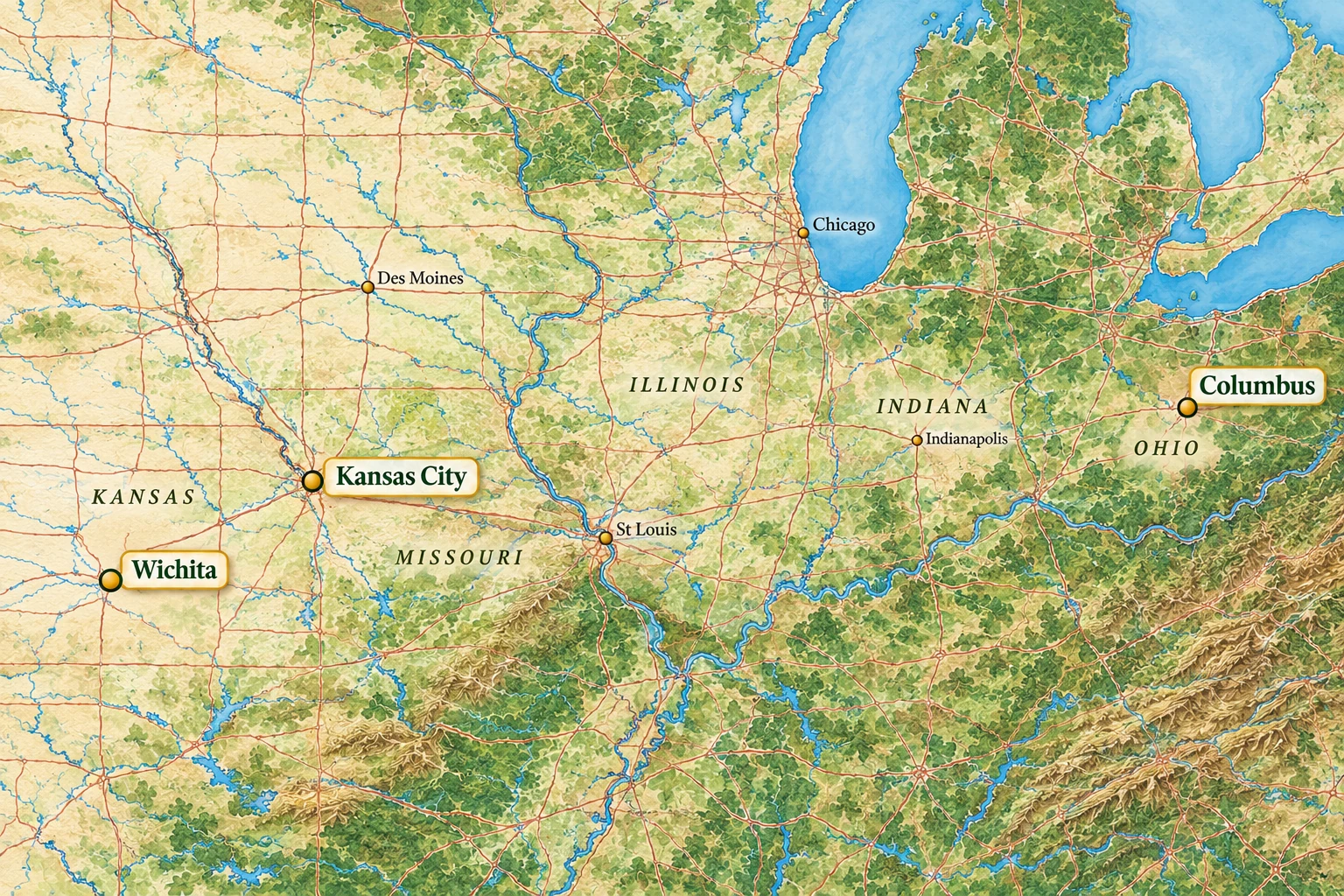
Geographic reference
Wichita: see what a smaller housing commitment could change
Wichita is one of the clearest historical housing contrasts in this selection. Its city gross-rent estimate is $975, $739 below Virginia Beach's point estimate. That makes it worth investigating when reliable income can move with you or a confirmed role supports the new base. The attraction is the possibility of a smaller required household month, not a promise that an equivalent available home costs exactly the survey median.
The landscape change is also substantial: an inland Kansas city rather than the Atlantic and Bay setting you know. Decide what you would want to do with the extra financial room or different home. More savings, less paid work or room for a particular household need are clearer aims than moving simply because a table has a lower number. Include the longer journey to Hampton Roads and the people you expect to visit.
Wichita Transit publishes current maps and route schedules. Use the current home-to-destination connection rather than an old route description or a general assumption about a downtown shuttle. The exact day, return and transfer matter if you are trying to reduce driving. If you expect to retain a car, count it fully and compare the actual work and household journeys. A lower housing commitment need not mean a car-free week to be useful, but the distinction should stay visible.
Try the worksite or another essential destination from an attainable home, then a grocery trip and an activity you would repeat. Price the complete month with reliable take-home income. Wichita deserves the next stage when the larger housing gap survives the income, transport and return-home costs. If the budget only works with a salary you have not secured, the destination is still a possibility rather than a financial solution you can commit to.
Try first: Replace the historical rent gap with an attainable home, reliable income, the full transport month and a Hampton Roads visit plan.
Local sources: Wichita Transit — maps and schedules.
Columbus: choose a useful home-and-work corridor in an interior city
Columbus gives you an Ohio city comparison when you want a supported role, education path or different urban routine rather than another coastal base. Start with the actual destination that shapes the week. A home convenient for one campus, office or facility can be inconvenient for another. The useful change is a connection you would use repeatedly, not the idea that a larger employment region automatically makes every household arrangement easier.
COTA provides current routes, a trip planner and service-change information. Its existing bus network and future LinkUS plans should not be treated as the same arrival-day service. Put the home, necessary destination and return on the operating network, including the day and any required connection. A central address can be valuable when it joins the pieces of your life; a regional label cannot guarantee that benefit.
The city gross-rent estimate is $1,295, $419 below Virginia Beach's point estimate in the common historical release. That gives you a housing question worth pursuing alongside work and transport. The actual home, income and number of vehicles decide the household result. Include the second adult's job or care arrangement, and the cost and time of maintaining Hampton Roads relationships. A modest apartment in a useful corridor may serve the purpose better than more space with scattered daily trips.
Visit the attainable home area during the kind of week you would have, then try the fixed journey and one normal activity. Include the less convenient return rather than only a midday city visit. Columbus earns a place when the supported opportunity, home and recurring month reinforce each other. If the position is far from the corridor that made the city appealing, compare that actual arrangement before assuming the move delivers a more connected life.
Try first: Try an operating-network home-to-role day and the return, with the second worker or care journey on the same sheet.
Local sources: Home Page | COTA, Central Ohio Transit Authority. Let's Go!.
Kansas City: compare the Missouri city home with the wider regional week
Kansas City widens the search to an inland metropolitan setting with a historical housing comparison below Virginia Beach. It can be useful when a confirmed role, retained income or established connection makes the new base realistic. Keep Kansas City, Missouri—the city used in this table—separate from Kansas City, Kansas and other regional municipalities. A metro-area home search can cross jurisdictions without making the housing and service figures interchangeable.
RideKC's current routes and trip planner let you compare the home with the worksite and other destinations that matter. A useful bus corridor and a streetcar outing can support different parts of the week. Try the return at your hours, then use the operator's current fare and payment information when pricing transport. If you will keep a car as well, include its continuing costs. The useful saving is the one that remains after all the journeys you need.
The Missouri city's historical gross-rent estimate is $1,238, $476 below Virginia Beach's point estimate. An attainable home can still differ substantially, especially if you need a particular layout or convenient route. Count vehicle costs, parking, utilities, care and the Hampton Roads return alongside reliable income. The larger distance makes it worth deciding how often you would see the people you intend to keep close.
Try the least flexible work or household journey from the actual home area, then a normal errand and evening activity. Kansas City belongs on the shortlist when that week and the lower required month can be supported together. If the affordable home creates long trips to the role or social life that attracted you, compare another corridor or another inland city before making the larger transition.
Try first: Use the correct municipality, an attainable home and current RideKC information to test the actual week and full month.
Local sources: Home | RideKC | Kansas City Area Transportation Authority.
A high basin, a desert city and the Front Range
Laramie, Tucson and Denver change the landscape and the seasons in different ways. None turns a weekend outdoor trip into the whole household week.
High basin, desert and Front Range

Geographic reference

Laramie: a cooler summer and a much colder high-country winter
Laramie is a substantial change from Virginia Beach: an inland high-basin city in southeastern Wyoming, with a university-centered local context and nearby mountain landscapes. It deserves attention when that setting and a supported role, course or income arrangement fit your plans. It is not simply a cheaper version of the coastal week. The winter, distance from Hampton Roads and size of the local opportunity need to be part of the reasoned choice.
Laramie Regional's January monthly mean is 21.9°F and July mean 64.8°F, compared with the regional Norfolk International figures of 42.2°F and 81.1°F. The cooler summer is paired with a far colder winter. These are station monthly means including nights, not daily highs or a promise about a particular home. Try the winter entrance, essential journeys and heating arrangement as well as the outdoor season that attracts you.
UWYO Roundup provides public fixed-route transport around campus and Laramie, with route, weekday and academic-calendar conditions. Its separate SafeRide arrangements have their own service periods. Do not assume that a campus-area bus or late-night service creates the same network every day of the year. Establish the actual course or worksite and current return, including the break period or weekend that your life requires.
The city's historical gross-rent estimate is $925, $789 below Virginia Beach's point estimate. That is a reason to investigate a suitable home, not evidence about your next wage or the availability of the particular home you need. Put reliable income, heating, transport, care and long-distance family visits into the month. Keep Laramie when the supported high-country life remains attractive in the difficult season. If winter is the problem you want to escape, another horizon answers that question more directly.
Try first: Try the actual winter week and current campus-or-city transport calendar, then confirm the income and suitable home.
Local sources: UWYO Roundup — public transport in Laramie · NOAA — monthly climate normals.
Tucson: warmer winter, hotter summer and a specific central corridor
Tucson is worth exploring when you want the winter and the landscape to change substantially, with a historical housing comparison below Virginia Beach's. It is an inland desert city, so the move also means giving up the easy coastal setting you already have. Keep the reason positive and concrete: the activity, season or supported opportunity you would use often enough to justify the distance from Hampton Roads.
The NOAA station comparison makes the seasonal tradeoff visible. Tucson International's January monthly mean is 53.6°F against Norfolk International's regional 42.2°F; in July the figures are 88.2°F and 81.1°F. These are averages including nights, not daytime highs or a measure of humidity. A warmer winter does not supply a cooler summer. Try the actual home, cooling arrangement and essential journey in the hotter part of the year before treating the climate change as settled.
Sun Link connects a defined central sequence of districts: Mercado San Agustín, Downtown, Fourth Avenue, Main Gate Square and the University of Arizona. That gives a useful starting corridor for a home search when those destinations match your life. It is not the whole Tucson region or a route to every job or trail. Include the walk, bus or other connection beyond the streetcar, especially if you plan to reduce driving rather than simply move it elsewhere.
Tucson's historical gross-rent estimate is $1,145, $569 below Virginia Beach's point estimate. Replace that background with an attainable home and reliable take-home income, then include transport, cooling, coverage and Hampton Roads returns. Tucson deserves the next visit when the supported ordinary week and the winter change are both appealing. Keep another option if the saving depends on an income you cannot retain, or the summer makes your necessary daily routine uncomfortable.
Try first: Try a home on a useful actual corridor and a hotter-season workday, then price the complete month and the Hampton Roads return.
Local sources: Sun Link Streetcar · NOAA — monthly climate normals.
Denver: make the Front Range setting worth the whole city commitment
Denver is worth exploring when a supported opportunity and the Front Range landscape are part of the life you want next. The city sits east of the mountains; living in Denver and reaching a mountain outing are separate parts of the arrangement. From Virginia Beach, you are exchanging familiar coast and local support for a different urban region and landscape. Give that larger change a concrete weekly benefit rather than relying only on the view.
RTD supplies bus and rail services across particular metropolitan corridors. The current network, construction changes and operating connections matter more than a broad rail map or planned future extension. Try the actual home-to-work or course journey, including the walk and return. A suitable home near a useful connection may improve independence; a different regional address may preserve much of the driving you hoped to reduce.
The Denver City gross-rent estimate is $1,831, $117 above Virginia Beach's point estimate in the common historical release. It does not price a particular home, but it gives no basis for presenting Denver as an automatic housing-saving choice. Use the confirmed income and whole recurring month, including the second worker, care and Hampton Roads visits. A role or a life change can justify paying more when the household understands what it gains.
Make the first visit include an ordinary workday and errand before the outdoor trip. Then try the outing you would realistically repeat from that home area, with the time and travel it needs. Denver earns the next stage when both the city week and mountain access are worthwhile at an attainable cost. If the budget depends on assumed higher earnings or the outdoor benefit stays an occasional long trip, compare the actual compromise with Laramie, Tucson or another supported option.
Try first: Price a supported Denver week and separately try the realistic mountain outing from the attainable home area.
Local sources: Regional Transportation District | RTD-Denver.
Three western settings, only one directly on the ocean
Eugene is an inland Oregon city, Sacramento an inland California capital and San Diego a Pacific coastal city. Price the home that would support each version.
Three western settings, from Oregon to Southern California
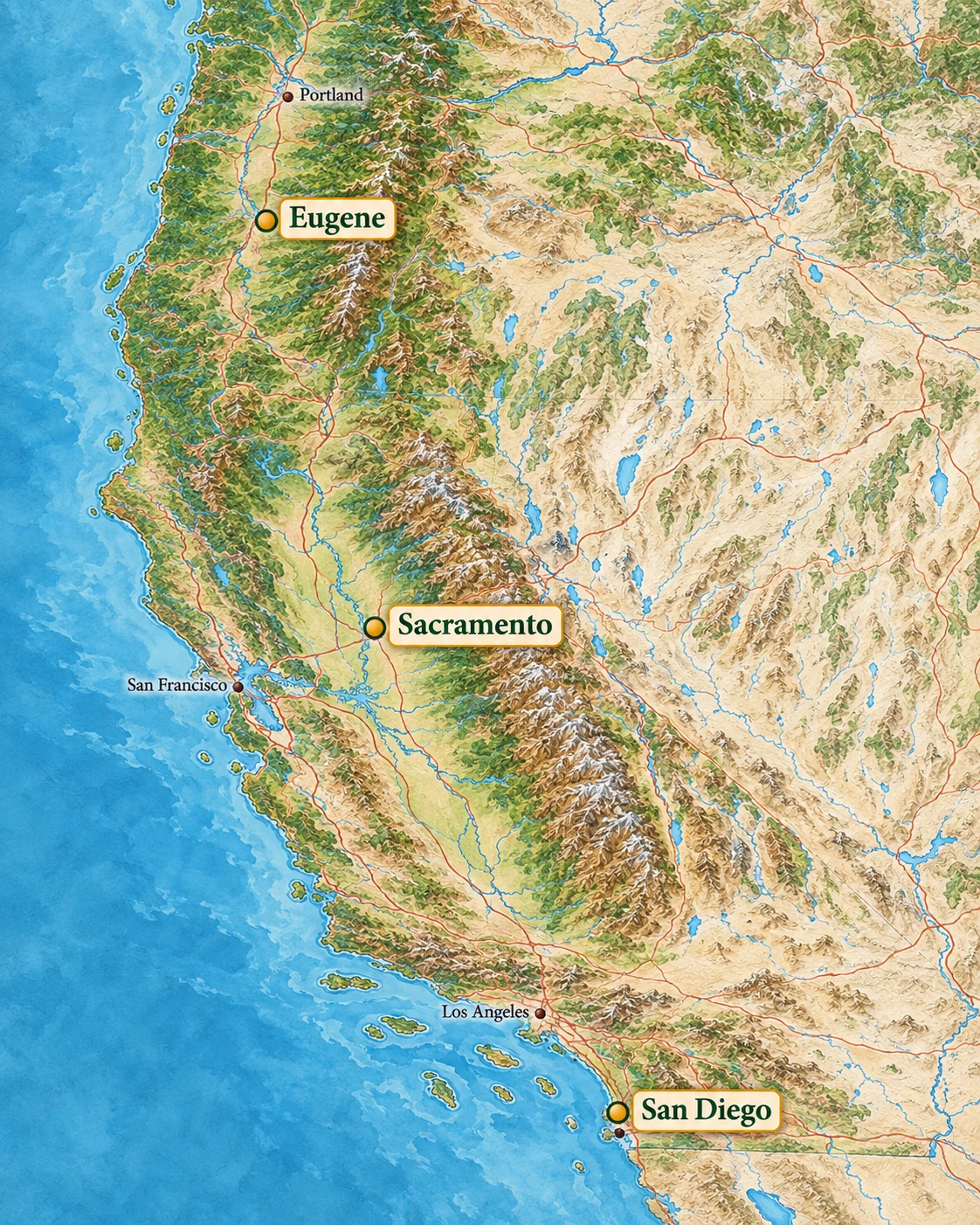
Geographic reference

Eugene: an inland Oregon daily life rather than a beach replacement
Eugene gives you a western valley-city comparison when the next chapter is about an inland routine, a supported course or role, and access to a different landscape. It sits in Oregon's Willamette Valley, not directly on the Pacific. The move therefore changes more than which beach you visit: it changes the household base and the distance from the people and services you know in Hampton Roads.
Lane Transit District supplies current routes, journey planning and service alerts for the actual local connection. Eugene, neighboring Springfield and other Lane County destinations should not be treated as one uniformly convenient home area. Place the actual worksite or campus, shopping and evening return beside the address you could choose. A useful corridor can make an ordinary week easier without implying that every regional trip or coast outing is handled by the same service.
The Eugene City gross-rent estimate is $1,402, $312 below Virginia Beach's point estimate. That historical background supports a housing comparison, not a prediction about an available apartment or your wage. Include the whole transport arrangement and the more substantial return to Hampton Roads. If you plan to retain remote income, establish employer location permission before relying on it. A lower home payment is only one part of what the transcontinental change needs to support.
Visit the attainable home area and make the essential trip, then try an ordinary walk or activity that represents the new valley life. Keep the coast or mountain trip separate so it does not hide the daily arrangement. Eugene belongs on the list when the supported week itself is appealing. If the main wish is to keep a daily beach routine, San Diego or a different actual coastal home answers that preference more directly, with its own budget tradeoff.
Try first: Try the inland home-to-role week on current LTD connections, then price the Hampton Roads return separately.
Local sources: Lane Transit District.
San Diego: keep a coastal preference and face the larger housing question
San Diego is the Pacific coastal comparison when you want to keep water in your life while making a substantial regional change. A confirmed role, family connection, suitable climate preference or attainable home can give the move a clear purpose. From Virginia Beach, simply being near the ocean is already available; explain what the San Diego version adds often enough to justify the transition and distance from your current support.
The historical city gross-rent estimate is $2,313, $599 above Virginia Beach's point estimate. That makes the household budget an early decision, not a final detail after the visit. A higher supported income or a different home arrangement may make the choice workable. The city's household-income median does not offer you that income. Use reliable take-home pay, the actual property and the complete month before deciding how much room the coastal preference leaves.
MTS's Trolley connects defined parts of the city and region, including downtown, East County, UC San Diego and South Bay corridors. The current station list includes specific campus and medical-center stops. That is a useful way to test a relevant home-to-destination journey, not a guarantee for every job, neighborhood or beach. Include the final walk or bus connection and the return at your hours. A home chosen for one corridor may not help another household member.
Try the ordinary work or study day from an area you can afford, then one coastal activity you would repeat. Include the visits back to Hampton Roads, care and any continuing vehicle costs. San Diego earns a place when the supported life and attainable home justify the higher commitment. If the main task is to reduce spending after an income loss, the lower-rent inland comparisons or a smaller local home deserve attention before this larger coastal change.
Try first: Establish the actual housing and take-home budget, then try the needed Trolley or other connection and a repeatable coastal activity.
Local sources: Trolley | San Diego Metropolitan Transit System.
Sacramento: compare an inland California city week on its own terms
Sacramento offers a California comparison centered on an inland city rather than a Pacific beachfront home. It can be useful when a real role, household connection or supported daily routine makes the capital-city setting attractive. Keep the Central Valley base clear in the decision. A trip to the coast or mountains remains an outing with its own time and transport, not an amenity directly outside every Sacramento home.
SacRT's current directory distinguishes its Gold, Blue and Green light-rail lines and bus routes. Use the operating line, station and onward connection that reach the actual work, study or household destination. Sacramento City and the wider region contain different home and service contexts. A home close to one station does not settle another adult's job, a school assignment or the return after a late shift.
The city gross-rent estimate is $1,779, $65 above Virginia Beach's point estimate in the common historical release. That small difference does not establish equivalent housing costs, and it is not a financial reason by itself to undertake the distant transition. Compare an attainable home, confirmed income, transport, cooling, coverage and Hampton Roads visits. A useful local connection or supported role may matter more than the citywide housing gap.
Try the essential day and one ordinary city activity from the home area you could support. Include the hotter part of the calendar in the practical home-and-journey question rather than importing a general idea of California coastal weather. Sacramento belongs on the shortlist when the inland city week itself supplies the improvement. If what you want is a beach outside your regular routine, compare the actual distance and cost with San Diego or the coastal life you already have.
Try first: Try the actual inland home-and-role week on the current SacRT network, then compare the complete month and return-home plan.
Local sources: SacRT — current routes and schedules.
Compare the money left, then the cost of changing homes
Start with the amount the household has left after its recurring essentials. A lower housing payment matters, but so do transport, utilities, coverage, childcare, medical spending and visits to people you are leaving. Use reliable take-home income rather than a city household-income median or the top of a job advertisement. The useful question is whether the home and the necessary week leave enough room for the life you want.
The four cases below are chosen household inputs, not prices for Norfolk, Wichita or any other destination. In the current arrangement, $6,200 of monthly take-home income leaves $1,000 after $5,200 of recurring essentials. A lower home payment saves $350, but $300 more in transport leaves only $50 of additional room. That could still be worthwhile for another reason; it is a weak financial case for a costly transition on its own.
The connected-home case costs $150 more for housing but $450 less for transport, leaving $1,300. The $300 improvement comes from the complete arrangement rather than the cheapest home. Treat the transport reduction as something to establish: which vehicle, insurance, parking or paid journeys would actually disappear? If you keep the same two cars and add transit spending, that particular model no longer describes your household.
In the lower-income case, take-home pay falls to $5,000 while the lower-home and higher-transport arrangement remains. It produces a $150 monthly shortfall. A cheaper home has not repaired the income loss. You would need another attainable expense change, confirmed income or a deliberately funded temporary period. Do not ask a one-time moving budget to cover an indefinite recurring gap.
Keep the cost of the transition in a separate column. In this example, $4,200 of unrecoverable costs divided by the connected case's $300 monthly improvement takes fourteen full months to recover. If the improvement were only $50, the same arithmetic would take eighty-four months. Neither calculation predicts your quote or how long you will stay. It shows why a small apparent saving deserves careful attention before you give up a workable arrangement.
Separate unrecoverable spending from deposits and from the reserve you keep available. A deposit may tie up cash even when you expect it back. The reserve should still cover the difficult weeks after arrival: a late first paycheck, an essential repair or a visit home. Count overlapping housing, temporary accommodation, travel, setup and the selected moving services according to the actual plan. Avoid placing the same item in both the recurring month and the transition total.
The historical housing table helps narrow the search. Virginia Beach's monthly median gross rent is $1,714 with a published $19 margin of error in the 2020–2024 ACS five-year release. Wichita is $975, Laramie $925 and Tucson $1,145; Charleston is $1,722 and San Diego $2,313. These are occupied-home survey estimates with different housing mixes. They are not new-listing prices, equivalent-bedroom quotes or guaranteed savings, and subtracting two point estimates does not establish a statistically meaningful difference.
For buying, use the attainable property's whole carrying cost and work involved, rather than substituting a sale price for rent. For renting, compare the same required bedrooms, entrance and lease conditions. A home may earn a place on the shortlist because it frees time, supports one vehicle or accommodates someone comfortably, even when its payment is higher. Write that benefit beside the money left so the decision stays honest about what the household gains.
Hypothetical monthly US dollars · chosen inputs, not destination quotes
| Monthly result | Current arrangement | Lower home payment, more travel | Connected home, less transport | Lower income, more travel |
|---|---|---|---|---|
| Money left each month | $1,000 | $1,050 | $1,300 | −$150 |
| Take-home income | $6,200 | $6,200 | $6,200 | $5,000 |
| Recurring essentials | $5,200 | $5,150 | $4,900 | $5,150 |
Current arrangement
$1,000Money left each month
- Take-home income
- $6,200
- Recurring essentials
- $5,200
Lower home payment, more travel
$1,050Money left each month
- Take-home income
- $6,200
- Recurring essentials
- $5,150
Connected home, less transport
$1,300Money left each month
- Take-home income
- $6,200
- Recurring essentials
- $4,900
Lower income, more travel
−$150Monthly shortfall
- Take-home income
- $5,000
- Recurring essentials
- $5,150
The lower home payment leaves only $50 more after extra transport. The connected-home case leaves $300 more despite a higher housing payment. With the income drop, the lower-home case has a $150 monthly shortfall.
See the hypothetical inputs
| Recurring expense | Current arrangement | Lower home payment, more travel | Connected home, less transport | Lower income, more travel |
|---|---|---|---|---|
| Housing and applicable utilities | $1,900 | $1,550 | $2,050 | $1,550 |
| Transport, vehicles and paid journeys | $950 | $1,250 | $500 | $1,250 |
| Other recurring household essentials | $2,350 | $2,350 | $2,350 | $2,350 |
Current arrangement
- Housing and applicable utilities
- $1,900
- Transport, vehicles and paid journeys
- $950
- Other recurring household essentials
- $2,350
Lower home payment, more travel
- Housing and applicable utilities
- $1,550
- Transport, vehicles and paid journeys
- $1,250
- Other recurring household essentials
- $2,350
Connected home, less transport
- Housing and applicable utilities
- $2,050
- Transport, vehicles and paid journeys
- $500
- Other recurring household essentials
- $2,350
Lower income, more travel
- Housing and applicable utilities
- $1,550
- Transport, vehicles and paid journeys
- $1,250
- Other recurring household essentials
- $2,350
These are chosen arithmetic inputs. Replace them with attainable housing, reliable take-home pay and your complete recurring essentials. No vehicle saving applies until that cost actually disappears.
At $300 more left each month, a chosen $4,200 unrecoverable transition takes fourteen full months to recover. At $50, it takes eighty-four months. Deposits and your reserve remain separate cash needs.
Compare historical rent and household-income estimates
Comparable Census places · 2020–2024 ACS five-year estimates · 2024 US dollars. Gross rent covers occupied cash-rent homes and applicable utilities, not current listings. Income is annual household income before tax, not a salary or take-home amount. The ± figure is the published 90% margin of error. Differences subtract Virginia Beach point estimates; they are not a significance test or personal saving. Scroll the table sideways on a narrow screen.
Choose around the actual role, course and second worker
Begin a work-led move with the place and hours where the work happens. A Virginia Beach household may have more than one worksite, a campus, changing shifts or access requirements that make a broad regional label unhelpful. For a local change, place those destinations on the same week before comparing Norfolk, Hampton and Chesapeake homes. For a distant change, get the role and location clear enough to test the rest of the household arrangement.
An employer's city does not automatically identify the office or facility you will use. Ask where you must report, how often, whether those days can change and what the arrival and departure hours are. If the position involves restricted access, confirm the requirements with the employer rather than assuming an ordinary commute reaches the workplace door. A general interest in naval, public-sector or technical work is not a job offer or a promise of eligibility.
For remote work, obtain the employer's decision about the proposed location before choosing a lease around the old paycheck. Confirm working hours, required travel, equipment, payroll arrangements and whether the permission applies to another state or country. Test the actual home's internet and workspace, including the person sharing the home. A quiet-looking room in a listing does not tell you how two simultaneous workdays will feel.
For a household with two workers, compare the combined result. One better offer can be outweighed by a second income disappearing, expensive care or a vehicle added to reach separate jobs. Agree which role is fixed and which can change. Keep a temporary one-income month distinct from a long-term arrangement, and establish how long the household can support the transition. It is easier to make a fair decision before one adult has committed to the attractive part.
If you are changing profession, use the actual training and qualification route rather than a city's reputation for opportunity. Establish admission, attendance, required placements, tuition and whether paid work fits the timetable. A college-city home can be convenient for one campus and awkward for another site. In Laramie, university-supported public transport has its own route and calendar conditions; in Tucson, the streetcar supplies a specific central corridor. Neither replaces the course's actual schedule.
For a licensed profession, ask the destination regulator what your current qualification permits and which additional steps apply. Keep the time, documentation and possible gap in earnings in the plan. Do not treat a national demand statement or a household-income median as evidence that your next job is available. An actual employer conversation and applicable qualification path are more useful than an attractive average.
For a first job or first independent home, build the first year around reliable earnings, the deposit and the route you can use at the hours offered. A smaller shared home near work may support the transition better than a larger isolated place. Include the adult who can help in a difficult week and how you would reach them. Independence becomes easier to sustain when the ordinary arrangements are realistic from the beginning.
Keep two work-led comparisons on the shortlist if you can: the supported opportunity that is ready now and the place that would require a longer change. That makes the tradeoff visible without asking you to solve every career decision before exploring. A destination earns the next visit when the role or course and an attainable household week can be described together.

Make the week work for everyone who is moving
For a household with children, choose around the whole chain: home, school or care, work, pickup and the return. A house can look convenient when each destination is considered separately and still produce an impossible day when they are combined. Put the latest pickup beside the least flexible work finish, then include the extra minutes that a missed connection or delayed crossing can require. That is often more useful than a general school ranking.
If you remain in Virginia Beach, use the district's address locator and registration process for the particular residence. Norfolk, Hampton and Chesapeake have their own school arrangements; a nearby move can change more than the route. For any destination, ask the receiving school about the needed program, records, placement and first day before relying on a neighborhood description. A school building near a home is not an admission or attendance-zone promise.
Care is a separate availability question. At the checked date, Virginia Beach's 2026–27 before-and-after-school online registration is closed and the city directs interested families to an interest form. That does not mean every child already has a place or that a move into a particular home supplies one. For the next destination, establish the age served, actual site, operating calendar, pickup rules and a place you can obtain. Keep a workable temporary arrangement if arrival precedes enrollment.
For preschool children, do not substitute a school-age program for the care you need. Compare the full hours and days, the path between the provider and work, and what happens when the usual arrangement closes. For school-age children, include holidays and breaks rather than only a regular school day. A lower housing payment can be consumed quickly by replacing help that a relative currently provides at no charge.
For teenagers, ask what independence they would gain or lose. The new home might shorten a school trip while making friends, a part-time job or an activity inaccessible without an adult driving. Include a route they can realistically use and a way home at the hour the activity ends. Invite them into the visit with a concrete task to try. A move is easier to assess when their ordinary life appears beside the adults' work and housing needs.
For one parent, reliable backup deserves its own line in the budget and shortlist. Identify who can collect a child, respond to a changed workday or help during illness. A friendly person you hope to meet after arrival is not yet that arrangement. A nearby move that preserves support may be better than a distant home with a larger apparent saving. A distant move can still work when the care and backup are established rather than left to chance.
For several generations, begin with how each person enters and uses the home. Count bedrooms alongside stairs, bathroom access, privacy, the daily care task and the route to appointments or activities. Another adult's presence does not automatically mean unpaid care is available. Agree what help is possible and wanted. A home that looks generous on a floor plan can still concentrate difficult work on one person.
Ask each person who is moving what would make the next home and week easier. An older parent may want to keep working and cycling; a young adult may need accessible transport or practical support. Include the language, services, social connections and daily journeys each person values. Citizenship and household status may change an international plan, so establish the route available to everyone before choosing around one adult’s preferences.

Local sources: Registration - Virginia Beach City Public Schools · School Locator - Virginia Beach City Public Schools · Before and After School | City of Virginia Beach.
Build a life when you move on your own
Moving alone gives you more freedom to choose a place, but usually less room to share costs and practical tasks. Start with the home you can support on one reliable income and the journeys you can make without borrowing someone else's time. Include the evening return, an appointment when you feel unwell and the day the usual transport does not work. These are ordinary parts of independence, not reasons to rule out a move.
Choose a repeatable social routine before choosing a reputation for friendliness. A weekly class, volunteering shift, sports session, library group or community activity gives you a reason to see the same people again. Locate one or two real activities that fit your interests and working hours, then place the home and return beside them. A list of festivals or a lively weekend visit cannot supply that repeated contact on its own.
For a Virginia Beach resident seeking more spontaneous evenings, a connected Norfolk home is a useful nearby test. You may gain a different city routine while preserving access to people you know. Farther away, Baltimore, Columbus or a central Tucson corridor pose different versions of the same question: can the attainable address connect you to work and the activities you will actually attend? The city's size alone cannot answer it.
If you expect to live without a car, test a whole week rather than a single pleasant walk. Include groceries, work or study, medical needs and one evening activity. Account for waiting, the last service and the crossing between stop and entrance. A home can be excellent for a person with a particular route and unsuitable for someone working different hours. Keep the actual transport spending in the one-income budget.
If you are single and hoping for a new social beginning, choose a home from which you can join the activities and communities that interest you. Try the evening journey and the return, then decide whether you would want to do it every week. Include any parenting responsibilities and the support you need on difficult days. A place becomes easier to settle into when the people and activities you hope to meet have a practical place in your routine.
If language or cultural connections matter to you, locate the resources you would actually use: a language class, congregation, community organization, familiar food shopping or a way to keep family ties active. Ask the people moving with you which connections they want to preserve or build. For an overseas option, consider both the ordinary experience in that community and the residence or work basis available to your household.
Give the first ninety days a modest shape. Establish the home essentials and one regular activity first, then add another connection after you know the workweek. Keep someone who knows your new address and a realistic way to ask for help. A smaller social beginning is enough if it is repeatable. The goal is to make the new place part of your ordinary life, not to reproduce every Virginia Beach connection in the first month.
Make a smaller home give you a larger usable life
Downsizing works best when it removes work you no longer want while keeping the parts of life you value. The improvement may be fewer stairs, less land to maintain, a shorter errand or a home closer to someone important. Begin with those gains before comparing square footage. A smaller place with an awkward entrance or additional driving can reduce the floor area without reducing the effort of living there.
For a Virginia Beach homeowner, compare the current property's upkeep and carrying costs with an attainable smaller local home. Include the work that belongs to the building or association, the costs you still pay and the services you would use. A Town Center apartment, another accessible neighborhood home and a distant option can be compared on the same sheet. You do not have to leave the region to make the next stage different.
For retirement on a fixed income, prioritize the month you can continue to support rather than a place described generally as affordable. Use actual housing, transport, coverage, medical spending and visits to family. Keep an allowance for costs that fluctuate and a reserve for the transition. A lower historical rent estimate is useful for starting a search, but it does not guarantee an accessible home at that figure or the care arrangement you need.
Medical continuity belongs near the top of the shortlist when you use regular care. Establish whether the needed provider can see you, whether your coverage works there and how you would get to appointments. A hospital symbol on a city map does not answer those questions. For a distant move, allow time to transfer records, arrange prescriptions through the appropriate professionals and bridge any gap in routine care. Keep the private clinical decisions with your care team.
For someone planning to stop driving, the whole daily route matters more than a nearby stop. Check the entrance, crossing, waiting place and return, and the backup you could actually use. In coastal Virginia, a summer visitor service should not be the basis for a year-round home. In another city, a central rail or bus corridor can help, but only if it reaches the destinations and hours that shape your life.
Include family visits as an ordinary expense and time commitment. A move to Norfolk may preserve frequent contact; a move to San Diego or Calgary changes the return substantially. Decide how often you hope to meet, who can travel and what happens when a visit becomes urgent. A cheaper home can be the right choice even with those costs, but the comparison is incomplete if the people you want to see disappear from the arithmetic.
Use a reversible beginning where it suits the plan. A suitable rental can let you learn a new area before taking on a property and its maintenance. Keep enough flexibility to change the home if the entrance, transport or household arrangement proves different from the visit. The strongest next-stage choice is the one that supports independence and the relationships you want to keep, whether it is nearby or across the country.
Choose the season and landscape you want to live with
Virginia Beach already offers access to Atlantic beaches, the Bay and quieter southern landscapes. If nature leads the move, be precise about what is missing. You may want hills outside the door, a different kind of walking, a cooler summer, a dry setting or land for a particular activity. Another coastal name may change the scenery without changing the daily experience that has become tiring.
Separate daily access from a weekend outing. A river path near a home in Chattanooga or Eugene can be part of an ordinary evening. A mountain trip from Denver takes its own route, time and conditions. A Tucson city home and a desert outing are also separate choices. Put one realistic activity beside the place you could afford, including the trip back after the time you expect to finish.
The station comparison below shows why a climate choice needs the whole year. Norfolk International, used here as a regional Hampton Roads baseline, has a January monthly mean of 42.2°F and July mean of 81.1°F. Tucson International is 53.6°F and 88.2°F; Laramie Regional is 21.9°F and 64.8°F. These 1991–2020 monthly means include nights. They are not afternoon highs, humidity measures or forecasts for an individual home.
Tucson therefore offers a useful warmer-winter comparison, with a hotter summer in this measure. Laramie offers a much cooler summer and a substantially colder winter. Neither is simply better weather than Virginia Beach. Think about the months you most want to change, then the opposite season you would accept. Include the heating or cooling arrangement, walking conditions and how the essential journey works when you least want to be outside.
Moving inland can change coastal exposure, but it does not make every property free of water, weather or insurance concerns. Virginia Beach's floodplain information and Virginia's evacuation zones answer different address-level questions. A flood map describes mapped flood hazard; an evacuation zone helps authorities direct action during an event. Do not use one as a substitute for the other, or assume that a home outside a mapped high-risk area can never flood.
Apply the same practical attention in the destination. Ask about the actual building, access road, coverage and responsibilities, then use the relevant official local information. A hillside, river setting, dry landscape or forest edge brings its own conditions. Avoid turning a state's general risk into a verdict on every home. The purpose is to understand the attainable property and the week you would have there, not to find a place with no possible difficulty.
For rural space, count the errands and maintenance that come with it. You may enjoy distance from busy streets but need more driving, different utilities or paid help. If your main aim is less work and more independence, those additions can be the opposite of what you want. A smaller home near a useful park or path may provide more nature in your actual week than a larger remote property.
Try the less appealing part of the calendar when you can. If the first visit is in a favorite season, keep the other-season question open rather than treating the trip as a complete answer. Speak in concrete preferences: a cooler evening walk, a winter with less outdoor effort, or a landscape you can reach repeatedly. Those preferences make it easier to choose between very different settings without pretending that one climate suits everyone.


| Regional station | January mean | July mean |
|---|---|---|
| Norfolk International, Virginia — Hampton Roads comparison | 42.2°F | 81.1°F |
| Tucson International, Arizona | 53.6°F | 88.2°F |
| Laramie Regional, Wyoming | 21.9°F | 64.8°F |
Regional-station monthly means, not a forecast or property condition. NOAA climate normals.
Local sources: NOAA — monthly climate normals · Floodplain Management | City of Virginia Beach · Know Your Zone – VDEM.
Four countries, four different household beginnings
Another country belongs on the list when its daily life, opportunity or family connection is the change you want. Calgary in Canada, Zaragoza in Spain, Cork in Ireland and Heredia in Costa Rica show four different beginnings. You can compare each city’s ordinary week with the life you have in Virginia Beach, then follow the official residence and work routes that apply to your household.
Begin with the residence and work arrangement available to each adult, then build the local-currency month around an attainable home. Citizenship, family status, a real role, a course and the type of remote work can change the route. An employer's permission to work away from Virginia Beach and the destination's permission are separate matters. Establish both before relying on the old paycheck or making a nonrefundable commitment.
Keep the people left in Hampton Roads in the plan. Compare the full return journey, the leave you would need and the cost of the frequency you hope to maintain. Medical coverage, school or care, qualification recognition, language and the second adult's work also belong beside the attractive setting. A country can be a good fit while a particular city or household arrangement is not.
For a household move within the US or to Canada, our Virginia Beach long-distance page explains how to plan the shipment. The Spain, Ireland and Costa Rica profiles help you compare possible places to live; transport to those countries requires a separate provider arrangement. Use the linked authorities for the current residence and work route, with advice for your own circumstances where needed.
Canada: Calgary for an inland city and a genuinely different winter
Start with Calgary. Other cities to explore: Toronto · Montréal · Ottawa · Vancouver.
Canada: begin with Calgary

Geographic reference

Calgary offers a Canadian example that changes Virginia Beach's coastal starting point substantially. It is an inland Alberta city east of the Rockies, with a different winter and a new household base rather than a short extension of your Hampton Roads life. Consider it when a real role, course, family connection or applicable residence arrangement supports the change. The mountain setting can be part of the attraction without replacing the work and home you would need during an ordinary week.
Start the home search with the operating Calgary Transit network. Its published maps distinguish the Red and Blue CTrain lines, MAX connections and other bus services. A home convenient for one corridor may be awkward for a different worksite or another adult's destination. Put the entrance, walk, connection and return beside the address you could choose. Keep a mountain outing separate from the city transport question; a CTrain station does not itself provide the outdoor trip you are imagining.
Establish the work and residence basis for each adult before relying on the move. Canada's immigration authority distinguishes employer-specific and open work permits, other applicable routes and exceptions. An open category is not a permission everyone can select. If you want to retain US work, confirm the employer's decision and the applicable basis for doing that work from the proposed Canadian home. A visit, a course admission and a supported working household answer different questions.
Build the recurring month in Canadian dollars with the actual income currency visible. Use an attainable home and include transport, coverage, care, household setup and visits to Hampton Roads. The US rent table does not supply a Calgary listing or a Canadian pay offer. Add the full return journey and the leave it would require at the frequency you hope to maintain. The distance matters when a relative needs practical help, even if ordinary video calls preserve some contact.
Try the less comfortable part of the calendar as well as a clear-day outing. Walk from the home entrance to the connection you would need, test the workday and choose one local activity you could repeat. Calgary belongs on the shortlist when the supported city week and the larger inland seasonal change both appeal. Toronto, Montréal, Ottawa and Vancouver widen the Canadian horizon for another role or family tie; they do not share Calgary's exact home, climate or transport arrangement.
Try first: Confirm the household’s actual Canadian route, then test an operating-network Calgary week, Canadian-dollar budget and Hampton Roads return.
Local sources: Canada — temporary work routes · LRT Station, Bus Terminal and System Maps.
Spain: Zaragoza for an inland, Spanish-speaking city routine
Start with Zaragoza. Other cities to explore: Madrid · Valencia · Bilbao · Málaga.
Spain: an inland Zaragoza beginning

Geographic reference

Zaragoza is the Spanish example for someone who wants more than another beach. The inland city on the Ebro changes the language, cultural setting and shape of the ordinary day. It can be worth investigating if an applicable work or residence route supports the household and you want a more connected city routine. From Virginia Beach, the attraction should be something you will use repeatedly: the local neighborhood, an activity, a course or a home-and-work arrangement you can sustain.
The city's tram Line 1 provides a concrete corridor, with stops serving central districts and the Campus Río Ebro direction as well as the southern part of the line. Use the operator's actual stop and journey information for the home you could choose. It does not cover every workplace, home or regional trip. Include the walk, any bus connection and the return at your hours. An enjoyable central visit should lead to a test of the ordinary neighborhood week, not an assumption that every address works the same way.
Spain's Washington consular office publishes a telework route for qualifying circumstances, including particular employer or professional arrangements and documentation. The existence of that route does not make every remote job eligible. Confirm the applicable category, the employer's permission, the requirements for accompanying family and the current process for your consular jurisdiction. If a different status or citizenship applies, start with that actual basis instead of fitting the household into a convenient label.
Keep the euro household month separate from the US survey comparison. Price the attainable home, recurring charges, transport, coverage, care and the full Hampton Roads return. Show which income is retained and its currency, then consider exchange-rate changes without treating a favorable day as a permanent saving. Resolve the applicable tax and employment position for the actual arrangement. No housing estimate or permit discussion here establishes a personal entitlement or disposable-income result.
Try an ordinary working day, grocery errand and local activity in Spanish from the area you could afford. Include the summer home and journey conditions and the time difference for any US-based work. Language learning and rebuilding support take time even when the city is exciting. Keep Zaragoza when the supported inland city life is the change you want. Madrid, Valencia, Bilbao and Málaga offer other Spanish horizons; choose one of them for a real household reason rather than assuming this tram-based example describes the whole country.
Try first: Establish the applicable household status and work arrangement, then try the tram-connected neighborhood day and a euro budget.
Local sources: Telework (Digital nomad) Visa - Consular Section · Tranvía de Zaragoza |.
Ireland: Cork for a supported role and a different maritime city life
Start with Cork. Other cities to explore: Dublin · Galway · Limerick.
Ireland: begin with Cork
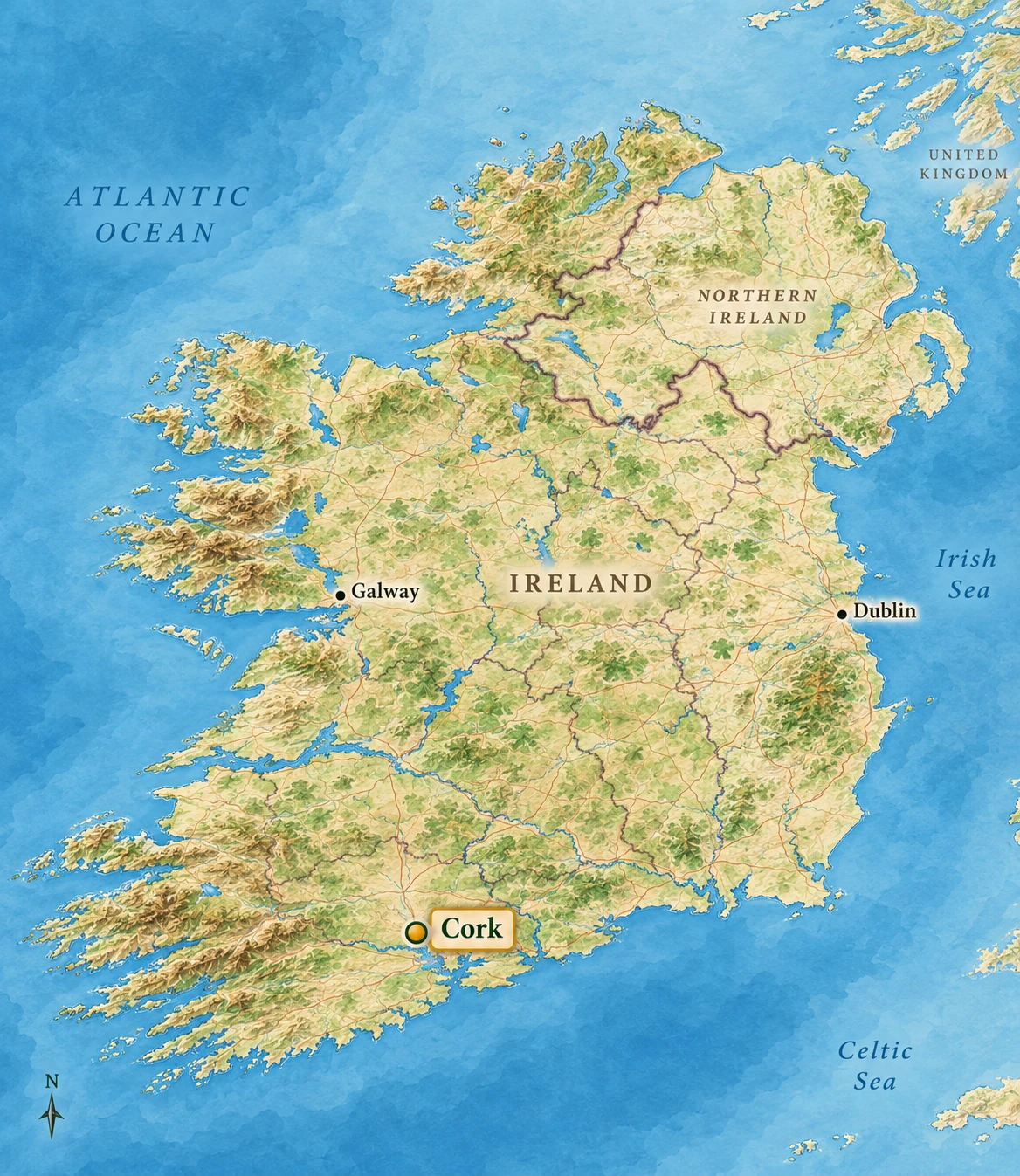
Geographic reference

Cork gives you an English-language city comparison within a different national and cultural setting. The city is on the River Lee, inland from the open sea, so it is not a direct replacement for a Virginia Beach home by the Atlantic. Explore it when an actual role, course, family connection or applicable permission gives the move a foundation. The useful change might be a more connected local routine or being near an opportunity you cannot obtain by changing your Virginia Beach address.
Transport for Ireland's Cork network information distinguishes city and suburban buses, regional services, rail and airport connections. Cork Kent and the relevant bus or rail corridor can anchor a particular home search, but the final worksite and return still matter. Do not treat a network map's planned-frequency material as proof that every future route is already carrying passengers. Use the operating journey for your actual arrival period and the destination that shapes the week.
Ireland's immigration service explains the work-permission starting point, while the employment department publishes different permit categories. For someone without an existing applicable right to work, establish the route and the actual qualifying role before committing the home. The position of an accompanying adult also needs its own current answer. A US passport, an English-speaking job advertisement and an ability to visit do not by themselves settle the right to take up local work or remain for the intended period.
Use a euro budget based on homes you can genuinely consider. Include the household income that is available, transport, coverage, school or care needs and returns to Hampton Roads. A potential job offer should be compared after the recurring month and the second adult's position are understood. The income and rent figures in the US table are not estimates for Cork. Keep the practical cost of arrival and any temporary accommodation separate from the ongoing month.
Try the ordinary day in the weather and home area you would live with, including the walk to the stop and the return after an activity. Add one repeatable local connection rather than expecting language familiarity to replace the support you already have. Cork is worth carrying forward when the supported opportunity and daily city life reinforce each other. Dublin, Galway and Limerick can widen the Irish search for another role or family tie, but each needs its own attainable home and journey comparison.
Try first: Confirm the actual role or other applicable basis for every adult, then test the operating Cork journey, home and euro month.
Local sources: Types of permit - DETE · Ireland — coming to work · Cork City Bus & Train Network Maps | Transport for Ireland.
Costa Rica: Heredia for a Central Valley beginning rather than a beach assumption
Start with Heredia. Other cities to explore: San José · Alajuela · Cartago.
Costa Rica: Heredia in the Central Valley
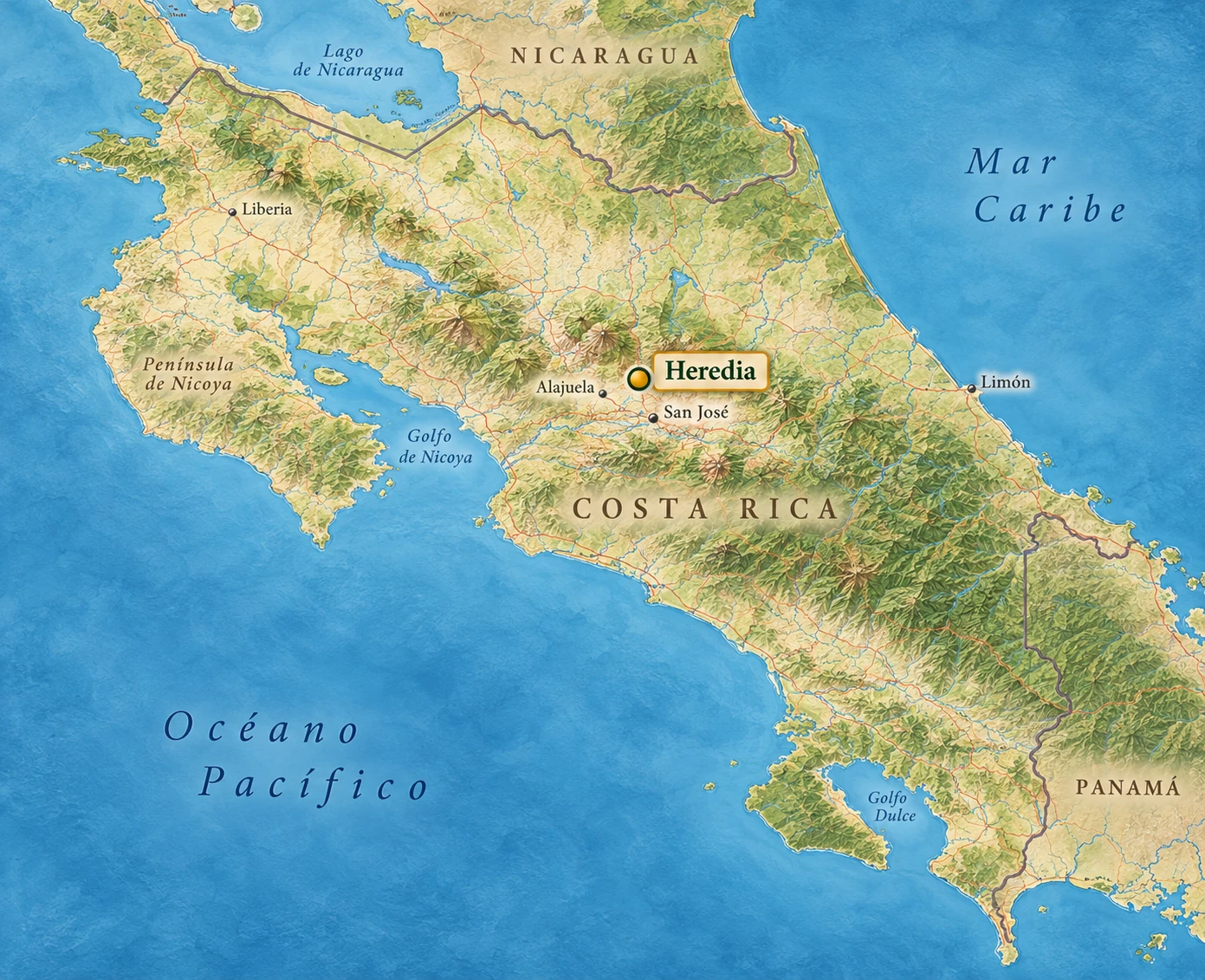
Geographic reference

Heredia provides a different Costa Rican question from a beachfront escape. The Central Valley setting offers an inland home base near the San José region, with Spanish as part of ordinary daily life. It can be useful when an applicable remote-work or other residence arrangement supports the household and you want that specific local experience. From Virginia Beach, giving up a familiar coast should buy a change you actually want, rather than an image of permanent holiday life.
INCOFER's San José–Heredia–Alajuela route page identifies regular service from Monday to Friday. That is a useful commuter starting point and an important limit. Do not build a whole weekend or evening routine around a rail service simply because a station is nearby. Put the attainable home, station access, actual work pattern and the return on the same day. Establish a workable arrangement for the journeys outside that rail service, including shopping, care and activities.
Costa Rica's official tourism authority describes its digital-nomad program for qualifying remote workers and publishes income, documentation, insurance and other conditions. Establish whether the actual household and work fit the program or another applicable route. It is not a general permission to take any local job. The employer's location decision remains a separate question, and the accompanying household needs its own supported arrangement rather than an assumption based on one adult's work.
Prepare the month in Costa Rican colones with the income currency clearly shown. Use actual homes and include utilities, connectivity, transport, coverage, care, setup and Hampton Roads visits. Do not assume that an inland location or a foreign currency makes the complete month cheaper. If work depends on the internet, test the actual address and a practical contingency. Resolve the applicable tax and employment questions for the arrangement instead of treating a general program description as a personal financial result.
Try a normal workday and errands in the area you could afford, including the wetter conditions you would have to live with and the transport outside the commuter period. Add a repeated local activity and the support you would use when plans change. Heredia belongs on the shortlist when that inland household week is appealing and supported. San José, Alajuela and Cartago widen the Central Valley horizon; they are distinct places, not interchangeable station names or substitutes for a coastal Costa Rican home.
Try first: Confirm the applicable residence and remote-work basis, then test the Central Valley home, weekday rail limits and full local-currency month.
Local sources: Digital Nomads: Live and Work - Visit Costa Rica · Tren San José - Heredia - Alajuela | Horarios | INCOFER.
Use a visit to try the life, not just enjoy the place
Visit the two strongest candidates first if you can. Choose accommodation near an area you could actually afford rather than the most convenient holiday base. Write down the ordinary day you are testing: a departure, a work or course destination, an errand, an activity and the return. The result should tell you whether that arrangement deserves the next commitment, not simply whether the city is enjoyable.
Make the least flexible journey early in the visit. For Hampton, that may be the required harbor crossing at your working hours. For Norfolk or Chesapeake, it may be a particular facility, care pickup or evening return. For a distant city, the same principle applies to the actual role or campus. A short map distance can hide a transfer, parking search, access requirement or a gap between service and the building entrance.
Try the home area on foot or by the transport you expect to use. Buy ordinary groceries, look at the crossing and carry what you normally carry. Include the person whose mobility, schedule or care responsibility makes the journey harder. A route that works when one adult travels lightly may fail when the same adult has a child, shopping or a necessary appointment. That difference can change which home area is suitable.
Ask the landlord or agent about the exact home rather than a general building description. Establish the entrance, stairs or lift, noise, utilities, lease dates, pets and the recurring charges relevant to you. For buying, investigate the property's condition, ongoing responsibilities and coverage through the appropriate professionals. Keep important answers in a form you can return to when comparing the other candidate.
For work, confirm the reporting site and location permission before a home commitment. For school or care, speak to the actual receiving organization about the program and place, not only a broad city information page. For regular medical needs, establish a workable provider and coverage route. You do not have to complete every administrative step during a visit, but the unresolved answer should be specific enough to decide what happens next.
Spend time on one activity you want to repeat after moving. It could be a path, a class, a community group or a small weekly outing. Try its return at the hour you would use it. This is the positive part of the visit: the ordinary pleasure the new place would add. Put it beside the practical evidence so the decision does not become only a list of difficulties and costs.
If you cannot visit, make the remote check more concrete. Request a live view of the actual entrance and home, compare current provider information for the necessary journeys and speak to the people responsible for work, care or the lease. Use a reversible first arrangement where possible and keep the unknowns visible. A remote search can narrow the options; it should not quietly turn missing information into a confirmed advantage.
Afterward, give each candidate a short decision: keep, investigate one named issue or remove. Record what changed your mind and the current figures or answers that support it. A place you remove has still helped the comparison if it reveals what matters. You are ready to move forward when two to four options have a credible home-and-week arrangement, and the next step is an identifiable decision rather than another open-ended search.
Keep two to four places, then make the move concrete
Your shortlist should now be smaller than the map. Beside each place, keep a sentence explaining the improvement, the compromise and the unresolved answer. A useful comparison might put a Norfolk home with a more connected week against a Greensboro home with a smaller required month. Another might compare Charlottesville's inland setting with the larger climate change of Tucson. The places do not need to resemble each other if they answer the same household question in different ways.
Use the worksheet for actual addresses and arrangements as the search becomes more specific. Keep income, recurring expenses and the amount left together. Put unrecoverable transition costs, cash tied up and the reserve in separate rows. Add the person, activity or service you want to preserve. This makes it easier to see why a cheaper property is attractive, why a higher payment might still help, and what would make either choice fail.
Give every unknown an owner and a next action. The employer answers a reporting-location question; the receiving school or care provider answers placement; the landlord or appropriate property professional answers the home issue. A current transport timetable supports the route, while the trial journey shows how it works for you. You should not have to research the entire city again to know which answer matters next.
When a destination and home arrangement are firm enough, turn to the moving plan. Prepare an accurate inventory and describe the pickup and delivery access: entrances, stairs, lifts, parking or loading arrangements, long carries and timing constraints. Decide which packing, unpacking or other selected services you actually want. Moving the things you intend to keep and separately arranging unwanted-item removal are different tasks; include each only when it is part of the agreed scope.
For a move from Virginia Beach within the US or to Canada, our long-distance page explains the next service decisions. Share the route, inventory, access, timing and chosen services so the estimate can describe your shipment. Ask how dedicated or consolidated arrangements would affect the plan, which receiving dates are agreed and what you need to prepare. The written scope should make those practical details clear before you commit.
You can keep planning without choosing a moving date today. Set the next decision around the answer that will change the shortlist: a confirmed role, an attainable home, a care place or a return journey that works. If none of the distant options improves the whole arrangement, a different Virginia Beach home remains a useful result. If one does, you will know what the larger transition is buying.
The questions below give direct starting answers to common choices from Virginia Beach. Use them with the profiles, the figures and your own household constraints. The goal is a place you can explain and a week you can picture clearly enough to test, followed by a move organized around that actual life.
Compare two to four places you could call home
Virginia Beach, Virginia origin · date:
What must change?
Three things to keep:
| My comparison | Place 1 | Place 2 | Place 3 | Place 4 |
|---|---|---|---|---|
| Place / actual home | ||||
| What gets better? | ||||
| Hardest compromise | ||||
| Must-haves and support | ||||
| Take-home income / month | ||||
| Essentials / month | ||||
| Money left / month | ||||
| One-time costs you will spend | ||||
| Refundable deposits | ||||
| Cash kept for emergencies | ||||
| Answer still needed / who to ask | ||||
| My next step / when |
For each place, write what gets better, the hardest compromise and the monthly amount left after essentials. Keep the home and reliable income together. Note the answer still needed, who to ask and your next step and date. Leave unknowns visible. Record one-time spending, refundable deposits and cash kept for emergencies separately.
Questions when choosing where to move from Virginia Beach
Where should I start if I want to leave Virginia Beach?
Start with the change you would notice during an ordinary week. For a more connected nearby routine, compare Norfolk and an attainable Town Center or Old Beach home. For a lower required month, investigate Greensboro, Huntsville, Wichita or Tucson with reliable income and the full transport cost included. For a new role or course, begin with its actual location. Keep two to four places that offer a specific improvement and an acceptable compromise.
Which places in this guide have a lower historical rent estimate?
Norfolk, Hampton, Chesapeake, Charlottesville, Baltimore, Greensboro, Chattanooga, Huntsville, Wichita, Columbus, Kansas City MO, Laramie, Tucson and Eugene have lower point estimates than Virginia Beach in the common 2020–2024 ACS release. The largest gaps here are Laramie and Wichita. These occupied-home estimates do not price equivalent available homes or guarantee savings. Use the table and its margins of error to narrow a housing search, then compare actual options and reliable income.
Is Charleston a cheaper alternative to Virginia Beach?
The historical rent comparison does not support that as a general answer. Charleston’s monthly city estimate is $1,722 versus Virginia Beach’s $1,714, an $8 point-estimate difference with published uncertainty around both figures. An actual home could still change your costs. Choose Charleston for a supported household, work or lifestyle reason, then compare the complete month rather than assuming another southern coast is cheaper.
Should I try Norfolk, Hampton or Chesapeake first?
Try Norfolk first if a more connected Southside city routine is the main goal. Try Hampton first when the essential role or family connection is on the Peninsula, and test any necessary harbor crossing. Try Chesapeake when a particular Southside home, layout or connection improves the household arrangement. The exact address and work or care journey decide which is useful. Straight-line distance and the city name do not settle the week.
Is Chesapeake Beach the same place as Chesapeake?
No. Chesapeake Beach is a Bayfront neighborhood within Virginia Beach. Chesapeake is a separate independent city with its own municipal and school arrangements. Keep the exact residence and jurisdiction clear when comparing homes, services and daily trips. A search result containing the word Chesapeake does not establish that you are moving out of Virginia Beach or that a particular school or service applies.
Can I live without a car in Virginia Beach or nearby?
A carefully chosen home can support fewer car trips, especially when the actual work, shopping and activities fit a connected corridor. Town Center, an Old Beach home and a suitable Norfolk address are useful comparisons. Test the complete week, including medical needs and the evening return. Virginia Beach’s seasonal Wave is not year-round transport, and the regional network does not make every address convenient. If you cannot drive, include the essential appointment, shopping and backup journey in that trial.
Does the Tide go to Virginia Beach Town Center?
The Tide’s Newtown Road terminus is in Norfolk; it does not provide a rail station in Virginia Beach Town Center. Use the appropriate current bus or other onward connection for the actual Virginia Beach destination. Route 20 is one corridor to investigate through the Newtown Road, Pembroke and Oceanfront areas. Include waiting, the walk to the entrance and the return at your required hours before choosing a home around the journey.
Can I use the VB Wave for an ordinary winter commute?
No. The published 2026 VB Wave and Bayfront schedules are seasonal, with service periods tied to the summer and Neptune Festival season. For a winter commute, compare the current year-round HRT route, actual stop and return for the home and worksite you would use. Route 20 or Route 33 may help with particular destinations, but the exact day and whole journey still decide whether the home works for you.
Will a cheaper home leave more money each month?
Only if the rest of the arrangement preserves the saving. In our hypothetical cases, a $350 lower housing cost is offset by $300 more transport, leaving only $50 extra. A connected home costs $150 more for housing but $450 less for transport, leaving $300 extra. Replace these chosen inputs with your own reliable take-home income and complete recurring costs. No vehicle saving counts until that cost actually disappears.
How long would it take to recover the moving cost?
Divide the unrecoverable transition cost by the additional amount reliably left each month. In the worked example, $4,200 divided by $300 is fourteen full months; at a $50 monthly improvement it is eighty-four months. Your quote and household result may differ. Keep deposits, overlapping housing and the reserve you need available visible, and avoid counting the same expense twice. If the recurring budget has a shortfall, there is no positive savings payback to calculate.
Which options should I investigate after an income drop?
Begin with an attainable smaller local arrangement and the supported lower-rent comparisons, such as Greensboro, Huntsville, Wichita or Tucson. Use the income you can actually keep, including a temporary gap if one applies. Our lower-income case still has a $150 monthly shortfall despite a cheaper home because transport remains higher. A distant move needs a plan that closes the recurring gap and funds the transition; a lower city median alone does neither.
Should a higher salary make Denver or San Diego workable?
It can, if the actual take-home increase survives the home, transport, care, coverage and return-home costs. Denver and San Diego have higher historical rent point estimates than Virginia Beach in this comparison. Use a real role or approved retained income, not the city’s household-income median. Include a second worker’s position and the first months after arrival. Keep the higher-cost option when the complete supported life is worth the commitment.
Where should I look for a warmer winter or cooler summer?
Tucson is a useful warmer-winter comparison, paired with a hotter summer. Laramie is a cooler-summer comparison paired with a much colder winter. The station monthly means shown here are Norfolk International 42.2°F in January and 81.1°F in July, Tucson 53.6°F and 88.2°F, and Laramie 21.9°F and 64.8°F. They include nights and do not measure humidity or predict a particular home. Choose the whole seasonal tradeoff you want.
Which destinations offer a different landscape without another beach?
Charlottesville offers an inland foothill-city comparison; Chattanooga a river-and-hills setting; Wichita an inland plains city; Laramie a high-basin beginning; Tucson a desert city; and Eugene an inland Oregon valley base. Denver adds a Front Range city and separate mountain outings. Choose the activity you could repeat from an attainable home, then try the ordinary workweek and less comfortable season. The attractive landscape should fit the daily life you can support.
Is moving inland enough to solve flooding and insurance concerns?
An inland move changes the exposure question, but the actual property still needs its own assessment. In Virginia Beach, mapped flood hazard and Virginia’s evacuation zones serve different purposes. Neither should substitute for the other, and being outside a mapped high-risk flood area does not mean a home can never flood. In the destination, use current official local information and the actual coverage and property details rather than treating a whole state as one risk level.
How do I choose a place for children without relying on school rankings?
Compare the actual program and the complete home–school or care–work–pickup chain. Use the receiving district’s address assignment and registration process, then confirm the needed program and first day. Care is a separate place and schedule question. Virginia Beach’s checked 2026–27 before-and-after-school page directs new interest to a form after online registration closed; a home address alone does not supply a care place. Include breaks and a workable backup arrangement.
What should I prioritize if I am moving alone?
Choose a home you can support on one reliable income and journeys you can make at your actual hours. Then identify one or two repeatable activities where you can build connections, with a practical evening return. Norfolk is a useful nearby city-week test; farther options depend on the role, budget and activities you want. A reputation for friendliness or nightlife does not replace the ordinary routine and support you will need after arrival.
Do I have to leave Hampton Roads to downsize or retire?
No. A smaller suitable Virginia Beach home or a nearby move may reduce maintenance, stairs or daily travel while keeping familiar care and family connections. Compare that with the distant option using the whole fixed-income month, entrance, transport and medical continuity. A farther move can still be right for a supported reason, but a smaller floor area alone does not guarantee less effort or greater independence.
Can I keep my remote job when I move?
Confirm the employer’s permission for the proposed location before relying on the paycheck. Ask about required office trips, working hours, payroll arrangements, equipment and whether the permission covers another state or country. Test the actual home’s internet and workspace. An international destination also needs the applicable residence and work basis for your circumstances; the employer’s approval and a visitor’s ability to enter do not settle that question.
Which international options does this guide compare?
Canada through Calgary, Spain through Zaragoza, Ireland through Cork and Costa Rica through Heredia. Each provides a different household beginning, with other cities named to widen the horizon. Start with the applicable residence and work arrangement for every adult, then the local-currency budget, ordinary week and Hampton Roads return. The examples do not establish personal immigration eligibility or an offer to move household goods to every country discussed.
How can I test a destination if I cannot make a long visit?
Use an attainable home area, a live view of the actual entrance and property, current provider information for the necessary journeys, and direct answers from the employer, school or care organization. Keep unknowns specific and choose a reversible first arrangement where it fits. A short or remote check can narrow the list; it should not turn an untested route, home condition or care place into a confirmed advantage.
When should I ask Sterling Oakbridge about the move?
Ask when the route and household plan are clear enough to describe, even if the date is still being narrowed. Prepare the inventory, pickup and delivery access, timing constraints and selected packing or unpacking services. Our Virginia Beach long-distance page explains US and Canada arrangements. Ask for a written estimate that identifies the work, receiving arrangements and terms for your actual shipment.
Sources and method
Local operators, public agencies and institutions are linked beside the comparisons they support. Information was checked in October 2026; service notices and data releases have their own dates. The US comparison uses the common 2020–2024 ACS five-year release for exact Census places, with Norfolk, Hampton, Chesapeake and Virginia Beach treated as separate independent cities, with published margins of error; the climate comparison uses NOAA 1991–2020 regional-station monthly means. Neither prices a current home or predicts a particular day. Budget inputs are hypothetical household arithmetic.
The city and household scenes are original AI illustrations. The detailed AI atlas maps use checked geographic references to picture settings and relative places. Use current provider information and the actual address when choosing a home or planning a journey.
- Schedules | Maryland Transit Administration
- LRT Station, Bus Terminal and System Maps
- Canada — temporary work routes
- Charleston CARTA — Downtown Area Shuttle
- Transit | Charlottesville, VA
- Home | CARTA | Chattanooga’s Ride
- Home Page | COTA, Central Ohio Transit Authority. Let's Go!
- Cork City Bus & Train Network Maps | Transport for Ireland
- Digital Nomads: Live and Work - Visit Costa Rica
- Regional Transportation District | RTD-Denver
- Lane Transit District
- Greensboro Transit Agency — riding and service days
- Tren San José - Heredia - Alajuela | Horarios | INCOFER
- Route 20 – Hampton Roads Transit
- HRT — The Tide light rail
- Virginia Beach – Routes – Hampton Roads Transit
- VB Wave & Bayfront Bus – Hampton Roads Transit
- Huntsville — Orbit bus schedule
- Ireland — coming to work
- Types of permit - DETE
- Home | RideKC | Kansas City Area Transportation Authority
- UWYO Roundup — public transport in Laramie
- NOAA — monthly climate normals
- Movers in Virginia Beach, VA | Sterling Oakbridge
- Moving to Virginia Beach: Neighborhoods & Relocation Guide | Sterling Oakbridge
- SacRT — current routes and schedules
- Trolley | San Diego Metropolitan Transit System
- Telework (Digital nomad) Visa - Consular Section
- Sun Link Streetcar
- Before and After School | City of Virginia Beach
- Floodplain Management | City of Virginia Beach
- Pembroke SGA | City of Virginia Beach
- School Locator - Virginia Beach City Public Schools
- Registration - Virginia Beach City Public Schools
- Know Your Zone – VDEM
- Hampton Roads bridges and tunnels | Virginia Department of Transportation
- Wichita Transit — maps and schedules
- Tranvía de Zaragoza |
Census ACS methods · 2024 Census Gazetteer
Download the comparison data (CSV) · Download the model inputs (JSON)