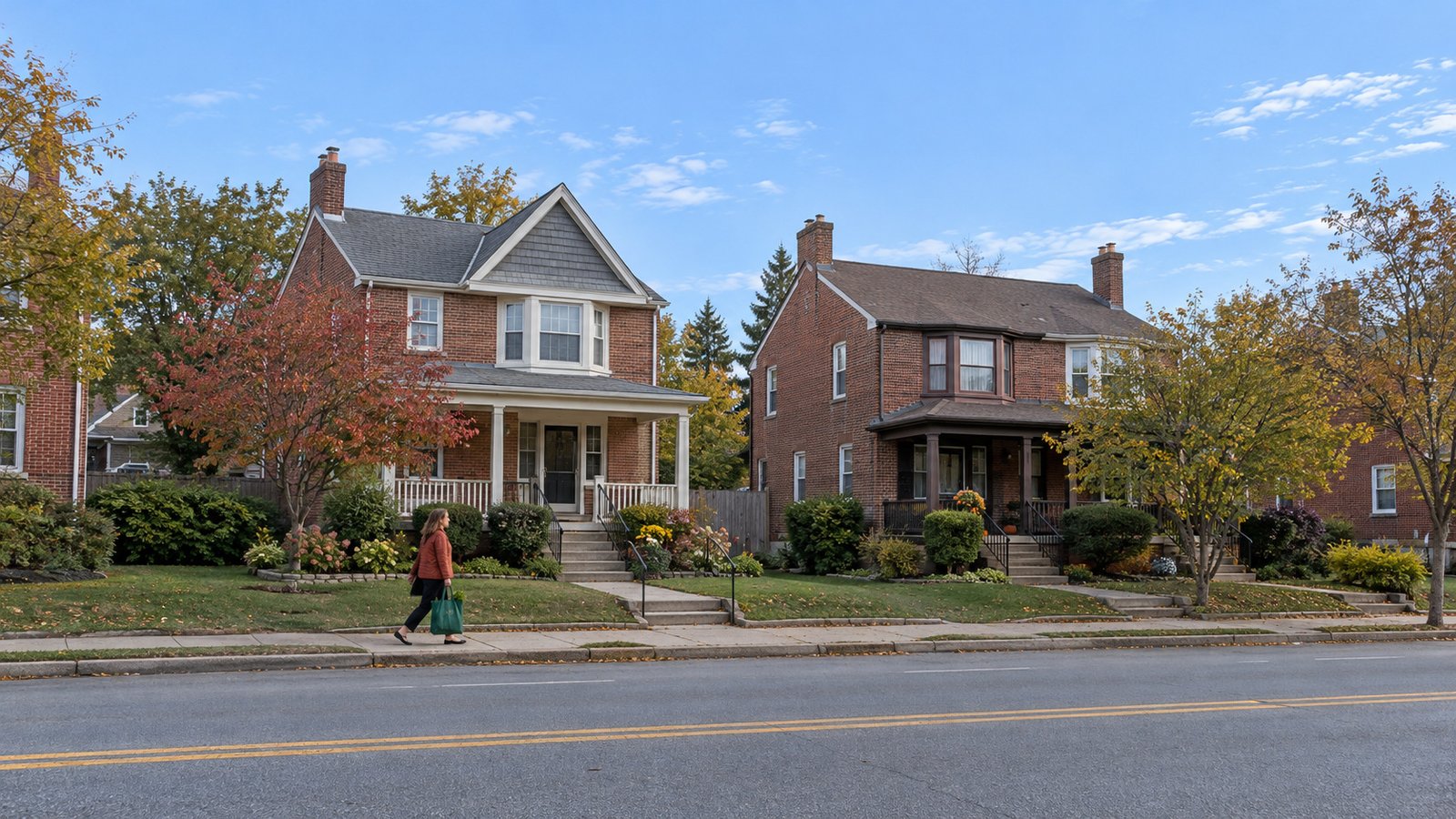
Moving to Reading, PA: choose a home and build your routine
Compare a Reading home with the week you need to run: usable rooms, full housing costs, groceries and buses, school enrollment and household services. Then bring keys, parking, the receiving route and an arrival fallback together before the move.
Try the walk from groceries or a bus stop to the actual front door, including the steps into the home.
01 /
Choose an address that can support your ordinary week
Still comparing homes? Start with the four street corridors and the housing chapter. Put the actual rooms, complete payment, food shop and return journey on the same comparison sheet. Reading has older attached streets, larger historic homes and different residential settings toward the northeast; the postal name alone cannot tell you which arrangement you are choosing.
Moving with children? Read school registration first, then test the school-day journey alongside work, care and groceries. A nearby school building or a familiar ZIP code does not establish attendance assignment.
Already have an address? Go to household services, collection and the arrival plan. Settle who controls keys, accounts and the receiving route before choosing the final delivery window. Reading moving services covers Sterling Oakbridge’s service and estimate process.
Photographs are generated illustrations of representative settings, rather than documentary views of specific properties or facilities.
02 /
Reading City, a Reading mailing address and the places around it
This guide concerns Reading city in Berks County, Pennsylvania. West Reading, Wyomissing, Shillington and surrounding townships have their own local arrangements. Do not use a Reading postal label as proof that the City’s trash, parking or historic-property procedures apply to a home.
The City’s ZIP and boundary explanation illustrates why: even commonly associated ZIPs have street-number exceptions, while other Reading ZIPs include substantial territory outside the City. That address-range page dates from 2017. Use it to understand the distinction, then establish the current municipality for the full street and unit address with the property documents and City, rather than treating the old ranges as a current parcel determination. A post-office box is not the residential address needed for school assignment.
The map below uses the full Census municipal boundary for Reading, GEOID 4263624, including its interior exclusion, and Census road, water and railway geometry. Four numbered street intersections locate the comparisons below. They are search markers, not neighborhood boundaries, school zones, surveyed entrances or bus routes. Railway lines on this map do not establish passenger service.
Use the numbered key to compare four neighborhood settings. Search markers are approximate; the map does not show school boundaries or legal truck directions. Explore the map.
03 /
Four places to begin a home-and-routine comparison
These four search corridors connect housing questions with everyday destinations. They overlap broader neighborhood names and do not replace a municipal, parcel or school map. Compare the actual home and return journey in each.
1. Downtown / BTC: central trips and a usable home entrance
Begin around the central street grid and the 8th-and-Cherry bus hub when transfers, Main Library or Washington Street activities belong to your ordinary week. The marker locates a useful starting intersection; it is not an official neighborhood edge.
For an apartment above a storefront or in a converted building, inspect the separate residential door, stairs, shared hallway, meters and storage that actually belong to the unit. Establish street exposure and the complete payment rather than infer the interior from a central location.
Daily travel
Walk to the appropriate BTC boarding point and the actual food shop. Include bags, the final doorway and the journey home after an evening activity; being near the hub does not extend a route’s operating hours.
Before choosing
Central connections can simplify a week, while a particular frontage may bring shared access, parking or delivery constraints. Visit at the times you expect to use it and establish the exact entrance and permissions.
2. Centre Park surroundings: older homes and multistory living
The association places Centre Park’s historic residential area between Centre Avenue and North 5th Street, with the cemetery to the north and railroad to the south. The map marker is at Centre Avenue and Douglass Street, near the park’s described setting.
History and buildings
The association dates much of the area’s residential development to the late nineteenth and early twentieth centuries. That history helps explain the varied forms; its undated old prices are not current housing offers.
The association describes rows, semidetached twins and larger houses, with several stories and basements. Compare the actual unit, floor, heating and repair responsibilities; upper-floor headroom, stairs and storage can differ even between adjoining homes.
Daily travel
Try the route from the actual entrance to food, school or care and the chosen bus stop. North-south and cross-town errands need their own connections; nearness to Centre Avenue does not establish a direct trip to every destination.
Before choosing
Historic character comes with property-specific exterior-review questions and older-house access. Establish the particular local designation, systems and full stair route before choosing the home or planning exterior alterations.
3. Northeast / 13th Street: compare the block and the full return
Use the North 13th Street and Rockland Street corridor to compare the northeast part of the City. BARTA’s Route 5 connects the Albright and Reading High School corridor with Downtown; the surrounding search is broader than one stop.
Inspect the actual house type rather than assume every Reading street is attached housing. The North 15th Street Cape Cod example illustrates a different layout and heating arrangement from a narrow multistory row home. Compare rooms, basement use, outdoor space and the complete bill.
Daily travel
Test both the walk to the useful stop and the return with groceries. Route 5’s direction matters for its Weis Market timepoint, and its weekday/Saturday pattern does not establish a Sunday routine. Grades and side-street approaches matter beside the main corridor.
Before choosing
Choose a home whose school, shopping and evening returns actually work. A college or school nearby does not guarantee attendance assignment, public use of its facilities or a late bus home.
4. Southeast / Cotton Street: attached-home checks and a day-specific bus plan
The 19th-and-Cotton timepoint provides a concrete southeast search anchor. It connects with the central bus network; Pendora’s City-listed location at 19th and Forest is another reference for an ordinary outdoor visit.
On older attached-home blocks, inspect the actual kitchen, laundry, private or shared rear approach, upstairs turns and where waste is collected. A historic Cotton Street property description shows these rooms can be arranged over several levels; it is not a current availability or condition promise.
Daily travel
Route 19 gives a useful direct comparison with BTC. Its northern shopping extension differs by operating day, so test the real Saturday and Sunday grocery journey as well as a weekday commute.
Before choosing
A workable central connection can coexist with stairs, a narrow gate or a different weekend routine. Establish the complete receiving route and actual collection eligibility for the building instead of treating the corridor name as a service guarantee.
04 /
Compare rooms, responsibilities and the full payment
Compare the cost of operating the actual home, not an advertised payment by itself. For a rental, write down base rent and each separate charge assigned to the tenant: electricity, heating fuel, water or sewer, waste, internet, parking and any stated pet or building charge. Keep deposits and other initial payments separate from the recurring total. Ask which meters serve the unit and which bills remain in the owner’s name.
For a purchase, compare current purchase terms, property taxes, insurance quotes, applicable association charges, utilities and the work the property needs. Read the inspection and written repair responsibilities for that home. A large house divided into units and a single household occupying all floors involve different shared entrances, storage, maintenance and heating questions.
An attractive older exterior can conceal very different systems. For example, the 1920 North 15th Street listing describes a 1952 Cape Cod with a modernized kitchen, oil hot-water heat and no cooling. That is a property example, not a promise about current availability or a description of every northeast home. Confirm the actual heating equipment, fuel ordering, cooling and useful billing history for each candidate.
Use the same comparison at every viewing
Item
Establish for this home
Why it changes the choice
Complete payment
Written recurring charges, included services and separate initial payments
A lower base rent may leave a larger total household bill
Usable rooms
Dimensions, headroom, daylight, heat and the permitted use of each room
An attic or basement in a photograph may not function as the room you need
Shared property
Entrance, laundry, yard, meters, parking and storage assigned to the unit
A visible feature may be shared or unavailable to this tenancy
Keep-and-fit list
Retained furniture against room dimensions and every entrance, turn and landing
A usable room still needs a workable furniture route
Weekly routine
Food, school, work, care, evening activities and weekend returns
The ordinary week can matter more than a single convenient trip
In a historic-property search, distinguish designation from the work it regulates. The City’s HARB and conservation maps explain that publicly visible exterior work in a locally regulated historic district needs the preservation review process. Conservation districts have a narrower exterior demolition, new-construction and addition scope. The City’s HARB explanation also distinguishes locally regulated districts from a National Register listing. Establish the specific property’s designation and speak with the Preservation Officer before designing exterior changes; this is separate from moving belongings into an existing home.
Keep the kitchen working and the route to the rear door clear while packed occasional-use items wait beside the wall.
05 /
Choose the route, direction and day that serve the errand
The BARTA Transportation Center, or BTC, is at 8th and Cherry Streets, with the published address 701 Franklin Street. It is the central transfer point. Its building opening hours are not the service hours of every bus. Choose the correct stop and direction for the particular journey.
Three useful connections to test from a prospective home
South Reading, Alvernia and the Kenhorst Plaza / Redner’s connection
Use its own current table and construction notice for both directions
A supermarket name on a route is useful only if the stop, shopping hours and return all work. On Route 19, Sunday service links BTC and the Cotton Street end during a shorter part of the day; it does not provide the northern shopping extension shown on other days. Avoid building a Sunday food plan from the route’s general destination list.
Reopen BARTA’s schedule and alert directory before traveling. Proposed January 2027 changes are proposals, while current bridge or construction detours have their own notices. For a timed appointment, retain an earlier workable connection or an agreed passenger ride alternative if the last transfer would be too fragile.
06 /
Can you live in Reading without a car?
Yes, for some households: a home within a comfortable walk of daily essentials and a useful BTC or direct BARTA connection can support a car-free week. Downtown is a logical place to start that comparison; a northeast or Cotton Street address can also work when the specific route and operating days fit. This is a practical judgment about a household’s destinations, not a claim that all homes on those corridors are equally walkable.
Test groceries, pharmacy, work, school or care, an evening activity and a weekend visit. Walk the actual crossings and the return with bags, a stroller or other equipment you use. Look at grades, sidewalk continuity and the distance between the bus stop and the entrance. A short line on a map says little about an uphill return in poor weather.
Bus timetables constrain late finishes and spontaneous weekend trips. Route 5’s published Saturday service ends in the early evening, and Route 19’s Sunday shopping limitation matters even when weekday travel works. Library branches and activities also keep different hours. Keep a separate Sunday and evening plan instead of repeating Monday’s itinerary.
For a cyclist who can use the actual street route, BARTA’s fixed-route bike racks provide two spaces without an extra bicycle charge. Limited rack capacity is not a reserved space. Inspect traffic, hills, weather and secure storage before making cycling the essential link.
For travel beyond the local network, BTC lists FlixBus service toward Philadelphia and New York and explicitly says to verify the stop before boarding. Establish the dated departure, return, ticket and boarding point with the carrier. This does not prove a frequent rail or bus connection to every regional destination.
If you cannot drive, the fallback must work for you as a passenger: an agreed pickup or a ride provider that actually accepts the route and timing. No universal on-demand availability is established here. Car rental only helps someone eligible to drive. A household with changing late shifts, several scattered care stops or frequent off-corridor trips may find a car substantially easier; then include a real parking arrangement in the home comparison.
Include the crossing, waiting area and trip home with bags when testing a bus-based routine.
07 /
Establish the assigned school and complete enrollment
Use Reading School District’s Enroll in RSD page and its linked address-based school locator for the complete residential address. The current map shows attendance zones; a ZIP, neighborhood name or nearby campus does not assign a child. Establish the grade, placement and first-day arrangements with the district before organizing the daily journey.
The online path offers English and Spanish PowerSchool registration: create an account, or add a student to an existing family account. A successful online form produces a confirmation email, after which a clerk arranges an in-person appointment. The district says families completing the online forms do not also need a duplicate paper packet. Paper forms remain available from the school or the linked packet, followed by the clerk’s appointment.
The current 2026–2027 registration packet requests proof of age, immunization records, an accepted address document such as a lease, deed or current utility bill, parent photo identification, completed forms and applicable school records. A parent or guardian attends. It gives a next-school-day start after a complete packet is received, with up to five days for specified transportation, special-education placement or scheduling circumstances. Submitting an online form is not completion of all these steps.
The packet lists age five for kindergarten and age four for pre-K, with a September 1 cutoff. The current English packet and the undated enrollment wording differ on the exact September 1 birthday edge. Resolve that birthday with the enrollment clerk instead of assuming eligibility from one phrase. Elementary enrollment: 484-258-7032; secondary: 484-258-7041. Arrange prior support records, care and dismissal with the appropriate school staff.
Temporary or unstable housing has a separate enrollment route. The district’s Families in Transition page covers qualifying situations such as shelter, motel or doubled-up arrangements caused by loss of housing. Pennsylvania’s Education for Homeless Youth guidance requires immediate enrollment for eligible students even when the usual records or residency documents are missing, with liaison assistance. Contact district liaison Emily Snisky at 610-371-5705, extension 81981, about qualification and school placement; do not postpone that conversation because the ordinary packet is incomplete.
08 /
Find a library, outdoor place and activity you will actually use
Choose one ordinary food shop, a pharmacy, care destinations and a public place near the home’s real routine. A trip to a park or a class can add to the week without replacing a reliable grocery journey. Use the actual entrance and current hours for each visit.
Reading Public Library’s location directory lists Main at 100 South 5th Street, Northeast at 1348 North 11th Street and Northwest at 901 Schuylkill Avenue, with separate hours. Do not assume every branch opens on Sunday or offers the same evening. The current Main Library elevator notice takes priority over generic accessibility wording: the outage is expected to last until January 2027. Accessible branches can receive requested Main materials; call Main at 610-655-6350 for its stated outside or patron-lot service arrangements before a visit.
The library-card procedure gives free physical borrowing access to Pennsylvania residents, while some digital services have narrower Berks or City eligibility. Bring photo identification and address proof when the ID is not current. An eCard option exists in specified cases without address proof; children’s registration and full borrowing privileges have their own requirements. Choose the appropriate card path rather than assume an online request immediately supplies every service.
The City’s park and playground inventory locates City Park at 11th and Washington and Pendora at 19th and Forest, useful outdoor reference points for central/east-side and southeast home searches. The inventory establishes locations, not a current closure, dog policy or guaranteed facility booking. Read the actual park notice before an organized activity.
GoggleWorks at 201 Washington Street provides galleries, films, classes and workshops. Choose an actual age-appropriate session, its registration terms and the journey home after it finishes; the presence of an arts center does not guarantee space in a particular class.
For a longer outdoor outing beyond the ordinary City errand, the County’s Antietam Lake Park page is the place to start. It currently describes the September 2026–January 2027 deer-management program, so read current access notices for the selected trail. The County parks pet policy permits leashed dogs at Antietam Lake and excludes pets from the other County parks, subject to its service-animal provisions. County park hours change by month. Those County rules should not be transferred to every City park.
Make room in the first weeks for ordinary library visits and shared reading, as well as school and work trips.
09 /
Separate the property handover from service requests
Start with the lease, settlement papers and actual meters. Record who is responsible for water, sewer, electricity, heating fuel and internet; identify separate and shared meters. The provider serving one Reading postal address does not establish the provider or fuel at another.
Reading Area Water Authority’s account FAQ says the property owner is the legally required bill recipient. A new purchaser supplies settlement papers; an owner can authorize a duplicate bill to a tenant with the required name and address. Clarify how any tenant payment is handled under the agreement instead of treating a duplicate as a transfer of ownership responsibility. RAWA’s number is 610-406-6300. Sewer questions go to the City service center at 1-877-727-3234.
Reach payment and system notices from the current RAWA home page: its payment portal changed in September 2026. Confirm which water system serves the property before applying a drought notice. Different notices on the site concern different systems; a general conservation message is not a substitute for the rules applying to the address.
For a FirstEnergy-served address, its start, stop or move request asks for the service address, account holder and dates, and confirms by email whether the requested date can be met. The online process may require at least two business days of processing; allow for that and access requirements rather than treating form completion as activation. Its moving and billing guidance also distinguishes delivery charges from electricity supply: choosing a supplier does not replace the utility that delivers power. Compare fixed or variable terms, length and fees before changing supply.
If the actual home has UGI service, its start/stop procedure offers online forms or 800-276-2722. Oil, another fuel or included building heat needs the relevant arrangement instead. Book internet against the precise unit, installation access and accepted appointment. Keep requested dates, confirmed dates, access contacts and outstanding requirements on a handover list; one address change does not update all accounts.
10 /
Check building eligibility before planning the first collection
The City’s trash and recycling instructions distinguish ordinary City service for smaller residential buildings from private collection for buildings with seven or more dwelling units and commercial or institutional properties. Ask the owner how the specific building is enrolled and where its collection point is. A tenant should not infer service from a bin left outside.
The City service application is an owner process for a property needing enrollment. It states up to four 30–55-gallon bags, no more than 35 pounds each, and one bulk item weekly. Establish the actual day, holiday changes, recycling instructions and payer through the owner and City service center, 1-877-727-3234, before the unpacking waste appears.
The special-collection procedure makes a mattress and a box spring two separate bulky items: each must be fully wrapped in plastic and put out in different weeks under the one-item limit. Refrigerant appliances need certified removal and tagging. Excess, unusually heavy and hazardous items need an appropriate accepted alternative, rather than being left with ordinary household trash.
Electronics are a separate request, with a stricter building exclusion. The City describes an iRequest or service-center request for one electronic item weekly and excludes multifamily buildings with five or more units from that electronics service. A five- or six-unit building may therefore have ordinary City trash but need another electronics arrangement. Settle the item type, eligibility and accepted collection before the last day at the old home.
Keep clean unpacking material separate, flatten cartons and use the current accepted-material instructions. Ask about an unusually large batch and any collection limit instead of leaving an unlimited curb pile. Arrange unwanted furniture and restricted items before moving the belongings you intend to keep.
11 /
Resident parking, temporary signs and building permission are separate
A resident vehicle permit does not reserve space for a commercial moving truck. Reading Parking Authority’s residential permit process excludes commercial vehicles. Establish the everyday vehicle’s actual zone and property parking arrangement separately from delivery access.
For temporary curb signs, the RPA ordering procedure requires at least 48 hours and says RPA posts and removes the signs. A specific property or half/whole-block request needs the attached block diagram. Record the exact frontage, both cross streets, required spaces, dates and hours. An order form is a step in the process, not proof that the requested space has been issued.
The City daily-permit code permits only otherwise legal on-street spaces and allows RPA to require a Police special-event permit for four or more signs. Its shorter code minimum should not replace RPA’s published operational lead time. Neither temporary signs nor a building’s permission authorizes a street closure or use of a prohibited position.
12 /
Trace the entire receiving route before the delivery window
Walk from the accepted truck position to the final room. Include the curb, public sidewalk, private path, gate, porch steps, door clear opening, hall, every stair flight and turn, landings and overhead clearance. In an older multistory home, a broad front door can still lead to a tight stair turn. Compare the retained item’s dimensions with the actual bottleneck, not the frame’s decorative outer trim.
For an apartment, establish the receiving entrance, working hours, elevator or loading-space booking, usable lift size and load limit, shared-lift arrangements and who has keys. Ask about wall and floor protection, required certificate-of-insurance wording, any labor or union access rule, submission deadline and charge. These are questions for the specific property, not asserted rules for all Reading buildings. Keep the approving person’s accepted arrangements, not just a submitted request.
If an item or route is unsuitable, settle the permitted solution before loading: a different usable entrance, agreed preparation or a separately authorized specialist arrangement where actually available. Do not remove a door, railing or historic exterior feature on an assumption. Establish permission, responsibility and any charge for the chosen method.
13 /
Prepare the winter route and choose a workable fallback
The City’s snow-emergency page explains declared emergency routes and removal of vehicles from them, with ticketing or towing consequences. Read the current declaration and signs. Any temporary garage or lot relief has its own terms; it does not give a moving truck automatic permission or make parking free throughout winter.
Assign the responsible owner, tenant or property contact to clear the sidewalk and the whole private receiving approach before dispatch. Include the gate’s full swing, paths, every step and landing, doorway threshold and usable lighting. Inspect again after plowing or new precipitation. Do not put chairs or furniture in the street to save a space, or place cleared snow where it blocks the route.
Set a decision deadline before the truck leaves if keys, safe access or the receiving window remain uncertain. The authorized customer representative and moving planning contact must choose a confirmed later slot, another permitted usable route, a separate stage or genuinely available storage. Settle who approves and carries out the change, access, additional handling or waiting charges and the condition for resuming. A storage contact is not a reservation.
Keep identification, medication, chargers, essential clothing and the first night’s supplies with the household. Decide where people will stay and how they will get there if the goods arrive later. Inform both property contacts of the accepted change; resume when keys and the required receiving access are actually confirmed.
Assign snow clearing for the gate, path and doorstep before arrival, and keep the gate’s full opening usable.
14 /
Before signing, before dispatch and during the first week
Before signing: establish municipality, unit and usable rooms; compare the full payment and the week’s journeys; resolve school placement and shared-space questions.
Once the address is chosen: arrange school documents and appointment, account responsibilities, accepted utility dates and the actual waste service. Keep every request distinct from its confirmation.
Before dispatch: bring keys, property permission, truck position, complete route and receiving contact together. Resolve outstanding access by the agreed decision deadline, with a confirmed fallback if needed.
At handover: record property condition and meter arrangements as agreed, keep common routes usable and place essentials where the household can use them.
During the first week: finish enrollment or account requirements, establish collection habits and make the ordinary food, library and transport trips. Correct the parts of the routine that did not work.
A rushed schedule still needs a real process. Ask the responsible office or property contact which current appointment or date is available; an urgent move does not itself shorten a notice period or establish permission. Bring the address, retained belongings and accepted route to the moving estimate discussion.
15 /
Questions before you arrive
Does a Reading ZIP code mean the home is in Reading City?
No. A Reading mailing address can be in another municipality, and even ZIPs commonly associated with the City have street-number exceptions. Establish the full property and unit’s current municipality before using City trash, parking or preservation procedures. School assignment requires the district’s residential-address process separately.
Where should I start comparing places to live?
Compare four routines: Downtown around the BTC hub, Centre Park’s older multistory housing, the northeast 13th Street corridor, and southeast Cotton Street. Then compare a real home’s usable rooms, complete payment and daily journeys in each. These are search areas, not rankings of safety, price or school quality.
Can I live in Reading without a car?
Yes, when the home’s ordinary errands are within a comfortable walk and the remaining journeys fit BARTA. Downtown and useful direct-route corridors are reasonable starting points. Test groceries, school or care, evenings and Sunday returns; Route 19’s northern shopping extension does not run on Sunday. Late or scattered regional trips need an accepted passenger alternative if you cannot drive.
Can I use BTC for a trip to Philadelphia or New York?
BTC lists FlixBus service toward Philadelphia and New York and directs riders to verify the stop before boarding. Obtain the carrier’s actual dated departure, return, ticket terms and boarding point before relying on it. The BTC building’s opening hours do not establish a scheduled coach departure or service to every regional destination.
How do I compare housing costs without a reliable current citywide price?
Use the written offer for the actual home and add the recurring charges assigned to your household. Keep deposits and initial payments separate. Compare heating fuel, cooling, shared meters, parking, repairs and usable rooms alongside that total. An old sale price or a broader Reading postal search is not a current City rent or purchase offer.
Does living near a school guarantee that my child can attend it?
No. Use RSD’s address locator with the full residential address and establish grade and placement with enrollment staff. Then arrange the school-day journey, care and dismissal. A ZIP, neighborhood or nearby building cannot substitute for the attendance process.
Is submitting the online school form enough to start classes?
No. The district’s online confirmation is followed by a clerk-arranged in-person appointment and completion of the required documents. The 2026–2027 packet gives a next-school-day start after a complete packet is received, with specified up-to-five-day exceptions. Resolve the actual start with the clerk; families completing online forms do not also need duplicate paper forms.
What if we are temporarily staying with someone and lack the usual school documents?
Contact RSD’s Families in Transition liaison about whether your housing situation qualifies. Pennsylvania’s homeless-student guidance provides immediate enrollment for eligible students even without the usual residency, school or immunization records, with assistance obtaining them. This is a specific qualifying route, not a waiver of every family’s ordinary registration requirements.
Can a tenant simply put the water account in their own name?
RAWA says the property owner is the legally required bill recipient. An owner can authorize a duplicate bill to a tenant with the required details. Agree who pays under the lease and how payment is handled; the duplicate does not itself change ownership responsibility. Set up energy and internet separately with the providers serving the unit.
Does ordinary City trash service include electronics for every small apartment building?
No. Ordinary City collection generally covers residential buildings with fewer than seven units, but the special electronics service excludes multifamily buildings with five or more. A five- or six-unit property can therefore need another electronics arrangement. For an eligible property, use the separate City request process and accepted item limit.
Can I put a mattress and box spring out together before moving?
Under the City’s one-bulky-item-per-week rule, they are separate items for separate weeks, and each must be fully wrapped in plastic. Arrange an accepted alternative if the remaining collection opportunities are insufficient. Refrigerant appliances and electronics have different preparation or request requirements.
Does a resident parking permit reserve room for the moving truck?
No. RPA residential permits exclude commercial vehicles. Temporary curb signs use a separate order with at least 48 hours under RPA’s published procedure and a block diagram where required. Establish legal space and the issued arrangement; temporary signs do not authorize a street closure or replace the building’s permission.
Can I assume Main Library has elevator access during our first visit?
No. Its current elevator-outage notice is expected to continue until January 2027. Accessible branches can receive requested Main materials, and Main describes outside or patron-lot services by arrangement. Call ahead and choose the branch, service and actual hours that meet your needs rather than rely on generic accessibility text.
What if keys, snow clearing or the receiving window are unresolved on moving day?
Use the deadline agreed before dispatch. The authorized customer representative and moving planning contact must choose a confirmed later slot, another permitted usable route, a separate stage or genuinely available storage, including access and charges. Keep essentials with the household, settle where people stay and resume only when keys and required receiving access are confirmed.
Continue planning
The other side of your move
Explore the local guide or plan the moving services for this location.
Bring the chosen address, retained belongings and accepted receiving route together, then explore the service and estimate process for your Reading move.
Official procedures and local resources are linked beside the answers above. Reopen the relevant page when arranging a date: fees, schedules and application requirements can change.
Full or selected packing in Reading, Pennsylvania, with a usable final night, separate destination groups and optional unpacking or customer-directed organizing.