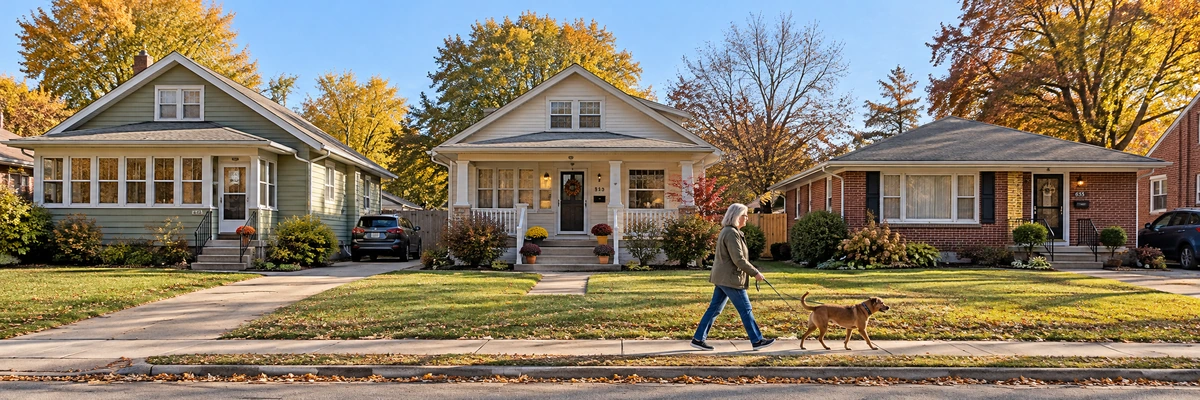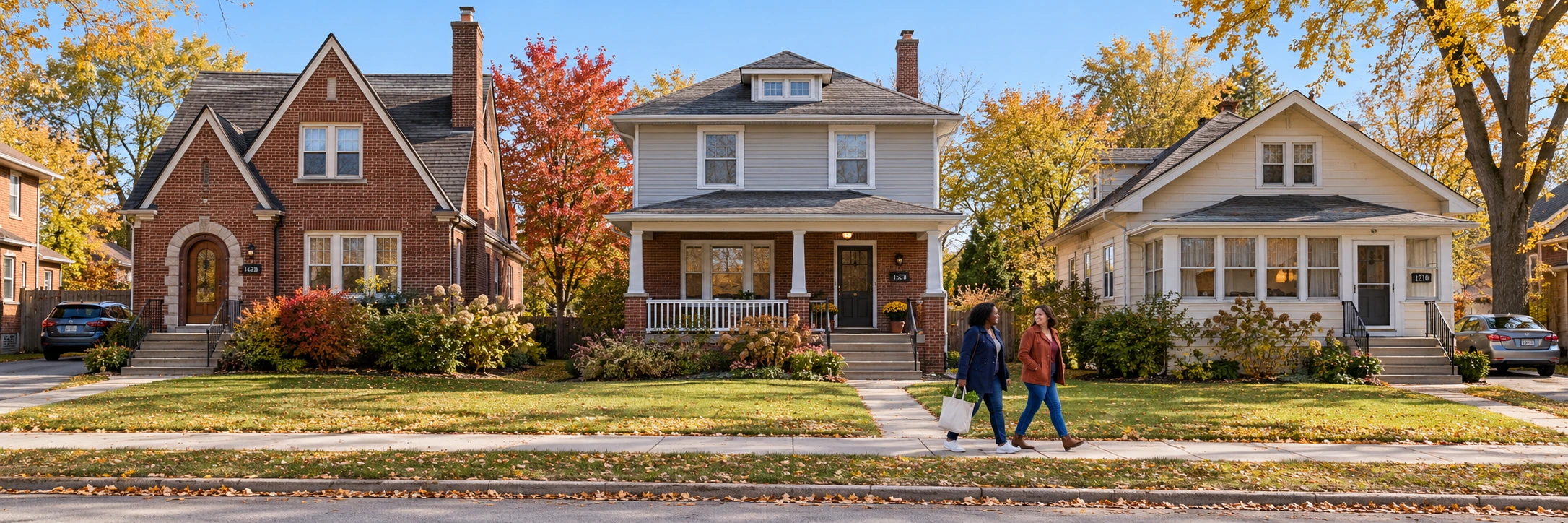
Two women walk along a sidewalk in front of Michigan brick and clapboard houses

State moving guide

Moving to Michigan: communities and preparation

Explore Michigan city neighborhoods, university settings and lakefront communities. Compare the moving work, understand the receiving arrangements and prepare the home behind your destination.

Michigan planning

Find the Michigan setting you want to explore

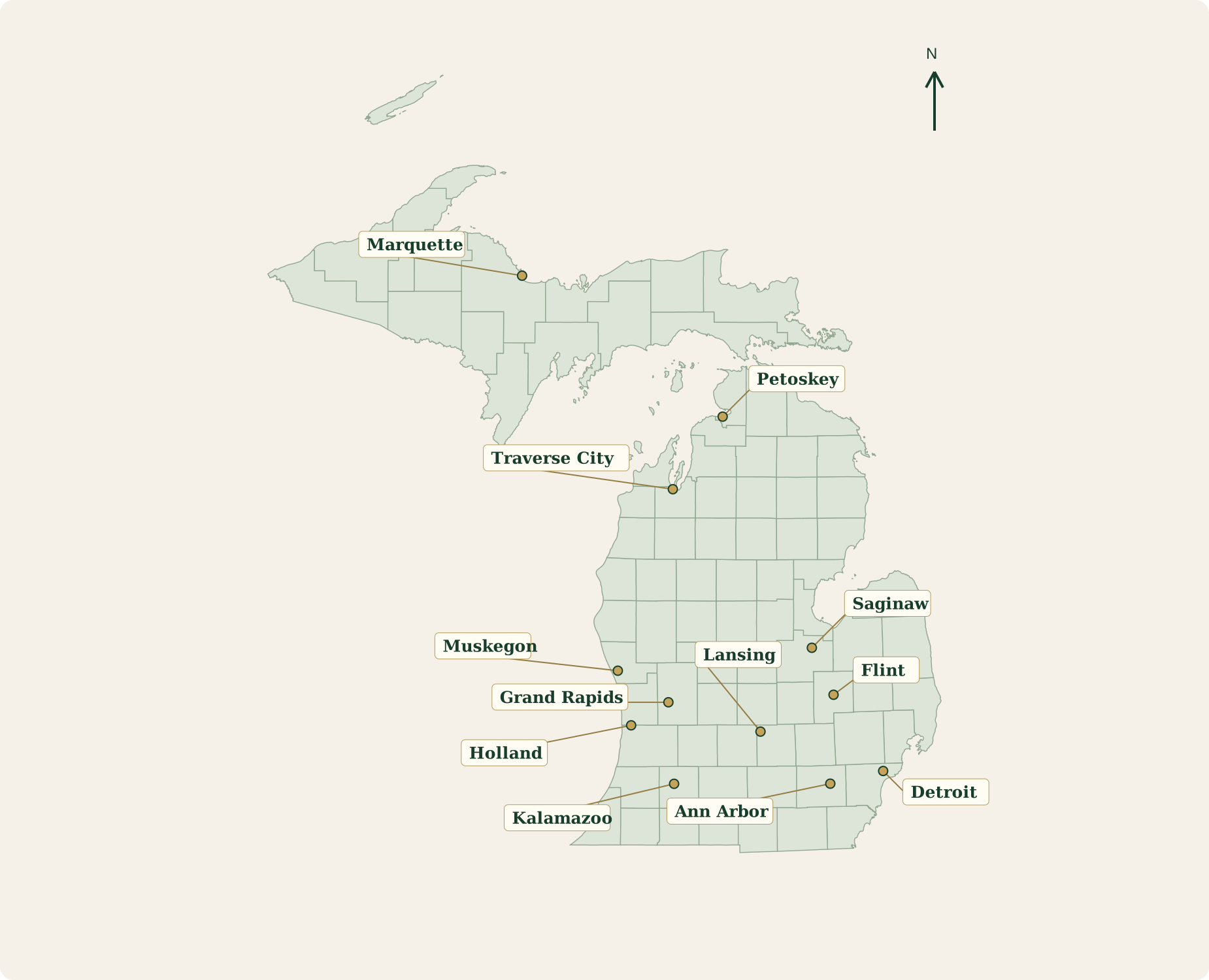
Begin with the places that interest you. Detroit brings metropolitan neighborhoods, cultural institutions and historic streets. Grand Rapids offers a western city comparison, while Ann Arbor and Lansing introduce different university and capital-city surroundings. Kalamazoo, Flint and Saginaw have their own downtown and cultural settings. Holland and Muskegon give western shoreline searches different starting points; Traverse City and Petoskey offer northern Lower Peninsula communities. Across the straits, Marquette introduces an Upper Peninsula city beside Lake Superior.

The map and twelve portraits help narrow that wide choice. Follow a cultural district, independent shopping street or waterfront that appeals to you, then investigate the residential area around a possible home. Explore the ordinary journeys, services and indoor and outdoor space the household would use. A memorable visit is a useful introduction, but it does not settle the condition, availability or suitability of a particular property.

If you already know the destination, start with the shipment. Gather the two complete addresses, contents, dates and receiving arrangements. Sterling Oakbridge plans interstate household moves involving Michigan after reviewing the actual journey and requested work. Use the practical chapters to describe that work clearly, compare the written proposal and prepare the new home to receive it.

Michigan cities and regions
Explore twelve Michigan cities across the Lower and Upper peninsulas, from metropolitan neighborhoods to northern lake settings.

Michigan planning

Compare city neighborhoods, historic downtowns and lake settings

The twelve city profiles offer different ways to begin a Michigan search. Detroit's Midtown museums and cultural destinations provide one metropolitan introduction. Grand Rapids' Heritage Hill adds a historic residential setting, while Ann Arbor's Main Street, Kerrytown, State Street and South University districts offer separate downtown experiences. Lansing's Old Town brings galleries, Victorian buildings and a Grand River setting. Kalamazoo's pedestrian mall and Flint's cultural institutions introduce two more distinct city centers.

On the western side, compare Holland's historic shopping streets with Muskegon's lakefront trail and maritime surroundings. Traverse City's Front Street and Grand Traverse Bay setting differ from Petoskey's Gaslight District and Little Traverse Bay. Saginaw's Old Town, murals and riverfront add another Lower Peninsula comparison. Marquette's downtown shops, cafés and Lake Superior surroundings belong to the Upper Peninsula and deserve their own visit and household plan.

Choose a few places to examine closely. The local sources introduce public places and visitor districts; the home still needs a separate review. Keep a wider tourism region distinct from the municipality and neighborhood you are considering. Check the current information for an attraction or business before visiting, then explore the residential streets and routines that would shape daily life.

City portraits

Explore Michigan’s cities

Explore twelve different Michigan city settings, then investigate the neighborhood, home and everyday journeys behind your shortlist.

An older man reads a program on a stone bench beside an urban cultural plazaMI

Detroit

Midtown offers a cultural introduction through institutions including the Detroit Institute of Arts and Charles H. Wright Museum of African American History, alongside historic architecture, shops and cafés. Use those destinations to explore the city, then compare the residential streets that might become part of your week. An older brick house and a different neighborhood's apartment require their own property review. Keep Detroit distinct from other municipalities in the wider metropolitan area. Investigate the home, services and regular journeys around its actual address before allowing a familiar regional name to settle the whole choice.

A woman walks a bicycle on a sidewalk in front of two historic housesMI

Grand Rapids

Heritage Hill introduces a residential side of Grand Rapids through nineteenth- and early twentieth-century architecture, including varied house styles and the Meyer May House. The neighborhood can be a useful starting point for someone drawn to established streets, while the wider city offers other settings to compare. Explore the ordinary services and journeys around a possible home separately from a visit to a landmark. A historic house's porch, interior turns and condition still need individual attention. County-wide information for Kent should remain a wider reference rather than a description of every Grand Rapids property.

A man browses an open book outside a bookshop on a brick sidewalkMI

Ann Arbor

Kerrytown, Main Street, State Street and South University give downtown Ann Arbor several distinct points of entry. Independent shops, restaurants, music, theater and university surroundings can help shape an exploratory visit. Compare those public places with the neighborhood and home behind a possible move, including the services and journeys you would use regularly. A compact condominium and an older house can lead to different preparation and receiving questions. Keep Ann Arbor's municipality clear when a wider itinerary includes other Washtenaw communities; a regional visitor description does not identify the receiving address.

An older couple walks beside a gallery window displaying framed paintingsMI

Lansing

Old Town's Victorian buildings, galleries, murals and independent shops offer one way into Lansing city life. The Grand River setting adds a different kind of public space to an exploratory visit. Spend time beyond the visitor district as well: investigate the residential streets, services and routines around the home you are considering. Keep the actual municipality and property contact clear when comparing the wider capital region. A gallery street or attractive river walk does not establish housing availability or a loading location. Confirm the home and its receiving arrangements separately when the move becomes concrete.

A woman drinks coffee at an outdoor table on a pedestrian shopping streetMI

Kalamazoo

The downtown Kalamazoo Mall combines pedestrian shopping space, cafés and historic buildings, including Art Deco architecture. It is an outdoor downtown setting rather than an enclosed regional shopping center, and can introduce the city's public life on foot. Follow that visit with a closer look at possible residential areas and the services the household would use. Keep the property approach distinct from a pedestrian visitor route: a welcoming shopping street is not automatic permission for a moving vehicle to stop. Review the actual receiving home, parking instructions and interior route before collection.

People walk and sit in a landscaped plaza between cultural buildingsMI

Flint

Flint's cultural setting includes the Flint Institute of Arts, the symphony and other institutions around the Flint Cultural Center, with additional art and entertainment downtown. These provide different destinations for exploring the city before narrowing a residential search. Compare the home, ordinary services and regular journeys on their own terms rather than treating a cultural itinerary as a neighborhood recommendation. The wider Flint and Genesee visitor region also includes separate communities such as Fenton and Grand Blanc. Locate each destination and keep the actual municipality clear in the household brief and property arrangements.

People walk beside a freshwater bay along a tree-lined path with benchesMI

Traverse City

Front Street's historic buildings, brick sidewalks, independent shops and restaurants provide a compact introduction to downtown Traverse City. Grand Traverse Bay adds a waterfront context, while the wider visitor region extends well beyond the city. Explore the residential area around a possible home and the journeys that would form an ordinary week. A seasonal visit can introduce a place without establishing year-round routines, current parking availability or housing supply. Keep the municipality, property access and receiving instructions specific when moving from a northern Michigan shortlist to a particular household plan.

A woman in a red coat looks at books displayed in a shop windowMI

Marquette

Marquette's historic downtown shops, cafés and bookshops offer a city setting beside Lake Superior. It is a distinct Upper Peninsula comparison for someone exploring Michigan's northern places. A wider Marquette visitor itinerary can include other communities, so keep the residential address and municipality clear rather than treating the whole region as downtown. Investigate the home, services and regular journeys around it, and prepare for the current conditions on the actual route. Marquette uses Eastern time; the four western Upper Peninsula Central-time counties are a different group. Write the local zone when arranging receiving.

An older woman carries paper-wrapped flowers along a brick shopping sidewalkMI

Holland

Downtown Holland's historic buildings, brick sidewalks, independent stores and book, home and antique shopping offer a useful introduction on foot. Explore those public places, then compare the residential streets and ordinary services around the home you are considering. The wider Holland visitor area and a particular neighborhood are different scales of search. Downtown's heated sidewalk system also does not establish that a private entrance or handling path will be winter-ready. When planning the move, review the actual approach, property instructions and receiving arrangements with the people responsible for that home.

An older man uses binoculars beside a freshwater lake and paved trailMI

Muskegon

Muskegon's municipal Lakeshore Trail introduces the Muskegon Lake shore, channel and maritime connections through a paved public route. Keep that lake setting distinct from Lake Michigan and the separate Pere Marquette beach area when locating places for a visit. A trail can help you explore the surroundings without establishing the routine from a particular home. Investigate residential streets, services and regular journeys separately, and use the actual address in the moving brief. Public shoreline access and a truck's legal stopping place answer different questions; obtain the relevant property and loading instructions for receiving.

Two adults look at an antique-shop window on a historic brick streetMI

Saginaw

Saginaw's Old Town antiques, murals, market and riverfront arts and entertainment provide several ways to begin exploring the city. Follow the public places that interest you, then look closely at the neighborhood, home and services that would support an ordinary week. The wider visitor region includes destinations outside the residential city core, including natural areas, and Saginaw Township is a separate municipality. Keep those locations distinct when comparing a possible routine. Once a home is selected, review its actual approach, entrance and receiving arrangements rather than relying on a broad regional description.

A woman sketches in a notebook on a downtown bench with a bay visible beyondMI

Petoskey

Petoskey's Gaslight District brings independent stores and galleries together with a Little Traverse Bay setting. Bayfront Park and its pedestrian connection add another part of a downtown visit. The district's historic name should not be read as a claim that the streetlights still burn gas; they have used electricity since the early 1980s. Explore the residential area and services around a possible home separately from that visitor route. A waterfront outing does not establish housing availability, winter access or a loading space. Keep the property's actual approach and receiving instructions clear when preparing a move.

Michigan planning

Name the municipality as well as the familiar region

Use both complete addresses in the moving brief. A Detroit-area destination may be in a separate municipality, and an Ann Arbor itinerary may include places outside Ann Arbor. The Grand Traverse Bay region is wider than Traverse City. Saginaw city and Saginaw Township are different places, while a Marquette-area visitor source can include other Upper Peninsula communities. A postal name or regional description alone cannot identify the property contact or the authority responsible for a road.

County profiles provide a wider view without turning the county into one city. Wayne, Kent, Washtenaw, Ingham, Grand Traverse and Marquette each include more than the featured city setting. Use county population as a dated county estimate, and locate the actual home separately. The incorporated-place directory is another reference: it covers Michigan cities and villages, rather than every township, unincorporated community or postal name.

Those distinctions matter when the plan becomes practical. Confirm the property's actual municipality, entrance and receiving instructions with the relevant contact. Keep the state line clear as well. A nearby move into Ohio, Indiana or Wisconsin is an interstate journey. Reviewing that journey does not establish a Sterling Oakbridge local branch or unrestricted local-only service throughout Michigan.

More places to explore

Keep exploring Michigan communities

Looking beyond the featured cities? These communities offer more starting points for your Michigan home search.

Ask about your Michigan move →

Michigan planning

Explain the entire path from the vehicle to the room

Show the coordinator how the shipment reaches and enters the home. An older Detroit house may have front steps, a raised porch and an inner entrance with a tight turn. A Grand Rapids home can add an enclosed porch or a separate approach beside the house. A condominium may have a modest private entrance but shared grounds and parking instructions. The useful description follows the actual route rather than assuming that every house of the same age works alike.

Photograph the vehicle approach, proposed stopping place, pedestrian route, entrance and first interior turns. Include steps, slopes, low branches, gates, surfaces and the room available on a landing. Measure a doubtful opening together with the item that must pass through it. A wide outer door does not establish that a deep cabinet can make the turn beyond an inner door. Explain any goods on another level or in an outbuilding as part of the same shipment.

Obtain instructions from the people who control the building, grounds and loading location. A usable walking path does not itself grant permission to stop a truck beside it. Share uncertainty before collection so that the coordinator can review any additional handling arrangement and include it in the written scope. Update the brief if the entrance or property instructions change.

Two male movers carry a quilt-wrapped cabinet along a path in front of a brick and clapboard house
Two movers carry a protected cabinet along the front path.

The moving process

Your move, step by step

  1. 1

    Describe the household

    Send the two addresses, complete contents, dates and the work you want included.

  2. 2

    Confirm the access

    Show the approach and interior route, and obtain building and loading instructions.

  3. 3

    Agree the written plan

    Review the inventory, price, protection, payment and delivery arrangement together.

  4. 4

    Prepare for collection

    Finish the chosen packing, keep essentials apart and make the working path available.

  5. 5

    Receive the goods

    Have an authorized person ready, direct placement and check the inventory and condition.

Ready when you are

Ready to discuss your move?Tell us where you are moving, what is coming with you and the dates you have in mind.

Michigan planning

Understand the charging basis for a Michigan-only move

For a household move entirely within Michigan, check the actual provider's Michigan intrastate household-goods authority. Michigan State Police's Commercial Vehicle Enforcement Division administers that authority and provides a carrier search. MSP explains that a USDOT number alone does not authorize this Michigan-only work. Review the business and the particular proposed service rather than treating a familiar name or federal listing as the whole check.

Distance changes the charging framework described by MSP. For moves of 40 miles or less, rates are unregulated and can be negotiated on an hourly basis. For moves over 40 miles, MSP describes regulated charges based on weight, mileage and supplemental services under the applicable tariff. Ask the carrier to explain which basis applies, the estimated work and any additional tasks. Compare equivalent inventories, preparation and access assumptions before comparing totals.

Michigan law provides for a free written, reasonably accurate approximate estimate that is clearly nonbinding. It must identify the shipment and services, remain attached to the bill of lading and be recorded there. For a move over 40 miles, final charges follow the applicable tariff. Keep these Michigan-only requirements separate from the company's agreed interstate flat rate; neither a local hourly estimate nor the Michigan release-payment rule turns every move into a fixed-price service.

County guides

Explore the area around your new home

Compare six wider county settings connected to the city portraits, then explore all 83 counties. Each county covers more than its featured city.

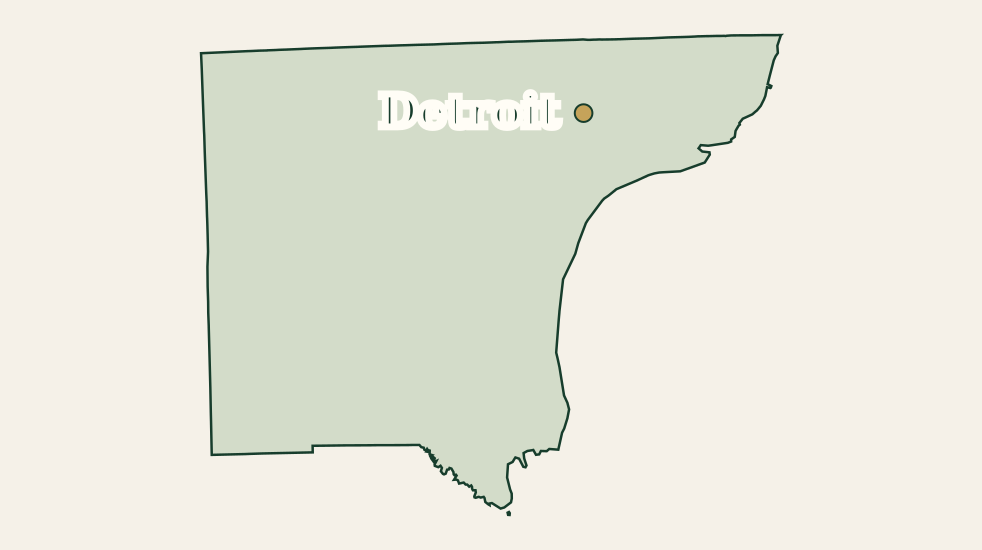
Wayne County with Detroit marked
Detroit and the metropolitan county settingPop. 1,772,259 · 2024

Wayne County

Detroit's Midtown institutions, historic architecture and neighborhood streets introduce one part of wider Wayne County. The county also includes separate municipalities and settings beyond the featured city; a Detroit-area label does not identify every receiving address. Explore the residential streets, services and ordinary journeys around the actual home. An older brick house, a raised porch and a different property's apartment entrance call for their own access review. Keep the municipality and property instructions clear when connecting a metropolitan search with a moving plan.

Key communities

Detroit

Check mover credentials →
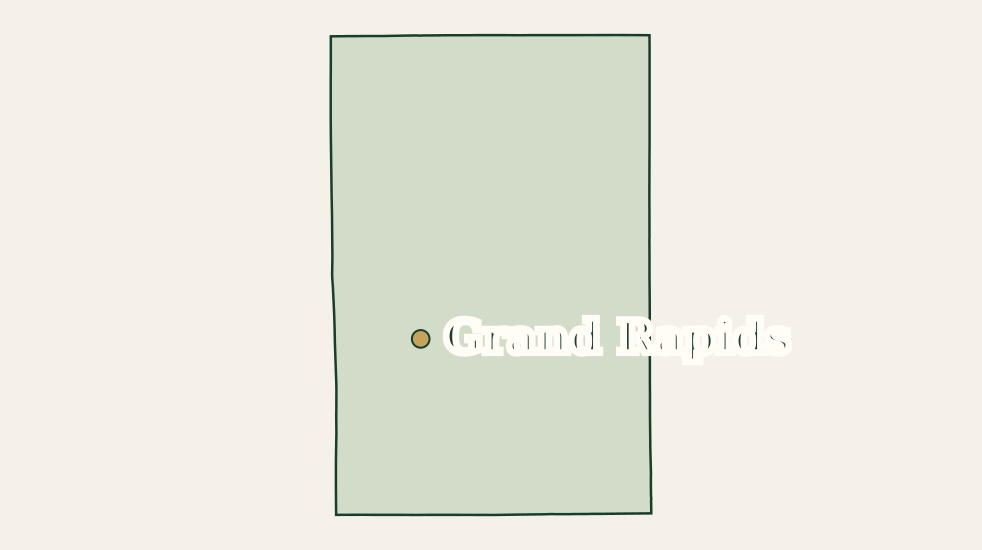
Kent County with Grand Rapids marked
Grand Rapids and the western county settingPop. 663,150 · 2024

Kent County

Grand Rapids offers historic residential architecture in Heritage Hill and a wider city setting to explore within Kent County. The county reference covers more than the featured neighborhood or municipality. Use the local visitor introduction to choose places to investigate, then compare the home, services and regular journeys around its actual address. A historic house's porch and interior turns need an individual review rather than assumptions from its style or age. Confirm the property approach and receiving arrangements separately from the county population context.

Key communities

Grand Rapids

Check mover credentials →
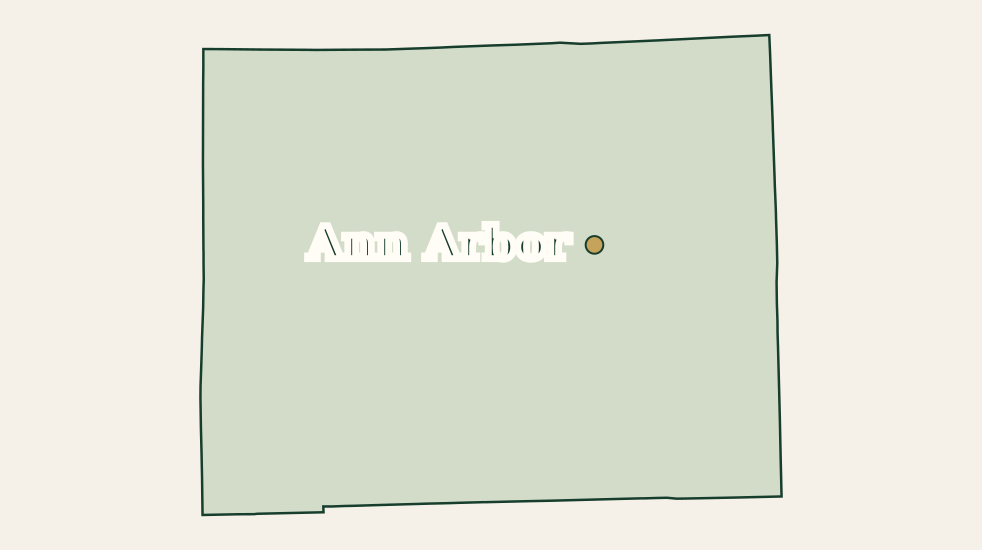
Washtenaw County with Ann Arbor marked
Ann Arbor and the wider university-region countyPop. 369,822 · 2024

Washtenaw County

Ann Arbor's Kerrytown, Main Street, State Street and South University districts give a city search several starting points. Washtenaw County extends beyond Ann Arbor into other communities and settings, which should remain distinct when planning an ordinary routine. Locate the actual home and services rather than treating a regional itinerary as one neighborhood. A compact condominium may involve shared grounds and parking instructions as well as its private entrance. Review the contents, property access and receiver for that particular address before collection.

Key communities

Ann Arbor

Check mover credentials →
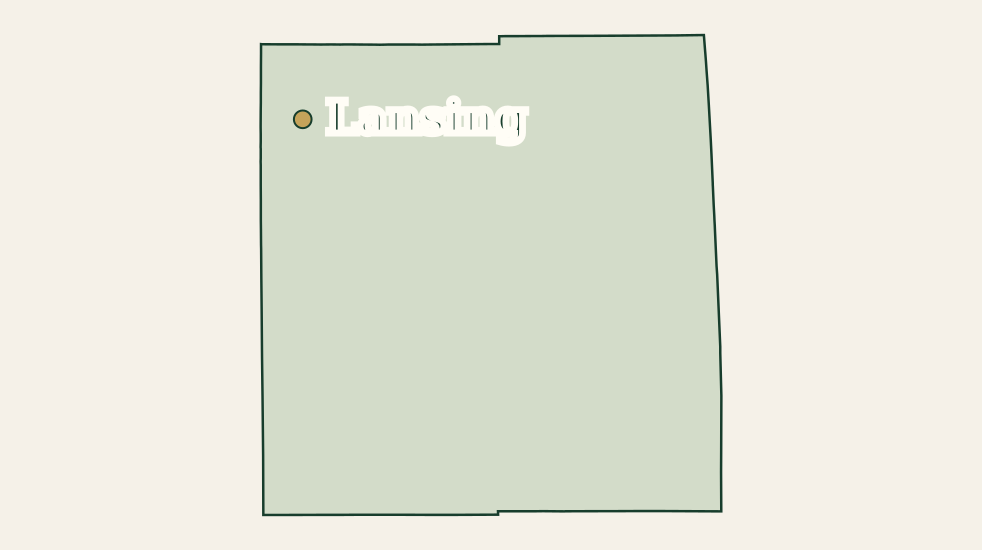
Ingham County with Lansing marked
Lansing and the capital-region county settingPop. 283,913 · 2024

Ingham County

Lansing's Old Town galleries, Victorian buildings, murals and Grand River surroundings offer one city introduction within the wider capital region. Ingham County population describes a county extent, rather than a count for the featured district or a guarantee about any home. Keep the municipality clear when comparing places across the region. Explore residential streets, services and regular journeys around the actual address, then obtain the relevant property instructions. A riverfront visit and a usable loading or handling route answer different questions.

Key communities

Lansing

Check mover credentials →
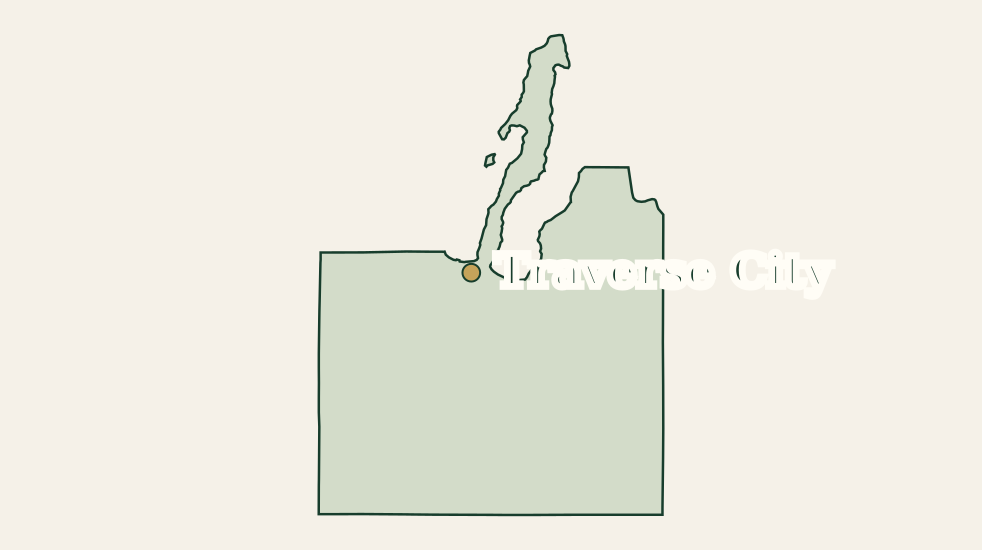
Grand Traverse County with Traverse City marked
Traverse City and the northern Lower Peninsula countyPop. 96,166 · 2024

Grand Traverse County

Traverse City's Front Street shops, historic buildings and Grand Traverse Bay context provide one introduction to a wider northern visitor region. Grand Traverse County and that tourism region are not interchangeable with the city or with each other. Locate the home and the services the household would use, and investigate ordinary routines separately from a seasonal visit. Check current conditions for the planned journey and the actual property approach. Clear receiving instructions matter whether the home is near a visitor district or elsewhere in the county.

Key communities

Traverse City

Check mover credentials →
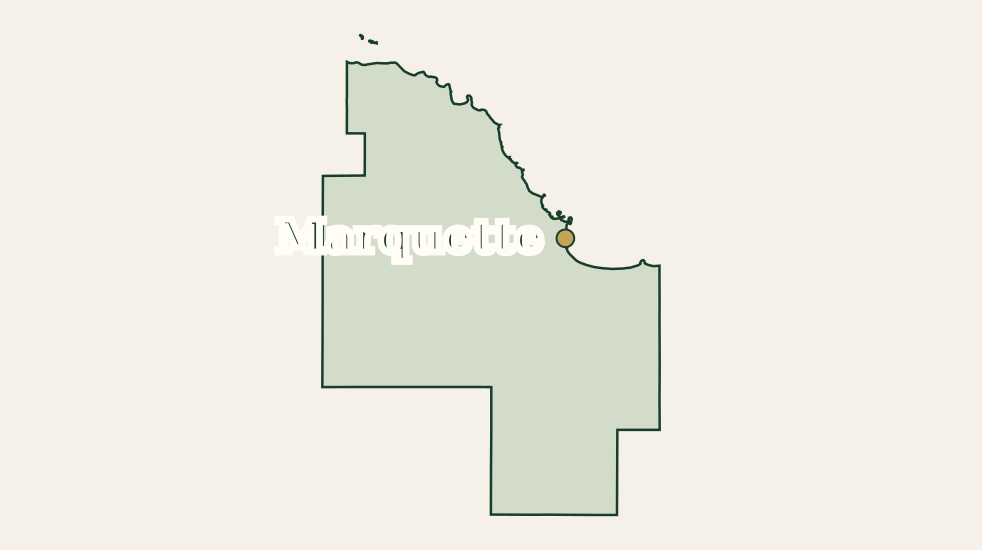
Marquette County with Marquette marked
Marquette and the Lake Superior county settingPop. 67,112 · 2024

Marquette County

Marquette's historic downtown shops, cafés and Lake Superior surroundings introduce an Upper Peninsula city within wider Marquette County. Regional destinations in other communities should remain in their own locations when comparing a possible routine. Marquette uses Eastern time; the four western Upper Peninsula Central-time counties are a separate group. State the destination's local zone when arranging receiving. If the reviewed route crosses Mackinac Bridge, follow current authority instructions for the actual vehicle and keep the receiver informed of a changed crossing arrangement.

Key communities

Marquette

Check mover credentials →

County population: 2024 ACS five-year estimates, U.S. Census Bureau. These period estimates do not count current movers or available homes. Read the source.

All 83 Michigan counties

Michigan planning

Review the piece and its tightest turn together

Start with the furniture that is least certain to fit. Record its height, width, depth and projecting parts, then show the porch, landing, doorways and final room. A cabinet may pass one opening but have too little turning space at the next. In a compact condominium, the route beside a built-in cabinet or sliding door can matter as much as the first entrance. Share destination information before the item leaves the origin home.

Ask which basic preparation is appropriate and included in the reviewed work. Identify removable parts, loose fittings, fragile finishes, damage and any available instructions. Removing another component is not automatically safe, especially with an unfamiliar mechanism or weakened joint. A specialist piece needs its own assessment rather than an assumption that ordinary furniture preparation will solve every restriction.

Keep the handling path available while retaining ordinary household circulation. Move loose belongings out of the working area, discuss suitable surface protection and keep children and pets away from handling activity. Connect hardware and instructions with the correct item for the agreed reassembly. Good information lets the team review the route and preparation before a heavy piece reaches the point at which it cannot turn.

A male mover kneels beside a flat floor runner and smooths its edge near the entrance
A mover smooths a floor runner near the entrance.

Michigan planning

Keep the estimate, release-payment rule and claim separate

Retain the estimate, bill of lading, inventory, correspondence and the provisions explaining a Michigan-only shipment. Read the business name, goods, included services and payment arrangements before signing. If the contents or requested work change, ask the carrier to explain the effect in writing. Keep a copy that you can reach during collection and receiving rather than packing the only record into the shipment.

Michigan's rule for a cash-on-delivery shipment under a nonbinding approximate estimate concerns release of the goods. On the shipper's request, the carrier must release the shipment for acceptable payment of no more than 110% of that estimate and defer demanding the remaining balance until 30 days after delivery. The statute has an exception for warehouse storage requested by the shipper and allows a larger payment voluntarily tendered within that period. This is not a cap on final charges: an amount can still remain due under the applicable charging basis.

For loss, damage or a billing concern, preserve the specific records and contact the carrier promptly. MSP's Michigan consumer tips advise submitting written claims within 30 days. Follow the requirements applicable to the shipment, and distinguish that Michigan-only advice from interstate claim procedures. An agency complaint is a separate channel; it does not itself submit a carrier claim or establish compensation.

Who does what

A little coordination before moving day

You, the moving team and your building contacts each handle a different part of getting the move ready.

01 Moving checklist

The household

Choose what moves, keep the inventory accurate and obtain permission to use both properties.

02 Moving checklist

The moving team

Review the shipment and access, explain the proposed work and identify the coordinating contact.

03 Moving checklist

The building and receiver

Keep the agreed entrance and appointment available and prepare to direct and check delivery.

Michigan planning

Identify who transports the goods and what the records cover

Before an interstate move, identify the actual household-goods carrier and any broker. FMCSA provides a search for their current registration, role, insurance information and complaint records. A broker arranging transport and a carrier transporting the shipment perform different roles. Check the actual business involved and keep its identity consistent across the proposal and moving records. A source link here is a way to perform that check, not a claim that every business record has already been verified for your move.

Read the written estimate, bill of lading and inventory together. The estimate explains the proposed charges and services; the bill of lading is the transportation contract and receipt; the inventory identifies the goods and recorded condition. FMCSA advises reviewing the documents and avoiding blank forms. Ask about an unexplained difference before signing and retain accessible copies for the person receiving the shipment.

Choose protection before collection. For interstate household goods, Full Value Protection applies unless Released Value is selected through the required written waiver. Valuation describes the mover's liability and differs from a separate insurance policy. Discuss the actual choice, cost, limits, high-value items and claims process in the moving documents. At delivery, an authorized person should be ready to direct placement and record a specific concern.

Michigan planning

Prepare for changed conditions at the road and the home

Check current weather and road information close to the moving day, then confirm the property approach with the receiving contact. Michigan's two peninsulas and different lake settings do not share one dependable set of conditions. A clear major road does not establish that a private entrance, parking area or handling path is ready. Explain snow, ice, standing water, soft ground or another restriction that affects the agreed approach rather than assuming the coordinator can see the property from a road report.

For a journey across Mackinac Bridge, read the bridge authority's current instructions. Wind restrictions can mean an advisory, an escort for high-profile vehicles, a restriction on those vehicles or closure to all traffic. Other hazards can change the authority's decision. The moving vehicle and a family car may not have the same crossing permission, so keep the people’s travel and the shipment's receiving arrangements connected without assuming that they can cross together.

Prepare keys, contacts, suitable clothing and personal essentials for a change in timing. Agree who will keep the working entrance available and tell the coordinator promptly when it cannot be used. Follow current closure instructions. A flexible household plan helps address changed conditions without converting a provisional delivery arrangement into an unsupported promise.

Michigan planning

Separate the truck route from permission to stop

Ask the carrier to review the route for the actual vehicle and load. MDOT's truck resources include route information and the state's oversize and overweight permit system when applicable. A state or federal highway arrangement does not cover every city street, county road or private approach. Local road authorities and property contacts can have separate requirements, and not every household moving vehicle requires an oversize or overweight permit.

Seasonal restrictions also have different owners. MDOT's state-road notices distinguish its network from restrictions imposed by county road commissions and city public works departments. Check the current information for the intended route rather than relying on a past spring notice or a passenger-car navigation estimate. Mi Drive can help review reported construction and incidents, but it does not certify a particular truck's clearance or final approach.

Confirm where the vehicle may stop and how the goods will reach the entrance. Shared drives, private roads, managed parking and a pedestrian shopping street need the relevant owner's instructions. Describe the actual distance, surface, steps and turns along the handling route. If the proposed stopping place is unavailable, ask the coordinator to review the alternative and explain any change in the written work before collection.

Moving routes

Where are you moving?

Choose the framework for the actual journey, then connect the contents, access and receiving arrangements with the written plan.

Within Michigan

A Michigan-only household move

Check the actual provider’s Michigan authority, distance-based charging framework and nonbinding estimate.

Charges

Ask whether the 40-mile distinction calls for negotiated hourly rates or weight, mileage and applicable tariff services.

Records

Keep the estimate, bill of lading and inventory; distinguish release payment, final charges and a shipment claim.

Read Michigan moving guidance →

Across a state line

A nearby interstate journey

Keep both full addresses and the state line clear even when the destinations feel nearby.

Work

Review the shipment, preparation and two property approaches.

Receiving

Agree keys, local time zones, the authorized receiver and the delivery arrangement.

Plan interstate moving →

A longer journey

Cross-country or Canada

Compare dedicated direct service with suitable consolidation and any separate stage.

Model

Agree the reviewed shipment’s delivery window from the completion of pickup and loading.

Handover

Connect inventory, border or storage records with the next provider and receiver.

Review the full journey →

Direct service uses a dedicated truck and the same pickup and delivery crew. Suitable smaller consolidated shipments use a wider agreed window; confirm the model in writing.

Michigan planning

Count the contents inside the cupboards as part of the move

A small home can still contain a full kitchen, bookshelves, clothing and fragile household pieces. Describe those contents alongside the large furniture. Decide which rooms or items you will pack and which need help, and explain any preparation that remains uncertain. A furniture list alone cannot show the packing time needed for filled cupboards or a collection stored in several rooms.

The company's packing service uses working time. Company-supplied cartons are charged separately; moving blankets, shrink wrap and tape have no separate basic material charge. Identify the selected work and materials in the proposal so that a few fragile items are not confused with full-household packing. Discuss artwork, delicate objects and unusual pieces individually, including any special preparation that needs review before collection.

Use suitable containers and preparation for the contents, keep room labels useful and set aside personal essentials. Avoid overloading a carton simply because more space remains inside it. Keep the working table and a clear circulation path available while packing progresses. Tell the coordinator about an additional cupboard, storage area or requested task before it becomes unexpected work on collection day.

A male mover supports a bowl in packing paper beside a closed Sterling Oakbridge carton
A mover holds a bowl in packing paper.

Michigan planning

Connect protection, basic preparation and reassembly

Describe the pieces that need attention before handling: an older cabinet with a loose joint, a table with removable legs or a bed whose hardware needs to stay together. Include dimensions, condition and useful instructions with the inventory. The team can then review suitable protection, safe basic preparation and the receiving route as parts of one task. An unfamiliar mechanism or specialist installation may need a separate assessment.

Under the company's confirmed service, basic furniture assembly and disassembly uses working time without a separate basic labor fee. Moving blankets, shrink wrap and tape carry no separate basic material charge. These conditions do not mean every item can be dismantled safely or every specialist operation is included automatically. Put the reviewed preparation and any additional work into the written scope.

At the new home, have the room plan and useful instructions ready. Keep hardware associated with the right piece and leave space for agreed placement and reassembly. Furniture unwrapping belongs to the company's delivery service. Removing contents from cartons is a different optional task using working time, and packaging waste removal is charged separately. Clear expectations help the receiver recognize what should be completed before the team leaves.

Michigan planning

Use dated housing figures to ask better property questions

Michigan's 2024 American Community Survey five-year estimates describe a housing stock of 4,622,236 units. Detached single-unit homes account for 3,327,693, or about 72.0% of that total. An estimated 672,770 units, about 14.6%, were built in 1939 or earlier. These are estimates for the 2020–2024 period; they are useful background for comparing building types, rather than a list of homes available today.

Use that background to investigate the property you are actually considering. An older house may have a raised porch, narrow interior turn or later alteration, but its age alone does not establish any of those features. A condominium can offer a straightforward private entrance while still involving shared grounds, parking or association instructions. Review photographs, measurements and the relevant property information instead of assigning one access pattern to a whole category of housing.

Tenure uses a different denominator. Of 4,076,369 occupied units, the estimates identify 2,984,190 owner-occupied homes, about 73.2%, and 1,092,179 renter-occupied homes, about 26.8%. Those figures do not count vacant units in the percentage calculation. Use the planning table and linked Census sources to keep the period and denominator visible when comparing this context with the actual home.

Michigan planning

Read previous-residence data without turning it into demand

The 2024 ACS one-year mobility estimate reports that 1.4% of Michigan residents age one and older lived in another U.S. state one year earlier. It describes a previous-residence characteristic for that population. It does not count household shipments, identify why people moved or establish the volume of work available to a moving company.

The measure also does not subtract people who left Michigan, so it is not net migration. It should not be combined casually with the five-year housing estimates, which cover a different period and subject. A percentage of residents and a percentage of housing units have different meanings even when they appear in the same planning table. Keep those distinctions when comparing places or reading a claim about relocation trends.

Your household brief needs different information: the two addresses, actual contents, timing, selected preparation and receiving arrangements. A statewide mobility figure cannot establish whether a truck can reach your property, how long a reviewed journey will take or what the move should cost. Use it as dated population context while making those practical decisions from the particular shipment and written proposal.

Michigan planning

Give a nearby interstate move a complete household plan

A state line can matter even when the destinations feel part of one familiar region. A move between Michigan and Indiana, Ohio or Wisconsin is an interstate journey. Identify the complete addresses, carrier role and applicable documents rather than describing the job only as nearby. The route, actual access and receiving arrangements still need review for the chosen homes.

Describe the full contents and selected work. A short driving distance does not remove packing, large furniture preparation, steps, a difficult turn or time needed for receiving. Confirm where the vehicle can stop at each property and who can provide access. If someone other than the customer will receive the shipment, prepare that person to direct placement, check the inventory and record a concern.

Suitable small nearby jobs may permit same-day delivery after early loading and review of lawful travel, access and receiving time. Do not infer that arrangement from distance alone. Ask the coordinator to confirm the actual collection and delivery plan in writing. The same complete brief makes a comparison useful whether the next home is across a nearby state line or much farther away.

Michigan planning

Write the appointment with its local time zone

Most of Michigan uses Eastern time. Four western Upper Peninsula counties—Gogebic, Iron, Dickinson and Menominee—use Central time. Marquette is in the Eastern time area. State the destination's local zone when arranging a property appointment, receiving time or a call with someone elsewhere; a reference to Michigan time can leave an important hour unclear.

Keep several dates distinct. The day you obtain possession, the proposed collection, the agreed delivery arrangement and a building's receiving appointment each serve a different purpose. Confirm keys, loading instructions and an authorized receiver before relying on a particular arrival. For the company's long-distance service, the delivery window begins when pickup and loading are complete, rather than when the estimate is requested or the team first reaches the origin.

Review fixed commitments with the coordinator, especially when the route includes the straits, a border or a property with limited receiving hours. Share a changed appointment promptly and record the revised arrangement. The direct or consolidated transport model, current route conditions and the receiving home's readiness need to fit together. A household's preferred date should be checked against the reviewed plan before it becomes the basis for travel or another booking.

Michigan planning

Choose the delivery model around the actual shipment

The company's direct long-distance service uses a dedicated truck and the same moving crew at pickup and delivery. Review the contents, preparation, two properties and receiving arrangements with the planning team, whose role is separate from the moving crew. A dedicated journey still needs a workable truck route and an agreed destination handover.

For a suitable small shipment, consolidated delivery can be an alternative when the household can accept a wider receiving window. Discuss the goods, destination, timing and any storage stage before choosing it. The company's approximate small-shipment guidance of 300–400 cubic feet is a starting point for review, rather than a minimum volume or automatic eligibility test. Do not assume the direct service's same-crew arrangement for consolidation.

The confirmed consolidated windows depend on the reviewed destination and journey: up to 60 days for Canada or Florida, up to 90 days for California, and up to 30 days for other reviewed routes no longer than 700 truck-route miles. Other longer routes require individual agreement. The clock begins after pickup and loading are complete. Compare that flexibility with the household's keys, personal travel and receiving commitments before deciding which model is appropriate.

Common moving situations

How the plan changes with your needs

These conditional situations show how a Michigan setting changes the preparation or receiving conversation.

A raised entrance at an older Detroit house

A deep cabinet must cross front steps and turn beyond an inner entrance.

What to do. Show the entire route and landing, measure the piece and review suitable basic preparation before collection.

Why it helps. The proposal can address the tightest turn before the cabinet reaches it.

A Marquette delivery reached across the straits

The family’s car and the moving vehicle plan to cross Mackinac Bridge on the same day.

What to do. Check current bridge instructions for each vehicle and keep the receiver informed if high-profile restrictions change the shipment’s crossing.

Why it helps. The receiving appointment can be reviewed against the truck’s actual permission rather than the car’s progress.

A compact Ann Arbor condominium with a full kitchen

The large furniture list is short, but cupboards and shelves still need preparation.

What to do. Describe those contents, agree selected packing work and cartons, and confirm the private entrance and shared grounds instructions.

Why it helps. The plan includes the preparation and access the small home actually requires.

Michigan to Canada with household goods arriving later

The household enters Canada before the shipment follows.

What to do. Check the actual arrival category, prepare accompanying and goods-to-follow lists, present them at first entry and retain the accounting record.

Why it helps. The later goods have connected records for the applicable arrival process.

Michigan planning

Connect Canadian arrival records with the later shipment

For a move into Canada, begin with the household's actual arrival category and the goods being imported. CBSA distinguishes people establishing a first residence from former residents returning after the relevant absence. The conditions for personal effects include ownership, possession and use, with different rules for those categories and restrictions on particular goods. A moving proposal does not determine immigration eligibility or guarantee release at the border.

CBSA advises preparing two copies of a goods list before arrival, with values and identifying details where applicable. Divide it into goods accompanying you and goods to follow. Present the list at the first entry even if no household goods travel with you then, and retain the personal-effects accounting record for the later shipment. Goods arriving later need to be on the original list to qualify under the applicable entitlement.

Review collection, border coordination, receiving and any storage or separate provider stage as one connected journey. Identify who holds the goods, what condition and inventory record accompanies them, the relevant charges and the next authorized receiver. Island, remote or other separate transport arrangements require their own review; general U.S. and Canada coverage does not establish every crossing, vessel, property permission or specialist operation.

Michigan planning

Compare the same shipment and the same selected work

Begin a price comparison with the complete contents, both addresses and requested tasks. Include cupboards and shelves, large or delicate pieces, additional levels and stored goods. Explain the vehicle approach, stopping location, handling route and property appointment at each end. The company's planning team can use an item list, video review or an in-person survey according to the work being considered. Floor area is context rather than a complete inventory.

For the company's agreed interstate flat-rate service, the price remains the same if the same agreed work or journey takes longer. Added belongings, omitted items, extra packing or changed access and delivery requirements can change the scope and price. Have additions reviewed in writing before the affected work begins. Keep that rule separate from a Michigan-only carrier's hourly or tariff-based charges and the nonbinding-estimate release-payment provision.

Make the materials and optional work clear. Packing uses working time, company-supplied cartons are separate, and basic blankets, shrink wrap and tape have no separate material charge. Optional carton unpacking and packaging waste removal need their own stated arrangements. Equivalent assumptions make two proposals easier to assess than totals based on different preparation, contents or receiving conditions.

Michigan planning

Resolve possession and receiving before the final week

While choosing the home, investigate the neighborhood and obtain useful property information. Once the destination is settled, assemble the contents, dates, access photographs and requested work for review. Identify any uncertain piece or entrance early enough to discuss suitable preparation. Keep changes to the inventory and property instructions connected with the written proposal rather than scattered through separate conversations.

Before collection, confirm possession, keys, loading instructions, the delivery model, payment arrangements and protection choice. Decide which packing belongs to the household and which belongs to the team. Prepare the receiver and room plan, especially when someone else will be present at the new home. Put personal essentials, travel documents, medicines and the records needed during the journey where they remain with the people traveling.

Close to the day, review current road and weather information and check that the working entrance is available. Report a changed appointment, unavailable path or possession delay promptly. If a storage stage becomes necessary, define it before the goods are collected. At delivery, use the inventory and room plan, record a specific concern and keep the completed records accessible for any follow-up.

Michigan planning

Prepare both the rooms and the authorized receiver

Choose where the large pieces will go before delivery. A simple room plan and useful labels help the receiver direct placement without blocking the entrance or the path needed for later items. Check that keys, property instructions and the agreed receiving appointment are available. Explain any room that cannot yet be used and review its effect on the plan with the coordinator.

If you cannot be present, arrange an authorized person who understands the shipment and selected work. Give them the inventory, room plan, contact details and relevant moving records. They need time to provide access, direct placement, check the goods and record a particular concern. Being available only to unlock the door does not cover all of those responsibilities. State the local time zone clearly, including a western Upper Peninsula Central-time appointment when applicable.

The company's delivery includes furniture unwrapping and the agreed basic reassembly. Optional carton unpacking uses working time, while packaging waste removal is charged separately. Check what the proposal includes before expecting every carton emptied or all packaging removed. Keep a useful path through the home and personal essentials within reach while the remaining settling-in work continues.

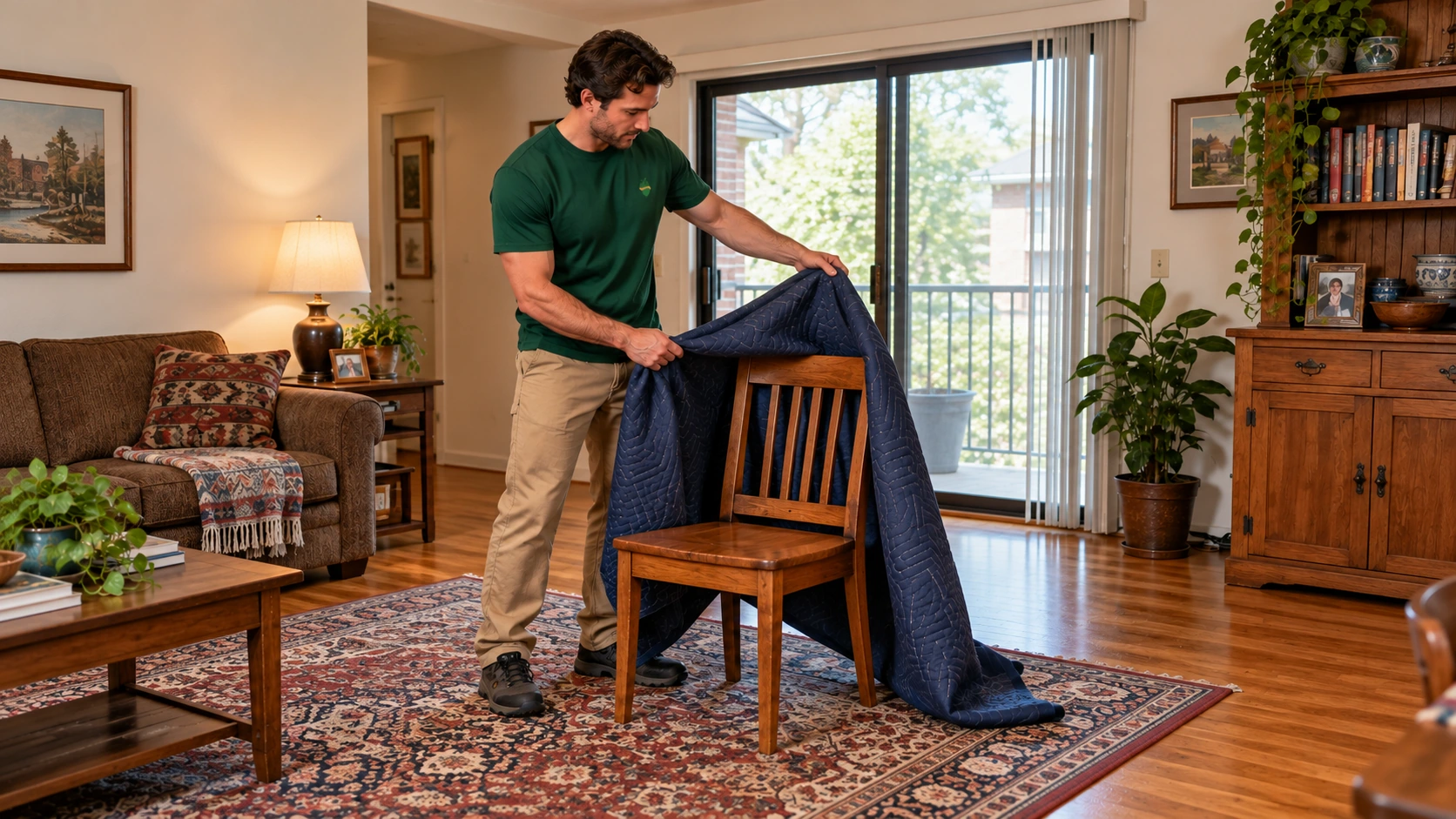
A male mover draws a loose quilt back from a wooden chair standing on a rug
A mover draws a blanket back from a wooden chair.

Michigan planning

Define the handover during a gap between homes

Discuss storage when possession, repairs or a receiving appointment may leave a gap. Identify the storage location and provider, the contents, condition record, charges, access and later delivery arrangements. Explain what remains uncertain about the new home so that the coordinator can review the actual stage rather than assume an indefinite wait beside the property.

Keep responsibility clear at each handover. Ask who holds the goods, which inventory and protection arrangements apply, how an authorized person obtains access and who receives the later delivery. If a different provider handles a stage, connect its records with the shipment rather than assuming the original proposal explains every subsequent task. Retain the terms and useful contacts with the household's accessible moving records.

Set aside the goods needed before the later delivery: clothing, personal documents, essential equipment and first-night supplies. Update the plan when the home becomes ready. The storage conversation should establish the agreed service and cost; do not assume free storage, unlimited access or a vehicle waiting for an unspecified period. Michigan's estimate statute also treats shipper-requested warehouse storage differently, so keep the actual storage terms and applicable shipment rules clear.

Michigan planning

Make daily life work and prepare Michigan resident documents

Start with usable rooms, personal essentials and an accessible path through the home. Unpack what the household needs for the first ordinary days, then work through the remaining cartons by room. Keep moving records and any condition concern together for follow-up. Explore the services and routines around the actual address rather than relying solely on the visitor destinations that first introduced the area.

Michigan's Secretary of State says new residents should obtain a Michigan license or ID, title and registration as soon as residency is established; there is no grace period. For an ordinary valid out-of-state license transfer, prepare the applicable identity, legal-presence, Social Security and Michigan residency documents, including two residency records, and the office visit. Age, foreign credentials and other circumstances can change the requirements, so use the current checklist for your case.

Prepare vehicle ownership records and Michigan No-Fault insurance documentation for registration. The named owners, or an appointed agent where applicable, need to be accounted for. If an out-of-state lienholder holds the title, the Secretary of State describes a registration-only arrangement without issuing a Michigan title. Out-of-state insurance is not accepted for Michigan registration. Check the actual vehicle and ownership situation separately from transferring the driver's license.

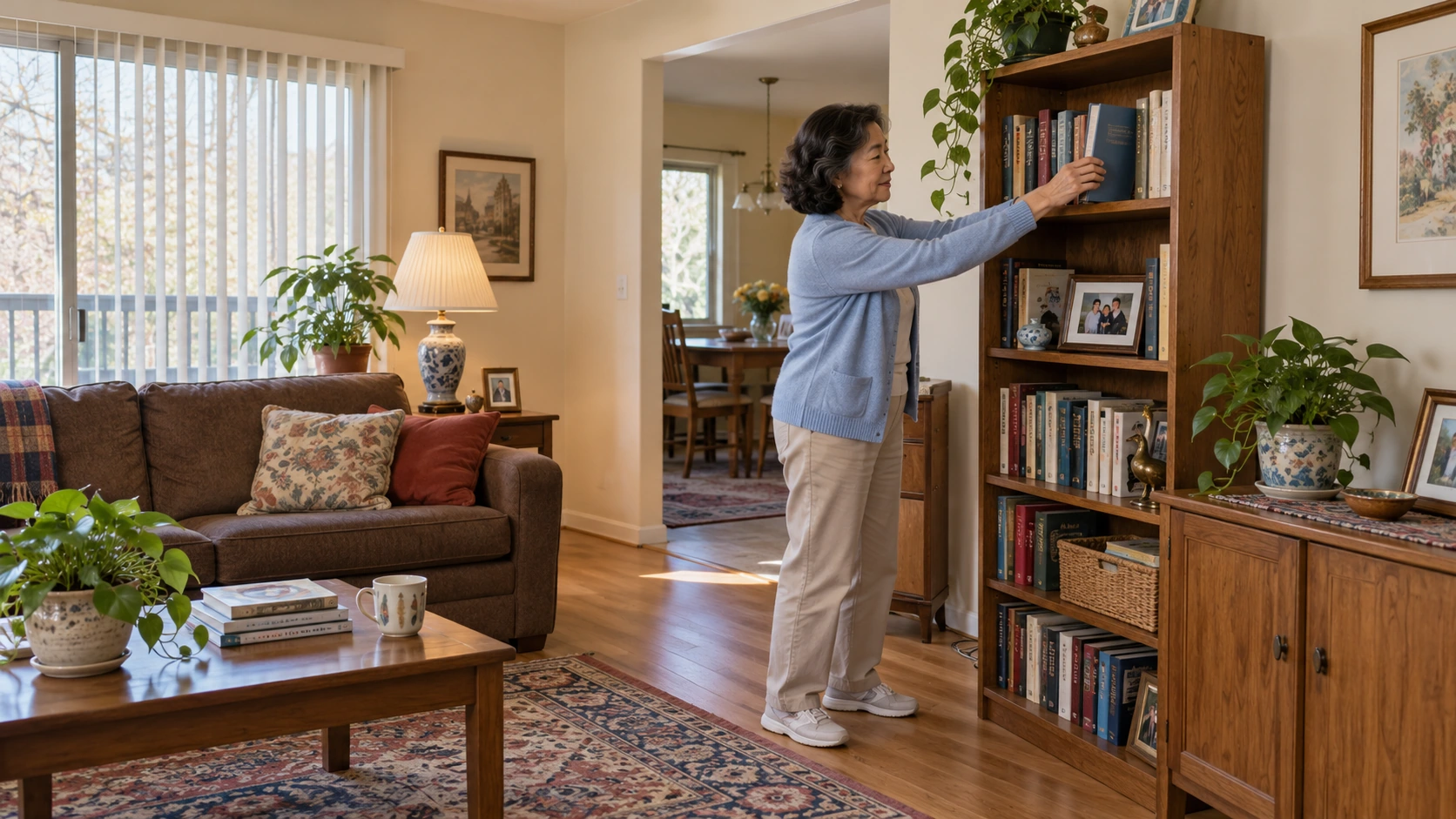
A woman places a blue book on a wooden shelf beside other books
A resident places a book on a shelf.

Michigan planning

Bring the place, shipment and receiving plan together

Use the guide in the order that fits your next decision. If you are still choosing a place, compare a few city portraits and county settings, then investigate homes and ordinary routines in those areas. If the destination is fixed, move directly to the contents, property approach, selected work and receiving arrangements. The same Michigan map can support both stages without deciding either one for the household.

Before requesting a proposal, gather both complete addresses, the contents and useful photographs, the dates, doubtful pieces and the preparation you want included. State any building appointment, access restriction, storage gap, border stage or authorized receiver. The coordinator can then review a concrete journey and explain the appropriate transport model, work, price and records. Keep changed information connected with the written plan.

Before collection and receiving, check the current conditions, keys, usable entrance, personal essentials and person responsible at each home. Read the estimate, inventory, protection, payment and delivery terms together. The links below help continue a particular service or destination question, while the grouped primary sources let you review the Michigan procedure behind the advice. An accurate household brief remains the most useful starting point for planning the move.

Verified data

Michigan planning data

Planning factEstimateVintageSource
Total housing units4,622,2362024 ACS 5-yearU.S. Census Bureau
Detached single-unit homes3,327,693 · 72.0% of housing units2024 ACS 5-yearU.S. Census Bureau
Homes built in 1939 or earlier672,770 · 14.6% of housing units2024 ACS 5-yearU.S. Census Bureau
Owner-occupied homes2,984,190 · 73.2% of occupied homes2024 ACS 5-yearU.S. Census Bureau
Renter-occupied homes1,092,179 · 26.8% of occupied homes2024 ACS 5-yearU.S. Census Bureau
Residents age 1+ from another U.S. state one year earlier1.4% · not net migration or shipments2024 ACS 1-yearU.S. Census Bureau

Planning answers

Michigan moving questions

Straightforward answers about prices, packing, delivery and getting settled.

Ask about your move
How should I start choosing a place to live in Michigan?

Begin with a few contrasting settings, such as Detroit’s metropolitan neighborhoods, Ann Arbor’s downtown districts, a western lake-area city and Marquette in the Upper Peninsula. Explore the public places that interest you, then investigate homes, services and ordinary journeys in those areas. The twelve portraits and six county profiles help narrow the search. They do not establish a property’s availability, school eligibility or suitability, so examine the actual neighborhood and home before deciding.

Do the twelve city profiles cover every Michigan community?

No. They are twelve different starting points for exploring the state, with a wider directory of 533 incorporated cities and villages. Townships, unincorporated communities and census-designated places are a different geography and are not all included in that directory. Use the actual municipality and complete address when researching a home or arranging property instructions. A familiar postal name, county or tourism region can cover a different area from the place where you will live.

Does this guide mean Sterling Oakbridge provides local-only moves everywhere in Michigan?

No. Sterling Oakbridge plans interstate household journeys involving Michigan after reviewing the addresses, contents, dates, access and requested work. The city and county descriptions help readers explore places; they do not establish a branch in each community or statewide local-only availability. For a move entirely within Michigan, check the actual provider’s Michigan household-goods authority and the charging requirements for that shipment. Confirm the service and date through a written proposal.

What should I send when requesting an interstate moving proposal?

Send both complete addresses, the contents, useful photographs, preferred dates and the preparation you want included. Show the vehicle approach, proposed stopping location, entrance, steps and interior turns at both homes. Identify large or delicate pieces, stored goods, building appointments, a storage gap and the person receiving delivery. The planning team can decide whether an item list, video review or in-person survey is appropriate. Floor area alone does not describe the shipment or packing work.

What authority should I check for a Michigan-only household mover?

Check the actual provider’s Michigan intrastate household-goods authority through Michigan State Police’s Commercial Vehicle Enforcement Division and its carrier search. MSP explains that a USDOT number alone is insufficient for that Michigan-only work. Keep the business identity consistent with the estimate and moving records, and ask how the proposed services will be charged. A federal interstate search answers a different part of the question. No company-specific authority or insurance result is implied by the links in this guide.

How does the 40-mile distinction affect Michigan-only moving charges?

MSP describes moves of 40 miles or less as having unregulated rates that can be negotiated on an hourly basis. For moves over 40 miles, it describes regulated charges based on weight, mileage and supplemental services under the applicable tariff. Ask the carrier which basis applies and what the written estimate includes. Compare the same contents, preparation and access assumptions. This Michigan-only framework is separate from the company’s agreed interstate flat-rate service.

Does Michigan’s 110% rule cap the final moving bill?

No. For a cash-on-delivery shipment under a nonbinding approximate estimate, Michigan law requires release on the shipper’s request for acceptable payment no greater than 110% of the estimate, with demand for the remaining balance deferred until 30 days after delivery. Shipper-requested warehouse storage is an exception, and a larger payment can be accepted if voluntarily tendered. Final charges can still exceed that release payment under the applicable charging basis. Read the actual shipment records and terms.

What should I do if there is a concern about a Michigan-only shipment?

Record the specific issue, preserve the estimate, bill of lading, inventory, photographs and correspondence, and contact the carrier promptly. MSP’s Michigan consumer tips advise submitting written claims within 30 days. Check the requirements for the actual shipment rather than treating that advice as a universal interstate deadline. An agency complaint and a carrier claim are separate steps. Using one channel does not automatically file the other or establish the outcome or compensation.

How do I check a carrier or broker for an interstate move?

Identify the actual carrier and any broker, then use FMCSA’s mover and broker search to review the business’s current role, registration, insurance information and complaint records. Keep those names consistent across the written proposal and moving documents. Read the estimate, bill of lading, inventory and protection terms, and do not sign blank records. A broker arranging transportation and a carrier transporting the goods have different roles. The source link does not itself certify a particular business.

What is the difference between direct and consolidated delivery?

The company’s direct service uses a dedicated truck and the same moving crew at pickup and delivery. Consolidated delivery may suit a smaller shipment when the household can accept a wider agreed receiving window. Approximate guidance of 300–400 cubic feet starts the discussion; it is not an automatic eligibility cutoff or minimum. Review the actual destination, goods, dates, access and receiving arrangements. Do not assume the direct service’s same-crew arrangement applies to consolidation.

When does the consolidated delivery window begin, and how long is it?

The window begins when pickup and loading are complete. The company’s confirmed destination rules allow up to 60 days for Canada or Florida, up to 90 days for California, and up to 30 days for other reviewed journeys no longer than 700 truck-route miles. Other longer routes need individual agreement. The particular shipment must be suitable for consolidation and have a written receiving arrangement. A destination in another western state does not inherit California’s window.

Will the agreed interstate flat rate rise if the same journey takes longer?

No. For the company’s agreed interstate flat-rate work, the price stays unchanged when the same agreed shipment or work takes longer. Added belongings, omitted items, extra packing or changed access and delivery requirements can change the scope and price. Have additions reviewed and agreed in writing before the affected work starts. Keep the inventory and both properties accurate in the proposal. This condition differs from a Michigan-only hourly or tariff-based estimate.

How are packing, cartons and basic materials charged?

Packing uses working time, while company-supplied cartons are charged separately. Moving blankets, shrink wrap and tape have no separate basic material charge. Explain the contents of cupboards, shelves and storage areas, and agree which goods the household will pack and which tasks the team will handle. A small furniture list does not establish that the rest is already packed. Record selected packing work and materials in the proposal so that a partial arrangement is clear.

Is basic furniture disassembly a separate labor charge?

Under the company’s confirmed service, basic furniture assembly and disassembly uses working time without a separate basic labor fee. Identify the actual pieces and include the reviewed preparation in the scope. Unusual mechanisms, specialist installations, damage or a doubtful route may need separate assessment. Keep instructions and hardware associated with the correct piece. Prepare the destination route and enough room for placement and the agreed reassembly rather than assuming that every item can safely be taken apart.

Does delivery include emptying all the cartons?

No. Furniture unwrapping is part of the company’s delivery service; optional removal of contents from cartons uses working time. Packaging waste removal is charged separately. Discuss the rooms and goods you want unpacked and record that work in the proposal. Have the room plan and useful labels ready, with a clear path for later items. Keep first-night essentials with the household so that ordinary use can begin while the remaining cartons are unpacked.

Can another person receive the shipment at my Michigan home?

Yes, arrange an authorized receiver before delivery. Give that person the inventory, room plan, moving records and coordinator’s contact details. They need to provide access, direct placement, check the goods and record a specific concern. Confirm the property instructions, appointment and local time zone. Someone available only to unlock the door may not be able to complete all the receiving tasks. Explain the selected work, including any agreed reassembly or optional unpacking, before the team arrives.

What if the Michigan home is not ready for delivery?

Discuss storage and later delivery before collection. Identify the location and provider, contents and condition record, access, charges, protection arrangements, next receiver and responsibility at each handover. Explain what remains uncertain about possession or the property appointment, and update the coordinator when it changes. Keep essentials and moving records with the people traveling. Do not assume free storage, unlimited access or a vehicle waiting indefinitely without a defined arrangement.

Does all of Michigan use the same time zone?

No. Most of Michigan uses Eastern time, while the western Upper Peninsula counties of Gogebic, Iron, Dickinson and Menominee use Central time. Marquette is in the Eastern time area. Write the date and destination’s local time zone when arranging receiving, a building appointment or a call with someone elsewhere. A reference to Michigan time can leave an hour unclear. Check that the authorized receiver and property contact are working from the same appointment.

How can Mackinac Bridge conditions affect the moving plan?

The bridge authority can apply wind advisories, high-profile vehicle escorts, restrictions on those vehicles or closure to all traffic, and other hazards can change the decision. A moving truck and a household’s passenger car may not have the same crossing permission. Check current bridge authority instructions, keep personal travel connected with the shipment plan and update the receiving contact if conditions change. A general weather report or a previous crossing does not establish current permission for the actual vehicle.

Does an MDOT route or permit also authorize the local loading space?

No. Review the actual vehicle route, applicable state or federal road requirements and any separate city or county restrictions. Property, curb and loading instructions have their own owners. Michigan county road commissions and city departments may apply seasonal restrictions that differ from the state network. Confirm the proposed stopping place and handling path with the relevant contact. Not every moving vehicle requires an oversize or overweight permit, and a permit does not grant permission to occupy a private approach.

How should I prepare for a Michigan move in winter conditions?

Review current weather, road and relevant bridge information, then confirm that the actual property approach and working entrance are usable. Agree who will keep the path available and report a changed condition or appointment promptly. Prepare keys, contacts, suitable clothing and personal essentials for the people traveling. A clear main road, or Holland’s heated downtown sidewalks, does not establish readiness at a private home. Follow current closure instructions and review the receiving plan when the property cannot be used as agreed.

When should a new resident obtain a Michigan driver’s license?

Michigan’s Secretary of State says to obtain the Michigan license or ID as soon as residency is established; there is no grace period. For an ordinary valid out-of-state license transfer, prepare the applicable identity, legal-presence, Social Security and two Michigan residency records, with the required office visit and vision check. Age, foreign credentials and other circumstances can change the process. Use the current checklist for your case and keep driver licensing separate from vehicle title and registration.

What should I prepare to title and register an out-of-state vehicle in Michigan?

Arrange the Michigan title and registration as soon as residency is established. Prepare the applicable ownership records, identification, Michigan No-Fault insurance and named owners or appointed agent. Out-of-state insurance is not accepted for Michigan registration. If an out-of-state lienholder holds the title, the Secretary of State describes a registration-only arrangement without issuing a Michigan title. Use the current checklist for the actual ownership or lease situation; transferring the driver’s license does not itself complete the vehicle tasks.

How should I begin a Michigan–Canada household move?

Review the complete journey, contents, dates, access and receiving arrangements with the coordinator. For entry into Canada, check the household’s CBSA arrival category, ownership, possession and use conditions, and item restrictions. Prepare two goods-list copies divided into accompanying goods and goods to follow, declare the list at first entry and retain the personal-effects accounting record. Connect any storage or separate provider stage with the shipment records. The moving arrangement does not decide immigration eligibility or guarantee border release.

Primary sources

Sources for the decisions in this guide

Official resources for choosing a community in Michigan and preparing the move. Figures retain their stated dates; follow current agency guidance for your own circumstances.

Michigan-only authority, estimates and consumer records

4 sources
  • Household-goods moving consumer tipsMichigan State Police · Commercial Vehicle Enforcement Division

    Michigan authority, the 40-mile charging distinction, moving documents and prompt written claims.

  • Motor-carrier regulatory authority and complaint contactsMichigan State Police · Commercial Vehicle Enforcement Division

    Michigan intrastate operating authority and required filings; a carrier claim remains separate from an agency complaint.

  • Michigan carrier authority searchMichigan State Police · Commercial Vehicle Enforcement Division

    Check the actual provider for the proposed Michigan-only household-goods work; USDOT alone is insufficient.

  • Nonbinding approximate estimates · MCL477.7bMichigan Legislature

    Written estimate and bill-of-lading requirements; conditional 110% release payment and deferred demand for a remaining balance, with the warehouse-storage exception. This is not a final-charge cap.

Interstate records and Canadian arrival

3 sources
  • Tips for a successful interstate moveFederal Motor Carrier Safety Administration

    Carrier and broker identities, written estimate, bill of lading, inventory, protection and authorized receiving.

  • Interstate mover and broker searchFederal Motor Carrier Safety Administration

    Check the actual business and current role and records; no company-specific verification result is implied.

  • Moving or returning to CanadaCanada Border Services Agency

    Arrival categories, personal-effects conditions and separate accompanying and goods-to-follow records.

Resident documents and Michigan time zones

3 sources
  • New Michigan resident questionsMichigan Department of State · Secretary of State

    License, title and registration as soon as residency is established, with no grace period; check the actual circumstances.

  • New resident document guideMichigan Department of State · Secretary of State

    License-transfer records, Michigan No-Fault documentation, owners and registration-only arrangements for applicable lienholder-held titles.

  • Eastern–Central boundary · 49 CFR 71.5Office of the Federal Register · U.S. Government Publishing Office

    The Michigan boundary puts Gogebic, Iron, Dickinson and Menominee counties in Central time; most Michigan, including Marquette, uses Eastern time.

City settings and the wider region

13 sources

Truck routes, the straits and current conditions

4 sources
  • Michigan truck resourcesMichigan Department of Transportation

    Truck-route information, Mi Drive and applicable oversize or overweight arrangements; local roads and loading permissions remain separate.

  • Seasonal road restriction ownershipMichigan Department of Transportation

    May 2026 notice distinguishes state-road restrictions from county and city restrictions; check current conditions for the planned route.

  • Mackinac Bridge wind and vehicle restrictionsMackinac Bridge Authority

    Advisories, high-profile escorts, vehicle restrictions and closures depend on current authority instructions.

  • Preparing for a winter stormMichigan State Police · Emergency Management and Homeland Security Division

    Household, home and vehicle preparation for changed winter conditions.

Dated housing, population and geographic evidence

7 sources

Photographs are original representative illustrations, not customer jobs or identified addresses.

Let’s plan your move

Tell us about your Michigan move.

Tell us where you are moving, what you are taking and your preferred dates. Add any packing, furniture preparation, unpacking or storage help you need.

A Sterling Oakbridge move coordinator in the planning office